Acta Phys. -Chim. Sin. ›› 2024, Vol. 40 ›› Issue (4): 2304037.doi: 10.3866/PKU.WHXB202304037
• REVIEW • Previous Articles Next Articles
PNIPAm Thermo-Responsive Nanofibers Mats: Morphological Stability and Response Behavior under Cross-Linking
Xiaojing Tian1,2, Zhichun Huang3, Qingsong Zhang1,4,*( ), Xu Wang5, Ning Yang1,2, Nanping Deng3
- 1 School of Materials Science and Engineering, Tiangong University, Tianjin 300387, China
2 State Key Laboratory of Separation Membranes and Membrane Processes, Tianjin 300387, China
3 School of Textile Science and Engineering, Tiangong University, Tianjin 300387, China
4 Yantai Nanshan University, Yantai 265706, Shandong Province, China
5 Lining (China) Sports Goods, Co., Ltd., Beijing 100000, China
-
Received:2023-04-20Revised:2023-06-19Accepted:2023-06-23Published:2023-06-30 -
Contact:Email: zqs8011@163.com; Tel.: +86-18622036882 (Qingsong Zhang) -
Supported by:the National Natural Science Foundation of China(52173060); Science and Technology Guidance Projects of China National Textile and Apparel Council(2018034); Natural Science Foundation of Shandong Province(ZR2022ME095); Fiber Research Foundation of Tiangong University(TGF-21-B5); Research Plan of Combining Medicine with Engineering of Tiangong University(2021YGJHLX03)

Cite this article
Xiaojing Tian, Zhichun Huang, Qingsong Zhang, Xu Wang, Ning Yang, Nanping Deng. PNIPAm Thermo-Responsive Nanofibers Mats: Morphological Stability and Response Behavior under Cross-Linking[J]. Acta Phys. -Chim. Sin. 2024, 40(4), 2304037. doi: 10.3866/PKU.WHXB202304037
share this article
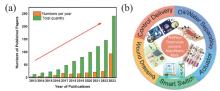
Fig 1
(a) Tendency of published papers on PNIPAm cross-inked thermo-responsive nanofibers mats published in Web of Science core journals collection 2013–2023, up to March 2023; (b) application of PNIPAm thermo-responsive nanofibers mats."
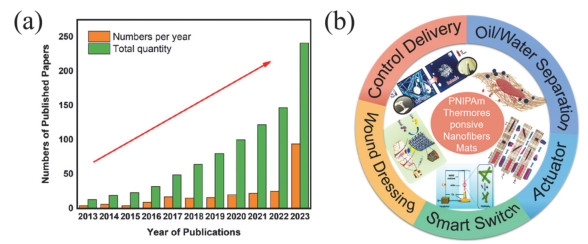
Fig 2
(a) Plane SEM image and (b) cross-section diagrams of pure PNIPAm nanofibers 13; (c) plane SEM image of ecovio®/PNIPAm nanofibers 22; (d) nanofibers cross-section SEM image 23. (a, b) Adapted with permission from Ref. 13, Copyright 2008 Elsevier Inc.; (c) Adapted with permission from Ref. 22, Copyright 2022 SciELO; (d) Adapted with permission from Ref. 23, Copyright 2019 American Chemical Society."
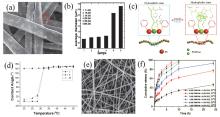
Fig 3
(a) SEM image of PNIPAm/35% ZnO nanofibers mat, (b) the average fiber diameters with different ZnO contents 25; (c) molecular mechanism diagram of the thermo-responsive of PNIPAm/PS nanofibers mats, (d) temperature dependences of the WCAs for PNIPAm/PS composite nanofibers mats Ⅰ, Ⅱ and Ⅲ in which the fraction of PNIPAm versus PS is 10%, 60% and 20%, respectively 12; (e) SEM image of 16.0% (w/v) PNIPAm/1.0% (w/v) PEO nanofibers mats, (f) the in vitro release profiles of VB12 from the PNIPAm/PEO nanofibers mats 26. (a, b) Adapted with permission from Ref. 25, Copyright 2015 Elsevier Inc.; (c, d) Adapted with permission from Ref. 12, Copyright 2008 John Wiley and Sons; (e, f) Adapted with permission from Ref. 26 Copyright 2011 Elsevier Inc."
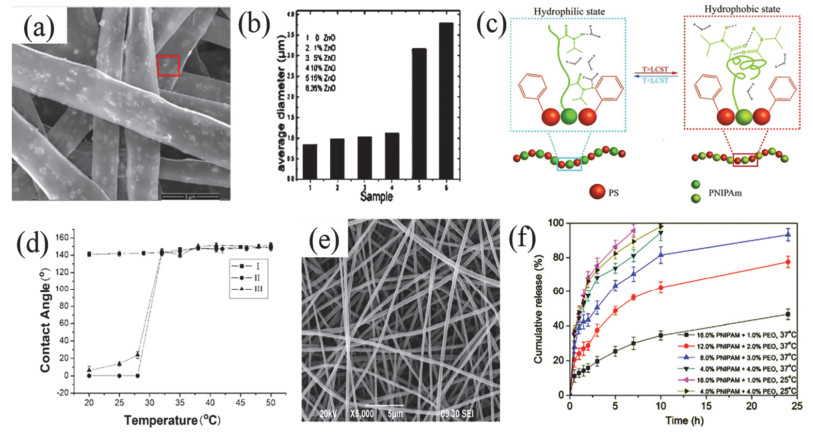
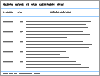
Table 1
Properties and application scenarios of poly(N-isopropylacrylamide) non-cross-linked thermo-responsive nanofibers mats."
| Composition of thermo-responsive nanofibers mats | Solvent | Mean diameter of nanofibers/nm | LCST/℃ | Water resistance | Application Scenarios | Ref. |
| PNIPAm/PS | THF | 100–500 | 32–33 | NO | – | |
| PNIPAm | Water | 750 | 32 | NO | – | |
| PNIPAm/ZnO | DMF | 1670 | – | NO | Thermo-responsive photocatalysis | |
| PNIPAm/PEO | Water | 250–380 | 32 | NO | Controlled release of drugs |
Table 2
Cross-linking methods, properties and application scenarios of poly(N-isopropylacrylamide) thermo-responsive nanofibers mats."
| Composition of thermo-responsive nanofibers mats | Cross-linking methods | Crosslinkers | Solvent | Mean diameter of nanofibers/nm | LCST/℃ | Water resistance | Application Scenarios | Ref. |
| p(NIPAm-co-SA) | Physical cross-linking | – | – | 207 | 23 | YES | Actuators | |
| PNIPAm | – | OpePOSS | DMF : THF = 1 : 1 | 970 ± 120 | 31 | YES | – | |
| PNIPAm/Gelatin | In situ cross-linking | EDC-NHS | TFE : H2O = 1 : 1 | 600–800 | 32 | YES | Controlled release of drugs | |
| p(PFPA-co-NIPAm) | Esteramine reaction | – | THF : DMF = 3 : 1 | 620 ± 160 | 32 | YES | Cell culture | |
| PNIPAm/EA/PCL | Heating cross-linking | – | TFE | 614 | 26 | YES | Controlled release of drugs | |
| PCL/PNIPAm | UV cross-linking | BP、PETM | DMF/Trichloromethane | 600 | – | YES | Captures and Releases Cells | |
| p(NIPAm-ABP) | UV cross-linking | ABP | DMF | 150–250 | – | YES | Actuators | |
| p(NIPAm-co-MAA)/ β-CD | Esterification reaction | – | DMF | – | – | YES | Dye adsorption | |
| P(NIPAm-co-NMA)/ChNWs | In situ cross-linking | – | H2O : THF = 1 : 2 | 380 | – | YES | Water/oil separation | |
| PNIPAm/AuNRs | – | OpePOSS | DMF | – | – | YES | Smart Switch | |
| P(NIPAm-ABP)/TPU | UV cross-linking | ABP | DMF | 477 ± 69 | 29 | YES | Actuators | |
| p(NIPAm-co-NMA) | Self-condensation reactions | – | – | 600–700 | 38 | YES | Controlled release of drugs | |
| PNIPAm-NMA-Am | Esterification reaction | – | DMF : THF = 1 : 1 | 200 | 55 | YES | Controlled release of drugs |
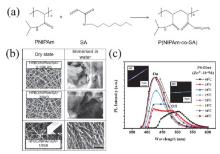
Fig 4
(a) Mechanism of PNIPAm and SA polymerization; (b) dry and underwater SEM images of HPBO/NIPAm/SA nanofibers mats with different component ratios; (c) variation of the PL spectra of P4 nanofibers mats with temperature using a Zn2+ concentration of 10−4 mol∙L−1. The two inset figures show confocal images of the nanofibers at 40 and 10 ℃ 35. (b) (c) Adapted with permission from Ref. 35, Copyright 2014 Royal Society of Chemistry."
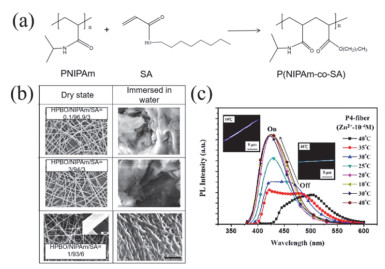
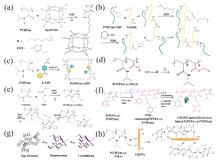
Fig 5
Chemical cross-linking mechanism of PNIPAm-based temperature-sensitive nanofibers mats: (a) OpePOSS as cross-linking agent16; (b) NHS/EDC as cross-linking agent; (c) ABP as cross-linking agent; (d) esterification reaction; (e) self-condensation reaction; (f) ester-amine reaction; (g) egg protein heating cross-linking; (h) in situ cross-linking. (a) Adapted with permission from Ref. 16, Copyright 2011 Royal Society of Chemistry."
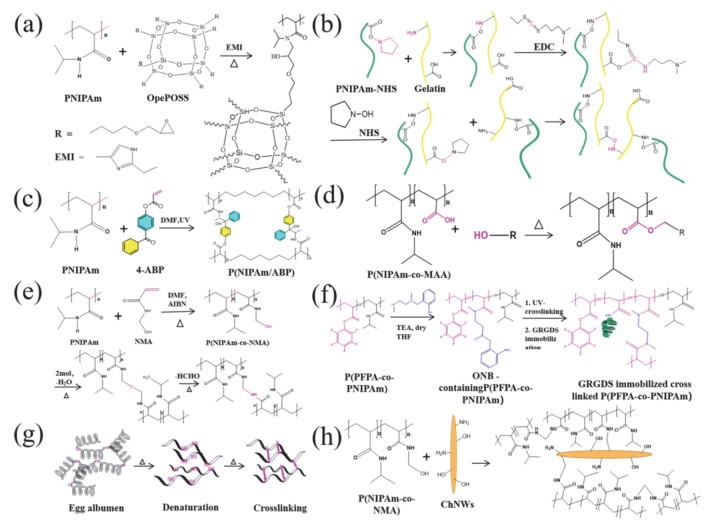
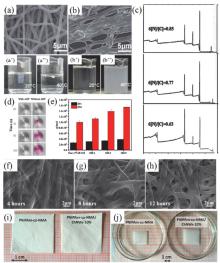
Fig 6
(a, b) Effect of the presence of EMI on the morphology of PNIPAm/OpePOSS nanofibers mats 16; (c) XPS patterns of PNIPAm/PCL cross-linked nanofibers mats after 1 h, 2 h and 3 h immersion in water 63; (d) the nanofibers mats obtained from p(NIPAm-ABP) (left) and pure PNIPAm (right) were immersed in water at 20 ℃ for given times, (e) molecular weight of p(NIPAm-ABP) from different molar ratio between NIPAm and ABP 64; SEM images of p(NIPAm-co-β-CD)/p(NIPAm-co-MAA) nanofibers mats after (f) 4 h, (g) 8 h, (h) 12 h crosslinking 68; images of (i) dry state, (j) p(NIPAm-co-NMA) and p(NIPAm-co-NMA)/ChNWs nanofibers mats in water 69. (a, b) Adapted with permission from Ref. 16, Copyright 2011 Royal Society of Chemistry; (c) Adapted with permission from Ref. 63, Copyright 2016 John Wiley and Sons; (d, e) Adapted with permission from Ref. 64, Copyright 2019 Elsevier Inc.; (f, g, h) Adapted with permission from Ref. 68, Copyright 2020 Elsevier Inc.; (i, j) Adapted with permission from Ref. 69, Copyright 2018 American Chemical Society."
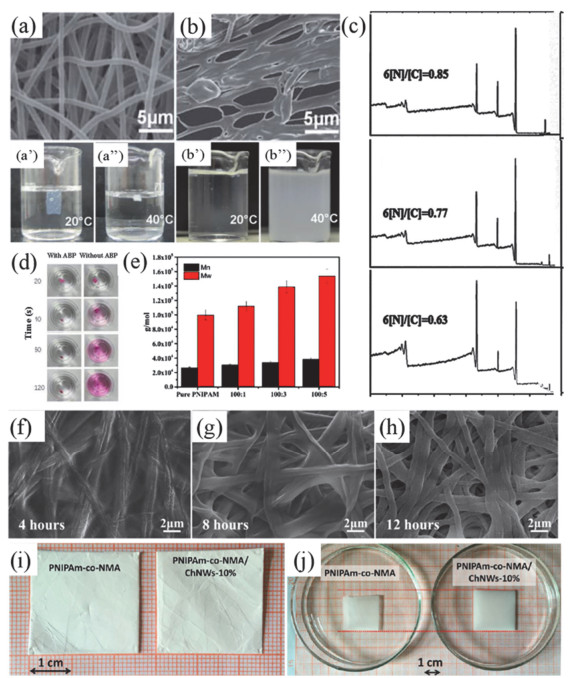
Fig 7
Morphology of AuNRs/PNIPAm/OpePOSS nanofibers mats at (a) 0 s, (b) 2.5 s under light, (c) "current-time" amplification signal when the thermal/optical control switch is turned on and off 73; (d) morphology of p(NIPAm-ABP)/TPU bilayer nanofibers mats in different states and response rates 74; the effect of cross-linker ratios on (e) swelling and (f) de-swelling ratios for p(NIPAm-ABP) nanofibers mats 64; (g) temperature dependence of optical transmittance of fibers mats with different degrees of cross-linked, (h) variations of swelling ratio for the cross-linked nanofibers mats in response to cycles of temperature alternation between 10 and 45 ℃ 76; (i) effect of Am content on the LCST of PNIPAm-NMA-Am nanofibers mats, (j) release profiles of curcumin from PNIPAm-NMA-Am10 cross-linked nanofibers mats 77. (a, b, c) Adapted with permission from Ref. 73, Copyright 2017 American Chemical Society; (d) Adapted with permission from Ref. 74, Copyright 2015 John Wiley and Sons. (e, f) Adapted with permission from Ref. 64, Copyright 2019 Elsevier Inc.; (g, h) Adapted with permission from Ref. 76, Copyright 2012 iopscience; (i, j) Adapted with permission from Ref. 77, Copyright 2019 Elsevier Inc."
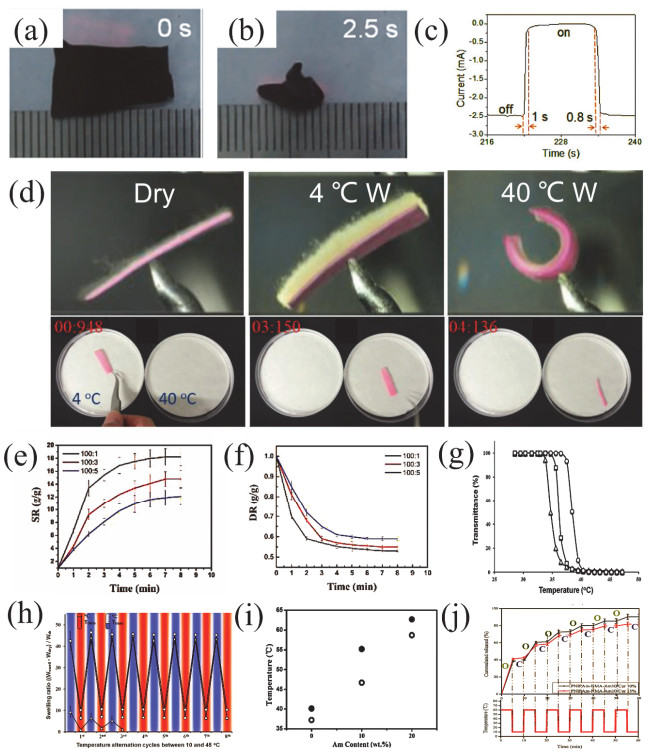
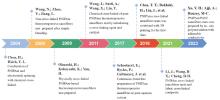
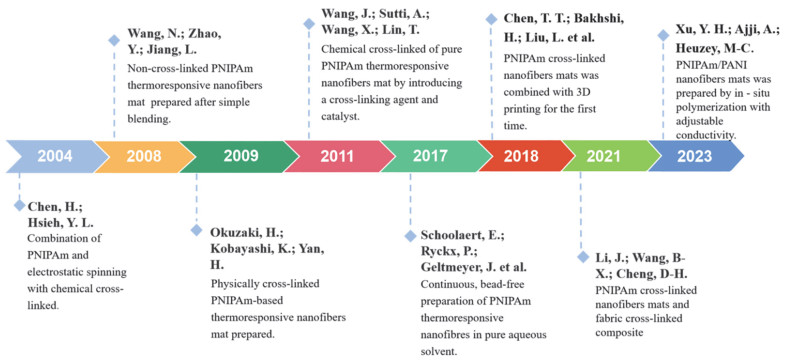
Fig 8
Timeline of PNIPAm cross-linked thermo-responsive nanofibers mats development."
| 1 |
doi: 10.1002/adma.200306516 |
| 2 |
doi: 10.1016/s0142-9612(03)00340-5 |
| 3 |
doi: 10.1002/admt.202100410 |
| 4 |
doi: 10.1039/C8PY00378E |
| 5 |
doi: 10.1039/c2cs35083a |
| 6 |
doi: 10.1016/j.jconrel.2008.01.005 |
| 7 |
doi: 10.1016/j.ifset.2011.10.012 |
| 8 |
doi: 10.1002/marc.201100373 |
| 9 |
doi: 10.1007/s13233-016-4052-2 |
| 10 |
doi: 10.1039/c0nr00570c |
| 11 |
doi: 10.1002/pola.20461 |
| 12 |
doi: 10.1002/marc.200700785 |
| 13 |
doi: 10.1016/j.polymer.2008.06.018 |
| 14 |
doi: 10.1021/ma9014356 |
| 15 |
doi: 10.1016/j.synthmet.2009.07.046 |
| 16 |
doi: 10.1039/c1sm00010a |
| 17 |
doi: 10.1021/acsami.7b05074 |
| 18 |
doi: 10.1002/adfm.201800514 |
| 19 |
doi: 10.1371/journal.pone.0219254 |
| 20 |
doi: 10.1016/j.envres.2020.109494 |
| 21 |
doi: 10.3390/coatings11060632 |
| 22 |
doi: 10.1590/s1517-707620220002.1381 |
| 23 |
doi: 10.1021/acssuschemeng.9b05273 |
| 24 |
doi: 10.1016/j.sna.2022.114016 |
| 25 |
doi: 10.1016/j.colsurfa.2015.02.023 |
| 26 |
doi: 10.1016/j.colsurfb.2011.08.015 |
| 27 |
doi: 10.1039/C2JM33601D |
| 28 |
doi: 10.1088/0957-4484/18/45/455601 |
| 29 |
doi: 10.1073/pnas.1320298111 |
| 30 |
doi: 10.1002/mabi.201600123 |
| 31 |
doi: 10.1002/marc.200600653 |
| 32 |
doi: 10.1016/j.addr.2012.09.009 |
| 33 |
doi: 10.1007/s10973-019-08571-4 |
| 34 |
doi: 10.1038/376219a0 |
| 35 |
doi: 10.1039/C4RA07422J |
| 36 |
doi: 10.1039/C9RA08832F |
| 37 |
doi: 10.1002/marc.200500062 |
| 38 |
doi: 10.1002/mame.201500160 |
| 39 |
doi: 10.1016/j.xcrp.2021.100463 |
| 40 |
doi: 10.1039/C2PY20333B |
| 41 |
doi: 10.1163/156856200743670 |
| 42 |
doi: 10.1021/ma300784d |
| 43 |
doi: 10.1021/ma4007347 |
| 44 |
doi: 10.16790/j.cnki.1009-9239.im.2011.01.015 |
|
何伟; 唐安斌; 罗春明; 马庆柯; 李振中. 绝缘材料, 2011, 44, 67.
|
|
| 45 |
doi: 10.1002/anie.200801951 |
| 46 |
doi: 10.11777/j.issn1000-3304.2021.21047 |
|
鲍丙坤; 刘湍; 林秋宁; 朱麟勇. 高分子学报, 2021, 52, 646.
|
|
| 47 |
doi: 10.1016/j.polymer.2010.05.006 |
| 48 |
doi: 10.1021/acssuschemeng.5b00416 |
| 49 |
doi: 10.1021/cm00013a038 |
| 50 |
doi: 10.3866/PKU.WHXB202008047 |
|
王苹; 李海涛; 曹艳洁; 余火根. 物理化学学报, 2021, 37, 2008047.
|
|
| 51 |
doi: 10.1080/01932691.2018.1472012 |
| 52 |
doi: 10.1021/acs.biomac.7b00382 |
| 53 |
doi: 10.1081/PRE-120024419 |
| 54 |
doi: 10.1002/marc.200500390 |
| 55 |
doi: 10.1002/pola.22994 |
| 56 |
doi: 10.1016/j.msec.2014.11.037 |
| 57 |
doi: 10.1002/pi.1611 |
| 58 |
doi: 10.1002/adma.201102124 |
| 59 |
doi: 10.1016/j.memsci.2010.03.012 |
| 60 |
doi: 10.1016/S0266-3538(03)00178-7 |
| 61 |
doi: 10.1016/j.addr.2009.07.007 |
| 62 |
doi: 10.1016/j.actbio.2017.02.004 |
| 63 |
doi: 10.1002/admi.201500652 |
| 64 |
doi: 10.1016/j.polymer.2019.121880 |
| 65 |
Mu, Q. F. Thermo-responsive Gels Nanofibers Mats and Mechanism of Structural Evolution of Colloidal Electrospinning Fibers. Master Dissertation, TianGong University, Tianjin, 2018.
|
|
穆齐锋. 温敏凝胶纳米纤维膜及胶体静电纺纤维结构演变机理[硕士学位论文]. 天津: 天津工业大学, 2018.
|
|
| 66 |
doi: 10.1016/j.carbpol.2018.12.075 |
| 67 |
doi: 10.1021/ar500109h |
| 68 |
doi: 10.1016/j.cej.2020.124472 |
| 69 |
doi: 10.1021/acssuschemeng.7b03102 |
| 70 |
doi: 10.1002/adem.202100221 |
| 71 |
doi: 10.1016/j.desal.2023.116544 |
| 72 |
doi: 10.1002/adfm.201500420 |
| 73 |
doi: 10.1021/acsami.7b05223 |
| 74 |
doi: 10.1002/adma.201502133 |
| 75 |
doi: 10.1021/acsami.0c06164 |
| 76 |
doi: 10.1088/1468-6996/13/6/064203 |
| 77 |
doi: 10.1016/j.colsurfb.2019.110347 |
| 78 |
doi: 10.1016/j.actbio.2012.03.045 |
| 79 |
doi: 10.1039/D2TB02179J |
| [1] | Tian Wang, Taiyang Zhang, Yuetian Chen, Yixin Zhao. Highly Moisture Resistant 5-Aminovaleric Acid Crosslinked CH3NH3PbBr3 Perovskite Film with ALD-Al2O3 Protection [J]. Acta Phys. -Chim. Sin., 2021, 37(4): 2007021-. |
| [2] | Hanxiao Wang, Lifei Xu, Minghua Liu. Supramolecular Gel Based on Amphiphilic Quinoxaline: Chirality Inversion and Chiroptical Switch with Multiple Stimuli-Responsiveness [J]. Acta Physico-Chimica Sinica, 2020, 36(10): 1910036-. |
| [3] | Hongyao YIN,Yue YU,Zongcheng LI,Ganghong ZHANG,Yujun FENG. Smart Honeycomb-Patterned Porous Films: Fabrications, Responsive Properties, and Applications [J]. Acta Physico-Chimica Sinica, 2019, 35(12): 1341-1356. |
| [4] | ZHAO Rong-Li, LIN Ke, ZHOU Xiao-Guo, LIU Shi-Lin. Solubility of Poly(N-isopropylacrylamide) in Aqueous Methanol from Raman Spectroscopy [J]. Acta Phys. -Chim. Sin., 2010, 26(07): 1915-1922. |
|
||