Acta Phys. -Chim. Sin. ›› 2024, Vol. 40 ›› Issue (9): 2307034.doi: 10.3866/PKU.WHXB202307034
Special Issue: Carbon-Based Materials and Electrochemical Energy Storage
• REVIEW • Previous Articles Next Articles
Research Progress and Prospect on Electrolyte Additives for Interface Reconstruction of Long-Life Ni-Rich Lithium Batteries
Zhuo Han, Danfeng Zhang, Haixian Wang, Guorui Zheng, Ming Liu*( ), Yanbing He*()
- Institute of Materials Research (iMR), Tsinghua Shenzhen International Graduate School, Shenzhen 518055, Guangdong Province, China
-
Received:2023-07-19Revised:2023-08-26Accepted:2023-08-26Published:2023-09-08 -
Contact:Email: he.yanbing@sz.tsinghua.edu.cn; Tel.: +86-755-26032517 (Yanbing He)liuming@sz.tsinghua.edu.cn; Tel.: +86-755-26033206 (Ming Liu) -
Supported by:the National Natural Science Foundation of China(U2001220)

Cite this article
Zhuo Han, Danfeng Zhang, Haixian Wang, Guorui Zheng, Ming Liu, Yanbing He. Research Progress and Prospect on Electrolyte Additives for Interface Reconstruction of Long-Life Ni-Rich Lithium Batteries[J]. Acta Phys. -Chim. Sin. 2024, 40(9), 2307034. doi: 10.3866/PKU.WHXB202307034
share this article
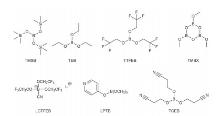
Fig 1
Structural formula of boron-containing additives: tris(trimethylsilyl)borate (TMSB), triethyl borate (TEB), tris(2, 2, 2-trifluoroethyl) borate (TTFEB), 2, 4, 6-trimethylboroxin (TMBX), lithium cyano tris(2, 2, 2-trifluoroethyl) borate (LCTFEB), lithium 4-pyridyl trimethyl borate (LPTB), tris(2-cyanoethyl) borate (TCEB)."
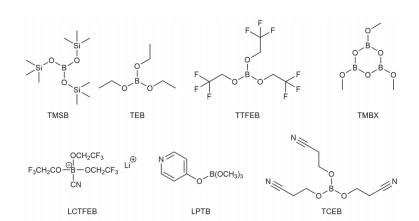
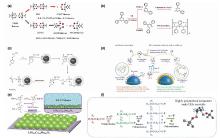
Fig 2
(a) When the additive contains both B―B and B―O bonds, the B―B bond was more likely for break to form a thin and uniform CEI, (b) 2, 4, 6-triphenyl Boroxine formed the B―O―B chain structure at the interface, (c) decomposition mechanism of phosphoalkane additives on the surface of cathode, (d) LiPO2F2 and FEC acted synergistically to form CEI, (e) oxidation process and acid removal mechanism of 2, 4, 6-trimethyl-2, 4, 6-tris(3, 3, 3-trifluoropropyl)-1, 3, 5, 2, 4, 6-trioxatrisilinane (D3F), (f) unsaturated silicon-containing additives formed the cross-linked continuous network protection layer. (a) Adapted with permission from Ref. 30. Copyright 2021, American Chemical Society. (b) Adapted with permission from Ref. 33. Copyright 2020, American Chemical Society. (c) Adapted with permission from Ref. 24. Copyright 2019, American Chemical Society. (d) Adapted with permission from Ref. 38. Copyright 2020, WILEY-VCH Verlag GmbH & Co. KGaA, Weinheim. (e) Adapted with permission from Ref. 40. Copyright 2022, American Chemical Society. (f) Adapted with permission from Ref. 46. Copyright 2022, Wiley-VCH GmbH."
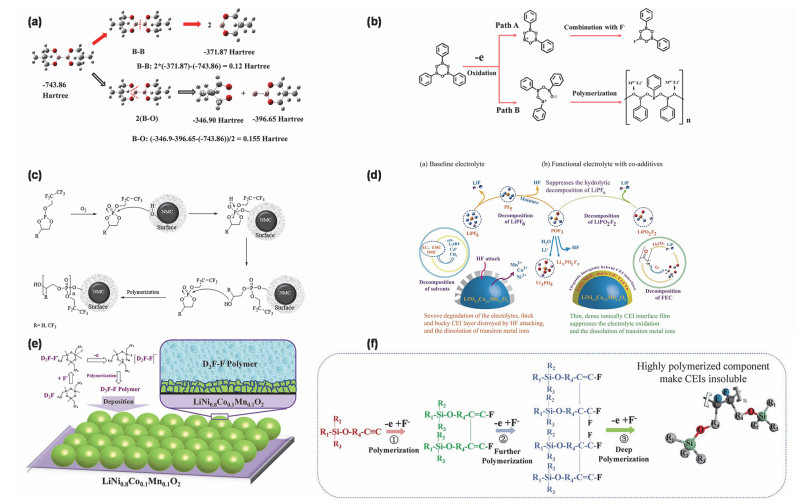
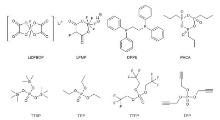
Fig 3
Structural formula of phosphorus-containing additives: lithium difluorobis(oxalato) phosphate (LiDFBOP), lithium tetrafluoro(fluoromalonato)phosphate (LFMP), 1, 2-bis(diphenylphosphino) ethane (DPPE), propylphosphonic anhydride (PACA), tris(trimethylsilyl) phosphate (TTSP), triethyl phosphite (TEP), tris (2, 2, 2-trifluoroethyl) phosphite (TTFP), tripropargyl phosphate (TPP)."
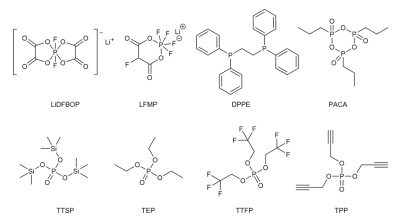
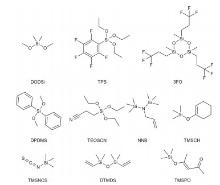
Fig 4
Structural formula of silicon-containing additives: dimethoxy(dimethyl)silane (DODSi), triethoxy (pentafluorophenyl)silane (TPS), 2, 4, 6-trimethyl-2, 4, 6-tris(3, 3, 3-trifluoropropyl)-1, 3, 5, 2, 4, 6-trioxatrisilinane (3FO), dimethoxydiphenylsilane(DPDMS), (2-cyanoethyl) triethoxysilane (TEOSCN), N-allyl-N, N-bis(trimethylsilyl) amine (NNB), 1-(trimethylsilyloxy)-cyclohex-1-ene (TMSCH), isocyanatomethyl (trimethyl)silane (TMSNCS), divinyltetramethyldisiloxane (DTMDS), (3E)-4-[(trimethylsilyl)oxy]-3-penten-2-one (TMSPO)."
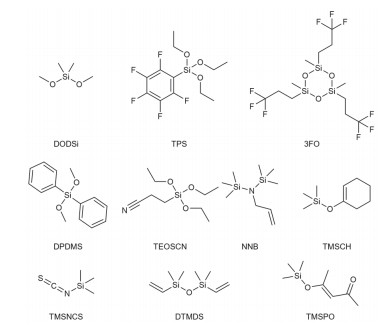
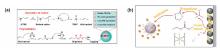
Fig 5
(a) The unsaturated silicon-containing additive allyl trimethylsilane (ATMS) initiated EC ring-opening polymerization, (b) aluminum isopropyl alcohol (AIP) induced ring-opening polymerization in EC solvent. (a) Adapted with permission from Ref. 47. Copyright 2022, American Chemical Society. (b) Adapted with permission from Ref. 50. Copyright 2021, Wiley-VCH GmbH."
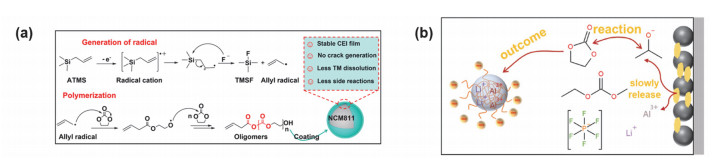
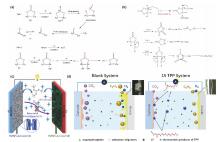
Fig 6
(a) Oxidative ring-opening of EC produced CO2, (b) the presence of 1O2 and H2O led to EC open-loop decomposition and gas production, (c) tri (trimethylsilyl) phosphite (TMSPi) could remove Li2CO3 and reduced gas production, (d) tripropyl phosphate (TPP) formed uniform film and reduced gas generation. (a, b) Adapted with permission from Ref. 8. Copyright 2021, Zhengzhou University. (c) Adapted with permission from Ref. 56. Copyright 2020, WILEY-VCH Verlag GmbH & Co. KGaA, Weinheim. (d) Adapted with permission from Ref. 58. Copyright 2020, American Chemical Society."
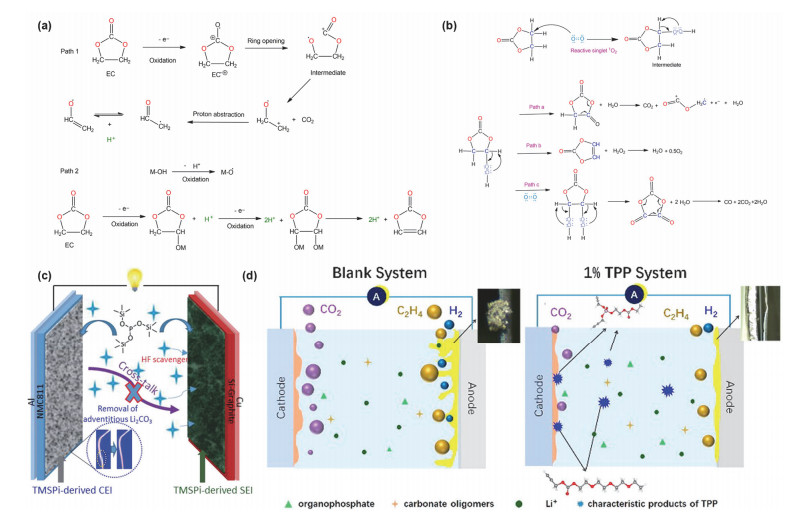
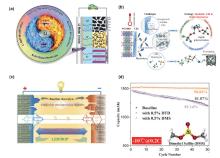
Fig 7
(a) Electrolyte design of lithium metal anode under extreme temperature conditions, (b) unsaturated silicon-containing additives generated insoluble CEI to help pouch cell operate at 60 ℃, (c) lithium difluorodioxalate phosphate (LiDFBOP), as an additive, produced anion polymerized CEI with high Li+ conductivity and insolubility, preferentially forming film to accelerate Li+ diffusion kinetics, (d) dimethyl sulfite (DMS) improved the low temperature performance of the battery. (a) Adapted with permission from Ref. 66. Copyright 2021, Wiley-VCH GmbH. (b) Adapted with permission from Ref. 46. Copyright 2022, Wiley-VCH GmbH. (c) Adapted with permission from Ref. 75. Copyright 2018, WILEY-VCH Verlag GmbH & Co. KGaA, Weinheim. (d) Adapted with permission from Ref. 77. Copyright 2019, American Chemical Society."
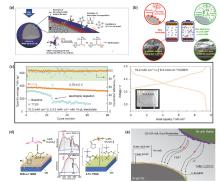
Fig 8
(a) TMSP removed HF, and the decomposition of organic solvent at the interface was reduced, speeding up Li+ transmission, (b) the inorganic LiPO2F2 and organic 1, 3, 6-hexatrionitrile (HTN) additives formed stable SEI to assist the high-voltage battery, (c) trimethylsilyl phosphate (TTSP) increased the charging voltage of NCM811 to 4.5 V, (d) TMSB reduced the interaction between anions and EC, inhibiting EC decomposition, (e) LiBOB acted as a kind of high-voltage additive to form thin and effective passivation layer. (a) Adapted with permission from Ref. 84. Copyright 2021, American Chemical Society. (b) Adapted with permission from Ref. 79. Copyright 2022, American Chemical Society. (c) Adapted with permission from Ref. 85. Copyright 2020, WILEY-VCH Verlag GmbH & Co. KGaA, Weinheim. (d) Adapted with permission from Ref. 89. Copyright 2019, American Chemical Society. (e) Adapted with permission from Ref. 93. Copyright 2018, WILEY-VCH Verlag GmbH & Co. KGaA, Weinheim."
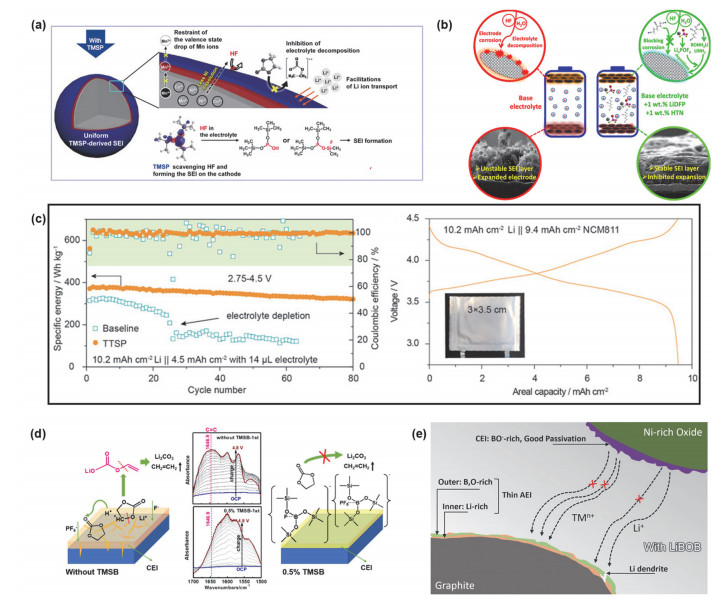
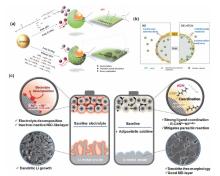
Fig 9
(a) The additive containing ―C≡N reduced transition metal dissolution, (b) mechanism of 1, 3, 6-hexane trinitrile (HTCN), (c) adiponitrile bi-functional additive improved the surface stability of cathode and anode. (a) Adapted with permission from Ref. 99. Copyright 2022, American Chemical Society. (b) Adapted with permission from Ref. 101. Copyright 2022, Wiley-VCH GmbH. (c) Adapted with permission from Ref. 102. Copyright 2019, WILEY-VCH Verlag GmbH & Co. KGaA, Weinheim."
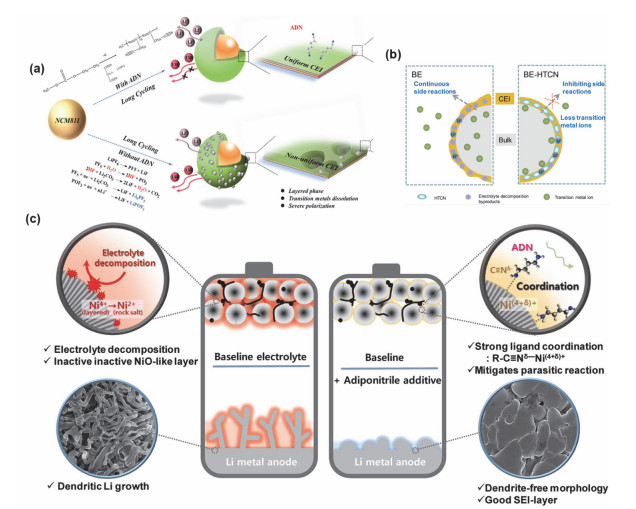
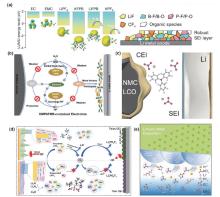
Fig 10
(a) The potassium salt additive KFPB formed film on the anode, (b) 4-(N, N-dimethylamino-phenylborate) binalol ester (DMPATMB) regulated the solvation structure and promoted the anion to participate in SEI formation, (c) TPFPB and LiNO3 cooperated to produce the SEI containing Li2O and CEI containing B, P, (d) high donor number of tetramethylurea (TMU) promotes the dissolution of LiNO3, (e) the synergistic effect of indium trifluoromesylate (In(OTF)3) and LiNO3 coarsened the deposited lithium grains. (a) Adapted with permission from Ref. 109. Copyright 2023, Wiley-VCH GmbH. (b) Adapted with permission from Ref. 82. Copyright 2023, Wiley-VCH GmbH. (c) Adapted with permission from Ref. 114. Copyright 2020, WILEY-VCH Verlag GmbH & Co. KGaA, Weinheim. (d) Adapted with permission from Ref. 28. Copyright 2022, Wiley-VCH GmbH. (e) Adapted with permission from Ref. 118. Copyright 2020, Wiley-VCH GmbH."
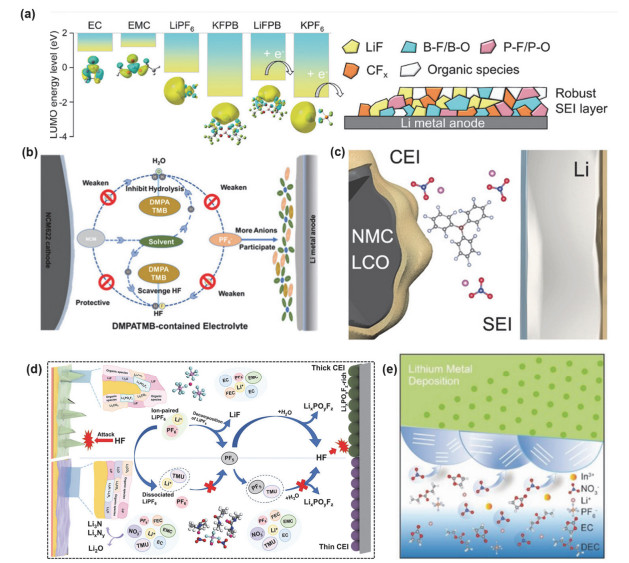
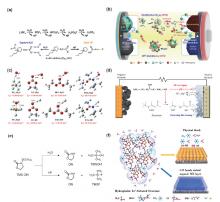
Fig 11
(a) Ionic liquid Pyr14+CH3COO− removed H2O by electrostatic interaction and hydrogen bonding, and removed acid with HF, (b) the chelating agent DPPE and Ni2+ formed didentate coordination structure, which reduced the migration of Ni2+, (c) binding energy of N, O-bis(trimethylsilyl) trifluoroacetamide (BTA), solvent, PF6−, PF5 and H2O, HF, (d) (trimethylsiloxy)-3-pentene-2-one (TMSPO) captured HF, (e) TMS-ON removes HF, H2O by chemical interaction, (f) acrylic acid 1, 1, 1, 3, 3, 3-hexafluoroisopropyl ester HFAC physically blocked PF6− and H2O in the coordination structure. (a) Adapted with permission from Ref. 123. Copyright 2022, American Chemical Society. (b) Adapted with permission from Ref. 124. Copyright 2022, Wiley-VCH GmbH. (c) Adapted with permission from Ref. 127. Copyright 2021, American Chemical Society. (d) Adapted with permission from Ref. 128. Copyright 2019, American Chemical Society. (e) Adapted with permission from Ref. 129. Copyright 2020, Wiley-VCH GmbH. Weinheim. (f) Adapted with permission from Ref. 133. Copyright 2022, Wiley-VCH GmbH."
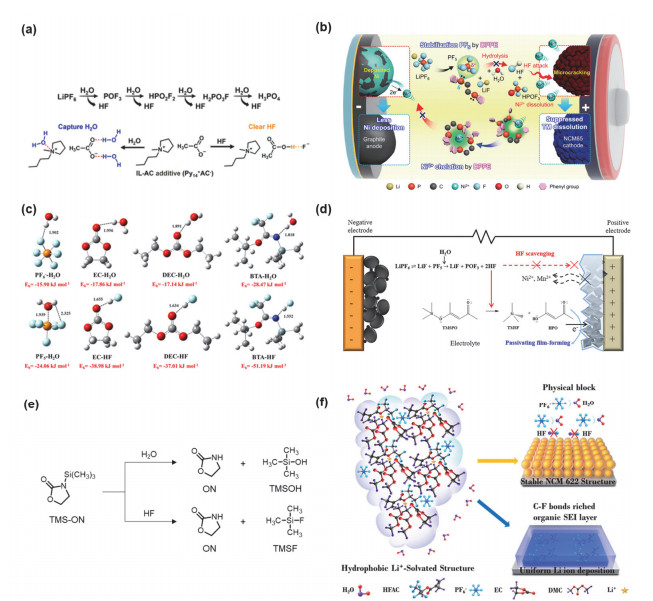
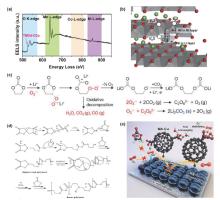
Fig 12
(a) The orbital overlap of TM 3d and O 2p resulted in a decrease in the oxygen binding energy associated with lithium depotting, (b) the surface of the oxide cathode was prone to the migration of oxygen ions and the formation of oxygen vacancy, (c) O2•− produced by the cathode attacked the CH2 structure of the cyclic carbonate solvent, resulting in EC decomposition and gas production, (d) the decomposition intermediates of LiBOB could induce the polymerization of EC, (e) malonic acid modified fullerenes were used as additives to effectively remove reactive oxygen species. (a) Adapted with permission from Ref. 27. Copyright 2017, American Chemical Society. (b) Adapted with permission from Ref. 136. Copyright 2018, WILEY-VCH Verlag GmbH & Co. KGaA, Weinheim. (c) Adapted with permission from Ref. 140. Copyright 2018, WILEY-VCH Verlag GmbH & Co. KGaA, Weinheim. (d) Adapted with permission from Ref. 147. Copyright 2021, American Chemical Society. (e) Adapted with permission from Ref. 151. Copyright 2020, WILEY-VCH Verlag GmbH & Co. KGaA, Weinheim."
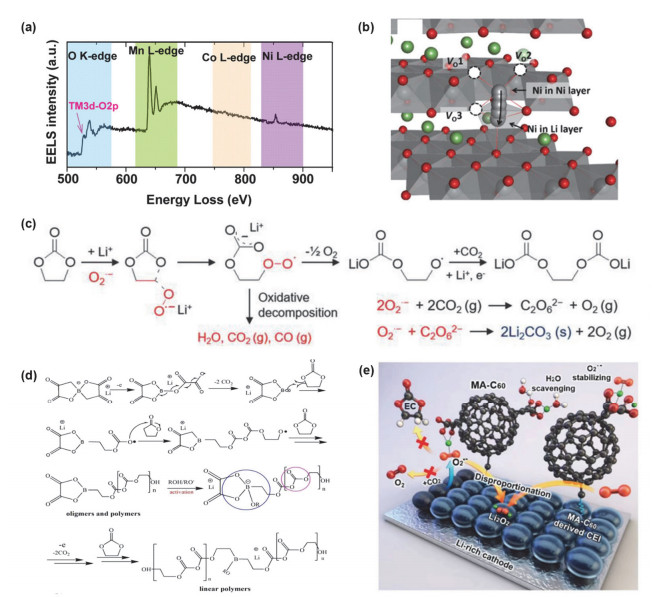
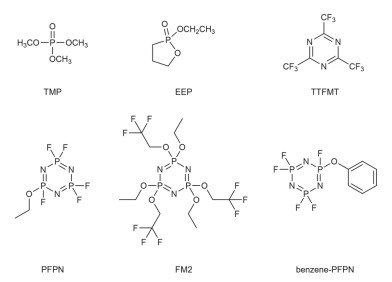
Fig 13
Structural formula of flame retardant additives: trimethyl phosphite (TMP), ethyl phosphate (EEP), 2, 4, 6-tris(trifluoromethyl)-1, 3, 5-triazine (TTFMT), 2-ethoxy-2, 4, 4, 6, 6-pentafluoro-2, 2, 4, 4, 6, 6-hexahydro (PFPN), tri(ethoxy-tri(2, 2, 2-trifluoroethoxy-cyclotriphosphonitrile) (FM2), 2-phenoxy-2, 4, 4, 6, 6-pentafluoro-2, 2, 4, 4, 6, 6-hexahydro (benzene-PFPN)."
| 1 |
doi: 10.1016/j.jechem.2016.04.010 |
| 2 |
doi: 10.1039/d1ee02898g |
| 3 |
doi: 10.1016/j.electacta.2017.11.029 |
| 4 |
doi: 10.1021/acsenergylett.1c01089 |
| 5 |
doi: 10.1002/aenm.202201151 |
| 6 |
doi: 10.1021/acsenergylett.0c00468 |
| 7 |
doi: 10.1021/jacs.0c09602 |
| 8 |
doi: 10.1002/eem2.12180 |
| 9 |
doi: 10.1038/s41560-022-01020-x |
| 10 |
doi: 10.1149/1.2083267 |
| 11 |
doi: 10.1021/acsami.6b06157 |
| 12 |
doi: 10.1039/c9ee02543j |
| 13 |
doi: 10.1039/d0cp06422j |
| 14 |
doi: 10.1016/j.nanoen.2017.11.010 |
| 15 |
doi: 10.1038/ncomms14101 |
| 16 |
|
|
吴晨; 周颖; 朱晓龙; 詹忞之; 杨汉西; 钱江锋. 物理化学学报, 2021, 37, 2008044.
doi: 10.3866/PKU.WHXB202008044 |
|
| 17 |
doi: 10.1016/j.jallcom.2018.09.286 |
| 18 |
doi: 10.1021/acsenergylett.1c00750 |
| 19 |
doi: 10.1016/j.jpowsour.2021.230618 |
| 20 |
doi: 10.1039/c8ee00364e |
| 21 |
doi: 10.1039/c3ee24414h |
| 22 |
doi: 10.1021/acs.nanolett.5b05283 |
| 23 |
doi: 10.1016/j.ensm.2022.05.009 |
| 24 |
doi: 10.1021/acsami.9b03359 |
| 25 |
doi: 10.1002/anie.202107957 |
| 26 |
doi: 10.1002/adfm.202300629 |
| 27 |
doi: 10.1021/acs.chemmater.6b04784 |
| 28 |
doi: 10.1002/adma.202108400 |
| 29 |
doi: 10.1016/j.joule.2019.08.004 |
| 30 |
doi: 10.1021/acsaem.1c01977 |
| 31 |
doi: 10.1016/j.jelechem.2021.115682 |
| 32 |
doi: 10.1016/j.esci.2022.05.003 |
| 33 |
doi: 10.1021/acsami.0c05623 |
| 34 |
doi: 10.1021/acs.jcim.9b00035 |
| 35 |
doi: 10.1016/j.nanoen.2021.106301 |
| 36 |
doi: 10.1016/j.ensm.2023.02.029 |
| 37 |
doi: 10.1039/d2ee04109j |
| 38 |
doi: 10.1002/adfm.202000396 |
| 39 |
doi: 10.1016/j.ensm.2021.02.039 |
| 40 |
doi: 10.1021/acsaem.2c02160 |
| 41 |
doi: 10.1038/s41467-022-34717-4 |
| 42 |
doi: 10.1016/j.jpowsour.2021.230437 |
| 43 |
doi: 10.1021/acsami.8b00913 |
| 44 |
doi: 10.1016/j.nanoen.2018.11.046 |
| 45 |
doi: 10.1002/anie.202103403 |
| 46 |
doi: 10.1002/aenm.202201631 |
| 47 |
doi: 10.1021/acsaem.2c02179 |
| 48 |
doi: 10.1016/j.jpowsour.2017.04.094 |
| 49 |
doi: 10.1021/acsami.7b14662 |
| 50 |
doi: 10.1002/aenm.202101956 |
| 51 |
doi: 10.1021/jacs.2c04124 |
| 52 |
doi: 10.1016/j.cej.2022.137288 |
| 53 |
doi: 10.1149/2.042406jes |
| 54 |
doi: 10.1021/acsami.6b01544 |
| 55 |
doi: 10.1016/j.mattod.2018.03.037 |
| 56 |
doi: 10.1002/admi.202000277 |
| 57 |
doi: 10.1016/j.electacta.2020.136722 |
| 58 |
doi: 10.1021/acsami.9b21605 |
| 59 |
doi: 10.1016/j.jpowsour.2006.07.038 |
| 60 |
doi: 10.1002/aenm.201600218 |
| 61 |
doi: 10.1016/j.jpowsour.2015.10.051 |
| 62 |
doi: 10.1016/j.jpowsour.2015.10.088 |
| 63 |
doi: 10.1016/j.jpowsour.2013.12.024 |
| 64 |
doi: 10.1016/j.jpowsour.2016.05.038 |
| 65 |
doi: 10.1016/j.electacta.2017.03.155 |
| 66 |
doi: 10.1002/advs.202101051 |
| 67 |
doi: 10.1021/acsami.7b13887 |
| 68 |
doi: 10.1021/acsami.9b03821 |
| 69 |
doi: 10.1007/s12039-009-0039-2 |
| 70 |
doi: 10.1016/j.electacta.2016.10.037 |
| 71 |
doi: 10.1016/j.electacta.2012.09.083 |
| 72 |
doi: 10.1016/j.ssi.2013.10.047 |
| 73 |
doi: 10.1016/S1388-2481(02)00490-3 |
| 74 |
doi: 10.1016/j.cej.2021.129400 |
| 75 |
doi: 10.1002/aenm.201800802 |
| 76 |
doi: 10.1016/j.electacta.2018.09.077 |
| 77 |
doi: 10.1021/acsami.9b12020 |
| 78 |
doi: 10.1016/j.electacta.2019.01.120 |
| 79 |
doi: 10.1021/acsami.1c24808 |
| 80 |
doi: 10.1016/j.jpowsour.2019.227366 |
| 81 |
doi: 10.1038/s41467-021-21106-6 |
| 82 |
doi: 10.1002/adfm.202214422 |
| 83 |
doi: 10.1016/j.jpowsour.2015.10.043 |
| 84 |
doi: 10.1021/acsami.5b01770 |
| 85 |
doi: 10.1002/adfm.202002824 |
| 86 |
doi: 10.1016/j.jpowsour.2018.11.083 |
| 87 |
doi: 10.1016/j.jpowsour.2012.08.028 |
| 88 |
doi: 10.1016/j.electacta.2022.140958 |
| 89 |
doi: 10.1021/acsami.9b17438 |
| 90 |
doi: 10.1016/j.cej.2022.138318 |
| 91 |
doi: 10.1021/acs.jpcc.6b09097 |
| 92 |
doi: 10.1021/acsenergylett.2c01433 |
| 93 |
doi: 10.1002/aenm.201801957 |
| 94 |
doi: 10.1021/acs.chemmater.9b00555 |
| 95 |
doi: 10.1039/c7ee03122j |
| 96 |
doi: 10.1016/j.jechem.2021.05.022 |
| 97 |
doi: 10.1016/j.electacta.2019.135465 |
| 98 |
doi: 10.1039/c5ee03360h |
| 99 |
doi: 10.1021/acsami.1c23335 |
| 100 |
doi: 10.1039/d0ta05827k |
| 101 |
doi: 10.1002/smll.202202989 |
| 102 |
doi: 10.1002/adfm.201902496 |
| 103 |
doi: 10.1016/j.jcis.2021.10.061 |
| 104 |
doi: 10.1002/anie.201903466 |
| 105 |
|
|
冉琴; 孙天霷; 韩冲宇; 张浩楠; 颜剑; 汪靖伦. 物理化学学报, 2020, 36, 1912068.
doi: 10.3866/PKU.WHXB201912068 |
|
| 106 |
doi: 10.1021/acsenergylett.1c01999 |
| 107 |
doi: 10.1016/j.jpowsour.2020.227833 |
| 108 |
doi: 10.1016/j.cej.2022.138359 |
| 109 |
doi: 10.1002/adma.202301312 |
| 110 |
doi: 10.1002/anie.202013271 |
| 111 |
doi: 10.1002/adma.202303347 |
| 112 |
doi: 10.1038/s41467-022-29761-z |
| 113 |
doi: 10.1016/j.xcrp.2022.100919 |
| 114 |
doi: 10.1002/anie.202004853 |
| 115 |
doi: 10.1016/j.nanoen.2021.106353 |
| 116 |
doi: 10.1038/s41560-023-01282-z |
| 117 |
doi: 10.1002/cey2.283 |
| 118 |
doi: 10.1002/adfm.202003800 |
| 119 |
doi: 10.1038/s41467-022-28959-5 |
| 120 |
doi: 10.1126/science.1253292 |
| 121 |
doi: 10.1021/acsami.0c04372 |
| 122 |
doi: 10.1021/jacs.1c11315 |
| 123 |
doi: 10.1021/acsami.2c12497 |
| 124 |
doi: 10.1002/advs.202205918 |
| 125 |
doi: 10.1016/j.jcis.2021.03.058 |
| 126 |
doi: 10.1016/j.ensm.2021.06.018 |
| 127 |
doi: 10.1021/acsami.1c18783 |
| 128 |
doi: 10.1021/acsami.8b19009 |
| 129 |
doi: 10.1002/aenm.202000012 |
| 130 |
doi: 10.1002/adfm.201605989 |
| 131 |
doi: 10.1016/j.jpowsour.2020.229172 |
| 132 |
doi: 10.1002/celc.202101067 |
| 133 |
doi: 10.1002/anie.202205091 |
| 134 |
doi: 10.1002/adma.202212292 |
| 135 |
doi: 10.1039/d0ee00060d |
| 136 |
doi: 10.1002/aenm.201802586 |
| 137 |
doi: 10.1002/aenm.201400498 |
| 138 |
doi: 10.1038/s41565-019-0428-8 |
| 139 |
doi: 10.1021/ja2021747 |
| 140 |
doi: 10.1002/adma.201804822 |
| 141 |
doi: 10.1039/d0qm00094a |
| 142 |
doi: 10.1038/s41467-020-17126-3 |
| 143 |
doi: 10.1002/advs.201800843 |
| 144 |
doi: 10.1038/s41560-022-01036-3 |
| 145 |
doi: 10.1016/j.jpowsour.2013.10.071 |
| 146 |
doi: 10.1016/j.jpowsour.2016.12.012 |
| 147 |
doi: 10.1021/acsaem.1c02331 |
| 148 |
doi: 10.1016/j.nanoen.2020.105282 |
| 149 |
doi: 10.1016/j.electacta.2022.141745 |
| 150 |
doi: 10.1016/j.jpowsour.2015.07.065 |
| 151 |
doi: 10.1002/aenm.202000563 |
| 152 |
doi: 10.1039/d3ee00157a |
| 153 |
doi: 10.1016/j.electacta.2012.09.065 |
| 154 |
doi: 10.1016/j.ensm.2020.07.018 |
| 155 |
doi: 10.1149/1.1533040 |
| 156 |
doi: 10.1016/S0378-7753(03)00259-3 |
| 157 |
doi: 10.1002/aenm.201701398 |
| 158 |
doi: 10.1016/j.nanoen.2018.02.029 |
| 159 |
doi: 10.1016/j.jpowsour.2014.04.015 |
| 160 |
doi: 10.1016/j.nanoen.2022.107122 |
| 161 |
doi: 10.1016/j.jpowsour.2016.12.007 |
| 162 |
doi: 10.1016/j.jpowsour.2017.05.091 |
| 163 |
doi: 10.1016/j.electacta.2008.10.043 |
| 164 |
doi: 10.1002/anie.202203693 |
| 165 |
doi: 10.1016/j.ensm.2021.06.023 |
| [1] | Jiandong Liu, Zhijia Zhang, Kamenskii Mikhail, Volkov Filipp, Eliseeva Svetlana, Jianmin Ma. Research Progress on Cathode Electrolyte Interphase in High-Voltage Lithium Batteries [J]. Acta Phys. -Chim. Sin., 2025, 41(2): 100011-. |
| [2] | Qing Xue, Shengyi Li, Yanan Zhao, Peng Sheng, Li Xu, Zhengxi Li, Bo Zhang, Hui Li, Bo Wang, Libin Yang, Yuliang Cao, Zhongxue Chen. Novel Alkaline Sodium-Ion Battery Capacitor Based on Active Carbon||Na0.44MnO2 towards Low Cost, High-Rate Capability and Long-Term Lifespan [J]. Acta Phys. -Chim. Sin., 2024, 40(2): 2303041-. |
| [3] | Qu Zhuoyan, Zhang Xiaoyin, Xiao Ru, Sun Zhenhua, Li Feng. Application of Organosulfur Compounds in Lithium-Sulfur Batteries [J]. Acta Phys. -Chim. Sin., 2023, 39(8): 2301019-0. |
| [4] | Huan Liu, Yu Ma, Bin Cao, Qizhen Zhu, Bin Xu. Recent Progress of MXenes in Aqueous Zinc-Ion Batteries [J]. Acta Phys. -Chim. Sin., 2023, 39(5): 2210027-0. |
| [5] | Yuanhao Shen, Qingyu Wang, Jie Liu, Cheng Zhong, Wenbin Hu. Spontaneous Reduction and Adsorption of K3[Fe(CN)6] on Zn Anodes in Alkaline Electrolytes: Enabling a Long-Life Zn-Ni Battery [J]. Acta Phys. -Chim. Sin., 2022, 38(11): 2204048-0. |
| [6] | Qin Ran, Tianyang Sun, Chongyu Han, Haonan Zhang, Jian Yan, Jinglun Wang. Natural Polyphenol Tannic Acid as an Efficient Electrolyte Additive for High Performance Lithium Metal Anode [J]. Acta Physico-Chimica Sinica, 2020, 36(11): 1912068-. |
| [7] | Zhenjie CHENG, Yayun MAO, Qingyu DONG, Feng JIN, Yanbin SHEN, Liwei CHEN. Fluoroethylene Carbonate as an Additive for Sodium-Ion Batteries: Effect on the Sodium Cathode [J]. Acta Physico-Chimica Sinica, 2019, 35(8): 868-875. |
| [8] | Rui CHEN,Wei WANG,Tongle BU,Zhiliang KU,Jie ZHONG,Yong PENG,Shengqiang XIAO,Wei YOU,Fuzhi HUANG,Yibing CHENG,Zhengyi FU. Low-Cost Fullerene Derivative as an Efficient Electron Transport Layer for Planar Perovskite Solar Cells [J]. Acta Phys. -Chim. Sin., 2019, 35(4): 401-407. |
| [9] | LI Jing-Zhe, KONG Fan-Tai, WU Guo-Hua, HUANG Yang, CHEN Wang-Chao, DAI Song-Yuan. TiO2/Dye/Electrolyte Interface Modification for Dye-Sensitized Solar Cells [J]. Acta Phys. -Chim. Sin., 2013, 29(09): 1851-1864. |
|
||