Acta Phys. -Chim. Sin. ›› 2025, Vol. 41 ›› Issue (4): 100032.doi: 10.3866/PKU.WHXB202404006
Special Issue: Electrochemical Separation and Recycling
• REVIEW • Previous Articles Next Articles
Opportunities and Challenges of Capacitive Deionization for Uranium Extraction from Seawater
Guoze Yan1, Bin Zuo1,*, Shaoqing Liu1, Tao Wang1, Ruoyu Wang1, Jinyang Bao1, Zhongzhou Zhao1, Feifei Chu1, Zhengtong Li2, Yamauchi Yusuke3,4,5, Melhi Saad6, Xingtao Xu1,*( )
)
- 1 Marine Science and Technology College, Zhejiang Ocean University, Zhoushan 316022, Zhejiang Province, China
2 State Key Laboratory of Hydrology-Water Resources and Hydraulic Engineering, Hohai, University, Nanjing 210098, China
3 Department of Materials Process Engineering, Graduate School of Engineering, Nagoya University, Nagoya University, Nagoya 464-8601, Japan
4 Australian Institute for Bioengineering and Nanotechnology (AIBN), The University of Queensland, Brisbane, QLD 4072, Australia
5 Department of Chemical and Biomolecular Engineering, Yonsei University, 50 Yonsei-ro, Seodaemun-gu, Seoul 03722, South Korea
6 Department of Chemistry, College of Science, University of Bisha, Bisha, 61922, Saudi Arabia
-
Received:2024-04-02Revised:2024-04-30Accepted:2024-05-07Published:2024-12-28 -
Contact:Email: zuobin@zjou.edu.cn (Bin Zuo)xingtao.xu@zjou.edu.cn (Xingtao Xu) -
Supported by:the Zhejiang Ocean University Talent Introduction Research Fund(JX6311101423); the Zhejiang Ocean University Talent Introduction Research Fund(JX6311103723); the General Project of the Zhejiang Provincial Department of Education(Y202353930); the Fundamental Research Funds for Zhejiang Provincial Universities and Research Institutes(2024J006); the National Undergraduate Innovation Training Program(202310340024)

Cite this article
Guoze Yan, Bin Zuo, Shaoqing Liu, Tao Wang, Ruoyu Wang, Jinyang Bao, Zhongzhou Zhao, Feifei Chu, Zhengtong Li, Yamauchi Yusuke, Melhi Saad, Xingtao Xu. Opportunities and Challenges of Capacitive Deionization for Uranium Extraction from Seawater[J]. Acta Phys. -Chim. Sin. 2025, 41(4), 100032. doi: 10.3866/PKU.WHXB202404006
share this article
Fig 1
Schematic diagram of CDI and their electrosorption processes. (a) A CDI cell with two porous electrodes. (b) The schematic of an MCDI cell. (c) The schematic of a FCDI cell. (d) A CDI cell used to selectively remove target ions 45. Adapted with permission from Ref. 45, Copyright 2020 Royal Society of Chemistry."
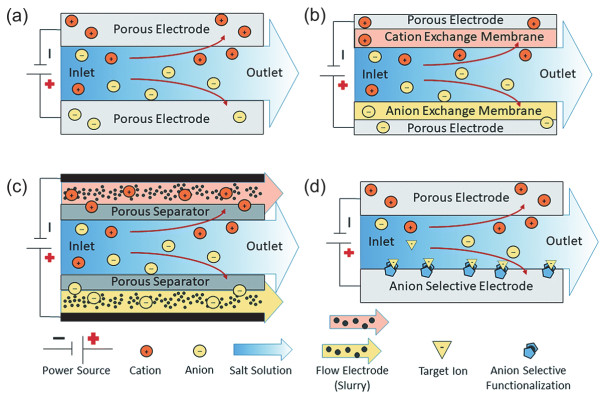
Fig 2
Summary of the advantages of CDI for UES."
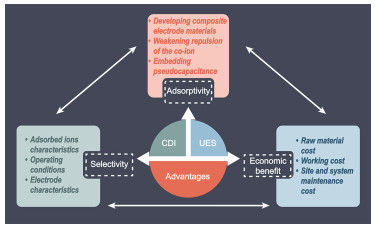
Table 1
Summary of CDI materials with different adsorbabilities derived from simulation experiments."
| Electrode material/Type | Electrosorption mechanism | Adsorption performance | Ref. | |
| Uptake capacity | Removal ratio | |||
| 3DG | EDL formation | 113.80 mg∙g−1 (at 1.8 Ⅴ) | N/A | |
| CS/GO | EDL formation and complexation | 271.2 mg∙g−1 (at 0.9 Ⅴ) | N/A | |
| CS/BC | EDL formation, ion exchange and complexation | 207.6 mg∙g−1 (at 0.9 Ⅴ and pH 4.0) | N/A | |
| PVA/GO | EDL formation and complexation | 333.0 mg∙g−1 (at 0.9 Ⅴ) | N/A | |
| RGH | EDL, extra micro electric field and complexation | N/A | 97.9% (at 1.2 Ⅴ and 4 h) | |
| HGNbP | Electro-adsorption, electro-reduction and coordination | 1340 mg∙g−1 (in 1000 mg∙L−1 U(Ⅵ) solution) | 99.9% (within 30 min in 50 mg∙L−1 U(Ⅵ) solution) | |
| WO3/C | Synergistic effect of EDLs and pseudocapacitive from WO3/C | 449.9 mg∙g−1 (at 1.2 Ⅴ) | N/A | |
| CMPC | EDLs and pseudocapacitive | 410.33 mg∙g−1 (at 1.2 Ⅴ). | 95.2% | |
| CC/PANI | Hybrid capacitive adsorption and coordination | 282.2 mg∙g−1 (at 0.9 Ⅴ and pH 4.0) | N/A | |
| GO/PPy | EDL and pseudocapacitive adsorption and complexation | 246.5 mg∙g−1 (at pH 4.0 and 0.9 Ⅴ) | N/A | |
| FCDI | Electrosorption and electroreduction | The volume of uranium-containing water was reduced from 2400 mL to 40 mL | 99% | |
| MCDI | Electrosorption | N/A | 98.9% (a groundwater source containing 50 μg∙L−1 uranium) | |
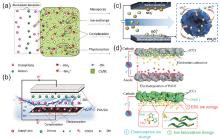
Fig 3
(a) The electrosorption mechanism for U(Ⅵ) removal by CS/BC-2 electrode 116. Adapted with permission from Ref. 116, Copyright 2021 Elsevier. (b) Possible mechanism for U(Ⅵ) electrosorption on PVA/GO-4 117. Adapted with permission from Ref. 117, Copyright 2022 Elsevier. (c) Schematic diagram of electrosorption mechanism of WO3/C electrode 124. Adapted with permission from Ref. 124, Copyright 2020 Elsevier. (d) Possible mechanism for U(Ⅵ) electrosorption on CC/PANI-2 125. Adapted with permission from Ref. 125, Copyright 2023 Elsevier."
Table 2
Summary of CDI materials with different selectivities derived from simulation experiments."
| Electrode material | Electrosorption mechanism | Performance | Ref. | |
| Uptake capacity | Comparation | |||
| NHPC | UO22+ and NHPC produce synergistic effects through coulomb interaction and reduction reaction | 152.43 mg∙g−1 | Kd = 1620.84 mL∙g−1 | |
| CMM | MXene provides a pseudocapacitance/intercalation effect and the conductive base | 582.46 mg∙g−1 (at 1.2 Ⅴ) | 92.3% multi-ionic solution | |
| Amorphous BP nanosheets | The strong coordination between P and U | In aqueous solutions ranging from 0.05 to 130 mg∙L−1, the maximum adsorption capacity is 2584 mg∙g−1. | When nine kinds of ions coexist and the concentration is 100 times, the material maintains good selectivity for uranyl ions. | |
| CSKN-15 | The redox fixation of U(Ⅵ) | 78.34 mg∙g−1 in seawater | SU/M is higher than 120. | |
| HGP hydrogel | The physi-, chemi-, and electro-sorption simultaneously took effect | 545.7 mg∙g−1 (at 1.2 Ⅴ and pH 5.0) | SU/M values for each cation are far above 1. | |
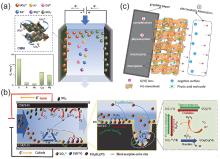
Fig 4
(a) Schematic diagram of electroadsorption mechanism of CMM electrode 139. Adapted with permission from Ref. 139, Copyright 2022 Elsevier. (b) Diagram of faradic reaction and electroadsorption process occurring at CSKN-15 electrode 140. Adapted with permission from Ref. 140, Copyright 2023 Elsevier. (c) Illustration of electrosorption mechanism of HGP electrode 143. Adapted with permission from Ref. 143, Copyright 2019 Elsevier."
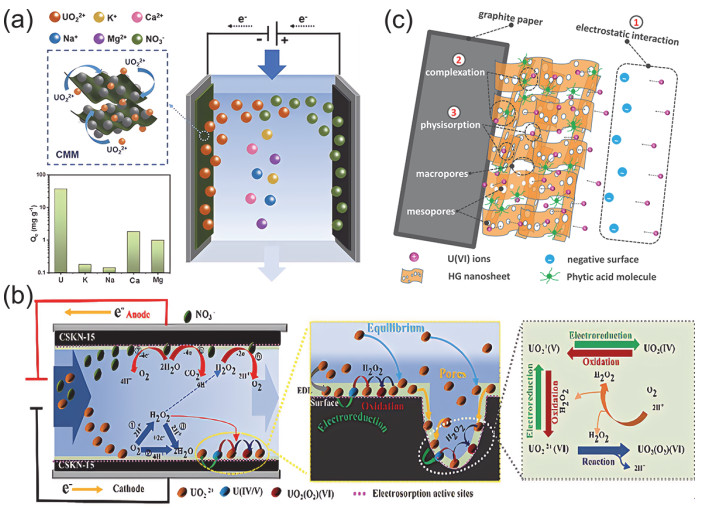
Table 3
Basic cost analysis of four UES technologies derived from simulation experiments (US$ per kg of uranium)."
| Technologies | Raw material cost | Working cost | Site and system maintenance cost | Total cost |
| Chemical reduction | $20 to $41 | $20 to $100 | $40 to $120 | $80 to $261 |
| Microbial reduction | $20 to $41 | $50 to $130 | $30 to $56 | $100 to $227 |
| Photocatalytic reduction | $20 to $41 | $23 to $30 | $$30 to $60 | $73 to $131 |
| CDI | $40 to $80 | $0.74 to $1.75 | $10 to $80 | $50.74 to $161.75 |
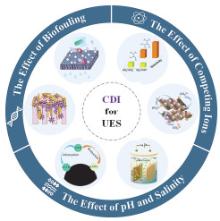
Fig 5
Summary diagram of challenge factors of CDI for UES."
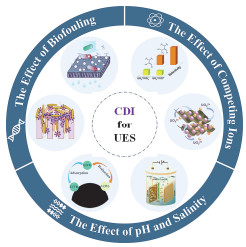
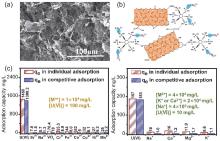
Fig 6
(a) SEM image of 3DG electrode material 114. Adapted with permission from Ref. 114, Copyright 2019 Springer International Publishing. (b) Structure legend of HGP hydrogel electrode 143. Adapted with permission from Ref. 143, Copyright 2019 Elsevier. (c) Comparison of equilibrium adsorption capacity (qe) in the environment of a single competitive metal ion solution and multiple competitive metal ion solutions 95. Adapted with permission from Ref. 95, Copyright 2020 Elsevier."
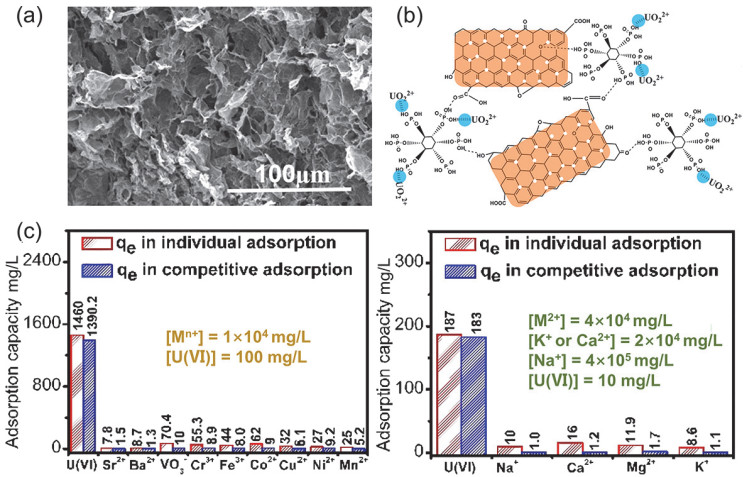
Fig 7
(a) Synthesis principle of NHPC. (b) Adsorption of uranium at different pH values. (c) Schematic diagram of uranium migration process and valence state change in CDI process 138. Adapted with permission from Ref. 138, Copyright 2023 Elsevier."
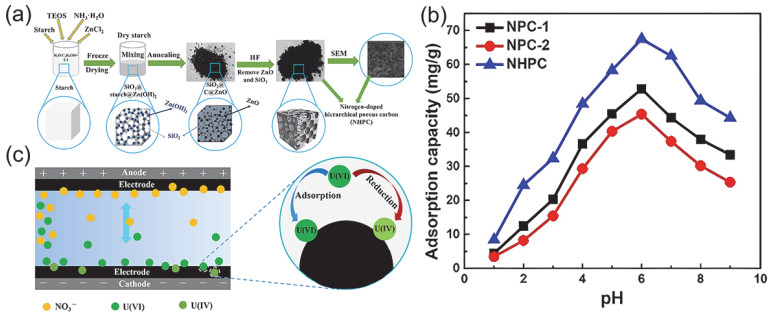
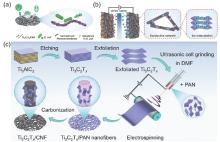
Fig 8
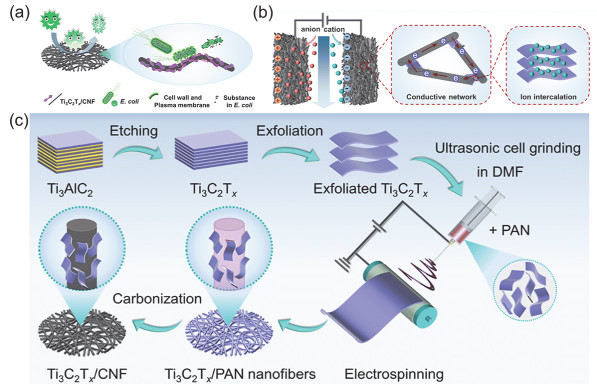
(a) Schematic diagram of how Ti3C2Tx/CNF-14 inactivates E. coli. (b) Ti3C2Tx/CNF-14 CDI structure diagram. (c) Ti3C2Tx/CNF-14 synthesis flow chart 170. Adapted with permission from Ref. 170, Copyright 2023 Royal Society of Chemistry."
| 1 |
doi: 10.1016/j.desal.2023.116773 |
| 2 |
doi: 10.3390/en15124310 |
| 3 |
doi: 10.1002/anie.202007895 |
| 4 |
doi: 10.1016/j.ccr.2023.215097 |
| 5 |
doi: 10.1002/anie.201906191 |
| 6 |
doi: 10.1016/j.ccr.2023.215234 |
| 7 |
doi: 10.1021/acs.est.0c08743 |
| 8 |
doi: 10.1016/j.seppur.2023.124204 |
| 9 |
doi: 10.1016/j.desal.2022.116153 |
| 10 |
doi: 10.1016/j.cej.2021.133578 |
| 11 |
doi: 10.1021/acsami.1c09107 |
| 12 |
doi: 10.1039/d0qm00946f |
| 13 |
doi: 10.1016/j.cej.2020.128129 |
| 14 |
doi: 10.1016/j.asej.2022.102030 |
| 15 |
doi: 10.1016/j.chemosphere.2019.125003 |
| 16 |
doi: 10.1039/c9en00730j |
| 17 |
doi: 10.1016/j.jece.2022.109028 |
| 18 |
doi: 10.1016/j.chemosphere.2018.11.071 |
| 19 |
doi: 10.1021/acs.est.8b02807 |
| 20 |
doi: 10.1080/19443994.2016.1152638 |
| 21 |
doi: 10.1016/j.seppur.2022.122169 |
| 22 |
doi: 10.1016/j.cej.2023.142012 |
| 23 |
doi: 10.1039/d3ta04476a |
| 24 |
|
|
卢淼; 刘建允; 程健; 王世平; 杨健茂. 物理化学学报, 2014, 30, 2263.
doi: 10.3866/PKU.WHXB201410141 |
|
| 25 |
|
|
王雷; 于飞; 马杰. 物理化学学报, 2017, 33, 1338.
doi: 10.3866/PKU.WHXB201704113 |
|
| 26 |
|
|
熊岳城; 于飞; 马杰. 物理化学学报, 2022, 38, 2006037.
doi: 10.3866/PKU.WHXB202006037 |
|
| 27 |
doi: 10.1016/j.seppur.2021.120172 |
| 28 |
doi: 10.1021/acs.chemrev.1c00396 |
| 29 |
doi: 10.1016/j.desal.2022.116219 |
| 30 |
doi: 10.1016/j.pmatsci.2013.03.005 |
| 31 |
doi: 10.1021/j100819a038 |
| 32 |
doi: 10.1149/1.2408094 |
| 33 |
doi: 10.1149/1.1836402 |
| 34 |
doi: 10.1016/j.cplett.2012.06.016 |
| 35 |
doi: 10.1149/1.2213354 |
| 36 |
doi: 10.1016/j.jelechem.2011.01.012 |
| 37 |
doi: 10.1016/j.carbon.2008.11.012 |
| 38 |
doi: 10.1039/c9en00017h |
| 39 |
doi: 10.1016/s0378-3820(00)00114-4 |
| 40 |
doi: 10.1016/j.desal.2006.01.011 |
| 41 |
doi: 10.1039/c3ee24443a |
| 42 |
doi: 10.1039/c4ee02378a |
| 43 |
doi: 10.1016/j.desal.2018.10.013 |
| 44 |
doi: 10.1016/j.watres.2017.10.024 |
| 45 |
doi: 10.1039/c9ew00945k |
| 46 |
doi: 10.3390/membranes12050459 |
| 47 |
doi: 10.1016/j.watres.2015.08.012 |
| 48 |
doi: 10.1038/s41578-020-0193-1 |
| 49 |
doi: 10.1016/j.cocis.2022.101602 |
| 50 |
doi: 10.1002/adfm.202213578 |
| 51 |
doi: 10.21743/pjaec/2021.12.02 |
| 52 |
doi: 10.1016/j.jelechem.2020.114416 |
| 53 |
doi: 10.1016/j.memsci.2009.09.043 |
| 54 |
|
| 55 |
doi: 10.1016/j.desal.2018.01.026 |
| 56 |
doi: 10.1016/j.desal.2019.01.031 |
| 57 |
doi: 10.1021/acs.est.7b05874 |
| 58 |
doi: 10.1016/j.watres.2012.08.031 |
| 59 |
doi: 10.1016/j.desal.2013.04.013 |
| 60 |
doi: 10.1016/j.coelec.2022.101084 |
| 61 |
doi: 10.1016/j.cej.2022.137415 |
| 62 |
doi: 10.1016/j.desal.2023.117096 |
| 63 |
doi: 10.1016/j.memsci.2017.10.026 |
| 64 |
doi: 10.1016/j.seppur.2020.116626 |
| 65 |
doi: 10.1016/j.electacta.2016.09.026 |
| 66 |
doi: 10.1016/j.desal.2022.115569 |
| 67 |
doi: 10.1016/j.desal.2018.10.009 |
| 68 |
doi: 10.1021/acssuschemeng.0c04101 |
| 69 |
doi: 10.1016/j.desal.2019.114078 |
| 70 |
doi: 10.1016/j.seppur.2023.124577 |
| 71 |
doi: 10.1016/S1872-5805(23)60736-X |
| 72 |
doi: 10.1021/acsami.1c09107 |
| 73 |
doi: 10.1016/j.cej.2021.133161 |
| 74 |
doi: 10.3390/en16031136 |
| 75 |
doi: 10.1039/d1mh01882e |
| 76 |
doi: 10.1016/j.cej.2020.124493 |
| 77 |
doi: 10.1016/j.cej.2019.01.098 |
| 78 |
doi: 10.1016/j.seppur.2023.124519 |
| 79 |
doi: 10.1016/j.desal.2023.116619 |
| 80 |
doi: 10.3390/pr10061075 |
| 81 |
doi: 10.1016/j.carbon.2015.12.095 |
| 82 |
doi: 10.1016/j.cej.2023.141621 |
| 83 |
doi: 10.1038/s41545-021-00109-2 |
| 84 |
doi: 10.1016/j.jclepro.2021.128251 |
| 85 |
doi: 10.1021/acs.est.8b04858 |
| 86 |
doi: 10.1002/wer.10696 |
| 87 |
doi: 10.1080/10643389.2021.1902698 |
| 88 |
doi: 10.1016/j.watres.2020.116059 |
| 89 |
doi: 10.1016/j.cej.2017.01.082 |
| 90 |
doi: 10.1016/j.desal.2023.117146 |
| 91 |
Xu, P.; Elson, B.; E Drewes, J. Electrosorption of Heavy Metals with Capacitive Deionization: Water Reuse, Desalination and Resources Recovery. In Desalination; 2019; pp 497–523.
|
| 92 |
doi: 10.1021/acs.est.8b07157 |
| 93 |
doi: 10.1016/j.cej.2023.142012 |
| 94 |
doi: 10.1016/j.seppur.2023.125494 |
| 95 |
doi: 10.1016/j.seppur.2020.117175 |
| 96 |
doi: 10.1016/j.cej.2017.07.067 |
| 97 |
doi: 10.1016/j.colsurfa.2022.129367 |
| 98 |
doi: 10.1016/j.seppur.2023.125292 |
| 99 |
doi: 10.1016/j.jwpe.2022.102930 |
| 100 |
doi: 10.1016/j.seppur.2022.122169 |
| 101 |
doi: 10.1016/j.seppur.2020.117753 |
| 102 |
doi: 10.1016/j.techfore.2013.04.019 |
| 103 |
doi: 10.1016/j.apsusc.2016.11.230 |
| 104 |
doi: 10.1021/ie970518k |
| 105 |
doi: 10.1021/cr5001546 |
| 106 |
doi: 10.1016/j.watres.2014.07.013 |
| 107 |
doi: 10.1039/c7ta03515b |
| 108 |
doi: 10.1039/c7en00019g |
| 109 |
doi: 10.1016/j.electacta.2010.02.012 |
| 110 |
doi: 10.1007/s12039-010-0071-2 |
| 111 |
doi: 10.1016/j.chemosphere.2015.12.012 |
| 112 |
doi: 10.1039/d0ee00341g |
| 113 |
doi: 10.1007/s13762-016-1061-9 |
| 114 |
doi: 10.1007/s10967-019-06650-2 |
| 115 |
doi: 10.1016/j.seppur.2022.120827 |
| 116 |
doi: 10.1016/j.seppur.2021.119005 |
| 117 |
doi: 10.1016/j.seppur.2021.119604 |
| 118 |
doi: 10.1039/c4ee03172e |
| 119 |
doi: 10.1016/j.cej.2021.130351 |
| 120 |
doi: 10.1016/j.jhazmat.2022.130054 |
| 121 |
doi: 10.1016/j.cej.2020.128200 |
| 122 |
doi: 10.1016/j.jcis.2018.07.129 |
| 123 |
doi: 10.1016/j.desal.2014.03.041 |
| 124 |
doi: 10.1016/j.cej.2020.125460 |
| 125 |
doi: 10.1016/j.desal.2023.116773 |
| 126 |
doi: 10.1016/j.jece.2023.111498 |
| 127 |
doi: 10.1016/j.watres.2018.11.064 |
| 128 |
doi: 10.1021/es5055989 |
| 129 |
doi: 10.1016/j.seppur.2021.120172 |
| 130 |
doi: 10.1021/acs.est.3c03477 |
| 131 |
doi: 10.1039/d0ee03145c |
| 132 |
doi: 10.1021/ie050321p |
| 133 |
doi: 10.1016/j.desal.2012.12.029 |
| 134 |
doi: 10.1021/jp711706z |
| 135 |
doi: 10.1016/j.jhazmat.2015.09.064 |
| 136 |
doi: 10.1002/anie.202302180 |
| 137 |
doi: 10.1016/j.cej.2018.11.236 |
| 138 |
doi: 10.1016/j.seppur.2022.122866 |
| 139 |
doi: 10.1016/j.cej.2021.132702 |
| 140 |
doi: 10.1016/j.cej.2023.142413 |
| 141 |
doi: 10.1016/j.jhazmat.2022.128591 |
| 142 |
doi: 10.1038/nenergy.2017.7 |
| 143 |
doi: 10.1016/j.apsusc.2019.04.103 |
| 144 |
doi: 10.1038/s41893-021-00709-3 |
| 145 |
doi: 10.1002/er.5845 |
| 146 |
doi: 10.1002/advs.201900085 |
| 147 |
doi: 10.1016/j.eneco.2015.01.016 |
| 148 |
doi: 10.3390/nano13132005 |
| 149 |
doi: 10.1016/j.cej.2021.128810 |
| 150 |
doi: 10.1002/anie.202101015 |
| 151 |
doi: 10.1016/j.desal.2022.116154 |
| 152 |
doi: 10.1016/j.micromeso.2021.111231 |
| 153 |
doi: 10.1039/d0dt00618a |
| 154 |
doi: 10.1016/j.ccr.2022.214615 |
| 155 |
doi: 10.1002/advs.202201735 |
| 156 |
doi: 10.1016/j.ijbiomac.2022.03.019 |
| 157 |
doi: 10.1021/acsestwater.0c00262 |
| 158 |
doi: 10.1002/adsu.202300393 |
| 159 |
doi: 10.1016/j.inoche.2023.111284 |
| 160 |
doi: 10.1016/j.molliq.2022.120514 |
| 161 |
doi: 10.1016/j.desal.2023.116893 |
| 162 |
doi: 10.1016/j.cej.2021.133121 |
| 163 |
doi: 10.1016/j.seppur.2023.126170 |
| 164 |
doi: 10.1016/j.tree.2022.02.009 |
| 165 |
doi: 10.1016/j.desal.2022.115721 |
| 166 |
doi: 10.1016/j.jhazmat.2022.128983 |
| 167 |
doi: 10.1021/acsami.1c02882 |
| 168 |
doi: 10.1021/acs.est.7b06382 |
| 169 |
doi: 10.1016/j.reactfunctpolym.2021.105068 |
| 170 |
doi: 10.1039/d2sc06946f |
| 171 |
doi: 10.1016/j.seppur.2023.125186 |
| 172 |
doi: 10.1016/j.seppur.2022.120571 |
| 173 |
doi: 10.1016/j.jhazmat.2021.126872 |
| 174 |
doi: 10.1016/j.memsci.2019.117564 |
| 175 |
doi: 10.3390/ma16196451 |
| 176 |
doi: 10.1021/acs.est.6b06339 |
| 177 |
doi: 10.3390/ijerph191710599 |
| 178 |
doi: 10.3390/su142114429 |
| 179 |
doi: 10.2174/1573413716666210101120710 |
| 180 |
doi: 10.3390/app13095635 |
| 181 |
doi: 10.1016/j.cej.2022.134959 |
| 182 |
doi: 10.1016/j.joule.2017.12.010 |
| 183 |
doi: 10.1039/c5ee00519a |
| 184 |
doi: 10.1039/d0ee02838j |
| 185 |
doi: 10.1007/s10845-018-1392-0 |
| 186 |
doi: 10.1002/adma.202107212 |
| [1] | Shuhong Xiang, Lv Yang, Yingsheng Xu, Guoxin Cao, Hongjian Zhou. Selective electrosorption of Cs(Ⅰ) from high-salinity radioactive wastewater using CNT-interspersed potassium zinc ferrocyanide electrodes [J]. Acta Phys. -Chim. Sin., 2025, 41(9): 100097-. |
| [2] | Zeqiu Chen, Limiao Cai, Jie Guan, Zhanyang Li, Hao Wang, Yaoguang Guo, Xingtao Xu, Likun Pan. Advanced electrode materials in capacitive deionization for efficient lithium extraction [J]. Acta Phys. -Chim. Sin., 2025, 41(8): 100089-. |
| [3] | Jun Huang, Pengfei Nie, Yongchao Lu, Jiayang Li, Yiwen Wang, Jianyun Liu. Efficient adsorption of hardness ions by a mordenite-loaded, nitrogen-doped porous carbon nanofiber cathode in capacitive deionization [J]. Acta Phys. -Chim. Sin., 2025, 41(7): 100066-. |
| [4] | Ping Ye, Lingshuang Qin, Mengyao He, Fangfang Wu, Zengye Chen, Mingxing Liang, Libo Deng. Potential of Zero Charge-Mediated Electrochemical Capture of Cadmium Ions from Wastewater by Lotus Leaf-Derived Porous Carbons [J]. Acta Phys. -Chim. Sin., 2025, 41(3): 100023-. |
| [5] | Zhuo Wang, Xue Bai, Kexin Zhang, Hongzhi Wang, Jiabao Dong, Yuan Gao, Bin Zhao. MOF-Templated Synthesis of Nitrogen-Doped Carbon for Enhanced Electrochemical Sodium Ion Storage and Removal [J]. Acta Phys. -Chim. Sin., 2025, 41(3): 100026-. |
| [6] | Zehao Zhang, Zheng Wang, Haibo Li. Preparation of 2D V2O3@Pourous Carbon Nanosheets Derived from V2CFx MXene for Capacitive Desalination [J]. Acta Phys. -Chim. Sin., 2024, 40(8): 2308020-. |
| [7] | Xiaochen Zhang, Fei Yu, Jie Ma. Cutting-Edge Applications of Multi-Angle Numerical Simulations for Capacitive Deionization [J]. Acta Phys. -Chim. Sin., 2024, 40(11): 2311026-. |
| [8] | Yuecheng Xiong, Fei Yu, Jie Ma. Research Progress in Chlorine Ion Removal Electrodes for Desalination by Capacitive Deionization [J]. Acta Phys. -Chim. Sin., 2022, 38(5): 2006037-. |
| [9] | Lei WANG,Fei YU,Jie MA. Design and Construction of Graphene-Based Electrode Materials for Capacitive Deionization [J]. Acta Phys. -Chim. Sin., 2017, 33(7): 1338-1353. |
| [10] | LU Miao, LIU Jian-Yun, CHENG Jian, WANG Shi-Ping, YANG Jian-Mao. Functionalized Graphene/Activated Carbon Composite Electrodes for Asymmetric Capacitive Deionization [J]. Acta Phys. -Chim. Sin., 2014, 30(12): 2263-2271. |
| [11] | WANG Xi-Wen, JIANG Fang-Ting, SUO Quan-Ling, FANG Yu-Zhu, LU Yong. Self-supporting Macroscopic Carbon/Ni-Fiber Hybrid Electrodes Prepared by Catalytic Chemical Vapor Deposition Using Various Carbonaceous Compounds and Their Capacitive Deionization Performance [J]. Acta Phys. -Chim. Sin., 2011, 27(11): 2605-2612. |
|
||