Acta Phys. -Chim. Sin. ›› 2025, Vol. 41 ›› Issue (4): 100033.doi: 10.3866/PKU.WHXB202404023
• ARTICLE • Previous Articles Next Articles
Design of Amorphous High-Entropy FeCoCrMnBS (Oxy) Hydroxides for Boosting Oxygen Evolution Reaction
Xin Han1, Zhihao Cheng1, Jinfeng Zhang1, Jie Liu1,*( ), Cheng Zhong1,2, Wenbin Hu1,2
- 1 Key Laboratory of Advanced Ceramics and Machining Technology (Ministry of Education), and Tianjin Key Laboratory of Composite and Functional Materials, School of Materials Science and Engineering, Tianjin University, Tianjin 300072, China
2 Joint School of National University of Singapore and Tianjin University, International Campus of Tianjin University, Binhai New City, Fuzhou 350207, China
-
Received:2024-04-15Revised:2024-06-30Accepted:2024-07-01Published:2024-12-28 -
Contact:Email: jieliu0109@tju.edu.cn (Jie Liu) -
Supported by:the National Natural Science Foundation of China(52271224); the National Natural Science Foundation of China(51801134); Tianjin Natural Science Foundation(20JCQNJC01130)

Cite this article
Xin Han, Zhihao Cheng, Jinfeng Zhang, Jie Liu, Cheng Zhong, Wenbin Hu. Design of Amorphous High-Entropy FeCoCrMnBS (Oxy) Hydroxides for Boosting Oxygen Evolution Reaction[J]. Acta Phys. -Chim. Sin. 2025, 41(4), 100033. doi: 10.3866/PKU.WHXB202404023
share this article
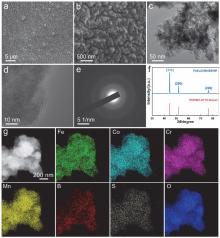
Fig 1
(a, b) SEM, (c) TEM and (d) HRTEM images of FeCoCrMnBS HEH, (e) SAED pattern of FeCoCrMnBS HEH, (f) XRD spectrum of FeCoCrMnBS/NF sample and (g) the corresponding elemental mapping images."
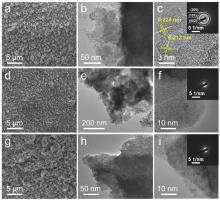
Fig 2
(a) SEM, (b) TEM and (c) HRTEM images of FeCoCrMn HEH (inset of SAED pattern), (d) SEM, (e) TEM and (f) HRTEM images of FeCoCrMnB HEH (inset of SAED pattern), (g) SEM, (h) TEM and (i) HRTEM images of FeCoCrMnS HEHs (inset of SAED pattern)."
Fig 3
XPS spectra of (a) Fe 2p, (b) Co 2p, (c) Cr 2p, (d) Mn 2p, (e) O 1s, (f) B 1s and (g) S 2p for FeCoCrMn, FeCoCrMnB, FeCoCrMnS and FeCoCrMnBS HEHs."
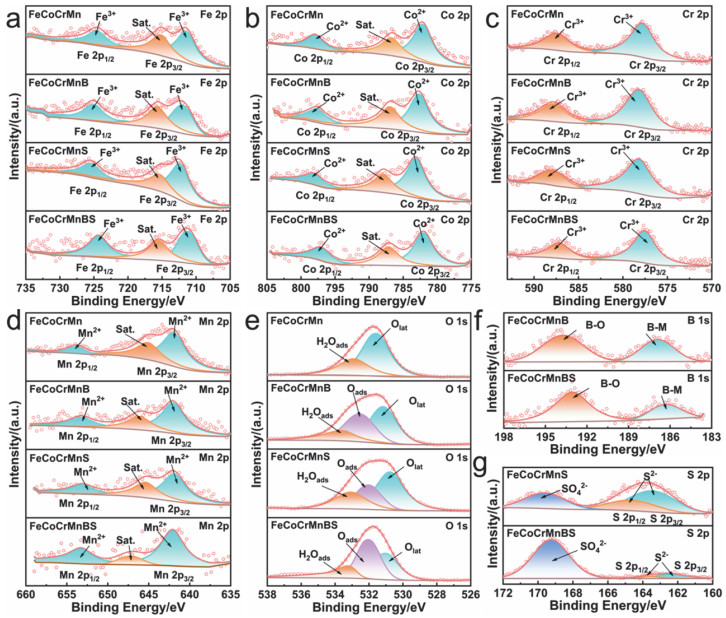
Fig 4
Electrocatalytic performance evaluation of the obtained high entropy electrocatalysts. (a) LSV curves, (b) The histograms of overpotential at different current density, (c) Tafel curves, (d) Nyquist curves, (e) Cdl values and (f) Chronopotentionetry curve of FeCoCrMnBS/NF."
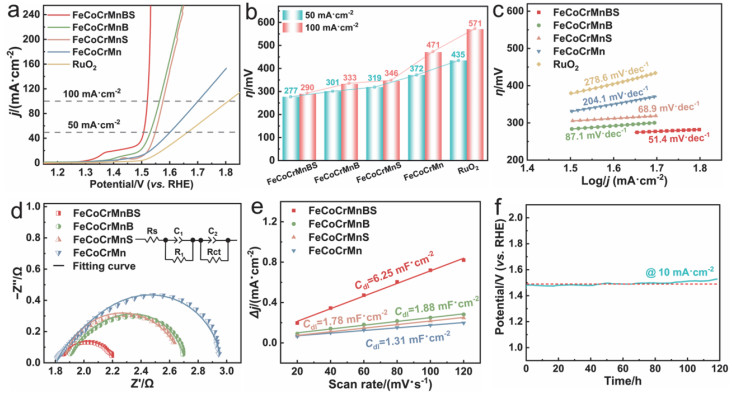
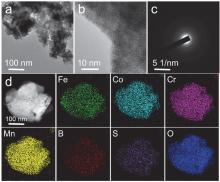
Fig 5
(a) TEM and (b) HRTEM images of FeCoCrMnBS HEH after the OER testing, (c) the corresponding SAED pattern and (d) elements mapping images."
| 1 |
doi: 10.1002/adfm.202101586 |
| 2 |
doi: 10.3390/pr11010245 |
| 3 |
doi: 10.1002/adfm.202110645 |
| 4 |
doi: 10.1063/5.0117046 |
| 5 |
doi: 10.1021/acscatal.2c02778 |
| 6 |
doi: 10.1016/j.jcis.2021.08.060 |
| 7 |
doi: 10.1021/acscatal.2c02604 |
| 8 |
doi: 10.1007/s40843-020-1461-2 |
| 9 |
doi: 10.1016/j.cej.2021.132410 |
| 10 |
doi: 10.1007/s12274-021-3802-4 |
| 11 |
doi: 10.1016/j.jmst.2021.09.003 |
| 12 |
doi: 10.1002/smll.202106127 |
| 13 |
doi: 10.1016/j.jallcom.2021.160995 |
| 14 |
doi: 10.1002/adma.202100745 |
| 15 |
doi: 10.1016/j.jallcom.2022.168582 |
| 16 |
doi: 10.1002/aenm.202002887 |
| 17 |
doi: 10.1021/acsmaterialslett.1c00762 |
| 18 |
doi: 10.1016/j.cej.2021.132883 |
| 19 |
doi: 10.1002/adfm.202208170 |
| 20 |
doi: 10.1007/s40843-024-2967-2 |
| 21 |
doi: 10.1039/D4QI00103F |
| 22 |
doi: 10.1039/D3CS00557G |
| 23 |
doi: 10.1002/smtd.202400108 |
| 24 |
doi: 10.1016/j.cej.2021.131533 |
| 25 |
doi: 10.1039/d1se02038b |
| 26 |
doi: 10.1002/adma.202302067 |
| 27 |
doi: 10.1002/adfm.202304963 |
| 28 |
doi: 10.1002/adma.202101845 |
| 29 |
doi: 10.1038/s41467-022-33846-0 |
| 30 |
doi: 10.1038/s41467-023-37751-y |
| 31 |
doi: 10.3866/PKU.WHXB202009077 |
| 32 |
doi: 10.1016/j.jpowsour.2022.231004 |
| 33 |
doi: 10.1021/acsnano.1c02775 |
| 34 |
doi: 10.1038/s41467-019-10303-z |
| 35 |
doi: 10.1126/science.aan5412 |
| 36 |
doi: 10.1038/s41467-023-41359-7 |
| 37 |
doi: 10.1007/s40843-022-2234-5 |
| 38 |
doi: 10.1039/d2dt03637a |
| 39 |
doi: 10.1002/adfm.202309438 |
| 40 |
doi: 10.1002/sstr.202300012 |
| 41 |
doi: 10.1021/acsmaterialslett.9b00414 |
| 42 |
doi: 10.1016/j.cej.2021.133251 |
| 43 |
doi: 10.1016/j.susmat.2022.e00455 |
| 44 |
doi: 10.1007/s12598-021-01760-x |
| 45 |
doi: 10.1016/j.jallcom.2021.159064 |
| 46 |
doi: 10.1002/adfm.202101405 |
| 47 |
doi: 10.1016/j.apcatb.2023.122577 |
| 48 |
doi: 10.1016/j.apsusc.2021.149327 |
| 49 |
doi: 10.1016/j.jmst.2020.06.045 |
| 50 |
doi: 10.1002/adfm.202106229 |
| 51 |
doi: 10.3866/pku.Whxb202212025 |
| 52 |
doi: 10.1039/d2cc00696k |
| 53 |
doi: 10.1002/anie.202011097 |
| 54 |
doi: 10.1002/smll.201905779 |
| [1] | Fan Fan, Hao Xiu, Yuting Wang, Yongpeng Cui, Yajun Wang. Construction of NH2-MIL-125/Na-doped g-C3N4 composite S-scheme heterojunction and its performance in photocatalytic hydrogen peroxide production [J]. Acta Phys. -Chim. Sin., 2026, 42(2): 100143-. |
| [2] | Yun Chen, Daijie Deng, Li Xu, Xingwang Zhu, Henan Li, Chengming Sun. Covalent bond modulation of charge transfer for sensitive heavy metal ion analysis in a self-powered electrochemical sensing platform [J]. Acta Phys. -Chim. Sin., 2026, 42(1): 100144-. |
| [3] | Sumiya Akter Dristy, Md Ahasan Habib, Shusen Lin, Mehedi Hasan Joni, Rutuja Mandavkar, Young-Uk Chung, Md Najibullah, Jihoon Lee. Exploring Zn doped NiBP microspheres as efficient and stable electrocatalyst for industrial-scale water splitting [J]. Acta Phys. -Chim. Sin., 2025, 41(7): 100079-. |
| [4] | Xianghai Song, Xiaoying Liu, Zhixiang Ren, Xiang Liu, Mei Wang, Yuanfeng Wu, Weiqiang Zhou, Zhi Zhu, Pengwei Huo. Insights into the greatly improved catalytic performance of N-doped BiOBr for CO2 photoreduction [J]. Acta Phys. -Chim. Sin., 2025, 41(6): 100055-. |
| [5] | Xinyu Xu, Jiale Lu, Bo Su, Jiayi Chen, Xiong Chen, Sibo Wang. Steering charge dynamics and surface reactivity for photocatalytic selective methane oxidation to ethane over Au/Ti-CeO2 [J]. Acta Phys. -Chim. Sin., 2025, 41(11): 100153-. |
| [6] | Wentao Xu, Xuyan Mo, Yang Zhou, Zuxian Weng, Kunling Mo, Yanhua Wu, Xinlin Jiang, Dan Li, Tangqi Lan, Huan Wen, Fuqin Zheng, Youjun Fan, Wei Chen. Bimetal Leaching Induced Reconstruction of Water Oxidation Electrocatalyst for Enhanced Activity and Stability [J]. Acta Phys. -Chim. Sin., 2024, 40(8): 2308003-. |
| [7] | Weicheng Feng, Jingcheng Yu, Yilan Yang, Yige Guo, Geng Zou, Xiaoju Liu, Zhou Chen, Kun Dong, Yuefeng Song, Guoxiong Wang, Xinhe Bao. Regulating the High Entropy Component of Double Perovskite for High-Temperature Oxygen Evolution Reaction [J]. Acta Phys. -Chim. Sin., 2024, 40(6): 2306013-. |
| [8] | Haitao Wang, Lianglang Yu, Jizhou Jiang, Arramel, Jing Zou. S-Doping of the N-Sites of g-C3N4 to Enhance Photocatalytic H2 Evolution Activity [J]. Acta Phys. -Chim. Sin., 2024, 40(5): 2305047-. |
| [9] | Huiwei Ding, Bo Peng, Zhihao Wang, Qiaofeng Han. Advances in Metal or Nonmetal Modification of Bismuth-Based Photocatalysts [J]. Acta Phys. -Chim. Sin., 2024, 40(4): 2305048-. |
| [10] | Yajuan Xing, Hui Xue, Jing Sun, Niankun Guo, Tianshan Song, Jiawen Sun, Yi-Ru Hao, Qin Wang. Cu3P-Induced Charge-Oriented Transfer and Surface Reconstruction of Ni2P to Achieve Efficient Oxygen Evolution Activity [J]. Acta Phys. -Chim. Sin., 2024, 40(3): 2304046-. |
| [11] | Wuxin Bai, Qianqian Zhou, Zhenjie Lu, Ye Song, Yongsheng Fu. Co-Ni Bimetallic Zeolitic Imidazolate Frameworks Supported on Carbon Cloth as Free-Standing Electrode for Highly Efficient Oxygen Evolution [J]. Acta Phys. -Chim. Sin., 2024, 40(3): 2305041-. |
| [12] | Fan Yang, Zheng Liu, Da Wang, KwunNam Hui, Yelong Zhang, Zhangquan Peng. Preparation and Properties of P-Bi2Te3/MXene Superstructure-based Anode for Potassium-Ion Battery [J]. Acta Phys. -Chim. Sin., 2024, 40(2): 2303006-. |
| [13] | Wencheng Fang, Dong Liu, Ying Zhang, Hao Feng, Qiang Li. Improved Photoelectrochemical Performance by Polyoxometalate-Modified CuBi2O4/Mg-CuBi2O4 Homojunction Photocathode [J]. Acta Phys. -Chim. Sin., 2024, 40(2): 2304006-. |
| [14] | Qin Hu, Liuyun Chen, Xinling Xie, Zuzeng Qin, Hongbing Ji, Tongming Su. Construction of Electron Bridge and Activation of MoS2 Inert Basal Planes by Ni Doping for Enhancing Photocatalytic Hydrogen Evolution [J]. Acta Phys. -Chim. Sin., 2024, 40(11): 2406024-. |
| [15] | Xinxuan Duan, Marshet Getaye Sendeku, Daoming Zhang, Daojin Zhou, Lijun Xu, Xueqing Gao, Aibing Chen, Yun Kuang, Xiaoming Sun. Tungsten-Doped NiFe-Layered Double Hydroxides as Efficient Oxygen Evolution Catalysts [J]. Acta Phys. -Chim. Sin., 2024, 40(1): 2303055-. |
|
||