Acta Phys. -Chim. Sin. ›› 2024, Vol. 40 ›› Issue (11): 2404030.doi: 10.3866/PKU.WHXB202404030
Special Issue: Solar fuel preparation
• ARTICLE • Previous Articles Next Articles
Construction of ZnCoP/CdLa2S4 Schottky Heterojunctions for Enhancing Photocatalytic Hydrogen Evolution
Jianyin He1, Liuyun Chen1, Xinling Xie1, Zuzeng Qin1, Hongbing Ji1,2, Tongming Su1,*( )
)
- 1 Guangxi Key Laboratory of Petrochemical Resource Processing and Process Intensification Technology, School of Chemistry and Chemical Engineering, Guangxi University, Nanning 530004, China
2 Institute of Green Petroleum Processing and Light Hydrocarbon Conversion, College of Chemical Engineering, Zhejiang University of Technology, Hangzhou 310014, China
-
Received:2024-04-19Revised:2024-05-20Accepted:2024-05-21Published:2024-10-14 -
Contact:Email: sutm@gxu.edu.cn (Tongming Su) -
Supported by:the National Natural Science Foundation of China(22208065); Guangxi Natural Science Foundation(2022GXNSFBA035483); Opening Project of Guangxi Key Laboratory of Petrochemical Resource Processing and Process Intensification Technology(2023K012); Special Funding for 'Guangxi Bagui Scholars'

Cite this article
Jianyin He, Liuyun Chen, Xinling Xie, Zuzeng Qin, Hongbing Ji, Tongming Su. Construction of ZnCoP/CdLa2S4 Schottky Heterojunctions for Enhancing Photocatalytic Hydrogen Evolution[J]. Acta Phys. -Chim. Sin. 2024, 40(11), 2404030. doi: 10.3866/PKU.WHXB202404030
share this article
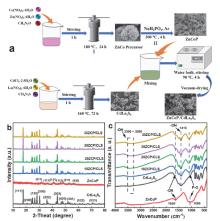
Fig 1
Schematic illustration of the synthesis of the xZCP/CLS composites (a). XRD patterns (b) and FT-IR spectra (c) of the CdLa2S4, ZnCoP, and xZCP/CLS composites."
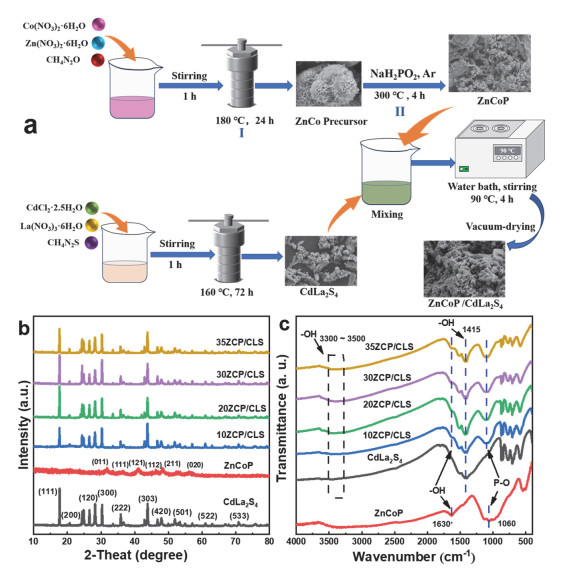
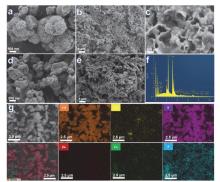
Fig 2
SEM images of the ZnCo precursor (a), ZnCoP (b, c), CdLa2S4 (d), and 30ZCP/CLS (e). EDS spectrum (f), HAADF-STEM image and corresponding EDS element mappings (g) of 30ZCP/CLS."
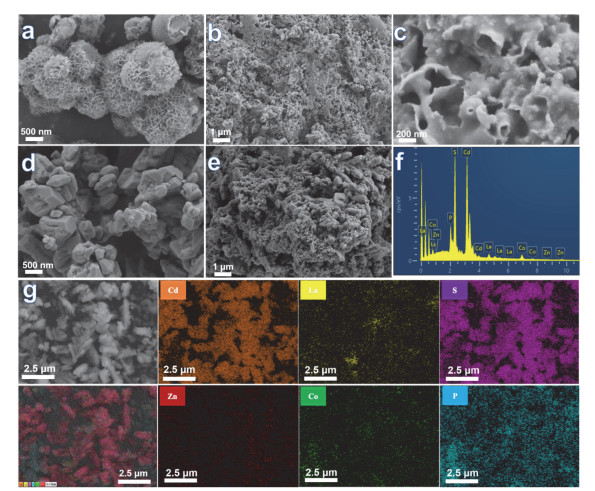
Fig 3
TEM and HRTEM images of CdLa2S4 (a, b, c), ZnCoP (d, e, f), and 30ZCP/CLS (g, h, i)."
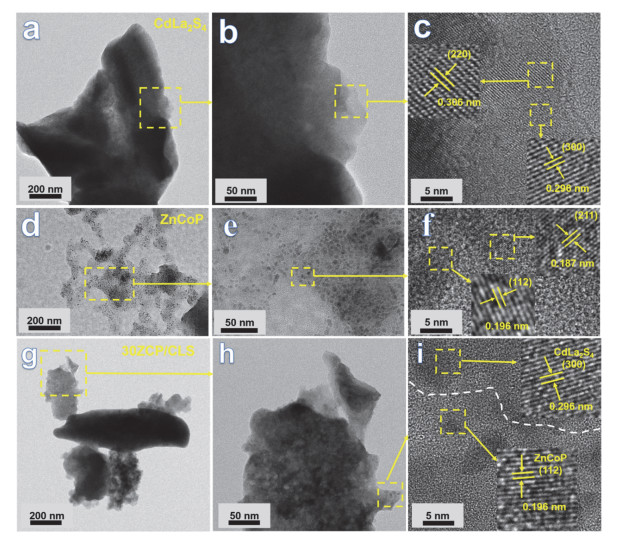
Fig 4
High-resolution XPS spectra of Cd 3d (a), La 3d (b), and S 2p (c) in CdLa2S4 and 30ZCP/CLS. High-resolution XPS spectra of Zn 2p (d), Co 2p (e), and P 2p (f) in ZnCoP and 30ZCP/CLS."
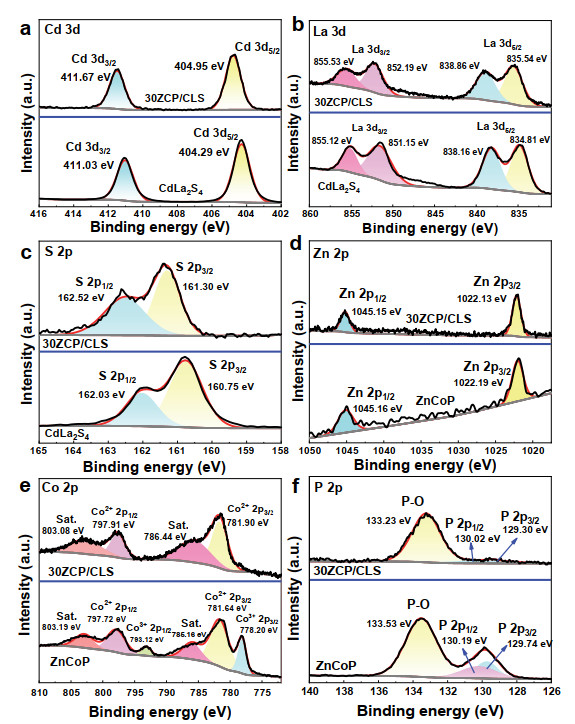
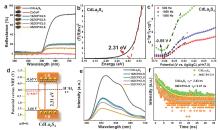
Fig 5
UV-Vis diffuse reflectance spectra of the CdLa2S4, ZnCoP and xZCP/CLS composites (a), and the band gap of CdLa2S4 determined by the Kubelka-Munk equation (b). Mott-Schottky curves of CdLa2S4 at different frequencies (c). Energy band alignment (vs. NHE, pH = 0) of CdLa2S4 (d). PL spectra of the CdLa2S4 and xZCP/CLS composites (e). Time-resolved photoluminescence (TRPL) spectra of CdLa2S4 and 30ZCP/CLS composites (f)."
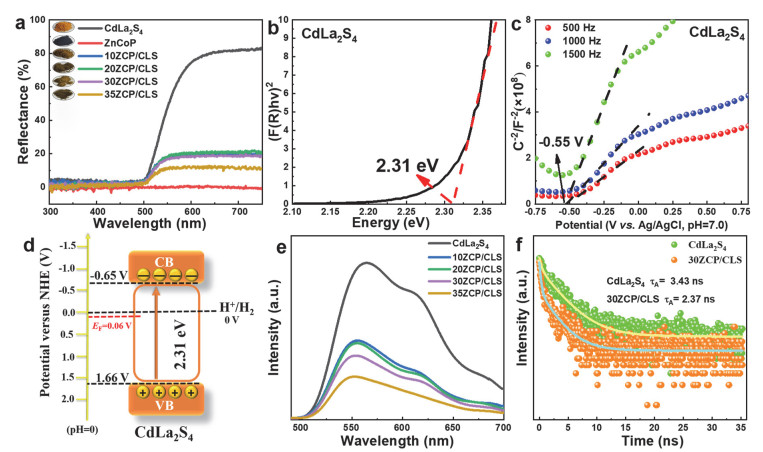
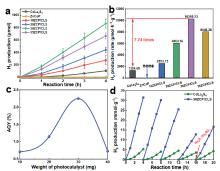
Fig 6
Time course of the photocatalytic H2 evolution performance (a) and the photocatalytic H2 production rate (b) of the CdLa2S4, ZnCoP and xZCP/CLS composites. Relationship between the AQY at 400 nm and the weight of 30ZCP/CLS (c). Cyclic experiments of photocatalytic H2 evolution over CdLa2S4 and 30ZCP/CLS (d)."
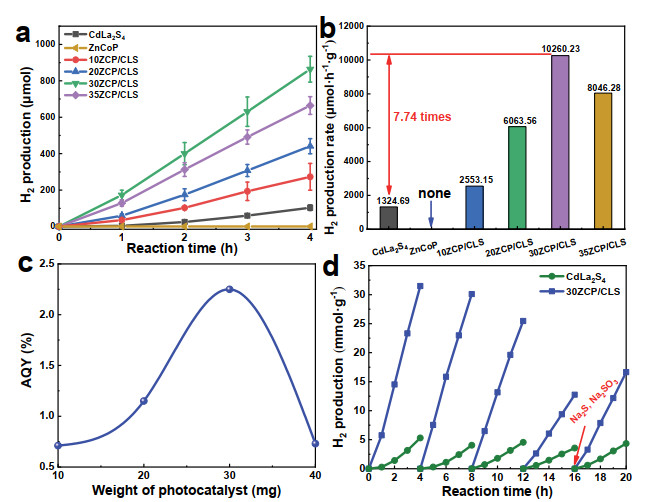
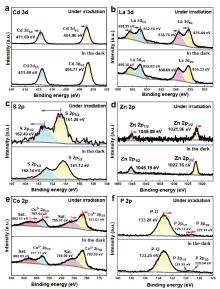
Fig 7
In situ XPS spectra of Cd 3d (a), La 3d (b), S 2p (c), Zn 2p (d), Co 2p (e), and P 2p (f) in 30ZCP/CLS before and after irradiation."
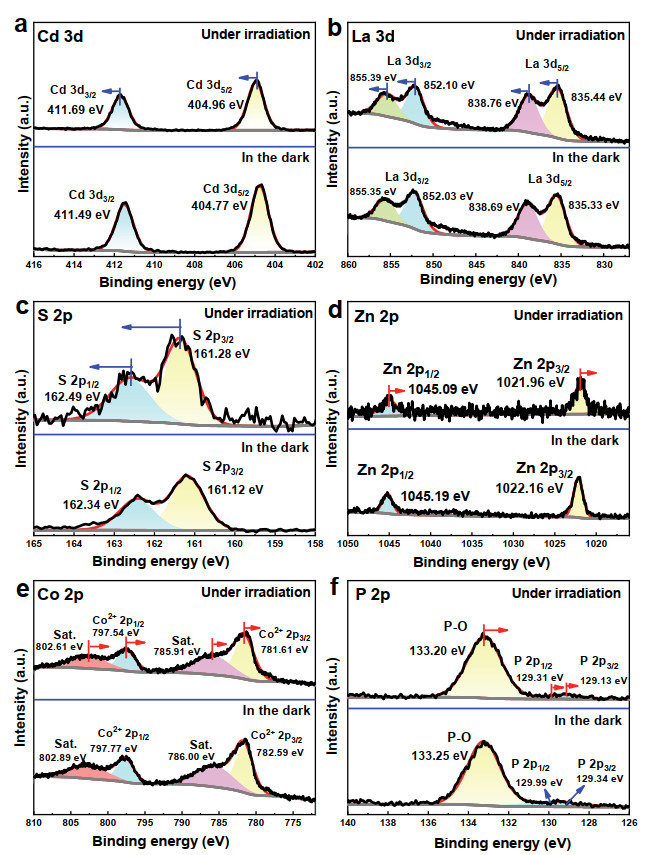
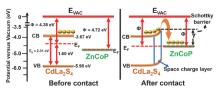
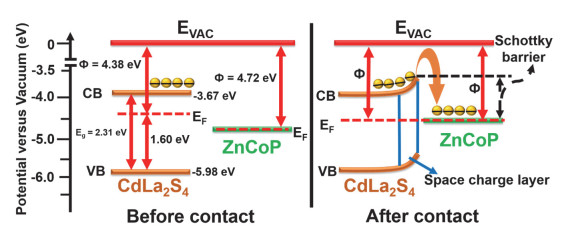
Fig 8
Band alignment of CdLa2S4 and ZnCoP before and after contact."
| 1 |
doi: 10.1021/acs.inorgchem.1c01540 |
| 2 |
doi: 10.1021/acsami.9b15578 |
| 3 |
doi: 10.3866/PKU.WHXB202005027 |
| 4 |
doi: 10.1039/d2ra00788f |
| 5 |
doi: 10.1038/natrevmats.2016.98 |
| 6 |
doi: 10.1021/acs.nanolett.0c00983 |
| 7 |
doi: 10.1021/acsanm.0c02481 |
| 8 |
doi: 10.1021/acsami.1c03240 |
| 9 |
doi: 10.1021/acsanm.9b01773 |
| 10 |
doi: 10.1021/acscatal.0c05520 |
| 11 |
doi: 10.1016/j.cej.2021.134474 |
| 12 |
doi: 10.1016/j.cjsc.2023.100145 |
| 13 |
doi: 10.1039/c9nr00168a |
| 14 |
doi: 10.1016/j.jallcom.2023.170265 |
| 15 |
doi: 10.1039/d2nj00850e |
| 16 |
doi: 10.1021/acsanm.1c03497 |
| 17 |
doi: 10.1002/adma.201702410 |
| 18 |
doi: 10.1016/j.chempr.2022.04.013 |
| 19 |
doi: 10.1038/238037a0 |
| 20 |
doi: 10.1016/j.ijhydene.2021.10.227 |
| 21 |
doi: 10.1021/acsnano.1c05834 |
| 22 |
doi: 10.1021/acssuschemeng.8b05396 |
| 23 |
doi: 10.1016/j.cej.2019.122389 |
| 24 |
doi: 10.1021/acsanm.3c01443 |
| 25 |
doi: 10.1039/c2ra21641h |
| 26 |
doi: 10.1039/c8cp00373d |
| 27 |
doi: 10.1016/j.ijhydene.2020.08.102 |
| 28 |
doi: 10.1016/j.ceramint.2021.07.199 |
| 29 |
doi: 10.1021/acs.energyfuels.1c01482 |
| 30 |
doi: 10.1021/acsami.9b04787 |
| 31 |
doi: 10.3866/PKU.WHXB202211051 |
| 32 |
doi: 10.1002/anie.202313172 |
| 33 |
doi: 10.1016/j.cej.2023.144240 |
| 34 |
doi: 10.1016/j.apcatb.2016.03.074 |
| 35 |
doi: 10.1016/j.seppur.2023.126243 |
| 36 |
doi: 10.1016/j.jmst.2022.11.001 |
| 37 |
doi: 10.1016/j.jallcom.2023.169006 |
| 38 |
doi: 10.1039/c9ce01575b |
| 39 |
doi: 10.1016/j.electacta.2020.137063 |
| 40 |
doi: 10.1016/j.cclet.2021.07.057 |
| 41 |
doi: 10.1016/j.jcis.2023.11.141 |
| 42 |
doi: 10.1016/j.mtener.2020.100412 |
| 43 |
doi: 10.1021/acsami.8b03736 |
| 44 |
doi: 10.1016/j.apcatb.2019.118379 |
| 45 |
doi: 10.1002/advs.202103715 |
| 46 |
doi: 10.1016/j.apcatb.2019.118462 |
| 47 |
doi: 10.1016/j.jcis.2023.04.146 |
| 48 |
doi: 10.1016/j.apsusc.2022.154206 |
| 49 |
doi: 10.1021/acsanm.2c03031 |
| 50 |
doi: 10.1016/j.est.2022.105402 |
| 51 |
doi: 10.1016/j.jallcom.2019.06.252 |
| 52 |
doi: 10.1021/acsnano.7b05050 |
| 53 |
doi: 10.1038/nmat4410 |
| 54 |
doi: 10.1021/acsaem.1c03019 |
| 55 |
doi: 10.1016/j.ijhydene.2018.10.200 |
| 56 |
doi: 10.1016/j.cej.2023.145173 |
| 57 |
doi: 10.1002/solr.202100863 |
| 58 |
doi: 10.3866/PKU.WHXB202201037 |
| 59 |
doi: 10.1039/c8cs00542g |
| 60 |
doi: 10.1016/j.jcis.2021.04.027 |
| 61 |
doi: 10.3866/PKU.WHXB202302051 |
| 62 |
doi: 10.1002/cssc.201701574 |
| 63 |
doi: 10.1021/acs.jpcc.8b01666 |
| 64 |
doi: 10.1038/srep29997 |
| 65 |
doi: 10.3866/PKU.WHXB202308036 |
| 66 |
doi: 10.1039/C9TA01061K |
| 67 |
doi: 10.1016/j.nanoen.2018.03.014 |
| 68 |
doi: 10.1016/j.cej.2022.139970 |
| 69 |
doi: 10.1016/j.jallcom.2022.163864 |
| 70 |
doi: 10.1002/smll.202103447 |
| 71 |
doi: 10.1016/j.mtener.2022.101164 |
| 72 |
doi: 10.3866/PKU.WHXB202304050 |
| 73 |
doi: 10.1021/acsaem.0c03168 |
| 74 |
doi: 10.1039/D2QI01665F |
| [1] | Guoqiang Peng, Xiuyan Li, Min Li, Zhibo Su, Falu Hu, Guowei Zhou. Engineering efficient metal-organic frameworks for photocatalytic CO2 reduction [J]. Acta Phys. -Chim. Sin., 2026, 42(2): 100164-. |
| [2] | Yun Chen, Daijie Deng, Li Xu, Xingwang Zhu, Henan Li, Chengming Sun. Covalent bond modulation of charge transfer for sensitive heavy metal ion analysis in a self-powered electrochemical sensing platform [J]. Acta Phys. -Chim. Sin., 2026, 42(1): 100144-. |
| [3] | Huoshuai Huang, Zhidong Wei, Jiawei Yan, Jiasheng Chi, Qianxiang Su, Mingxia Chen, Zhi Jiang, Yangzhou Sun, Wenfeng Shangguan. Unveiling the mechanism of direct-to-indirect bandgap transition in the photocatalytic hydrogen evolution of ZnxCd1−xS solid solution [J]. Acta Phys. -Chim. Sin., 2026, 42(1): 100141-. |
| [4] | Qi Wu, Changhua Wang, Yingying Li, Xintong Zhang. Enhanced photocatalytic synthesis of H2O2 by triplet electron transfer at g-C3N4@BN van der Waals heterojunction interface [J]. Acta Phys. -Chim. Sin., 2025, 41(9): 100107-. |
| [5] | Wenlong Wang, Wentao Hao, Lang He, Jia Qiao, Ning Li, Chaoqiu Chen, Yong Qin. Bandgap and adsorption engineering of carbon dots/TiO2 S-scheme heterojunctions for enhanced photocatalytic CO2 methanation [J]. Acta Phys. -Chim. Sin., 2025, 41(9): 100116-. |
| [6] | Chao Liu, Huan Yu, Jiaming Li, Xi Yu, Zhuangzhi Yu, Yuxi Song, Feng Zhang, Qinfang Zhang, Zhigang Zou. Facile synthesis of hierarchical Ti3C2/Bi12O17Br2 Schottky heterojunction with photothermal effect for solar-driven antibiotics photodegradation [J]. Acta Phys. -Chim. Sin., 2025, 41(7): 100075-. |
| [7] | Yi Yang, Xin Zhou, Miaoli Gu, Bei Cheng, Zhen Wu, Jianjun Zhang. Femtosecond transient absorption spectroscopy investigation on ultrafast electron transfer in S-scheme ZnO/CdIn2S4 photocatalyst for H2O2 production and benzylamine oxidation [J]. Acta Phys. -Chim. Sin., 2025, 41(6): 100064-. |
| [8] | Peng Li, Yuanying Cui, Zhongliao Wang, Graham Dawson, Chunfeng Shao, Kai Dai. Efficient interfacial charge transfer of CeO2/Bi19Br3S27 S-scheme heterojunction for boosted photocatalytic CO2 reduction [J]. Acta Phys. -Chim. Sin., 2025, 41(6): 100065-. |
| [9] | Xinwan Zhao, Yue Cao, Minjun Lei, Zhiliang Jin, Tsubaki Noritatsu. Constructing S-scheme heterojunctions by integrating covalent organic frameworks with transition metal sulfides for efficient noble-metal-free photocatalytic hydrogen evolution [J]. Acta Phys. -Chim. Sin., 2025, 41(12): 100152-. |
| [10] | Yihong Shao, Rongchen Shen, Song Wang, Shijie Li, Peng Zhang, Xin Li. Composition engineering in covalent organic frameworks for tailored photocatalysis [J]. Acta Phys. -Chim. Sin., 2025, 41(12): 100176-. |
| [11] | Mian Wei, Chang Cheng, Bowen He, Bei Cheng, Kezhen Qi, Chuanbiao Bie. Inorganic-organic CdS/YBTPy S-scheme photocatalyst for efficient hydrogen production and its mechanism [J]. Acta Phys. -Chim. Sin., 2025, 41(12): 100158-. |
| [12] | Ruiyun Liu, Ping Wang, Xuefei Wang, Feng Chen, Huogen Yu. Work-function-engineered Mo 4d electronic structure modulation in Mo2C MXene cocatalyst for efficient photocatalytic H2 evolution [J]. Acta Phys. -Chim. Sin., 2025, 41(11): 100137-. |
| [13] | Jinhui Jiang, Jiaqi Sun, Yongyi Chen, Lei Zhang, Pengyu Dong. W18O49/Al-doped SrTiO3 S-scheme heterojunction aided by the LSPR effect for full-spectrum solar light-driven photocatalytic hydrogen evolution [J]. Acta Phys. -Chim. Sin., 2025, 41(11): 100145-. |
| [14] | Jiaqi Yang, Xuqiang Hao, Jiejie Jing, Yuqiang Hao, Zhiliang Jin. 3D/2D ReSe2/ZnCdS S-scheme photocatalyst with efficient interfacial charge separation for optimized hydrogen production [J]. Acta Phys. -Chim. Sin., 2025, 41(10): 100131-. |
| [15] | Yushan Cai, Fang-Xing Xiao. Revisiting MXenes-based Photocatalysis Landscape: Progress, Challenges, and Future Perspectives [J]. Acta Phys. -Chim. Sin., 2024, 40(8): 2306048-. |
|
||