Acta Phys. -Chim. Sin. ›› 2024, Vol. 40 ›› Issue (11): 2406005.doi: 10.3866/PKU.WHXB202406005
Special Issue: Solar fuel preparation
• ARTICLE • Previous Articles Next Articles
Simultaneously Improving Inter-Plane Crystallization and Incorporating K Atoms in g-C3N4 Photocatalyst for Highly-Efficient H2O2 Photosynthesis
Wei Zhong, Dan Zheng, Yuanxin Ou, Aiyun Meng*( ), Yaorong Su*()
- College of New Materials and New Energies, Shenzhen Technology University, Shenzhen 518118, Guangdong Province, China
-
Received:2024-06-05Revised:2024-07-16Accepted:2024-07-17Published:2024-10-14 -
Contact:Email: mengaiyun@sztu.edu.cn (Aiyun Meng)suyaorong@sztu.edu.cn; Tel: +86-755-2325-6080 (Yaorong Su) -
Supported by:the National Natural Science Foundation of China(22178224); the National Natural Science Foundation of China(22272110); Guangdong Basic and Applied Basic Research Foundation(2023A1515110535); Guangdong Basic and Applied Basic Research Foundation(2020A1515110873); Shenzhen Science and Technology Program(RCBS20231211090522041); the Fundamental Research Funds for Shenzhen Technology University(20211063010047); Shenzhen Key Laboratory of Applied Technologies of Super-Diamond and Functional Crystals(ZDSYS20230626091303007); Shenzhen Science and Technology Program(20231127203830001)

Cite this article
Wei Zhong, Dan Zheng, Yuanxin Ou, Aiyun Meng, Yaorong Su. Simultaneously Improving Inter-Plane Crystallization and Incorporating K Atoms in g-C3N4 Photocatalyst for Highly-Efficient H2O2 Photosynthesis[J]. Acta Phys. -Chim. Sin. 2024, 40(11), 2406005. doi: 10.3866/PKU.WHXB202406005
share this article
Fig 1
(a) Synthesis process of the K-incorporated highly crystalline g-C3N4 photocatalyst, SEM images of (b) CN and (c) CN-K(1:6), (d) TEM and (e) HRTEM images of CN-K(1:6). The violet, green, bright yellow, and white spheres are represented C, N, K, and H atoms, respectively."
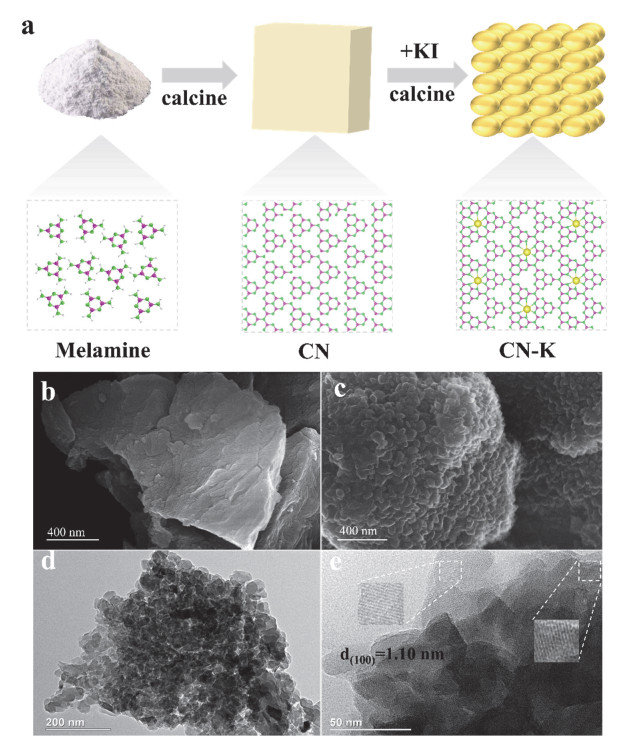
Fig 2
(a, b) XRD data and (c) FT-IR spectra of the synthesized samples; XPS spectra of CN and CN-K(1:6): (d) Full survey, (e) C 1s and K 2p, (f) N 1s."
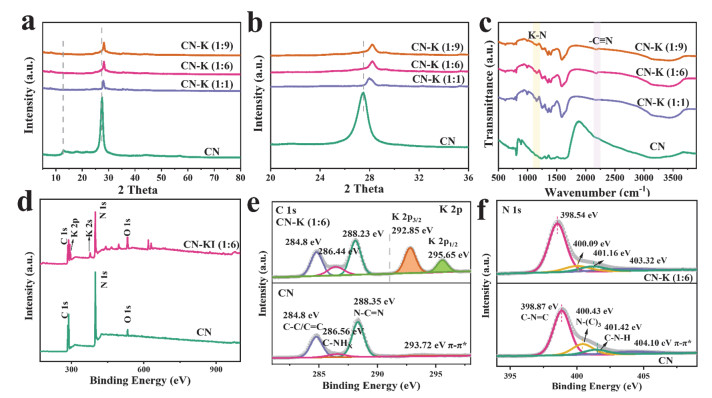
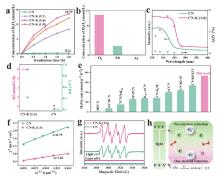
Fig 3
(a) Photocatalytic H2O2-production rates for the synthesized photocatalysts. (b) The H2O2 production rates of CN-K(1:6) photocatalyst under different condition. (c) Wavelength dependence of the apparent quantum yield for CN and CN-K(1:6) samples. (d) The H2O2 formation (Kf) and the decomposition (Kd) values for CN and CN-K(1:6) photocatalysts. (e) Systematic comparison of the H2O2 generation performance for g-C3N4-based photocatalysts. (f) Koutecky-Levich plots of CN and CN-K(1:6) samples. (g) EPR spectra of DMPO-O2− radicals for CN and CN-K(1:6) samples. (h) Proposed H2O2 production mechanism via 2e−-ORR process."
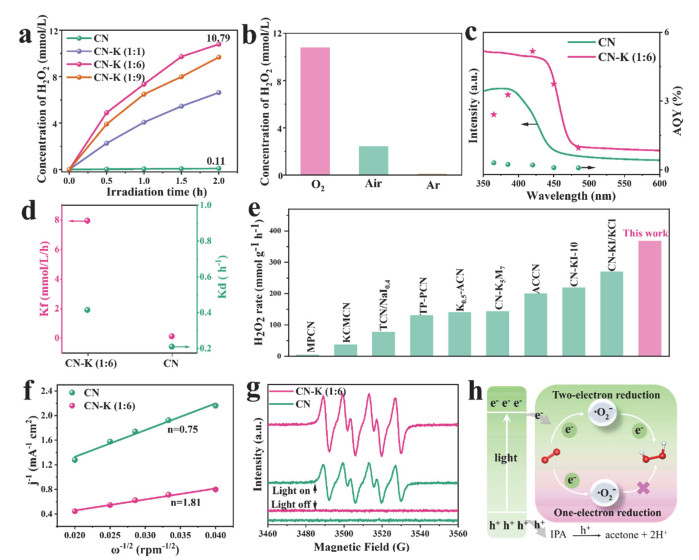
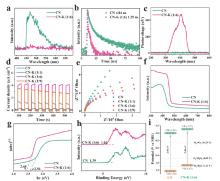
Fig 4
(a) PL, (b) TRPL, (c) SPV, (d) transient photocurrent responses, (e) electrochemical impedance spectra, (f) UV-Vis data, (g) Kubelka-Munk function vs. photon energy, (h) XPS valence band spectra, and (i) band structure alignments for the CN and CN-K(1:6) photocatalysts."
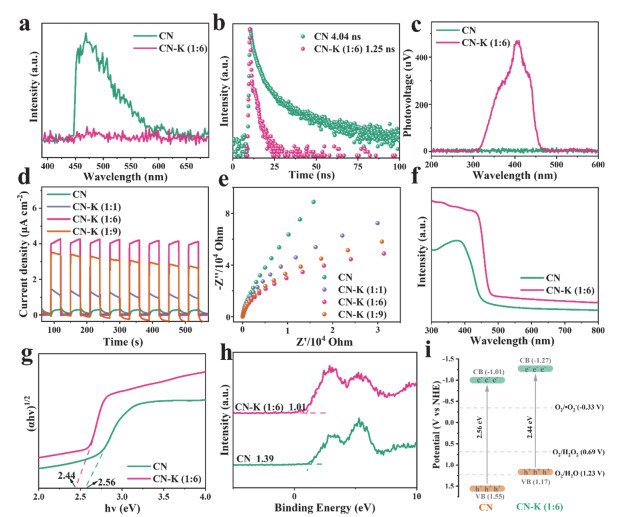
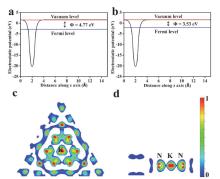
Fig 5
The calculated electrostatic potentials of (a) pristine CN and (b) CN-K(1:6) structures. Electronic location function (ELF) analysis of CN-K(1:6) structure for (c) top view and (d) side view."
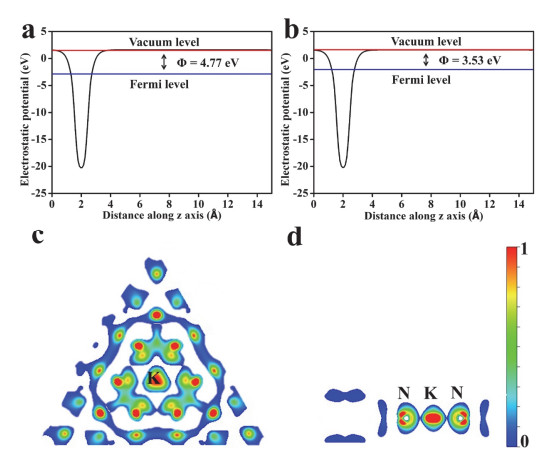
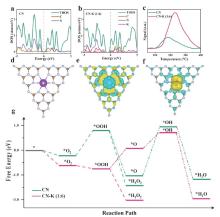
Fig 6
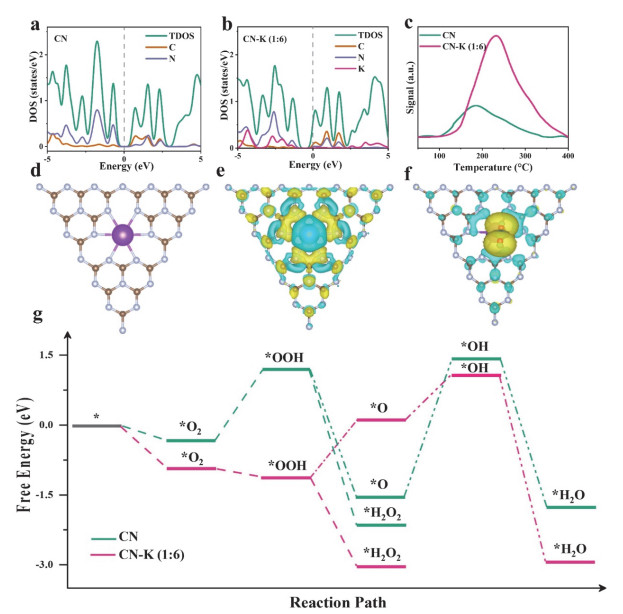
The density of states for (a) CN and (b) CN-K (1:6). (c) O2-TPD signal of CN and CN-K (1:6). (d) The optimized structure of CN-K(1:6) and the charge density differences (e) before and (f) after O2 adsorption. (g) Calculated free energy diagrams for 2e−-ORR (H2O2 evolution) and 4e−-ORR (H2O production) of the CN and CN-K structures. Blue and yellow regions represent electron depletion and accumulation, respectively. The gray, yellow, purple, and red spheres are represented as N, C, K and O atoms, respectively."
| 1 |
doi: 10.1038/s41467-024-47624-7 |
| 2 |
doi: 10.1007/s12274-021-3882-1 |
| 3 |
doi: 10.3866/PKU.WHXB202212010 |
| 4 |
doi: 10.1021/acs.jpclett.3c00811 |
| 5 |
doi: 10.1007/s40843-023-2717-0 |
| 6 |
doi: 10.1016/j.jmst.2022.09.002 |
| 7 |
doi: 10.1016/j.apcatb.2023.123340 |
| 8 |
doi: 10.3866/PKU.WHXB202307022 |
| 9 |
doi: 10.1038/s41467-020-20823-8 |
| 10 |
doi: 10.1002/adsu.202200113 |
| 11 |
doi: 10.3866/PKU.WHXB202201008 |
| 12 |
doi: 10.1007/s40843-023-2755-2 |
| 13 |
doi: 10.3866/PKU.WHXB202212026 |
| 14 |
doi: 10.1016/S1872-2067(23)64514-0 |
| 15 |
doi: 10.3866/PKU.WHXB202209016 |
| 16 |
doi: 10.1016/j.jmst.2023.03.045 |
| 17 |
doi: 10.1002/adfm.202205119 |
| 18 |
doi: 10.1002/adfm.202315426 |
| 19 |
doi: 10.1002/adma.202203225 |
| 20 |
doi: 10.1016/j.jmst.2023.03.054 |
| 21 |
doi: 10.1002/adma.202310600 |
| 22 |
doi: 10.3866/PKU.WHXB202301001 |
| 23 |
doi: 10.1002/anie.202310847 |
| 24 |
doi: 10.1016/j.jmst.2023.05.030 |
| 25 |
doi: 10.1016/j.cej.2022.135999 |
| 26 |
doi: 10.1039/D3EE03032F |
| 27 |
doi: 10.1016/j.cej.2022.138489 |
| 28 |
doi: 10.1016/j.jmst.2024.02.048 |
| 29 |
doi: 10.3866/PKU.WHXB202209037 |
| 30 |
doi: 10.1016/j.nanoen.2023.108917 |
| 31 |
doi: 10.1002/adfm.202105731 |
| 32 |
doi: 10.1021/acscatal.3c05360 |
| 33 |
doi: 10.1007/s42765-023-00354-9 |
| 34 |
doi: 10.1016/S1872‐2067(24)60008‐2 |
| 35 |
doi: 10.1016/j.cej.2021.132032 |
| 36 |
doi: 10.1021/acssuschemeng.3c00230 |
| 37 |
doi: 10.1016/S1872-2067(22)64111-1 |
| 38 |
doi: 10.1016/j.apcatb.2020.118970 |
| 39 |
doi: 10.1016/j.apcatb.2022.121099 |
| 40 |
doi: 10.1039/d1ee02369a |
| 41 |
doi: 10.1038/s41929-021-00605-1 |
| 42 |
doi: 10.1016/j.efmat.2023.01.001 |
| 43 |
doi: 10.1002/smll.202303813 |
| 44 |
doi: 10.1073/pnas.2215305120 |
| 45 |
doi: 10.1016/j.cej.2023.143379 |
| 46 |
doi: 10.1016/j.jcat.2022.08.030 |
| 47 |
doi: 10.1016/j.jallcom.2023.169663 |
| 48 |
doi: 10.1021/acscatal.0c03359 |
| 49 |
doi: 10.1002/anie.202111769 |
| 50 |
doi: 10.1016/j.jcat.2023.115180 |
| 51 |
doi: 10.3866/PKU.WHXB202110049 |
| 52 |
doi: 10.1016/j.apcatb.2020.119817 |
| 53 |
doi: 10.3866/PKU.WHXB202108028 |
| 54 |
doi: 10.1002/smll.202303960 |
| 55 |
doi: 10.1002/adfm.202302325 |
| 56 |
doi: 10.1021/acscatal.2c04042 |
| 57 |
doi: 10.1021/acscatal.2c00233 |
| 58 |
doi: 10.1002/adma.202101455 |
| 59 |
doi: 10.1002/anie.202304559 |
| 60 |
doi: 10.1039/D3TA00196B |
| 61 |
doi: 10.1016/s1872-2067(23)64491-2 |
| 62 |
doi: 10.1002/adma.202400288 |
| [1] | Fan Fan, Hao Xiu, Yuting Wang, Yongpeng Cui, Yajun Wang. Construction of NH2-MIL-125/Na-doped g-C3N4 composite S-scheme heterojunction and its performance in photocatalytic hydrogen peroxide production [J]. Acta Phys. -Chim. Sin., 2026, 42(2): 100143-. |
| [2] | Yun Chen, Daijie Deng, Li Xu, Xingwang Zhu, Henan Li, Chengming Sun. Covalent bond modulation of charge transfer for sensitive heavy metal ion analysis in a self-powered electrochemical sensing platform [J]. Acta Phys. -Chim. Sin., 2026, 42(1): 100144-. |
| [3] | Fanpeng Meng, Fei Zhao, Jingkai Lin, Jinsheng Zhao, Huayang Zhang, Shaobin Wang. Optimizing interfacial electric fields in carbon nitride nanosheet/spherical conjugated polymer S-scheme heterojunction for hydrogen evolution [J]. Acta Phys. -Chim. Sin., 2025, 41(8): 100095-. |
| [4] | Jingzhao Cheng, Shiyu Gao, Bei Cheng, Kai Yang, Wang Wang, Shaowen Cao. Construction of 4-Amino-1H-imidazole-5-carbonitrile Modified Carbon Nitride-Based Donor-Acceptor Photocatalyst for Efficient Photocatalytic Hydrogen Evolution [J]. Acta Phys. -Chim. Sin., 2024, 40(11): 2406026-. |
| [5] | Tao Sun, Chenxi Li, Yupeng Bao, Jun Fan, Enzhou Liu. S-Scheme MnCo2S4/g-C3N4 Heterojunction Photocatalyst for H2 Production [J]. Acta Phys. -Chim. Sin., 2023, 39(6): 2212009-. |
| [6] | Cheng Luo, Qing Long, Bei Cheng, Bicheng Zhu, Linxi Wang. A DFT Study on S-Scheme Heterojunction Consisting of Pt Single Atom Loaded G-C3N4 and BiOCl for Photocatalytic CO2 Reduction [J]. Acta Phys. -Chim. Sin., 2023, 39(6): 2212026-. |
| [7] | Yue Huang, Feifei Mei, Jinfeng Zhang, Kai Dai, Graham Dawson. Construction of 1D/2D W18O49/Porous g-C3N4 S-Scheme Heterojunction with Enhanced Photocatalytic H2 Evolution [J]. Acta Phys. -Chim. Sin., 2022, 38(7): 2108028-. |
| [8] | Rongchen Shen, Lei Hao, Qing Chen, Qiaoqing Zheng, Peng Zhang, Xin Li. P-Doped g-C3N4 Nanosheets with Highly Dispersed Co0.2Ni1.6Fe0.2P Cocatalyst for Efficient Photocatalytic Hydrogen Evolution [J]. Acta Phys. -Chim. Sin., 2022, 38(7): 2110014-. |
| [9] | Zhicong Sun, Ergui Luo, Qinglei Meng, Xian Wang, Junjie Ge, Changpeng Liu, Wei Xing. High-Performance Palladium-Based Catalyst Boosted by Thin-Layered Carbon Nitride for Hydrogen Generation from Formic Acid [J]. Acta Phys. -Chim. Sin., 2022, 38(3): 2003035-. |
| [10] | Kaining Li, Mengxi Zhang, Xiaoyu Ou, Ruina Li, Qin Li, Jiajie Fan, Kangle Lv. Strategies for the Fabrication of 2D Carbon Nitride Nanosheets [J]. Acta Phys. -Chim. Sin., 2021, 37(8): 2008010-. |
| [11] | Wei Wang, Yu Huang, Zhenyu Wang. Defect Engineering in Two-Dimensional Graphitic Carbon Nitride and Application to Photocatalytic Air Purification [J]. Acta Phys. -Chim. Sin., 2021, 37(8): 2011073-. |
| [12] | Xingang Fei, Haiyan Tan, Bei Cheng, Bicheng Zhu, Liuyang Zhang. 2D/2D Black Phosphorus/g-C3N4 S-Scheme Heterojunction Photocatalysts for CO2 Reduction Investigated using DFT Calculations [J]. Acta Phys. -Chim. Sin., 2021, 37(6): 2010027-. |
| [13] | Juanjuan Huang,Jianmei Du,Haiwei Du,Gengsheng Xu,Yupeng Yuan. Control of Nitrogen Vacancy in g-C3N4 by Heat Treatment in an Ammonia Atmosphere for Enhanced Photocatalytic Hydrogen Generation [J]. Acta Physico-Chimica Sinica, 2020, 36(7): 1905056-. |
| [14] | Yiqing Wang,Shaohua Shen. Progress and Prospects of Non-Metal Doped Graphitic Carbon Nitride for Improved Photocatalytic Performances [J]. Acta Physico-Chimica Sinica, 2020, 36(3): 1905080-. |
| [15] | Dandan CAO, Rong LÜ, Anchi YU. Preparation and Characterization of Carbon Nitride Film with High Optical Quality [J]. Acta Physico-Chimica Sinica, 2019, 35(4): 442-450. |
|
||