Acta Phys. -Chim. Sin. ›› 2024, Vol. 40 ›› Issue (1): 2304004.doi: 10.3866/PKU.WHXB202304004
Special Issue: Multi-Physical Fields Driven Catalysis for Energy Conversion
• REVIEW • Previous Articles Next Articles
Silicon Nanostructure Arrays: An Emerging Platform for Photothermal CO2 Catalysis
Chengcheng Zhang1,2, Zhiyi Wu2, Jiahui Shen2, Le He2,*( ), Wei Sun1,*()
- 1 State Key Laboratory of Silicon Materials, School of Materials Science and Engineering, Zhejiang University, Hangzhou 310027, China
2 Institute of Functional Nano & Soft Materials (FUNSOM), Jiangsu Key Laboratory of Advanced Negative Carbon Technologies, Soochow University, Suzhou 215123, Jiangsu Province, China
-
Received:2023-04-03Revised:2023-05-05Accepted:2023-05-08Published:2023-08-21 -
Contact:Email: sunnyway423@zju.edu.cn; Tel.: +86-571-87951667 (Wei Sun)lehe@suda.edu.cn (Le He) -
Supported by:the National Key R & D Program of China(2021YFF0502000); the National Natural Science Foundation of China(61721005); the National Natural Science Foundation of China(52172221); the National Natural Science Foundation of China(51920105005); the U of T-ZJU Joint Seed Fund, China; the Fundamental Research Funds for the Central Universities, China(226-2022-00159); the U of T-ZJU Joint Seed Fund, China, the Fundamental Research Funds for the Central Universities, China(226-2022-00200); the National Postdoctoral Program for Innovative Talents, China(BX20220222); the China Postdoctoral Science Foundation(2021M702388); Jiangsu Funding Program for Excellent Postdoctoral Talent(2022ZB564); the Natural Science Foundation of Jiangsu Province, China(BK20200101); Suzhou Key Laboratory of Functional Nano & Soft Materials, Collaborative Innovation Center of Suzhou Nano Science & Technology; the 111 Project, Soochow University-Western University Centre for Synchrotron Radiation Research

Cite this article
Chengcheng Zhang, Zhiyi Wu, Jiahui Shen, Le He, Wei Sun. Silicon Nanostructure Arrays: An Emerging Platform for Photothermal CO2 Catalysis[J]. Acta Phys. -Chim. Sin. 2024, 40(1), 2304004. doi: 10.3866/PKU.WHXB202304004
share this article
"
"
"
"
"
"
"
"
"
"
| Catalyst | Light source | H2 : CO2 | RCO2 (mol∙gcat −1∙h−1) | Reference |
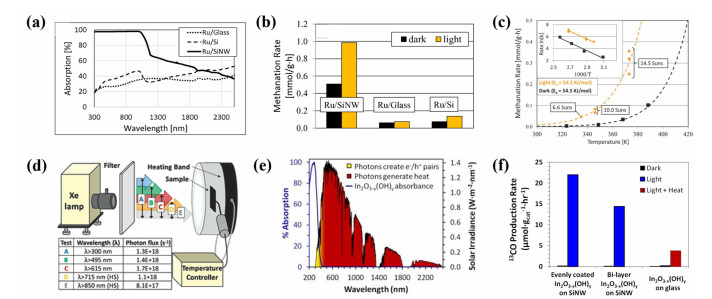
| Ru/SiNW | 300 W Xe light (0.32 W∙cm−2) | 4 : 1 | 1.1 × 10⁻⁴ | |
| In2O3−x(OH)y/SiNW | 300 W Xe light (2.0 W∙cm−2) | 1 : 1 | 2.2 × 10⁻⁵ | |
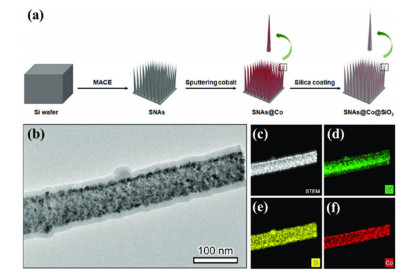
| SNAs@Co | 300 W Xe light (2.5 W∙cm−2) | 1 : 1 | 4.3 × 10⁻¹ | |
| SiNCs@Co | 300 W Xe light (2.5 W∙cm−2) | 1 : 1 | 1.78 | |
| ncRuO2/i-Si-o | 300 W Xe light (2.2 W∙cm−2) | 4 : 1 | 4.4 × 10⁻³ | |
| Ru/i-Si-o | 300 W Xe light (2.5 W∙cm−2) | 4 : 1 | 2.8 × 10⁻³ | |
| Co@SiO2-array | 300 W Xe light (2.4 W∙cm−2) | 1 : 1 | 4.1 × 10⁻² | |
| Co-PS@SiO2 | 300 W Xe light (2.5 W∙cm−2) | 1 : 1 | 0.60 |
| 1 |
doi: 10.1126/science.aaf1835 |
| 2 |
doi: 10.1002/anie.201900781 |
| 3 |
doi: 10.1021/acscatal.9b00862 |
| 4 |
doi: 10.1039/C3EE41272E |
| 5 |
doi: 10.1002/anie.201907443 |
| 6 |
doi: 10.1016/j.joule.2018.08.016 |
| 7 |
doi: 10.1039/C8CS00829A |
| 8 |
doi: 10.1039/c6cs00306k |
| 9 |
doi: 10.1021/acs.chemrev.8b00400 |
| 10 |
doi: 10.1002/anie.202015756 |
| 11 |
doi: 10.1039/C8TA12427B |
| 12 |
doi: 10.1038/238037a0 |
| 13 |
doi: 10.1002/adma.201400087 |
| 14 |
doi: 10.1038/nenergy.2016.126 |
| 15 |
doi: 10.1126/science.1200488 |
| 16 |
|
|
全泉; 谢顺吉; 王野; 徐艺军; 物理化学学报, 2017, 33, 2404.
doi: 10.3866/PKU.WHXB201706263 |
|
| 17 |
doi: 10.1016/j.apsusc.2015.03.050 |
| 18 |
doi: 10.1002/adma.201600305 |
| 19 |
doi: 10.1002/anie.201809984 |
| 20 |
doi: 10.1002/adma.201102752 |
| 21 |
doi: 10.1039/C8EE02790K |
| 22 |
doi: 10.1039/C7MH01064H |
| 23 |
doi: 10.1038/nature11475 |
| 24 |
doi: 10.1002/advs.202103926 |
| 25 |
doi: 10.1039/d0cs00357c |
| 26 |
doi: 10.1016/j.gee.2017.06.003 |
| 27 |
doi: 10.1039/D1CS00782C |
| 28 |
doi: 10.1021/acsnano.6b02346 |
| 29 |
doi: 10.1016/j.cclet.2022.04.018 |
| 30 |
doi: 10.1016/j.joule.2017.07.015 |
| 31 |
doi: 10.1038/s41929-018-0199-x |
| 32 |
doi: 10.1021/acsnano.2c09025 |
| 33 |
doi: 10.1002/anie.201404953 |
| 34 |
doi: 10.1098/rsfs.2014.0084 |
| 35 |
doi: 10.1021/acs.iecr.7b03173 |
| 36 |
doi: 10.1016/j.rser.2013.08.050 |
| 37 |
doi: 10.1016/j.ijhydene.2010.04.040 |
| 38 |
doi: 10.1016/j.cej.2021.129989 |
| 39 |
doi: 10.1002/adfm.202204056 |
| 40 |
doi: 10.1002/advs.201700252 |
| 41 |
doi: 10.1002/aenm.202201009 |
| 42 |
doi: 10.1007/s12274-021-3436-6 |
| 43 |
doi: 10.1016/j.nanoen.2022.107723 |
| 44 |
doi: 10.1126/science.285.5428.692 |
| 45 |
doi: 10.1038/s41578-022-00423-2 |
| 46 |
doi: 10.1038/35104607 |
| 47 |
doi: 10.1016/j.checat.2022.06.001 |
| 48 |
doi: 10.1038/nmat3008 |
| 49 |
doi: 10.1021/ja501513t |
| 50 |
doi: 10.1038/ncomms11335 |
| 51 |
doi: 10.1021/ja908085c |
| 52 |
doi: 10.1038/s41467-022-33029-x |
| 53 |
|
|
王中辽; 汪静; 张金锋; 代凯; 物理化学学报, 2023, 39, 2209037.
doi: 10.3866/PKU.WHXB202209037 |
|
| 54 |
doi: 10.1002/smll.202006530 |
| 55 |
doi: 10.1016/j.nantod.2017.10.013 |
| 56 |
doi: 10.1002/adma.200306185 |
| 57 |
doi: 10.1016/j.bios.2013.10.048 |
| 58 |
doi: 10.1021/nl3026955 |
| 59 |
doi: 10.1002/adma.201002410 |
| 60 |
doi: 10.1021/am1010354 |
| 61 |
doi: 10.1063/1.2357642 |
| 62 |
doi: 10.1007/s40242-022-2039-4 |
| 63 |
doi: 10.1016/j.joule.2019.03.003 |
| 64 |
doi: 10.1002/solr.202200493 |
| 65 |
doi: 10.1038/s41467-021-24912-0 |
| 66 |
doi: 10.1016/j.apcatb.2021.120157 |
| 67 |
doi: 10.1038/s41467-020-18944-1 |
| 68 |
doi: 10.1016/j.apcatb.2021.120551 |
| 69 |
doi: 10.1007/s12274-022-4795-3 |
| 70 |
doi: 10.1039/d0cs00357c |
| 71 |
doi: 10.1016/j.checat.2021.10.005 |
| 72 |
doi: 10.1016/j.checat.2021.01.003 |
| 73 |
doi: 10.1016/j.chempr.2018.06.015 |
| 74 |
doi: 10.1002/smll.202007025 |
| 75 |
doi: 10.1021/acsnano.1c00990 |
| 76 |
doi: 10.1038/s41560-021-00867-w |
| 77 |
doi: 10.1016/j.apcatb.2022.121063 |
| 78 |
doi: 10.1016/j.chempr.2019.07.021 |
| 79 |
doi: 10.1002/aenm.202202459 |
| 80 |
doi: 10.1002/adma.201900509 |
| 81 |
doi: 10.1002/cctc.201802081 |
| 82 |
doi: 10.1016/j.apcatb.2022.121734 |
| 83 |
doi: 10.1038/s41467-022-30958-5 |
| 84 |
doi: 10.1002/adma.201903915 |
| 85 |
doi: 10.1038/s41467-020-16336-z |
| 86 |
doi: 10.1002/asia.202200993 |
| 87 |
doi: 10.1002/adma.202108727 |
| 88 |
doi: 10.1063/1.3231438 |
| 89 |
doi: 10.1002/solr.202100596 |
| 90 |
doi: 10.1016/j.isci.2023.106317 |
| 91 |
doi: 10.1039/D2MA00984F |
| 92 |
doi: 10.1002/cnma.201600151 |
| 93 |
doi: 10.1039/C9FD00104B |
| 94 |
doi: 10.1039/c5ee03380b |
| 95 |
doi: 10.1126/science.1180783 |
| 96 |
doi: 10.1021/nl203564s |
| 97 |
doi: 10.1002/anie.201411200 |
| 98 |
doi: 10.1038/s41467-019-10464-x |
| 99 |
doi: 10.1039/D2NR05140K |
| 100 |
doi: 10.1038/nnano.2013.271 |
| 101 |
doi: 10.1002/advs.201400001 |
| 102 |
doi: 10.1021/acsnano.6b05416 |
| 103 |
doi: 10.1002/solr.202000387 |
| 104 |
doi: 10.1039/d2nr02680e |
| 105 |
doi: 10.1021/ja800288f |
| 106 |
doi: 10.1021/acs.jpclett.5b01353 |
| 107 |
doi: 10.1002/aenm.201702277 |
| 108 |
doi: 10.1039/c8ee02347f |
| 109 |
doi: 10.1002/adma.202000014 |
| 110 |
doi: 10.1002/advs.202000310 |
| 111 |
doi: 10.1007/s10853 |
| 112 |
doi: 10.1021/cr050172k |
| 113 |
doi: 10.1039/D2CC02658A |
| 114 |
doi: 10.1016/j.xcrp.2021.100371 |
| 115 |
doi: 10.1126/science.1136494 |
| 116 |
doi: 10.1038/srep41418 |
| 117 |
doi: 10.1021/acsnano.2c10707 |
| 118 |
doi: 10.3390/chemistry5010036 |
| 119 |
doi: 10.1002/advs.202104972 |
| 120 |
doi: 10.1021/jacs.7b05362 |
| 121 |
|
|
宋千伟; 何观朝; 费慧龙; 物理化学学报, 2023, 39, 2212038.
doi: 10.3866/PKU.WHXB202212038 |
|
| 122 |
doi: 10.1016/j.cej.2020.124382 |
| 123 |
doi: 10.1039/D0TA06022D |
| 124 |
doi: 10.1021/acs.chemrev.7b00430 |
| 125 |
doi: 10.1038/s41563-020-00858-4 |
| 126 |
doi: 10.1021/acscatal.2c00926 |
| 127 |
doi: 10.1016/j.checat.2022.01.017 |
| [1] | Guoqiang Peng, Xiuyan Li, Min Li, Zhibo Su, Falu Hu, Guowei Zhou. Engineering efficient metal-organic frameworks for photocatalytic CO2 reduction [J]. Acta Phys. -Chim. Sin., 2026, 42(2): 100164-. |
| [2] | Jianan Hong, Chenyu Xu, Yan Liu, Changqi Li, Menglin Wang, Yanwei Zhang. Decoding the interfacial competition between hydrogen evolution and CO2 reduction via edge-active-site modulation in photothermal catalysis [J]. Acta Phys. -Chim. Sin., 2025, 41(9): 100099-. |
| [3] | Jiaxing Cai, Wendi Xu, Haoqiang Chi, Qian Liu, Wa Gao, Li Shi, Jingxiang Low, Zhigang Zou, Yong Zhou. Highly Efficient InOOH/ZnIn2S4 Hollow Sphere S-Scheme Heterojunction with 0D/2D Interface for Enhancing Photocatalytic CO2 Conversion [J]. Acta Phys. -Chim. Sin., 2024, 40(11): 2407002-. |
| [4] | Xiutao Xu, Chunfeng Shao, Jinfeng Zhang, Zhongliao Wang, Kai Dai. Rational Design of S-Scheme CeO2/Bi2MoO6 Microsphere Heterojunction for Efficient Photocatalytic CO2 Reduction [J]. Acta Phys. -Chim. Sin., 2024, 40(10): 2309031-. |
| [5] | Zhanjun He, Min Huang, Tiejun Lin, Liangshu Zhong. Recent Advances in Dry Reforming of Methane via Photothermocatalysis [J]. Acta Phys. -Chim. Sin., 2023, 39(9): 2212060-0. |
| [6] | Qianwei Song, Guanchao He, Huilong Fei. Photothermal Catalytic Conversion Based on Single Atom Catalysts: Fundamentals and Applications [J]. Acta Phys. -Chim. Sin., 2023, 39(9): 2212038-0. |
| [7] | HUANG Yan, FU Min, HE Tao. Synthesis of g-C3N4/BiVO4 Nanocomposite Photocatalyst and Its Application in Photocatalytic Reduction of CO2 [J]. Acta Phys. -Chim. Sin., 2015, 31(6): 1145-1152. |
|
||