Acta Phys. -Chim. Sin. ›› 2024, Vol. 40 ›› Issue (2): 2304026.doi: 10.3866/PKU.WHXB202304026
Special Issue: Carbon-Based Materials and Electrochemical Energy Storage
• REVIEW • Previous Articles Next Articles
SiC Nanomaterials and Their Derived Carbons for High-Performance Supercapacitors
Huimin Liu, Kezhi Li, Xin Zhang, Xuemin Yin*( ), Qiangang Fu*(), Hejun Li
- Shaanxi Province Key Laboratory of Fiber Reinforced Light Composite Materials, Northwestern Polytechnical University, Xi'an 710072, China
-
Received:2023-04-14Revised:2023-05-23Accepted:2023-05-24Published:2023-06-12 -
Contact:Email: yinxuemin@nwpu.edu.cn (Xuemin Yin)fuqiangang@nwpu.edu.cn (Qiangang Fu) -
Supported by:the National Natural Science Foundation of China(52125203); the National Natural Science Foundation of China(52293371); the National Natural Science Foundation of China(52202047); the National Key R & D Program of China(2021YFA0715803); the Natural Science Basic Research Plan in Shaanxi Province(2022JQ-324); the China Postdoctoral Science Foundation(2021M702659); the Young Talent Fund of Association for Science and Technology in Shaanxi, China(20220435); the Practice and Innovation Funds for Graduate Students of Northwestern Polytechnical University(PF2023004)

Cite this article
Huimin Liu, Kezhi Li, Xin Zhang, Xuemin Yin, Qiangang Fu, Hejun Li. SiC Nanomaterials and Their Derived Carbons for High-Performance Supercapacitors[J]. Acta Phys. -Chim. Sin. 2024, 40(2), 2304026. doi: 10.3866/PKU.WHXB202304026
share this article
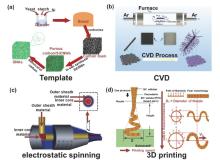
Fig 1
Preparation methods of SiC nanomaterials. (a) Template method18, (b) CVD method19, (c) electrostatic spinning method37, (d) 3D printing41. (a–d) Adapted from Elsevier publisher."
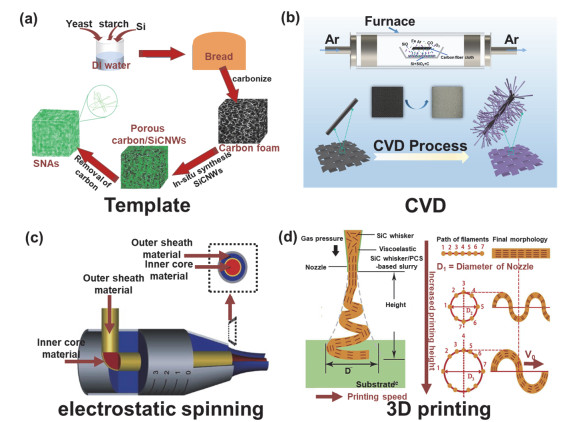
Fig 2
Preparation methods of SiC derived carbon. (a) High temperature halogen etching44, (b) supercritical hydrothermal synthesis46, (c) high temperature molten salt electrochemical etching52. (a) Adapted from Elsevier publisher. (b) Adapted from Elsevier publisher. (c) Adapted with permission from Royal Society of Chemistry."
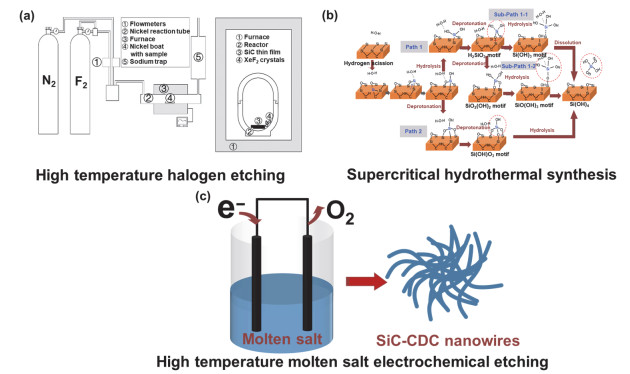
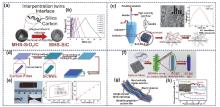
Fig 3
SiC nanospheres, SiC nanofibers and SiC nanowires based electrode materials for electric double-layer capacitors. (a) Schematic illustration of the synthetic procedure, (b) galvanic charge-discharge (GCD) curves in 6 mol∙L−1 KOH solution of MHS-SiC57; (c) schematic illustration of fabrication process of SiC nanofibers (insets are scanning electron microscope (SEM) image and charge/discharge curves of SiC nanofibers in 1 mol∙L−1 KOH at 1 A∙g−1)59; (d) schematic illustration of fabrication process, (e) electrochemical performance of a flexible, all-solid-state of N-SiCNWs nanoarray61; (f) schematic illustration of fabrication process, (g) the designed electrode, (h) Ragone plot in 2 mol∙L−1 KCl of SiC@C nanowire arrays62. (a, b) Adapted with permission from Royal Society of Chemistry. (c) Adapted from Elsevier publisher. (d, e) Adapted with permission from American Chemical Society. (f–h) Adapted from Elsevier publisher."
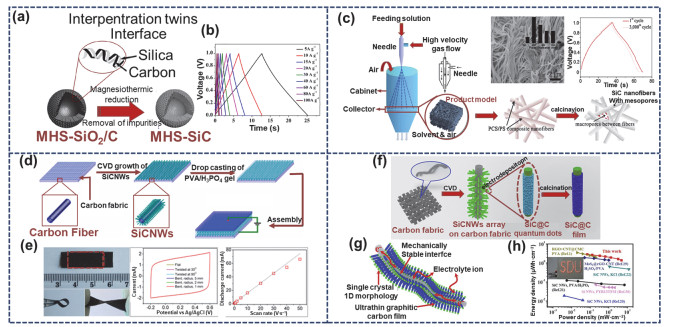
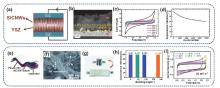
Fig 4
Wide temperature domain SiC nanowire based electrode materials for electric double-layer capacitors. (a) Schematic illustration, (b) SEM image, (c) cyclic voltammetry (CV) curves at 100 mV∙s−1, (d) cycling stability test at 200 mV∙s−1 of SiC nanowires (SiCNWs)/YSZ/SiCNWs device65; (e) schematic illustration of supercapacitor construction, (f) SEM image, (g) digital photographs of flat and multi-folded supercapacitor, (h) capacitance retention of the soft-packaged supercapacitor bent at different angles, (i) CV curves at 50 mV∙s−1 with 1-butyl-3-methylimidazolium tetrafluoroborate as the electrolyte of SiC/CNT composite66. (a–d) Adapted with permission from American Chemical Society. (e–i) Adapted with permission from Royal Society of Chemistry."
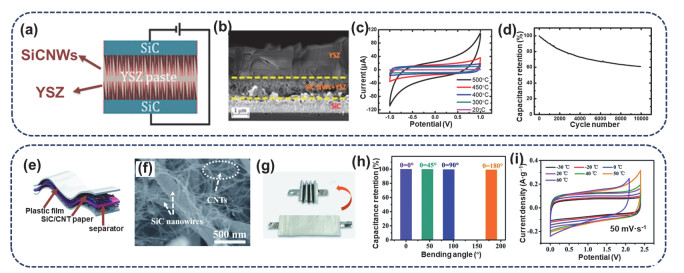
Fig 5
SiC nanocrystalline film, SiC nanosheet, three dimensional SiC "nanoforest" based electrode materials for electric double-layer capacitors. (a) Transmission electron microscope (TEM) image of nanocrystalline SiC films67; (b) schematic ilustration of the mechanism, (c) CV curves in 1 mol∙L−1 Na2SO4 of 3C/2H-SiC/C nanosheets70; (d) SEM imagines, (e) schematic illustration of stable framework and continuous electron pathways, (f) cycling performance of charge-discharge at 100 μA∙cm−2 in 0.5 mol∙L−1 H2SO4 of 3C-SiC/graphene "nanoforest" films71. (a) Adapted with permission from American Chemical Society. (b, c) Adapted from Elsevier publisher. (d–f) Adapted from Elsevier publisher."
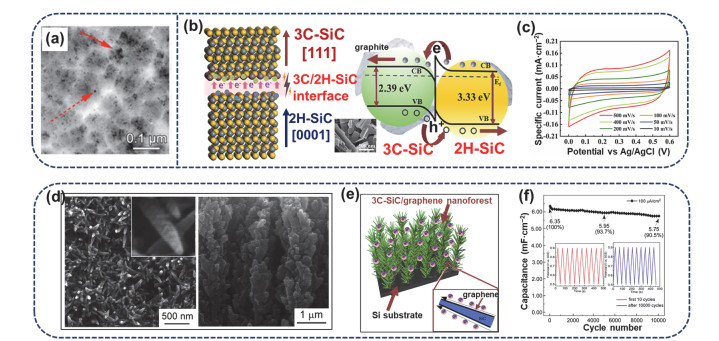
Fig 6
SiC nanomaterials combined with pseudocapacitance materials based composite electrodes. (a) Schematic illustration of flexible supercapacitor based on SiC/N doped bio-renewable carbon material72; (b) electrochemical performance diagram, (c) SEM image, (d) CV curves using polyvinyl alcohol (PVA)-KOH gel electrolyte in different bending states of carbon cloth (CC)/SiCNWs@NiCo2O4 nanosheets arrays/CC/SiCNWs@C nanosheets arrays device78; (e) schematic illustration of fabrication process on carbon cloth, (f) SEM image, (g) high-magnification TEM image of SiCNWs@NiCo2O4/NiO nanosheets81; (h) schematic illustration of the designed free-standing electrode (inset is the SEM image), (i) GCD curves in 2 mol∙L−1 KCl of SiC@PEDOT nanowires87. (a–d, h–i) Adapted from Elsevier publisher. (e–g) Adapted with permission from American Chemical Society."
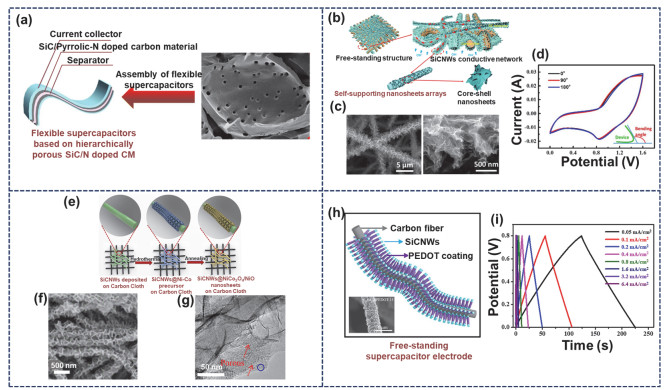
Table 1
Performance of different SiC-based electrode materials for supercapacitors."
| Electrode | Fabrication method | Electrolyte | Specific capacitance | Reference |
| mesoporous hollow SiC nanospheres | magnesiothermic reduction | 6 mol∙L−1 KOH | 116 F∙g−1 at 100 A∙g−1 | |
| SiC nanofibers | carbothermal reduction | 2 mol∙L−1 KCl | 4.36 mF∙cm−2 at 50 mV∙s−1 | |
| SiC nanofiber membranes | solution blowing method | 1 mol∙L−1 KOH | 189 F∙g−1 at 1 A∙g−1 | |
| N-SiCNWs | pyrolysis of polymer precursor | 3 mol∙L−1 KCl | 2.38 mF∙cm−2 at 20000 mV∙s−1 | |
| 3D 3C-SiC/graphene hybrid nanolaminate films | microwave plasma-assisted CVD | 1 mol∙L−1 Na2SO4 | 391.8 µF∙cm−2 at 10 mV∙s−1 | |
| N-SiCNWs@CQDs | pyrolysis of polymer precursor and ultrasonic-hydrothermal method | 2 mol∙L−1 KCl | 78.98 mF∙cm−2 at 0.2 mA∙cm−2 | |
| SiCNWs | CVD | 2 mol∙L−1 KCl | 23 mF∙cm−2 at 50 mV∙s−1 | |
| SiCNWs | pyrolysis of polymer precursors followed by etching | 2 mol∙L−1 KCl | 23.6 mF∙cm–2 at 0.2 mA∙cm–2 | |
| SiC/CNT composite films | vacuum filtration process | 1-butyl-3-methylimidazolium tetrafluoroborate | 8.43 F∙g−1 at 0.02 A∙g−1 | |
| nanocrystalline 3C-SiC film | microwave plasma CVD | 0.1 mol∙L−1 Na2SO4 | 72.7 μF∙cm−2 at 100 mV∙s−1 | |
| SiC/C nanosheets | wet-chemical etching | 1 mol∙L−1 Na2SO4 | 734 μF∙cm−2 at 10 mV∙s−1 | |
| 3C-SiC/graphene films | laser CVD | 0.5 mol∙L−1 H2SO4 | 8.533 mF∙cm−2 at 20 μA∙cm−2 | |
| RuO2/SiC whiskers | carbon thermal reduction and hydrothermal method | 1 mol∙L−1 H2SO4 | 649.2 F∙g−1 at 0.2 A∙g−1 | |
| SiC flakes/Fe3O4 | carbonization process and chemical reduction | 1 mol∙L−1 KOH | 423.2 F∙g−1 at 5 mV∙s−1 | |
| CC/SiCNWs@NiCo2O4 nanosheets arrays | CVD, ion-exchanging and thermal annealing | 1 mol∙L−1 KOH | 1604.7 F∙g−1 at 0.5 A∙g−1 | |
| SiCNWs@NiCo2O4@NiO nanosheets | chemical vapor reaction, hydrothermal reaction and thermal annealing | 6 mol∙L−1 KOH | 1801 F∙g−1 at 1 mA∙cm–2 | |
| SiCNWs@MoS2 nanoflowers | hydrothermal method | 1 mol∙L−1 Na2SO4 | 200.35 F∙g−1 at 0.1 A∙g−1 | |
| NiSi/SiC core-shell nanowires | hot-wire CVD | 1 mol∙L−1 KOH | 234.13 mF∙cm−2 at 100 mV∙s−1 | |
| SiC@polyaniline core/shell nanowires | CVD and electrodeposition | 1 mol∙L−1 H2SO4 | 352 mF∙cm−2 at 1 mA∙cm−2 | |
| SiC@PEDOT nanowires | pyrolysis of polymer precursors and oxidative CVD | 2 mol∙L−1 KCl | 26.53 mF∙cm−2 at 0.2 mA∙cm−2 |
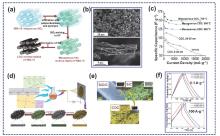
Fig 7
Porous structure design of SiC-CDC. (a) Schematic illustration of the fabrication process, (b) SEM images, (c) Ragone plot of CDC with aligned mesopores99; (d) Schematic illustration of the preparation procedure, (e) SEM images, (f) GCD curves in 6 mol∙L−1 KOH of SiC-derived carbon nanofibers100. (a–c) Adapted with permission from American Chemical Society. (d–f) Adapted from Elsevier publisher."
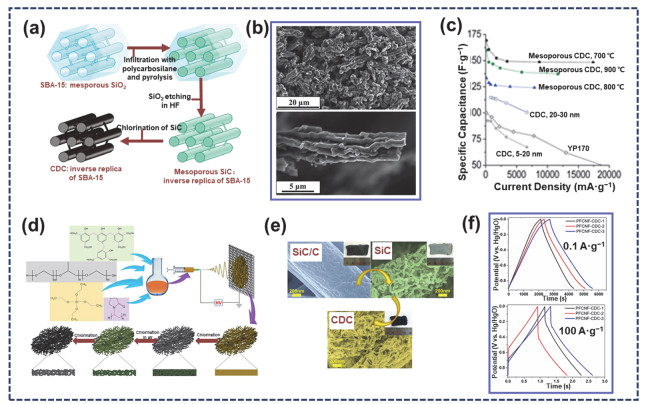
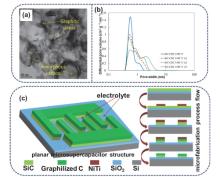
Fig 8
Activated and doped SiC-CDC electrode materials. (a) TEM image101; (b) Pore size distribution of additionally CO2 activated SiC-CDC102; (c) Schematic illustration of the planar microsupercapacitor structure of graphitizing nitrogen-doped poly-SiC films107. (a) Adapted from Elsevier publisher. (b) Adapted from Electrochemical Society publisher. (c) Adapted from IEEE publisher."
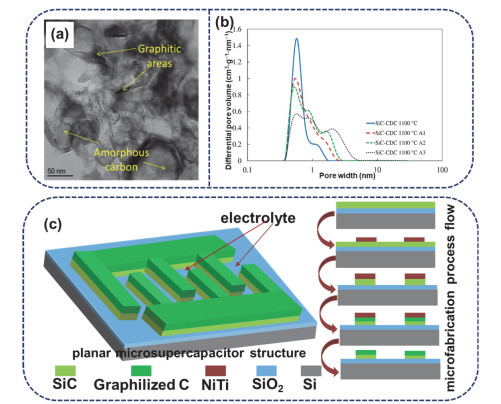
Fig 9
Graphene/SiC-CDC composites as electrode materials. (a) SEM images, (b) CV curves in in 6 mol∙L−1 KOH, (c) Long-term cyclic charge/discharge test at 1 A∙g−1 of G/ACDC109. (d) Schematic illustration of synthesis process, (e) Nyquist plots, (f) Specific capacitance in 3.5 mol∙L−1 KCl of rGO and rGO-CDC films110. Adapted from Elsevier publisher."
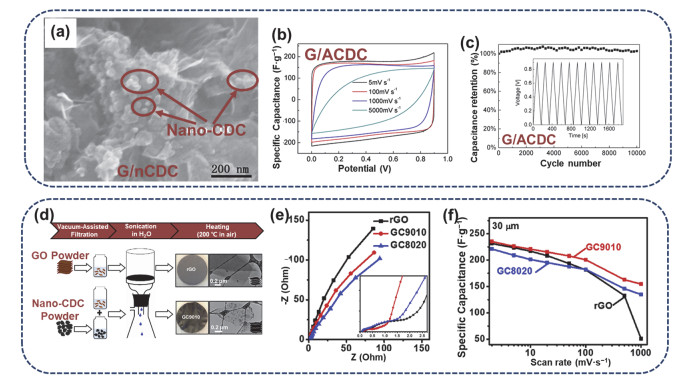
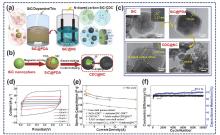
Fig 10
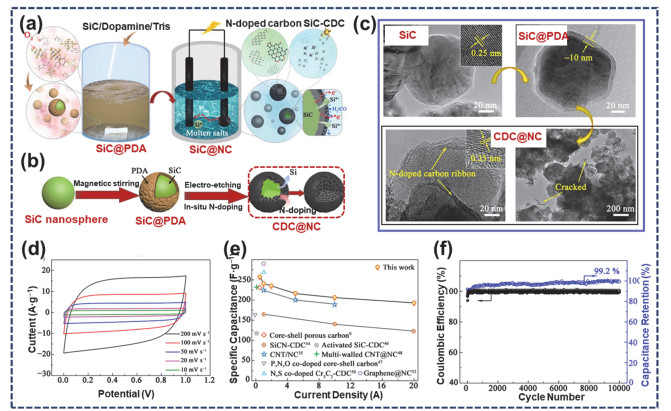
SiC-CDC@NC composites as electrode materials. (a) Schematic illustrations of the synthesis process of CDC@NC, (b) Schematic illustrations and (c) TEM images of the conversion process from SiC to CDC@NC, (d) CV curves, (e) Specific capacitance comparison, (f) Coulombic efficiency and cycling performance at 0.5 A∙g−1 in 6 mol∙L−1 KOH solution of CDC@NC112. Adapted from Elsevier publisher."
| 1 |
doi: 10.1039/c1ee01249e |
| 2 |
doi: 10.1016/j.rser.2015.12.249 |
| 3 |
doi: 10.1002/aenm.202104053 |
| 4 |
doi: 10.1039/c9ta04421c |
| 5 |
doi: 10.1002/idm2.12057 |
| 6 |
doi: 10.1039/c9qi00052f |
| 7 |
doi: 10.1016/j.jcis.2019.12.098 |
| 8 |
doi: 10.1016/j.jcis.2017.01.100 |
| 9 |
doi: 10.1039/d1ta11063b |
| 10 |
doi: 10.1016/j.flatc.2022.100467 |
| 11 |
doi: 10.1002/smll.201801857 |
| 12 |
doi: 10.1016/j.rser.2018.10.026 |
| 13 |
doi: 10.1007/s10853-020-05157-6 |
| 14 |
doi: 10.3390/nano13010150 |
| 15 |
doi: 10.1016/j.pmatsci.2015.01.003 |
| 16 |
doi: 10.1002/smll.202101775 |
| 17 |
doi: 10.1016/0009-2614(94)00342-4 |
| 18 |
doi: 10.1016/j.matlet.2020.129014 |
| 19 |
doi: 10.1016/j.ceramint.2022.08.038 |
| 20 |
doi: 10.1016/j.ceramint.2022.08.186 |
| 21 |
doi: 10.1016/j.ceramint.2017.12.015 |
| 22 |
|
|
宋永才; 李斌. 材料科学与工程学报, 2004, 22, 341.
doi: 10.3969/j.issn.1673-2812.2004.03.007 |
|
| 23 |
doi: 10.22052/jns.2020.03.019 |
| 24 |
|
|
张波; 李建保; 孙晶晶. 炭素技术, 2000 (4), 50.
doi: 10.3969/j.issn.1001-3741.2000.04.014 |
|
| 25 |
doi: 10.1016/j.jpcs.2016.11.026 |
| 26 |
doi: 10.1021/jp0462153 |
| 27 |
doi: 10.1111/j.1551-2916.2006.01439.x |
| 28 |
doi: 10.1016/s0022-0248(01)00597-8 |
| 29 |
|
|
吴旭峰; 凌一鸣. 硅酸盐学报, 2006, 34, 1283.
doi: 10.3321/j.issn:0454-5648.2006.10.024 |
|
| 30 |
doi: 10.1021/jp0687192 |
| 31 |
doi: 10.1007/s10853-010-4346-2 |
| 32 |
doi: 10.1039/c5nr00952a |
| 33 |
doi: 10.1007/s10853-009-3246-9 |
| 34 |
doi: 10.1039/c5nr00776c |
| 35 |
|
|
王军凯; 张远卓; 李赛赛; 葛胜涛; 宋健波; 张海军. 材料研究学报, 2018, 32, 767.
doi: 10.11901/1005.3093.2017.533 |
|
| 36 |
doi: 10.1021/nl049590f |
| 37 |
doi: 10.1016/j.matlet.2009.08.009 |
| 38 |
doi: 10.1111/jace.17396 |
| 39 |
doi: 10.1063/1.4755778 |
| 40 |
doi: 10.1088/0957-4484/18/36/365603 |
| 41 |
doi: 10.1016/j.jallcom.2019.151824 |
| 42 |
doi: 10.1016/j.jeurceramsoc.2019.02.045 |
| 43 |
|
|
于艳艳; 关云锋; 丛野; 袁修兰; 李轩科; 张江. 无机化学学报, 2017, 33, 853.
doi: 10.11862/cj1c.2017.085 |
|
| 44 |
doi: 10.1016/j.tsf.2010.05.120 |
| 45 |
doi: 10.1023/a:1004480814477 |
| 46 |
doi: 10.1016/j.actamat.2021.116803 |
| 47 |
doi: 10.1016/0008-6223(65)90027-8 |
| 48 |
doi: 10.1016/j.jcrysgro.2022.126903 |
| 49 |
doi: 10.1016/j.carbon.2018.10.032 |
| 50 |
doi: 10.1016/j.elecom.2013.10.014 |
| 51 |
doi: 10.1016/j.carbon.2013.12.022 |
| 52 |
doi: 10.1039/c8ta03922d |
| 53 |
doi: 10.1016/j.jmst.2021.03.076 |
| 54 |
doi: 10.1002/adfm.202204965 |
| 55 |
doi: 10.1021/acs.iecr.6b00737 |
| 56 |
doi: 10.1007/s10853-021-06318-x |
| 57 |
doi: 10.1039/d2cc04723c |
| 58 |
doi: 10.1016/j.ceramint.2021.05.187 |
| 59 |
doi: 10.1016/j.electacta.2016.05.003 |
| 60 |
doi: 10.1002/aenm.201900073 |
| 61 |
doi: 10.1021/acsnano.5b01784 |
| 62 |
doi: 10.1016/j.ensm.2020.02.009 |
| 63 |
doi: 10.1016/j.jpowsour.2013.06.050 |
| 64 |
doi: 10.1002/adfm.202008901 |
| 65 |
doi: 10.1021/acsami.5b08423 |
| 66 |
doi: 10.1039/d2ta03866h |
| 67 |
doi: 10.1021/acsami.5b02024 |
| 68 |
doi: 10.1016/j.inoche.2019.06.009 |
| 69 |
doi: 10.1016/j.cej.2015.12.087 |
| 70 |
doi: 10.1016/j.jmst.2021.09.012 |
| 71 |
doi: 10.1016/j.jpowsour.2019.227308 |
| 72 |
doi: 10.1016/j.cej.2021.133738 |
| 73 |
doi: 10.1016/j.cej.2021.131114 |
| 74 |
doi: 10.1039/d0ta09655e |
| 75 |
doi: 10.1039/c5ra27291b |
| 76 |
doi: 10.1088/1361-6528/aa6812 |
| 77 |
doi: 10.1021/acsami.0c04825 |
| 78 |
doi: 10.1016/j.jmst.2020.10.085 |
| 79 |
doi: 10.1016/j.jcis.2020.05.101 |
| 80 |
doi: 10.1016/j.jcis.2020.10.086 |
| 81 |
doi: 10.1021/acssuschemeng.6b00697 |
| 82 |
doi: 10.1016/j.jallcom.2018.02.280 |
| 83 |
doi: 10.1016/j.jpowsour.2016.09.128 |
| 84 |
doi: 10.1016/j.tsf.2020.138430 |
| 85 |
doi: 10.1016/j.matchar.2017.08.005 |
| 86 |
doi: 10.1016/j.electacta.2022.139867 |
| 87 |
doi: 10.1016/j.jechem.2021.07.007 |
| 88 |
doi: 10.1002/wene.102 |
| 89 |
doi: 10.3389/fmats.2020.00217 |
| 90 |
doi: 10.1016/j.jpowsour.2005.09.008 |
| 91 |
doi: 10.1016/j.carbon.2011.03.029 |
| 92 |
|
|
刘汉卿; 周锋; 师晓宇; 史全; 吴忠帅. 物理化学学报, 2022, 38, 2204017.
doi: 10.3866/PKU.WHXB202204017 |
|
| 93 |
doi: 10.1002/chem.201705465 |
| 94 |
doi: 10.1016/j.carbon.2016.11.050 |
| 95 |
doi: 10.1149/1.2918304 |
| 96 |
doi: 10.1016/j.jpowsour.2016.01.038 |
| 97 |
doi: 10.1007/s10008-013-2306-x |
| 98 |
doi: 10.1016/j.micromeso.2013.12.022 |
| 99 |
doi: 10.1021/nn901825y |
| 100 |
doi: 10.1016/j.apsusc.2021.148933 |
| 101 |
doi: 10.1016/j.electacta.2015.02.106 |
| 102 |
doi: 10.1149/2.0931607jes |
| 103 |
doi: 10.1016/j.electacta.2015.12.022 |
| 104 |
doi: 10.1126/science.aab3798 |
| 105 |
doi: 10.1016/j.electacta.2015.07.094 |
| 106 |
doi: 10.1021/am4055029 |
| 107 |
Liu, F.; Gutes, A.; Carraro, C.; Chu, J.; Maboudian, R. In Graphitization of n-type Polycrystalline Silicon Carbide and Its Application for Micro-Supercapacitors, 16th International Solid-State Sensors, Actuators and Microsystems Conference (TRANSDUCERS), Beijing, China, 05-09 June 2011; IEEE: Beijing, China, 2011; p 1879.
|
| 108 |
doi: 10.1088/0957-4484/26/43/434005 |
| 109 |
doi: 10.1016/j.ijhydene.2016.07.045 |
| 110 |
doi: 10.1016/j.carbon.2017.03.094 |
| 111 |
doi: 10.1039/c6ta08900c |
| 112 |
doi: 10.1016/j.jechem.2020.08.042 |
| [1] | Mingyu ZHAO,Lin ZHU,Bowen FU,Suhua JIANG,Yongning ZHOU,Yun SONG. Sodium Ion Storage Performance of NiCo2S4 Hexagonal Nanosheets [J]. Acta Phys. -Chim. Sin., 2019, 35(2): 193-199. |
| [2] | DU Xue-Lian, CONG Ye, JIANG Lu, LI Xuan-Ke, CUI Zheng-Wei, DONG Zhi-Jun, YUAN Guan-Ming, ZHANG Jiang. Preparation and Structure Regulation of Silicon Carbide-Derived Carbon/ Spherical Natural Graphite Composites [J]. Acta Phys. -Chim. Sin., 2015, 31(3): 583-588. |
| [3] | HE Yuan-Yuan, ZHANG Jin-Jiang, ZHAO Jian-Wei. Influence of Graphene with Different Oxidation Degrees on Nickel Hydroxide Pseudocapacitor Characterization [J]. Acta Phys. -Chim. Sin., 2014, 30(2): 297-304. |
| [4] | XUE Rong, YAN Jing-Wang, TIAN Ying, YI Bao-Lian. Lanthanum Doped Manganese Dioxide/Carbon Nanotube Composite Electrodes for Electrochemical Supercapacitors [J]. Acta Phys. -Chim. Sin., 2011, 27(10): 2340-2346. |
| [5] | GUO Xiang-Yun, JIN Guo-Qiang, WANG Ying-Yong. Preparations and Catalytic Applications of High Surface Area Silicon Carbide [J]. Acta Phys. -Chim. Sin., 2010, 26(04): 1143-1150. |
| [6] | SUN Guo-Hua; LI Kai-Xi; FAN Hui; GU Jian-Yu; LI Qiang; LIU Yue. Eelectrochemical Performance of Capacitors Using [BMIm]BF4/Fc as Electrolyte [J]. Acta Phys. -Chim. Sin., 2008, 24(01): 103-108. |
| [7] | ZHAN Ying-Ying; CAI Guo-Hui; ZHENG Yong; SHEN Xiao-Nv; ZHENG Ying; WEI Ke-Mei. Synthesis of High Surface Area Silicon Carbide and Its Application in CO Oxidation Reaction [J]. Acta Phys. -Chim. Sin., 2008, 24(01): 171-175. |
| [8] | CHEN Jian; HUANG Zheng-Ren; DONG Shao-Ming; JIANG Dong-Liang. Adsorption of Polyethylene Glycol on Silicon Carbide Measured by Thermal Gravimetric and Differential Thermal Analysis [J]. Acta Phys. -Chim. Sin., 2007, 23(06): 926-928. |
| [9] | LI Qiang;LI Kai-Xi;SUN Guo-Hua;FAN Hui;GU Jian-Yu. A New Kind of Redox Electrolyte Electrochemical Capacitor System [J]. Acta Phys. -Chim. Sin., 2006, 22(12): 1445-1450. |
|
||