Acta Phys. -Chim. Sin. ›› 2024, Vol. 40 ›› Issue (3): 2305016.doi: 10.3866/PKU.WHXB202305016
Special Issue: Solid State Batteries
• ARTICLE • Previous Articles Next Articles
Uniform Garnet Nanoparticle Dispersion in Composite Polymer Electrolytes
Hanmei Lü, Xin Chen, Qifu Sun, Ning Zhao*( ), Xiangxin Guo*()
- College of Physics, Qingdao University, Qingdao 266071, Shandong Province, China
-
Received:2023-05-08Revised:2023-06-06Accepted:2023-06-06Published:2023-06-13 -
Contact:Email: n.zhao@qdu.edu.cn (Ning Zhao)xxguo@qdu.edu.cn (Xiangxin Guo) -
Supported by:the Key R&D Program of Shandong Province(2021CXGC010401); the National Natural Science Foundation of China(U1932205); the National Natural Science Foundation of China(52002197)

Cite this article
Hanmei Lü, Xin Chen, Qifu Sun, Ning Zhao, Xiangxin Guo. Uniform Garnet Nanoparticle Dispersion in Composite Polymer Electrolytes[J]. Acta Phys. -Chim. Sin. 2024, 40(3), 2305016. doi: 10.3866/PKU.WHXB202305016
share this article
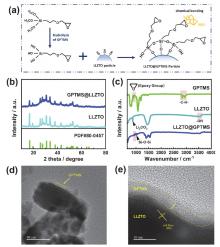
Fig 1
(a) The schematic illustration of the reaction between GPTMS and LLZTO particles; (b) XRD scan and (c) FTIR spectra of LLZTO and LLZTO@GPTMS particles; (d) TEM micrograph of GPTMS-modified LLZTO particles; (e) TEM micrograph of the GPTMS layer on the LLZTO particles."
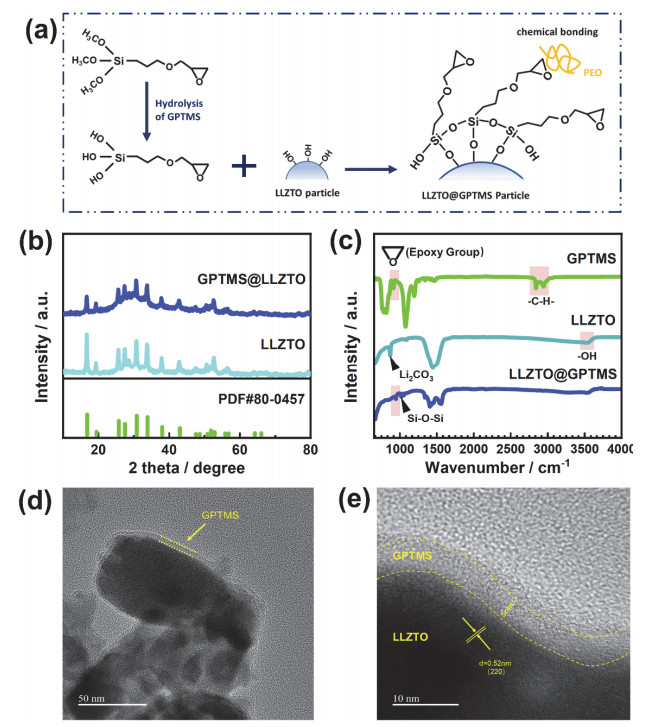
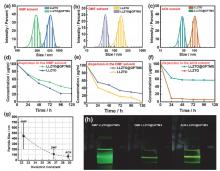
Fig 2
The particle size distribution of LLZTO@GPTMS and pristine LLZTO powders in (a) NMP, (b) DMF and (c) ACN solvent. The absorbance ratio of LLZTO and LLZTO@GPTMS particles as a function of time in (d) NMP, (e) DMF and (f) ACN solvent. (g) The relationship between dispersed size of LLZTO@GPTMS and the polarity of solvents which can be quantified by the dielectric constant. (h) Photo images of the Tyndall effect of GPTMs@LLZTO nanoparticles in NMP, DMF and ACN solvents."
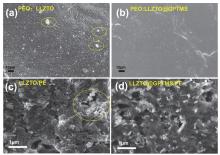
Fig 3
The SEM images of (a) PEO: LLZTO and (b) PEO: LLZTO@GPTMS composite polymer electrolytes (CPEs). Cross-sectional SEM images of (c) LLZTO/PE and (d) LLZTO@GPTMS/PE separators."
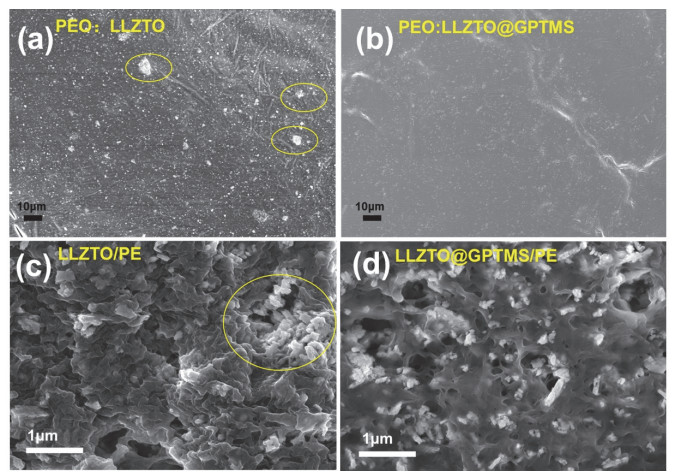
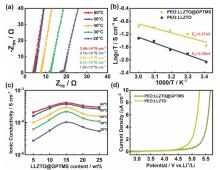
Fig 4
(a) The Nyquist plots of the PEO: LLZTO@GPTMS membrane electrolytes at different temperatures. (b) The Arrhenius plots of the PEO: LLZTO@GPTMS and PEO: LLZTO membrane electrolytes. (c) The ionic conductivities of PEO: LLZTO@GPTMS membrane electrolytes with different weight ratios of LLZTO@GPTMS at different temperatures; (d) The linear scan voltammetry (LSV) curves of PEO: LLZTO@GPTMS and PEO: LLZTO vs. Li+/Li."
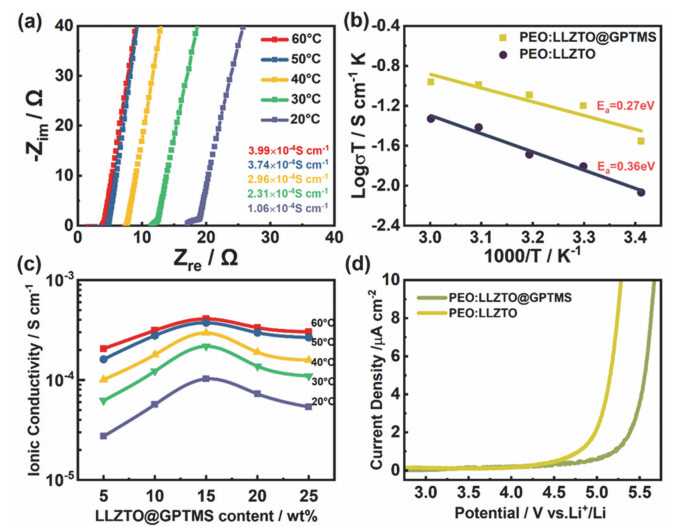
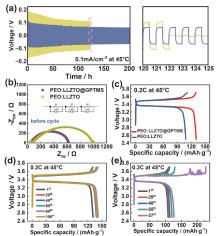
Fig 5
(a) The galvanostatic cycling curves of the Li symmetric cells with the PEO: LLZTO@GPTMS CPEs and PEO: LLZTO CPEs at current density of 0.1 mA∙cm−2 at 45 ℃. (b) The Nyquist plot of lithium symmetric cells show the interface resistance of PEO: LLZTO@GPTMS and PEO: LLZTO before cycling measured at 45 ℃. (c)The initial charge and discharge curves for LFP|PEO: LLZTO@GPTMS|Li and LFP|PEO: LLZTO|Li battery. The charge and discharge curves for the solid-state Li batteries with LiFePO4 cathode and (d) PEO: LLZTO@GPTMS and (e) PEO: LLZTO CPEs."
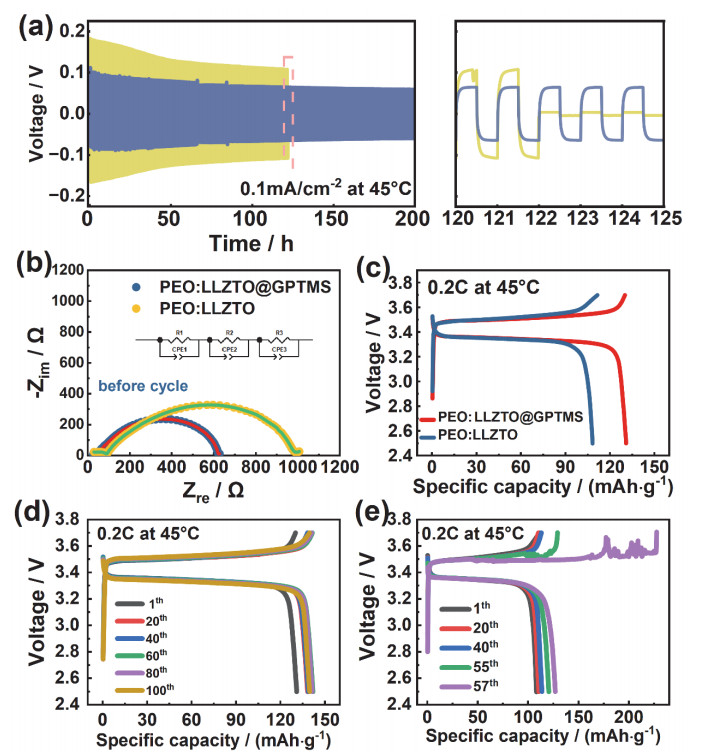
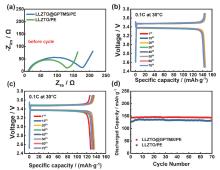
Fig 6
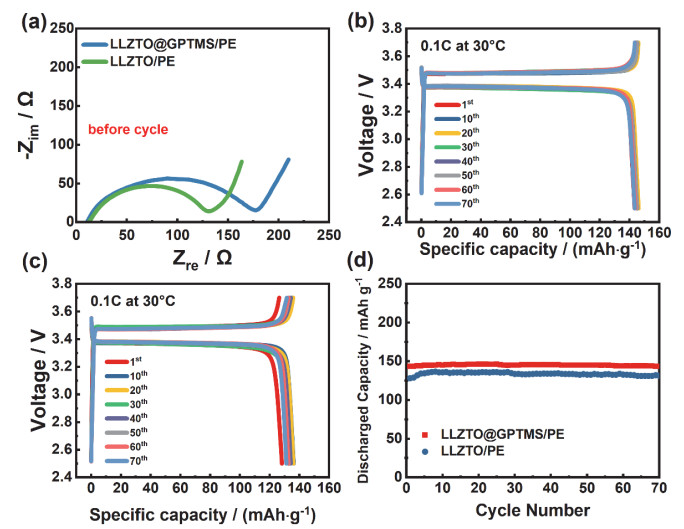
(a) The Nyquist plots of Li/LiFePO4 cells show the resistance of LLZTO@GPTMS/PE and LLZTO/PE before cycling measured at 30 ℃. The charge and discharge curves for the solid-state Li batteries with LiFePO4 cathode and (b) LLZTO@GPTMS/PE and (c) LLZTO/PE separator. (d) Cycle performance of LFP|LLZTO@GPTMS/PE|Li and LFP|LLZTO/PE|Li batteries at 0.1C."
| 1 |
doi: 10.1016/j.joule.2019.03.019 |
| 2 |
doi: 10.1016/j.ensm.2020.11.038 |
| 3 |
|
|
金锋; 李静; 胡晨吉; 董厚才; 陈鹏; 沈炎宾; 陈立桅. 物理化学学报, 2019, 35 (12), 1399.
doi: 10.3866/PKU.WHXB201904085 |
|
| 4 |
doi: 10.1039/D2CS00322H |
| 5 |
doi: 10.1016/j.ensm.2022.02.048 |
| 6 |
doi: 10.1063/5.0098255 |
| 7 |
doi: 10.1016/j.jpowsour.2022.231939 |
| 8 |
doi: 10.15541/jim20210486 |
| 9 |
|
|
王晗; 安汉文; 单红梅; 赵雷; 王家钧. 物理化学学报, 2021, 37 (11), 2007070.
doi: 10.3866/PKU.WHXB202007070 |
|
| 10 |
doi: 10.34133/energymatadv.0015 |
| 11 |
doi: 10.1002/aenm.202200967 |
| 12 |
doi: 10.1016/j.nanoen.2022.107470 |
| 13 |
doi: 10.1002/aenm.201804004 |
| 14 |
doi: 10.1007/s40242-021-1054-1 |
| 15 |
doi: 10.1016/j.nanoen.2016.09.002 |
| 16 |
|
|
虞鑫润; 马君; 牟春博; 崔光磊. 物理化学学报, 2022, 38 (3), 1912061.
doi: 10.3866/PKU.WHXB201912061 |
|
| 17 |
doi: 10.19799/j.cnki.2095-4239.2022.0097 |
| 18 |
doi: 10.1016/j.nanoen.2017.12.037 |
| 19 |
doi: 10.1039/c9ta03395e |
| 20 |
doi: 10.1016/j.jechem.2020.03.017 |
| 21 |
doi: 10.1021/acsaem.8b01850 |
| 22 |
doi: 10.1039/b608177k |
| 23 |
doi: 10.1016/j.cis.2020.102162 |
| 24 |
doi: 10.1021/acsami.0c13434 |
| 25 |
doi: 10.1016/j.progpolymsci.2013.02.003 |
| 26 |
doi: 10.1016/j.compositesa.2010.03.005 |
| 27 |
doi: 10.1021/acs.nanolett.3c00783 |
| 28 |
doi: 10.1016/j.ensm.2019.11.018 |
| 29 |
doi: 10.1016/j.ensm.2022.06.025 |
| 30 |
doi: 10.1016/s1875-5372(12)60024-1 |
| 31 |
Li, H.; Wang, C. A.; Guo, Z. H.; Wang, H. R.; Zhang, Y. X.; Hong, R.; Peng, Z. R. Effects of Silane Coupling Agents on the Electrical Properties of Silica/Epoxy Nanocomposites, In IEEE International Conference on Dielectrics (ICD), Montpellier, France July 03–07; IEEE: Montpellier, France, 2016; pp. 1036.
|
| 32 |
doi: 10.1016/j.jpowsour.2020.229363 |
| 33 |
doi: 10.1007/s00289-009-0045-z |
| 34 |
doi: 10.1080/10667857.2016.1196033 |
| 35 |
doi: 10.1016/j.electacta.2018.03.101 |
| 36 |
doi: 10.1016/j.expthermflusci.2013.06.001 |
| 37 |
doi: 10.1016/s0021-9797(02)00176-5 |
| 38 |
doi: 10.1007/s10404-014-1491-y |
| 39 |
doi: 10.1038/s41563-022-01343-w |
| 40 |
doi: 10.1016/j.mtnano.2020.100075 |
| 41 |
doi: 10.1002/adma.202000399 |
| [1] | Kuangyu Wang, Kai Liu, Hui Wu. Molten Alkali Metal Batteries Based on Solid Electrolytes [J]. Acta Phys. -Chim. Sin., 2023, 39(12): 2301009-. |
| [2] | Mingli Cai, Liu Yao, Jun Jin, Zhaoyin Wen. In situ Lithiophilic ZnO Layer Constructed using Aqueous Strategy for a Stable Li-Garnet Interface [J]. Acta Phys. -Chim. Sin., 2021, 37(1): 2009006-. |
|
||