Acta Phys. -Chim. Sin. ›› 2025, Vol. 41 ›› Issue (5): 100041.doi: 10.1016/j.actphy.2024.100041
• TUTORIAL • Previous Articles Next Articles
Interfacial Electrical Double Layer in Electrocatalytic Reactions: Fundamentals, Characterizations and Applications
Xueting Cao, Shuangshuang Cha, Ming Gong*( )
)
- Department of Chemistry, Shanghai Key Laboratory of Molecular Catalysis and Innovative Materials, Collaborative Innovation Center of Chemistry for Energy Materials (iChEM), Fudan University, Shanghai 200438, China
-
Received:2024-10-25Revised:2024-11-18Accepted:2024-11-19Published:2025-04-18 -
Contact:Email: gongm@fudan.edu.cn (Ming Gong) -
Supported by:the National Natural Science Foundation of China(22172036); the Fundamental Research Funds for the Central Universities(20720220011)

Cite this article
Xueting Cao, Shuangshuang Cha, Ming Gong. Interfacial Electrical Double Layer in Electrocatalytic Reactions: Fundamentals, Characterizations and Applications[J]. Acta Phys. -Chim. Sin. 2025, 41(5), 100041. doi: 10.1016/j.actphy.2024.100041
share this article
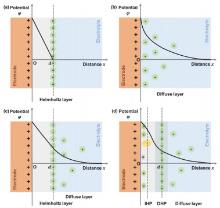
Fig 1
Schematic diagram of four classic double layer models, wherein the orange area is the electrode side with positive surface charges, and the blue area is the electrolyte side. (a) The Helmholtz-Perrin model, where the electrode with positive surface charges and the ions with negative charges on the solution side (green solid circles) form an electrical double layer, and the potential φ decreases linearly with the distance x from the surface; (b) the Gouy-Chapman model, where the negatively charged ions on the solution side form a diffusion layer, and the potential φ decreases exponentially with the distance x from the surface; (c) the GCS model modified by Stern, the ions on the solution side have a certain distance d (d ≠ 0) from the electrode, that is, the ions can only reach the (outer) Helmholtz layer at the nearest point, and the potential φ first decreases linearly with the increase of the distance x from the surface, and then decreases exponentially; (d) the GCSG model, modified by Grahame, incorporates specific adsorption of positive and negative ions and organic molecules on the electrode surface (represented by dark gray solid ellipse, green solid ellipse and yellow solid ellipse respectively), namely IHP. The Helmholtz layer in (c) is OHP in (d), and the potential φ varies with the distance x from the surface in a relatively complex manner. The curves presented here are intended to be schematic only and should not be taken as an accurate representation of the actual data."
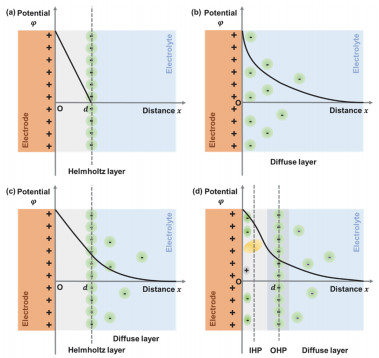

Table 1
List of Symbols."
| Symbols | Connotations |
| A | the interactions between adsorbates in the Frumkin adsorption isotherm |
| b | difference between the Gibbs free energy change for the formation of the down-state water at the electrode surface and the up-state water |
| β | symmetry factor |
| ca | concentration of adsorbates in the bulk phase of the solution |
| c0 | concentration of species i in the bulk phase of the solution |
| concentration of the reduced species Re in the bulk phase of the solution in the interfacial single-electron transfer reaction | |
| concentration of the oxidized species Ox in the interfacial single-electron transfer reaction | |
| concentration of the oxidized species Ox in the bulk phase of the solution in the interfacial single-electron transfer reaction | |
| csurface | concentration of species on electrode surface |
| C | double layer (differential) capacitance |
| Ccharge | capacitance formed when ions are adsorbed on the electrode surface |
| Cdipole | capacitance formed when water dipoles are adsorbed by the electrode |
| Ceqcm | correction constant for EQCM resonator |
| CM | the contribution of electrode side to the interfacial capacitance |
| CH | the contribution of Helmholtz layer to the interfacial capacitance |
| CG | the contribution of diffusion layer to the interfacial capacitance |
| χ(2) | second-order optical susceptibility |
| χ(3) | third-order optical susceptibility |
| The effective second-order optical susceptibility | |
| d | Differential notation (as distinguished from italicized d for the plate separation distance) |
| d | the plate separation distance in the parallel plate capacitor model |
| E | electric field intensity |
| e0 | the charge carried by one single electron |
| ε | the dielectric constant in a certain medium |
| ε0 | vacuum dielectric constant |
| F | Faraday constant |
| f | f= F/RT |
| Δf | the change in vibrational frequency measured by EQCM |
| ΔGn | Gibbs free energy change for primitive reaction steps associated with n proton-electron pairs |
| the change of surface dipole potential | |
| gM | the electrode potential on the metal electrode surface within the double layer |
| gS | the electrode potential on the solution side within the double layer |
| The surface potential contributed by oriented water molecules | |
| I2ω | the emitted light intensity of SHG |
| i | imaginary unit, species designation (such as species i) |
| i | current density |
| i0 | exchange current density |
| icath | cathodic current density |
| iS | the current of the substrate in SECM |
| iT | the (Faradaic) current passing through the tip in SECM |
| k0 | standard reaction rate constant |
| kb | backward reaction rate constant |
| kf | forward reaction rate constant |
| κ-1 | the characteristic thickness of the EDL in the GC model |
| KA→B | the integral capacitance from A to B |
| γ | interfacial tension |
| kB | Boltzmann constant |
| Δm | the change of the electrode mass |
| Mads | the molar mass of adsorbed species |
| dipole moment | |
| the electrochemical potential of the electrons on the reference electrode | |
| the electrochemical potential of the electrons on the (other) metal electrode | |
| Δμ | Stark tunability |
| n | Variable indicating ‘number’, e.g., number of radical reactions, number of water molecules in hydrated ions, etc. |
| Ne, trans | electron transfer coefficient per unit mole of reaction |
| Nt | the background signal in a radiotracer measurement |
| Nt’ | the signal under the voltage without specific adsorption in a radiotracer measurement |
| Nt’’ | the signal under the voltage with specific adsorption in a radiotracer measurement |
| Nwater | number of water molecules on the electrode surface |
| ϕ | the phase of emitted light of SHG |
| φ | inner potential, the electrode potential under certain conditions |
| Δφ | the potential difference within the electrical double layer, i.e., the electrode | solution interface potential difference |
| φt | the potential of the working electrode at time t |
| φdc | the potential of the working electrode under direct current |
| φx | the potential at a distance x from the electrode surface, with the bulk solution potential defined as 0 |
| ψ | outer potential |
| Δψ | the outer potential difference of the electrical double layer |
| ω | frequency |
| qCA | the charge density of specific adsorbed ions |
| qd | the total diffuse charge density in solution |
| qM | the charge density of the (metal) electrode |
| ΔQ | the change of quantity of electric charge during electrocatalytic reactions |
| R | ideal gas constant |
| R | the roughness of the electrode |
| t | time |
| T | absolute temperature |
| θa | coverage (referring to the fraction of the surface that is covered) |
| θ | the phase difference between χ(3) and χ(2) |
| U | Maximum value of dipole-dipole interaction energy |
| V | the voltage drop per unit area of M | S EDL interface |
| Vapp | applied potential |
| vscan | the potential scan rate in cyclic voltammetry |
| x | the vertical distance of the target site from the electrode surface |
| X | the constant related to lateral interactions, 0 < X < 1 |
| y | an artificially defined physical quantity to represent the electrical and lateral interactions in interactions within EDL |
| Z | an artificially defined physical quantity to represent the distribution of water in the up and down states on the electrode surface |
| z | the number of charges per ion |
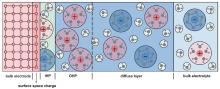
Fig 2
Theoretical model of electrical double layer, modified on the solution side and electrode side. Adapted based on the literature 31."
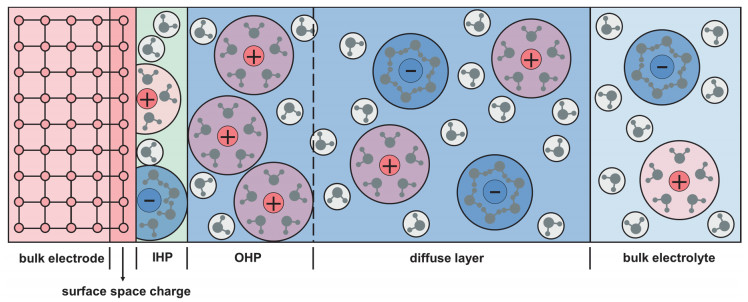
Table 2
Summary of different electrocatalytic EDL characterization techniques and their technical properties."
| Characterization Techniques | Abbreviation | Basic Principles | Vertical Resolution | Horizontal Resolution | Time Resolution | Information | On the Electrode Side | IHP/Adsorption Layer | OHP & Diffusion Layer | Category |
| Electrocapillary | – | Measurement of interfacial tension as a function of applied voltage | Macroscopic nature | Macroscopic nature | Measurement of the differential capacitance and the potential of zero charge of an EDL | Electrochemical Method | ||||
| Cyclic Voltammetry | CV | Potential scanning cyclically to obtain the current-potential relationship | Macroscopic nature | Macroscopic nature | Electrochemical behaviors of the system | Electrochemical Method | ||||
| Alternating Current Voltammetry | ACV | Relationship between the variation of AC amplitude and phase with DC polarization potential at a given electrical signal frequency | Macroscopic nature | Macroscopic nature | Distinguishing between Faraday and charging currents and separating to obtain information on different electrochemical processes | Electrochemical Method | ||||
| Electrochemical Impedance Spectroscopy | EIS | Variation of AC impedance of an electrochemical system as a function of the frequency of an applied electrical signal under a certain condition of DC polarization | Macroscopic nature | Macroscopic nature | Frequency dependent, up to milliseconds | Solution resistance from reference electrode to working electrode, double layer capacitance, charge transfer resistance, detection of diffusion processes from the body to the electrode surface and in the electrolyte | Electrochemical Method | |||
| Electrochemical Quartz Crystal Microbalance | EQCM | The oscillation frequency of quartz crystal lenses is affected by changes in electrode mass, thus correlating electrochemical information with changes in electrode mass | Relationships between mass, current and charge as a function of potential in the surface layer of solid electrodes, tracking mass transfer and charge transfer processes | Derivative Electrochemical Method | ||||||
| Radiotracer Measurements | - | Detection of β particles from isotope decay in the electrolyte by means of a scintillation counter, where the signal from the decay of the radioactive substrate is not recorded if it is adsorbed on the electrode | Surface radiation intensity or surface concentration, corresponding to the number of molecules adsorbed on the electrode surface Limitations lie in finding target molecules with radioactive isotopes | √ | Spectroscopy | |||||
| in situ/operando Infrared Reflection Absorption Spectroscopy | IRRAS | The infrared light passes through a thin layer of electrolyte to illuminate the interface, while elective absorption occurs and multiple reflections and attenuation result in an outgoing light that contains information about the interface | 100 nm | 5 μm | In the order of milliseconds and microseconds | Chemical nature and adsorption structure of adsorbed species Orientation of molecules on surfaces and the effect of double layer electric fields on intramolecular bonding Functional groups, molecular symmetry, and catalyst-molecule interactions | (very weak) | √ | IR Spectroscopy | |
| Attenuated Total Reflectance Infrared Spectroscopy | ATR-IR | Infrared light irradiates the sample to be measured, penetrates into the interface to a certain depth and undergoes selective absorption, and is reflected and attenuated several times to obtain the outgoing light which contains the interface information | 100 nm | 5 μm | √ | √ (no resolution) | √ | IR Spectroscopy | ||
| Surface Enhanced Infrared Absorption Spectroscopy | SEIRAS | When a molecule is adsorbed on the surface of a noble metal, transition metal or semiconductor substrate, its infrared absorption signal is dramatically amplified by several orders of magnitude | 10 nm | 5 μm | √ | √ | √ | IR Spectroscopy | ||
| in situ/operando Raman Spectroscopy | Raman | Scattered light undergoes an energy exchange within the illuminated object, and the difference in photon energy between the scattered light and the incident light reflects information about the vibrational energy levels of the molecules | 500 nm | 2-3 μm | Generally in the order of milliseconds with CCD; in the order of 10 nanoseconds with pump light | Structure and orientation of molecules on the surface, the effect of the electric field of the double electric layer on intramolecular bonding; qualitative and quantitative information about the electrode composition in the near-surface region, i.e., bonding on the catalyst surface; changes in the surface with potential, state of charge, and/or time | √ | √ (no resolution) | √ | Raman Spectroscopy |
| Surface enhanced Raman Spectroscopy | SERS | When a molecule is adsorbed on the surface of a noble metal, transition metal or semiconductor substrate, the Raman scattering signal is dramatically amplified by several orders of magnitude | 1 nm | √ | √ | √ | Raman Spectroscopy | |||
| Sum Frequency Generation Vibrational Spectroscopy | SFG-VS | Simultaneous irradiation of an electrochemical interface with non-central symmetry (satisfying symmetry breaking) by an infrared beam and a visible beam produces a sum-frequency signal | Measurement of surface potential, molecular structure, symmetry and orientation of interfacial reactants/solvents/intermediates, and surface number density | √ | √ | No solution phase information | Nonlinear Optical Characterization | |||
| Second Harmonic Generation | SHG | Two incident photons of the same frequency pass through the electrode-electrolyte interface to produce a doubled-frequency photon, and the resulting intensity of the incident light reflects the electric field information at the interface | Measurement of surface potential, determination of zero-charge potential, molecular structure and orientation of interfacial reactants/solvents/intermediates | √ | √ | No solution phase information | Nonlinear Optical Characterization | |||
| in situ X-ray Diffraction | XRD | Using an in situ electrochemical cell, X-rays diffract with the working electrode phase and contain information on the bulk phase of the crystalline electrode under reaction conditions | > 1 mm | 1–3 μm | Fast enough to capture the typical dynamic processes of active substances in operando experiments | Qualitative and quantitative information on the (average) composition of bulk phase electrodes Changes in the crystal structure of bulk phase electrodes with potential, state of charge and/or time | √ (bulk) | × | × | X-Ray Diffraction Spectroscopy |
| in situ X-ray absorption near edge structure | XANES | Incident X-rays excite the inner electrons to unoccupied energy levels and the X-rays are strongly absorbed, reflecting information about the oxidation state and electronic structure of the element under test | Penetrate the bulk phase | Average oxidation states and electronic configurations of specific elements in electrode materials for amorphous electrodes | √ (bulk) | Characterization of hydrogen bond strength of water molecules in IHP | × | X-Ray Absorption Spectroscopy | ||
| in situ Extended X-ray Absorption Fine Structure | EXAFS | Incident X-ray excitation to the continuum state of the inner electrons interferes with neighboring atoms, reflecting information such as bond distances and coordination numbers | Penetrate the bulk phase | 5 Å range of short-range covalent structures | Interface constituent element analysis, interatomic distances, coordination information, available for amorphous electrodes | √ (bulk) | × (analyzed indirectly in conjunction with other techniques) | × | X-Ray Absorption Spectroscopy | |
| Ambient Pressure X-ray Photoelectron Spectroscopy | APXPS | Improvements to the vacuum system, X-ray source and feeding technique have enabled the XPS to be tested at near atmospheric pressure, measuring the photoelectron beam formed by the incident X-rays striking the inner electrons | 1–12 nm | 30 μm | Qualitative and semi-quantitative elemental analysis, depth imaging, oxidation states; molecular structure identification at interfaces | √ | √ | √ | Photoelectron Spectroscopy | |
| Ambient Pressure Resonance Auger Electron Spectroscopy | APRAES | The incident X-ray-excited inner electron leaps back into the inner vacancy and the energy released excites the valence electron, the Rochelle electron | 1–6 nm | 0.02–50 μm | Surface elemental composition, adsorbate coverage, interfacial electronic structure | √ | √ | √ | Photoelectron Spectroscopy | |
| Electrochemical Scanning Tunneling Microscopy | EC-STM | The tunnelling current is sensitive to the probe-sample distance and the electronic properties of the sample, reflecting interfacial information | 0.1–1 nm | 1–10 nm | In the order of milliseconds | Adsorption of species structure, electrode surface morphology, electronic structure and active sites, information on both liquid and solid phase sides can be obtained | √ | √ | Scanning Probe Microscopy | |
| Scanning Electrochemical Microscopy | SECM | Faraday currents generated by electrochemical reactions at the interface, which are strongly correlated with the probe-sample distance, reflect interfacial information | 10 nm | 20–50 nm | Quantification of local concentrations of interfacial species, adsorbed species coverage, local pH, surface reactivity | √ | Scanning Probe Microscopy |
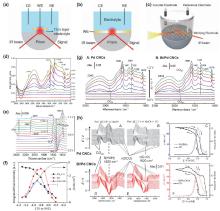
Fig 3
(a) Schematic illustration of the principle of the external reflection mode for in situ infrared spectroscopy, where CE is the counter electrode, WE is the working electrode and RE is the reference electrode (the same notation applies to subsequent figures) [75]. (b) Schematic illustration of the principle of internal reflection mode [75]. (c) Schematic representation of the apparatus configuration for in situ infrared spectroscopy [80]. (d) In situ IRRAS spectrum of ethanol electrooxidation catalyzed by Pt/TaC under alkaline conditions [76]. (e) In situ ATR-SEIRAS spectrum of the CO2 reduction reaction process using CO2-saturated KHCO3 as the electrolyte and a Cu thin film as the working electrode, with reference to the spectrum at 0.3 V vs. RHE [77]. (f) Evolution of current density and integrated intensities of characteristic infrared peaks as a function of electrode potential during in situ testing [77]. (g) In situ IRRAS spectra of the alcohol oxidation reaction in the 0.5 mol·L−1 NaOH + 0.5 mol·L−1 ethylene glycol system, with Pd CNCs as the catalyst for panel A and Bi-Pd CNCs for panel B, referenced to the spectrum at 0.15 V vs. RHE in the same system [81]. (h) In situ ATR-SEIRAS spectra of the alcohol oxidation reaction in the 0.5 mol·L−1 NaOH + 0.5 mol·L−1 ethylene glycol system, referenced to the spectrum at 1.02 V vs. RHE in the 0.5 mol·L−1 NaOH system [81]. The evolution of the current density and integrated intensity of the CO peak with electrode potential during the test is also shown, with panels A–C using Pd CNCs as the catalyst and panels D–F using Bi-Pd CNCs."
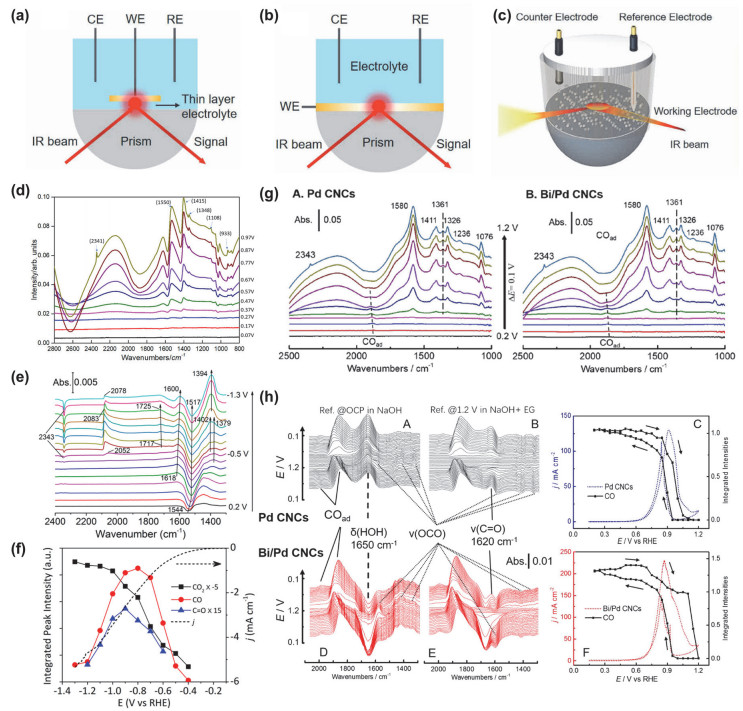
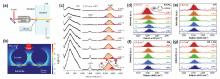
Fig 4
(a) Schematic diagram of the in situ shell-isolated nanoparticle-enhanced Raman spectroscopy setup; (b) Numerical simulation results of the electromagnetic enhancement field in Au@SiO2 core-shell structures for in situ surface-enhanced Raman spectroscopy; (c) In situ surface-enhanced Raman spectroscopy results of Pd(111)|0.1 mol·L−1 NaClO4 interface, all adapted from reference [88]; (d)–(g) In situ Raman spectra of probe molecules on cyanobenzoic acid (10 mmol·L−1) in four different electrolytes [82]."
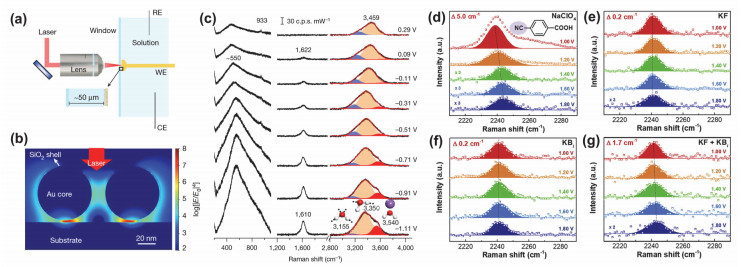
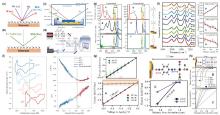
Fig 5
(a) Schematic diagram illustrating the fundamental principle of SFG-VS, redrawn based on reference [91]; (b) Schematic diagram depicting the basic principles of SHG; (c) Schematic diagram representing the device for SFG-VS [93]; (d) Schematic diagram showcasing the setup for SHG installation [95]; (e) Experimental and theoretical calculations of IR spectra (A and D) of PDI-W(CO)5 in solution, along with perpendicular SFG-VS spectra of PDI-W(CO)5 relative to the Au electrode surface at −0.4 V vs. Ag/Ag+ reference electrode (B and C denote experimental values, while E and F represent theoretical simulated values) [94]; (f) In situ SFG spectrum at the interface of Au|PDI-W(CO)5 | electrolyte denoted by A, and the relationship between the peak frequency ω(φ) and electrode potential φ, where B represents Au―C≡N, C corresponds to W―C≡W, and D signifies W―CO [94]. (g) For Au|PDI-W(CO)5 | electrolyte interface, (A) the relationship between interface electric field and electrode potential, (B) schematic diagram of the structure, and (C) electric field intensity at different positions in the double layer under varying electrode potentials [94]. (i) The CV curves and SHG measurements at the Pt | aqueous solution interface under different pH conditions, using electrolytes composed of specific ratios of HClO4 and NaOH [95]."
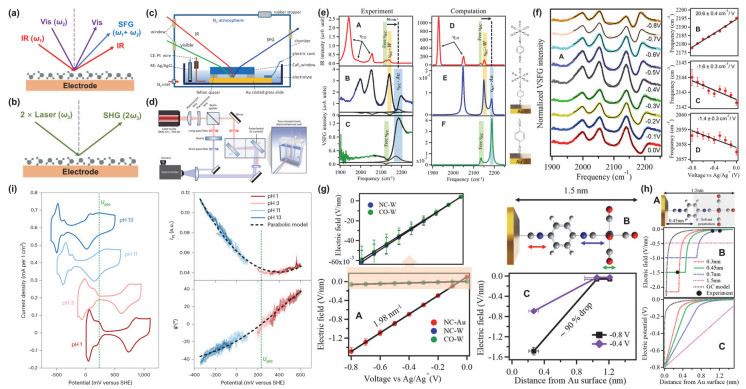
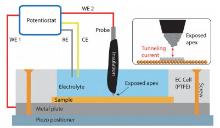
Fig 6
Schematic diagram of a typical experimental apparatus for electrochemical scanning tunneling microscopy, adapted from reference [101]."
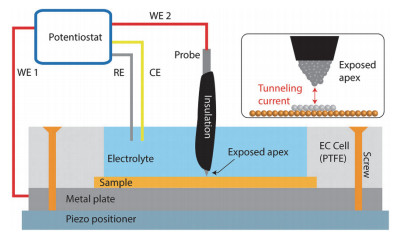
Fig 7
(a) Schematic representation of a conventional experimental setup for scanning electrochemical probe microscopy, adapted from reference 104; (b) Schematic representation of the substrate generation-tip collection mode in scanning electrochemical microscopy."
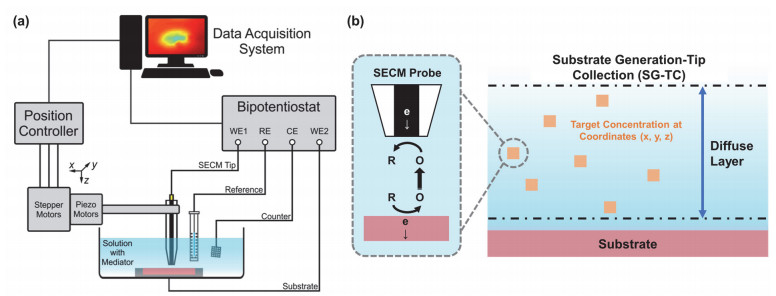
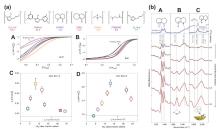
Fig 8
(a) ORR current-potential curves and current-pKa relationships (corresponding to C and D) after 7 ionic liquids with different pKa were modified on the Au/C (A) and Pt/C (B) working electrode surfaces, respectively [110]; (b) In situ ATR-SEIRAS using [MTBD][NTf2] modified Au/C as the working electrode, where the electrolyte is 0.1 mol·L−1 HClO4 saturated with oxygen: C=N stretching region (A), O-O-H bending vibration region (B) and X-H (X = N, O) stretching vibration region, all with open-circuit potential spectra as reference [110]."
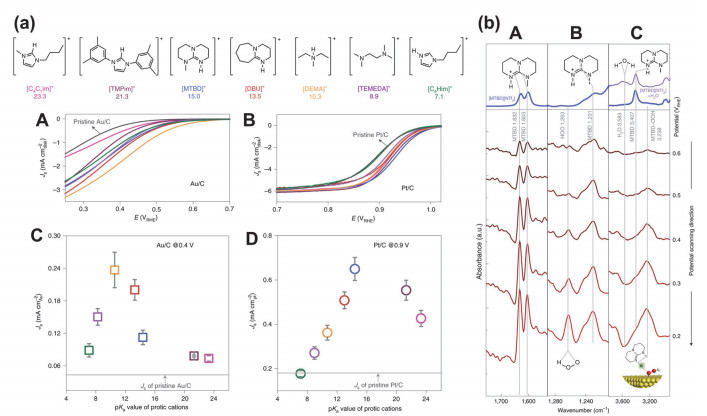
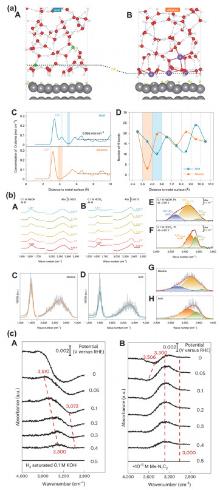
Fig 9
(a) Double layer structure under the hydrogen evolution potential on the surface of Pt(111) electrode in acid system (A) and alkaline system (B) simulated by AIMD, where the gray, red, white, green, purple and yellow spheres represent Pt, O, H, H3O+, Na+ and Had respectively, while the dashed blue lines represent hydrogen bonds. And the relationship between the concentration of O atom in water and the distance from the metal surface (C) and the number of hydrogen bonds perpendicular to the surface and the distance from the metal surface (D) [24]; (b) The ATR-SEIRAS spectra of alkaline system (A) and acidic system (B) and their respective O-H characteristic peaks (E, F) under 0.20 – −0.05 V vs. RHE test conditions were compared with the simulation results (C, D, G, H) [24]; (c) ATR-SEIRAS spectra without (A) and with (B) 1,2-dimethylimidazole added to the electrolyte [78]."
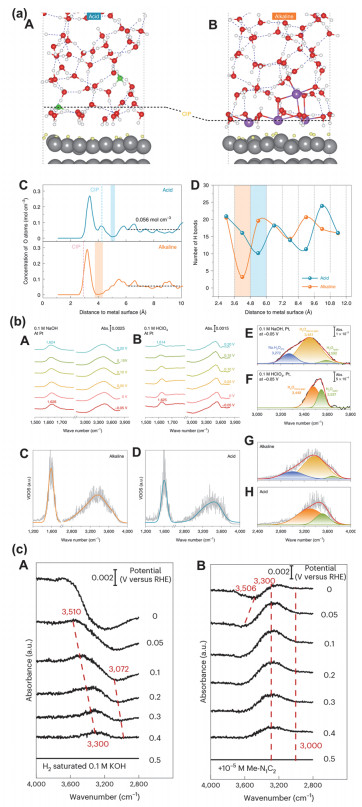
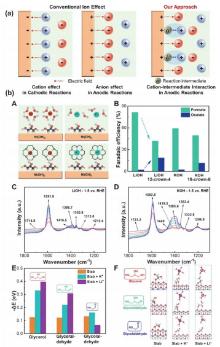
Fig 10
(a) Schematic diagram illustrating the conventional cationic effect and our newly discovered cationic effect [79]; (b) Experimental setup depicting the capture of Li+ and K+ by crown ether (A), changes in Faradaic efficiency of products before and after crown ether capture (B), in situ IRRAS spectrum recorded during electrolysis of 2 mol·L−1 LiOH + 0.1 mol·L−1 glycerol at 1.50 V vs. RHE for 30 minutes (C), In situ IRRAS spectra obtained during a 30-minute electrolysis of 2 mol·L−1 KOH + 0.1 mol·L−1 glycerol at 1.50 V vs. RHE (D). Changes in adsorption free energy (E) and adsorption structures (F) of glycerol, glyceraldehyde, and glycolaldehyde on NiOOH materials under different ion conditions [79]."
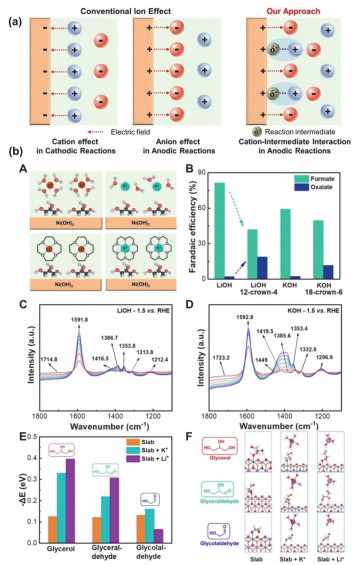
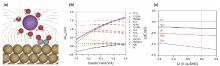
Fig 11
(a) Schematic diagram of cationic control interface electric field [118]; (b) The adsorption free energy change of Co2RR-related intermediates on the Cu(111) plane - electric field intensity curve [118]; (c) The energy-electrode potential relationship required for the hydrated cation in the bulk phase to enter the OHP of Cu(111) [118]."
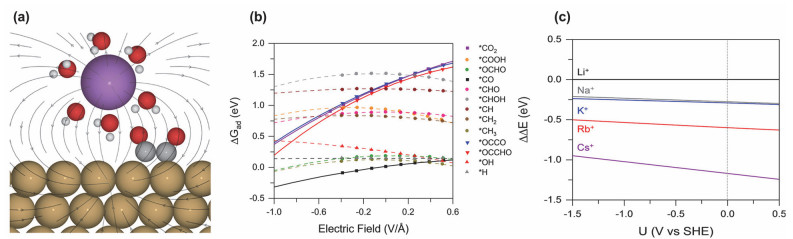
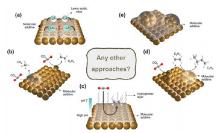
Fig 12
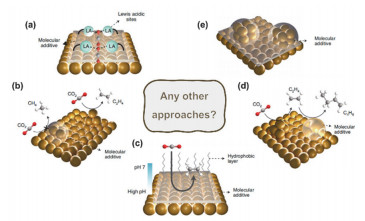
Five future directions for electrocatalytic reactions regulated by electrode side surface modification, adapted from the literature[120]. (a) Regulation of electrocatalytic reactions by altering interactions within the second coordination layer, such as hydrogen bonding and Lewis acid-base equivalence; (b) Control of reaction selectivity by surface modification to prevent the formation of by-products; (c) Modification of the surface hydrophilicity and pH to affect the electrocatalytic reaction; (d) Modification of different additives on the catalyst surface to promote a single reaction process, and coupling can achieve a series reaction; (e) Stabilization of the catalyst surface, such as maintaining a specific crystal surface with high catalytic activity."
| 1 |
doi: 10.1016/j.nanoen.2016.09.025 |
| 2 |
doi: 10.1038/s41578-021-00303-1 |
| 3 |
Bockris, J. O'. M.; Reddy, A. K. N.; Gamboa-Aldeco, M. Modern Electrochemistry 2A: Fundamentals of Electrodics, 2nd ed.; Kluwer Academic Publishers: New York, NY, USA, 2000; pp. 771–775.
|
| 4 |
|
|
许义飞; 杨瀚文; 常晓侠; 徐冰君. 物理化学学报, 2023, 39, 2210025.
doi: 10.3866/PKU.WHXB202210025 |
|
| 5 |
doi: 10.1039/D2TC01631A |
| 6 |
doi: 10.1007/s10008-024-05850-5 |
| 7 |
doi: 10.1051/jphystap:019100090045700 |
| 8 |
doi: 10.1080/14786440408634187 |
| 9 |
doi: 10.1002/bbpc.192400182 |
| 10 |
doi: 10.1021/cr60130a002 |
| 11 |
doi: 10.1038/s41467-024-46318-4 |
| 12 |
doi: 10.1038/s41929-020-00570-1 |
| 13 |
doi: 10.3389/fchem.2023.1231886 |
| 14 |
doi: 10.1007/s10008-011-1337-4 |
| 15 |
doi: 10.1016/0039-6028(69)90266-0 |
| 16 |
Bockris, J. O'. M.; Reddy, A. K. N.; Gamboa-Aldeco, M. Modern Electrochemistry 2A: Fundamentals of Electrodics, 2nd ed.; Kluwer Academic Publishers: New York, NY, USA, 2000; pp. 933–959, 1190–1201.
|
| 17 |
doi: 10.1039/C4CS00087K |
| 18 |
doi: 10.1002/anie.202403466 |
| 19 |
doi: 10.1080/14786444208520813 |
| 20 |
doi: 10.1021/ja01421a013 |
| 21 |
doi: 10.1039/tf9514700756 |
| 22 |
doi: 10.1098/rspa.1963.0114 |
| 23 |
Bockris, J. O'. M.; Reddy, A. K. N.; Gamboa-Aldeco, M. Modern Electrochemistry 2A: Fundamentals of Electrodics, 2nd ed.; Kluwer Academic Publishers: New York, NY, USA, 2000; pp. 895–919.
|
| 24 |
doi: 10.1038/s41929-022-00846-8 |
| 25 |
doi: 10.1038/s41570-021-00293-2 |
| 26 |
doi: 10.1002/aenm.202402974 |
| 27 |
|
|
张露露; 李琛坤; 黄俊. 电化学(中英文), 2022, 28(2), 2108471.
doi: 10.13208/j.electrochem.210847 |
|
| 28 |
doi: 10.1515/mlbmb-2017-0010 |
| 29 |
doi: 10.1080/00268977500103051 |
| 30 |
doi: 10.1039/F29807601388 |
| 31 |
doi: 10.1039/C8CP05113E |
| 32 |
doi: 10.1002/andp.19003060312 |
| 33 |
doi: 10.1063/1.447092 |
| 34 |
Bockris, J. O'. M.; Reddy, A. K. N.; Gamboa-Aldeco, M. Modern Electrochemistry 2A: Fundamentals of Electrodics, 2nd ed.; Kluwer Academic Publishers: New York, NY, USA, 2000; pp. 919–968.
|
| 35 |
doi: 10.1016/0013-4686(96)00060-6 |
| 36 |
doi: 10.1093/nsr/nwad166 |
| 37 |
doi: 10.1126/science.1132195 |
| 38 |
doi: 10.1007/s10008-020-04597-z |
| 39 |
|
|
方亚辉; 刘智攀. 催化学报, 2019, 40(s1), 90.
|
|
| 40 |
|
|
方亚辉; 刘智攀. 电化学(中英文), 2020, 26(1), 32.
doi: 10.13208/j.electrochem.181243 |
|
| 41 |
doi: 10.1021/jp047349j |
| 42 |
doi: 10.1021/acs.jpcc.3c03796 |
| 43 |
doi: 10.1021/acs.jpcc.1c10870 |
| 44 |
doi: 10.1021/jacs.2c08743 |
| 45 |
doi: 10.1021/acs.jpclett.5b01043 |
| 46 |
doi: 10.1039/D1CS00789K |
| 47 |
doi: 10.1039/D4TA02285H |
| 48 |
doi: 10.1021/jacsau.3c00410 |
| 49 |
doi: 10.1039/D1TA07791K |
| 50 |
doi: 10.1063/1.4946894 |
| 51 |
doi: 10.1002/wcms.1415 |
| 52 |
doi: 10.1016/j.matt.2020.11.010 |
| 53 |
doi: 10.1002/aenm.202200708 |
| 54 |
Bard, A. J.; Faulkner, L. R. Electrochemical Methods: Fundamentals and Applications, 2nd ed.; Wiley: New York, NY, USA, 2001; pp. 156–417.
|
| 55 |
Zhang, J. Q. Electrochemical Measurement Technology, 1st ed.; Chemical Industry Press: Beijing, 2010; pp. 73–300.
|
|
张鉴清等. 电化学测试技术, 第一版; 北京: 化学工业出版社, 2010; 73–300.
|
|
| 56 |
doi: 10.1007/s40828-015-0016-y |
| 57 |
Bockris, J. O'. M.; Reddy, A. K. N.; Gamboa-Aldeco, M. Modern Electrochemistry 2A: Fundamentals of Electrodics, 2nd ed.; Kluwer Academic Publishers: New York, NY, USA, 2000; pp. 859–869.
|
| 58 |
doi: 10.1021/j100722a045 |
| 59 |
doi: 10.1016/0039-6028(71)90246-9 |
| 60 |
doi: 10.1016/0022-0728(96)01006-6 |
| 61 |
doi: 10.1021/ac053370k |
| 62 |
doi: 10.1021/acs.jpcc.8b00272 |
| 63 |
doi: 10.1002/anie.201911929 |
| 64 |
doi: 10.1021/la702454k |
| 65 |
doi: 10.1021/acs.jpcc.7b00287 |
| 66 |
doi: 10.1016/j.jelechem.2006.02.012 |
| 67 |
Bard, A. J.; Faulkner, L. R. Electrochemical Methods: Fundamentals and Applications, 2nd ed.; Wiley: New York, NY, USA, 2001; pp. 537–544.
|
| 68 |
doi: 10.1016/j.susc.2014.04.014 |
| 69 |
doi: 10.20964/2021.03.50 |
| 70 |
doi: 10.1039/C3AN00791J |
| 71 |
doi: 10.1021/acscatal.0c04789 |
| 72 |
doi: 10.1039/D1CS00629K |
| 73 |
doi: 10.1007/s10008-009-0926-y |
| 74 |
doi: 10.1016/0022-0728(92)80463-E |
| 75 |
doi: 10.1016/S1872-2067(22)64157-3 |
| 76 |
doi: 10.1016/j.apcatb.2018.04.052 |
| 77 |
doi: 10.1021/jacs.7b10462 |
| 78 |
doi: 10.1038/s41560-023-01302-y |
| 79 |
doi: 10.1002/anie.202113362 |
| 80 |
doi: 10.1021/jacs.9b07000 |
| 81 |
doi: 10.1021/acscatal.6b03108 |
| 82 |
doi: 10.1016/j.chempr.2022.06.012 |
| 83 |
doi: 10.1038/nature08907 |
| 84 |
doi: 10.1002/anie.202014551 |
| 85 |
doi: 10.1021/jacs.0c11307 |
| 86 |
doi: 10.1021/jacs.0c04867 |
| 87 |
doi: 10.1016/j.ccr.2021.213824 |
| 88 |
doi: 10.1038/s41586-021-04068-z |
| 89 |
doi: 10.1039/D1SC01876K |
| 90 |
doi: 10.1039/D1CY01090E |
| 91 |
doi: 10.1116/6.0002007 |
| 92 |
doi: 10.1002/anie.201908722 |
| 93 |
doi: 10.1021/acs.accounts.9b00001 |
| 94 |
doi: 10.1021/jacs.2c05563 |
| 95 |
doi: 10.1038/s41563-023-01474-8 |
| 96 |
doi: 10.1016/j.coelec.2020.08.005 |
| 97 |
doi: 10.1515/pac-2019-1006 |
| 98 |
doi: 10.1038/ncomms12695 |
| 99 |
doi: 10.1016/j.matt.2021.09.024 |
| 100 |
doi: 10.1021/acs.chemrev.2c00766 |
| 101 |
doi: 10.1002/smtd.201800387 |
| 102 |
doi: 10.1021/ja071330n |
| 103 |
doi: 10.1038/s41467-023-39206-w |
| 104 |
doi: 10.1021/acs.chemrev.6b00067 |
| 105 |
doi: 10.1021/jacs.2c12775 |
| 106 |
doi: 10.1021/acs.analchem.9b04952 |
| 107 |
doi: 10.1038/s41560-020-00730-4 |
| 108 |
doi: 10.1038/s41467-023-36718-3 |
| 109 |
doi: 10.1038/s41467-023-35912-7 |
| 110 |
doi: 10.1038/s41929-021-00668-0 |
| 111 |
doi: 10.1002/adma.202200270 |
| 112 |
doi: 10.1038/s41929-019-0383-7 |
| 113 |
doi: 10.1021/la200694a |
| 114 |
doi: 10.1038/s41929-021-00655-5 |
| 115 |
doi: 10.1021/jacs.1c10171 |
| 116 |
doi: 10.1039/C9EE01341E |
| 117 |
doi: 10.1021/jacs.7b06765 |
| 118 |
doi: 10.1126/sciadv.abd2569 |
| 119 |
doi: 10.1021/jacs.3c00565 |
| 120 |
doi: 10.1038/s41563-020-0610-2 |
| [1] | Ruizhi Duan, Xiaomei Wang, Panwang Zhou, Yang Liu, Can Li. The role of hydroxyl species in the alkaline hydrogen evolution reaction over transition metal surfaces [J]. Acta Phys. -Chim. Sin., 2025, 41(9): 100111-. |
| [2] | Runhua Chen, Qiong Wu, Jingchen Luo, Xiaolong Zu, Shan Zhu, Yongfu Sun. Defective Ultrathin Two-Dimensional Materials for Photo-/Electrocatalytic CO2 Reduction: Fundamentals and Perspectives [J]. Acta Phys. -Chim. Sin., 2025, 41(3): 100019-. |
| [3] | Xue Dong, Xiaofu Sun, Shuaiqiang Jia, Shitao Han, Dawei Zhou, Ting Yao, Min Wang, Minghui Fang, Haihong Wu, Buxing Han. Electrochemical CO2 Reduction to C2+ Products with Ampere-Level Current on Carbon-Modified Copper Catalysts [J]. Acta Phys. -Chim. Sin., 2025, 41(3): 100024-. |
| [4] | Qing Li, Guangxun Zhang, Yuxia Xu, Yangyang Sun, Huan Pang. P-Regulated Hierarchical Structure Ni2P Assemblies toward Efficient Electrochemical Urea Oxidation [J]. Acta Phys. -Chim. Sin., 2024, 40(9): 2308045-. |
| [5] | Yan Kong, Wei Wei, Lekai Xu, Chen Chen. Electrochemical Synthesis of Organonitrogen Compounds from N-integrated CO2 Reduction Reaction [J]. Acta Phys. -Chim. Sin., 2024, 40(8): 2307049-. |
| [6] | Wentao Xu, Xuyan Mo, Yang Zhou, Zuxian Weng, Kunling Mo, Yanhua Wu, Xinlin Jiang, Dan Li, Tangqi Lan, Huan Wen, Fuqin Zheng, Youjun Fan, Wei Chen. Bimetal Leaching Induced Reconstruction of Water Oxidation Electrocatalyst for Enhanced Activity and Stability [J]. Acta Phys. -Chim. Sin., 2024, 40(8): 2308003-. |
| [7] | Ye Wang, Ruixiang Ge, Xiang Liu, Jing Li, Haohong Duan. An Anion Leaching Strategy towards Metal Oxyhydroxides Synthesis for Electrocatalytic Oxidation of Glycerol [J]. Acta Phys. -Chim. Sin., 2024, 40(7): 2307019-. |
| [8] | Xinyi Zhang, Kai Ren, Yanning Liu, Zhenyi Gu, Zhixiong Huang, Shuohang Zheng, Xiaotong Wang, Jinzhi Guo, Igor V. Zatovsky, Junming Cao, Xinglong Wu. Progress on Entropy Production Engineering for Electrochemical Catalysis [J]. Acta Phys. -Chim. Sin., 2024, 40(7): 2307057-. |
| [9] | Xin Feng, Kexin Guo, Chunguang Jia, Bowen Liu, Suqin Ci, Junxiang Chen, Zhenhai Wen. Hydrogen Generation Coupling with High-Selectivity Electrocatalytic Glycerol Valorization into Formate in an Acid-Alkali Dual-Electrolyte Flow Electrolyzer [J]. Acta Phys. -Chim. Sin., 2024, 40(5): 2303050-. |
| [10] | Lu Zhuoran, Li Shengkai, Lu Yuxuan, Wang Shuangyin, Zou Yuqin. Cleavage of C―C Bonds for Biomass Upgrading on Transition Metal Electrocatalysts [J]. Acta Phys. -Chim. Sin., 2024, 40(4): 2306003-. |
| [11] | Yanhui Guo, Li Wei, Zhonglin Wen, Chaorong Qi, Huanfeng Jiang. Recent Progress on Conversion of Carbon Dioxide into Carbamates [J]. Acta Phys. -Chim. Sin., 2024, 40(4): 2307004-. |
| [12] | Tao Wang, Qin Dong, Cunpu Li, Zidong Wei. Sulfur Cathode Electrocatalysis in Lithium-Sulfur Batteries: A Comprehensive Understanding [J]. Acta Phys. -Chim. Sin., 2024, 40(2): 2303061-. |
| [13] | Huasen Lu, Shixu Song, Qisen Jia, Guangbo Liu, Luhua Jiang. Advances in Cu2O-based Photocathodes for Photoelectrochemical Water Splitting [J]. Acta Phys. -Chim. Sin., 2024, 40(2): 2304035-. |
| [14] | Xinxuan Duan, Marshet Getaye Sendeku, Daoming Zhang, Daojin Zhou, Lijun Xu, Xueqing Gao, Aibing Chen, Yun Kuang, Xiaoming Sun. Tungsten-Doped NiFe-Layered Double Hydroxides as Efficient Oxygen Evolution Catalysts [J]. Acta Phys. -Chim. Sin., 2024, 40(1): 2303055-. |
| [15] | Hanyu Xu, Xuedan Song, Qing Zhang, Chang Yu, Jieshan Qiu. Mechanistic Insights into Water-Mediated CO2 Electrochemical Reduction Reactions on Cu@C2N Catalysts: A Theoretical Study [J]. Acta Phys. -Chim. Sin., 2024, 40(1): 2303040-. |
|
||