Acta Phys. -Chim. Sin. ›› 2026, Vol. 42 ›› Issue (1): 100157.doi: 10.1016/j.actphy.2025.100157
• ARTICLE • Previous Articles
Modulate surface potential well depth of Bi12O17Cl2 by FeOOH in Bi12O17Cl2@FeOOH heterojunction to boost piezoelectric charge transfer and piezo-self-Fenton catalysis
Jiangyuan Qiu1,2,3, Tao Yu1,2, Junxin Chen3, Wenxuan Li3, Xiaoxuan Zhang1,2, jinsheng Li1,2, Rui Guo1,2,*( ), Zaiyin Huang3,*(), Xuanwen Liu1,2,*()
- 1 School of Materials Science and Engineering, Northeastern University, Shenyang 110819, Liaoning Province, China
2 School of Resources and Materials, Northeastern University at Qinhuangdao, Qinhuangdao 066004, Hebei Province, China
3 School of Chemistry and Chemical Engineering, Guangxi Minzu University, Nanning 530006, Guangxi Zhuang Autonomous Region, China
-
Received:2025-05-04Revised:2025-08-10Accepted:2025-08-13Published:2025-11-01 -
Contact:

Cite this article
Jiangyuan Qiu, Tao Yu, Junxin Chen, Wenxuan Li, Xiaoxuan Zhang, jinsheng Li, Rui Guo, Zaiyin Huang, Xuanwen Liu. Modulate surface potential well depth of Bi12O17Cl2 by FeOOH in Bi12O17Cl2@FeOOH heterojunction to boost piezoelectric charge transfer and piezo-self-Fenton catalysis[J]. Acta Phys. -Chim. Sin. 2026, 42(1), 100157. doi: 10.1016/j.actphy.2025.100157
share this article
Fig 1
SEM images of (a) BOC, (b) FeOOH, (c) 0.35-BF and (f–i) EDX elemental maps of Bi, O, Cl and Fe in 0.35-BF; (d) and (e) TEM images of 0.35-BF."
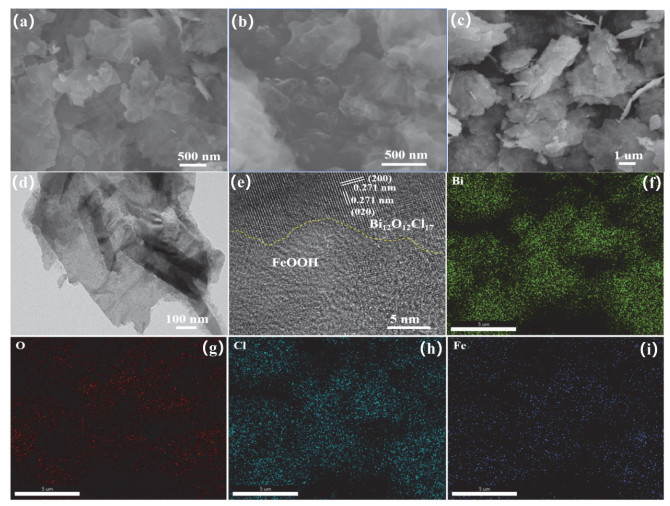
Fig 2
The XPS high resolution spectra of (a) Bi 4f, (b) Cl 2p, (c) Fe 2p, and (d) O 1s in BOC and 0.35-BF; (e) FT-IR spectra of BOC, FeOOH, and 0.35-BF; (f) Schematic illustration of interfacial Bi–O–Fe bond between FeOOH and BOC (010) facet."
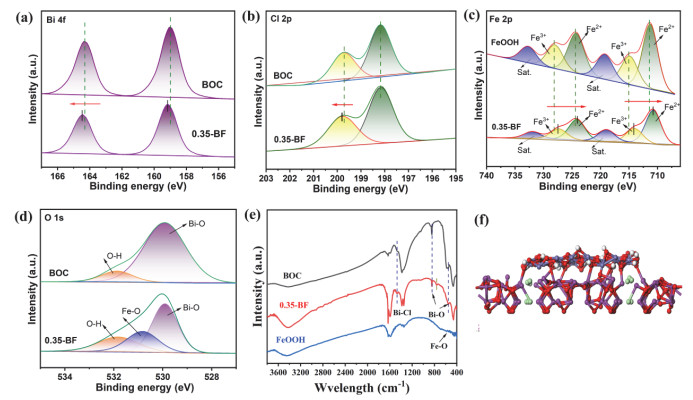
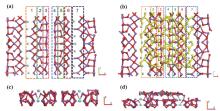
Fig 3
(a) and (b) Models of BOC and BOC@FeOOH; BOC layers in the figure are divided into 7 strips; (c) and (d) the side views of BOC and BOC@FeOOH, respectively."
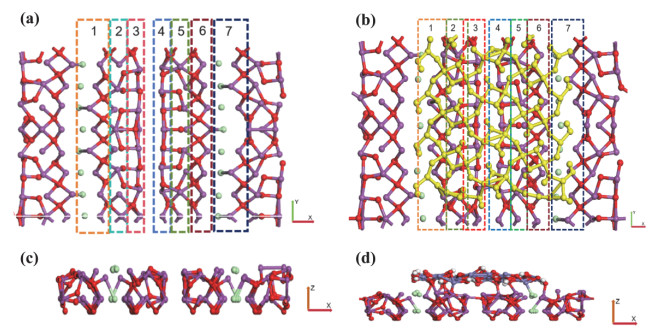
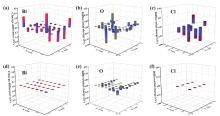
Fig 4
(a–c) Present the charge variations of Bi, Cl, and O atoms in strips 1–7 on pristine BOC surfaces under 1% compressive strain; (d–f) show corresponding variations in the BOC@FeOOH heterojunction structure."
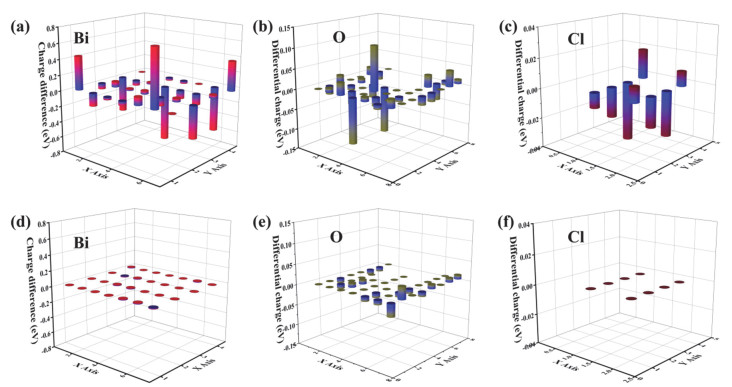
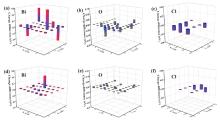
Fig 5
(a–c) present the charge variations of Bi, Cl, and O atoms in strips 1–7 on pristine BOC surfaces under 1% tensile strain; (d–f) show corresponding variations in the BOC@FeOOH heterojunction structure."
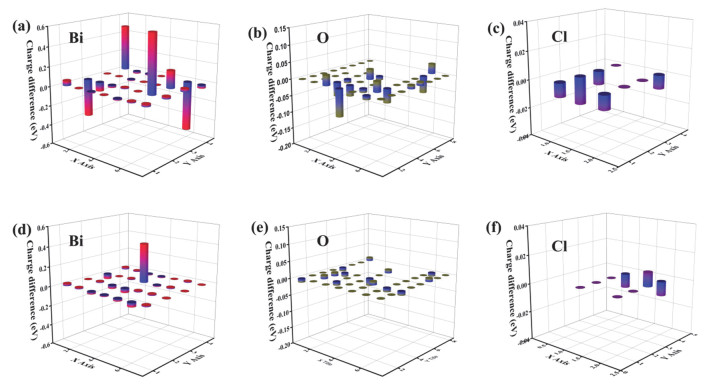
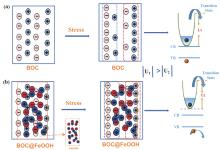
Fig 6
(a) and (b) schematically illustrate the stress-induced surface potential wells of the BOC component in pristine BOC and the BOC@FeOOH heterojunction, respectively, and their manipulation of piezo-carriers."
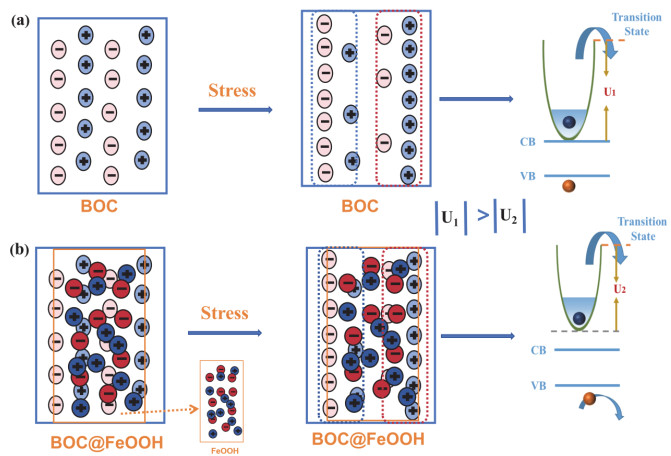
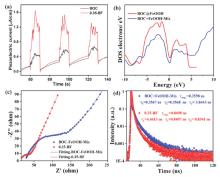
Fig 7
(a) Transient piezocurrent curves of BOC and 0.35-BF; (b) DOS of 0.35-BF and BOC+FeOOH-Mix; (c) EIS of 0.35-BF and BOC+FeOOH-Mix; (d) Transient fluorescence spectrum of 0.35-BF and BOC+FeOOH-Mix."
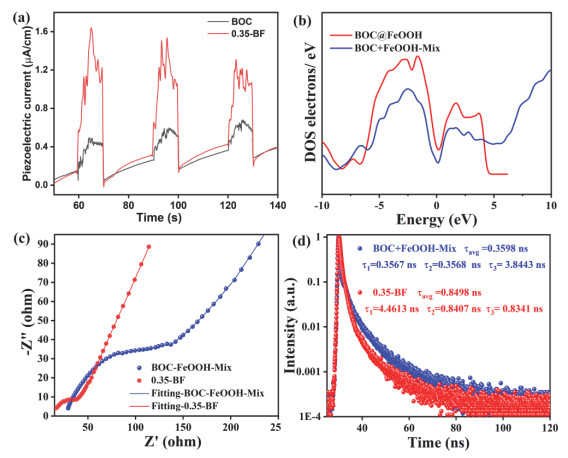
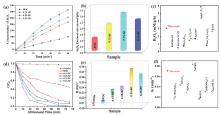
Fig 8
(a) Time-course curve of H₂O₂ generation rate by piezoelectric catalysts, (b) H₂O₂ generation rate via piezoelectric catalysis. (d) TC degradation and (e) Time courses of TC degradation evolved rate over different piezoelectric catalysts. (c) and (f) Performance comparison of TC degradation and H2O2 production over various representative piezoelectric catalysts."
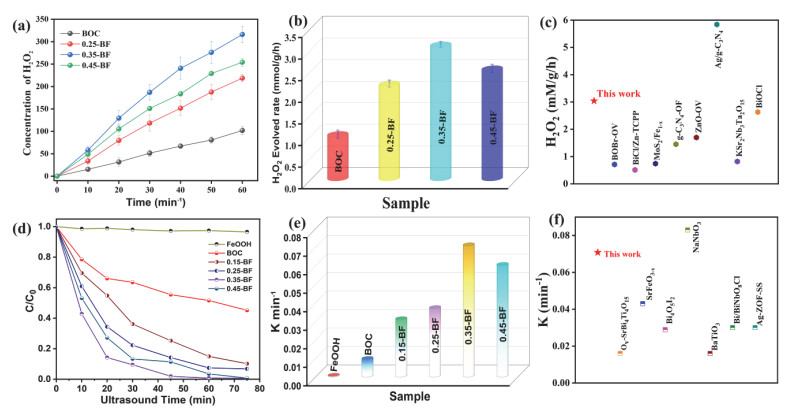
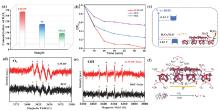
Fig 9
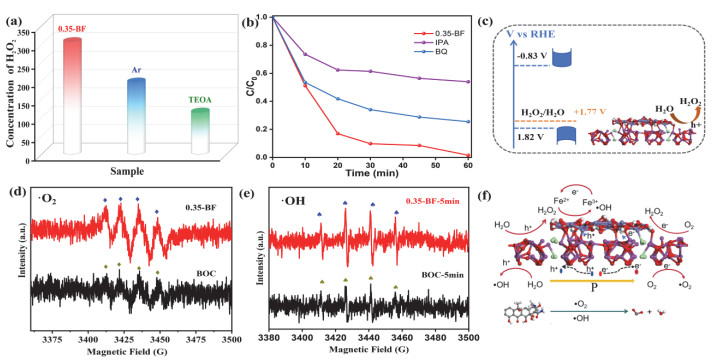
(a) H2O2 generation under different scavengers; (b) TC degradation under different scavengers; (c) Band alignments in BOC; (d) and (e) Detection of •O2− and •OH of BOC and 0.35-BF by ESR spectra; (f) Proposed piezoelectric catalytic mechanism of TC degradation in BOC@FeOOH heterojunction."
| 1 |
L. Gao, Y. Cao, L. Wang, S. Li. Front. Environ. Sci. Eng. 2021, 16 (6), 77.
doi: 10.1007/s11783-021-1511-6 |
| 2 |
F. Qin, J. Qiu, Q. Feng, K. Chen, X. Li, X. Zhang, C. Zuo, L. Feng, H. Zhu. Appl. Surf. Sci. 2024, 648, 158987.
doi: 10.1016/j.apsusc.2023.158987 |
| 3 |
K. Hou, Z. Pi, F. Chen, L. He, F. Yao, S. Chen, X. Li, H. Dong. Q. Yang. J. Hazard. Mater. 2022, 435, 128970.
doi: 10.1016/j.jhazmat.2022.128970 |
| 4 |
Y. Wu, H. Che, B. Liu, Y. Ao. Small Struct. 2023, 200c; 4 (7), 2200371.
doi: 10.1002/sstr.202200371 |
| 5 |
Z. Liang, Q. Yan, H. Ou, D. Li, Y. Zhang, J. Zhang, L. Zeng, M. Xing. Proc. Natl. Acad. Sci. 2024, 121 (9), e2317394121.
doi: 10.1073/pnas.2317394121 |
| 6 |
N. Tian, C. Hu, J. Wang, Y. Zhang, T. Ma, H. Huang. Coord. Chem. Rev. 2022, 463, 214515.
doi: 10.1016/j.ccr.2022.214515 |
| 7 |
P. Zhu, Y. Chen, J. Shi. Adv. Mater. 2020, 32 (29), 2001976.
doi: 10.1002/adma.202001976 |
| 8 |
C. Wang, C. Hu, F. Chen, H. Li, Y. Zhang, T. Ma, H. Huang. Adv. Funct. Mater. 2023, 33 (29), 2301144.
doi: 10.1002/adfm.202301144 |
| 9 |
L. Liu, M. Ruan, C. Wang, Z. Liu. Appl. Catal. B-Environ. Energy. 2024, 354, 124117.
doi: 10.1016/j.apcatb.2024.124117 |
| 10 |
S. Liu, B. Jing, C. Nie, Z. Ao, X. Duan, B. Lai, Y. Shao, S. Wang, T. An. Environ. Sci. -Nano 2021, 8 (3), 784.
doi: 10.1039/D0EN01237H |
| 11 |
M. Ran, B. Du, W. Liu, Z. Liang, L. Liang, Y. Zhang, L. Zeng, M. Xing. Proc. Natl. Acad. Sci. 2024, 121 (9), e2317435121.
doi: 10.1073/pnas.2317435121 |
| 12 |
Y. Zhang, L. Wang, H. Huang, C. Hu, X. Zhang, C. Wang, Y. Zhang. Appl. Catal. B-Environ. 2023, 331, 122714.
doi: 10.1016/j.apcatb.2023.122714 |
| 13 |
P. Zhou, W. Ren, G. Nie, X. Li, X. Duan, Y. Zhang, S. Wang. Angew. Chem. Int. Ed. 2020, 59 (38), 16517.
doi: 10.1002/anie.202007046 |
| 14 |
F. Wang, J. Xu, Z. Wang, Y. Lou, C. Pan, Y. Zhu. Appl. Catal. B-Environ. 2022, 312, 121438.
doi: 10.1016/j.apcatb.2022.121438 |
| 15 |
R. Guo, X. Zhang, A. Kuklin, G. Peng, L. Jin, Y. Chen, A. Hans, Y. Zhang. J. Hazard. Mater. 2025, 490, 137774.
doi: 10.1016/j.jhazmat.2025.137774 |
| 16 |
X. Ning, D. Jia, S. Li, M. Khan, A. Hao. Rare Met. 2023, 42 (9), 3034.
doi: 10.1007/s12598-023-02363-4 |
| 17 |
R. Su, J. Zhang, V. Wong, D. Zhang, Y. Yang, Z. Luo, X. Wang, H. Wen, Y. Liu, J. Seidel, et al.. Adv. Mater. 2023, 35 (42), 2303018.
|
| 18 |
X. Ning, A. Hao, X. Qiu. Adv. Funct. Mater. 2025, 35 (2), 2413217.
doi: 10.1002/adfm.202413217 |
| 19 |
F. Huang, W. Wang, G. Li, M. Humayun, Q. Yu, Y. Wang, C. Wang, J. Wang. Rare Met. 2025, 44 (6), 3981.
doi: 10.1007/s12598-024-03203-9 |
| 20 |
Q. Tang, R. Sanchis-Gual, N. Qin, H. Ye, S. Sevim, A. Veciana, C. Corral-Casas, K. Thodkar, J. Wu, B. J. Nelson, et al.. J. Am. Chem. Soc. 2025, 147 (10), 8289.
doi: 10.1021/jacs.4c15681 |
| 21 |
T. Takada, Y. Hayase, Y. Tanaka, T. Okamoto. IEEE Trans. Dielectr. Electr. Insul. 2008, 15 (1), 152.
doi: 10.1109/T-DEI.2008.4446746 |
| 22 |
H. Wu, F. Zhuo, H. Qiao, L. Kodumudi Venkataraman, M. Zheng, S. Wang, H. Huang, B. Li, X. Mao, Q. Zhang. Energy Environ. Mater. 2022, 5 (2), 486.
doi: 10.1002/eem2.12237 |
| 23 |
H. Zheng, Y. Wang, J. Liu, J. wang, K. Yan, K. Zhu. Appl. Catal. B-Environ. 2024, 341, 123335.
doi: 10.1016/j.apcatb.2023.123335 |
| 24 |
J. Qiu, X. Lei, B. Wang, H. Zhang, J. You, R. Guo, X. Liu. Coord. Chem. Rev. 2024, 519, 216115.
doi: 10.1016/j.ccr.2024.216115 |
| 25 |
Y. Wu, P. Wang, H. Che, W. Liu, C. Tang, Y. Ao. Angew. Chem. Int. Ed. 2024, 63 (6), e202316410.
doi: 10.1002/anie.202316410 |
| 26 |
X. Hou, X. Huang, F. Jia, Z. Ai, J. Zhao, L. Zhang. Environ. Sci. Technol. 2017, 51 (9), 5118.
doi: 10.1021/acs.est.6b05906 |
| 27 |
J. Tang, R. Xu, G. Sui, D. Guo, Z. Zhao, S. Fu, X. Yang, Y. Li, J. Li. Small 2023, 19 (22), 2208232.
doi: 10.1002/smll.202208232 |
| 28 |
J. Li, G. Zhan, Y. Yu, L. Zhang. Nat. Commun. 2016, 7 (1), 11480.
doi: 10.1038/ncomms11480 |
| 29 |
C. Zhu, Q. He, T. Sun, M. Xu, J. Wang, Q. jin, C. Chen, X. Duan, H. Xu, S. Wang. Chem. Eng. J. 2023, 464, 142704.
doi: 10.1016/j.cej.2023.142704 |
| 30 |
Y. Zhang, J. Di, X. Zhu, M. Ji, C. Chen, Y. Liu, L. Li, T. Wei, H. Li, J. Xia. Appl. Catal. B-Environ. 2023, 323, 122148.
doi: 10.1016/j.apcatb.2022.122148 |
| 31 |
L. Yu, X. Liu, H. Zhang, B. Zhou, Z. Chen, H. Li, L. Zhang. J. Am. Chem. Soc. 2024, 146 (47), 32816.
doi: 10.1021/jacs.4c13254 |
| 32 |
S. Zhou, H. He, J. Li, Z. Ye, Z. Liu, J. Shi, Y. Hu. W. Cai. Adv. Funct. Mater. 2024, 34 (12), 2313770.
doi: 10.1002/adfm.202313770 |
| 33 |
S. Guo, Z. Hu, M. Zhen, B. Gu, B. Shen, F. Dong. Appl. Catal. B-Environ. 2020, 264, 118506.
doi: 10.1016/j.apcatb.2019.118506 |
| 34 |
S. Nayak, G. Swain, K. Parida. ACS Applied Materials & Interfaces. 2019, 11 (23), 20923.
doi: 10.1021/acsami.9b06511 |
| 35 |
Y. Zhang, X. Zhai, N. Wang, J. Sun, F. Ma, K. Dou, P. Ju, J. Duan, B. Hou. J. Environ. Chem. Eng. 2024, 12 (2), 112163.
doi: 10.1016/j.jece.2024.112163 |
| 36 |
Y. Shi, H. Li, C. Mao, G. Zhan, Z. Yang, C. Ling, K. Wei, X. Liu, Z. Ai. L. ACS ES & T Eng. 2022, 2 (6), 957.
doi: 10.1021/acsestengg.1c00466 |
| 37 |
X. Lu, K. Ye, S. Zhang, J. Zhang, J. Yang, Y. Huang, H. Ji. Chem. Eng. J. 2022, 428, 131027.
doi: 10.1016/j.cej.2021.131027 |
| 38 |
Q. Chai, Z. Liu, Z. Deng, Z. Peng, X. Chao, J. Lu, H. Huang, S. Zhang, Z. Yang. Nat. Commun. 2025, 16 (1), 1633.
doi: 10.1038/s41467-025-56767-0 |
| 39 |
S. Rauf, M. B. Hanif, F. Wali, Z. Tayyab, B. Zhu, N. Mushtaq, Y. Yang, K. Khan, P. D. Lund, M. Motola, W. Xu. Energy Environ. Mater. 2024, 7 (3), e12606.
doi: 10.1002/eem2.12606 |
| 40 |
J. Guo, Z. Lei, F. Wang, J. Xu, S. Xu. Chemosensors 2020, 8 (3), 50.
doi: 10.3390/chemosensors8030050 |
| 41 |
V. R. Khalilov, F. K. Chibirova. Chibirova. J. Phys. A Math. Theor. 2007, 40 (24), 6469.
doi: 10.1088/1751-8113/40/24/013 |
| 42 |
R. Sun, Z. Zhu, N. Tian, Y. Zhang, H. Huang. Angew. Chem. Int. Ed. 2024, 63 (41), e202408862.
doi: 10.1002/anie.202408862 |
| 43 |
J. Hu, B. Li, X. Li, T. Yang, X. Yang, J. Qu, Y. Cai, H. Yang, Z. Lin. Adv. Mater. 2024, 36 (49), 2412070.
doi: 10.1002/adma.202412070 |
| 44 |
N. Chen, S. Che, Y.-H. Zhang, H. Li, Y. Li, X. He. Rare Met. 2025, 44 (7), 4740.
doi: 10.1007/s12598-025-03295-x |
| 45 |
Z. Bian, T. Tachikawa, P. Zhang, M. Fujitsuka, T. Majima. Nat. Commun. 2014, 5 (1), 3038.
doi: 10.1038/ncomms4038 |
| 46 |
R. Li, J. Hu, M. Deng, H. Wang, X. Wang, Y. Hu, H. Jiang, J. Jiang, Q. Zhang, Y. Xie, Y. Xiong. Adv. Mater. 2014, 26 (28), 4783.
|
| 47 |
J. Qiu, H. Feng, Z. Chen, S. Ruan, Y.- Chen, T. Xu, J. Su, E. Ha, L. Wang. Rare Met. 2022, 41 (6), 2074.
doi: 10.1007/s12598-021-01929-4 |
| 48 |
W. Yu, C. Hu, L. Bai, N. Tian, Y. Zhang, H. Huang. Nano Energy 2022, 104, 107906.
doi: 10.1016/j.nanoen.2022.107906 |
| 49 |
J. Xie, C. Zhang, T. D. Waite. Water Res. 2022, 217, 118425.
doi: 10.1016/j.watres.2022.118425 |
| 50 |
W. Shi, W. Sun, Y. Liu, K. Zhang, H. Sun, X. Lin, Y. Hong, F. Guo, W. Shi, W. Sun, et al.. J. Hazard. Mater. 2022, 436, 129141.
doi: 10.1016/j.jhazmat.2022.129141 |
| 51 |
J. Qiu, J. Chen, B. Xiao, X. Li, T. Wan, F. Qin, Y. Mi, Z. Huang. Catal. Lett. 2020, 150 (1), 222.
doi: 10.1007/s10562-019-02920-6 |
| [1] | Peng Zhang, Jiquan Wang, Yuan Li, Lisha Jiang, Zhuangzhuang Wang, Gaoke Zhang. Non-Noble-Metallic Cocatalyst Ni2P Nanoparticles Modified Graphite-Like Carbonitride with Enhanced Photocatalytic Hydrogen Evolution under Visible Light Irradiation [J]. Acta Phys. -Chim. Sin., 2021, 37(8): 2009102-. |
| [2] | PENG Jin-Ping, ZHANG Dong-Dong, GUAN Li, ZHANG Hui, ZHANG Zhong, QIU Xiao-Hui. An Electrostatic Force Microscopy Investigation of the Dynamic Properties of Microscopic Interface in Nanocomposites [J]. Acta Phys. -Chim. Sin., 2013, 29(07): 1603-1608. |
| [3] | LI Rui, LI Hang. Comparison Study between Mg2+-K+ and Ca2+-K+ Exchange Kinetics under Electric Fields at the Solid-Liquid Interface of Soil [J]. Acta Phys. -Chim. Sin., 2010, 26(03): 552-560. |
|
||