Acta Phys. -Chim. Sin. ›› 2026, Vol. 42 ›› Issue (1): 100149.doi: 10.1016/j.actphy.2025.100149
• ARTICLE • Previous Articles Next Articles
SBA-15 templated covalent triazine frameworks for boosted photocatalytic hydrogen production
Chengxiao Zhao1, Zhaolin Li1,2, Dongfang Wu2,*( ), Xiaofei Yang1,*()
- 1 College of Science, Nanjing Forestry University, Nanjing 210037, Jiangsu Province, China
2 School of Chemistry and Chemical Engineering, Southeast University, Nanjing 211189, Jiangsu Province, China
-
Received:2025-06-24Revised:2025-08-02Accepted:2025-08-04Published:2025-11-01 -
Contact:

Cite this article
Chengxiao Zhao, Zhaolin Li, Dongfang Wu, Xiaofei Yang. SBA-15 templated covalent triazine frameworks for boosted photocatalytic hydrogen production[J]. Acta Phys. -Chim. Sin. 2026, 42(1), 100149. doi: 10.1016/j.actphy.2025.100149
share this article
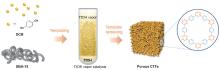
Fig 1
Schematic illustration of the synthesis procedure for CTF-Sx."
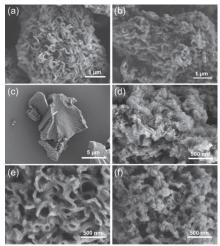
Fig 2
SEM images of (a) SBA-15, (b) SBA-15@CTF-1, (c) pristine CTF-1, (d) CTF-S1, (e) CTF-S2, and (f) CTF-S3."
Fig 3
(a, b) TEM images and (c) element mapping of CTF-S2. Optical images illustrating the surface hydrophilicity of (d) CTF-1, (e) CTF-S1, (f) CTF-S2, and (g) CTF-S3."
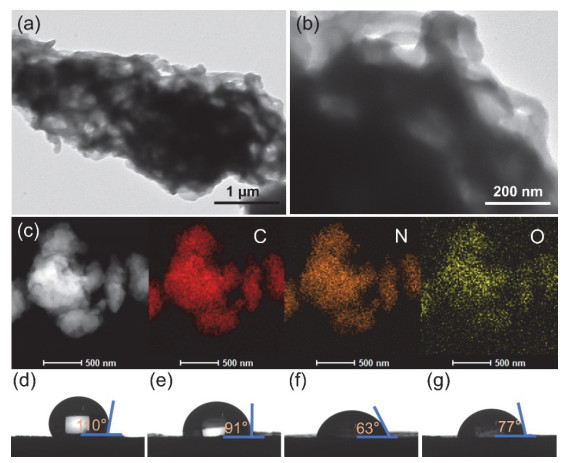
Fig 4
(a) PXRD patterns of CTF-1 and CTF-Sx; (b) FTIR spectra of DCB, SBA-15, CTF-1 and CTF-S2; high-resolution XPS spectra of CTF-S2: (c) C 1s and (d) N 1s."
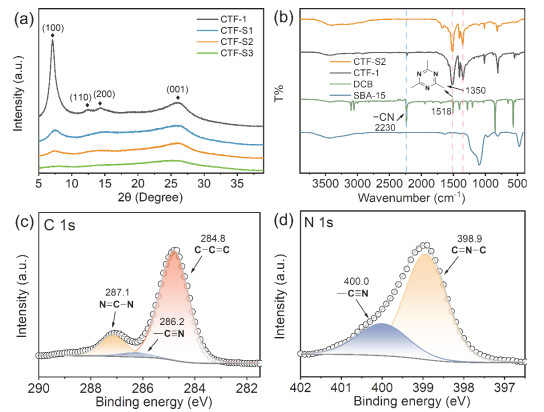
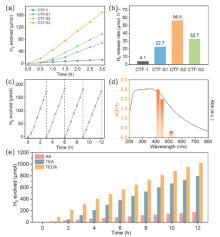
Fig 5
(a, b) Photocatalytic H2 production and H2 releasing rates for CTF-1 and CTF-Sx. (c) Photocatalytic stability and (d) AQY values of CTF-S2. (e) The evolution of photocatalytic H2 production by CTF-S2 (50 mg) in AA, TEA, and TEOA solutions, respectively."
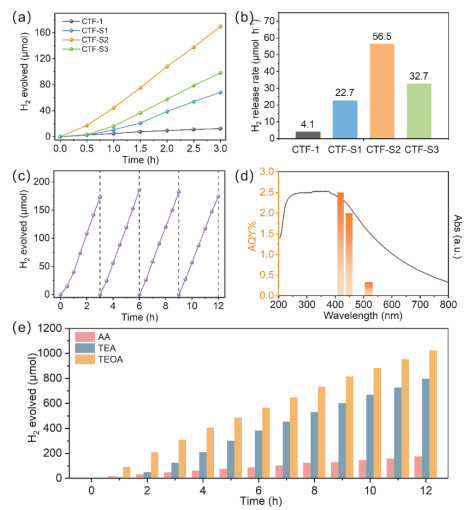
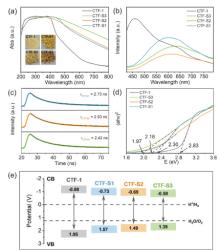
Fig 6
(a) UV-Vis DRS spectra, (b) Steady-state PL spectra of CTF-1 and CTF-Sx; (c) Time-resolved PL decay spectra of CTF-Sx; (d) Tauc plots, (e) band structure diagrams of CTF-1 and CTF-Sx."
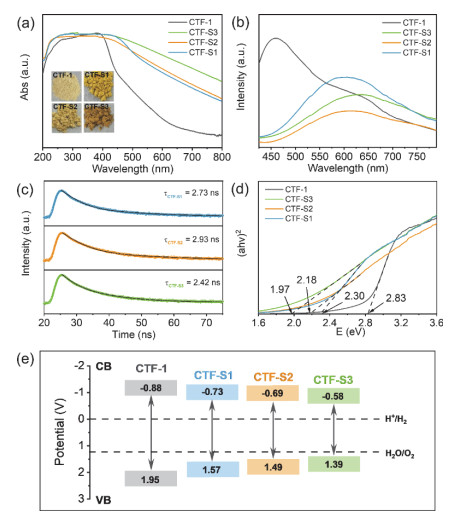
Fig 7
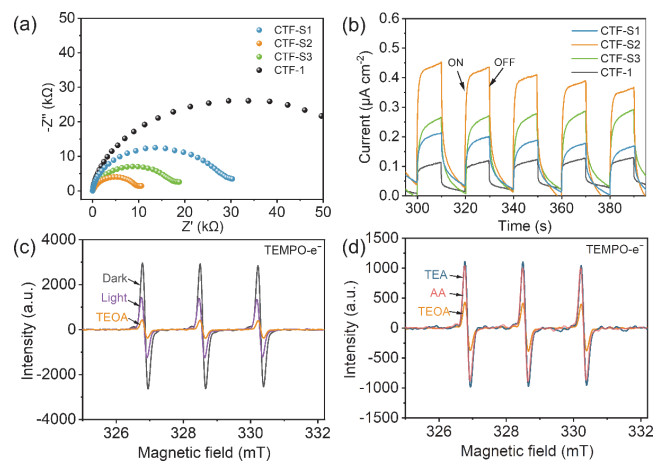
(a) EIS plots and (b) photocurrent response curves of CTF-1 and CTF-Sx. EPR spectra of CTF-S2 under various conditions: (c) in dark and illumination for 5 min, (d) illumination for 5 min in the presence of AA, TEA and TEOA."
| 1 |
T. Zhang, G. Zhang, L. Chen. Acc. Chem. Res. 2022, 55, 795.
doi: 10.1021/acs.accounts.1c00693 |
| 2 |
C. Qian, L. Feng, W.L. Teo, J. Liu, W. Zhou, D. Wang, Y. Zhao. Nat. Rev. Chem. 2022, 6, 881.
doi: 10.1038/s41570-022-00437-y |
| 3 |
L. Wang, Y. Zhang. Small 2025, 21, 2408395.
doi: 10.1002/smll.202408395 |
| 4 |
A. Rodríguez-Camargo, K. Endo, B.V. Lotsch. Angew. Chem. Int. Ed. 2024, 63, e202413096.
doi: 10.1002/anie.202413096 |
| 5 |
L. Yuan, Y. Peng, Z.-J. Guan, Y. Fang. Acta Phys. Chim. Sin. 2025, 41, 100086.
doi: 10.1016/j.actphy.2025.100086 |
| 6 |
Z. Lu, H. Lv, Q. Liu, Z. Wang. Acta Phys. Chim. Sin. 2024, 40, 2405005.
doi: 10.3866/PKU.WHXB202405005 |
| 7 |
C. Zhuang, W. Li, Y. Chang, S. Li, Y. Zhang, Y. Li, J. Gao, G. Chen, Z. Kang. J. Mater. Chem. A 2024, 12, 5711.
doi: 10.1039/D3TA07951A |
| 8 |
J. Zhang, G. Yu, C. Yang, S. Li. Curr. Opin. Chem. Eng. 2024, 45, 101040.
doi: 10.1016/j.coche.2024.101040 |
| 9 |
C. Krishnaraj, H.S. Jena, K. Leus, P. Van der Voort. Green Chem. 2020, 22, 1038.
doi: 10.1039/C9GC03482J |
| 10 |
A.J. Liang, W.B. Li, A.B. Li, H. Peng, G.F. Ma, L. Zhu, Z.Q. Lei, Y.X. Xu. Nano Res. 2024, 17, 7830.
doi: 10.1007/s12274-024-6779-y |
| 11 |
R. Sun, B. Tan. Chem. Eur. J. 2023, 29, e202203077.
doi: 10.1002/chem.202203077 |
| 12 |
S.Y. Yu, J. Mahmood, H.J. Noh, J.M. Seo, S.M. Jung, S.H. Shin, Y.K. Im, I.Y. Jeon, J.B. Baek. Angew. Chem. Int. Ed. 2018, 57, 8438.
doi: 10.1002/anie.201801128 |
| 13 |
T. Sun, Y. Liang, W. Luo, L. Zhang, X. Cao, Y. Xu. Angew. Chem. Int. Ed. 2022, 61, e202203327.
doi: 10.1002/anie.202203327 |
| 14 |
Z. Yang, H. Chen, S. Wang, W. Guo, T. Wang, X. Suo, D.-E. Jiang, X. Zhu, I. Popovs, S. Dai. J. Am. Chem. Soc. 2020, 142, 6856.
doi: 10.1021/jacs.0c00365 |
| 15 |
C. Zhao, Z. Li, X. Wu, H. Su, F.-Q. Bai, X. Ran, L. Yang, W. Fang, X. Yang. Small 2024, 20, 2400541.
doi: 10.1002/smll.202400541 |
| 16 |
Z. Li, T. Li, J. Miao, C. Zhao, Y. Jing, F. Han, K. Zhang, X. Yang. Sci. China Mater. 2023, 66, 2290.
doi: 10.1007/s40843-022-2394-6 |
| 17 |
T. Sun, Y. Liang, Y. Xu. Angew. Chem. Int. Ed. 2022, 61, e202113926.
doi: 10.1002/anie.202113926 |
| 18 |
C.X. Wang, P. Lyu, Z. Chen, Y.X. Xu. J. Am. Chem. Soc. 2023, 145, 12745.
doi: 10.1021/jacs.3c02874 |
| 19 |
Z.-A. Lan, M. Wu, Z. Fang, Y. Zhang, X. Chen, G. Zhang, X. Wang. Angew. Chem. Int. Ed. 2022, 61, e202201482.
doi: 10.1002/anie.202201482 |
| 20 |
S.Q. Zhang, G. Cheng, L.P. Guo, N. Wang, B.E. Tan, S.B. Jin. Angew. Chem. Int. Ed. 2020, 59, 6007.
doi: 10.1002/anie.201914424 |
| 21 |
K. Huang, D. Chen, X. Zhang, R. Shen, P. Zhang, D. Xu, X. Li. Acta Phys. Chim. Sin. 2024, 40, 2407020.
doi: 10.3866/PKU.WHXB202407020 |
| 22 |
C.X. Wang, H.L. Zhang, W.J. Luo, T. Sun, Y.X. Xu. Angew. Chem. Int. Ed. 2021, 60, 25381.
doi: 10.1002/anie.202109851 |
| 23 |
S. Li, M.-F. Wu, T. Guo, L.-L. Zheng, D. Wang, Y. Mu, Q.-J. Xing, J.-P. Zou. Appl. Catal. B Environ. 2020, 272, 118989.
doi: 10.1016/j.apcatb.2020.118989 |
| 24 |
K. Shen, L. Zhang, X. Chen, L. Liu, D. Zhang, Y. Han, J. Chen, J. Long, R. Luque, Y. Li, B. Chen. Science 2018, 359, 206.
doi: 10.1126/science.aao3403 |
| 25 |
H. Luo, Y.V. Kaneti, Y. Ai, Y. Wu, F. Wei, J. Fu, J. Cheng, C. Jing, B. Yuliarto, M. Eguchi, J. Na, Y. Yamauchi, S. Liu. Adv. Mater. 2021, 33, 2007318.
doi: 10.1002/adma.202007318 |
| 26 |
R.-R. Liang, S.-Y. Jiang, R.-H. A, X. Zhao. Chem. Soc. Rev. 2020, 49, 3920.
doi: 10.1039/D0CS00049C |
| 27 |
F. Heck, L. Grunenberg, N. Schnabel, T. Sottmann, L. Yao, B.V. Lotsch, ChemRxiv Version 1 (2024), https://doi.org/10.26434/chemrxiv-2024-wd9ft.
|
| 28 |
I.E. Khalil, P. Das, H. Küçükkeçeci, V. Dippold, J. Rabeah, W. Tahir, J. Roeser, J. Schmidt, A. Thomas. Chem Mater 2024, 36, 8330.
doi: 10.1021/acs.chemmater.4c01298 |
| 29 |
N. He, Y. Zou, C. Chen, M. Tan, Y. Zhang, X. Li, Z. Jia, J. Zhang, H. Long, H. Peng, K. Yu, B. Jiang, Z. Han, N. Liu, Y. Li, L. Ma. Nat. Commun. 2024, 15, 3896.
doi: 10.1038/s41467-024-48160-0 |
| 30 |
X. Yang, L. Tian, X. Zhao, H. Tang, Q. Liu, G. Li. Appl. Catal. B Environ. 2019, 244, 240.
doi: 10.1016/j.apcatb.2018.11.056 |
| 31 |
T. Zhang, Y. Hou, V. Dzhagan, Z. Liao, G. Chai, M. Löffler, D. Olianas, A. Milani, S. Xu, M. Tommasini, D.R.T. Zahn, Z. Zheng, E. Zschech, R. Jordan, X. Feng. Nat. Commun. 2018, 9, 1140.
doi: 10.1038/s41467-018-03444-0 |
| 32 |
Y. Lu, Z. Li, J. Liang, X. Xu, G. Zhang, H. Min. Desalination 2024, 592, 118196.
doi: 10.1016/j.desal.2024.118196 |
| 33 |
Z. Shen, X. Wang, D. Fan, X. Xu, Y. Lu. J. Mater. Sci. 2023, 58, 13154.
doi: 10.1007/s10853-023-08849-x |
| 34 |
J. Liu, W. Zan, K. Li, Y. Yang, F. Bu, Y. Xu. J. Am. Chem. Soc. 2017, 139, 11666.
doi: 10.1021/jacs.7b05025 |
| 35 |
K. Wu, Q. Ye, L. Wang, F. Meng, H. Dai. Appl. Clay Sci. 2022, 229, 106660.
doi: 10.1016/j.clay.2022.106660 |
| 36 |
S. Cao, B. Zhong, C. Bie, B. Cheng, F. Xu. Acta Phys. Chim. Sin. 2024, 40, 2307016.
doi: 10.3866/PKU.WHXB202307016 |
| 37 |
L. Zhang, J. Zhang, J. Yu. H. García. Nat. Rev. Chem. 2025, 9, 328.
doi: 10.1038/s41570-025-00698-3 |
| 38 |
J. Zhu, S. Wageh, A.A. Al-Ghamdi. Chin. J. Catal. 2023, 49, 5.
doi: 10.1016/S1872-2067(23)64438-9 |
| 39 |
C. Wang, C. You, K. Rong, C. Shen, F. Yang, S. Li. Acta Phys. Chim. Sin. 2024, 40, 2307045.
doi: 10.3866/PKU.WHXB202307045 |
| 40 |
S. Li, C. You, K. Rong, C. Zhuang, X. Chen, B. Zhang. Adv. Powder Mater. 2024, 3, 100183.
doi: 10.1016/j.apmate.2024.100183 |
| 41 |
M. Cai, Y. Liu, K. Dong, X. Chen, S. Li. Chin. J. Catal. 2023, 52, 239.
doi: 10.1016/S1872-2067(23)64496-1 |
| 42 |
D. Kong, X. Han, J. Xie, Q. Ruan, C.D. Windle, S. Gadipelli, K. Shen, Z. Bai, Z. Guo, J. Tang. ACS Catal. 2019, 9, 7697.
doi: 10.1021/acscatal.9b02195 |
| 43 |
J.-H. Tsai, T.-Y. Lee, H.-L. Chiang. Nanomaterials 2023, 13, 1015.
doi: 10.3390/nano13061015 |
| 44 |
Z. Li, T. Deng, S. Ma, Z. Zhang, G. Wu, J. Wang, Q. Li, H. Xia, S.-W. Yang, X. Liu. J. Am. Chem. Soc. 2023, 145, 8364.
doi: 10.1021/jacs.2c11893 |
| [1] | Ying Wang, Mingcheng Yang, Zhu Yin, Yingqi Wang, Jiajia Cheng. Transition metal-free poly(heptazine imide) photocatalyst for C–X bond construction from katritzky salts [J]. Acta Phys. -Chim. Sin., 2026, 42(7): 100212-. |
| [2] | Shuangshuang Mao, Juhua Luo, Bingjie Han, Jiahuan Shi, Yujia Gu. Covalent organic framework-derived Fe3C/NC/TiO2 heterostructures for high-performance electromagnetic wave absorption [J]. Acta Phys. -Chim. Sin., 2026, 42(7): 100290-. |
| [3] | Yujin Deng, Yishuang Chen, Lijie Zhang, Huile Jin, Yun Yang, Quanlong Xu, Shun Wang. Plasmonic Au nanobipyramid assembly covalent organic framework for boosting photocatalytic hydrogen evolution through strong local electric field [J]. Acta Phys. -Chim. Sin., 2026, 42(6): 100193-. |
| [4] | Xiaofei Zhang, Shanhao Xu, Zhiyuan Wang, Long He, Tiangcheng Huang, Yongming Xu, Yucui Bian, Yike Li, Haijun Chen, Zhongjun Li. Surface doping of graphene into BiOCl for efficient photocatalytic amine coupling under visible light [J]. Acta Phys. -Chim. Sin., 2026, 42(5): 100202-. |
| [5] | Xiao Ziyi, Ma Xinyi, Wang Linping, Hu Haobin, Liu Enzhou. Efficient photocatalytic conversion H2S over NiS2/twinned-Mn0.5Cd0.5S Schottky/S-scheme homojunction in Na2S/Na2SO3 solution [J]. Acta Phys. -Chim. Sin., 2026, 42(4): 100171-. |
| [6] | Qiu Yanping, Zhang Jiatong, Li Linping, Gao Yangqin, Li Ning, Ge Lei. MOF-derived g-C3N4/ZnIn2S4 S-scheme heterojunction: interface-engineering enhanced photocatalytic NO conversion [J]. Acta Phys. -Chim. Sin., 2026, 42(4): 100175-. |
| [7] | Ze Luo, Yukun Zhu, Yadan Luo, Guangmin Ren, Yonghong Wang, Hua Tang. Photocatalytic selective oxidation of 5-hydroxymethylfurfural coupled with H2 evolution over In2O3/ZnIn2S4 S-scheme heterojunction [J]. Acta Phys. -Chim. Sin., 2026, 42(3): 100166-. |
| [8] | Yu Liu, Pengfei Li, Yize Liu, Zaicheng Sun. Recent advances in carbon dots as a single photocatalyst [J]. Acta Phys. -Chim. Sin., 2026, 42(2): 100167-. |
| [9] | Yuhang Zhang, Yi Li, Yuehan Cao, Yingjie Shuai, Yu Zhou, Ying Zhou. Regulating the formation type by Ir of intermediates to suppress product overoxidation in photocatalytic methane conversion [J]. Acta Phys. -Chim. Sin., 2026, 42(2): 100173-. |
| [10] | Shiyi Chen, Jialong Fu, Jianping Qiu, Guoju Chang, Shiyou Hao. Waste medical mask-derived carbon quantum dots enhance the photocatalytic degradation of polyethylene terephthalate (PET) over BiOBr/g-C3N4 S-scheme heterojunction [J]. Acta Phys. -Chim. Sin., 2026, 42(1): 100135-. |
| [11] | Menglan Wei, Xiaoxia Ou, Yimeng Wang, Mengyuan Zhang, Fei Teng, Kaixuan Wang. S-scheme heterojunction g-C3N4/Bi2WO6 highly efficient degradation of levofloxacin: performance, mechanism and degradation pathway [J]. Acta Phys. -Chim. Sin., 2025, 41(9): 100105-. |
| [12] | Jingping Li, Suding Yan, Jiaxi Wu, Qiang Cheng, Kai Wang. Improving hydrogen peroxide photosynthesis over inorganic/organic S-scheme photocatalyst with LiFePO4 [J]. Acta Phys. -Chim. Sin., 2025, 41(9): 100104-. |
| [13] | Fengying Zhang, Yanglin Mei, Yuman Jiang, Shenshen Zheng, Kaibo Zheng, Ying Zhou. Research progress of transient absorption spectroscopy in solar energy conversion and utilization [J]. Acta Phys. -Chim. Sin., 2025, 41(9): 100118-. |
| [14] | Jiajie Cai, Chang Cheng, Bowen Liu, Jianjun Zhang, Chuanjia Jiang, Bei Cheng. CdS/DBTSO-BDTO S-scheme photocatalyst for H2 production and its charge transfer dynamics [J]. Acta Phys. -Chim. Sin., 2025, 41(8): 100084-. |
| [15] | Lewang Yuan, Yaoyao Peng, Zong-Jie Guan, Yu Fang. Insights into the development of 2D covalent organic frameworks as photocatalysts in organic synthesis [J]. Acta Phys. -Chim. Sin., 2025, 41(8): 100086-. |
|
||