基于单原子催化剂的光热催化转化:原理和应用
Photothermal Catalytic Conversion Based on Single Atom Catalysts: Fundamentals and Applications
(a–f) Adapted with permission
基于单原子催化剂的光热催化转化:原理和应用 |
| 宋千伟, 何观朝, 费慧龙 |
|
Photothermal Catalytic Conversion Based on Single Atom Catalysts: Fundamentals and Applications |
| Qianwei Song, Guanchao He, Huilong Fei |
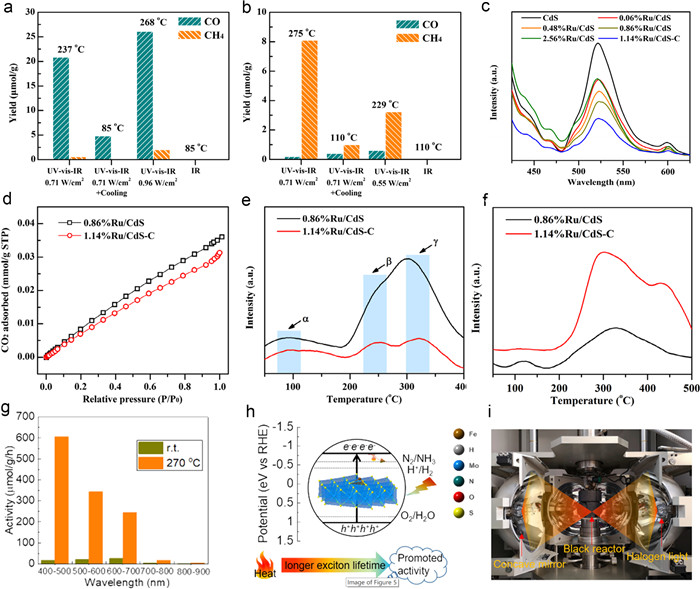
| 图7 (a) CdS和(b) 0.86% Ru/CdS在不同反应条件下将CO2转化为CO和CH4的变化:1) UV-Vis-IR光照(0.71 W∙cm−2),2)外部控温下的UV-Vis-IR光照(0.71 W∙cm−2),3) UV-Vis-IR光照,a图为0.96 W∙cm−2,b图为0.55 W∙cm−2,4) IR光照至目标温度;(c)各样品的光致发光光谱;0.86% Ru/CdS和1.14% Ru/CdS-C的(d) CO2吸附等温线;(e) CO2和(f) CH4程序升温脱附曲线的质谱信号;(g)不同波长下的催化性能;(h) pH值为7时,活性与热和光的相关性;光通过光激发直接影响氨合成活性,而热通过后续增强速率和延长激子寿命间接影响活性;(i)来自Crystal Systems的四镜浮动区太阳能炉照片,可以在无电气设备输入其他能量的情况下,利用太阳能集中器汇集光束提供Fe-sMoS2 (3 wt%)所需的热量和光子 |
| Fig 7 Evolutions of CO and CH4 of CO2 conversion over (a) bare CdS and (b) 0.86% Ru/CdS under different reaction conditions: 1) UV-Vis-IR light irradiation (0.71 W∙cm−2), 2) UV-Vis-IR light irradiation (0.71 W∙cm−2) with external temperature control, 3) UV-Vis-IR light irradiation with different light intensities (0.96 W∙cm−2 for a and 0.55 W∙cm−2 for b), and 4) IR light irradiation to the desired temperature; (c) PL spectra of the samples; (d) The CO2 adsorption isotherm curves; (e) MS signal of CO2 desorption for CO2 TPD profiles, and (f) CH4 TPD of 0.86% Ru/CdS and 1.14% Ru/CdS-C; (g) Catalytic performances under different light wavelengths; (h) Correlation of activity with heat and light at pH 7. It can be seen that light directly affects the activity of ammonia synthesis through photoexcitation and that heat indirectly affects the activity through subsequent rate enhancements and prolonged exciton lifetime; (i) Photograph of a four-mirror floating-zone solar furnace from Crystal Systems used to mimic a solar concentrator to focus a light beam to provide both heat and photons to the Fe-sMoS2 (3 wt%) without any other energy input from an electrical. (a–f) Adapted with permission |
|
|