物理化学学报 >> 2024, Vol. 40 >> Issue (6): 2306054.doi: 10.3866/PKU.WHXB202306054
构筑富含阳离子缺陷的贫P-Ni2P和富P-CoP3异质结用于增强尿素/肼电催化氧化反应
谭雯娟†, 叶勇†, 孙秀娟*( ), 刘备*(), 周佳佳, 廖海龙, 吴秀琳, 丁锐, 刘恩辉, 高平
- 湘潭大学化学学院, 环境友好与利用教育部重点实验室, 湖南 湘潭 411105
-
收稿日期:2023-06-30修回日期:2023-08-13录用日期:2023-08-13发布日期:2023-11-29 -
通讯作者:Email: sunxj594@xtu.edu.cn Tel.: +86-136156471 (孙秀娟)liubei@xtu.edu.cn; Tel.: +86-18175631945 (刘备) -
作者简介:†These authors contributed equally to this work.
-
基金资助:湖南省教育厅一般项目(20C1774); 湖南省自然科学基金(2021JJ40530); 湖南省自然科学基金(2022JJ40428)
Building P-Poor Ni2P and P-Rich CoP3 Heterojunction Structure with Cation Vacancy for Enhanced Electrocatalytic Hydrazine and Urea Oxidation
Wenjuan Tan, Yong Ye, Xiujuan Sun*(), Bei Liu*(), Jiajia Zhou, Hailong Liao, Xiulin Wu, Rui Ding, Enhui Liu, Ping Gao
- Key Laboratory of Environmentally Friendly Chemistry and Applications of Ministry of Education, College of Chemistry, Xiangtan University, Xiangtan 411105, Hunan Province, China
-
Received:2023-06-30Revised:2023-08-13Accepted:2023-08-13Published:2023-11-29 -
Contact:Email: sunxj594@xtu.edu.cn; Tel.: +86-136156471 (Xiujuan Sun)liubei@xtu.edu.cn; Tel.: +86-18175631945 (Bei Liu) -
Supported by:the General Project of Education Department of Hunan Province, China(20C1774); the Natural Science Foundation of Hunan Province, China(2021JJ40530); the Natural Science Foundation of Hunan Province, China(2022JJ40428)

摘要:
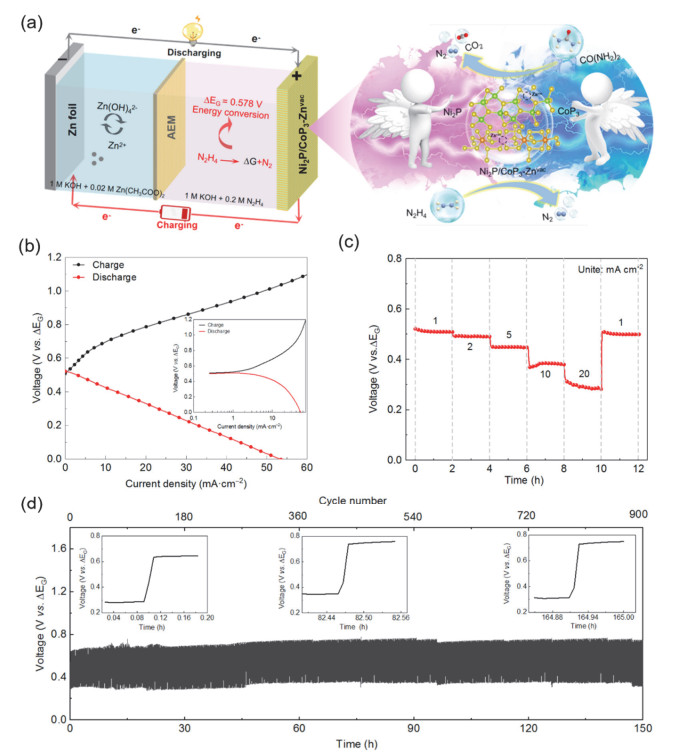
废水中存在的肼和尿素会对环境造成严重污染。利用电化学氧化技术处理含肼和尿素的废水,既可以有效处理废水,实现氮循环,又能将肼和尿素作为新型燃料,有助于新能源的发展。然而,目前实现肼氧化(HzOR)和尿素氧化(UOR)的电化学技术仍存在挑战。因此,开发低成本、高效且稳定性好的电催化剂是实现这一技术的先决条件。在本文中,我们采用水热-碱刻蚀-磷化的三步方法,制备了一种富含阳离子缺陷的双金属磷化物Ni2P/CoP3催化剂(简称Ni2P/CoP3-Znvac),并将其应用于肼氧化和尿素氧化。该催化剂由贫磷的Ni2P和富磷的CoP3两种不同性质的磷化物组成。CoP3中富集的磷含有大量的负电荷,有利于吸附带正电荷的中间物种;而Ni2P中磷含量较少,金属含量高,具有良好的导电性,可以确保快速的反应动力学。通过物理表征和电化学测试,证实了Ni2P/CoP3的成功合成和其独特的电子结构。电子顺磁测试(EPR)证明了阳离子空位的存在,大量的阳离子空位缺陷有助于增加活性位点的数量,从而提升催化性能。因此,该催化剂在肼氧化和尿素氧化方面表现出色。仅需−47 mV (HzOR)和1.311 V(UOR)的电位即可产生10 mA∙cm−2的电流密度。Tafel斜率分别为54.3 mV∙dec−1 (HzOR)和37.24 mV∙dec−1 (UOR)。Ni2P/CoP3-Znvac在HzOR和UOR方面的性能远优于单独的Ni2P和CoP3,也优于未经碱刻蚀的镍钴磷化物。基于以上的测试结果,我们将Ni2P/CoP3-Znvac催化剂应用于直接肼燃料电池(DHzFC)和直接尿素-双氧水燃料电池(DUHPFC)的阳极,测试表明DHzFC和DUHPFC的最大功率密度分别为229.01和16.22 mW∙cm−2。更为重要的是,DHzFC和DUHPFC能够稳定工作24 h,性能几乎不衰退。此外,Ni2P/CoP3-Znvac材料还可应用于自制的锌-肼燃料电池,并展示出良好的实际应用潜力。综上所述,本研究通过一系列方法制备了Ni2P/CoP3-Znvac催化剂,该催化剂在肼氧化和尿素氧化方面具有优异性能。这项工作为设计高效且稳定性好的肼氧化和尿素氧化电催化剂提供了新的思路。
引用本文
谭雯娟, 叶勇, 孙秀娟, 刘备, 周佳佳, 廖海龙, 吴秀琳, 丁锐, 刘恩辉, 高平. 构筑富含阳离子缺陷的贫P-Ni2P和富P-CoP3异质结用于增强尿素/肼电催化氧化反应[J]. 物理化学学报, 2024, 40(6), 2306054. doi: 10.3866/PKU.WHXB202306054
Wenjuan Tan, Yong Ye, Xiujuan Sun, Bei Liu, Jiajia Zhou, Hailong Liao, Xiulin Wu, Rui Ding, Enhui Liu, Ping Gao. Building P-Poor Ni2P and P-Rich CoP3 Heterojunction Structure with Cation Vacancy for Enhanced Electrocatalytic Hydrazine and Urea Oxidation[J]. Acta Phys. -Chim. Sin. 2024, 40(6), 2306054. doi: 10.3866/PKU.WHXB202306054
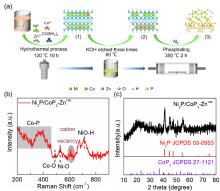
图1
"
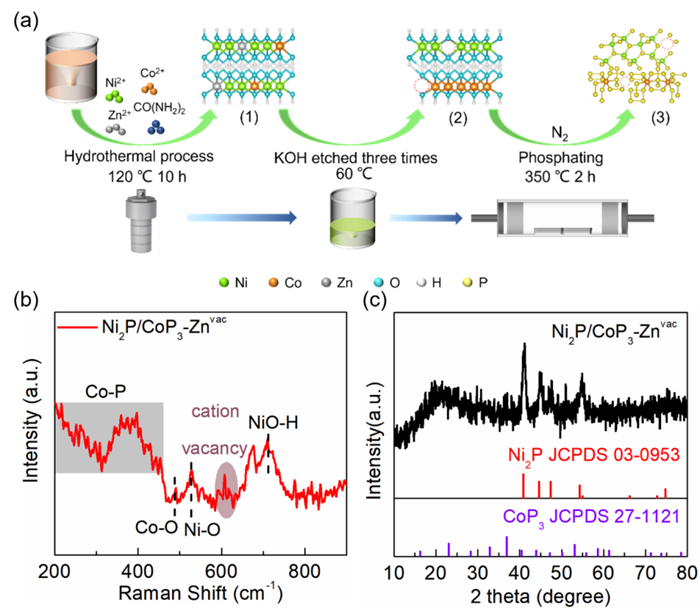
图2
"
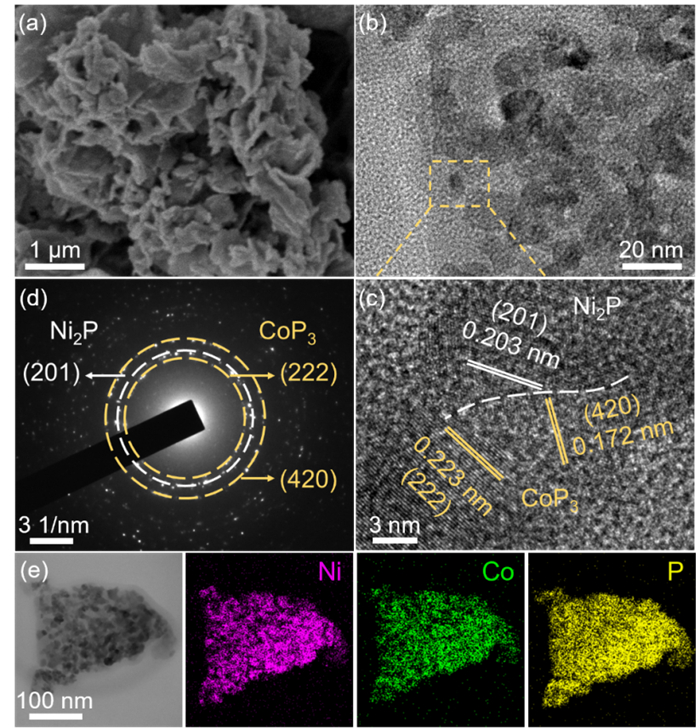
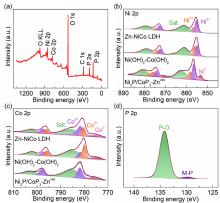
图3
"
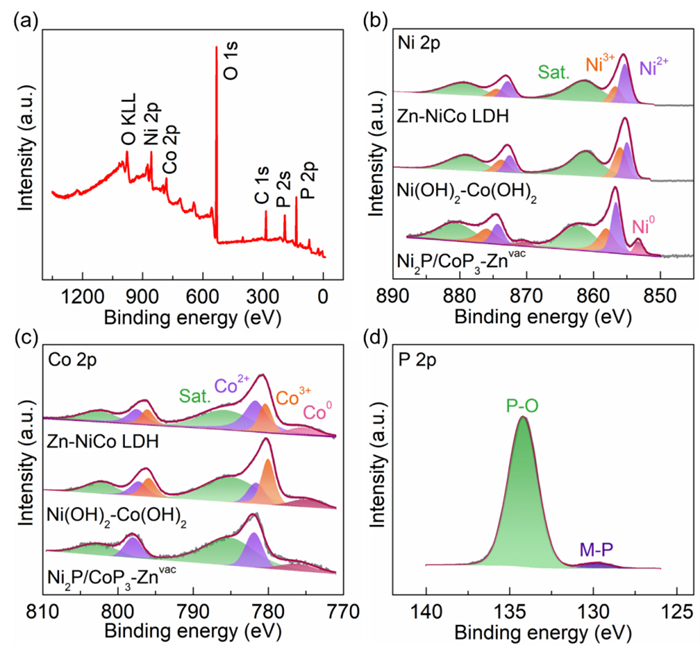
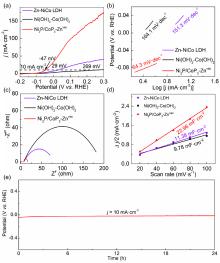
图4
"
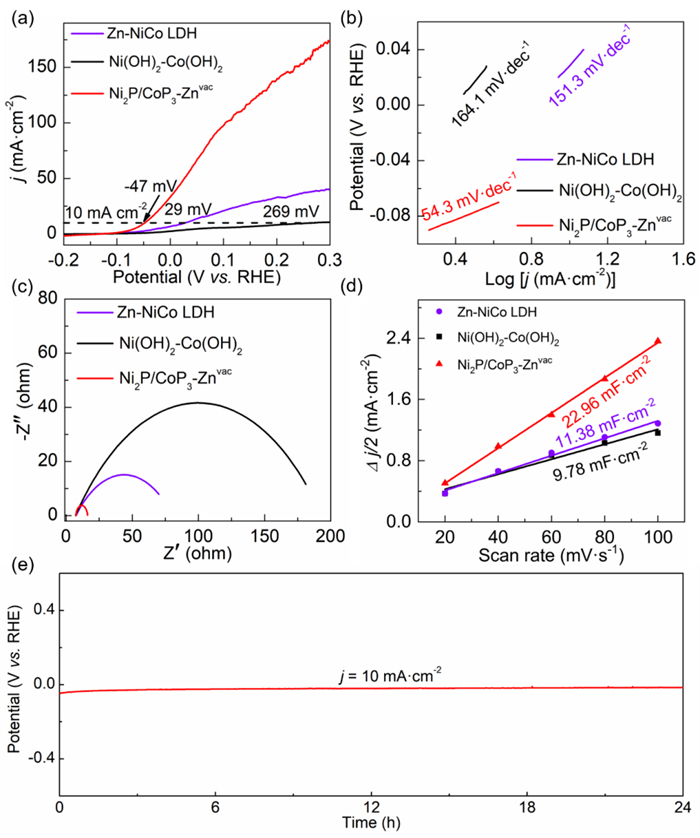
图5
"
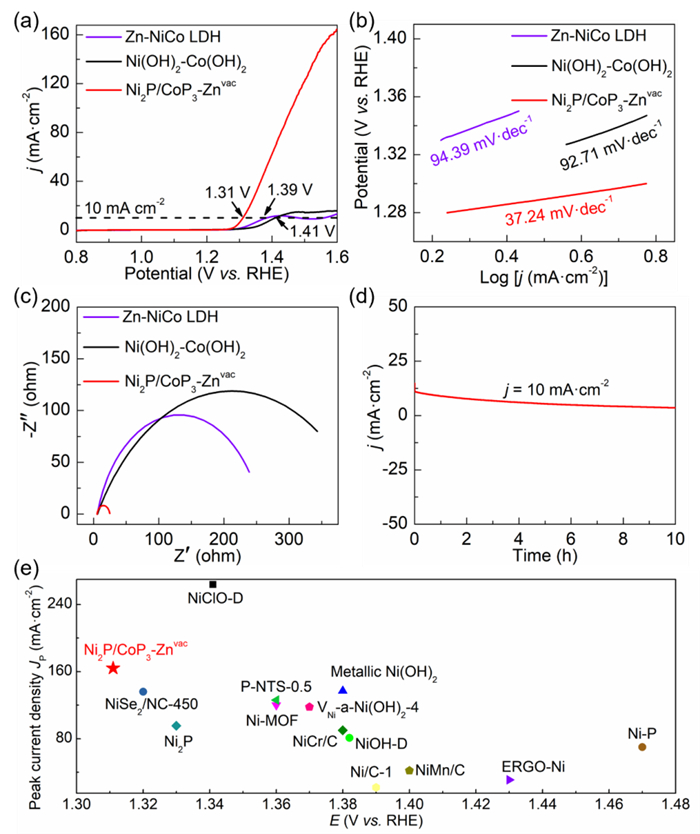
图6
"
图7
"
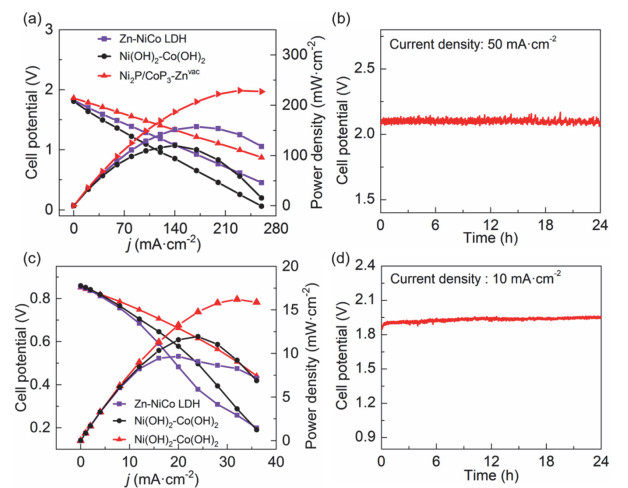
图8
"
| 1 |
doi: 10.1016/j.joule.2018.07.020 |
| 2 |
doi: 10.1016/j.scib.2018.07.008 |
| 3 |
doi: 10.1002/cey2.279 |
| 4 |
|
|
刘瑶钰; 王宇辰; 刘碧莹; AmerM.; 严凯. 物理化学学报, 2023, 39 (2), 2205028.
doi: 10.3866/PKU.WHXB202205028 |
|
| 5 |
doi: 10.1016/j.cej.2020.125160 |
| 6 |
doi: 10.1039/c7ta11364a |
| 7 |
doi: 10.1016/j.ensm.2022.10.045 |
| 8 |
|
|
肖瑶; 裴煜; 胡一帆; 马汝广; 王德义; 王家成. 物理化学学报, 2021, 37 (7), 2009051.
doi: 10.3866/PKU.WHXB202009051 |
|
| 9 |
doi: 10.3390/catal5031167 |
| 10 |
doi: 10.1039/d2cc03566a |
| 11 |
doi: 10.1016/j.cej.2022.136165 |
| 12 |
doi: 10.1016/j.cclet.2021.08.042 |
| 13 |
doi: 10.1016/j.apsusc.2022.154484 |
| 14 |
doi: 10.1039/c8ta10985k |
| 15 |
doi: 10.1016/j.jechem.2022.01.031 |
| 16 |
doi: 10.1039/c8ee00521d |
| 17 |
doi: 10.1021/acsaem.2c0100 |
| 18 |
doi: 10.1016/j.cej.2021.130686 |
| 19 |
doi: 10.1016/j.jcis.2019.09.012 |
| 20 |
doi: 10.1039/d0ta08078k |
| 21 |
doi: 10.1039/d0gc03994b |
| 22 |
doi: 10.1021/acs.inorgchem.6b02808 |
| 23 |
doi: 10.1016/j.scib.2021.02.03 |
| 24 |
doi: 10.1021/acssuschemeng.9b04699 |
| 25 |
doi: 10.1016/j.cej.2020.127814 |
| 26 |
doi: 10.1016/j.cej.2021.133829 |
| 27 |
doi: 10.1039/c9ta00481e |
| 28 |
doi: 10.1016/j.apcatb.2022.122207 |
| 29 |
doi: 10.1002/adma.201705366 |
| 30 |
doi: 10.1016/j.cej.2022.138710 |
| 31 |
doi: 10.1039/d0ta05628f |
| 32 |
doi: 10.1016/j.joule.2021.05.018 |
| 33 |
doi: 10.1016/j.electacta.2021.137755 |
| 34 |
doi: 10.1039/d2ta00120a |
| 35 |
doi: 10.1016/j.mtphys.2020.100292 |
| 36 |
doi: 10.1038/s41467-018-06815-9 |
| 37 |
doi: 10.1007/s12274-021-3850-9 |
| 38 |
doi: 10.1039/d0se00240b |
| 39 |
doi: 10.1039/c7cc06278h |
| 40 |
doi: 10.1002/aenm.201700020 |
| 41 |
doi: 10.1016/j.jpowsour.2020.227837 |
| 42 |
doi: 10.1039/c9nr05204f |
| 43 |
doi: 10.1016/j.jpowsour.2019.226754 |
| 44 |
doi: 10.1002/cctc.201900886 |
| 45 |
doi: 10.1002/adfm.202303300 |
| 46 |
doi: 10.1002/adfm.202300625 |
| 47 |
doi: 10.1002/anie.202109938 |
| 48 |
doi: 10.1021/acsami.2c03380 |
| 49 |
doi: 10.1002/anie.201909832 |
| 50 |
doi: 10.1002/anie.201606313 |
| 51 |
doi: 10.1039/c7cc06378d |
| 52 |
doi: 10.1002/cctc.201700451 |
| 53 |
doi: 10.1038/srep05863 |
| 54 |
doi: 10.1016/j.electacta.2012.11.046 |
| 55 |
doi: 10.1021/acsami.7b18650 |
| 56 |
doi: 10.1021/acsenergylett.8b00515 |
| 57 |
doi: 10.1016/j.catcom.2017.03.027 |
| 58 |
doi: 10.1016/j.jallcom.2021.160919 |
| 59 |
doi: 10.1039/d0nr08025j |
| 60 |
doi: 10.1016/j.electacta.2016.10.198 |
| 61 |
doi: 10.1039/d0ta05160h |
| 62 |
doi: 10.1007/s41061-018-0219-y |
| 63 |
doi: 10.1016/j.electacta.2013.06.137 |
| 64 |
doi: 10.1016/j.electacta.2012.07.007 |
| 65 |
doi: 10.1021/jp5052529 |
| 66 |
doi: 10.1039/d0nr01386b |
| 67 |
doi: 10.1039/d2ta05494a |
| 68 |
doi: 10.1016/j.jcis.2022.01.151 |
| 69 |
doi: 10.1016/j.cej.2022.137540 |
| 70 |
doi: 10.1016/j.apcatb.2021.120494 |
| 71 |
doi: 10.1002/adma.202207747 |
| [1] | 雷明杰, 胡文婷, 林可心, 孙秀娟, 张澔珅, 钱烨, 康彤玥, 吴秀琳, 廖海龙, 潘园, 张玉微, 魏笛野, 高平. Co/Mn/Mo掺杂加速NiSe2重构以提高其电催化尿素氧化性能[J]. 物理化学学报, 2025, 41(8): 100083 - . |
| [2] | 柳如艳, 倪振瑞, RuzimuradovOlim, TurayevKhayit, 刘涛, 余罗, 邝攀勇. Ni诱导的Pt 5d-H 1s反键轨道调控以增强析氢和尿素氧化[J]. 物理化学学报, 2025, 41(12): 100159 - . |
| [3] | 李清, 张光勋, 徐玉霞, 孙洋洋, 庞欢. 磷化调控构筑分层结构的Ni2P催化剂用于高效电氧化尿素[J]. 物理化学学报, 2024, 40(9): 2308045 - . |
| [4] | 刘瑶钰, 王宇辰, 刘碧莹, Amer Mahmoud, 严凯. 钴钒水滑石纳米片用于电催化尿素氧化[J]. 物理化学学报, 2023, 39(2): 2205028 -0 . |
| [5] | 王正慜, 洪庆玲, 王晓慧, 黄昊, 陈煜, 李淑妮. 氮掺杂石墨烯气凝胶锚定RuP纳米粒子用于水合肼氧化辅助产氢[J]. 物理化学学报, 2023, 39(12): 2303028 - . |
|
||