物理化学学报 >> 2025, Vol. 41 >> Issue (7): 100074.doi: 10.1016/j.actphy.2025.100074
所属专题: 光催化中的S型异质结
调节NNU-55(Fe)的d带中心以增强CO2吸附和光催化活性
杨雪琦1, 赵俊涛1, 叶家伟1,*( ), 周德森1, 狄廷敏2,*(), 张军1,*()
- 1 武汉工程大学, 化工与制药学院、绿色化工过程教育部重点实验室、新型反应器与绿色化学工艺湖北省重点实验室, 湖北 武汉 430205
2 武汉工程大学, 材料科学与工程学院、等离子体化学与新材料湖北省重点实验室, 湖北 武汉 430205
-
收稿日期:2025-01-26修回日期:2025-02-26录用日期:2025-02-26发布日期:2025-05-22 -
通讯作者:Email: yejiawei@wit.edu.cn (叶家伟)ditingmin19@wit.edu.cn (狄廷敏)junzhang@wit.edu.cn (张军) -
基金资助:国家自然科学基金(22308341); 国家自然科学基金(22005228); 武汉工程大学科学研究基金(K2024047)
Modulating the d-band center of NNU-55(Fe) for enhanced CO2 adsorption and photocatalytic activity
Xueqi Yang1, Juntao Zhao1, Jiawei Ye1,*(), Desen Zhou1, Tingmin Di2,*(), Jun Zhang1,*()
- 1 Key Laboratory of Green Chemical Process of Ministry of Education, Hubei Key Laboratory of Novel Reactor and Green Chemical Technology, School of Chemical Engineering and Pharmacy, Wuhan Institute of Technology, Wuhan 430205, Hubei Province, China
2 Hubei Key Laboratory of Plasma Chemistry and Advanced Materials, School of Materials Science and Engineering, Wuhan Institute of Technology, Wuhan 430205, Hubei Province, China
-
Received:2025-01-26Revised:2025-02-26Accepted:2025-02-26Published:2025-05-22 -
Contact:Email: yejiawei@wit.edu.cn (Jiawei Ye)ditingmin19@wit.edu.cn (Tingmin Di)junzhang@wit.edu.cn (Jun Zhang) -
Supported by:the National Natural Science Foundation of China (NSFC)(22308341); the National Natural Science Foundation of China (NSFC)(22005228); the Scientific Research Foundation of Wuhan Institute of Technology(K2024047)

摘要:
光催化二氧化碳(CO2)还原已成为一种有效的技术用于将CO2转化为高价值的化学品。金属有机框架(MOFs)材料因其结构可调、比表面积大、催化性能好和光响应性优异等特点而展现出巨大的潜力。本文采用MOF材料NNU-55(Fe)将CO2光催化转化为一氧化碳(CO)。通过改变无机阴离子配体调节金属活性中心(Fe-N4)的电子性质,可以轻松调控NNU-55(Fe) MOFs的光催化性能。研究表明,相较于SO42−和Cl−配位的催化剂,NO3−配位的NNU-55(Fe)展现出更优异的催化性能,在3 h内实现了124 μmol∙g−1的CO产量。NO3−更强的电子供给能力提升了Fe中心的电子密度,降低了Fe的d带中心,并增强了吸附系统成键轨道的占据,从而提高了CO2的吸附能力和还原活性。本研究通过改变金属位点的无机配体来调节MOFs电子结构和催化活性的策略,为开发高效光催化材料提供了新的思路。
引用本文
杨雪琦, 赵俊涛, 叶家伟, 周德森, 狄廷敏, 张军. 调节NNU-55(Fe)的d带中心以增强CO2吸附和光催化活性[J]. 物理化学学报, 2025, 41(7), 100074. doi: 10.1016/j.actphy.2025.100074
Xueqi Yang, Juntao Zhao, Jiawei Ye, Desen Zhou, Tingmin Di, Jun Zhang. Modulating the d-band center of NNU-55(Fe) for enhanced CO2 adsorption and photocatalytic activity[J]. Acta Phys. -Chim. Sin. 2025, 41(7), 100074. doi: 10.1016/j.actphy.2025.100074
图1
"
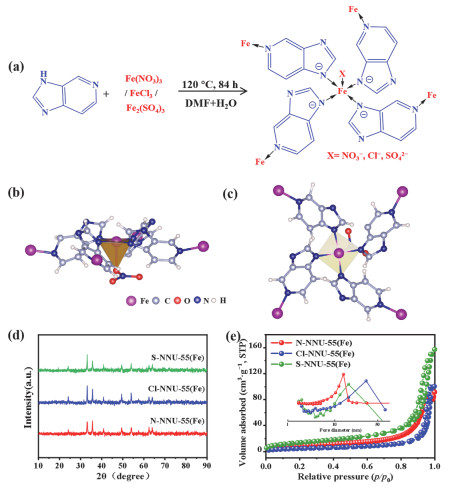
图2
"
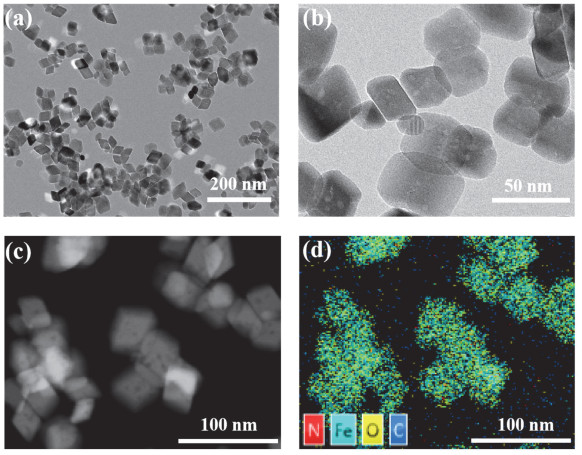
图3
"
图4
"
图5
"
图6
"
图7
"
| 1 |
J. Jiang, X. Wang, Q. Xu, Z. Mei, L. Duan, H. Guo. Appl. Catal. B-Environ. 2022, 316, 121679.
doi: 10.1016/j.apcatb.2022.121679 |
| 2 |
K. Zhong, P. Sun, H. Xu. Small 2024, 2310677.
doi: 10.1002/smll.202310677 |
| 3 |
J. Li, S. Jiang, S. Song. Chin. J. Catal. 2024, 59, 1.
doi: 10.1016/s1872-2067(23)64647-9 |
| 4 |
Y. Bian, H. He, G. Dawson, J. Zhang, K. Dai. Sci. China Mater. 2024, 67, 514.
doi: 10.1007/s40843-023-2725-y |
| 5 |
K. Wang, C. Liu, J. Li, Q. Cheng, B. Liu, J. Li. Appl. Catal. B-Environ. Energy 2025, 361, 124560.
doi: 10.1016/j.apcatb.2024.124560 |
| 6 |
J. Lei, N. Zhou, S. Sang, S. Meng, J. Low, Y. Li. Chin. J. Catal. 2024, 65, 163.
doi: 10.1016/s1872-2067(24)60109-9 |
| 7 |
K. Wang, Q. Cheng, W. Hou, H. Guo, X. Wu, J. Wang, J. Li, Z. Liu, L. Wang. Adv. Funct. Mater. 2023, 34, 2309603.
doi: 10.1002/adfm.202309603 |
| 8 |
X. Shao, K. Li, J. Li, Q. Cheng, G. Wang, K. Wang. Chin. J. Catal. 2023, 51, 193.
doi: 10.1016/S1872-2067(23)64478-X |
| 9 |
S. Xiong, S. Bao, W. Wang, J. Hao, Y. Mao, P. Liu, Y. Huang, Z. Duan, Y. Lv, D. Ouyang. Appl. Catal. B-Environ. 2022, 305, 121026.
doi: 10.1016/j.apcatb.2021.121026 |
| 10 |
L. Li, Z. Zhang, C. Ding, J. Xu. Chem. Eng. J. 2021, 419, 129543.
doi: 10.1016/j.cej.2021.129543 |
| 11 |
Z. Wang, G. Zou, J. H. Park, K. Zhang. Sci. China Mater. 2024, 67, 397.
doi: 10.1007/s40843-023-2698-5 |
| 12 |
D. Chen, Z. Wang, J. Fu, J. Zhang, K. Dai. Sci. China Mater. 2024, 67, 541.
doi: 10.1007/s40843-023-2770-8 |
| 13 |
C. Guan, Y. Liao, Q. Xiang. Sci. China Mater. 2024, 67, 473.
doi: 10.1007/s40843-023-2703-0 |
| 14 |
Y. Xu, Y. Ren, X. Liu, H. Li, Z. Lu. Acta Phys. -Chim. Sin. 2024, 40, 2403032.
doi: 10.3866/PKU.WHXB202403032 |
| 15 |
Y. Xia, B. Cheng, J. Fan, J. Yu, G. Liu. Sci. China Mater. 2020, 63, 552.
doi: 10.1007/s40843-019-1234-x |
| 16 |
H. Kominami, J. Kato, S. Murakami, Y. Ishii, M. Kohno, K. Yabutani, T. Yamamoto, Y. Kera, M. Inoue, T. Inui, B. Ohtani. Catal. Today 2003, 84, 181.
doi: 10.1016/s0920-5861(03)00272-4 |
| 17 |
J. Qin, Y. An, Y. Zhang. Acta Phys. -Chim. Sin. 2024, 40, 2408002.
doi: 10.3866/PKU.WHXB202408002 |
| 18 |
X. Wang, S. Dong, K. Qi, V. Popkov, X. Xiang. Acta Phys. -Chim. Sin. 2024, 40, 2408005.
doi: 10.3866/PKU.WHXB202408005 |
| 19 |
W. Yu, D. Xu, T. Peng. J. Mater. Chem. A 2015, 3, 19936.
doi: 10.1039/c5ta05503b |
| 20 |
X. Xu, C. Shao, J. Zhang, Z. Wang, K. Dai. Acta Phys. -Chim. Sin. 2024, 40, 2309031.
doi: 10.3866/PKU.WHXB202309031 |
| 21 |
C. Chen, J. Zhang, H. Chu, L. Sun, G. Dawson, K. Dai. Chin. J. Catal. 2024, 63, 81.
doi: 10.1016/S1872-2067(24)60072-0 |
| 22 |
Z. Zhang, X. Wang, H. Tang, D. Li, J. Xu. Chin. J. Catal. 2023, 55, 227.
doi: 10.1016/s1872-2067(23)64549-8 |
| 23 |
Z. Wang, Y. Chen, L. Zhang, B. Cheng, J. Yu, J. Fan. J. Mater. Sci. Technol. 2020, 56, 143.
doi: 10.1016/j.jmst.2020.02.062 |
| 24 |
J. Yang, J. Wang, G. Wang, K. Wang, J. Li, L. Zhao. J. Mater. Sci. Technol. 2024, 189, 86.
doi: 10.1016/j.jmst.2023.11.065 |
| 25 |
Y. Cui, J. Zhang, H. Chu, L. Sun, K. Dai. Acta Phys. -Chim. Sin. 2024, 40, 2405016.
doi: 10.3866/PKU.WHXB202405016 |
| 26 |
J. Wang, J. Yin, O. Shekhah, O. M. Bakr, M. Eddaoudi, O. F. Mohammed. ACS Appl. Mater. Interfaces 2022, 14, 9970.
doi: 10.1021/acsami.1c24759 |
| 27 |
Y. Chen, D. Wang, X. Deng, Z. Li. Catal. Sci. Technol. 2017, 7, 4893.
doi: 10.1039/c7cy01653k |
| 28 |
J. Tian, K. Zhong, X. Zhu, J. Yang, Z. Mo, J. Liu, J. Dai, Y. She, Y. Song, H. Li, H. Xu. Chem. Eng. J. 2023, 451, 138392.
doi: 10.1016/j.cej.2022.138392 |
| 29 |
K. Liu, T. Wu, L. Xu, Z. Zhang, Z. Liu, L. Wang, Z. Wang. Nano Res. 2023, 17, 1173.
doi: 10.1007/s12274-023-5957-7 |
| 30 |
R. Li, F. Xie, P. Kuang, T. Liu, J. Yu. Small 2024, 20, 2402867.
doi: 10.1002/smll.202402867 |
| 31 |
F. Zhao, B. Zhu, L. Wang, J. Yu. J. Colloid Interface Sci. 2024, 659, 486.
doi: 10.1016/j.jcis.2023.12.173 |
| 32 |
M. Sayed, F. Xu, P. Kuang, J. Low, S. Wang, L. Zhang, J. Yu. Nat. Commun. 2021, 12, 4936.
doi: 10.1038/s41467-021-25007-6 |
| 33 |
J. Cai, W. Xu, H. Chi, Q. Liu, W. Gao, L. Shi, J. Low, Z. Zou, Y. Zhou. Acta Phys. -Chim. Sin. 2024, 40, 2407002.
doi: 10.3866/pku.Whxb202407002 |
| 34 |
L. Wang, B. Zhu, B. Cheng, J. Zhang, L. Zhang, J. Yu. Chin. J. Catal. 2021, 42, 1648.
doi: 10.1016/S1872-2067(21)63805-6 |
| 35 |
J. Liu, N. Li, J. Sun, J. Liu, L. Dong, S. Yao, L. Zhang, Z. Xin, J. Shi, J. Wang, S. Li, Y. Lan. ACS Catal. 2021, 11, 4510.
doi: 10.1021/acscatal.0c04495 |
| 36 |
R. Manna, S. Rahut, A. N. Samanta. Mater. Today Energy 2023, 35, 101326.
doi: 10.1016/j.mtener.2023.101326 |
| 37 |
F. Dai, M. Zhang, Q. Chen, M. Mi, Z. Li, J. Han, J. Xing, S. Feng, L. Wang. Appl. Catal. B-Environ. 2023, 336, 122934.
doi: 10.1016/j.apcatb.2023.122934 |
| 38 |
S. Chen, F. Yang, H. Gao, J. Wang, X. Chen, X. Zhang, J. Li, A. Li. J. CO2 Util. 2021, 48, 101528.
doi: 10.1016/j.jcou.2021.101528 |
| 39 |
X. Sun, L. Sun, G. Li, Y. Tuo, C. Ye, J. Yang, J. Low, X. Yu, J. H. Bitter, Y. Lei, D. Wang, Y. Li. Angew. Chem. Int. Ed. 2022, 61, e202207677.
doi: 10.1002/anie.202207677 |
| 40 |
J. Liu, B. Han, X. Liu, S. Liang, Y. Fu, J. He, L. H. Chung, Y. Lin, Y. Wei, S. Wang, T. Ma, Z. Yang. Angew. Chem. Int. Ed. 2025, 64, e202417435.
doi: 10.1002/anie.202417435 |
| 41 |
D. Zhou, X. Zhang, Z. Li, J. Zhang, T. Wang, S. Cao. Appl. Catal. B-Environ. 2024, 344, 123639.
doi: 10.1016/j.apcatb.2023.123639 |
| 42 |
M. Glorius, C. Breitkopf. Catal. Today 2023, 417, 113735.
doi: 10.1016/j.cattod.2022.04.036 |
| 43 |
S. A. Rincón-Ortiz, J. H. Quintero-Orozco, R. Ospina. Surf. Sci. Spectra 2023, 30, 024003.
doi: 10.1116/6.0002667 |
| 44 |
T. G. Azuara, S. E. Muñoz, L. R. A. Guirado. Phys. Chem. Chem. Phys. 2023, 25, 3718.
doi: 10.1039/d2cp04701b |
| 45 |
B. C. Beard. Appl. Surf. Sci. 1990, 45, 221.
doi: 10.1016/0169-4332(90)90005-k |
| 46 |
J. M. Lázaro Martínez, E. Rodríguez-Castellón, R. M. T. Sánchez, L. R. Denaday, G. Y. Buldain, V. Campo Dall' Orto. J. Mol. Catal. A-Chem. 2011, 339, 43.
doi: 10.1016/j.molcata.2011.02.010 |
| 47 |
I. G. Casella, M. Contursi. J. Electroanal. Chem. 2006, 588, 147.
doi: 10.1016/j.jelechem.2005.12.015 |
| 48 |
S. Tengeler, M. Fingerle, W. Calvet, C. Steinert, B. Kaiser, T. Mayer, W. Jaegermann. J. Electrochem. Soc. 2018, 165, H3122.
doi: 10.1149/2.0151804jes |
| 49 |
T. Chen, J. Hu, K. Wang, K. Wang, G. Gan. J. Shi, Energy Fuels 2021, 35, 17784.
doi: 10.1021/acs.energyfuels.1c01616 |
| 50 |
N. Geng, W. Chen, H. Xu, M. Ding, T. Lin, Q. Wu, L. Zhang. Ultrason. Sonochem. 2021, 72, 105411.
doi: 10.1016/j.ultsonch.2020.105411 |
| 51 |
J. Gandara Loe, L. Pastor Perez, L. F. Bobadilla, J. A. Odriozola, T. R. Reina. React. Chem. Eng. 2021, 6, 787.
doi: 10.1039/d1re00034a |
| 52 |
C. Zheng, X. Qiu, J. Han, Y. Wu, S. Liu. ACS Appl. Mater. Interfaces 2019, 11, 42243.
doi: 10.1021/acsami.9b15306 |
| 53 |
H. Zhong, F. Pan, S. Yue, C. Qin, V. Hadjiev, F. Tian, X. Liu, F. Lin, Z. Wang, J. Bao. J. Phys. Chem. Lett. 2023, 14, 6702.
doi: 10.1021/acs.jpclett.3c01416 |
| 54 |
S. Kagatikar, D. Sunil, D. Kekuda. Chem. Pap. 2022, 76, 7685.
doi: 10.1007/s11696-022-02445-0 |
| 55 |
Z. Jin, J. Zhang, J. Qiu, Y. Hu, T. Di, T. Wang. J. Colloid Interface Sci. 2023, 652, 122.
doi: 10.1016/j.jcis.2023.08.025 |
| 56 |
Y. Xiong, Y. Jin, T. Deng, K. Mei, P. Qiu, L. Xi, Z. Zhou, J. Yang, X. Shi, L. Chen. J. Am. Chem. Soc. 2022, 144, 8030.
doi: 10.1021/jacs.1c13713 |
| 57 |
Z. Chen, G. Zhang, H. Chen, J. Prakash, Y. Zheng, S. Sun. Renew. Sust. Energ. Rev. 2022, 155, 111922.
doi: 10.1016/j.rser.2021.111922 |
| 58 |
J. Hao, Y. Zhang, L. Zhang, J. Shen, L. Meng, X. Wang. Chem. Eng. J. 2023, 464, 142536.
doi: 10.1016/j.cej.2023.142536 |
| 59 |
J. Xu, Q. Li, Y. Shang, Z. Liu, Z. Jin. Sol. RRL 2024, 8, 1006.
doi: 10.1002/solr.202301006 |
| 60 |
A. I. Ahmed, D. A. Kospa, S. Gamal, S. E. Samra, A. A. Salah, S. A. El-Hakam, A. Awad Ibrahim. J. Photochem. Photobiol. A 2022, 429, 113907.
doi: 10.1016/j.jphotochem.2022.113907 |
| 61 |
E. S. Gad, K. Chaudhary, A. H. Ahmed, S. Rafiq, A. M. Yousif, M. Suleman. Opt. Mater. 2023, 135, 113274.
doi: 10.1016/j.optmat.2022.113274 |
| 62 |
I. V. Pushkareva, M. A. Solovyev, S. I. Butrim, M. V. Kozlova, D. A. Simkin, A. S. Pushkarev. Membranes 2023, 13, 192.
doi: 10.3390/membranes13020192 |
| 63 |
C. Cheng, J. Yu, D. Xu, L. Wang, G. Liang, L. Zhang, M. Jaroniec. Nat. Commun. 2024, 15, 1313.
doi: 10.1038/s41467-024-45604-5 |
| 64 |
R. Li, C. Tung, B. Zhu, Y. Lin, F. Tian, T. Liu, H. Chen, P. Kuang, J. Yu. J. Colloid Interface Sci. 2024, 674, 326.
doi: 10.1016/j.jcis.2024.06.176 |
| 65 |
L. Wang, S. Zhang, L. Zhang, J. Yu. Appl. Catal. B-Environ. Energy 2024, 355, 124167.
doi: 10.1016/j.apcatb.2024.124167 |
| 66 |
X. Zhang, D. Gao, B. Zhu, B. Cheng, J. Yu, H. Yu. Nat. Commun. 2024, 15, 3212.
doi: 10.1038/s41467-024-47624-7 |
| 67 |
Y. Liu, Y. Jiang, M. Zhang, X. Zhang, Y. Ma. ACS Appl. Mater. Interfaces 2024, 16, 12455.
doi: 10.1021/acsami.3c17808 |
| 68 |
X. Zheng, L. Shen, X. Chen, X. Zheng, C. Au, L. Jiang. Inorg. Chem. 2018, 57, 10081.
doi: 10.1021/acs.inorgchem.8b01232 |
| 69 |
Y. Li, M. Wen, Y. Wang, G. Tian, C. Wang, J. Zhao. Angew. Chem. Int. Ed. 2020, 60, 910.
doi: 10.1002/anie.202010156 |
| 70 |
X. Deng, J. Zhang, K. Qi, G. Liang, F. Xu, J. Yu. Nat. Commun. 2024, 15, 4807.
doi: 10.1038/s41467-024-49004-7 |
| 71 |
R. Xie, K. Li, R. Tian, C. Lu. Chem. Sci. 2024, 15, 18085.
doi: 10.1039/d4sc03763d |
| 72 |
Y. Katayama, L. Giordano, R. R. Rao, J. Hwang, H. Muroyama, T. Matsui, K. Eguchi, Y. Shao-Horn. J. Phys. Chem. C 2018, 122, 12341.
doi: 10.1021/acs.jpcc.8b03556 |
| 73 |
Z. Ma, X. Liu, X. Wang, Z. Luo, W. Li, Y. Nie, L. Pei, Q. Mao, X. Wen, J. Zhong. Chem. Eng. J. 2023, 468, 143569.
doi: 10.1016/j.cej.2023.143569 |
| 74 |
N. Shehzad, M. Tahir, K. Johari, T. Murugesan, M. Hussain. J. CO2 Util. 2018, 26, 98.
doi: 10.1016/j.jcou.2018.04.026 |
| 75 |
X. Wu, L. Tan, G. Chen, J. Kang, G. Wang. Sci. China Mater. 2024, 67, 444.
doi: 10.1007/s40843-023-2755-2 |
| 76 |
C. Luo, Q. Long, B. Cheng, B. Zhu, L. Wang. Acta Phys. -Chim. Sin. 2023, 39, 2212026.
doi: 10.3866/PKU.WHXB202212026 |
| 77 |
F. Xie, C. Bie, J. Sun, Z. Zhang, B. Zhu. J. Mater. Sci. Technol. 2024, 170, 87.
doi: 10.1016/j.jmst.2023.06.028 |
| 78 |
Z. Wang, B. Cheng, L. Zhang, J. Yu, Y. Li, S. Wageh, A. A. Al-Ghamdi. Chin. J. Catal. 2022, 43, 1657.
doi: 10.1016/S1872-2067(21)64010-X |
| 79 |
G. Qian, W. Lyu, X. Zhao, J. Zhou, R. Fang, F. Wang, Y. Li. Angew. Chem. Int. Ed. 2022, 61, 10576.
doi: 10.1002/anie.202210576 |
| [1] | 苗鑫宇, 杨浩, 何杰, 王晶, 靳治良. 调整Keggin型多金属氧酸盐电子结构构建S型异质结用于光催化析氢[J]. 物理化学学报, 2025, 41(6): 100051 - . |
| [2] | 宋相海, 刘晓颖, 任智祥, 刘想, 汪梅, 吴元锋, 周伟强, 朱志, 霍鹏伟. 氮掺杂显著提升BiOBr光催化还原CO2性能研究[J]. 物理化学学报, 2025, 41(6): 100055 - . |
| [3] | 王卓, 白雪, 张可新, 王鸿志, 董家宝, 高源, 赵斌. MOF模板法合成氮掺杂碳材料用于增强电化学钠离子储存和去除[J]. 物理化学学报, 2025, 41(3): 100026 - . |
| [4] | 马浩桐, 衡明宇, 许杨, 毕炜, 缪应纯, 肖舒宁. 微波合成铜负载的碳掺杂氮化硼光催化材料及其大气浓度下CO2还原性能研究[J]. 物理化学学报, 2025, 41(11): 100132 - . |
| [5] | 张泽豪, 王政, 李海波. V2CFx MXene衍生2D V2O3@介孔碳纳米片的制备及其电容脱盐特性[J]. 物理化学学报, 2024, 40(8): 2308020 - . |
| [6] | 王春春, 游常俊, 戎珂, 申楚琦, 杨方, 李世杰. 富含氧空位S型MIL-101(Fe)/BiOCl异质结增强光催化去除Cr(Ⅵ)[J]. 物理化学学报, 2024, 40(7): 2307045 - . |
| [7] | 刘高鹏, 李利娜, 王彬, 单宁杰, 董金涛, 季梦夏, 朱文帅, 朱剑豪, 夏杰祥, 李华明. 构筑Bi纳米粒子负载BiOCl纳米片欧姆结用于光催化CO2还原[J]. 物理化学学报, 2024, 40(7): 2306041 - . |
| [8] | 邵碧珠, 董慧君, 龚云南, 梅剑华, 蔡锋石, 刘金彪, 钟地长, 鲁统部. 金属有机框架衍生镍纳米颗粒在宽电位窗口内高效电催化二氧化碳还原[J]. 物理化学学报, 2024, 40(4): 2305026 - . |
| [9] | 陈慧滢, 朱浩林, 廖培钦, 陈小明. 一例整合了三联吡啶钌和卟啉锌的金属-有机框架材料用于光催化二氧化碳还原全反应[J]. 物理化学学报, 2024, 40(4): 2306046 - . |
| [10] | 许银洁, 李随勤, 刘力豪, 贺佳辉, 李凯, 王梦欣, 赵舒影, 李纯, 张峥斌, 钟兴, 王建国. NiFe-MOF和氮氧自由基协同增强甾醇电催化氧化[J]. 物理化学学报, 2024, 40(3): 2305012 - . |
| [11] | 秦建宇, 安月皎, 张艳峰. 原位合成S型氮缺陷ZnWO4/g-C3N4异质结及CO2光还原性能[J]. 物理化学学报, 2024, 40(12): 2408002 - . |
| [12] | 谢斐, 袁成成, 谭海燕, MoshfeghAlireza Z., 朱必成, 余家国. d带中心调控过渡金属单原子负载COF吸附O2的理论计算研究[J]. 物理化学学报, 2024, 40(11): 2407013 - . |
| [13] | 徐阳锐, 任叶炜, 刘馨琳, 李宏平, 逯子扬. 具有高传质和亲和表面的NH2-UIO-66基疏水多孔液体用于增强CO2光还原[J]. 物理化学学报, 2024, 40(11): 2403032 - . |
| [14] | 项景超, 李静君, 杨雪, 高水英, 曹荣. 阳离子镍基MOF自组装CdS/PFC-8催化剂用于可见光光催化选择性苯甲醇氧化耦合产氢[J]. 物理化学学报, 2023, 39(4): 2205039 -0 . |
| [15] | 焦卓浩, 赵心远, 赵健, 谢瑶, 侯胜利, 赵斌. [Co3]簇基金属有机框架材料实现“一石二鸟”高效催化CO2转化为噁唑烷酮[J]. 物理化学学报, 2023, 39(11): 2301018 - . |
|
||