物理化学学报 >> 2026, Vol. 42 >> Issue (6): 100235.doi: 10.1016/j.actphy.2025.100235
所属专题: AI化学
LASPAI:人工智能驱动的未来原子模拟平台
罗涵之1, 梁琦茗1, 郭子兴1, 谢忻恬1, 唐锦朋1, 管曈1, 李晔飞1, 马思聪2, 许颖忱1, 王振雄1,*( ), 商城1,*(), 刘智攀1,2,*()
- 1 复旦大学化学系, 计算物质科学教育部重点实验室, 上海市分子催化与功能材料重点实验室, 能源材料化学协同创新中心, 多孔材料分离与转化国家重点实验室, 上海 200433
2 中国科学院上海有机化学研究所金属有机化学国家重点实验室, 上海 200032
-
收稿日期:2025-11-17修回日期:2025-12-30录用日期:2025-12-30发布日期:2026-04-21 -
通讯作者:Email: wangzhenxiong@fudan.edu.cn (王振雄)cshang@fudan.edu.cn (商城)zpliu@fudan.edu.cn (刘智攀)
LASPAI: AI-powered platform for the future atomic simulation
Han-Zhi Luo1, Qi-Ming Liang1, Zi-Xing Guo1, Xin-Tian Xie1, Jin-Peng Tang1, Tong Guan1, Ye-Fei Li1, Si-Cong Ma2, Ying-Chen Xu1, Zhen-Xiong Wang1,*(), Cheng Shang1,*(), Zhi-Pan Liu1,2,*()
- 1 State Key Laboratory of Porous Materials for Separation and Conversion, Collaborative Innovation Center of Chemistry for Energy Material, Shanghai Key Laboratory of Molecular Catalysis and Innovative Materials, Key Laboratory of Computational Physical Science, Department of Chemistry, Fudan University, Shanghai 200433, China
2 State Key Laboratory of Metal Organic Chemistry, Shanghai Institute of Organic Chemistry, Chinese Academy of Sciences, Shanghai 200032, China
-
Received:2025-11-17Revised:2025-12-30Accepted:2025-12-30Published:2026-04-21 -
Contact:Email: wangzhenxiong@fudan.edu.cn (Zhen-Xiong Wang)cshang@fudan.edu.cn (Cheng Shang)zpliu@fudan.edu.cn (Zhi-Pan Liu)

摘要:
原子模拟正成为现代科学的重要工具,架起了理论与实验之间的桥梁。自20世纪50年代诞生以来,精度与速度的平衡始终是原子模拟的核心命题。近年来,基于机器学习势函数的方法崭露头角,成为探索复杂势能面(PES)时密度泛函理论计算的有力替代方案。本文报道了我们开发的LASPAI平台(www.laspai.com),这是一个面向未来原子模拟的云端平台。该平台采用LASP软件中实现的广义全局神经网络势函数进行快速PES评估,同时整合了一系列通用扩散生成模型、随机表面行走(SSW)全局优化算法及其他PES探索工具。LASPAI平台通过任务导向、用户友好的网页图形界面(GUI),能大幅简化和加速从分子材料结构预测到气-固、液-固界面识别、固-固界面判定及反应路径模拟等广泛科学领域的原子模拟工作,旨在为科学家设计新材料和反应提供快速的化学知识支持。
引用本文
罗涵之, 梁琦茗, 郭子兴, 谢忻恬, 唐锦朋, 管曈, 李晔飞, 马思聪, 许颖忱, 王振雄, 商城, 刘智攀. LASPAI:人工智能驱动的未来原子模拟平台[J]. 物理化学学报, 2026, 42(6), 100235. doi: 10.1016/j.actphy.2025.100235
Han-Zhi Luo, Qi-Ming Liang, Zi-Xing Guo, Xin-Tian Xie, Jin-Peng Tang, Tong Guan, Ye-Fei Li, Si-Cong Ma, Ying-Chen Xu, Zhen-Xiong Wang, Cheng Shang, Zhi-Pan Liu. LASPAI: AI-powered platform for the future atomic simulation[J]. Acta Phys. -Chim. Sin. 2026, 42(6), 100235. doi: 10.1016/j.actphy.2025.100235
图1
"
图2
"
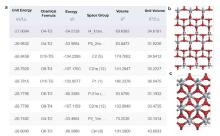
图3
"
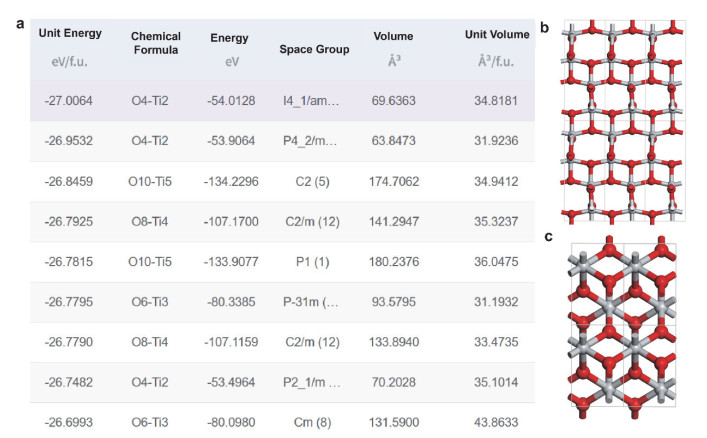
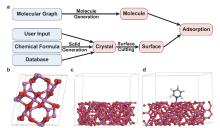
图4
"
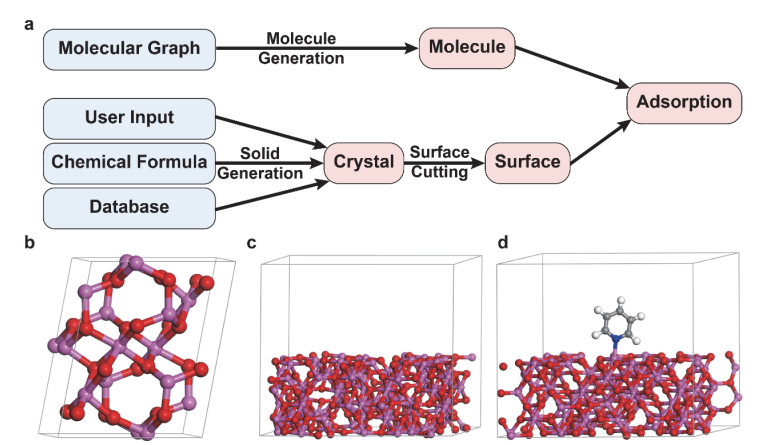
图5
"
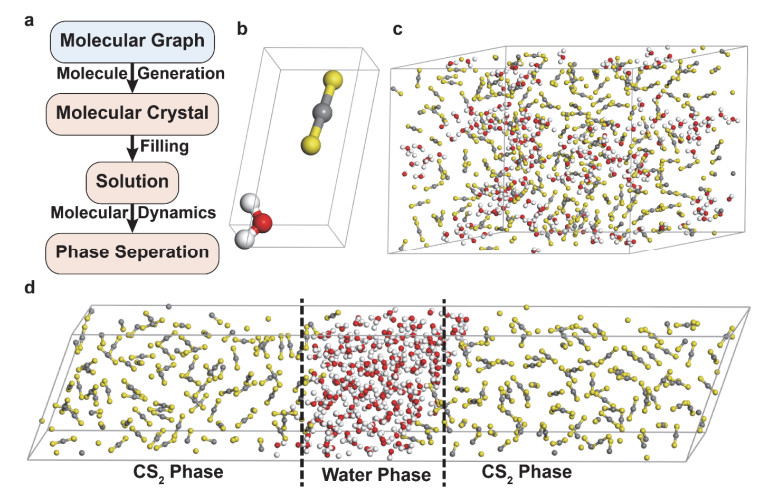
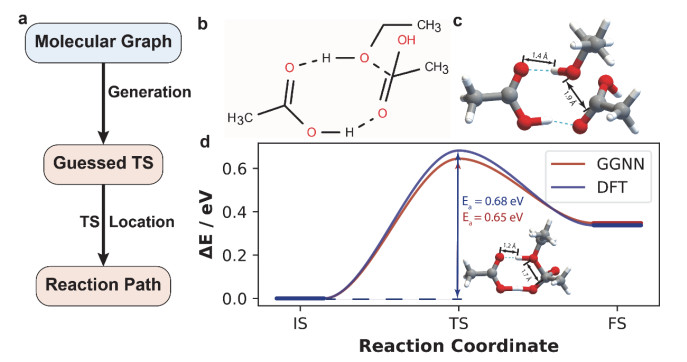
图6
"
| 1 |
C. Cazorla, J. Boronat. Rev. Mod. Phys. 2017, 89, 035003.
doi: 10.1103/RevModPhys.89.035003 |
| 2 |
Y. Foucaud, M. Badawi, L. Filippov, I. Filippova, S. Lebègue. Miner. Eng. 2019, 143, 106020.
doi: 10.1016/j.mineng.2019.106020 |
| 3 |
H. Liu, Z. Zhao, Q. Zhou, R. Chen, K. Yang, Z. Wang, L. Tang, M. Bauchy. C. R. Geosci. 2022, 354, 35.
doi: 10.5802/crgeos.116 |
| 4 |
M.O. Steinhauser, S. Hiermaier. Int. J. Mol. Sci. 2009, 10, 5135.
doi: 10.3390/ijms10125135 |
| 5 |
M. Kulichenko, B. Nebgen, N. Lubbers, J.S. Smith, K. Barros, A.E.A. Allen, A. Habib, E. Shinkle, N. Fedik, Y.W. Li, et al.. Chem. Rev. 2024, 124, 13681.
doi: 10.1021/acs.chemrev.4c00572 |
| 6 |
Y. Li, X. Zhang, L. Shen. J. Mater. Inf. 2025, 5
doi: 10.20517/jmi.2025.17 |
| 7 |
M. Rupp, A. Tkatchenko, K.-R. Müller, O.A. von Lilienfeld. Phys. Rev. Lett. 2012, 108, 058301.
doi: 10.1103/PhysRevLett.108.058301 |
| 8 |
A.P. Bartók, M.C. Payne, R. Kondor, G. Csányi. Phys. Rev. Lett. 2010, 104, 136403.
doi: 10.1103/PhysRevLett.104.136403 |
| 9 |
J. Behler, M. Parrinello. Phys. Rev. Lett. 2007, 98, 146401.
doi: 10.1103/PhysRevLett.98.146401 |
| 10 |
A.P. Bartók, R. Kondor, G. Csányi. Phys. Rev. B 2013, 87, 184115.
doi: 10.1103/PhysRevB.87.184115 |
| 11 |
O.T. Unke, S. Chmiela, H.E. Sauceda, M. Gastegger, I. Poltavsky, K.T. Schütt, A. Tkatchenko, K.-R. Müller. Chem. Rev. 2021, 121, 10142.
doi: 10.1021/acs.chemrev.0c01111 |
| 12 |
Y. Zhang, J. Xia, B. Jiang. Phys. Rev. Lett. 2021, 127, 156002.
doi: 10.1103/PhysRevLett.127.156002 |
| 13 |
Z.-X. Yang, X.-T. Xie, P.-L. Kang, Z.-X. Wang, C. Shang, Z.-P. Liu. J. Chem. Theory Comput. 2024, 20, 6717.
doi: 10.1021/acs.jctc.4c00660 |
| 14 |
L. Zhang, D.-Y. Lin, H. Wang, R. Car, W. E. Phys. Rev. Materials 2019, 3, 023804.
doi: 10.1103/PhysRevMaterials.3.023804 |
| 15 |
H. Wang, X. Guo, L. Zhang, H. Wang, J. Xue. Appl. Phys. Lett. 2019, 114, 244101.
doi: 10.1063/1.5098061 |
| 16 |
S. Klawohn, J.P. Darby, J.R. Kermode, G. Csányi, M.A. Caro, A.P. Bartók. J. Chem. Phys. 2023, 159, 174108.
doi: 10.1063/5.0160898 |
| 17 |
Y. Liu, L. Wang, M. Liu, X. Zhang, B. Oztekin, S. Ji, arXiv: 2102.05013, https://doi.org/10.48550/arXiv.2102.05013.
|
| 18 |
J. Gasteiger, C. Yeshwanth, S. Günnemann, Directional Message Passing on Molecular Graphs via Synthetic Coordinates, In Advances in Neural Information Processing Systems 34 (NeurIPS 2021), Curran Associates, Inc. : Red Hook, NY, USA, 2021, pp. 15421–15433, https://papers.nips.cc/paper/2021/hash/82489c9737cc245530c7a6ebef3753ec-Abstract.html.
|
| 19 |
V.G. Satorras, E. Hoogeboom, M. Welling, E(n) Equivariant Graph Neural Networks, In Proceedings of the 38th International Conference on Machine Learning, PMLR, 2021, pp. 9323–9332, https://proceedings.mlr.press/v139/satorras21a.html.
|
| 20 |
K.T. Schütt, O.T. Unke, M. Gastegger, arXiv: 2102.03150, https://doi.org/10.48550/arXiv.2102.03150.
|
| 21 |
A. Musaelian, S. Batzner, A. Johansson, L. Sun, C.J. Owen, M. Kornbluth, B. Kozinsky. Nat Commun 2023, 14, 579.
doi: 10.1038/s41467-023-36329-y |
| 22 |
I. Batatia, D.P. Kovacs, G. Simm, C. Ortner, G. Csanyi, MACE: Higher Order Equivariant Message Passing Neural Networks for Fast and Accurate Force Fields, In Advances in Neural Information Processing Systems 35 (NeurIPS 2022), Curran Associates, Inc. : Red Hook, NY, USA, 2022, pp. 11423–11436, https://proceedings.neurips.cc/paper_files/paper/2022/file/4a36c3c51af11ed9f34615b81edb5bbc-Paper-Conference.pdf.
|
| 23 |
S.-D. Huang, C. Shang, P.-L. Kang, Z.-P. Liu. Chem. Sci. 2018, 9, 8644.
doi: 10.1039/C8SC03427C |
| 24 |
P.-L. Kang, C. Shang, Z.-P. Liu. J. Am. Chem. Soc. 2019, 141, 20525.
doi: 10.1021/jacs.9b11535 |
| 25 |
Q.-Y. Liu, C. Shang, Z.-P. Liu. J. Am. Chem. Soc. 2021, 143, 11109.
doi: 10.1021/jacs.1c04624 |
| 26 |
S.-D. Huang, C. Shang, X.-J. Zhang, Z.-P. Liu. Chem. Sci. 2017, 8, 6327.
doi: 10.1039/C7SC01459G |
| 27 |
B. Deng, P. Zhong, K. Jun, J. Riebesell, K. Han, C.J. Bartel, G. Ceder. Nat. Mach. Intell. 2023, 5, 1031.
doi: 10.1038/s42256-023-00716-3 |
| 28 |
D. Zhang, H. Bi, F.-Z. Dai, W. Jiang, X. Liu, L. Zhang, H. Wang. npj Comput. Mater. 2024, 10, 94.
doi: 10.1038/s41524-024-01278-7 |
| 29 |
D. Zhang, X. Liu, X. Zhang, C. Zhang, C. Cai, H. Bi, Y. Du, X. Qin, A. Peng, J. Huang, et al.. npj Comput. Mater. 2024, 10, 293.
doi: 10.1038/s41524-024-01493-2 |
| 30 |
D. Zhang, A. Peng, C. Cai, W. Li, Y. Zhou, J. Zeng, M. Guo, C. Zhang, B. Li, H. Jiang, et al., arXiv: 2506.01686, https://doi.org/10.48550/arXiv.2506.01686.
|
| 31 |
Z.-X. Yang, X.-T. Xie, Z.-X. Wang, D.-X. Chen, Z.-X. Guo, J.-J. Du, Q.-M. Liang, Q.-Y. Liu, C. Shang, Z.-P. Liu. Sci. China Chem. 2025,
doi: 10.1007/s11426-025-3054-y |
| 32 |
M.Z. Makoś, N. Verma, E.C. Larson, M. Freindorf, E. Kraka. J. Chem. Phys. 2021, 155, 024116.
doi: 10.1063/5.0055094 |
| 33 |
O.-E. Ganea, L. Pattanaik, C.W. Coley, R. Barzilay, K.F. Jensen, W.H. Green, T.S. Jaakkola, arXiv: 2106.07802, https://doi.org/10.48550/arXiv.2106.07802.
|
| 34 |
J. Abramson, J. Adler, J. Dunger, R. Evans, T. Green, A. Pritzel, O. Ronneberger, L. Willmore, A.J. Ballard, J. Bambrick, et al.. Nature 2024, 630, 493.
doi: 10.1038/s41586-024-07487-w |
| 35 |
J. Westermayr, J. Gilkes, R. Barrett, R.J. Maurer. Nat. Comput. Sci. 2023, 3, 139.
doi: 10.1038/s43588-022-00391-1 |
| 36 |
J. Lim, S. Ryu, J.W. Kim, W.Y. Kim. J. Cheminform. 2018, 10, 31.
doi: 10.1186/s13321-018-0286-7 |
| 37 |
S. Choi. Nat. Commun. 2023, 14, 1168.
doi: 10.1038/s41467-023-36823-3 |
| 38 |
M. Xu, L. Yu, Y. Song, C. Shi, S. Ermon, J. Tang, arXiv: 2203.02923, https://doi.org/10.48550/arXiv.2203.02923.
|
| 39 |
B. Jing, G. Corso, J. Chang, R. Barzilay, T. Jaakkola, arXiv: 2206.01729, https://doi.org/10.48550/arXiv.2206.01729.
|
| 40 |
A. Morehead, J. Cheng. Commun. Chem. 2024, 7, 150.
doi: 10.1038/s42004-024-01233-z |
| 41 |
S. Kim, J. Woo, W.Y. Kim. Nat. Commun. 2024, 15, 341.
doi: 10.1038/s41467-023-44629-6 |
| 42 |
Y. Song, J. Sohl-Dickstein, D.P. Kingma, A. Kumar, S. Ermon, B. Poole, arXiv: 2011.13456, https://doi.org/10.48550/arXiv.2011.13456.
|
| 43 |
K. Xu, W. Hu, J. Leskovec, S. Jegelka, arXiv: 1810.00826, https://doi.org/10.48550/arXiv.1810.00826.
|
| 44 |
C. Duan, Y. Du, H. Jia, H.J. Kulik. Nat. Comput. Sci. 2023, 3, 1045.
doi: 10.1038/s43588-023-00563-7 |
| 45 |
M. Schreiner, A. Bhowmik, T. Vegge, J. Busk, O. Winther. Sci. Data 2022, 9, 779.
doi: 10.1038/s41597-022-01870-w |
| 46 |
Z.-X. Guo, J.-P. Tang, Z.-X. Wang, Q.-M. Liang, S.-C. Ma, C. Shang, L. Chen, Z.-P. Liu, http://www.lasphub.com/publication/228.pdf (accessed on Dec 30, 2025).
|
| 47 |
C. Shang, Z.-P. Liu. J. Chem. Theory Comput. 2010, 6, 1136.
doi: 10.1021/ct9005147 |
| 48 |
N. Thomas, T. Smidt, S. Kearnes, L. Yang, L. Li, K. Kohlhoff, P. Riley, arXiv: 1802.08219, https://doi.org/10.48550/arXiv.1802.08219.
|
| 49 |
S. Grimme, J. Antony, S. Ehrlich, H. Krieg. J. Chem. Phys. 2010, 132, 154104.
doi: 10.1063/1.3382344 |
| 50 |
H.-Z. Luo, C. Shang, Z.-P. Liu, http://www.lasphub.com/publication/230.pdf (accessed on Dec 30, 2025).
|
| 51 |
S. Axelrod, R. Gómez-Bombarelli. Sci Data 2022, 9, 185.
doi: 10.1038/s41597-022-01288-4 |
| 52 |
S. Ma, C. Shang, C.-M. Wang, Z.-P. Liu. Chem. Sci. 2020, 11, 10113.
doi: 10.1039/D0SC03918G |
| 53 |
M.K. Horton, P. Huck, R.X. Yang, J.M. Munro, S. Dwaraknath, A.M. Ganose, R.S. Kingsbury, M. Wen, J.X. Shen, T.S. Mathis, et al.. Nat. Mater. 2025, 24, 1522.
doi: 10.1038/s41563-025-02272-0 |
| 54 |
A. Jain, S.P. Ong, G. Hautier, W. Chen, W.D. Richards, S. Dacek, S. Cholia, D. Gunter, D. Skinner, G. Ceder, et al.. APL Mater. 2013, 1, 011002.
doi: 10.1063/1.4812323 |
| 55 |
C. Zeni, R. Pinsler, D. Zügner, A. Fowler, M. Horton, X. Fu, Z. Wang, A. Shysheya, J. Crabbé, S. Ueda, et al.. Nature 2025, 639, 624.
doi: 10.1038/s41586-025-08628-5 |
| 56 |
RDKit. (n.d.). https://www.rdkit.org/.
|
| 57 |
A. Vaitkus, A. Merkys, T. Sander, M. Quirós, P.A. Thiessen, E.E. Bolton, S. Gražulis. J. Cheminf. 2023, 15, 123.
doi: 10.1186/s13321-023-00780-2 |
| 58 |
A. Merkys, A. Vaitkus, A. Grybauskas, A. Konovalovas, M. Quirós, S. Gražulis. J. Cheminf. 2023, 15, 25.
doi: 10.1186/s13321-023-00692-1 |
| 59 |
A. Vaitkus, A. Merkys, S. Gražulis. J. Appl. Crystallogr. 2021, 54, 661.
doi: 10.1107/S1600576720016532 |
| 60 |
M. Quirós, S. Gražulis, S. Girdzijauskaitė, A. Merkys, A. Vaitkus. J. Cheminf. 2018, 10, 23.
doi: 10.1186/s13321-018-0279-6 |
| 61 |
S. Gražulis, A. Merkys, A. Vaitkus, M. Okulič-Kazarinas. J. Appl. Crystallogr. 2015, 48, 85.
doi: 10.1107/S1600576714025904 |
| 62 |
S. Gražulis, A. Daškevič, A. Merkys, D. Chateigner, L. Lutterotti, M. Quirós, N.R. Serebryanaya, P. Moeck, R.T. Downs, A. Le Bail. Nucleic Acids Res. 2012, 40, D420.
doi: 10.1093/nar/gkr900 |
| 63 |
S. Gražulis, D. Chateigner, R.T. Downs, A.F.T. Yokochi, M. Quirós, L. Lutterotti, E. Manakova, J. Butkus, P. Moeck, A. Le Bail. J. Appl. Crystallogr. 2009, 42, 726.
doi: 10.1107/S0021889809016690 |
| 64 |
C.R. Groom, I.J. Bruno, M.P. Lightfoot, S.C. Ward. Acta Crystallogr. B 2016, 72, 171.
doi: 10.1107/S2052520616003954 |
| 65 |
C. Shang, Z.-P. Liu. J. Chem. Theory Comput. 2012, 8, 2215.
doi: 10.1021/ct300250h |
| 66 |
B. Karulin, M. Kozhevnikov. J. Cheminf. 2011, 3, P3.
doi: 10.1186/1758-2946-3-S1-P3 |
| 67 |
N. Rego, D. Koes. Bioinformatics 2015, 31, 1322.
doi: 10.1093/bioinformatics/btu829 |
| 68 |
A. Togo. J. Phys. Soc. Jpn. 2023, 92, 012001.
doi: 10.7566/JPSJ.92.012001 |
| 69 |
A. Hjorth Larsen, J. Jørgen Mortensen, J. Blomqvist, I.E. Castelli, R. Christensen, M. Dułak, J. Friis, M.N. Groves, B. Hammer, C. Hargus, et al.. J. Phys. Condens. Matter 2017, 29, 273002.
doi: 10.1088/1361-648X/aa680e |
| 70 |
S.P. Ong, W.D. Richards, A. Jain, G. Hautier, M. Kocher, S. Cholia, D. Gunter, V.L. Chevrier, K.A. Persson, G. Ceder. Comput. Mater. Sci. 2013, 68, 314.
doi: 10.1016/j.commatsci.2012.10.028 |
| 71 |
L. Martínez, R. Andrade, E.G. Birgin, J.M. Martínez. J. Comput. Chem. 2009, 30, 2157.
doi: 10.1002/jcc.21224 |
| 72 |
D.T. Cromer, K. Herrington. J. Am. Chem. Soc. 1955, 77, 4708.
doi: 10.1021/ja01623a004 |
| 73 |
S.-C. Zhu, S.-H. Xie, Z.-P. Liu. J. Am. Chem. Soc. 2015, 137, 11532.
doi: 10.1021/jacs.5b07734 |
| 74 |
X. Yang, C. Shang, Z.-P. Liu. J. Mater. Chem. A 2025, 13, 17429.
doi: 10.1039/D5TA01715G |
| 75 |
C. Morterra. J. Catal. 1978, 54, 348.
doi: 10.1016/0021-9517(78)90083-0 |
| 76 |
C.H. Kline Jr., J. Turkevich. J. Chem. Phys. 1944, 12, 300.
doi: 10.1063/1.1723943 |
| 77 |
T.K. Phung, C. Herrera, M.Á. Larrubia, M. García-Diéguez, E. Finocchio, L.J. Alemany, G. Busca. Appl. Catal. A: Gen. 2014, 483, 41.
doi: 10.1016/j.apcata.2014.06.020 |
| [1] | 李一鸣;苑世领;徐桂英. 计算机模拟技术在表面活性剂研究中的应用[J]. 物理化学学报, 2003, 19(10): 986 -992 . |
|
||