Acta Phys. -Chim. Sin. ›› 2025, Vol. 41 ›› Issue (7): 100078.doi: 10.1016/j.actphy.2025.100078
Special Issue: Next-Generation Optoelectronic Functional Materials
• ARTICLE • Previous Articles Next Articles
Accurate and efficient prediction of Schottky barrier heights in 2D semimetal/silicon heterojunctions
Haiyu Zhu1,2, Zhuoqun Wen2,3,4, Wen Xiong3,4,*( ), Xingzhan Wei2,3,4,*(), Zhi Wang5,*()
- 1 School of Optoelectronic Engineering, Chongqing University of Posts and Telecommunications, Chongqing 400065, China
2 Chongqing School, University of Chinese Academy of Sciences, Chongqing 400714, China
3 Chongqing Institute of Green and Intelligent Technology, Chinese Academy of Sciences, Chongqing 400714, China
4 University of Chinese Academy of Sciences, Beijing 100049, China
5 State Key Laboratory of Semiconductor Physics and Chip Technologies, Institute of Semiconductors, Chinese Academy of Sciences, Beijing 100083, China
-
Received:2025-01-17Revised:2025-03-02Accepted:2025-03-04Published:2025-05-22 -
Contact:Email: xiongwen@cigit.ac.cn (Wen Xiong)weixingzhan@cigit.ac.cn (Xingzhan Wei)wangzhi@semi.ac.cn (Zhi Wang) -
Supported by:the National Natural Science Foundation of China(12174380); the National Natural Science Foundation of China(11904359); the National Natural Science Foundation of China(62074021); the Natural Science Foundation of Chongqing, China(CSTB2023NSCQ-LZX0087); the Natural Science Foundation Project of CQ CSTC, China(cstc2020jcyj-msxmX0822)

Cite this article
Haiyu Zhu, Zhuoqun Wen, Wen Xiong, Xingzhan Wei, Zhi Wang. Accurate and efficient prediction of Schottky barrier heights in 2D semimetal/silicon heterojunctions[J]. Acta Phys. -Chim. Sin. 2025, 41(7), 100078. doi: 10.1016/j.actphy.2025.100078
share this article
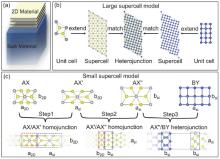
Fig 1
(a) Schematic plot of a heterojunction where 2D material stacks on bulk substrate. (b) The conventional model of the heterojunction, where both the 2D (here, transition metal ditelluride) and bulk materials (here, silicon) are extended into supercells to accommodate the lattice mismatch. (c) The small supercell model applied in this work, involving a three-step alignment from equilibrium 2D material (AX), to uniaxially (AX') and biaxially (AX'') strained 2D material, and eventually to equilibrium bulk silicon (BY). The vacuum region in AX''/BY structure is to mimic the high-k dielectric ultrathin layer in experiment."
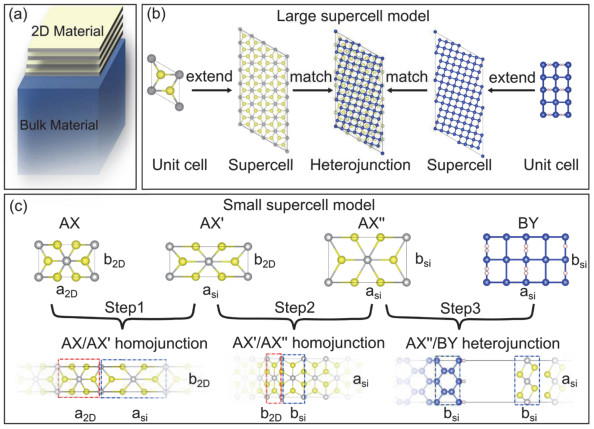
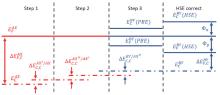
Fig 2
A diagram of the core-level energy alignment method for SBH in AX/BY heterojunction. The steps 1–3 correspond to the same steps illustrated in Fig. 1c."
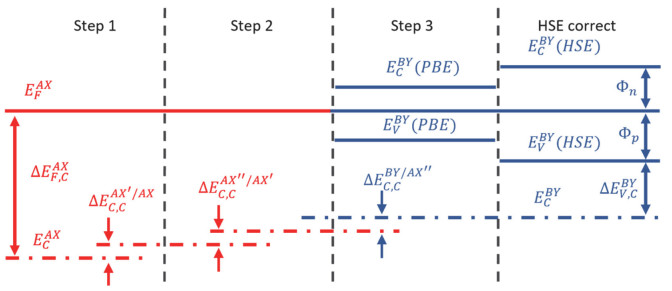

Table 1
Comparison of the equilibrium lattice constants of 2D semimetals in their hexagonal crystal system, between predictions from DFT and experimental measurements. After transforming to the orthorhombic lattice, they form heterojunction with Si(001) (a =7.68 Å, b = 3.84 Å), and lattice mismatches are also provided. A positive (negative) mismatch indicates a tensile (compressive) strain on 2D material when forming heterojunction."
| 2D material | Equilibrium lattice constant (hexagonal) (Å) | 2D/Si(001) heterojunction strain applied on 2D (%) | |||||
| This work | Exp. | ||||||
| a = b | c | a = b | c | along (100) | along (010) | ||
| IrTe2 | 3.959 | 5.419 | 3.929 a) | 5.405 a) | 10.7 | −3.1 | |
| NiTe2 | 3.860 | 5.177 | 3.878 b) | 5.265 b) | 13.0 | −0.5 | |
| PdTe2 | 4.028 | 5.128 | 4.036 c) | 5.126 c) | 8.3 | −5.9 | |
| PtTe2 | 4.048 | 5.113 | 4.026 d) | 5.221 d) | 8.7 | −5.4 | |
| ZrTe2 | 3.909 | 6.683 | 3.940 e) | 6.630 e) | 11.8 | −1.8 | |
Fig 3
Band structures of TMDs under strains. The strain conditions AX' and AX'' are the ones presented in Fig. 1. (a–c) Bulk IrTe2 under no strain, uniaxial strain, and biaxial strain; (d–f) Same properties for bulk NiTe2; (g–i) Same properties for bulk PdTe2; (j–l) Same properties for bulk PtTe2; (m–o) Same properties for bulk ZrTe2."
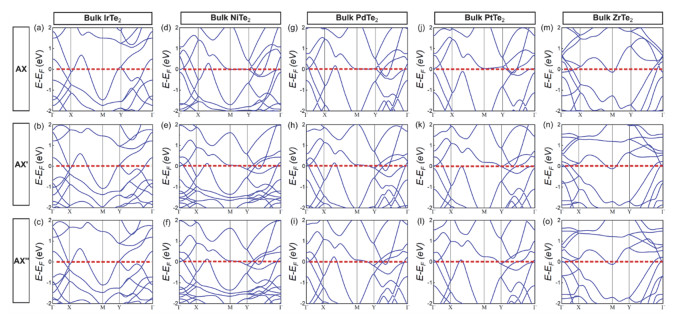
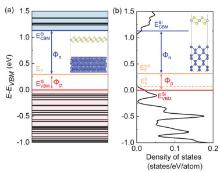
Fig 4
(a) Energy levels of Si (black solid lines) and the Fermi level of IrTe2 (orange solid line) in the large supercell model, calculated using HSE and only Γ point. (b) The projected DOS of Si (black) in the small supercell model, where the dash and solid orange lines are the Fermi levels of IrTe2 before () and after () corrections. VBM of silicon is set to be the energy zero."
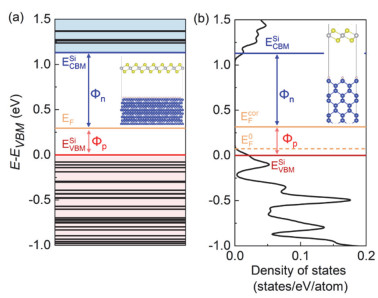
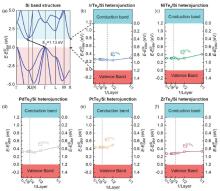
Fig 5
Calculated SBH for different TMD/Si heterojunctions. (a) Band structure of Si from HSE functional, showing a bandgap of 1.13 eV. (b–f) SBH for IrTe2/Si, NiTe2/Si, PdTe2/Si, PtTe2/Si, and ZrTe2/Si heterojunctions, respectively. The left axis represents the SBH for holes (Φp), and the right axis represents the SBH for electrons (Φn) as a function of TMD layer number."
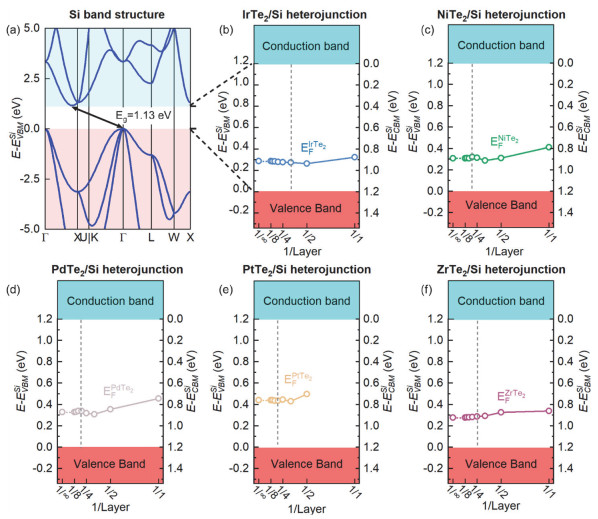
Table 2
Schottky barrier height of electron (Φn) (eV) for heterojunctions of 2D TMD materials with varying thicknesses. Note that the monolayer PtTe2 exhibits a semiconducting phase, and hence not provided here."
| Thickness | IrTe2/Si | NiTe2/Si | PdTe2/Si | PtTe2/Si | ZrTe2/Si |
| 1L | 0.813 | 0.725 | 0.681 | – | 0.797 |
| 2L | 0.872 | 0.826 | 0.781 | 0.640 | 0.811 |
| 3L | 0.861 | 0.850 | 0.828 | 0.707 | 0.845 |
| 4L | 0.859 | 0.823 | 0.819 | 0.691 | 0.849 |
| 5L | 0.858 | 0.826 | 0.797 | 0.702 | 0.854 |
| Bulk | 0.849 | 0.828 | 0.808 | 0.697 (exp.: 0.733*) | 0.859 |
| 1 |
Chang, C. C.; Sharma, Y. D.; Kim, Y. S.; Bur, J. A.; Shenoi, R. V.; Krishna, S.; Huang, D.; Lin, S. Y. Nano. Lett. 2010, 10, 1704.
doi: 10.1021/nl100081j |
| 2 |
Tan, C. L.; Mohseni, H. Nanophotonics 2018, 7, 169.
doi: 10.1515/nanoph-2017-0061 |
| 3 |
Tyagi, D.; Wang, H.; Huang, W.; Hu, L.; Tang, Y.; Guo, Z.; Ouyang, Z.; Zhang, H. Nanoscale 2020, 12, 3535.
doi: 10.1039/c9nr10178k |
| 4 |
Liu, C. Y.; Guo, J. S.; Yu, L. W.; Li, J.; Zhang, M.; Li, H.; Shi, Y. C.; Dai, D. X. Light Sci. Appl. 2021, 10, 123.
doi: 10.1038/s41377-021-00551-4 |
| 5 |
Zhang, K. X.; Zhang, L. B.; Han, L.; Wang, L.; Chen, Z. Q. Z.; Xing, H. Z.; Chen, X. S. Nano Ex. 2021, 2, 012001.
doi: 10.1088/2632-959X/abd45b |
| 6 |
Long, M. S.; Wang, P.; Fang, H. H.; Hu, W. D. Adv. Funct. Mater. 2018, 29, 1803807.
doi: 10.1002/adfm.201803807 |
| 7 |
Zha, J. J.; Luo, M. C.; Ye, M.; Ahmed, T.; Yu, X. C.; Lien, D. H.; He, Q. Y.; Lei, D. Y.; Ho, J. C.; Bullock, J.; et al. Adv. Funct. Mater. 2021, 32, 2111970.
doi: 10.1002/adfm.202111970 |
| 8 |
Jiang, H.; Wang, M.; Fu, J.; Li, Z.; Shaikh, M. S.; Li, Y.; Nie, C.; Sun, F.; Tang, L.; Yang, J.; et al. ACS Nano 2022, 16, 12777.
doi: 10.1021/acsnano.2c04704 |
| 9 |
Jiang, H.; Wei, J.; Sun, F.; Nie, C.; Fu, J.; Shi, H.; Sun, J.; Wei, X.; Qiu, C. W. ACS Nano 2022, 16, 4458.
doi: 10.1021/acsnano.1c10795 |
| 10 |
Fu, J.; Guo, Z.; Nie, C.; Sun, F.; Li, G.; Feng, S.; Wei, X. Innovation 2024, 5, 100600.
doi: 10.1016/j.xinn.2024.100600 |
| 11 |
Xie, C.; Zeng, L.; Zhang, Z.; Tsang, Y. H.; Luo, L.; Lee, J. H. Nanoscale 2018, 10, 15285.
doi: 10.1039/c8nr04004d |
| 12 |
Wu, Y.; Nie, C.; Sun, F.; Jiang, X.; Zhang, X.; Fu, J.; Peng, Y.; Wei, X. ACS Appl. Mater. Interfaces 2024, 16, 22632.
doi: 10.1021/acsami.4c00827 |
| 13 |
Chen, B.; Xu, S.; Cheng, R.; Zhao, Y. IEEE Electron Device Lett. 2019, 40, 632.
doi: 10.1109/led.2019.2897817 |
| 14 |
Huang, Z. W.; Yu, C. Y.; Chang, A. L.; Zhao, Y. M.; Huang, W.; Chen, S. Y.; Li, C. J. Mater. Sci. 2020, 55, 8630.
doi: 10.1007/s10853-020-04625-3 |
| 15 |
Tersoff, J. Phys. Rev. B 1984, 30, 4874.
doi: 10.1103/PhysRevB.30.4874 |
| 16 |
Tersoff, J. Phys. Rev. B 1985, 32, 6968.
doi: 10.1103/physrevb.32.6968 |
| 17 |
Chiappe, D.; Scalise, E.; Cinquanta, E.; Grazianetti, C.; Van den Broek, B.; Fanciulli, M.; Houssa, M.; Molle, A. Adv. Mater. 2014, 26, 2096.
doi: 10.1002/adma.201304783 |
| 18 |
Van, B. R.; Yao, Q.; Banerjee, S.; Cakir, D.; Oncel, N.; Zandvliet, H. J. W. Beilstein J. Nanotechnol 2017, 8, 1952.
doi: 10.3762/bjnano.8.196 |
| 19 |
Zhou, S. R.; Wen, S. F.; Fan, H. D.; Wei, Y. Y.; Yin, Y.; Lan, C. Y.; Li, C.; Liu, Y. ACS Photonics 2024, 11, 1810.
doi: 10.1021/acsphotonics.4c00331 |
| 20 |
Choi, H.; Min, K. A.; Cha, J.; Hong, S. Phys. Chem. Chem. Phys. 2018, 20, 25240.
doi: 10.1039/c8cp05201h |
| 21 |
Fang, P. X. W.; Nihtianov, S.; Sberna, P.; De Wijs, G. A.; Fang, C. M. J. Phys. Commun. 2022, 6, 085010.
doi: 10.1088/2399-6528/ac8854 |
| 22 |
Mott, N. F. Proc. R. Soc. (London) A 1939, 171, 27.
doi: 10.1098/rspa.1939.0051 |
| 23 |
Schottky, W. Z. Phys. 1939, 113, 367.
doi: 10.1007/BF01340116 |
| 24 |
Bardeen, J. Phys. Rev. 1947, 71, 717.
doi: 10.1103/PhysRev.71.717 |
| 25 |
Skachkov, D.; Liu, S. L.; Wang, Y.; Zhang, X. G.; Cheng H. P. Phys. Rev. B 2021, 104, 045429.
doi: 10.1103/PhysRevB.104.045429 |
| 26 |
Nangoi, J. K.; Palmstrom, C. J.; Van de Walle, C. G. Phys. Rev. B 2024, 110, 035302.
doi: 10.1103/PhysRevB.110.035302 |
| 27 |
Chin, K. K.; Cao, R.; Kendelewicz, T.; Miyano, K.; Williams, M. D.; Doniach, S.; Lindau, I.; Spicer, W. E. MRS Online Proc. Libr. 1986, 77, 297.
doi: 10.1557/PROC-77-297 |
| 28 |
Kim, H.; Kumar, M. D.; Kim, J. Sensor Actuat A-phys 2015, 233, 290.
doi: 10.1016/j.sna.2015.07.026 |
| 29 |
Taffelli, A.; Dirè, S.; Quaranta, A.; Pancheri, L. Sensors 2021, 21, 2758.
doi: 10.3390/s21082758 |
| 30 |
Wei, S. H.; Alex, Z. Appl. Phys. Lett. 1998, 72, 2011.
doi: 10.1063/1.121249 |
| 31 |
Li, Y. H.; Walsh, A.; Chen, S. Y.; Yin, W. J.; Yang, J. H.; Li, J. B.; Da Silva, J. L. F.; Gong X. G.; Wei, S. H. Appl. Phys. Lett. 2009, 94, 212109.
doi: 10.1063/1.3143626 |
| 32 |
Lang, L.; Zhang, Y. Y.; Xu, P.; Chen, S. Y.; Xiang, H. J.; Gong, X. G. Phys. Rev. B 2015, 92, 075102.
doi: 10.1103/PhysRevB.92.075102 |
| 33 |
Hu, Y. Y; Qiu, C.; Shen, T.; Yang, K. K.; Deng, H. X. J. Semicond. 2021, 42, 112102.
doi: 10.1088/1674-4926/42/11/112102 |
| 34 |
Kresse, G.; Furthmüller, J. Comput. Mater. Sci. 1996, 6, 15.
doi: 10.1016/0927-0256(96)00008-0 |
| 35 |
Kresse, G.; Furthmüller, J. Phys. Rev. B 1996, 54, 11169.
doi: 10.1103/PhysRevB.54.11169 |
| 36 |
Kresse, G.; Joubert, D. Phys. Rev. B 1999, 59, 1758.
doi: 10.1103/PhysRevB.59.1758 |
| 37 |
Perdew, J. P.; Burke, K.; Ernzerhof, M. Phys. Rev. Lett. 1996, 77, 3865.
doi: 10.1103/PhysRevLett.77.3865 |
| 38 |
Heyd, J.; Scuseria, G. E.; Ernzerhof, M. J. Chem. Phys. 2003, 118, 8207.
doi: 10.1063/1.1564060 |
| 39 |
Heyd, J.; Scuseria, G. E.; Ernzerhof, M. J. Chem. Phys. 2006, 124, 219906.
doi: 10.1063/1.2204597 |
| 40 |
Leendertz, C.; Mingirulli, N.; Schulze, T. F.; Kleider, J. P.; Rech, B.; Korte, L. Appl. Phys. Lett. 2011, 98, 2002108.
doi: 10.1063/1.3590254 |
| 41 |
Zeng, L. H.; Wu, D.; Jie, J. S.; Ren, X. Y.; Hu, X.; Lau, S. P.; Chai, Y.; Tsang, Y. H. Adv. Mater. 2020, 32, 2004412.
doi: 10.1002/adma.202004412 |
| 42 |
Wei, S. H.; Zunger, A. Phys. Rev. B 1999, 60, 5404.
doi: 10.1103/PhysRevB.60.5404 |
| 43 |
Li, Y. H.; Gong X. G.; Wei, S. H. Appl. Phys. Lett. 2006, 88, 042104.
doi: 10.1063/1.2168254 |
| 44 |
Zhang, L.; Zhu, X. D.; Ling, L. S.; Zhang, C. J.; Pi, L.; Zhang, Y. H. Philos. Mag. 2013, 94, 439.
doi: 10.1080/14786435.2013.855333 |
| 45 |
Qi, M. Y.; An, C.; Zhou, Y. H.; Wu, H.; Zhang, B. W.; Chen, C. H.; Yuan, Y. F.; Wang, S. Y.; Zhou, Y.; Chen, X. L.; et al. Phys. Rev. B 2020, 101, 115124.
doi: 10.1103/PhysRevB.101.115124 |
| 46 |
Noh, H. J.; Jeong, J.; Cho, E. J.; Kim, K.; Min, B. I.; Park, B. G. Phys. Rev. Lett. 2017, 119, 016401.
doi: 10.1103/PhysRevLett.119.016401 |
| 47 |
Ma, H. F.; Chen, P.; Li, B.; Li, J.; Ai, R. Q.; Zhang, Z. W.; Sun, G. Z.; Yao K. K.; Lin, Z. Y.; Zhao, B.; et al. Nano Lett. 2018, 18, 3523.
doi: 10.1021/acs.nanolett.8b00583 |
| 48 |
Zahir, M.; Muhammad, Z.; Sami, U.; Zhang, B.; Lu, Q. X.; Zhu, L.; Hu, R. Inorg. Chem. Front. 2021, 8, 3885.
doi: 10.1039/d1qi00553g |
| 49 |
Li, P. F.; Li, L.; Zeng, X. C. J. Mater. Chem. C 2016, 4, 3106.
doi: 10.1039/c6tc00130k |
| 50 |
Yu, M.; Trinkle, D. R. J. Chem. Phys. 2011, 134, 064111.
doi: 10.1063/1.3553716 |
| 51 |
Jan, G.; McMillan, P. F.; Marzke, R. F.; Ramachandran, G. K.; Patton, D.; Deb, S. K.; Sankey, O. F. Phys. Rev. B 2000, 62, R7707.
doi: 10.1103/PhysRevB.62.R7707 |
| 52 |
Villaos, R. A. B.; Crisostomo, C. P.; Huang, Z. Q.; Huang, S. M.; Padama, A. A. B.; Albao, M. A.; Lin, H.; Chuang, F. C. NPJ 2D Mater. Appl. 2019, 3, 2.
doi: 10.1038/s41699-018-0085-z |
| 53 |
Yan, M.; Huang, H.; Zhang, K.; Wang, E.; Yao, W.; Deng, K.; Wan, G.; Zhang, H.; Arita, M.; Yang, H.; et al. Nat. Commun. 2017, 8, 257.
doi: 10.1038/s41467-017-00280-6 |
| [1] | Jiao LI,Zhong CHEN. First-Principles Study on the Electronic and Photocatalytic Properties of Ag3XO4 (X = P, As, V) [J]. Acta Phys. -Chim. Sin., 2017, 33(5): 941-948. |
| [2] | Gang LI,Min-Qiang CHEN,Shi-Xiong ZHAO,Peng-Wei LI,Jie HU,Sheng-Bo SANG,Jing-Jing HOU. Effect of Se Doping on the Electronic Band Structure and Optical Absorption Properties of Single Layer MoS2 [J]. Acta Phys. -Chim. Sin., 2016, 32(12): 2905-2912. |
| [3] | Neil-Qiang SU,Jun CHEN,Xin XU,Dong-H. ZHANG. Quantum Reaction Dynamics Based on a New Generation Density Functional and Neural Network Potential Energy Surfaces [J]. Acta Phys. -Chim. Sin., 2016, 32(1): 119-130. |
| [4] | YUAN Jun-Hui, GAO Bo, WANG Wen, WANG Jia-Fu. First-Principles Calculations of the Electronic Structure and Optical Properties of Y-Cu Co-Doped ZnO [J]. Acta Phys. -Chim. Sin., 2015, 31(7): 1302-1308. |
| [5] | YANG Jian-Hui, JI Jia-Lin, LI Lin, WEI Shi-Hao. Hydrogen Chemisorption and Physisorption on the Two-Dimensional TiC Sheet Surface [J]. Acta Phys. -Chim. Sin., 2014, 30(10): 1821-1826. |
| [6] | DU Ye-Ping; CHEN Jing-Chao; FENG Jing. Mechanical Properties and Electronic Structures of Various SnO2 Crystal Structures [J]. Acta Phys. -Chim. Sin., 2009, 25(02): 278-284. |
| [7] | ZHAO Qing-Xun; GENG Bo; WANG Shu-Biao; BIAN Fang; GUAN Li; LIU Bao-Ting. Effect of Hydrogen on the Ferroelectric Properties of PbZr0.5Ti0.5O3 during Forming Gas Annealing [J]. Acta Phys. -Chim. Sin., 2009, 25(01): 183-186. |
| [8] | FENG Jing; CHEN Jing-Chao; XIAO Bing; DU Ye-Ping; WANG Sheng-Hao; ZHANG Li-Juan. Oxidation and Thermodynamic Properties of Ag-Sn Alloy [J]. Acta Phys. -Chim. Sin., 2008, 24(11): 2007-2012. |
| [9] | ZHOU Zhen;YAN Tian-Ying;GAO Xue-Ping. Simulation and Design for Energy Storage Materials [J]. Acta Phys. -Chim. Sin., 2006, 22(09): 1168-1174. |
|
||