Acta Phys. -Chim. Sin. ›› 2025, Vol. 41 ›› Issue (9): 100107.doi: 10.1016/j.actphy.2025.100107
• ARTICLE • Previous Articles Next Articles
Enhanced photocatalytic synthesis of H2O2 by triplet electron transfer at g-C3N4@BN van der Waals heterojunction interface
Qi Wu, Changhua Wang*( ), Yingying Li, Xintong Zhang*()
- Key Laboratory of UV-Emitting Materials and Technology of Chinese Ministry of Education, Northeast Normal University, Changchun 130024, Jilin Province, China
-
Received:2025-03-31Revised:2025-05-25Accepted:2025-05-25Published:2025-07-04 -
Contact:Email: wangch100@nenu.edu.cn (Changhua Wang)xtzhang@nenu.edu.cn (Xintong Zhang) -
Supported by:the Jilin Province Science and Technology Development Project(20220201073GX); the Natural Science Foundation of China(52273236); the Natural Science Foundation of China(U22A2078); the Natural Science Foundation of China(91833303); the Natural Science Foundation of China(51102001); the Fundamental Research Funds for the Central Universities(2412022QD035); the Education Department of Jilin Province(JJKH20241426KJ)

Cite this article
Qi Wu, Changhua Wang, Yingying Li, Xintong Zhang. Enhanced photocatalytic synthesis of H2O2 by triplet electron transfer at g-C3N4@BN van der Waals heterojunction interface[J]. Acta Phys. -Chim. Sin. 2025, 41(9), 100107. doi: 10.1016/j.actphy.2025.100107
share this article
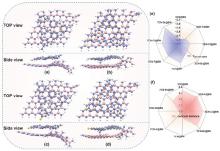
Fig 1
(a) Triazine-CN and BN heterojunction (3CN@BN); (b) Heptazine-CN and BN heterojunction (7CN@BN); (c) Fluorinated triazine-CN and BN heterojunction (3CN-F@BN); and (d) Fluorinated heptazine-CN and BN heterojunction (7CN-F@BN) top and side views of fully optimized monolayer structures, where blue represents C, gray represents N, gray represents B, green represents F, and white represents H; (e) Binding energies of eight CN@BN materials; (f) Centroid distances between CN and BN for eight CN@BN materials. Color online."
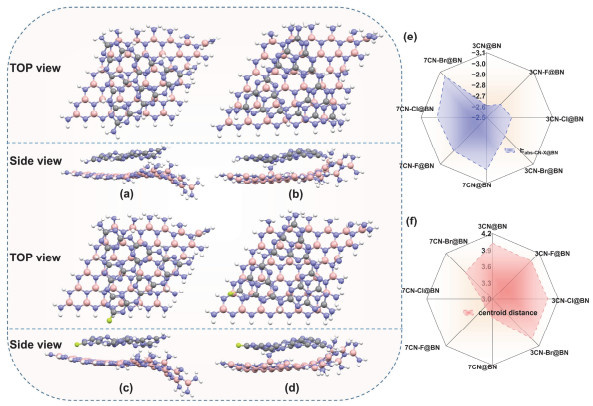
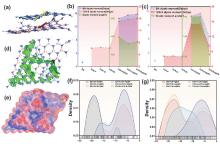
Fig 2
(a) Dipole moments at the BN and CN ends of the 3CN@BN structure; (b) Dipole moments and the angle between them at the CN and BN ends of the triazine CN@BN series heterojunctions; (c) Dipole moments and the angle between them at the CN and BN ends of the heptazine CN@BN series heterojunctions; (d) IGMH analysis diagram of the 7CN@BN structure; (e) ESP diagram of the 7CN@BN-Ⅰ structure; (f) Probability distribution of atomic electrostatic potential at the CN and BN ends of the triazine CN@BN series heterojunctions; (g) Probability distribution of atomic electrostatic potential at the CN and BN ends of the heptazine CN@BN series heterojunctions."
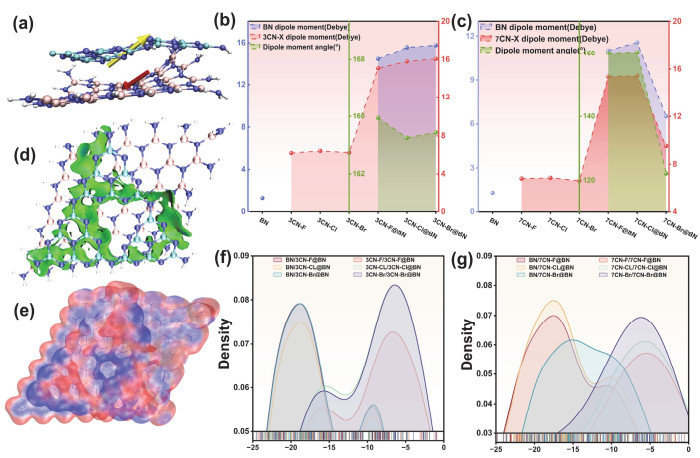
Fig 3
(a) HOMO and LUMO orbital energy levels of several materials; (b) Band gaps of several materials; (c) ODI values of several materials; (d) ELF isosurface diagram of 3CN@BN (isosurface value is 0.5 a.u.)."
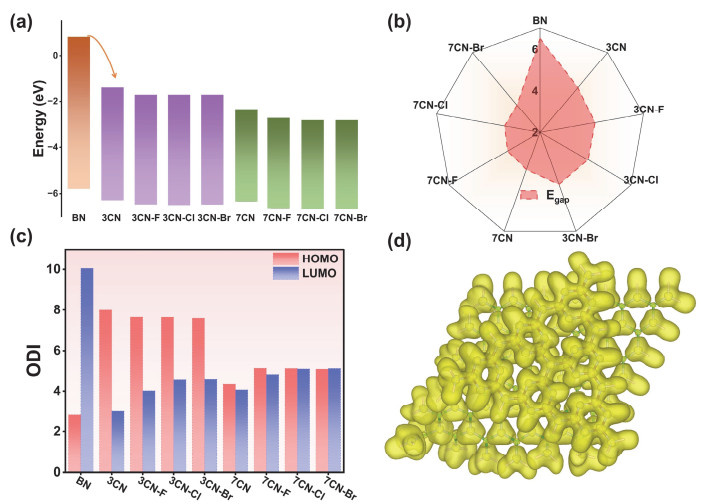
Fig 4
(a) Absorption spectra of several materials; (b) Charge transfer probability distribution of the first 30 excited states for the triazine CN@BN series materials; (c) Charge transfer probability distribution of the first 30 excited states for the heptazine CN@BN series materials; (d) Electron-hole recombination distance for the triazine CN@BN series materials; (e) Electron-hole recombination distance for the heptazine CN@BN series materials; (f) Gibbs free energy barriers for electron transfer and electron recombination of several materials; (g) HDI and EDI values for the triazine CN@BN series materials; (h) HDI and EDI values for the heptazine CN@BN series materials."
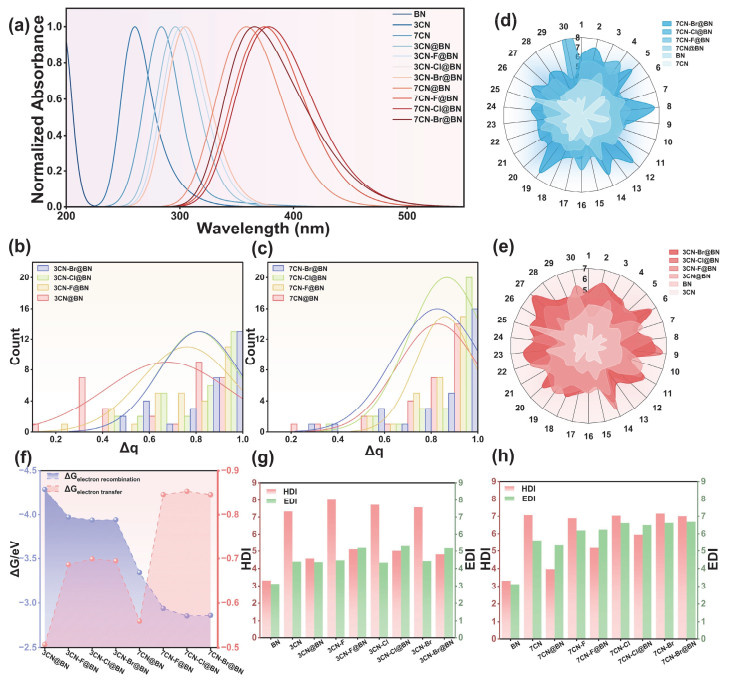
Fig 5
(a) Charge transfer probability distribution of the first 30 excited states between triazine CN@BN series materials and oxygen; (b) Charge transfer probability distribution of the first 30 excited states between heptazine CN@BN series materials and oxygen; (c) Vertical excitation energy of several materials with oxygen at different excited states; (d) Adsorption energy of CN@BN materials with different oxygen intermediates; (e) Reaction rate of energy transfer process between heptazine series materials and oxygen; (f) Reaction rate of energy transfer process between triazine series materials and oxygen."
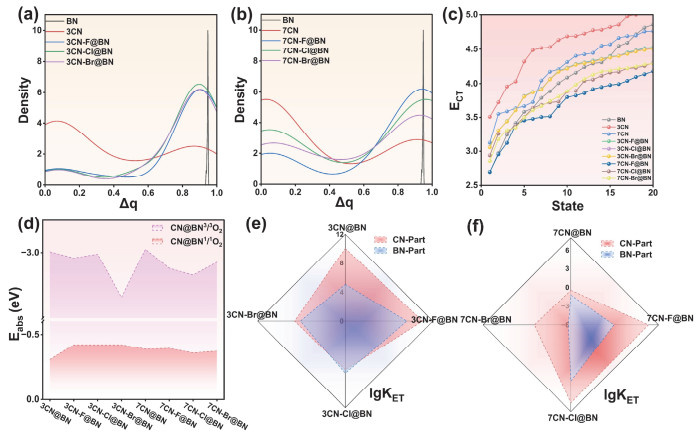
Fig 6
(a) Singlet-triplet energy levels of the first 30 excited states for triazine CN@BN material; (b) Singlet-triplet energy levels of the first 30 excited states for heptazine CN@BN material; (c) ΔEST of ten materials; (d) HOMO-LUMO orbital overlap integrals of ten materials; (e) < S0|Hso|T1 > of ten materials; (f) < S1|Hso|T1 > of ten materials; (g) CDD diagram of the T1 state for 7CN-Cl@BN; (h) Charge transfer amounts of the T1 state for ten materials; (i) Δr values of the T1 state for ten materials."
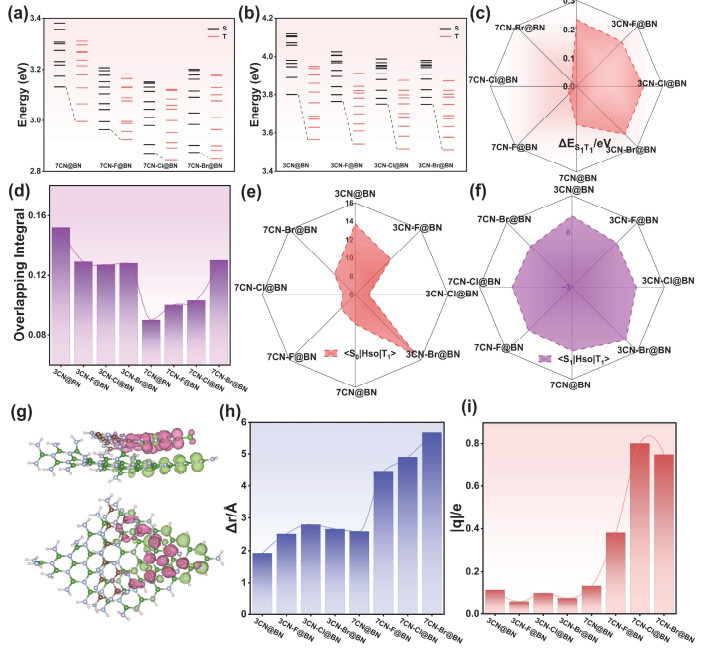
Fig 7
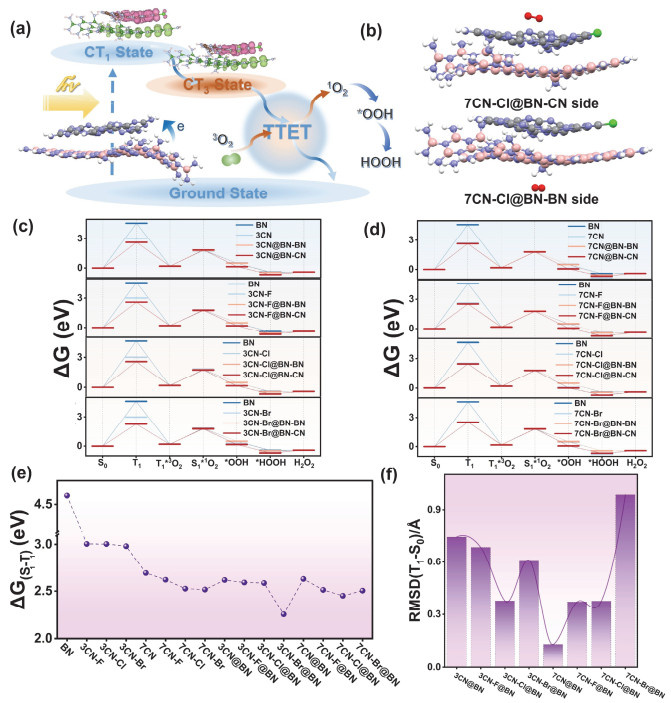
Presents several key aspects of the H2O2 production process catalyzed by the CN@BN material. Panel (a) shows a schematic diagram illustrating the process based on the 1O2 pathway. Panel (b) depicts the structures of two oxygen adsorption sites in the heptazine CN@BN-Cl material. Panels (c) and (d) outline the Gibbs free energy barriers for reaction pathways associated with triazine and heptazine series materials, respectively. Panel (e) compares the Gibbs free energy difference between monomer and heterojunction singlet-triplet states in the CN/BN material. Finally, panel (f) presents the RMSD values reflecting structural differences between singlet and triplet states in the CN@BN material."
| 1 |
doi: 10.1002/adma.202307490 |
| 2 |
doi: 10.3866/PKU.WHXB202406021 |
| 3 |
doi: 10.1002/adfm.202205119 |
| 4 |
doi: 10.1002/aenm.202301047 |
| 5 |
doi: 10.1016/j.apcatb.2023.123490 |
| 6 |
doi: 10.1016/j.cej.2023.141817 |
| 7 |
doi: 10.1016/j.apcatb.2021.120197 |
| 8 |
doi: 10.1016/j.apsusc.2022.155991 |
| 9 |
doi: 10.1063/5.0196557 |
| 10 |
doi: 10.1002/adma.202206516 |
| 11 |
doi: 10.1002/anie.202405396 |
| 12 |
doi: 10.1016/j.cej.2023.146383 |
| 13 |
doi: 10.1021/acscatal.4c01591 |
| 14 |
doi: 10.1002/anie.202310476 |
| 15 |
doi: 10.1016/j.checat.2023.100861 |
| 16 |
doi: 10.1021/jacs.4c08551 |
| 17 |
doi: 10.1016/j.ccr.2022.214975 |
| 18 |
doi: 10.1021/jacsau.2c00442 |
| 19 |
doi: 10.1021/acs.nanolett.2c00017 |
| 20 |
doi: 10.1021/acs.nanolett.4c02986 |
| 21 |
doi: 10.1016/j.actphy.2025.100065 |
| 22 |
doi: 10.1016/j.jmst.2024.12.094 |
| 23 |
doi: 10.1016/j.seppur.2023.125287 |
| 24 |
doi: 10.1016/S1872-2067(21)64010-X |
| 25 |
doi: 10.1016/j.jmst.2023.11.081 |
| 26 |
doi: 10.3866/PKU.WHXB202405016 |
| 27 |
doi: 10.3866/PKU.WHXB202310013 |
| 28 |
doi: 10.1016/j.cej.2022.136051 |
| 29 |
doi: 10.1002/anie.202004747 |
| 30 |
doi: 10.1073/pnas.2410504121 |
| 31 |
doi: 10.1016/j.actphy.2025.100052 |
| 32 |
doi: 10.3866/PKU.WHXB202407014 |
| 33 |
doi: 10.1016/S1872-2067(23)64496-1 |
| 34 |
doi: 10.1016/j.coche.2024.101040 |
| 35 |
doi: 10.3866/PKU.WHXB202403009 |
| 36 |
doi: 10.3866/PKU.WHXB202406005 |
| 37 |
doi: 10.1016/S1872-2067(24)60114-2 |
| 38 |
doi: 10.1038/s41570-025-00698-3 |
| 39 |
doi: 10.1021/acs.inorgchem.1c00062 |
| 40 |
doi: 10.1016/j.surfin.2023.103152 |
| 41 |
doi: 10.1016/S1872-2067(24)60072-0 |
| 42 |
doi: 10.1016/S1872-2067(23)64607-8 |
| 43 |
doi: 10.1016/j.apcatb.2017.09.059 |
| 44 |
doi: 10.1039/D4TA02059F |
| 45 |
doi: 10.1002/adfm.202315426 |
| 46 |
M.J. Frisch, G.W. Trucks, H.B. Schlegel, G.E. Scuseria, M.A. Robb, J.R. Cheeseman, G. Scalmani, V. Barone, G.A. Petersson, H. Nakatsuji, et al. Gaussian 16 Rev. B. 01[Z]. Wallingford, CT. 2016
|
| 47 |
doi: 10.1016/j.carbon.2021.11.005 |
| 48 |
doi: 10.1002/jcc.22885 |
| 49 |
doi: 10.1002/wcms.81 |
| 50 |
doi: 10.1002/jcc.26812 |
| 51 |
doi: 10.1016/0304-4173(85)90014-X |
| 52 |
doi: 10.1039/c0ee00071j |
| 53 |
doi: 10.1038/s41467-024-47022-z |
| 54 |
doi: 10.1002/anie.202306709 |
| 55 |
doi: 10.1007/s13538-013-0141-2 |
| 56 |
doi: 10.1016/j.carbon.2020.05.023 |
| 57 |
doi: 10.1021/ct400337e |
| 58 |
doi: 10.1038/s41560-023-01211-0 |
| 59 |
doi: 10.1021/acs.chemmater.6b01691 |
| 60 |
doi: 10.1021/acs.jpcc.5b03530 |
| 61 |
doi: 10.1016/j.actphy.2025.100064 |
| 62 |
doi: 10.1016/j.jmst.2023.12.054 |
| [1] | Hai-Long CHEN,Hong-Tao BIAN,Jun-Rong ZHENG. Determining 3D Molecular Conformations with Ultrafast Multiple-Dimensional Vibrational Spectroscopy [J]. Acta Phys. -Chim. Sin., 2017, 33(1): 40-62. |
| [2] | Xue-Feng PENG,Yong LEI,Zhen LIU,Xia-Xia JI,Chang-Jun FAN,Xiao-Hui YANG. Sensitized, Thermally Activated, Delayed Fluorescence Devices Based on a Polymer Host Material [J]. Acta Phys. -Chim. Sin., 2016, 32(9): 2369-2376. |
| [3] | XU Ze-Qing, GAO Bao-Jiao, HOU Xiao-Dong. Twofold Influence of Nitro Substituent on Aromatic Ring for Photoluminescence Properties of Benzoic Acid-Functionalized Polystyrene and Eu(Ⅲ) Complexes [J]. Acta Phys. -Chim. Sin., 2014, 30(4): 745-752. |
| [4] | DENG Tao-Li, YAN Shi-Run, HU Jian-Guo. Preparation and Up-Conversion Photoluminescence Properties of GdAlO3:Er3+, Yb3+ Phosphors [J]. Acta Phys. -Chim. Sin., 2014, 30(4): 773-780. |
| [5] | ZHAO Shun-Sheng, ZHANG Zhao, SHI Guo-Xiang, FENG Wei-Xu, LÜ Xing-Qiang, LIU Xiang-Rong. Heterobinuclear Zn-Eu or Zn-Tb Complexes Formed from Benzimidazole Derivatives and Metal Salts: Synthesis, Structures and Photophysical Properties [J]. Acta Phys. -Chim. Sin., 2013, 29(07): 1408-1414. |
| [6] | GUO Yuan-Hui, MEI Qun-Bo, YAN Fang, WANG Ling-Xia, WENG Jie-Na, ZHANG Bin, HUANG Wei. Application of Iridium(III) Complexes in Phosphorescent Chemosensors [J]. Acta Phys. -Chim. Sin., 2012, 28(04): 739-750. |
| [7] | DOU Xi-Hua, ZHAO Wei-Ren, SONG En-Hai, MIN Hua-Chu. Optical Properties and Energy Transfer of Sr1-x-yMgP2O7:xCe3+,yTb3+ Phosphor under Ultraviolet Excitation [J]. Acta Phys. -Chim. Sin., 2012, 28(03): 699-705. |
| [8] | ZHI Ze-Yong, LIU Peng-Cheng, HUANG Yan-Yi, ZHAO Xin-Sheng. A Microfluidic Mixer for Single-Molecule Kinetics Experiments [J]. Acta Phys. -Chim. Sin., 2011, 27(08): 1990-1995. |
| [9] | HAN Rong-Cheng1 YU Min1 SHA Yin-Lin. Interaction between CdSeS Quantum Dots and Gold Nanoparticles in Solution [J]. Acta Phys. -Chim. Sin., 2011, 27(01): 255-261. |
| [10] | LI Yan-Hu, FANG Yuan, ZOU Jian-Hua, WANG Biao, WU Hong-Bin, PENG Jun-Biao. Efficient Polymer White-Light-Emitting Devices Based on Two Complementary Phosphorescent Colors [J]. Acta Phys. -Chim. Sin., 2010, 26(10): 2752-2756. |
| [11] | YANG Fan, YU Long-Jiang, WANG Peng, AI Xi-Cheng, WANG Zheng-Yu, ZHANG Jian-Ping. Excitation Dynamics of the Light-Harvesting Complex 2 from Thermochromatium Tepidum [J]. Acta Phys. -Chim. Sin., 2010, 26(07): 2021-2030. |
| [12] | ZHOU Wen-Hua, YING Li-Ming. Single Molecule Fluorescence Resonance Energy Transfer and Ensemble Biophysical Characterization of a G-quadruplex Formed in the Promoter of Human Myocyte Enhancer Factor 2D [J]. Acta Phys. -Chim. Sin., 2010, 26(04): 1099-1106. |
| [13] | REN Xue-Feng, REN Ai-Min, WANG Qin, FENG Ji-Kang. Structural and Optical Properties of meso-Substituted Porphyrin Derivatives [J]. Acta Phys. -Chim. Sin., 2010, 26(01): 110-114. |
| [14] | MA Tao; JIANG Ya-Dong; YU Jun-Sheng; LOU Shuang-Ling; LI Lu; ZHANG Qing. Bright White Organic Light-Emitting Diode Mixed Blue and Green Emission [J]. Acta Phys. -Chim. Sin., 2008, 24(06): 977-980. |
| [15] | TANG Xiao-Qing; YU Jun-Sheng; LI Lu; WANG Jun; JIANG Ya-Dong. Polymer Doped High Brightness Phosphorescent Organic Light-Emitting Diodes [J]. Acta Phys. -Chim. Sin., 2008, 24(06): 1012-1016. |
|
||