Acta Phys. -Chim. Sin. ›› 2025, Vol. 41 ›› Issue (9): 100116.doi: 10.1016/j.actphy.2025.100116
Special Issue: S-scheme heterojunction in photocatalysis
• ARTICLE • Previous Articles Next Articles
Bandgap and adsorption engineering of carbon dots/TiO2 S-scheme heterojunctions for enhanced photocatalytic CO2 methanation
Wenlong Wang1,2, Wentao Hao2,3, Lang He2,*( ), Jia Qiao2, Ning Li1,*(), Chaoqiu Chen2,*(), Yong Qin2
- 1 School of Energy and Power Engineering & State Key Laboratory of Coal and CBM Co-Mining, North University of China, Taiyuan 030051, Shanxi Province, China
2 State Key Laboratory of Coal Conversion, Institute of Coal Chemistry, Chinese Academy of Sciences, Taiyuan 030001, Shanxi Province, China
3 University of Chinese Academy of Sciences, Beijing 100049, China
-
Received:2025-04-27Revised:2025-06-09Accepted:2025-06-10Published:2025-07-04 -
Contact:Email: helang@sxicc.ac.cn (Lang He)lnlong2834@yeah.net (Ning Li)chenchaoqiu@sxicc.ac.cn (Chaoqiu Chen) -
Supported by:the National Natural Science Foundation of China(22372190); ICC CAS(SCJC-2023-20); the special fund for Science and Technology Innovation Teams of Shanxi Province(202304051001007); the Postdoctoral Fellowship Program of CPSF(GZC20232815); China Postdoctoral Science Foundation(2024M753358); China Postdoctoral Science Foundation(2024M763394)

Cite this article
Wenlong Wang, Wentao Hao, Lang He, Jia Qiao, Ning Li, Chaoqiu Chen, Yong Qin. Bandgap and adsorption engineering of carbon dots/TiO2 S-scheme heterojunctions for enhanced photocatalytic CO2 methanation[J]. Acta Phys. -Chim. Sin. 2025, 41(9), 100116. doi: 10.1016/j.actphy.2025.100116
share this article
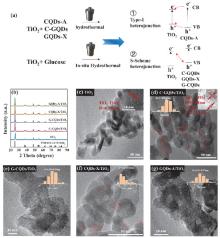
Fig 1
(a) Schematic illustration of the preparation of CDs/TiO2 heterojunctions, (b) XRD patterns of different CDs/TiO2 samples, (c–g) TEM and HRTEM images of TiO2 NPs and various CDs/TiO2 heterojunctions."
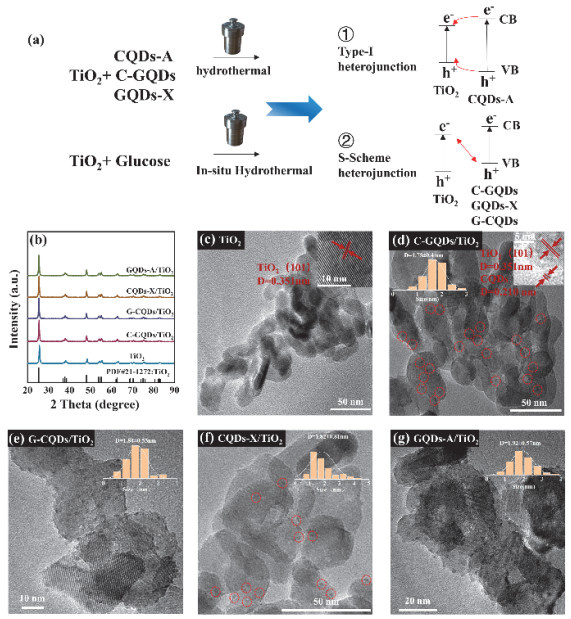
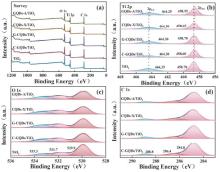
Fig 2
The (a) XPS survey, (b) Ti 2p high-resolution XPS spectra, (c) O 1s high-resolution XPS spectra, and (d) C 1s high-resolution XPS spectra of TiO2 NPs and various CDs/TiO2 heterojunctions."
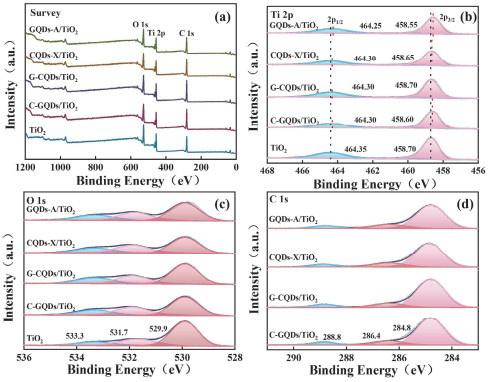
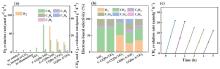
Fig 3
Yield (a) and electron-based selectivity (b) of products in CO2 photocatalytic reduction reaction of TiO2 NPs and various CDs/TiO2 heterojunctions, and (c) Stability of C-GQDs/TiO2 sample for photogeneration of CH4."
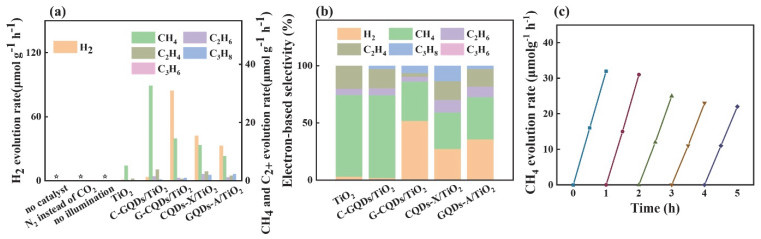
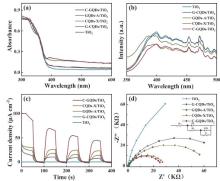
Fig 4
Photophysical and photo-electrochemical properties of TiO2 NPs and various CDs/TiO2 heterojunctions: (a) Normalized UV-Vis diffuse reflectance spectra, (b) PL curves, (c) Transient photocurrent responses, and (d) Electrochemical impedance spectroscopy spectra."
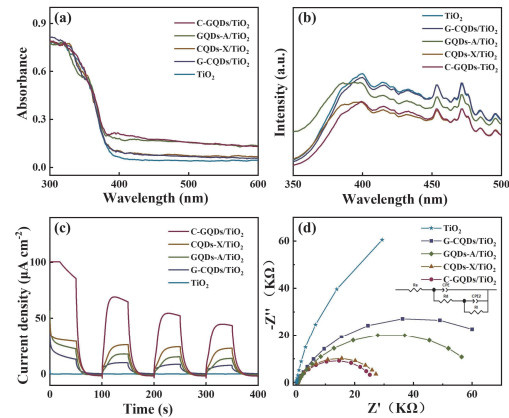
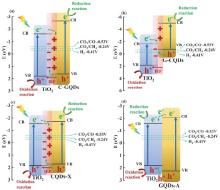
Fig 5
Band structure alignment and schematic diagram of carrier transfer mechanism in various CDs/TiO2 heterojunctions: (a) C-GQDs/TiO2, (b) G-CQDs/TiO2, (c) CQDs-X/TiO2, and (d) GQDs-A/TiO2."
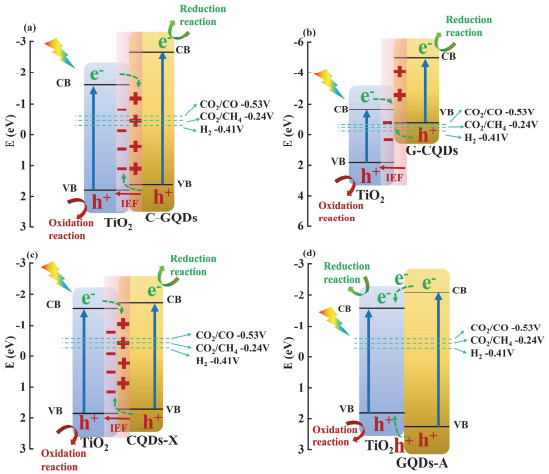
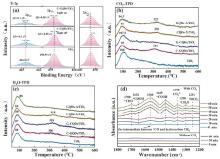
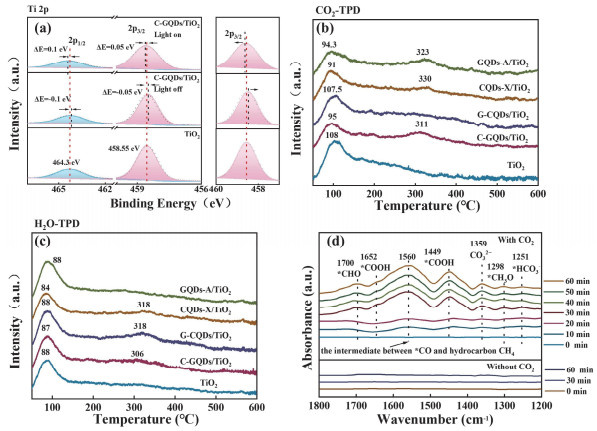
Fig 6
(a) In situ irradiated XPS spectra of C-GQDs/TiO2 (b, c) CO2 and H2O TPD profiles of TiO2 NPs and various CDs/TiO2 heterojunctions, (d) In situ DRIFTS spectra over C-GQDs/TiO2 sample under photocatalytic CO2 reduction."
| 1 |
doi: 10.1039/D1EE02714J |
| 2 |
doi: 10.1038/s43586-023-00243-w |
| 3 |
doi: 10.1038/s41467-024-49004-7 |
| 4 |
doi: 10.1002/adfm.202422055 |
| 5 |
doi: 10.1038/s41467-023-41943-x |
| 6 |
doi: 10.1002/anie.202425439 |
| 7 |
doi: 10.3866/PKU.WHXB202405016 |
| 8 |
doi: 10.1038/s41467-024-44753-x |
| 9 |
doi: 10.1021/jacs.3c11446 |
| 10 |
doi: 10.1002/anie.202410250 |
| 11 |
doi: 10.1016/j.matt.2022.09.009 |
| 12 |
doi: 10.1038/s41467-020-18350-7 |
| 13 |
doi: 10.1016/S1872-2067(23)64551-6 |
| 14 |
doi: 10.3866/PKU.WHXB202212016 |
| 15 |
doi: 10.3866/PKU.WHXB202209016 |
| 16 |
doi: 10.1016/j.jmst.2024.02.048 |
| 17 |
doi: 10.3866/PKU.WHXB202208030 |
| 18 |
doi: 10.1038/s41570-025-00698-3 |
| 19 |
doi: 10.1016/j.actphy.2025.100065 |
| 20 |
doi: 10.1016/j.jmst.2024.12.094 |
| 21 |
doi: 10.1016/S1872-2067(23)64607-8 |
| 22 |
doi: 10.1016/j.chempr.2020.06.010 |
| 23 |
doi: 10.1002/adma.201602581 |
| 24 |
doi: 10.1016/j.seppur.2024.127508 |
| 25 |
doi: 10.1002/adfm.202002654 |
| 26 |
doi: 10.3866/PKU.WHXB202403005 |
| 27 |
doi: 10.1016/j.jhazmat.2021.127721 |
| 28 |
doi: 10.1016/j.jallcom.2024.177098 |
| 29 |
doi: 10.1016/j.jcis.2024.07.144 |
| 30 |
doi: 10.1039/C7CC00461C |
| 31 |
doi: 10.1021/cs500648p |
| 32 |
doi: 10.1016/S1872-5813(24)60472-X |
| 33 |
doi: 10.1007/s42864-024-00303-y |
| 34 |
doi: 10.1016/j.cjsc.2024.100473 |
| 35 |
doi: 10.1002/adma.202008180 |
| 36 |
doi: 10.1002/anie.202414814 |
| 37 |
doi: 10.1039/C3TA14108 |
| 38 |
doi: 10.1002/smll.202309791 |
| 39 |
doi: 10.1016/j.cclet.2023.108692 |
| 40 |
doi: 10.1002/advs.202403607 |
| 41 |
doi: 10.1016/j.apcatb.2024.123694 |
| 42 |
doi: 10.1016/j.cej.2021.134000 |
| 43 |
doi: 10.1002/smtd.202100887 |
| 44 |
doi: 10.1021/acscatal.3c03095 |
| 45 |
doi: 10.1021/am4059183 |
| 46 |
doi: 10.1002/anie.202315340 |
| 47 |
doi: 10.1021/acssuschemeng.9b06430 |
| 48 |
doi: 10.1002/adma.202416210 |
| 49 |
doi: 10.1002/advs.202400099 |
| 50 |
Q. Li, Q. Tang, P. Xiong, D. Chen, J. Chen, Z. Wu, H. Wang, 46 (2023), https://doi.org/10.1016/S1872-2067(22)64199-8177.
|
| 51 |
doi: 10.1002/adfm.202305318 |
| 52 |
doi: 10.1002/adma.202420197 |
| 53 |
doi: 10.1038/s41560-019-0431-1 |
| 54 |
doi: 10.1016/j.apcatb.2024.124907 |
| 55 |
doi: 10.1002/anie.202414672 |
| 56 |
doi: 10.1016/j.apcatb.2025.125033 |
| 57 |
doi: 10.1002/anie.202209446 |
| 58 |
doi: 10.1002/anie.202301075 |
| 59 |
doi: 10.1021/jacs.2c11146 |
| 60 |
doi: 10.1021/acsnano.1c08505 |
| 61 |
doi: 10.1007/s40843-023-2770-8 |
| [1] | Shiyi Chen, Jialong Fu, Jianping Qiu, Guoju Chang, Shiyou Hao. Waste medical mask-derived carbon quantum dots enhance the photocatalytic degradation of polyethylene terephthalate (PET) over BiOBr/g-C3N4 S-scheme heterojunction [J]. Acta Phys. -Chim. Sin., 2026, 42(1): 100135-. |
|
||