Acta Phys. -Chim. Sin. ›› 2026, Vol. 42 ›› Issue (6): 100235.doi: 10.1016/j.actphy.2025.100235
• ARTICLE • Previous Articles Next Articles
LASPAI: AI-powered platform for the future atomic simulation
Han-Zhi Luo1, Qi-Ming Liang1, Zi-Xing Guo1, Xin-Tian Xie1, Jin-Peng Tang1, Tong Guan1, Ye-Fei Li1, Si-Cong Ma2, Ying-Chen Xu1, Zhen-Xiong Wang1,*( ), Cheng Shang1,*(), Zhi-Pan Liu1,2,*()
- 1 State Key Laboratory of Porous Materials for Separation and Conversion, Collaborative Innovation Center of Chemistry for Energy Material, Shanghai Key Laboratory of Molecular Catalysis and Innovative Materials, Key Laboratory of Computational Physical Science, Department of Chemistry, Fudan University, Shanghai 200433, China
2 State Key Laboratory of Metal Organic Chemistry, Shanghai Institute of Organic Chemistry, Chinese Academy of Sciences, Shanghai 200032, China
-
Received:2025-11-17Revised:2025-12-30Accepted:2025-12-30Published:2026-04-21 -
Contact:Email: wangzhenxiong@fudan.edu.cn (Zhen-Xiong Wang)cshang@fudan.edu.cn (Cheng Shang)zpliu@fudan.edu.cn (Zhi-Pan Liu)

Cite this article
Han-Zhi Luo, Qi-Ming Liang, Zi-Xing Guo, Xin-Tian Xie, Jin-Peng Tang, Tong Guan, Ye-Fei Li, Si-Cong Ma, Ying-Chen Xu, Zhen-Xiong Wang, Cheng Shang, Zhi-Pan Liu. LASPAI: AI-powered platform for the future atomic simulation[J]. Acta Phys. -Chim. Sin. 2026, 42(6), 100235. doi: 10.1016/j.actphy.2025.100235
share this article
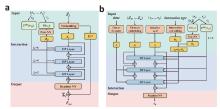
Fig 1
The HPNN architecture for (a) PES evaluation (generalized global neural network) and (b) structure generation (diffusion generative models). The figures are extracted from works by Yang et al. [31] and Guo et al. [46] respectively."
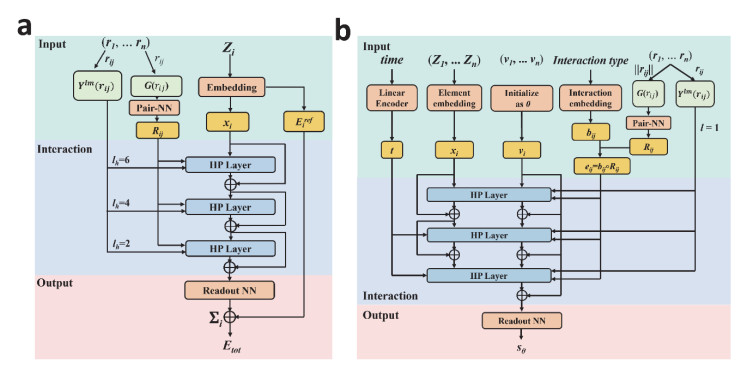
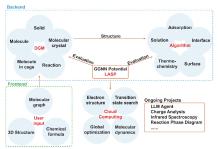
Fig 2
The architecture and user workflow of LASPAI website. The blue and green dotted box shows the architecture of the backend and frontend, respectively."
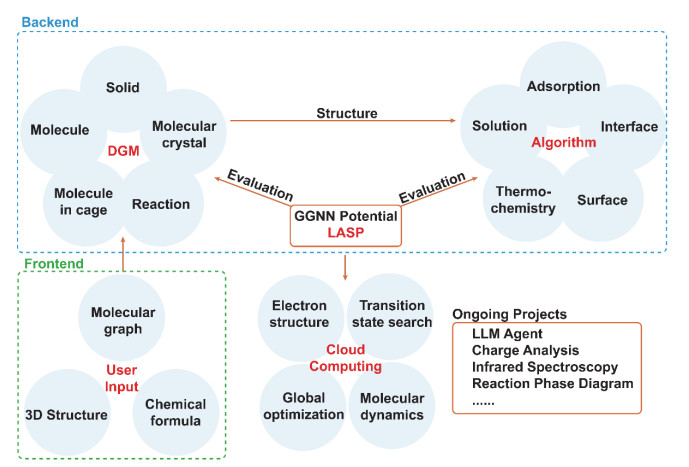
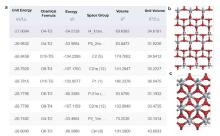
Fig 3
The generation of different polymorphs of TiO2 using the solid generation page. (a) The list of generated TiO2 structures sorted by unit energy. (b) and (c) are the first and second entries in (a), corresponding to the generated and optimized structures of anatase and rutile, respectively. The red and grey spheres represent O and Ti atoms, respectively."
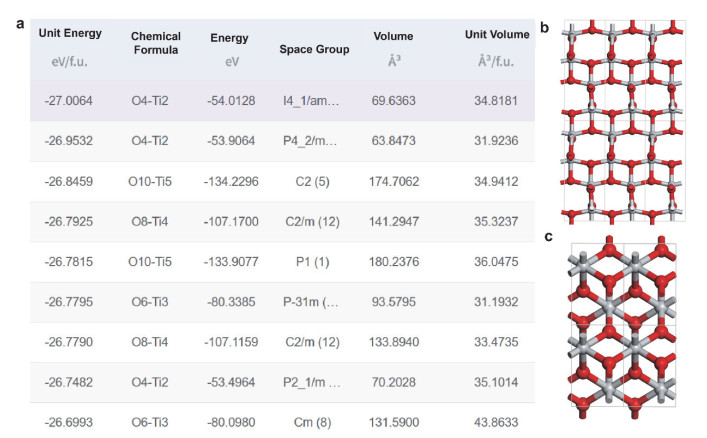
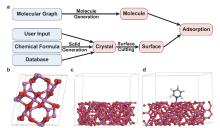
Fig 4
The adsorption of pyridine on γ-Al2O3. (a) The workflow of adsorption study in LASPAI. (b) The minimum γ-Al2O3 (γ-AD) structure found by Yang et al. [74]. (c) The (512) facet of γ-AD structure, corresponding to (110) facet of γ-Al2O3. (d) The generated adsorption structure of pyridine on Al2O3. The white, grey, blue, red and pink spheres represent H, C, N, O and Al atoms, respectively."
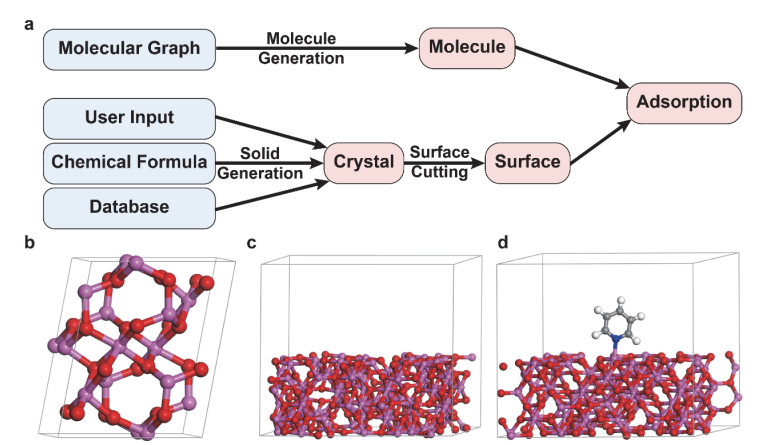
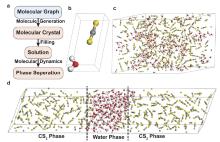
Fig 5
Atomic simulation of oil/water phase separation. (a) The workflow for performing phase separation simulation on LASPAI. (b) The generated 1:1 molecular crystal of water and CS2. (c) The 1 : 1 mixed starting solution structure. (d) The structure after MD simulation with the two phases separated. The white, grey, red and yellow spheres represent H, C, O and S atoms, respectively."
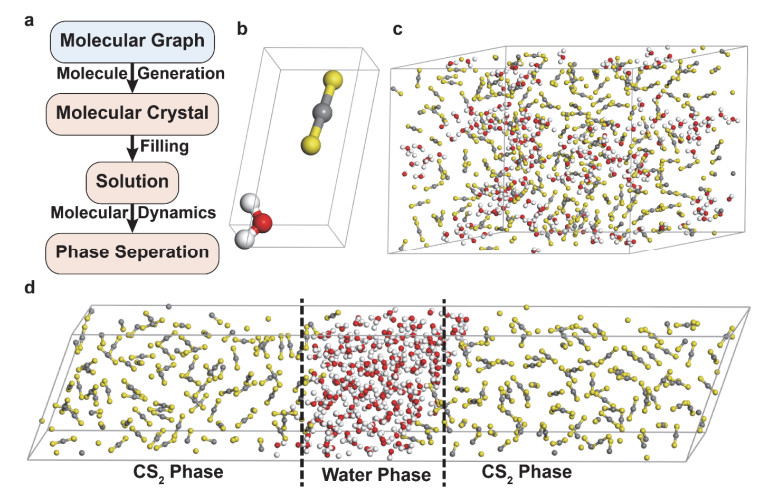
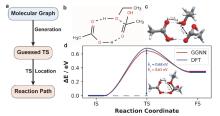
Fig 6
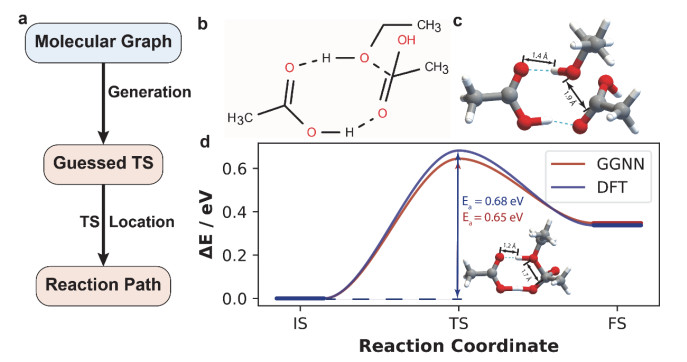
TS structure identification of esterification reaction. (a) The workflow for identifying TS structure on LASPAI. (b) The molecular graph used to specify the reaction where the reacting bond is represented as dotted line. (c) The generated TS structure. (d) The calculated reaction energy profile by GGNN potential and DFT, where the TS structure is shown in inset."
| 1 |
C. Cazorla, J. Boronat. Rev. Mod. Phys. 2017, 89, 035003.
doi: 10.1103/RevModPhys.89.035003 |
| 2 |
Y. Foucaud, M. Badawi, L. Filippov, I. Filippova, S. Lebègue. Miner. Eng. 2019, 143, 106020.
doi: 10.1016/j.mineng.2019.106020 |
| 3 |
H. Liu, Z. Zhao, Q. Zhou, R. Chen, K. Yang, Z. Wang, L. Tang, M. Bauchy. C. R. Geosci. 2022, 354, 35.
doi: 10.5802/crgeos.116 |
| 4 |
M.O. Steinhauser, S. Hiermaier. Int. J. Mol. Sci. 2009, 10, 5135.
doi: 10.3390/ijms10125135 |
| 5 |
M. Kulichenko, B. Nebgen, N. Lubbers, J.S. Smith, K. Barros, A.E.A. Allen, A. Habib, E. Shinkle, N. Fedik, Y.W. Li, et al.. Chem. Rev. 2024, 124, 13681.
doi: 10.1021/acs.chemrev.4c00572 |
| 6 |
Y. Li, X. Zhang, L. Shen. J. Mater. Inf. 2025, 5
doi: 10.20517/jmi.2025.17 |
| 7 |
M. Rupp, A. Tkatchenko, K.-R. Müller, O.A. von Lilienfeld. Phys. Rev. Lett. 2012, 108, 058301.
doi: 10.1103/PhysRevLett.108.058301 |
| 8 |
A.P. Bartók, M.C. Payne, R. Kondor, G. Csányi. Phys. Rev. Lett. 2010, 104, 136403.
doi: 10.1103/PhysRevLett.104.136403 |
| 9 |
J. Behler, M. Parrinello. Phys. Rev. Lett. 2007, 98, 146401.
doi: 10.1103/PhysRevLett.98.146401 |
| 10 |
A.P. Bartók, R. Kondor, G. Csányi. Phys. Rev. B 2013, 87, 184115.
doi: 10.1103/PhysRevB.87.184115 |
| 11 |
O.T. Unke, S. Chmiela, H.E. Sauceda, M. Gastegger, I. Poltavsky, K.T. Schütt, A. Tkatchenko, K.-R. Müller. Chem. Rev. 2021, 121, 10142.
doi: 10.1021/acs.chemrev.0c01111 |
| 12 |
Y. Zhang, J. Xia, B. Jiang. Phys. Rev. Lett. 2021, 127, 156002.
doi: 10.1103/PhysRevLett.127.156002 |
| 13 |
Z.-X. Yang, X.-T. Xie, P.-L. Kang, Z.-X. Wang, C. Shang, Z.-P. Liu. J. Chem. Theory Comput. 2024, 20, 6717.
doi: 10.1021/acs.jctc.4c00660 |
| 14 |
L. Zhang, D.-Y. Lin, H. Wang, R. Car, W. E. Phys. Rev. Materials 2019, 3, 023804.
doi: 10.1103/PhysRevMaterials.3.023804 |
| 15 |
H. Wang, X. Guo, L. Zhang, H. Wang, J. Xue. Appl. Phys. Lett. 2019, 114, 244101.
doi: 10.1063/1.5098061 |
| 16 |
S. Klawohn, J.P. Darby, J.R. Kermode, G. Csányi, M.A. Caro, A.P. Bartók. J. Chem. Phys. 2023, 159, 174108.
doi: 10.1063/5.0160898 |
| 17 |
Y. Liu, L. Wang, M. Liu, X. Zhang, B. Oztekin, S. Ji, arXiv: 2102.05013, https://doi.org/10.48550/arXiv.2102.05013.
|
| 18 |
J. Gasteiger, C. Yeshwanth, S. Günnemann, Directional Message Passing on Molecular Graphs via Synthetic Coordinates, In Advances in Neural Information Processing Systems 34 (NeurIPS 2021), Curran Associates, Inc. : Red Hook, NY, USA, 2021, pp. 15421–15433, https://papers.nips.cc/paper/2021/hash/82489c9737cc245530c7a6ebef3753ec-Abstract.html.
|
| 19 |
V.G. Satorras, E. Hoogeboom, M. Welling, E(n) Equivariant Graph Neural Networks, In Proceedings of the 38th International Conference on Machine Learning, PMLR, 2021, pp. 9323–9332, https://proceedings.mlr.press/v139/satorras21a.html.
|
| 20 |
K.T. Schütt, O.T. Unke, M. Gastegger, arXiv: 2102.03150, https://doi.org/10.48550/arXiv.2102.03150.
|
| 21 |
A. Musaelian, S. Batzner, A. Johansson, L. Sun, C.J. Owen, M. Kornbluth, B. Kozinsky. Nat Commun 2023, 14, 579.
doi: 10.1038/s41467-023-36329-y |
| 22 |
I. Batatia, D.P. Kovacs, G. Simm, C. Ortner, G. Csanyi, MACE: Higher Order Equivariant Message Passing Neural Networks for Fast and Accurate Force Fields, In Advances in Neural Information Processing Systems 35 (NeurIPS 2022), Curran Associates, Inc. : Red Hook, NY, USA, 2022, pp. 11423–11436, https://proceedings.neurips.cc/paper_files/paper/2022/file/4a36c3c51af11ed9f34615b81edb5bbc-Paper-Conference.pdf.
|
| 23 |
S.-D. Huang, C. Shang, P.-L. Kang, Z.-P. Liu. Chem. Sci. 2018, 9, 8644.
doi: 10.1039/C8SC03427C |
| 24 |
P.-L. Kang, C. Shang, Z.-P. Liu. J. Am. Chem. Soc. 2019, 141, 20525.
doi: 10.1021/jacs.9b11535 |
| 25 |
Q.-Y. Liu, C. Shang, Z.-P. Liu. J. Am. Chem. Soc. 2021, 143, 11109.
doi: 10.1021/jacs.1c04624 |
| 26 |
S.-D. Huang, C. Shang, X.-J. Zhang, Z.-P. Liu. Chem. Sci. 2017, 8, 6327.
doi: 10.1039/C7SC01459G |
| 27 |
B. Deng, P. Zhong, K. Jun, J. Riebesell, K. Han, C.J. Bartel, G. Ceder. Nat. Mach. Intell. 2023, 5, 1031.
doi: 10.1038/s42256-023-00716-3 |
| 28 |
D. Zhang, H. Bi, F.-Z. Dai, W. Jiang, X. Liu, L. Zhang, H. Wang. npj Comput. Mater. 2024, 10, 94.
doi: 10.1038/s41524-024-01278-7 |
| 29 |
D. Zhang, X. Liu, X. Zhang, C. Zhang, C. Cai, H. Bi, Y. Du, X. Qin, A. Peng, J. Huang, et al.. npj Comput. Mater. 2024, 10, 293.
doi: 10.1038/s41524-024-01493-2 |
| 30 |
D. Zhang, A. Peng, C. Cai, W. Li, Y. Zhou, J. Zeng, M. Guo, C. Zhang, B. Li, H. Jiang, et al., arXiv: 2506.01686, https://doi.org/10.48550/arXiv.2506.01686.
|
| 31 |
Z.-X. Yang, X.-T. Xie, Z.-X. Wang, D.-X. Chen, Z.-X. Guo, J.-J. Du, Q.-M. Liang, Q.-Y. Liu, C. Shang, Z.-P. Liu. Sci. China Chem. 2025,
doi: 10.1007/s11426-025-3054-y |
| 32 |
M.Z. Makoś, N. Verma, E.C. Larson, M. Freindorf, E. Kraka. J. Chem. Phys. 2021, 155, 024116.
doi: 10.1063/5.0055094 |
| 33 |
O.-E. Ganea, L. Pattanaik, C.W. Coley, R. Barzilay, K.F. Jensen, W.H. Green, T.S. Jaakkola, arXiv: 2106.07802, https://doi.org/10.48550/arXiv.2106.07802.
|
| 34 |
J. Abramson, J. Adler, J. Dunger, R. Evans, T. Green, A. Pritzel, O. Ronneberger, L. Willmore, A.J. Ballard, J. Bambrick, et al.. Nature 2024, 630, 493.
doi: 10.1038/s41586-024-07487-w |
| 35 |
J. Westermayr, J. Gilkes, R. Barrett, R.J. Maurer. Nat. Comput. Sci. 2023, 3, 139.
doi: 10.1038/s43588-022-00391-1 |
| 36 |
J. Lim, S. Ryu, J.W. Kim, W.Y. Kim. J. Cheminform. 2018, 10, 31.
doi: 10.1186/s13321-018-0286-7 |
| 37 |
S. Choi. Nat. Commun. 2023, 14, 1168.
doi: 10.1038/s41467-023-36823-3 |
| 38 |
M. Xu, L. Yu, Y. Song, C. Shi, S. Ermon, J. Tang, arXiv: 2203.02923, https://doi.org/10.48550/arXiv.2203.02923.
|
| 39 |
B. Jing, G. Corso, J. Chang, R. Barzilay, T. Jaakkola, arXiv: 2206.01729, https://doi.org/10.48550/arXiv.2206.01729.
|
| 40 |
A. Morehead, J. Cheng. Commun. Chem. 2024, 7, 150.
doi: 10.1038/s42004-024-01233-z |
| 41 |
S. Kim, J. Woo, W.Y. Kim. Nat. Commun. 2024, 15, 341.
doi: 10.1038/s41467-023-44629-6 |
| 42 |
Y. Song, J. Sohl-Dickstein, D.P. Kingma, A. Kumar, S. Ermon, B. Poole, arXiv: 2011.13456, https://doi.org/10.48550/arXiv.2011.13456.
|
| 43 |
K. Xu, W. Hu, J. Leskovec, S. Jegelka, arXiv: 1810.00826, https://doi.org/10.48550/arXiv.1810.00826.
|
| 44 |
C. Duan, Y. Du, H. Jia, H.J. Kulik. Nat. Comput. Sci. 2023, 3, 1045.
doi: 10.1038/s43588-023-00563-7 |
| 45 |
M. Schreiner, A. Bhowmik, T. Vegge, J. Busk, O. Winther. Sci. Data 2022, 9, 779.
doi: 10.1038/s41597-022-01870-w |
| 46 |
Z.-X. Guo, J.-P. Tang, Z.-X. Wang, Q.-M. Liang, S.-C. Ma, C. Shang, L. Chen, Z.-P. Liu, http://www.lasphub.com/publication/228.pdf (accessed on Dec 30, 2025).
|
| 47 |
C. Shang, Z.-P. Liu. J. Chem. Theory Comput. 2010, 6, 1136.
doi: 10.1021/ct9005147 |
| 48 |
N. Thomas, T. Smidt, S. Kearnes, L. Yang, L. Li, K. Kohlhoff, P. Riley, arXiv: 1802.08219, https://doi.org/10.48550/arXiv.1802.08219.
|
| 49 |
S. Grimme, J. Antony, S. Ehrlich, H. Krieg. J. Chem. Phys. 2010, 132, 154104.
doi: 10.1063/1.3382344 |
| 50 |
H.-Z. Luo, C. Shang, Z.-P. Liu, http://www.lasphub.com/publication/230.pdf (accessed on Dec 30, 2025).
|
| 51 |
S. Axelrod, R. Gómez-Bombarelli. Sci Data 2022, 9, 185.
doi: 10.1038/s41597-022-01288-4 |
| 52 |
S. Ma, C. Shang, C.-M. Wang, Z.-P. Liu. Chem. Sci. 2020, 11, 10113.
doi: 10.1039/D0SC03918G |
| 53 |
M.K. Horton, P. Huck, R.X. Yang, J.M. Munro, S. Dwaraknath, A.M. Ganose, R.S. Kingsbury, M. Wen, J.X. Shen, T.S. Mathis, et al.. Nat. Mater. 2025, 24, 1522.
doi: 10.1038/s41563-025-02272-0 |
| 54 |
A. Jain, S.P. Ong, G. Hautier, W. Chen, W.D. Richards, S. Dacek, S. Cholia, D. Gunter, D. Skinner, G. Ceder, et al.. APL Mater. 2013, 1, 011002.
doi: 10.1063/1.4812323 |
| 55 |
C. Zeni, R. Pinsler, D. Zügner, A. Fowler, M. Horton, X. Fu, Z. Wang, A. Shysheya, J. Crabbé, S. Ueda, et al.. Nature 2025, 639, 624.
doi: 10.1038/s41586-025-08628-5 |
| 56 |
RDKit. (n.d.). https://www.rdkit.org/.
|
| 57 |
A. Vaitkus, A. Merkys, T. Sander, M. Quirós, P.A. Thiessen, E.E. Bolton, S. Gražulis. J. Cheminf. 2023, 15, 123.
doi: 10.1186/s13321-023-00780-2 |
| 58 |
A. Merkys, A. Vaitkus, A. Grybauskas, A. Konovalovas, M. Quirós, S. Gražulis. J. Cheminf. 2023, 15, 25.
doi: 10.1186/s13321-023-00692-1 |
| 59 |
A. Vaitkus, A. Merkys, S. Gražulis. J. Appl. Crystallogr. 2021, 54, 661.
doi: 10.1107/S1600576720016532 |
| 60 |
M. Quirós, S. Gražulis, S. Girdzijauskaitė, A. Merkys, A. Vaitkus. J. Cheminf. 2018, 10, 23.
doi: 10.1186/s13321-018-0279-6 |
| 61 |
S. Gražulis, A. Merkys, A. Vaitkus, M. Okulič-Kazarinas. J. Appl. Crystallogr. 2015, 48, 85.
doi: 10.1107/S1600576714025904 |
| 62 |
S. Gražulis, A. Daškevič, A. Merkys, D. Chateigner, L. Lutterotti, M. Quirós, N.R. Serebryanaya, P. Moeck, R.T. Downs, A. Le Bail. Nucleic Acids Res. 2012, 40, D420.
doi: 10.1093/nar/gkr900 |
| 63 |
S. Gražulis, D. Chateigner, R.T. Downs, A.F.T. Yokochi, M. Quirós, L. Lutterotti, E. Manakova, J. Butkus, P. Moeck, A. Le Bail. J. Appl. Crystallogr. 2009, 42, 726.
doi: 10.1107/S0021889809016690 |
| 64 |
C.R. Groom, I.J. Bruno, M.P. Lightfoot, S.C. Ward. Acta Crystallogr. B 2016, 72, 171.
doi: 10.1107/S2052520616003954 |
| 65 |
C. Shang, Z.-P. Liu. J. Chem. Theory Comput. 2012, 8, 2215.
doi: 10.1021/ct300250h |
| 66 |
B. Karulin, M. Kozhevnikov. J. Cheminf. 2011, 3, P3.
doi: 10.1186/1758-2946-3-S1-P3 |
| 67 |
N. Rego, D. Koes. Bioinformatics 2015, 31, 1322.
doi: 10.1093/bioinformatics/btu829 |
| 68 |
A. Togo. J. Phys. Soc. Jpn. 2023, 92, 012001.
doi: 10.7566/JPSJ.92.012001 |
| 69 |
A. Hjorth Larsen, J. Jørgen Mortensen, J. Blomqvist, I.E. Castelli, R. Christensen, M. Dułak, J. Friis, M.N. Groves, B. Hammer, C. Hargus, et al.. J. Phys. Condens. Matter 2017, 29, 273002.
doi: 10.1088/1361-648X/aa680e |
| 70 |
S.P. Ong, W.D. Richards, A. Jain, G. Hautier, M. Kocher, S. Cholia, D. Gunter, V.L. Chevrier, K.A. Persson, G. Ceder. Comput. Mater. Sci. 2013, 68, 314.
doi: 10.1016/j.commatsci.2012.10.028 |
| 71 |
L. Martínez, R. Andrade, E.G. Birgin, J.M. Martínez. J. Comput. Chem. 2009, 30, 2157.
doi: 10.1002/jcc.21224 |
| 72 |
D.T. Cromer, K. Herrington. J. Am. Chem. Soc. 1955, 77, 4708.
doi: 10.1021/ja01623a004 |
| 73 |
S.-C. Zhu, S.-H. Xie, Z.-P. Liu. J. Am. Chem. Soc. 2015, 137, 11532.
doi: 10.1021/jacs.5b07734 |
| 74 |
X. Yang, C. Shang, Z.-P. Liu. J. Mater. Chem. A 2025, 13, 17429.
doi: 10.1039/D5TA01715G |
| 75 |
C. Morterra. J. Catal. 1978, 54, 348.
doi: 10.1016/0021-9517(78)90083-0 |
| 76 |
C.H. Kline Jr., J. Turkevich. J. Chem. Phys. 1944, 12, 300.
doi: 10.1063/1.1723943 |
| 77 |
T.K. Phung, C. Herrera, M.Á. Larrubia, M. García-Diéguez, E. Finocchio, L.J. Alemany, G. Busca. Appl. Catal. A: Gen. 2014, 483, 41.
doi: 10.1016/j.apcata.2014.06.020 |
| [1] | Zhilong Song, Shuaihua Lu, Qionghua Zhou, Jinlan Wang. T2MAT (text-to-material): a universal agent for generating material structures with goal properties from a single sentence [J]. Acta Phys. -Chim. Sin., 2026, 42(5): 100213-. |
|
||