Acta Phys. -Chim. Sin. ›› 2026, Vol. 42 ›› Issue (6): 100269.doi: 10.1016/j.actphy.2026.100269
• ARTICLE • Previous Articles Next Articles
Theoretical guidance for the rational design of FeCo foams toward efficient electromagnetic wave absorption in 2.0–8.0 GHz range
Bo Hu1, Yanyi Chen1, Yongzheng Chen1, Xuan Wang1,2, Xijiang Han1,*( ), Yunchen Du1,*()
- 1 MIIT Key Laboratory of Critical Materials Technology for New Energy Conversion and Storage, School of Chemistry and Chemical Engineering, Harbin Institute of Technology, Harbin 150001, Heilongjiang Province, China
2 School of Chemistry and Chemical Engineering, Northwestern Polytechnical University, Xi'an 710072, Shaanxi Province, China
-
Received:2026-01-12Revised:2026-02-25Accepted:2026-02-27Published:2026-04-21 -
Contact:Email: hanxijiang@hit.edu.cn (Xijiang Han)yunchendu@hit.edu.cn (Yunchen Du)

Cite this article
Bo Hu, Yanyi Chen, Yongzheng Chen, Xuan Wang, Xijiang Han, Yunchen Du. Theoretical guidance for the rational design of FeCo foams toward efficient electromagnetic wave absorption in 2.0–8.0 GHz range[J]. Acta Phys. -Chim. Sin. 2026, 42(6), 100269. doi: 10.1016/j.actphy.2026.100269
share this article
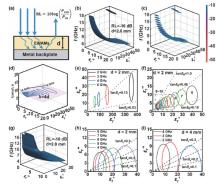
Fig 1
EM parameters required for effective absorption at different frequency bands and coating thicknesses: (a) schematic illustration of the transmission line theory calculation model, (b) isosurface of RL = −10.0 dB with μr = 1.0 and coating thickness of 2.0 mm, (c) RL values at different frequencies with μr = 1.0 and coating thickness of 2.0 mm, (d) EM wavelength distribution that satisfies RL = −10.0 dB under different frequencies and εr with the coating thickness of 2.0 mm (around λ = 4d), (e) contour line of RL = −10.0 dB at 2.0–5.0 GHz with μr = 1.0 and coating thickness of 2.0 mm, (f) contour line of RL = −10.0 dB at 6.0–18.0 GHz with μr = 1.0 and coating thickness of 2.0 mm, (g) isosurface of RL = −10.0 dB with μr of magnetic F-CIPs and coating thickness of 2.0 mm, (h) contour line of RL = −10.0 dB at 4.0–8.0 GHz with μr of magnetic F-CIPs and coating thickness of 2.0 mm, (i) contour line of RL = −10.0 dB at 2.0–4.0 GHz with μr of magnetic F-CIPs and coating thickness of 4.0 mm."
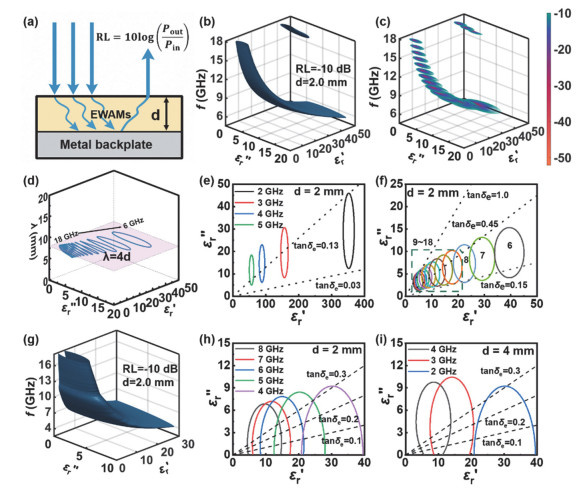
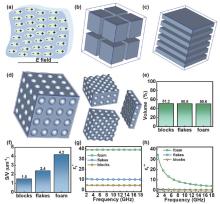
Fig 2
CST simulation for different microstructures: (a) Schematic illustration of the polarization process under electric field; models of (b) blocks, (c) flakes, and (d) foam. (e) Volume filling amount, and (f) areas per unit volume of different models; (g) εr', and (h) εr'' values of different models."
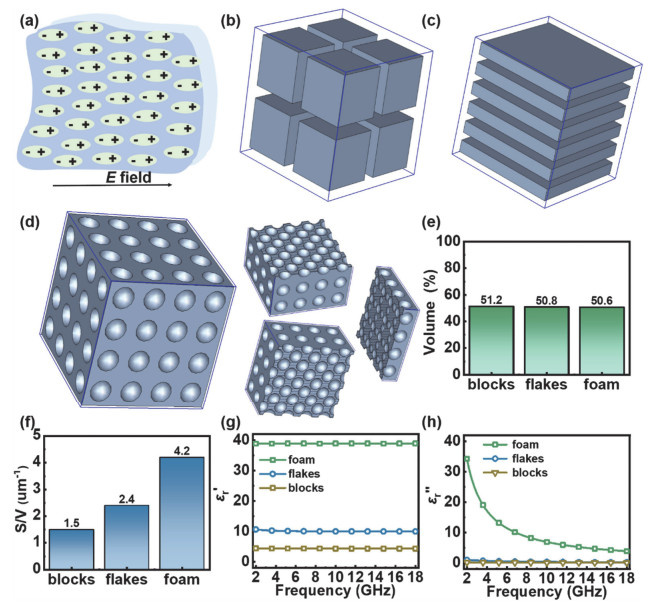
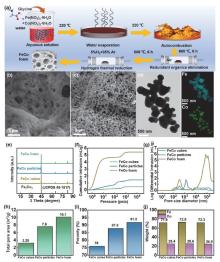
Fig 3
Characterization of FeCo cubes, FeCo particles, and FeCo foam: (a) schematic illustration of preparing the FeCo foam, SEM image (b) FeCo oxide foam precursor, and (c) FeCo foam, (d) TEM image of FeCo foam and the corresponding element mapping images, (e) XRD patterns, (f) Mercury intrusion curves, (g) corresponding pore size diameter distribution curves, (h) total pore areas and (i) porosity of FeCo cubes, FeCo particles, and FeCo foam, (j) Component contents of FeCo cubes, FeCo particles, and FeCo foam."
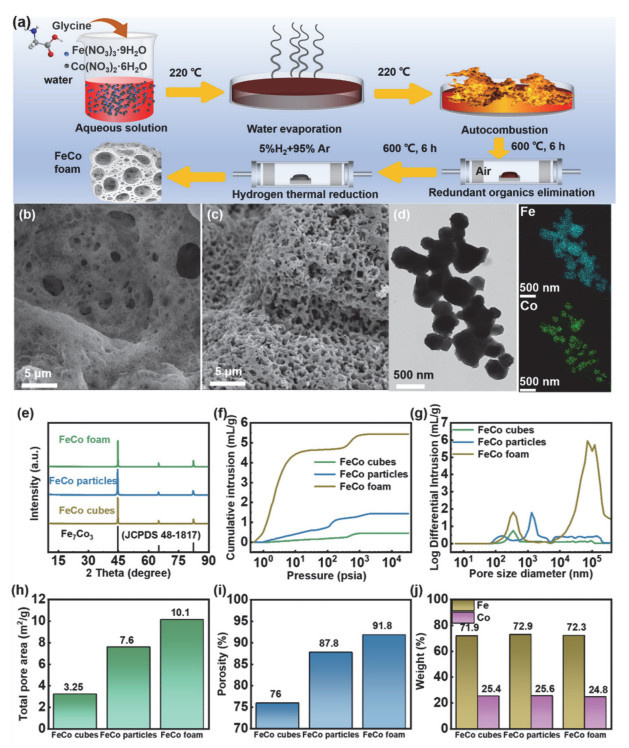
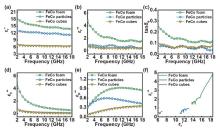
Fig 4
Dielectric properties of FeCo cubes, FeCo particles, and FeCo foam: (a) εr', (b) εr'', (c) tanδe, (d) εc'', (e) εp'', and (f) Cole-Cole semicircles."
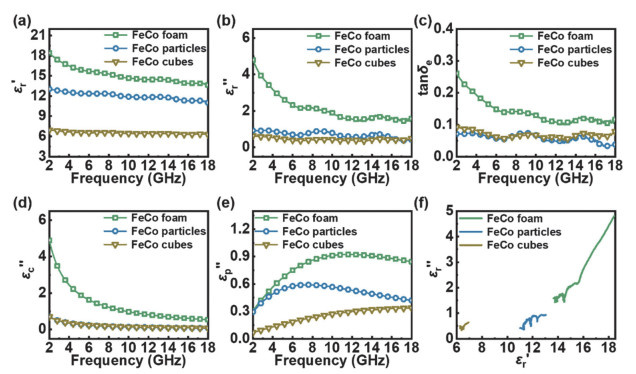
Fig 5
Magnetic properties of FeCo cubes, FeCo particles, and FeCo foam: (a) Magnetic hysteresis loops, and (b) their local magnification of FeCo cubes, FeCo particles, and FeCo foam, (c) Derivative of the demagnetization curve of FeCo cubes, FeCo particles, and FeCo foam, (d) Magnetic hysteresis loops of Fe foam, Co foam and FeCo foam, (e) μr', (f) μr'', (g) tanδm, and (h) C0 values of FeCo cubes, FeCo particles, and FeCo foam."
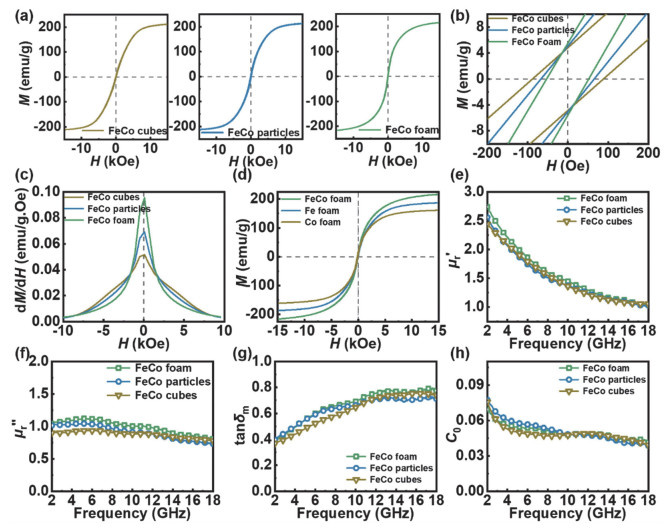
Fig 6
EM wave absorption performance and attenuation mechanisms of FeCo cubes, FeCo particles, and FeCo foam. Planar RL maps of (a) FeCo foam, (b) FeCo particles, and (c) FeCo cubes; (d) RL curves of FeCo foam with the coating thickness of 1.0 mm, 2.0 mm and 4.0 mm; (e) schematic illustration of an incident EM wave on EWAMs backed with a metal plate; (f) Front-face reflection coefficient values of FeCo cubes, FeCo particles, and FeCo foam; The separation of EM loss and λ/4 cancellation of FeCo foam with coating thicknesses of (g) 4.0 mm, (h) 2.0 mm, and (i) 1.0 mm."
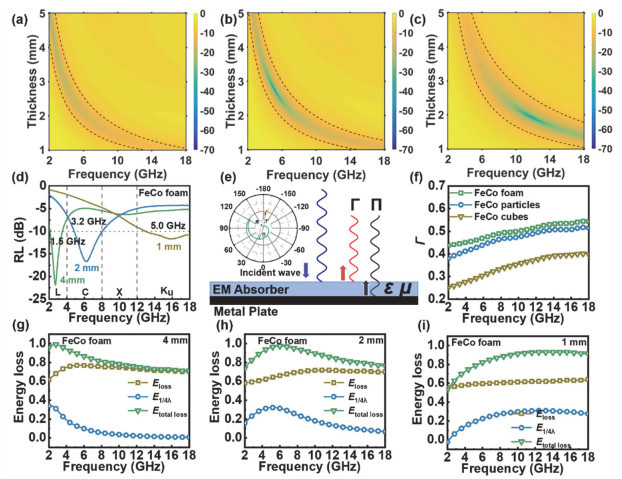
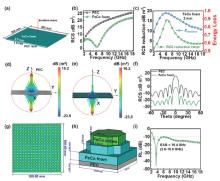
Fig 7
RCS simulation and EM wave absorption performance of FeCo foam-based structures: (a) Models of PEC layer and EWAMs for RCS simulation, (b) RCS simulated curves of PEC layer and PEC layer coated with FeCo foam at different frequencies, (c) RCS reduction values and corresponding total energy loss of FeCo foam at different frequencies, (d) 3D RCS plot for PEC layer, and (e) PEC layer coated with FeCo foam with the coating thickness of 2.0 mm, (f) RCS simulated curves of PEC layer and PEC layer coated with FeCo foam from different scanning angles, (g) Model of multi-layer periodic structure and (h) its local magnification, (i) RL values of multi-layer periodic structure."
| 1 |
X. Ren, Z. Jia, Z. Gao, S. Zhang, Y. Zhang, D. Lan, G. Wu. Adv. Funct. Mater. 2025, 35, 24264.
doi: 10.1002/adfm.202524264 |
| 2 |
Y. Chen, L. Gai, B. Hu, Y. Wang, Y. Chen, X. Han, P. Xu, Y. Du. Nano-Micro Lett. 2026, 18, 71.
doi: 10.1007/s40820-025-01920-z |
| 3 |
T. Hu, D. Lan, J. Wang, X. Zhong, G. Bu, P. Yin. Carbon 2025, 232, 119798.
doi: 10.1016/j.carbon.2024.119798 |
| 4 |
L. Gai, Y. Chen, Y. Wang, X. Han, P. Xu, Y. Du. J. Adv. Ceram. 2025, 14, 9221212.
doi: 10.26599/JAC.2025.9221212 |
| 5 |
W. L. Zhang, S. Xu, X. Li, Y. H. Yin, C. L. Sun, Z. L. Yu, C. Zhao, D. Lan, Z. R. Jia, G. L. Wu, et al.. Rare Met. 2025, 44, 70051.
doi: 10.1002/rar2.70051 |
| 6 |
J. Liu, Y. Pan, L. Yu, Z. Gao, S. Zhang, D. Lan, Z. Jia, G. Wu. Carbon 2025, 238, 120233.
doi: 10.1016/j.carbon.2025.120233 |
| 7 |
J. Zheng, L. Cheng, S. Zhang, D. Lan, X. Zhao, X. Liu, J. Zhou, S. Cai, L. Niu, G. Wu, et al.. J. Mater. Sci. Technol. 2026, 264, 163.
doi: 10.1016/j.jmst.2025.11.031 |
| 8 |
Y. Wang, L. Gai, X. He, X. Han, Y. Chen, Y. Du. Electron 2026, 4, e70029.
doi: 10.1002/elt2.70029 |
| 9 |
X. Li, J. Liu, Z. Jia, D. Lan, D. Ai, Z. Gao, F. Bai, G. Wu. J. Mater. Sci. Technol. 2026, 268, 41.
doi: 10.1016/j.jmst.2025.12.046 |
| 10 |
R. Niu, Z. Jia, D. Lan, S. Zhang, Z. Gao, Z. Weng, F. Bai, G. Wu. Nano Res. 2026, 19, 94908411.
doi: 10.26599/NR.2026.94908411 |
| 11 |
D. Liu, Y. Du, F. Wang, Y. Wang, L. Cui, H. Zhao, X. Han. Carbon 2020, 157, 478.
doi: 10.1016/j.carbon.2019.10.056 |
| 12 |
J. Zhou, X. Huang, D. Lan, Z. Jia, G. Wu. Carbon 2026, 248, 121143.
doi: 10.1016/j.carbon.2025.121143 |
| 13 |
L. Cui, Y. Wang, X. Han, P. Xu, F. Wang, D. Liu, H. Zhao, Y. Du. Carbon 2021, 174, 673.
doi: 10.1016/j.carbon.2020.10.070 |
| 14 |
F. Wang, Y. Liu, H. Zhao, L. Cui, L. Gai, X. Han, Y. Du. Chem. Eng. J. 2022, 450, 138160.
doi: 10.1016/j.cej.2022.138160 |
| 15 |
W. Zhao, Z. Guo, D. Lan, Z. Jia, S. Zhang, G. Wu. Small 2025, 21, 09339.
doi: 10.1002/smll.202509339 |
| 16 |
L. Gai, H. Zhao, X. Li, P. Wang, S. Yu, Y. Chen, C. Wang, D. Lan, F. Han, Y. Du. Chem. Eng. J. 2024, 501, 157556.
doi: 10.1016/j.cej.2024.157556 |
| 17 |
H. Xu, X. Yin, M. Zhu, M. Li, H. Zhang, H. Wei, L. Zhang, L. Cheng. Carbon 2019, 142, 346.
doi: 10.1016/j.carbon.2018.10.056 |
| 18 |
M. Yuan, B. Zhao, C. Yang, K. Pei, L. Wang, R. Zhang, W. You, X. Liu, X. Zhang, R. Che. Adv. Funct. Mater. 2022, 32, 2203161.
doi: 10.1002/adfm.202203161 |
| 19 |
D. Liu, R. Qiang, Y. Du, Y. Wang, C. Tian, X. Han. J. Colloid Interface Sci. 2018, 514, 10.
doi: 10.1016/j.jcis.2017.12.013 |
| 20 |
M. He, J. Hu, H. Yan, X. Zhong, Y. Zhang, P. Liu, J. Kong, J. Gu. Adv. Funct. Mater. 2025, 35, 2316691.
doi: 10.1002/adfm.202316691 |
| 21 |
P. Wang, D. Fan, L. Gai, B. Hu, P. Xu, X. Han, Y. Du. J. Mater. Chem. A 2024, 12, 8571.
doi: 10.1039/D4TA00125G |
| 22 |
Y. Li, F. Meng, Y. Mei, H. Wang, Y. Guo, Y. Wang, F. Peng, F. Huang, Z. Zhou. Chem. Eng. J. 2020, 391, 123512.
doi: 10.1016/j.cej.2019.123512 |
| 23 |
L. Wu, G. Wang, S. Shi, X. Liu, J. Liu, J. Zhao, G. Wang. Adv. Sci. 2023, 10, 2304218.
doi: 10.1002/advs.202304218 |
| 24 |
J. Yuan, C. Li, Z. Liu, D. Wu, L. Cao. CrystEngComm 2017, 19, 6506.
doi: 10.1039/C7CE01353A |
| 25 |
Y. Wang, X. Li, X. Han, P. Xu, L. Cui, H. Zhao, D. Liu, F. Wang, Y. Du. Chem. Eng. J. 2020, 387, 124159.
doi: 10.1016/j.cej.2020.124159 |
| 26 |
Z. Xu, Y. Du, D. Liu, Y. Wang, W. Ma, Y. Wang, P. Xu, X. Han. ACS Appl. Mater. Interfaces 2019, 11, 4268.
doi: 10.1021/acsami.8b19201 |
| 27 |
H. Zhao, F. Wang, L. Cui, X. Xu, X. Han, Y. Du. Nano-Micro Lett. 2021, 13, 208.
doi: 10.1007/s40820-021-00734-z |
| 28 |
F. Wang, Y. Sun, D. Li, B. Zhong, Z. Wu, S. Zuo, D. Yan, R. Zhuo, J. Feng, P. Yan. Carbon 2018, 134, 264.
doi: 10.1016/j.carbon.2018.03.081 |
| 29 |
R. Xu, D. Xu, Z. Zeng, D. Liu. Chem. Eng. J. 2022, 427, 130796.
doi: 10.1016/j.cej.2021.130796 |
| 30 |
J. Cheng, H. Zhang, M. Ning, H. Raza, D. Zhang, G. Zheng, Q. Zheng, R. Che. Adv. Funct. Mater. 2022, 32, 2200123.
doi: 10.1002/adfm.202200123 |
| 31 |
Y. Zhou, G. Yu, L. Lin, X. Huang. J. Mater. Chem. C 2025, 13, 11096.
doi: 10.1039/D5TC00588D |
| 32 |
J. Liu, L. Zhang, H. Wu. Adv. Funct. Mater. 2022, 32, 2110496.
doi: 10.1002/adfm.202110496 |
| 33 |
S. Dong, P. Hu, X. Li, C. Hong, X. Zhang, J. Han. Chem. Eng. J. 2020, 398, 125588.
doi: 10.1016/j.cej.2020.125588 |
| 34 |
J. Zhao, H. Wang, M. Chen, Y. Li, Z. Wang, C. Fang, P. Liu. J. Colloid Interface Sci. 2023, 639, 160.
doi: 10.1016/j.jcis.2023.02.050 |
| 35 |
M. Qin, L. Zhang, H. Wu. Adv. Sci. 2022, 9, 2105553.
doi: 10.1002/advs.202105553 |
| 36 |
R. Marchand. Am. J. Phys. 2024, 92, 158.
doi: 10.1119/5.0164442 |
| 37 |
H. F. Arnoldus. Opt. Commun. 2006, 265, 52.
doi: 10.1016/j.optcom.2006.03.024 |
| 38 |
C. A. Gonano, R. E. Zich, M. Mussetta. Prog. Electromagn. Res. B 2015, 64, 83.
doi: 10.2528/PIERB15100606 |
| 39 |
D. L. Mancipe-Huérfano, R. G. García-Cáceres. Int. J. Inf. Technol. 2024, 16, 4465.
doi: 10.1007/s41870-024-02036-0 |
| 40 |
A. M. Nicolson, G. F. Ross. IEEE Trans. Instrum. Meas. 1970, 19, 377.
doi: 10.1109/TIM.1970.4313932 |
| 41 |
W. Li, J. Chen, P. Gao. J. Colloid Interface Sci. 2022, 606, 719.
doi: 10.1016/j.jcis.2021.08.019 |
| 42 |
Y. Cheng, Y. Zhao, H. Zhao, H. Lv, X. Qi, J. Cao, G. Ji, Y. Du. Chem. Eng. J. 2019, 372, 390.
doi: 10.1016/j.cej.2019.04.174 |
| 43 |
L. Gai, Y. Wang, P. Wan, S. Yu, Y. Chen, X. Han, P. Xu, Y. Du. Nano-Micro Lett. 2024, 16, 167.
doi: 10.1007/s40820-024-01369-6 |
| 44 |
L. Gai, H. Zhao, F. Wang, P. Wang, Y. Liu, X. Han, Y. Du. Nano Res. 2022, 15, 9410.
doi: 10.1007/s12274-022-4695-6 |
| 45 |
F. Wu, K. Yang, Q. Li, T. Shah, M. Ahmad, Q. Zhang, B. Zhang. Carbon 2021, 173, 918.
doi: 10.1016/j.carbon.2020.11.088 |
| 46 |
S. Wei, T. Chen, Q. Wang, Z. Shi, W. Li, S. Chen. J. Colloid Interface Sci. 2021, 593, 370.
doi: 10.1016/j.jcis.2021.02.120 |
| 47 |
J. Lv, X. Liang, G. Ji, B. Quan, W. Liu, Y. Du. ACS Sustain. Chem. Eng. 2018, 6, 7239.
doi: 10.1021/acssuschemeng.7b03807 |
| 48 |
L. Xia, Y. Feng, B. Zhao. J. Mater. Sci. Technol. 2022, 130, 136.
doi: 10.1016/j.jmst.2022.05.010 |
| 49 |
J. Xiao, X. Qi, X. Gong, Q. Peng, Y. Chen, R. Xie, W. Zhong. J. Mater. Sci. Technol. 2023, 139, 137.
doi: 10.1016/j.jmst.2022.08.022 |
| 50 |
L. Liang, W. Gu, Y. Wu, B. Zhang, G. Wang, Y. Yang, G. Ji. Adv. Mater. 2022, 34, 2106195.
doi: 10.1002/adma.202106195 |
| 51 |
Y. Cheng, J. Z. Y. Seow, H. Zhao, Z. J. Xu, G. Ji. Nano-Micro Lett. 2020, 12, 125.
doi: 10.1007/s40820-020-00461-x |
| 52 |
Q. Zheng, M. Yu, X. Gao, Y. Wang, Z. Zhang, H. Zhou, Y. Dai. J. Mater. Sci. 2020, 55, 16954.
doi: 10.1007/s10853-020-05189-y |
| 53 |
W. Ye, W. Li, Q. Sun, J. Yu, Q. Gao. RSC Adv. 2018, 8, 24780.
doi: 10.1039/C8RA05065A |
| 54 |
Y. Liu, C. Tian, F. Wang, B. Hu, P. Xu, X. Han, Y. Du. Chem. Eng. J. 2023, 461, 141867.
doi: 10.1016/j.cej.2023.141867 |
| 55 |
W. Jiang, S. Xu, C. Lv, D. Lan, S. Zhang, Z. Gao, Z. Jia, G. Wu. Carbon 2025, 245, 120784.
doi: 10.1016/j.carbon.2025.120784 |
| 56 |
Z. Gao, A. Iqbal, T. Hassan, S. Hui, H. Wu, C. M. Koo. Adv. Mater. 2024, 36, 2311411.
doi: 10.1002/adma.202311411 |
| 57 |
P. Wang, L. Gai, B. Hu, Y. Liu, F. Wang, P. Xu, X. Han, Y. Du. Carbon 2023, 212, 118132.
doi: 10.1016/j.carbon.2023.118132 |
| 58 |
X. J. Zhang, J. Q. Zhu, P. G. Yin, A. P. Guo, A. P. Huang, L. Guo, G. S. Wang. Adv. Funct. Mater. 2018, 28, 1800761.
doi: 10.1002/adfm.201800761 |
| 59 |
Y. Wang, X. Han, P. Xu, D. Liu, L. Cui, H. Zhao, Y. Du. Chem. Eng. J. 2019, 372, 312.
doi: 10.1016/j.cej.2019.04.153 |
| 60 |
Y. Liu, F. Wang, Y. Wang, B. Hu, P. Xu, X. Han, Y. Du. Compos. Part B Eng. 2024, 273, 111244.
doi: 10.1016/j.compositesb.2024.111244 |
| 61 |
X. Luo, H. Xie, Y. Ma, D. Lan, G. Wu, Z. Jia. Int. J. Miner. Metall. Mater. 2025, 33, 1.
doi: 10.1007/s12613-025-3252-1 |
| 62 |
B. Li, Z. Ma, X. Zhang, J. Xu, Y. Chen, X. Zhang, C. Zhu. Small 2023, 19, 2207197.
doi: 10.1002/smll.202207197 |
| 63 |
X. Sun, Y. Li, Y. Huang, Y. Cheng, S. Wang, W. Yin. Adv. Funct. Mater. 2022, 32, 2107508.
doi: 10.1002/adfm.202107508 |
| 64 |
K. Kurokawa. IEEE Trans. Microw. Theory Tech. 1965, 13, 194.
doi: 10.1109/TMTT.1965.1125964 |
| 65 |
T. S. Bird. IEEE Antennas Propag. Mag. 2009, 51, 166.
doi: 10.1109/MAP.2009.5162049 |
| [1] | Renwei Feng, Congmin Fan, Di Lan, Lanxiang Liu, Qinchuan He, Yiqun Wang. Anchoring strategy-induced conductive loss in Ni-MOF@expanded graphite composites to achieve broadband microwave absorption [J]. Acta Phys. -Chim. Sin., 2026, 42(8): 100301-. |
| [2] | Shuai Zhang, Haifeng Li, Shijie Zhang, Shun Wang, Suxuan Du, Zhiwei Zhao, Xiaomiao Zhao, Xiaowei Liang. Microwave assisted construction of Ta2CTx MXene/CuInS2 heterostructures toward enhanced dielectric loss and broadband electromagnetic wave absorption [J]. Acta Phys. -Chim. Sin., 2026, 42(8): 100305-. |
| [3] | Zhiqing Jia, Xinju Gong, Di Lan, Huanhuan Sun, Yu Liu, Yuping Gao, Siyao Guo. Electrostatically induced dual-coupled interfaces of defect polarization enhanced PBA/MXene heterostructures for boosting electromagnetic wave absorption [J]. Acta Phys. -Chim. Sin., 2026, 42(8): 100312-. |
| [4] | Zirui Jia, Zehua Zhou, Shuang Xu, Yuan Wang, Mengjia Shi, Mengting He, Chuankun Zhang, Di Lan. Two birds with one stone: phosphorus doping to enhance conduction loss and dipole polarization for electromagnetic wave absorber [J]. Acta Phys. -Chim. Sin., 2026, 42(8): 100310-. |
| [5] | Weiheng Liu, Juhua Luo, Jiahuan Shi, Di Lan, Shuangshuang Mao, Yu Xie. Honeycomb-like BiCo@NC composites derived from bimetallic organic frameworks for high-efficiency electromagnetic wave absorption [J]. Acta Phys. -Chim. Sin., 2026, 42(8): 100313-. |
| [6] | Guangrong Wu, Jiahui Zhu, Xiaomeng Guo, Changmiao Zhang, Mengting He, Hua Qiu, Dongwei Ma. Construction of Schottky barrier and the enhanced interface polarization effect of C@ZnO/Sn@GaN for high performance electromagnetic wave absorption [J]. Acta Phys. -Chim. Sin., 2026, 42(8): 100324-. |
| [7] | Shuangshuang Mao, Juhua Luo, Bingjie Han, Jiahuan Shi, Yujia Gu. Covalent organic framework-derived Fe3C/NC/TiO2 heterostructures for high-performance electromagnetic wave absorption [J]. Acta Phys. -Chim. Sin., 2026, 42(7): 100290-. |
| [8] | Hui Xiong, Xinwen Xie, Miao Wang, Yaqi Hou, Xu Hou. CVD Grown Carbon Nanotubes on Reticulated Skeleton for Brine Desalination [J]. Acta Physico-Chimica Sinica, 2020, 36(9): 1912008-. |
| [9] | DU Xue-Lian, CONG Ye, JIANG Lu, LI Xuan-Ke, CUI Zheng-Wei, DONG Zhi-Jun, YUAN Guan-Ming, ZHANG Jiang. Preparation and Structure Regulation of Silicon Carbide-Derived Carbon/ Spherical Natural Graphite Composites [J]. Acta Phys. -Chim. Sin., 2015, 31(3): 583-588. |
| [10] | YANG Wen-Chao, BI Yu-Jing, YANG Bang-Cheng, WANG De-Yu, SHI Si-Qi. Preparation and Electrochemical Characterization of Nano-LiMnPO4 [J]. Acta Phys. -Chim. Sin., 2014, 30(3): 460-466. |
| [11] | WEI Yu-Long, BAO Chun-Xiong, GAO Hao, HUANG Huan, YU Tao, ZOU Zhi-Gang. Increasing Specific Surface Area of (110)-Oriented ZnO Nanosheets by Sulfuration-Oxidization Treatment for Photoelectrode Applications [J]. Acta Phys. -Chim. Sin., 2013, 29(09): 1975-1980. |
| [12] | YU Hong-Bo, JIAWen-Zhi, PU Zhi-Ying, WANG Yue-Juan, LU Ji-Qing, TENG Bo-Tao, LUO Meng-Fei. Preparation and Application of a Cr2O3-α-AlF3 Catalyst with a High Specific Surface Area [J]. Acta Phys. -Chim. Sin., 2011, 27(11): 2677-2681. |
| [13] | CHEN Ke, BAO Zhi-Hao, LIU Dong, ZHU Xiu-Rong, ZHANG Zhi-Hua, ZHOU Bin. Confined Synthesis and Properties of Porous Silicon from Silica Aerogel Templates by Magnesiothermic Reduction [J]. Acta Phys. -Chim. Sin., 2011, 27(11): 2719-2725. |
| [14] | LU Sheng-Yong, HUANG Yi-Long, WANG Qiu-Lin, LI Xiao-Dong, YAN Jian-Hua. Photocatalytic Degradation of Gaseous 1,2-Dichlorobenzene over TiO2/AC Photocatalysts [J]. Acta Phys. -Chim. Sin., 2011, 27(09): 2191-2199. |
| [15] | ZHENG Hai-Ying, XIE Guan-Qun, WANG Xiao-Xia, JIN Ling-Yun, LUO Meng-Fei. Selective Hydrogenation of Crotonaldehyde over ZrO2-Supported Pt Catalysts [J]. Acta Phys. -Chim. Sin., 2010, 26(12): 3273-3277. |
|
||