Acta Phys. -Chim. Sin. ›› 2024, Vol. 40 ›› Issue (7): 2307040.doi: 10.3866/PKU.WHXB202307040
• ARTICLE • Previous Articles Next Articles
Bimetallic Oxyhydroxide Cocatalyst Derived from CoFe MOF for Stable Solar Water Splitting
Shijie Ren, Mingze Gao, Rui-Ting Gao*( ), Lei Wang*()
- College of Chemistry and Chemical Engineering, College of Energy Material and Chemistry, Inner Mongolia University, Hohhot 010021, China
-
Received:2023-07-20Revised:2023-08-11Accepted:2023-08-11Published:2023-12-01 -
Contact:Email: gao-ruiting@imu.edu.cn (Rui-Ting Gao)wanglei@imu.edu.cn (Lei Wang) -
Supported by:the National Key Research and Development Program of China(2022YFA1205200); the National Natural Science Foundation of China(21965024); the National Natural Science Foundation of China(22269016)

Cite this article
Shijie Ren, Mingze Gao, Rui-Ting Gao, Lei Wang. Bimetallic Oxyhydroxide Cocatalyst Derived from CoFe MOF for Stable Solar Water Splitting[J]. Acta Phys. -Chim. Sin. 2024, 40(7), 2307040. doi: 10.3866/PKU.WHXB202307040
share this article
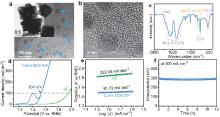
Fig 1
(a, b) TEM images of CoFe MOF; (c) FT-IR spectrum of CoFe MOF; (d) CV curves of Ni foam (NF) and CoFe MOF/NF measured in 1 mol·L–1 KOH; (e) Tafel plots of NF and CoFe MOF/NF; (f) chrono potentiometric curve of CoFe MOF/NF in 1 mol·L–1 KOH at 100 mA·cm–2 for 12 h."
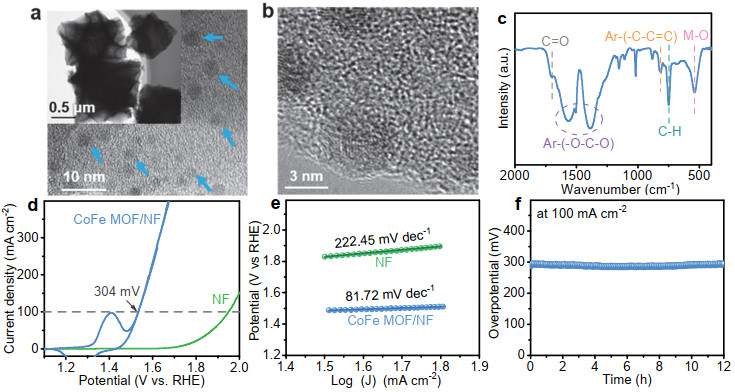
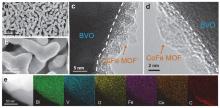
Fig 2
(a, b) SEM and (c, d) HRTEM images of CoFe MOF/BVO; (e) TEM-EDS elemental mapping of CoFe MOF/BVO."
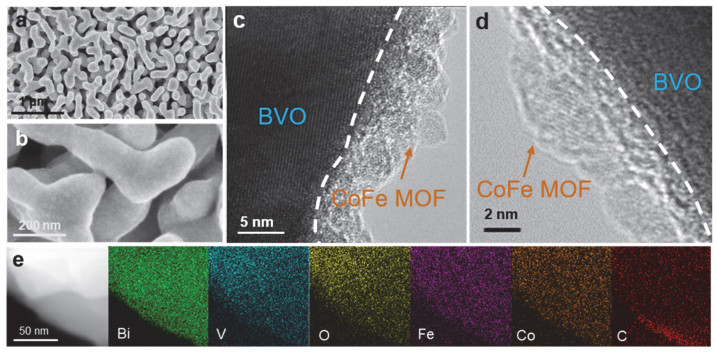
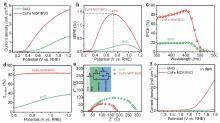
Fig 3
(a) LSV curves under AM 1.5G (100 mW∙cm−2) illumination in 1 mol·L−1 KBi (pH = 9.5), (b) ABPE values, (c) IPCEs at 1.23 VRHE; (d) surface separation efficiency, (e) electrochemical impedance spectroscopic data at 0.8 VRHE, and (f) LSV curves in dark of BVO and CoFe MOF/BVO."
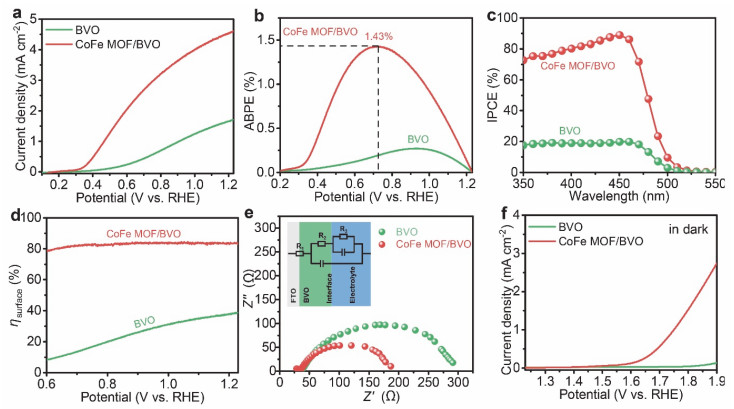
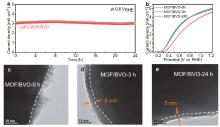
Fig 4
(a) I–t curves of CoFe MOF/BVO under AM 1.5G (100 mW∙cm−2) illumination in 1 mol·L−1 KBi (pH = 9.5) at 0.8 VRHE; (b) LSV curves of CoFe MOF/BVO during different reaction time; (c–e) TEM images of (c) CoFe MOF/BVO-0 h, (d) CoFe MOF/BVO-3 h, and (e) CoFe MOF/BVO-24 h."
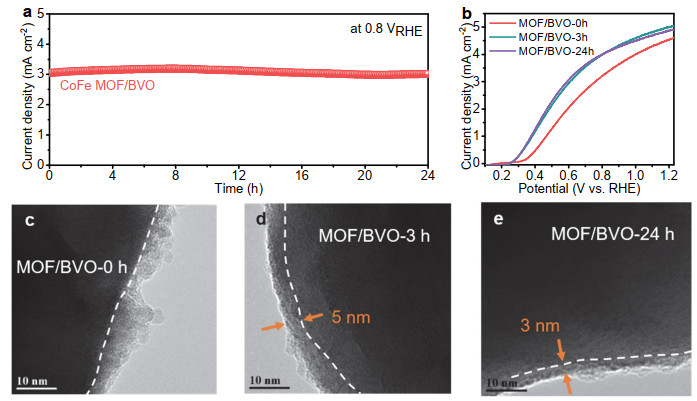
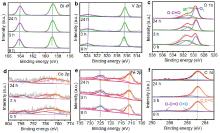
Fig 5
High resolution XPS peaks of (a) Bi 4f, (b) V 2p, (c) O 1s, (d) Co 2p, (e) Fe 2p, and (f) C 1s of CoFe MOF/BVO-0 h, CoFe MOF/BVO-3 h, and CoFe MOF/BVO-24 h."
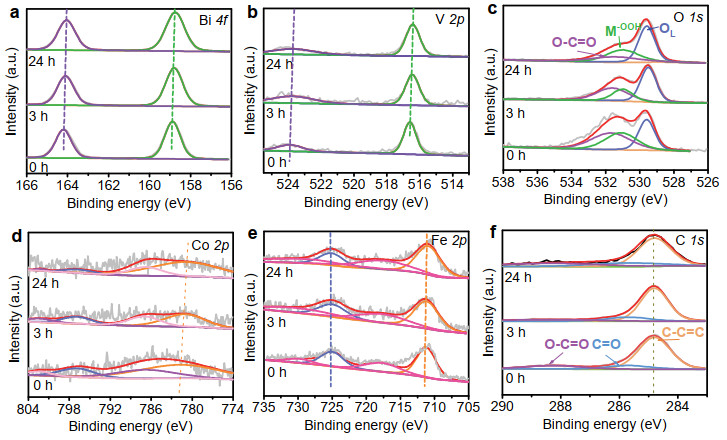
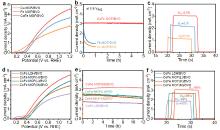
Fig 6
(a) LSV curves under AM 1.5G (100 mW∙cm−2) illumination in 1 mol·L−1 KBi (pH = 9.5), (b) i–t curves at 0.8 VRHE, and (c) transient photocurrents at 0.8 VRHE of Co MOF/BVO, Fe MOF/BVO, and CoFe MOF/BVO; (d) LSV curves; (e) i–t curves at 0.8 VRHE; (f) transient photocurrents at 0.8 VRHE of CoFe MOF(L)/BVO, CoFe MOF(M)/BVO, CoFe MOF(H)/BVO, and CoFe LDH/BVO."
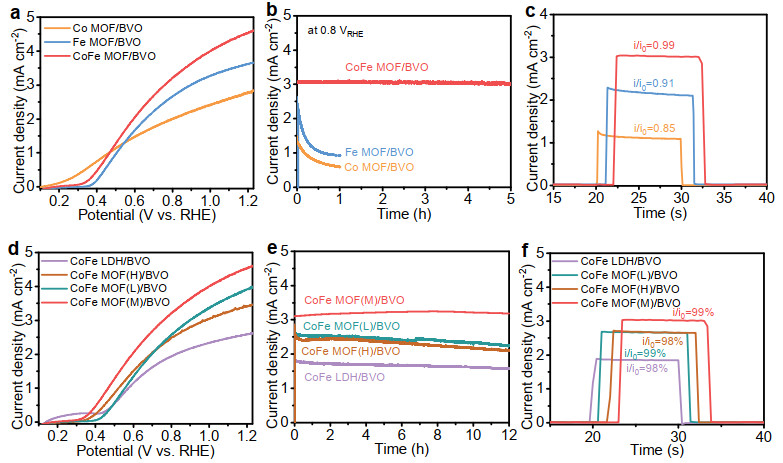
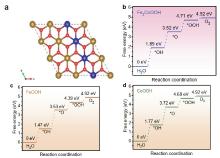
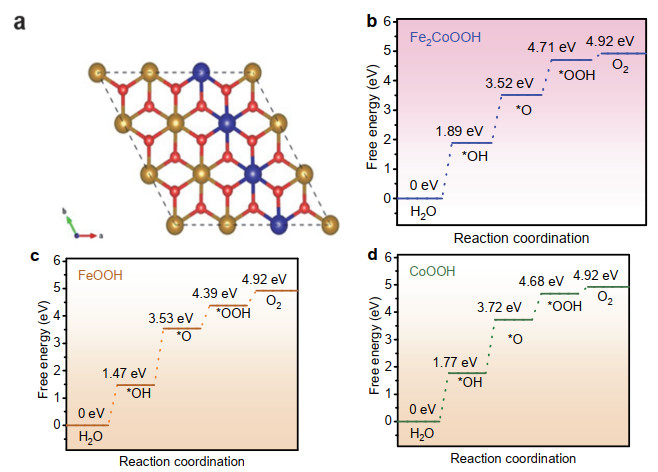
Fig 7
(a) Structure model of Fe2CoOOH; (b–d) free energy diagrams for (b) Fe2CoOOH, (c) FeOOH, and (d) CoOOH."
| 1 |
doi: 10.1038/NMAT4876 |
| 2 |
doi: 10.1002/ange.201903936 |
| 3 |
doi: 10.1002/aenm.201902494 |
| 4 |
doi: 10.1039/C7TA02745A |
| 5 |
doi: 10.1016/j.nanoen.2019.103880 |
| 6 |
doi: 10.1002/advs.201500345 |
| 7 |
doi: 10.1016/j.nanoen.2020.104648 |
| 8 |
doi: 10.3866/PKU.WHXB201409052 |
|
林雪; 郭晓宇; 王庆伟; 常利民; 翟宏菊. 物理化学学报, 2014, 30, 2113.
doi: 10.3866/PKU.WHXB201409052 |
|
| 9 |
doi: 10.3866/PKU.WHXB20100533 |
|
张爱平; 张进治. 物理化学学报, 2010, 26, 1337.
doi: 10.3866/PKU.WHXB20100533 |
|
| 10 |
doi: 10.3866/PKU.WHXB201305131 |
|
林雪; 于丽丽; 闫丽娜; 关庆丰; 闫永胜; 赵晗. 物理化学学报, 2013, 29, 1771.
doi: 10.3866/PKU.WHXB201305131 |
|
| 11 |
doi: 10.3866/PKU.WHXB202009022 |
|
李艳; 胡星盛; 黄静伟; 王磊; 佘厚德; 王其召. 物理化学学报, 2021, 37, 2009022.
doi: 10.3866/PKU.WHXB202009022 |
|
| 12 |
doi: 10.1016/j.apcatb.2017.07.002 |
| 13 |
doi: 10.3866/PKU.WHXB201910034 |
|
尹双凤. 物理化学学报, 2020, 36, 1910034.
doi: 10.3866/PKU.WHXB201910034 |
|
| 14 |
doi: 10.1021/ja405550k |
| 15 |
doi: 10.1002/adma.201804033 |
| 16 |
doi: 10.1021/acsenergylett.9b01150 |
| 17 |
doi: 10.1002/adfm.201500521 |
| 18 |
doi: 10.1002/anie.201915671 |
| 19 |
doi: 10.1002/anie.202012550 |
| 20 |
doi: 10.1016/j.apcatb.2019.118513 |
| 21 |
doi: 10.1002/aenm.202100911 |
| 22 |
doi: 10.1016/j.cej.2021.129330 |
| 23 |
doi: 10.1039/d1ta90130c |
| 24 |
doi: 10.1016/j.nanoen.2020.105606 |
| 25 |
doi: 10.1002/anie.202102632 |
| 26 |
doi: 10.1039/c5ta04105h |
| 27 |
doi: 10.1021/acssuschemeng.1c03116 |
| 28 |
doi: 10.1038/NENERGY.2016.184 |
| 29 |
doi: 10.1021/jacs.5b10699 |
| 30 |
doi: 10.1021/jacs.5b01006 |
| 31 |
doi: 10.1002/anie.201907600 |
| 32 |
doi: 10.1039/c8ta01062e |
| [1] | Yu Wang, Haiyang Shi, Zihan Chen, Feng Chen, Ping Wang, Xuefei Wang. Hollow AgPt@Pt core-shell cocatalyst with electron-rich Ptδ− shell for boosting selectivity of photocatalytic H2O2 production for faceted BiVO4 [J]. Acta Phys. -Chim. Sin., 2025, 41(7): 100081-. |
| [2] | Yuchen Zhou, Huanmin Liu, Hongxing Li, Xinyu Song, Yonghua Tang, Peng Zhou. Designing thermodynamically stable noble metal single-atom photocatalysts for highly efficient non-oxidative conversion of ethanol into high-purity hydrogen and value-added acetaldehyde [J]. Acta Phys. -Chim. Sin., 2025, 41(6): 100067-. |
| [3] | Xin Zhou, Yiting Huo, Songyu Yang, Bowen He, Xiaojing Wang, Zhen Wu, Jianjun Zhang. Understanding the effect of pH on protonated COF during photocatalytic H2O2 production by femtosecond transient absorption spectroscopy [J]. Acta Phys. -Chim. Sin., 2025, 41(12): 100160-. |
| [4] | Wentao Xu, Xuyan Mo, Yang Zhou, Zuxian Weng, Kunling Mo, Yanhua Wu, Xinlin Jiang, Dan Li, Tangqi Lan, Huan Wen, Fuqin Zheng, Youjun Fan, Wei Chen. Bimetal Leaching Induced Reconstruction of Water Oxidation Electrocatalyst for Enhanced Activity and Stability [J]. Acta Phys. -Chim. Sin., 2024, 40(8): 2308003-. |
| [5] | Yajuan Xing, Hui Xue, Jing Sun, Niankun Guo, Tianshan Song, Jiawen Sun, Yi-Ru Hao, Qin Wang. Cu3P-Induced Charge-Oriented Transfer and Surface Reconstruction of Ni2P to Achieve Efficient Oxygen Evolution Activity [J]. Acta Phys. -Chim. Sin., 2024, 40(3): 2304046-. |
| [6] | Xinyu Yin, Haiyang Shi, Yu Wang, Xuefei Wang, Ping Wang, Huogen Yu. Spontaneously Improved Adsorption of H2O and Its Intermediates on Electron-Deficient Mn(3+δ)+ for Efficient Photocatalytic H2O2 Production [J]. Acta Phys. -Chim. Sin., 2024, 40(10): 2312007-. |
| [7] | Erjun Lu, Junqian Tao, Can Yang, Yidong Hou, Jinshui Zhang, Xinchen Wang, Xianzhi Fu. Carbon-Encapsulated Pd/TiO2 for Photocatalytic H2 Evolution Integrated with Photodehydrogenative Coupling of Amines to Imines [J]. Acta Phys. -Chim. Sin., 2023, 39(4): 2211029-0. |
| [8] | Meihui Jiang, Lizhi Sheng, Chao Wang, Lili Jiang, Zhuangjun Fan. Graphene Film for Supercapacitors: Preparation, Foundational Unit Structure and Surface Regulation [J]. Acta Phys. -Chim. Sin., 2022, 38(2): 2012085-. |
| [9] | Yunfeng Li, Min Zhang, Liang Zhou, Sijia Yang, Zhansheng Wu, Ma Yuhua. Recent Advances in Surface-Modified g-C3N4-Based Photocatalysts for H2 Production and CO2 Reduction [J]. Acta Phys. -Chim. Sin., 2021, 37(6): 2009030-. |
| [10] | Fan Xie, Ye Xi, Qingda Xu, Jingquan Liu. Utah Neural Electrode Technology for Brain-Computer Interface [J]. Acta Phys. -Chim. Sin., 2020, 36(12): 2003014-. |
| [11] | Jincheng GUO,Yanfen LIN,Na TIAN,Shigang SUN. Modification of Tetrahexahedral Pd Nanocrystals with Ru and Their Performance for Methanol Electro-oxidation [J]. Acta Phys. -Chim. Sin., 2019, 35(7): 749-754. |
| [12] | Mingyue WANG,Shijing TAN,Xuefeng CUI,Bing WANG. Introducing Strain in Anatase TiO2(001) Films by Epitaxial Growth [J]. Acta Physico-Chimica Sinica, 2019, 35(12): 1412-1421. |
| [13] | Xin-Ran XIANG,Xiao-Mei WAN,Hong-Bo SUO,Yi HU. Study of Surface Modifications of Multiwalled Carbon Nanotubes by Functionalized Ionic Liquid to Immobilize Candida antarctic lipase B [J]. Acta Phys. -Chim. Sin., 2018, 34(1): 99-107. |
| [14] | Xue-Hui HUANG,Xiao-Hui SHANG,Peng-Ju NIU. Surface Modification of SBA-15 and Its Effect on the Structure and Properties of Mesoporous La0.8Sr0.2CoO3 [J]. Acta Phys. -Chim. Sin., 2017, 33(7): 1462-1473. |
| [15] | Hai-Fei WU,Yao CHEN,Shan-Hu XU,Yong-Hong YAN,Jian-Xiao SI,Yong-Sheng TAN. Molecular Beam Epitaxy Growth and Surface Structural Characteristics of PbTe(111) Thin Film [J]. Acta Phys. -Chim. Sin., 2017, 33(2): 419-425. |
|
||