Acta Phys. -Chim. Sin. ›› 2024, Vol. 40 ›› Issue (4): 2306003.doi: 10.3866/PKU.WHXB202306003
Special Issue: Multi-Physical Fields Driven Catalysis for Energy Conversion
• REVIEW • Previous Articles Next Articles
Cleavage of C―C Bonds for Biomass Upgrading on Transition Metal Electrocatalysts
Lu Zhuoran1, Li Shengkai1,2, Lu Yuxuan1,3, Wang Shuangyin1, Zou Yuqin1,*( )
)
- 1 State Key Laboratory of Chemo/Bio-Sensing and Chemometrics, Advanced Catalytic Engineering Research Center of the Ministry of Education, College of Chemistry and Chemical Engineering, Hunan University, Changsha 410082, China
2 Shenzhen Institute of Hunan University, Shenzhen 518057, Guangdong Province, China
3 School of Chemistry and Chemical Engineering, Jishou University, Jishou 416000, Hunan Province, China
-
Received:2023-06-01Revised:2023-07-03Accepted:2023-07-03Published:2023-07-10 -
Contact:Email: yuqin_zou@hnu.edu.cn (Yuqin Zou) -
Supported by:the National Key R&D Program of China(2020YFA0710000); the National Natural Science Foundation of China(22122901); the Provincial Natural Science Foundation of Hunan, China(2021JJ0008); the Provincial Natural Science Foundation of Hunan, China(2021JJ20024); the Provincial Natural Science Foundation of Hunan, China(2021RC3054); the Shenzhen Science and Technology Program, China(JCYJ20210324140610028)

Cite this article
Lu Zhuoran, Li Shengkai, Lu Yuxuan, Wang Shuangyin, Zou Yuqin. Cleavage of C―C Bonds for Biomass Upgrading on Transition Metal Electrocatalysts[J]. Acta Phys. -Chim. Sin. 2024, 40(4), 2306003. doi: 10.3866/PKU.WHXB202306003
share this article
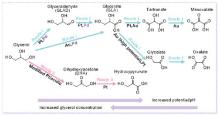
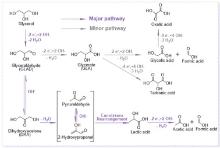
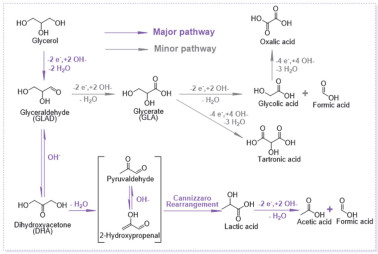
Scheme 1
Electrooxidation pathways of glycerol on various noble catalysts mainly in alkaline media (red words are uncertain routes on specific catalysts), color online 3."
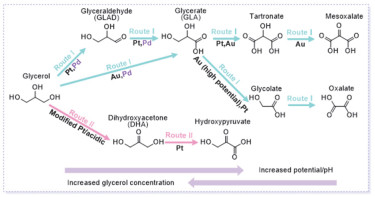
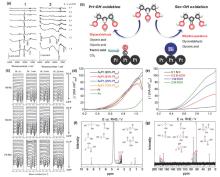
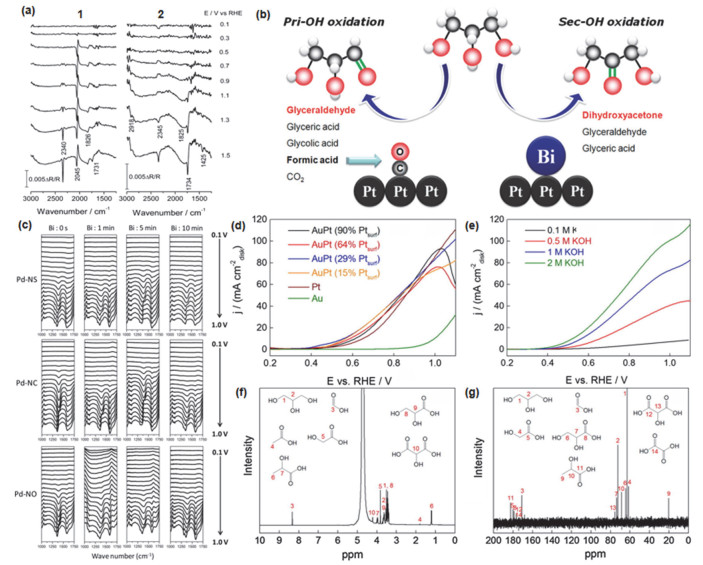
Fig 1
(a) Potential dependent FTIR spectra for (1) unmodified Pt electrode and (2) Bi-modified Pt electrode in 0.01 mol∙L−1 HClO4 + 0.1 mol∙L−1 glycerol 15. (b) Schematic illustration of the glycerol oxidation on pure Pt and Bi-modified Pt 15. (c) Infrared spectra recorded each 0.05 V for the electrooxidation 0.1 mol∙L−1 glycerol in 0.1 mol∙L−1 NaOH on the different Pd-NP electrodes 25. (d) Linear voltammograms of glycerol oxidation catalyzed on different AuPt and Au & Pt electrodes in 0.5 mol∙L−1 glycerol & 1 mol∙L−1 KOH solution 26. (e) Linear voltammograms of glycerol oxidation catalyzed by AuPt (15% Ptsurf) in 0.5 mol∙L−1 glycerol in KOH 26. (f) 1H and (g) 13C NMR spectra of the electrolyte solution after 12 h glycerol oxidation on AuPt (15% Ptsurf) in 0.5 mol∙L−1 glycerol & 1 mol∙L−1 KOH solution at 1.05 V vs. RHE 26."
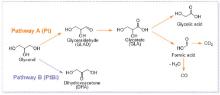
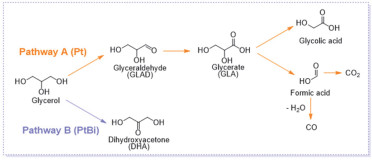
Scheme 2
Glycerol reaction pathways over Pt (Pathway A) and PtBi (Pathway B) catalysts 15."
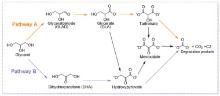
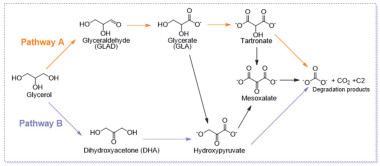
Scheme 3
Electrocatalytic pathways for the glycerol oxidation toward Pd-NP (Pathway A) and Bi-modified Pd-NP (Pathway B) catalysts 25."
Scheme4
Reaction mechanism of glycerol oxidation over AuPt catalyst 26."
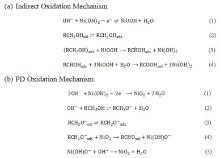
Scheme 5
Mechanism for the (a) indirect oxidation and (b) PD oxidation on NiOOH electrodes 27, 29."
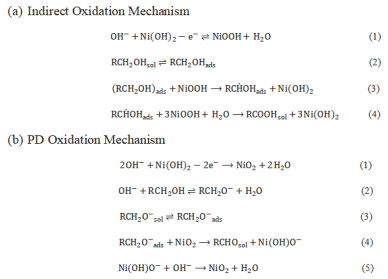
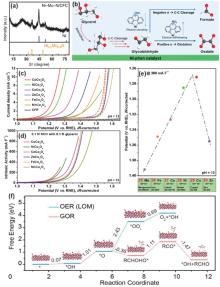
Fig 2
(a) XRD pattern of Ni-Mo-N/CFC 30. (b) Scheme of the glycerol oxidation pathway and the correlation between product selectivity and the Hammett parameters. (c) LSV curves of different MCo2O4 grown on carbon fiber paper and bare carbon fiber paper in the presence (solid lines) or absence (dash-dotted lines) of 0.1 mol∙L−1 glycerol 33. (d) Intrinsic GOR catalytic activities on different MCo2O4 catalysts in 0.1 mol∙L−1 KOH solution with 0.1 mol∙L−1 glycerol after ECSA normalization 33. (e) Intrinsic GOR catalytic activities on different MCo2O4 catalysts 33. (f) Reaction free-energy diagram of OER (LOM) and glycerol oxidation to GLAD 34."
Scheme 6
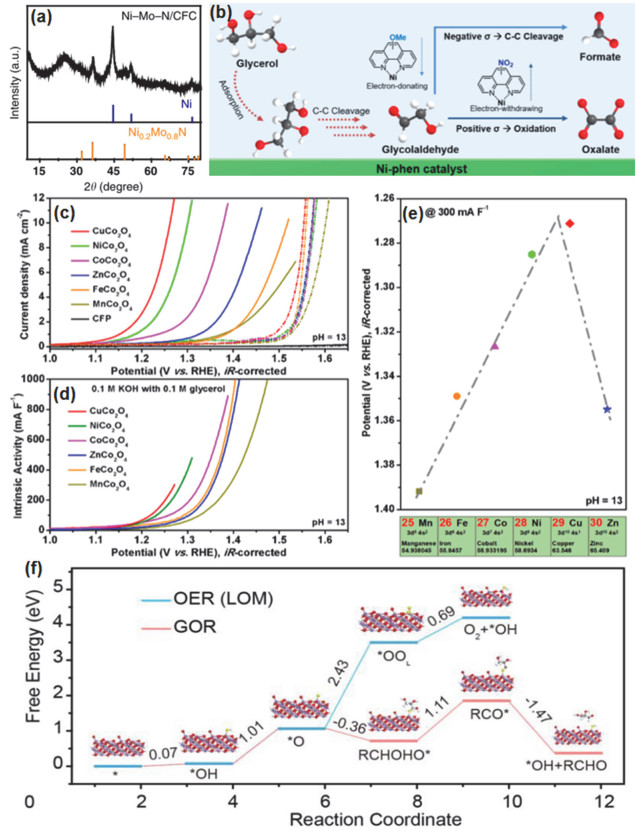
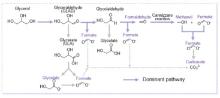
Proposed mechanism of glycerol electrooxidation on Ni–Mo–N/CFC electrode 30."
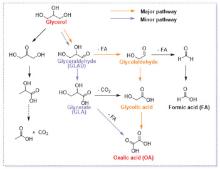
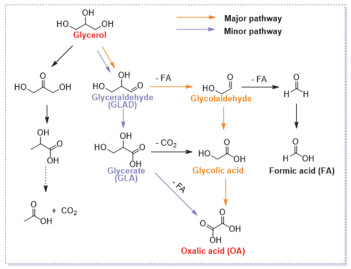
Scheme 7
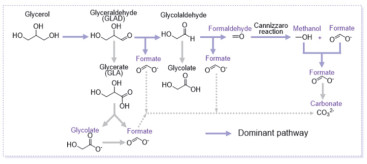
Possible electrooxidation pathways for the glycerol to OA on Ni-phen catalysts 31."
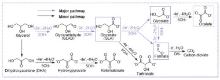
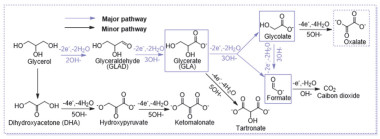
Scheme 8
Proposed reaction pathway of GOR over the CuCo2O4 electrocatalysts 33."
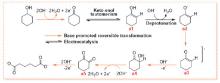
Scheme 9
Proposed reaction mechanism for the electrooxidation of KA oil on Ni(OH)2-SDS catalyst 46."
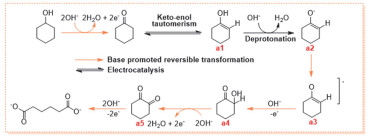
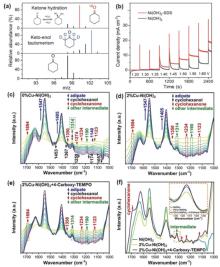
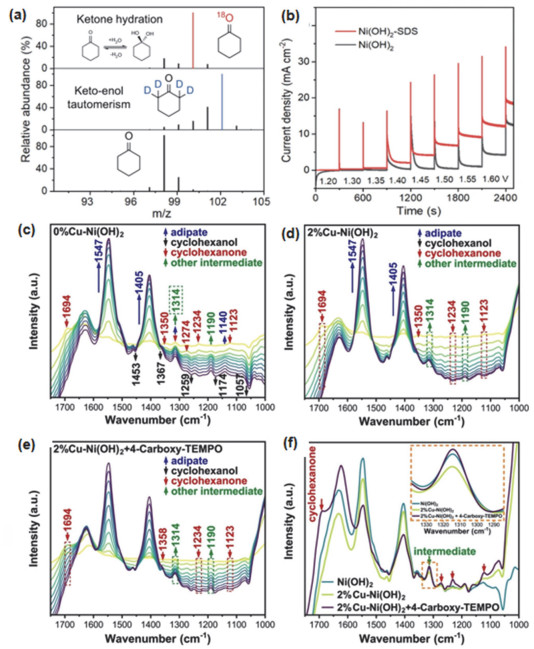
Fig 3
(a) Mass spectra of cyclohexanone in the isotope-labeled electrolyte 46. (b) I–t curves of Ni(OH)2-SDS and Ni(OH)2 at different potentials (V vs. RHE) in normal pulse voltammetry 46. In situ IRRAS spectra of the cyclohexanol oxidation products under 1.47 V vs. RHE with (c) Ni(OH)2, (d) 2% Cu-Ni(OH)2 and (e) 2% Cu-Ni(OH)2 + 4-Carboxy-TEMPO in the electrolyte at a time resolution of 30 s 42. (f) The comparison of the in situ IRRAS spectra at the third scan (90 s) 42."
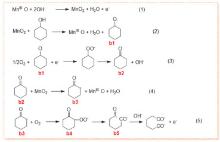
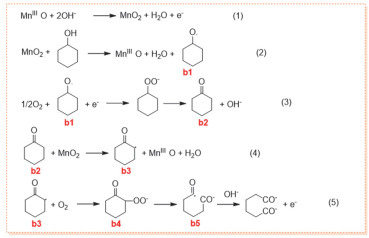
Scheme 10
Proposed electrooxidation mechanism of cyclohexanol to adipic acid on Fe-Mn/Mn2O3 membrane electrode 45."
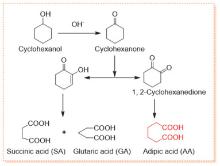
Scheme 11
Possible oxidation mechanism of cyclohexanol to adipic acid 48."
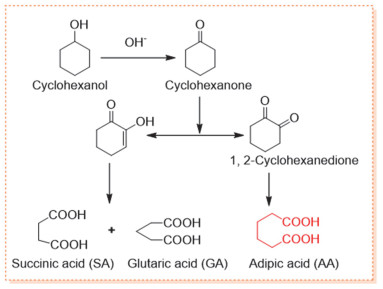
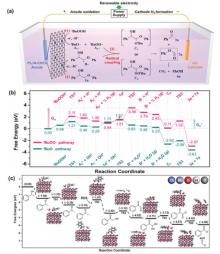
Fig 4
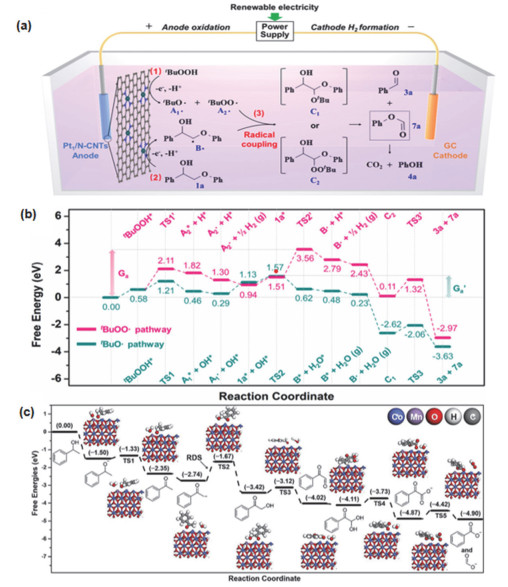
(a) Proposed mechanism of Pt1/N-CNTs-catalyzed conversion of 2-phenoxy-1-phenylethanol 79. (b) Potential energy surface for 2-phenoxy-1-phenylethanol conversion on Pt1/N-CNTs catalyst 79. (c) Free energy diagram for electrocatalytic oxidation of c1 over MnCoOOH catalyst 21."
Scheme 12
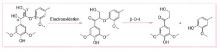
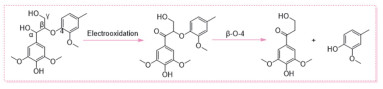
Proposed electrooxidation pathway of lignin over hp-Ni catalyst 80."
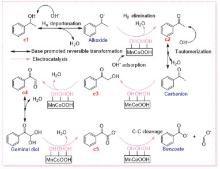
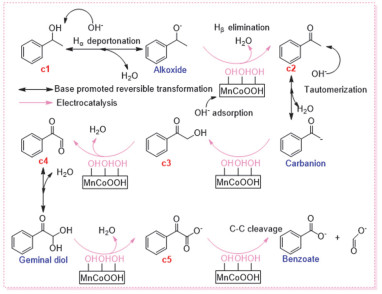
Scheme 13
Proposed electrooxidation pathway of the lignin derivative 1-phenylethanol on MnCoOOH/NF 21."
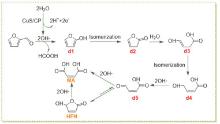
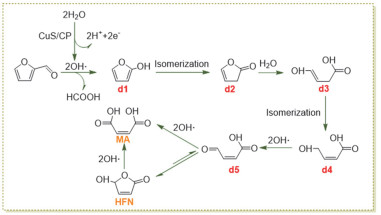
Scheme 14
Proposed oxidation pathway of furfural oxidation on CuS catalyst 86."
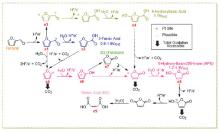
Scheme 15
Electrooxidation mechanism of furfural in acidic solution over Pt catalyst 95."
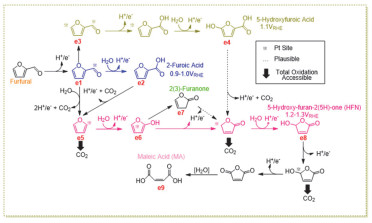
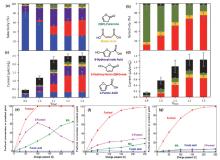
Fig 5
Selectivity and partial currents toward significant products of the electro-oxidation of (a, c) 100 mmol∙L−1 furfural and (b, d) 100 m mol∙L−1 FA on Pt/C electrode 95. Conversion of furfural and yield of oxidation products obtained using (e) PbO2, (f) MnO2 and (g) Pt anodes at 2.0, 1.8 and 2.2 V vs. RHE, respectively, during electrochemical oxidation of 10 mmol∙L−1 furfural over various charge 96."
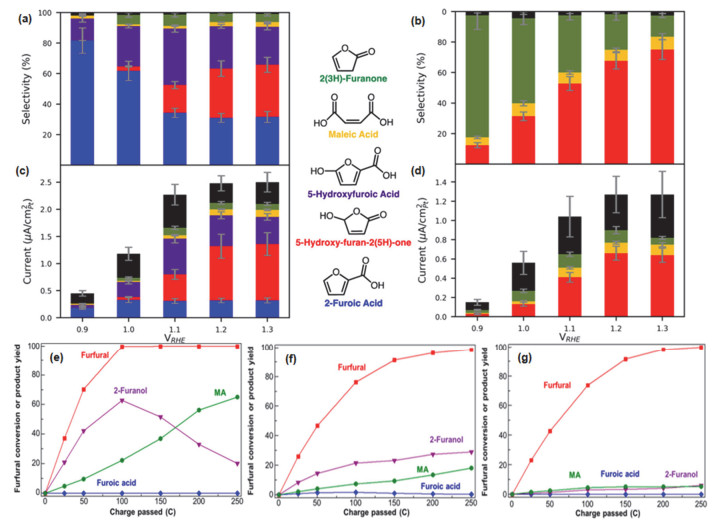
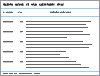
Table 1
Summary of electrocatalysts for biomass-derived organic molecules."
| Electrocatalyst | Reactant | Main product | Conversion/Production rate | Selectivity (%) | Electrolyte | Reference |
| Bi-modified Pt/C | Glyceral | DHA | 100 | 100 | 0.5 mol∙L−1 H2SO4 | |
| Bi-modified Pd-NP | Glyceral | Hydroxypyruvate | – | – | 0.5 mol∙L−1 H2SO4 | |
| AuPt | Glyceral | LA | – | 73.0 | 1 mol∙L−1 KOH | |
| Ni-Mo-N/CFC | Glyceral | Formate | – | 95.0 | 1 mol∙L−1 KOH | |
| Ni-phen | Glyceral | Formate | – | 92.7 | 2 mol∙L−1 KOH | |
| Co3O4 | C3-saturated alcohols | – | – | – | 1 mol∙L−1 KOH | |
| CuCo2O4 | Glyceral | Formic acid | 79.7 | 89.1 | 0.1 mol∙L−1 KOH | |
| MnO2/CP | Glyceral | Formic acid | – | – | 0.005 mol∙L−1 H2SO4 | |
| Ni(OH)2-SDS | Cyclohexanol | Adipic acid | – | – | 0.5 mol∙L−1 KOH | |
| Cu-Ni(OH)2 | Cyclohexanol | Adipic acid | 96.55 | 87 | 1 mol∙L−1 NaOH | |
| Fe-Mn/Mn2O3 | Cyclohexanol | Adipic acid | 94.5 | – | 0.5 mol∙L−1 NaOH | |
| Cu | Cyclohexanol | Adipic acid | – | – | 0.1 mol∙L−1 NaOH | |
| Pt1/N-CNTs | 2-phenoxy-1-phenylethanol | Benzaldehyde | 99 | 81.82 | TBHP, 70% aq.soln | |
| hp-Ni | Lignin | Vanillin and syringaldehyde | – | – | 1 mol∙L−1 KOH | |
| MnCoOOH/NF | 1-phenylethanol | Benzoate | – | – | 1 mol∙L−1 KOH | |
| CuS | Furfural | 5-Hydroxy-2(5H)-furanone (HFN) | 70.2 | 83.6 | [Et3NH]NO3 (1.8%, wt), Me-CN, and H2O (12.5%, wt) | |
| Pt | Furfural | Maleic acid (MA) | – | – | 0.25 mol∙L−1 HClO4 | |
| PbO2 | Furfural | Maleic acid (MA) | 99 | 65.76 | 0.05 mol∙L−1 H2SO4 |
| 1 |
doi: 10.1039/C6GC02620F |
| 2 |
doi: 10.1002/chem.201803319 |
| 3 |
doi: 10.1039/c8cy00533h |
| 4 |
doi: 10.1021/acssuschemeng.7b00868 |
| 5 |
doi: 10.1021/acscatal.5b00183 |
| 6 |
doi: 10.1021/acscatal.8b01317 |
| 7 |
doi: 10.1016/j.checat.2021.08.001 |
| 8 |
doi: 10.1038/s41467-019-12385-1 |
| 9 |
doi: 10.1016/j.jpowsour.2009.01.044 |
| 10 |
doi: 10.1149/2.073308jes |
| 11 |
doi: 10.1016/j.ijhydene.2015.02.103 |
| 12 |
doi: 10.1016/j.electacta.2013.09.032 |
| 13 |
doi: 10.1002/elan.201100321 |
| 14 |
doi: 10.1016/j.elecom.2010.06.001 |
| 15 |
doi: 10.1021/cs200599g |
| 16 |
doi: 10.1021/ja200976j |
| 17 |
doi: 10.1016/j.apcatb.2009.10.008 |
| 18 |
doi: 10.1007/s10800-012-0423-3 |
| 19 |
doi: 10.1016/j.electacta.2012.08.031 |
| 20 |
doi: 10.1016/j.ijhydene.2012.03.019 |
| 21 |
doi: 10.1002/anie.202015431 |
| 22 |
doi: 10.1149/2.007304jes |
| 23 |
doi: 10.1016/j.colsurfa.2014.09.027 |
| 24 |
doi: 10.1016/j.ijhydene.2012.09.001 |
| 25 |
doi: 10.1016/j.electacta.2015.07.073 |
| 26 |
doi: 10.1016/j.jcat.2017.10.010 |
| 27 |
doi: 10.1021/jacs.0c10924 |
| 28 |
doi: 10.1021/acscatal.1c04163 |
| 29 |
doi: 10.1016/j.phmed.2022.100054 |
| 30 |
doi: 10.1038/s41467-019-13375-z |
| 31 |
doi: 10.1002/anie.202216083 |
| 32 |
doi: 10.1016/j.electacta.2017.01.086 |
| 33 |
doi: 10.1021/acscatal.0c01498 |
| 34 |
doi: 10.1002/anie.202107510 |
| 35 |
doi: 10.1016/j.copbio.2017.03.006 |
| 36 |
doi: 10.3389/fchem.2020.00185 |
| 37 |
doi: 10.1126/science.aaz1293 |
| 38 |
doi: 10.1039/d1gc00638j |
| 39 |
doi: 10.1126/science.aaz6459 |
| 40 |
doi: 10.1039/c3cy20728e |
| 41 |
doi: 10.1016/j.biotechadv.2018.10.012 |
| 42 |
doi: 10.1002/anie.202214977 |
| 43 |
doi: 10.1134/s1070427214040089 |
| 44 |
doi: 10.1039/d0gc02210a |
| 45 |
doi: 10.1007/s10008-016-3286-4 |
| 46 |
doi: 10.1038/s41467-022-32769-0 |
| 47 |
doi: 10.1007/s11172-009-0339-1 |
| 48 |
doi: 10.1016/j.catcom.2008.09.010 |
| 49 |
doi: 10.1016/j.ccr.2010.04.007 |
| 50 |
doi: 10.1002/anie.201102117 |
| 51 |
doi: 10.1126/science.aaf7810 |
| 52 |
doi: 10.1038/nature13867 |
| 53 |
doi: 10.1007/s40843-017-9169-4 |
| 54 |
doi: 10.1039/d0cs00134a |
| 55 |
doi: 10.1007/s12274-018-2013-0 |
| 56 |
doi: 10.1039/C5GC03043A |
| 57 |
doi: 10.1021/acs.chemrev.7b00588 |
| 58 |
doi: 10.1021/acscentsci.7b00140 |
| 59 |
doi: 10.1002/anie.202014017 |
| 60 |
doi: 10.1002/anie.201712732 |
| 61 |
doi: 10.1021/acs.accounts.9b00512 |
| 62 |
doi: 10.1039/c4cs00235k |
| 63 |
doi: 10.1021/ja109016b |
| 64 |
doi: 10.1039/C2DT31065A |
| 65 |
doi: 10.1126/science.332.6035.1263-c |
| 66 |
doi: 10.1021/jacs.6b04144 |
| 67 |
doi: 10.1021/acscatal.7b01043 |
| 68 |
doi: 10.1021/acscatal.6b02212 |
| 69 |
doi: 10.1002/anie.201409408 |
| 70 |
doi: 10.1002/adsc.201400463 |
| 71 |
doi: 10.1039/c4gc01012d |
| 72 |
doi: 10.1002/anie.201107020 |
| 73 |
doi: 10.1021/jo1012509 |
| 74 |
doi: 10.1021/jo401680z |
| 75 |
doi: 10.1021/acs.accounts.5b00104 |
| 76 |
doi: 10.1021/jz201201q |
| 77 |
doi: 10.1021/jz201182w |
| 78 |
doi: 10.1039/c2gc36456e |
| 79 |
doi: 10.1021/jacs.1c02328 |
| 80 |
doi: 10.1021/acs.energyfuels.0c02284 |
| 81 |
doi: 10.1002/cssc.201100648 |
| 82 |
doi: 10.1039/C5EE02666K |
| 83 |
doi: 10.1021/acssuschemeng.5b00473 |
| 84 |
doi: 10.1021/acssuschemeng.9b05126 |
| 85 |
doi: 10.1039/C6GC03020C |
| 86 |
doi: 10.1039/c9sc00322c |
| 87 |
doi: 10.1186/s40508-015-0034-5/ |
| 88 |
doi: 10.1021/cr00083a003 |
| 89 |
doi: 10.1002/cssc.201701866 |
| 90 |
doi: 10.1016/0009-2509[74]80071-0 |
| 91 |
doi: 10.1039/C4GC00829D |
| 92 |
doi: 10.1021/jp2054712 |
| 93 |
doi: 10.1016/j.catcom.2010.12.033 |
| 94 |
doi: 10.1016/j.cattod.2015.11.036 |
| 95 |
doi: 10.1021/acscatal.9b02656 |
| 96 |
doi: 10.1021/acssuschemeng.8b02698 |
| [1] | Ruizhi Duan, Xiaomei Wang, Panwang Zhou, Yang Liu, Can Li. The role of hydroxyl species in the alkaline hydrogen evolution reaction over transition metal surfaces [J]. Acta Phys. -Chim. Sin., 2025, 41(9): 100111-. |
| [2] | Xueting Cao, Shuangshuang Cha, Ming Gong. Interfacial Electrical Double Layer in Electrocatalytic Reactions: Fundamentals, Characterizations and Applications [J]. Acta Phys. -Chim. Sin., 2025, 41(5): 100041-. |
| [3] | Runhua Chen, Qiong Wu, Jingchen Luo, Xiaolong Zu, Shan Zhu, Yongfu Sun. Defective Ultrathin Two-Dimensional Materials for Photo-/Electrocatalytic CO2 Reduction: Fundamentals and Perspectives [J]. Acta Phys. -Chim. Sin., 2025, 41(3): 100019-. |
| [4] | Xue Dong, Xiaofu Sun, Shuaiqiang Jia, Shitao Han, Dawei Zhou, Ting Yao, Min Wang, Minghui Fang, Haihong Wu, Buxing Han. Electrochemical CO2 Reduction to C2+ Products with Ampere-Level Current on Carbon-Modified Copper Catalysts [J]. Acta Phys. -Chim. Sin., 2025, 41(3): 100024-. |
| [5] | Qing Li, Guangxun Zhang, Yuxia Xu, Yangyang Sun, Huan Pang. P-Regulated Hierarchical Structure Ni2P Assemblies toward Efficient Electrochemical Urea Oxidation [J]. Acta Phys. -Chim. Sin., 2024, 40(9): 2308045-. |
| [6] | Yan Kong, Wei Wei, Lekai Xu, Chen Chen. Electrochemical Synthesis of Organonitrogen Compounds from N-integrated CO2 Reduction Reaction [J]. Acta Phys. -Chim. Sin., 2024, 40(8): 2307049-. |
| [7] | Wentao Xu, Xuyan Mo, Yang Zhou, Zuxian Weng, Kunling Mo, Yanhua Wu, Xinlin Jiang, Dan Li, Tangqi Lan, Huan Wen, Fuqin Zheng, Youjun Fan, Wei Chen. Bimetal Leaching Induced Reconstruction of Water Oxidation Electrocatalyst for Enhanced Activity and Stability [J]. Acta Phys. -Chim. Sin., 2024, 40(8): 2308003-. |
| [8] | Ye Wang, Ruixiang Ge, Xiang Liu, Jing Li, Haohong Duan. An Anion Leaching Strategy towards Metal Oxyhydroxides Synthesis for Electrocatalytic Oxidation of Glycerol [J]. Acta Phys. -Chim. Sin., 2024, 40(7): 2307019-. |
| [9] | Xinyi Zhang, Kai Ren, Yanning Liu, Zhenyi Gu, Zhixiong Huang, Shuohang Zheng, Xiaotong Wang, Jinzhi Guo, Igor V. Zatovsky, Junming Cao, Xinglong Wu. Progress on Entropy Production Engineering for Electrochemical Catalysis [J]. Acta Phys. -Chim. Sin., 2024, 40(7): 2307057-. |
| [10] | Xin Feng, Kexin Guo, Chunguang Jia, Bowen Liu, Suqin Ci, Junxiang Chen, Zhenhai Wen. Hydrogen Generation Coupling with High-Selectivity Electrocatalytic Glycerol Valorization into Formate in an Acid-Alkali Dual-Electrolyte Flow Electrolyzer [J]. Acta Phys. -Chim. Sin., 2024, 40(5): 2303050-. |
| [11] | Yanhui Guo, Li Wei, Zhonglin Wen, Chaorong Qi, Huanfeng Jiang. Recent Progress on Conversion of Carbon Dioxide into Carbamates [J]. Acta Phys. -Chim. Sin., 2024, 40(4): 2307004-. |
| [12] | Tao Wang, Qin Dong, Cunpu Li, Zidong Wei. Sulfur Cathode Electrocatalysis in Lithium-Sulfur Batteries: A Comprehensive Understanding [J]. Acta Phys. -Chim. Sin., 2024, 40(2): 2303061-. |
| [13] | Huasen Lu, Shixu Song, Qisen Jia, Guangbo Liu, Luhua Jiang. Advances in Cu2O-based Photocathodes for Photoelectrochemical Water Splitting [J]. Acta Phys. -Chim. Sin., 2024, 40(2): 2304035-. |
| [14] | Xinxuan Duan, Marshet Getaye Sendeku, Daoming Zhang, Daojin Zhou, Lijun Xu, Xueqing Gao, Aibing Chen, Yun Kuang, Xiaoming Sun. Tungsten-Doped NiFe-Layered Double Hydroxides as Efficient Oxygen Evolution Catalysts [J]. Acta Phys. -Chim. Sin., 2024, 40(1): 2303055-. |
| [15] | Hanyu Xu, Xuedan Song, Qing Zhang, Chang Yu, Jieshan Qiu. Mechanistic Insights into Water-Mediated CO2 Electrochemical Reduction Reactions on Cu@C2N Catalysts: A Theoretical Study [J]. Acta Phys. -Chim. Sin., 2024, 40(1): 2303040-. |
|
||