Acta Phys. -Chim. Sin. ›› 2024, Vol. 40 ›› Issue (4): 2306040.doi: 10.3866/PKU.WHXB202306040
Special Issue: Carbon Dioxide Valorization
• REVIEW • Previous Articles Next Articles
Imidazolium-Based Materials for CO2 Electroreduction
Qiang Zhang1,3, Yuanbiao Huang1,2,4,*( ), Rong Cao1,2,3,4,*()
- 1 State Key Laboratory of Structural Chemistry, Fujian Institute of Research on the Structure of Matter, Chinese Academy of Sciences, Fuzhou 350002, China
2 Fujian Science & Technology Innovation Laboratory for Optoelectronic Information of China, Fuzhou 350108, China
3 Department of Chemistry, School of Chemistry and Materials Science, University of Science and Technology of China, Hefei 230000, China
4 University of Chinese Academy of Sciences, Beijing 100049, China
-
Received:2023-06-26Revised:2023-07-28Accepted:2023-07-28Published:2023-08-07 -
Contact:Email: ybhuang@fjirsm.ac.cn; Tel.: +86-591-63001407 (Yuanbiao Huang)rcao@fjirsm.ac.cn. Tel.: +86-591-63173998 (Rong Cao) -
Supported by:the National Key Research and Development Program of China(2018YFA0704502); the National Natural Science Foundation of China(U22A20436); the National Natural Science Foundation of China(2071245); the National Natural Science Foundation of China(22033008); the National Natural Science Foundation of China(22220102005); the Fujian Science & Technology Innovation Laboratory for Optoelectronic Information of China(2021ZZ103)

Cite this article
Qiang Zhang, Yuanbiao Huang, Rong Cao. Imidazolium-Based Materials for CO2 Electroreduction[J]. Acta Phys. -Chim. Sin. 2024, 40(4), 2306040. doi: 10.3866/PKU.WHXB202306040
share this article
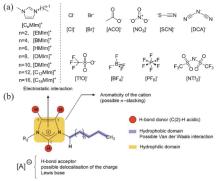
Fig 1
(a) Some common Im-ILs and their abbreviations. (b) Schematic of interactions presented in Im-ILs. Adapted from American Chemical Society 39, Elsevier 46, respectively."
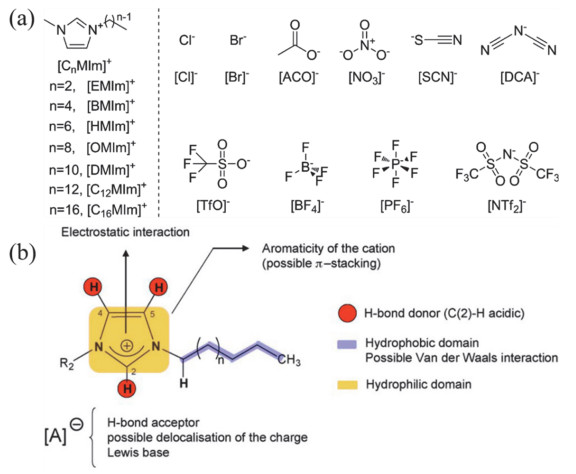
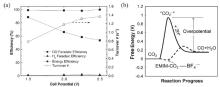
Fig 2
(a) FE towards CO and H2, turnover rate and energy efficiency as a function of cell potential. (b) A schematic of the free energy changes during the reaction CO2 + 2H+ + 2e− ⇋ CO + H2O in water or acetonitrile (solid line) or Emim-BF4 (dashed line). Adapted from American Association for the Advancement of Science 50."
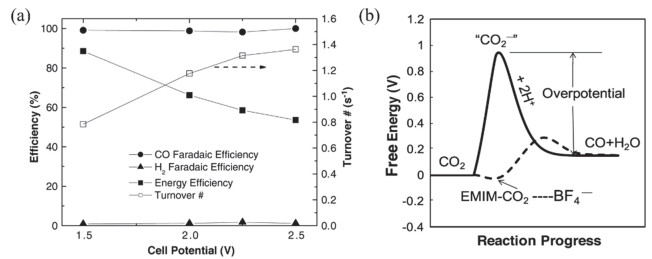
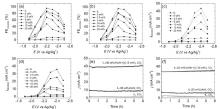
Fig 3
Effect of current density and FE using [Bmim][PF6](30%, mass fraction)/AcN-H2O electrolytes with different H2O contents. FE of HCOOH on (a) Pb and (b) Sn electrodes; partial current density of HCOOH (jHCOOH) on (c) Pb and (d) Sn electrodes; the dependence of current density over time on (e) Pb and (f) Sn electrodes. Adapted from Wiley 43."
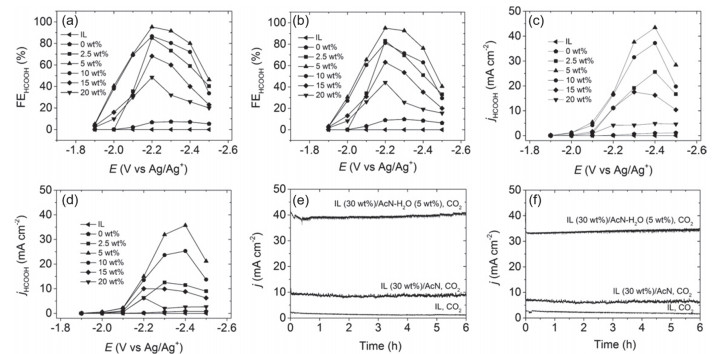
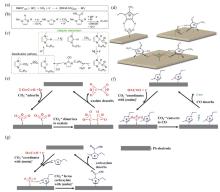
Fig 4
Mechanism of CO2RR involving an imidazolium-carboxylic acid/carboxylate species, proposed by (a) Rosen et al. 50, (b) Kemna et al. 47, (c) Zhao et al. 72. (d) Possible binding modes of [Emim]+ with an electro-generated CO2 anion radical on a silver surface. Hydrogen bonds represented by dashed line (red). Reaction pathways for the electrochemical reduction of CO2 in the (e) absence and (f, g) presence of [Emim][Tf2N] at a Pb electrode in MeCN. Adapted from American Chemical Society 47, 50, 71, 72, 78, respectively. Color online."
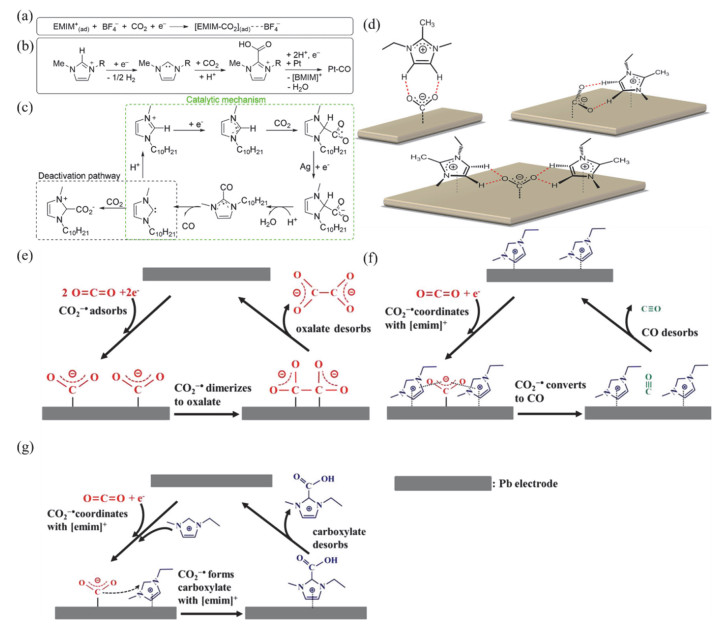
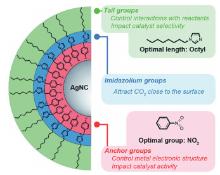
Fig 5
Overview of the action of imidazolium l igands on a AgNC surface. Adapted from Royal Society of Chemistry 87."
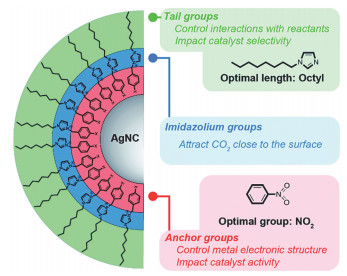
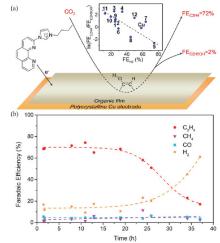
Fig 6
(a) Illustration of CO2RR on a polycrystalline Cu electrode modified with an imidazolium organic film. (b) FE of gaseous products over ∼37 h with an imidazolium organic film-modified Cu electrode in a 0.1 mol∙L−1 KHCO3 electrolyte at −1.24 vs. RHE. Adapted from American Chemical Society 82."
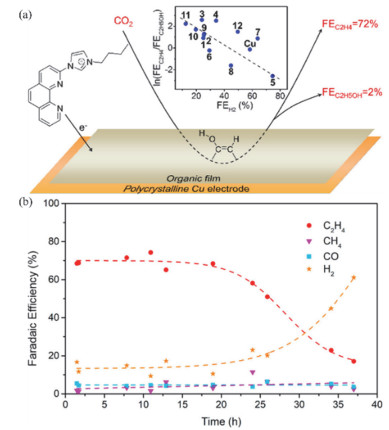
Fig 7
(a, b) Structural models for Co-iBFBim-COF-I− (a) and Co-BFBim-COF (b). Light blue, dark blue, red and pink atoms represent carbon, nitrogen, oxygen and cobalt, respectively. Color online. (c) Schematic of a MEA electrolyzer. (d) FECO of Co-iBFBim-COF-X (X = F−, Cl−, Br−, and I−) and Co-BFBim-COF. (e) jCO of Co-iBFBim-COF-X (X = F−, Cl−, Br−, and I−) and Co-BFBim-COF. (f) Comparison of the optimal FECO and EE with the reported SACs, metal electrocatalysts evaluated in a MEA electrolyzer. Adapted from Wiley 11."
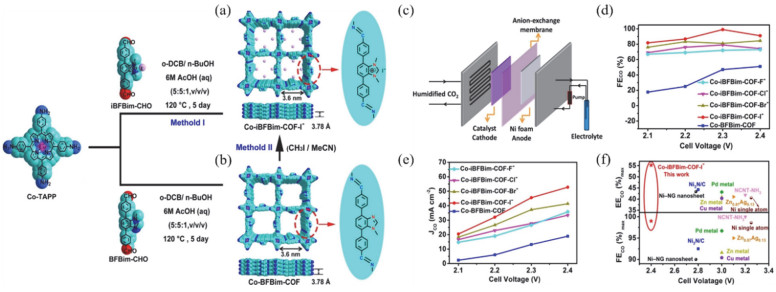
Fig 8
(a) Schematic illustration of the nanoconfined ILs strategy. (b) TEM image, scale bar: 100 nm. (c) HAADF-STEM image, scale bar: 2 nm. (d) EDS mapping, scale bar: 100 nm. (e) SAED pattern. Electrochemical performances of Ni-N-C/[Bmim][PF6] for electroreduction of diluted CO2. (f) LSV curves in diluted CO2 (5%, 10%, 50%) and pure CO2. (g) FECO of Ni-N-C and Ni-N-C/[Bmim][PF6] in 10% and 50% CO2. (h) jCO per ECSA of Ni-N-C and Ni-N-C/[Bmim][PF6] in 10% and 50% CO2. (i) IF values for Ni-N-C/[Bmim][PF6] based on Ni-N-C in 5%, 10%, 25%, and 50% CO2 concentrations at different applied potentials. Error bars indicate the standard deviation of three independent samples. Adapted from American Chemical Society 98, Elsevier 34, respectively."
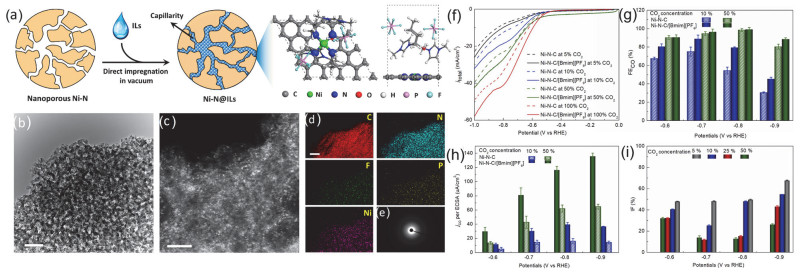
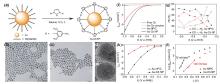
Fig 9
(a) Scheme of Cb ligand exchange reaction on Au NPs. TEM image of (b) Au-Oa NP and (c) Au-Cb NP, scale bar, 20 nm. HRTEM image of (d) Au-Oa NP and (e) Au-Cb NP with 5-fold twin structures, scale bar, 2 nm. (f) LSV scans of Au-Cb NP, Au NP/C, free carbene and molecular Au-Cb complex under CO2-saturated 0.1 mol∙L−1 KHCO3 at pH 6.8. (g) FE of products formed from Au-Cb NP and Au NP/C. (h) Specific CO current density plots for Au-Cb NP and Au NP/C. (i) Tafel plots of Au-Cb NP and Au NP/C. Adapted from American Chemical Society 120."
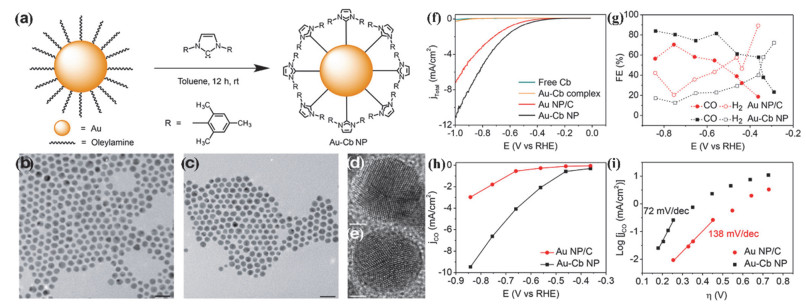
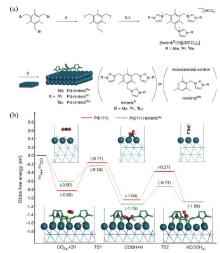
Fig 10
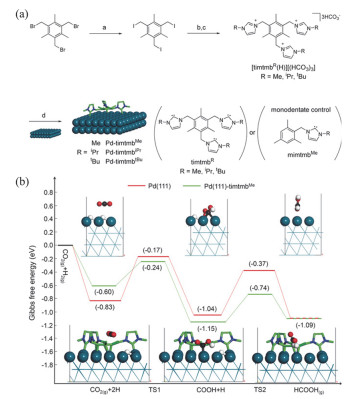
(a) Synthetic scheme for the preparation of tripodal NHCs and functionalization of Pd surfaces; (b) Free-energy diagrams for CO2 reduction to HCOOH on Pd(111) and Pd(111)-timtmbMe. Adapted from Wiley 123."
| 1 |
石永霞; 侯曼; 李俊俊; 李丽; 张志成. 物理化学学报, 2022, 38 (11), 2206020.
doi: 10.3866/PKU.WHXB202206020 |
|
|
|
| 2 |
doi: 10.1002/anie.202207478 |
| 3 |
doi: 10.1016/j.cej.2023.141360 |
| 4 |
doi: 10.1039/D0NR09064F |
| 5 |
doi: 10.1039/D0CS00017E |
| 6 |
doi: 10.1039/C6CS00250A |
| 7 |
doi: 10.1126/science.abc1607 |
| 8 |
doi: 10.1038/nchem.2157 |
| 9 |
doi: 10.1126/science.aaw4675 |
| 10 |
doi: 10.1021/acsenergylett.2c01372 |
| 11 |
doi: 10.1002/anie.202215687 |
| 12 |
doi: 10.1039/D0CS00071J |
| 13 |
叶成玉; 郁晓菲; 李文翠; 贺雷; 郝广平; 陆安慧. 物理化学学报, 2022, 38, 2004054.
doi: 10.3866/PKU.WHXB202004054 |
|
|
|
| 14 |
doi: 10.1002/anie.202112116 |
| 15 |
doi: 10.1007/s11426-022-1263-5 |
| 16 |
doi: 10.1039/C8CS00527C |
| 17 |
doi: 10.1021/jacs.0c06420 |
| 18 |
doi: 10.1038/s41929-020-00547-0 |
| 19 |
doi: 10.1039/D2NR03539A |
| 20 |
doi: 10.1039/D2TA00250G |
| 21 |
doi: 10.1021/acsnano.1c11664 |
| 22 |
doi: 10.1021/acscatal.2c03675 |
| 23 |
doi: 10.1039/D1TA09482C |
| 24 |
doi: 10.1002/adfm.202203677 |
| 25 |
doi: 10.1002/adma.202208224 |
| 26 |
doi: 10.1002/anie.202206085 |
| 27 |
doi: 10.1016/j.apcatb.2022.121161 |
| 28 |
doi: 10.1039/D1TA10991J |
| 29 |
doi: 10.1021/jacs.2c02972 |
| 30 |
doi: 10.1021/jacs.1c13024 |
| 31 |
doi: 10.1002/anie.202206399 |
| 32 |
doi: 10.1002/smll.202205730 |
| 33 |
doi: 10.1021/acs.iecr.0c04037 |
| 34 |
doi: 10.1016/j.apcatb.2021.120963 |
| 35 |
doi: 10.1039/c7ee03245e |
| 36 |
邹玉煌. 咪唑鎓盐功能化金属-有机材料的制备及其吸附、催化性能的研究[博士学位论文]. 合肥: 中国科学技术大学, 2021.
|
|
Zou, Y. H. The Synthesis of Imidazolium Functionalized Metal-Organic Materials and Their Applications in Adsorption and Catalysis. Ph. D. Dissertation, University of Science and Technology of China, Hefei, 2021.
|
|
| 37 |
doi: 10.1021/acs.energyfuels.8b02750 |
| 38 |
doi: 10.1039/D0FD00140F |
| 39 |
doi: 10.1021/acs.chemrev.6b00509 |
| 40 |
doi: 10.1021/ja5121088 |
| 41 |
doi: 10.1038/ncomms3819 |
| 42 |
doi: 10.1021/ja039615x |
| 43 |
doi: 10.1002/anie.201601974 |
| 44 |
doi: 10.1016/j.electacta.2015.01.096 |
| 45 |
doi: 10.1002/anie.202107156 |
| 46 |
doi: 10.1016/j.apcata.2009.10.008 |
| 47 |
doi: 10.1021/acscatal.9b01033 |
| 48 |
doi: 10.1021/acs.inorgchem.1c00287 |
| 49 |
doi: 10.1016/j.supflu.2003.12.015 |
| 50 |
doi: 10.1126/science.1209786 |
| 51 |
doi: 10.1021/acscatal.0c04283 |
| 52 |
doi: 10.1016/j.jssc.2017.06.008 |
| 53 |
doi: 10.1039/C6SC03194C |
| 54 |
doi: 10.1126/science.aaf4767 |
| 55 |
doi: 10.1016/j.cej.2021.131663 |
| 56 |
doi: 10.1002/anie.202116736 |
| 57 |
doi: 10.1002/anie.202003625 |
| 58 |
doi: 10.1016/j.apcatb.2022.122185 |
| 59 |
doi: 10.1021/acscatal.2c01434 |
| 60 |
doi: 10.1021/acs.nanolett.2c04335 |
| 61 |
doi: 10.1021/jacs.1c00151 |
| 62 |
doi: 10.1093/nsr/nwab022 |
| 63 |
doi: 10.1002/ange.201914831 |
| 64 |
doi: 10.1016/j.electacta.2020.136787 |
| 65 |
doi: 10.1038/s41467-022-29698-3 |
| 66 |
doi: 10.1021/acs.jpcc.2c03012 |
| 67 |
doi: 10.1021/jp210542v |
| 68 |
doi: 10.1021/ol401949f |
| 69 |
doi: 10.1039/B311350G |
| 70 |
doi: 10.1002/cphc.201700421 |
| 71 |
doi: 10.1021/la5009076 |
| 72 |
doi: 10.1021/acs.jpcc.6b08182 |
| 73 |
doi: 10.1039/C5CP02008E |
| 74 |
doi: 10.1039/B906320J |
| 75 |
doi: 10.1149/1.3606487 |
| 76 |
doi: 10.1016/j.electacta.2011.04.067 |
| 77 |
doi: 10.1021/acscatal.5b00656 |
| 78 |
doi: 10.1021/jacs.6b03366 |
| 79 |
doi: 10.1021/acsami.1c24386 |
| 80 |
doi: 10.1002/chem.200400683 |
| 81 |
doi: 10.1002/anie.202009498 |
| 82 |
doi: 10.1021/acsami.2c03748 |
| 83 |
doi: 10.1021/jacs.0c12478 |
| 84 |
doi: 10.1038/s41560-021-00920-8 |
| 85 |
doi: 10.1038/s41560-021-00930-6 |
| 86 |
doi: 10.1039/C5CP03028E |
| 87 |
doi: 10.1039/C9SC04439F |
| 88 |
doi: 10.1021/jacs.1c06212 |
| 89 |
doi: 10.31635/ccschem.022.202201943 |
| 90 |
doi: 10.1002/anie.202104564 |
| 91 |
doi: 10.1002/smll.202005254 |
| 92 |
doi: 10.1002/smll.202004933 |
| 93 |
doi: 10.1016/j.apcatb.2019.03.041 |
| 94 |
doi: 10.1002/adma.202103963 |
| 95 |
doi: 10.1016/j.jcou.2019.03.022 |
| 96 |
doi: 10.1002/aenm.202201843 |
| 97 |
doi: 10.1002/anie.202200039 |
| 98 |
doi: 10.1021/acscatal.0c03873 |
| 99 |
doi: 10.1016/S1872-2067(21)63970-0 |
| 100 |
doi: 10.1021/acscatal.7b03404 |
| 101 |
doi: 10.1002/anie.201508490 |
| 102 |
doi: 10.1021/ja202743r |
| 103 |
doi: 10.1021/jacs.7b07709 |
| 104 |
doi: 10.1039/D1CP01576A |
| 105 |
doi: 10.1016/j.inoche.2017.08.002 |
| 106 |
doi: 10.1039/C39840000328 |
| 107 |
doi: 10.1039/C39850001414 |
| 108 |
doi: 10.1021/acs.inorgchem.5b01080 |
| 109 |
doi: 10.1039/C39830000536 |
| 110 |
doi: 10.1039/C8CC06475J |
| 111 |
doi: 10.1021/jacs.8b13657 |
| 112 |
doi: 10.1021/acscatal.1c02899 |
| 113 |
doi: 10.1021/jacs.6b07014 |
| 114 |
doi: 10.1021/acs.jpcc.6b09947 |
| 115 |
doi: 10.1002/anie.202205301 |
| 116 |
doi: 10.1073/pnas.75.11.5250 |
| 117 |
doi: 10.1021/ar00069a004 |
| 118 |
doi: 10.1002/ange.202207666 |
| 119 |
doi: 10.1016/j.matpr.2020.02.201 |
| 120 |
doi: 10.1021/jacs.6b02878 |
| 121 |
doi: 10.1002/cjoc.201800450 |
| 122 |
doi: 10.1149/2.0371507jes |
| 123 |
doi: 10.1002/anie.201800367 |
| 124 |
doi: 10.1038/s41467-020-19500-7 |
| 125 |
doi: 10.1002/cctc.202000387 |
| 126 |
doi: 10.1039/D0DT01022G |
| 127 |
doi: 10.1002/anie.202114450 |
| 128 |
doi: 10.1002/anie.201909069 |
| 129 |
doi: 10.1002/anie.201311099 |
| 130 |
doi: 10.1039/C4CC05563B |
| 131 |
doi: 10.1039/C6CC03827A |
| 132 |
doi: 10.1002/ange.201800705 |
| 133 |
doi: 10.1021/acs.inorgchem.6b01657 |
| [1] | Haoyu Sun, Dun Li, Yuanyuan Min, Yingying Wang, Yanyun Ma, Yiqun Zheng, Hongwen Huang. Hierarchical Palladium-Copper-Silver Porous Nanoflowers as Efficient Electrocatalysts for CO2 Reduction to C2+ Products [J]. Acta Phys. -Chim. Sin., 2024, 40(6): 2307007-. |
| [2] | Youwen Rong, Jiaqi Sang, Li Che, Dunfeng Gao, Guoxiong Wang. Designing Electrolytes for Aqueous Electrocatalytic CO2 Reduction [J]. Acta Phys. -Chim. Sin., 2023, 39(5): 2212027-0. |
| [3] | Chengyu Ye, Xiaofei Yu, Wencui Li, Lei He, Guangping Hao, Anhui Lu. Engineering of Bifunctional Nickel Phosphide@Ni-N-C Catalysts for Selective Electroreduction of CO2-H2O to Syngas [J]. Acta Phys. -Chim. Sin., 2022, 38(4): 2004054-. |
| [4] | Wenqiong Chen, Yongji Guan, Jiao Zhang, Junjie Pei, Xiaoping Zhang, Youquan Deng. Atomistic Insight into Changes in the Vibrational Spectrum of Ionic Liquids under External Electric Field [J]. Acta Phys. -Chim. Sin., 2021, 37(10): 2001004-. |
| [5] | Zhiwei Wu, Weilu Ding, Yaqin Zhang, Yanlei Wang, Hongyan He. Interaction and Mechanism between Imidazolium Ionic Liquids and the Zwitterionic Amino Acid Tyr: a DFT Study [J]. Acta Phys. -Chim. Sin., 2021, 37(10): 2002021-. |
| [6] | Lu Liu, Yuping Xu, Xia Chen, Mei Hong, Jing Tong. Thermogravimetric Analysis of Enthalpy Variation of 1-Alkyl-3-methylimidazole Chloride [J]. Acta Physico-Chimica Sinica, 2020, 36(11): 2004014-. |
| [7] | Shurong Hui, Liwei Zhao, Qingshan Liu, Dayong Song. Basic Properties of [C3mim][NTf2]/DEC/[Li][NTf2] Systems [J]. Acta Physico-Chimica Sinica, 2020, 36(11): 1910067-. |
| [8] | Yan Yang,Yun Zhang,Jin-Song Hu,Li-Jun Wan. Progress in the Mechanisms and Materials for CO2 Electroreduction toward C2+ Products [J]. Acta Physico-Chimica Sinica, 2020, 36(1): 1906085-. |
| [9] | Yunyan GAO,Wenjiao CAI,Zhize OU,Tuotuo MA,Na YI,Zhiyuan LI. DNA Interactions and Cytotoxicity of Imidazole-Modified Naphthalimides [J]. Acta Phys. -Chim. Sin., 2019, 35(2): 230-240. |
| [10] | Jie WEI,Hexin DONG,Xia CHEN,Yuxuan YANG,Dawei FANG,Wei GUAN,Jiazhen YANG. Physicochemical Properties of 1-Methoxyethyl-3-Methylimidazolium Glycine [J]. Acta Phys. -Chim. Sin., 2018, 34(8): 927-932. |
| [11] | Hui NING,Wenhang WANG,Qinhu MAO,Shirui ZHENG,Zhongxue YANG,Qingshan ZHAO,Mingbo WU. Catalytic Electroreduction of CO2 to C2H4 Using Cu2O Supported on 1-Octyl-3-methylimidazole Functionalized Graphite Sheets [J]. Acta Phys. -Chim. Sin., 2018, 34(8): 938-944. |
| [12] | Bihua CHEN,H. M. ELAGEED Elnazeer,Yongya ZHANG,Guohua GAO. BmmimOAc-Catalyzed Direct Condensation of 2-(Arylamino) Alcohols to Synthesize 3-Arylthiazolidine-2-thiones [J]. Acta Phys. -Chim. Sin., 2018, 34(8): 952-958. |
| [13] | Qi-Ge ZHENG,Hui LIU,Quan XIA,Qing-Shan LIU,Lin MOU. Density, Dynamic Viscosity and Electrical Conductivity of Two Hydrophobic Phosphonium Ionic Liquids [J]. Acta Phys. -Chim. Sin., 2017, 33(4): 736-744. |
| [14] | Xiao-Ning ZHANG,Hong-Mei HU. Investigation of Interfaces of Ionic Liquid via Kelvin Probe Force Microscopy at Room Temperature [J]. Acta Phys. -Chim. Sin., 2016, 32(7): 1722-1726. |
| [15] | Ji-Fu SHI,Qi-Zhang HUANG,Qing-Cui WAN,Xue-Qing XU,Chun-Sheng LI,Gang XU. Sulfide-Based Ionic Liquid Electrolyte Widening the Application Temperature Range of Quantum-Dot-Sensitized Solar Cells [J]. Acta Phys. -Chim. Sin., 2016, 32(4): 822-827. |
|
||