Acta Phys. -Chim. Sin. ›› 2024, Vol. 40 ›› Issue (8): 2307049.doi: 10.3866/PKU.WHXB202307049
Special Issue: Carbon Dioxide Valorization
• REVIEW • Previous Articles Next Articles
Electrochemical Synthesis of Organonitrogen Compounds from N-integrated CO2 Reduction Reaction
Yan Kong, Wei Wei, Lekai Xu, Chen Chen*( )
)
- Engineering Research Center of Advanced Rare Earth Materials, Department of Chemistry, Tsinghua University, Beijing 100084, China
-
Received:2023-07-26Revised:2023-09-09Accepted:2023-09-11Published:2023-09-19 -
Contact:Email: cchen@mail.tsinghua.edu.cn (Chen Chen) -
Supported by:the National Key R&D Program of China(2021YFF0500503); National Natural Science Foundation of China(21925202); National Natural Science Foundation of China(21872076); International Joint Mission On Climate Change and Carbon Neutrality

Cite this article
Yan Kong, Wei Wei, Lekai Xu, Chen Chen. Electrochemical Synthesis of Organonitrogen Compounds from N-integrated CO2 Reduction Reaction[J]. Acta Phys. -Chim. Sin. 2024, 40(8), 2307049. doi: 10.3866/PKU.WHXB202307049
share this article
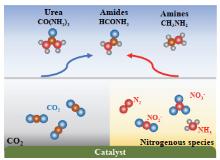
Fig 1
Major products of electrocatalytic NCR. (orange: C; red: N; blue: O; gray: H)."
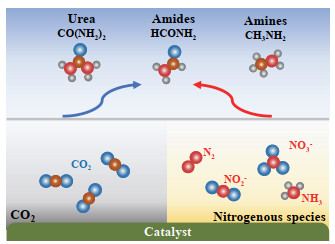
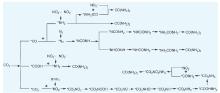
Fig 2
Proposed mechanism for urea synthesis38. Reproduced with permission from Ref. 38. Copyright 2021, Royal Society of Chemistry."
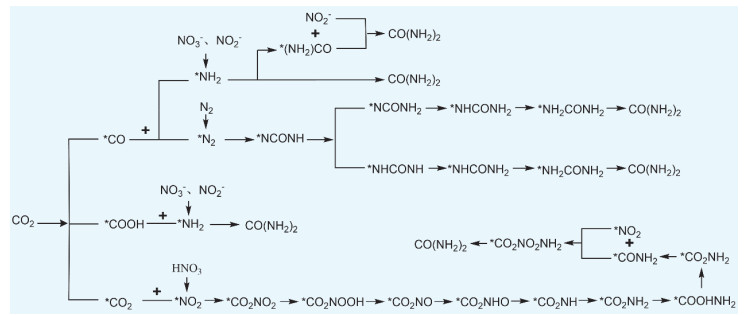
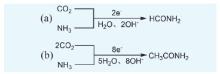
Fig 3
Proposed mechanism for (a) Formamide and (b) Acetamide25. Reproduced with permission from Ref. 25. Copyright 2022, RSC Chemical Science."
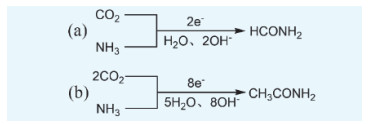
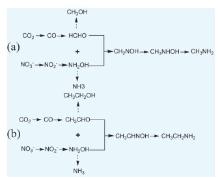
Fig 4
Proposed mechanism for (a) methylamine and (b) ethylamine46. Reproduced with permission from Ref. 46. Copyright 2022, Elsevier."
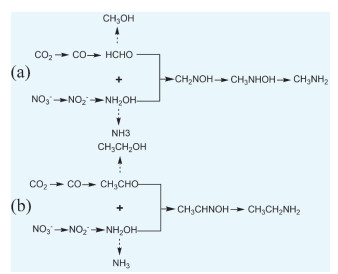
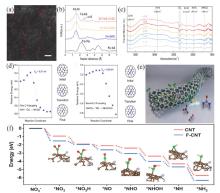
Fig 5
(a) Aberration-corrected HAADF-STEM image of B-FeNi-DASC, the scale bar is 2 nm. (b) FT-EXAFS spectra of Fe-SAC, I-FeNi-DASC, and B-FeNi-DASC. (c) Infrared signal in the range of 1500–3750 cm−1 under various potentials for B-FeNi-DASC during the electrocoupling of nitrate and CO2. (d) The reaction pathway of first C-N coupling for *NHCO formation and second C-N coupling for *NHCONO formation. The structures of the initial, transition and final states along with the *NHCO and *NHCONO formation are also presented. The purple, indigo, blue, red, and gray balls represent Fe, Ni, N, O, and C atoms, respectively. Reproduced with permission from Ref. 57. Copyright 2022, Springer Nature. (e) Schematic diagram of the structure of F-CNT and the urea synthesis. (f) Potential energy diagrams of NO3− reduction to *NH2 (C, O, H, F and N atoms are represented as brown, red, pinkish white, blue and green spheres, respectively.). Color online. Reproduced with permission from Ref. 63. Copyright 2022, Elsevier."
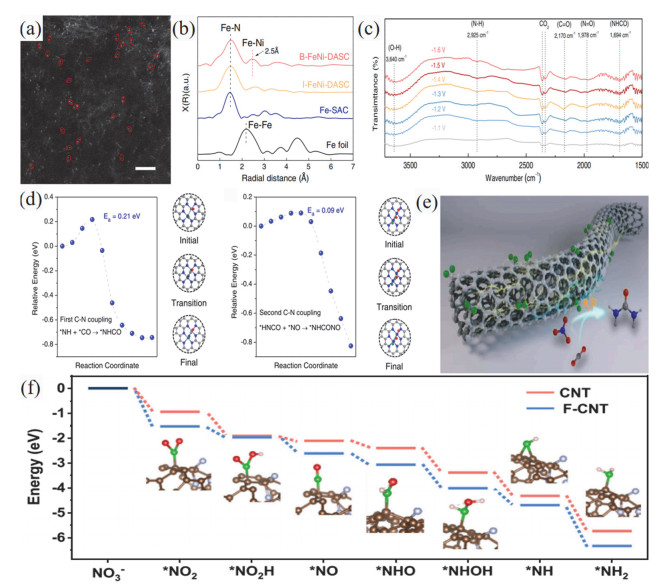
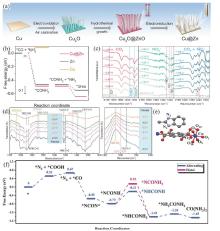
Fig 6
(a) Schematic illustration for the synthesis of the Cu@Zn catalyst. (b) C-N coupling on Cu@Zn, pure Zn, and pure Cu surfaces. (c) In situ ATR FTIR spectra of CO2, NO3−, and mixture (NO3− + CO2) electroreduction over Cu@Zn. Reproduced with permission from Ref. 65. Copyright 2022, American Chemical Society. (d) Infrared signals in the range of 1700–1300 cm−1 and Infrared signals in the range of 1300–1000 cm−1. Reproduced with permission from Ref. 67. Copyright 2023, Oxford University Press. (e) Structural diagrams of Co-PMDA-2-mbIM. (f) The urea electrosynthesis mechanism. Reproduced with permission from Ref. 68. Copyright 2022, Royal Society of Chemistry."
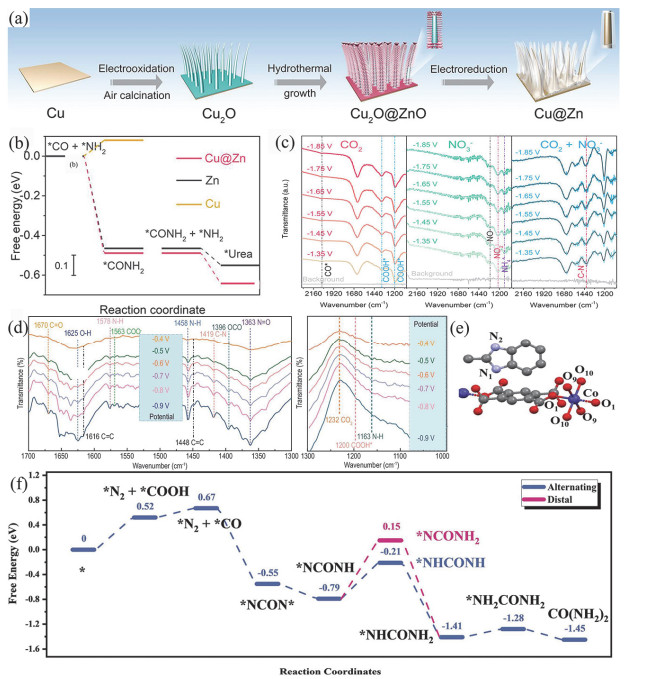
Fig 7
(a) A model illustration of the Au-Cu NW. (b, c) Urea FE of AuCu SANFs. Reproduced with permission from Ref. 72. Copyright 2022, Elsevier. (d) LSV curves recorded on the ZnO NSs electrode before and after electroreduction. The inset is an SEM image of as-prepared metallic Zn NBs, and the scale bar is 500 nm. (e) Time-dependent in situ electrochemical XRD patterns of ZnO under −2.1 V vs. RHE. Reproduced with permission from ref. 73. Copyright 2022, American Chemical Society. (f) Free-energy diagram of the electrolytic urea production via alternating mechanisms."
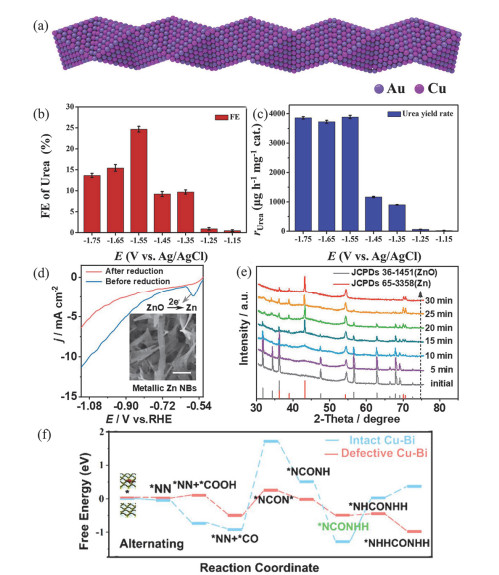
Fig 8
TEM images of Cu (a) and CuO (b); (c) Thin layers tend to form C1 products at a greater rate; (d) Thick layers leads to further reduction and accumulation of C2 intermediates; (e) Spectrum of additional species present on the CuO surface with CO2 and NH3 present; (f) Acetamide selectivity of Cu loading of 10 mg∙cm−2. Reproduced with permission from Ref. 25. Copyright 2022, RSC Chemical Science."
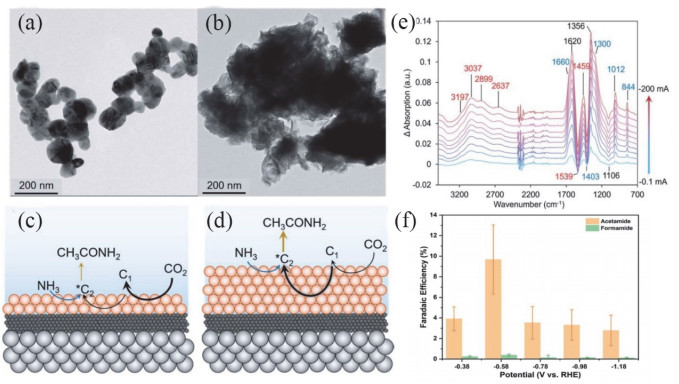
Fig 9
(a) Structural comparison between CoPc and CoPc-NH2. (b) Domino process of CO2-to-MeOH conversion via CO, catalysed by CoPc supported on carbon nanotubes (CNT). (c) FE for CO2 electroreduction catalysed by CoPc–NH2/CNT Caption. Reproduced with permission from Ref. 81. Copyright 2022, Springer Nature. (d) One-pot electrosynthesis of methylamine from inorganic wastes at ambient temperature and pressure. (e) Product distribution and total current density during 16 h electrolysis at −0.94 V versus RHE. Reproduced with permission from Ref. 35. Copyright 2022, Springer Nature. (f) Electrochemical co-reduction of CO2 and NO3− to synthesize acetaldoxime and ethylamine. Reproduced with permission from Ref. 46. Copyright 2022, Elsevier."
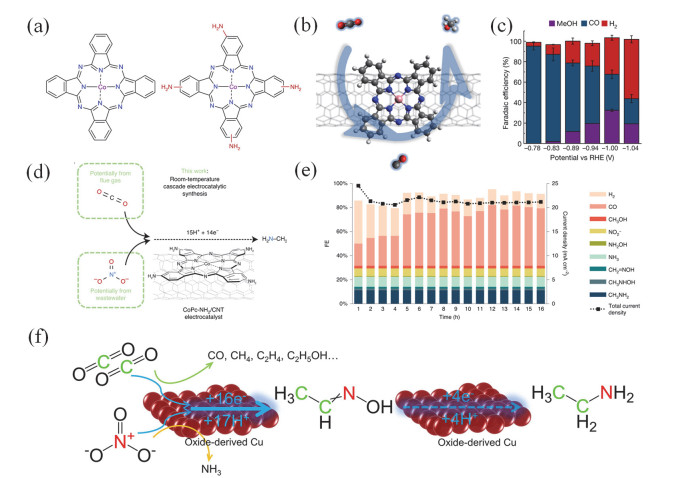
Table 1
Recent excellent electrocatalysts for different NCR products."
| Catalyst | Electrolyte | Product | FE | Formation rate | Ref. |
| Bi-BiVO4 | 0.1 mol∙L−1 KHCO3 | urea | 12.55% | 5.91 mmol∙h−1∙g−1 | |
| Cu-Bi | 0.1 mol∙L−1 KHCO3 | urea | 8.70% ± 1.70% | 0.45 ± 0.06 mg∙L−1 | |
| Cu single atoms/graphene sheets | 0.1 mol∙L−1 KHCO3 + 0.1 mol∙L−1 KNO3 | urea | 28.00% | 1800 μg∙h−1∙mg−1 | |
| Fe-Ni single atoms | 0.1 mol∙L−1 KHCO3 + 50 mmol∙L−1 KNO3 | urea | 17.80% | 20.2 mmol∙h−1∙g−1 | |
| Fe(amorphous)@C-Fe3O4/CNTs | 0.1 mol∙L−1 KNO3 | urea | 16.50% ± 6.10% | 1341.3 ± 112.6 μg∙h−1∙mg−1 | |
| F-rich CNTs | 0.1 mol∙L−1 KNO3 | urea | 18% | 6.36 mmol∙h−1∙g−1 | |
| Cu@Zn nanowires | 0.1 mol∙L−1 KNO3 + 0.2 mol∙L−1 KHCO3 | urea | 9.28% | 7.29 μmol∙cm−2∙h−1 | |
| Co-NiOx@graphdiyne | 0.01 mol∙L−1 NaNO2 | urea | 64.30% | 913.2 μg∙h−1∙mg−1 | |
| Co-PMDA-2-mbIM | 0.1 mol∙L−1 KHCO3 | urea | 48.97% | 14.47 mmol∙h−1∙g−1 | |
| AuCu nanofibers | 0.01 mol∙L−1 NaNO2 | urea | 24.70% | 3.889 μg∙h−1∙mg−1 | |
| Zn nanobelts | 0.2 mol∙L−1 KHCO3 | urea | 11.26% | 15.13 mmol∙h−1∙g−1 | |
| In(OH)3 | 0.1 mol∙L−1 KNO3 | urea | 53.40% | 533.1 mg∙h−1∙mg−1 | |
| InOOH | 0.1 mol∙L−1 KHCO3 | urea | 51.00% | 592.5 μg∙h−1∙mg−1 | |
| CeO2 | 0.1 mol∙L−1 KHCO3 + 50 mmol∙L−1 KNO3 | urea | – | 943.6 μg∙h−1∙mg−1 | |
| Cu/CuO | 1 mol∙L−1 KOH | acetamide + formamide | 10% acetamide 0.4% formamide | 2.2 mA∙cm−2 acetamide 0.2 mA∙cm−2 formamide | |
| CoPc-NH2 | 0.1 mol∙L−1 KHCO3 | methylamine | 13% | 3.4 mA∙cm−2 | |
| Oxide-derived Cu | 1 mol∙L−1 KHCO3 | Ethylamine | 0.30% | – |
| 1 |
doi: 10.1016/j.envsci.2020.12.004 |
| 2 |
doi: 10.1016/j.spc.2021.10.016 |
| 3 |
doi: 10.1038/s41560-022-01092-9 |
| 4 |
doi: 10.1038/s41467-022-30733-6 |
| 5 |
doi: 10.1021/jacs.2c11109 |
| 6 |
doi: 10.1039/D1CS00535A |
| 7 |
doi: 10.1038/s41560-019-0450-y |
| 8 |
doi: 10.1039/D0CS00071J |
| 9 |
doi: 10.1039/D0EE00900H |
| 10 |
doi: 10.1002/anie.202008289 |
| 11 |
doi: 10.1021/jacs.9b11817 |
| 12 |
doi: 10.1002/anie.202101522 |
| 13 |
doi: 10.1038/s41929-019-0252-4 |
| 14 |
doi: 10.1038/s41560-020-0654-1 |
| 15 |
doi: 10.1021/jz201461P |
| 16 |
doi: 10.1038/s41929-020-0450-0 |
| 17 |
doi: 10.1038/s41467-021-25573-9 |
| 18 |
doi: 10.1038/s41565-021-00974-5 |
| 19 |
doi: 10.1021/acsnano.2c11046 |
| 20 |
doi: 10.1038/s41570-022-00379-5 |
| 21 |
doi: 10.1016/j.energy.2021.120467 |
| 22 |
doi: 10.1038/s41563-020-0788-3 |
| 23 |
doi: 10.1038/s41893-021-00739-x |
| 24 |
doi: 10.1126/science.aav3506 |
| 25 |
doi: 10.1039/d1sc06590d |
| 26 |
Eller, K.; Henkes, E.; Rossbacher, R.; Hoke, H. Amines, Aliphatic. Ullmann's Encyclopedia of Industrial Chemistry; Wiley-VCH: Weinheim, Germany; 2000, 2, 647. doi: 10.1002/14356007.a02_001
|
| 27 |
Vogt, P. F.; Gerulis, J. Amines, Aromatic. Ullmann's Encyclopedia of Industrial Chemistry; Wiley-VCH: Weinheim, Germany; 2000, 2, 699. doi: 10.1002/14356007.a02_037
|
| 28 |
Rothgery, E. F. Kirk-Othmer Encyclopedia of Chemical Technology Wiley-VCH, Hoboken, USA; 2004, 13, 562. doi: 10.1002/0471238961.0825041819030809.a01.pub2
|
| 29 |
Booth, G. Nitro Compounds, Aromatic, Ullmann's Encyclopedia of Industrial Chemistry; Wiley-VCH, New York, NY, USA; 2000, 24, 301. doi: 10.1002/14356007.a17_411
|
| 30 |
doi: 10.1038/35102672 |
| 31 |
doi: 10.1890/1051-0761(2006)016[2123:MDITAA]2.0.CO;2 |
| 32 |
doi: 10.1016/j.apcatb.2015.07.045 |
| 33 |
doi: 10.1038/s41557-020-0481-9 |
| 34 |
doi: 10.1002/ange.202101275 |
| 35 |
doi: 10.1038/s41893-021-00705-7 |
| 36 |
doi: 10.1016/0022-0728(95)03992-P |
| 37 |
doi: 10.1002/anie.202304007 |
| 38 |
doi: 10.1021/jacs.1c10714 |
| 39 |
doi: 10.1038/s41893-021-00741-3 |
| 40 |
doi: 10.1021/jacs.2c03452 |
| 41 |
doi: 10.21203/rs.3.rs-1588933/v1 |
| 42 |
doi: 10.1016/j.xcrp.2021.100378 |
| 43 |
doi: 10.1021/jacs.2c05660 |
| 44 |
doi: 10.1038/s41557-019-0312-z |
| 45 |
doi: 10.1073/pnas.1802256115 |
| 46 |
doi: 10.1016/j.jechem.2021.06.007 |
| 47 |
doi: 10.1016/j.joule.2019.10.006 |
| 48 |
doi: 10.1002/anie.202105263 |
| 49 |
doi: 10.1016/j.chempr.2018.10.010 |
| 50 |
doi: 10.1039/c9ee02873k |
| 51 |
doi: 10.14102/j.cnki.0254-5861.2022-0100 |
| 52 |
doi: 10.1016/j.cogsc.2022.100648 |
| 53 |
doi: 10.1021/acs.nanolett.0c03400 |
| 54 |
doi: 10.1038/s41467-021-24400-5 |
| 55 |
doi: 10.1021/jacs.8b00814 |
| 56 |
doi: 10.1002/aenm.202201500 |
| 57 |
doi: 10.1038/s41467-022-33066-6 |
| 58 |
doi: 10.1016/s0009-2614(03)00173-8 |
| 59 |
doi: 10.1016/j.jhazmat.2012.02.068 |
| 60 |
doi: 10.1016/j.cej.2022.138885 |
| 61 |
doi: 10.1002/anie.202210958 |
| 62 |
doi: 10.1002/adma.201804672 |
| 63 |
doi: 10.1016/j.apcatb.2022.121618 |
| 64 |
doi: 10.1021/acs.jpclett.1c03242 |
| 65 |
doi: 10.1021/acsnano.2c01177 |
| 66 |
doi: 10.1021/acs.chemmater.2c01572 |
| 67 |
doi: 10.1093/nsr/nwac209 |
| 68 |
doi: 10.1039/d1ee03918k |
| 69 |
doi: 10.1039/D2EE00878E |
| 70 |
doi: 10.1038/s41467-022-33258-0 |
| 71 |
doi: 10.1021/acscatal.2c02346 |
| 72 |
doi: 10.1016/j.xcrp.2022.100869 |
| 73 |
doi: 10.1021/acsenergylett.1c02471 |
| 74 |
doi: 10.1016/j.apcatb.2022.121512 |
| 75 |
doi: 10.1016/j.checat.2022.09.012 |
| 76 |
doi: 10.1002/anie.202016219 |
| 77 |
doi: 10.1016/j.checat.2021.11.009 |
| 78 |
doi: 10.1002/anie.202312076 |
| 79 |
doi: 10.1007/s40843-021-1749-5 |
| 80 |
doi: 10.1002/anie.202115503 |
| 81 |
doi: 10.1038/s41586-019-1760-8 |
| 82 |
doi: 10.1002/smsc.202100070 |
| 83 |
doi: 10.1016/j.jcis.2020.05.014 |
| 84 |
doi: 10.1016/j.apcatb.2020.118747 |
| 85 |
doi: 10.1038/s41557-018-0201-x |
| 86 |
doi: 10.1039/C7EE03245E |
| 87 |
doi: 10.1039/D1SC01467F |
| 88 |
doi: 10.1016/j.chempr.2022.10.017 |
| [1] | Ruizhi Duan, Xiaomei Wang, Panwang Zhou, Yang Liu, Can Li. The role of hydroxyl species in the alkaline hydrogen evolution reaction over transition metal surfaces [J]. Acta Phys. -Chim. Sin., 2025, 41(9): 100111-. |
| [2] | Xueting Cao, Shuangshuang Cha, Ming Gong. Interfacial Electrical Double Layer in Electrocatalytic Reactions: Fundamentals, Characterizations and Applications [J]. Acta Phys. -Chim. Sin., 2025, 41(5): 100041-. |
| [3] | Runhua Chen, Qiong Wu, Jingchen Luo, Xiaolong Zu, Shan Zhu, Yongfu Sun. Defective Ultrathin Two-Dimensional Materials for Photo-/Electrocatalytic CO2 Reduction: Fundamentals and Perspectives [J]. Acta Phys. -Chim. Sin., 2025, 41(3): 100019-. |
| [4] | Xue Dong, Xiaofu Sun, Shuaiqiang Jia, Shitao Han, Dawei Zhou, Ting Yao, Min Wang, Minghui Fang, Haihong Wu, Buxing Han. Electrochemical CO2 Reduction to C2+ Products with Ampere-Level Current on Carbon-Modified Copper Catalysts [J]. Acta Phys. -Chim. Sin., 2025, 41(3): 100024-. |
| [5] | Qing Li, Guangxun Zhang, Yuxia Xu, Yangyang Sun, Huan Pang. P-Regulated Hierarchical Structure Ni2P Assemblies toward Efficient Electrochemical Urea Oxidation [J]. Acta Phys. -Chim. Sin., 2024, 40(9): 2308045-. |
| [6] | Wentao Xu, Xuyan Mo, Yang Zhou, Zuxian Weng, Kunling Mo, Yanhua Wu, Xinlin Jiang, Dan Li, Tangqi Lan, Huan Wen, Fuqin Zheng, Youjun Fan, Wei Chen. Bimetal Leaching Induced Reconstruction of Water Oxidation Electrocatalyst for Enhanced Activity and Stability [J]. Acta Phys. -Chim. Sin., 2024, 40(8): 2308003-. |
| [7] | Ye Wang, Ruixiang Ge, Xiang Liu, Jing Li, Haohong Duan. An Anion Leaching Strategy towards Metal Oxyhydroxides Synthesis for Electrocatalytic Oxidation of Glycerol [J]. Acta Phys. -Chim. Sin., 2024, 40(7): 2307019-. |
| [8] | Xinyi Zhang, Kai Ren, Yanning Liu, Zhenyi Gu, Zhixiong Huang, Shuohang Zheng, Xiaotong Wang, Jinzhi Guo, Igor V. Zatovsky, Junming Cao, Xinglong Wu. Progress on Entropy Production Engineering for Electrochemical Catalysis [J]. Acta Phys. -Chim. Sin., 2024, 40(7): 2307057-. |
| [9] | Xin Feng, Kexin Guo, Chunguang Jia, Bowen Liu, Suqin Ci, Junxiang Chen, Zhenhai Wen. Hydrogen Generation Coupling with High-Selectivity Electrocatalytic Glycerol Valorization into Formate in an Acid-Alkali Dual-Electrolyte Flow Electrolyzer [J]. Acta Phys. -Chim. Sin., 2024, 40(5): 2303050-. |
| [10] | Lu Zhuoran, Li Shengkai, Lu Yuxuan, Wang Shuangyin, Zou Yuqin. Cleavage of C―C Bonds for Biomass Upgrading on Transition Metal Electrocatalysts [J]. Acta Phys. -Chim. Sin., 2024, 40(4): 2306003-. |
| [11] | Yanhui Guo, Li Wei, Zhonglin Wen, Chaorong Qi, Huanfeng Jiang. Recent Progress on Conversion of Carbon Dioxide into Carbamates [J]. Acta Phys. -Chim. Sin., 2024, 40(4): 2307004-. |
| [12] | Tao Wang, Qin Dong, Cunpu Li, Zidong Wei. Sulfur Cathode Electrocatalysis in Lithium-Sulfur Batteries: A Comprehensive Understanding [J]. Acta Phys. -Chim. Sin., 2024, 40(2): 2303061-. |
| [13] | Huasen Lu, Shixu Song, Qisen Jia, Guangbo Liu, Luhua Jiang. Advances in Cu2O-based Photocathodes for Photoelectrochemical Water Splitting [J]. Acta Phys. -Chim. Sin., 2024, 40(2): 2304035-. |
| [14] | Xinxuan Duan, Marshet Getaye Sendeku, Daoming Zhang, Daojin Zhou, Lijun Xu, Xueqing Gao, Aibing Chen, Yun Kuang, Xiaoming Sun. Tungsten-Doped NiFe-Layered Double Hydroxides as Efficient Oxygen Evolution Catalysts [J]. Acta Phys. -Chim. Sin., 2024, 40(1): 2303055-. |
| [15] | Hanyu Xu, Xuedan Song, Qing Zhang, Chang Yu, Jieshan Qiu. Mechanistic Insights into Water-Mediated CO2 Electrochemical Reduction Reactions on Cu@C2N Catalysts: A Theoretical Study [J]. Acta Phys. -Chim. Sin., 2024, 40(1): 2303040-. |
|
||