Acta Phys. -Chim. Sin. ›› 2025, Vol. 41 ›› Issue (1): 100007.doi: 10.3866/PKU.WHXB202311021
• ARTICLE • Previous Articles Next Articles
Photomultiplication-Type All-Polymer Photodetectors and Their Applications in Photoplethysmography Sensor
Xingchao Zhao1, Xiaoming Li2, Ming Liu1, Zijin Zhao1, Kaixuan Yang1, Pengtian Liu1, Haolan Zhang1, Jintai Li1, Xiaoling Ma1, Qi Yao3, Yanming Sun2,*( ), Fujun Zhang1,*()
- 1 Key Laboratory of Luminescence and Optical Information, Ministry of Education, Beijing Jiaotong University, Beijing 100044, China
2 School of Chemistry, Beihang University, Beijing 100191, China
3 BOE Technology Group Co., LTD., Beijing 100176, China
-
Received:2023-11-13Revised:2023-12-15Accepted:2023-12-18Published:2024-01-11 -
Contact:Email: sunym@buaa.edu.cn (Yanming Sun)fjzhang@bjtu.edu.cn (Fujun Zhang) -
Supported by:the Fundamental Research Funds for the Central Universities of China(2023YJS080); Beijing Natural Science Foundation(4232073); National Natural Science Foundation of China(U22A6002); National Natural Science Foundation of China(62105017)

Cite this article
Xingchao Zhao, Xiaoming Li, Ming Liu, Zijin Zhao, Kaixuan Yang, Pengtian Liu, Haolan Zhang, Jintai Li, Xiaoling Ma, Qi Yao, Yanming Sun, Fujun Zhang. Photomultiplication-Type All-Polymer Photodetectors and Their Applications in Photoplethysmography Sensor[J]. Acta Phys. -Chim. Sin. 2025, 41(1), 100007. doi: 10.3866/PKU.WHXB202311021
share this article
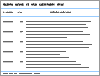
Table 1
The fundamental parameters of recently reported broadband PM-PPDs."
| Device structure (wt/wt) | Response (nm) | JD/(A∙cm−2) | EQE (%)@ λ (nm) | R (A∙W−2)@λ (nm) | D* (Jones)@λ (nm) | Bias (V) | Ref. |
| ITO/PEDOT : PSS/P3HT : PTB7-Th : IEICO (90 : 10 : 1)/Al | 330–810 | 6.4 × 10⁻³ | 510000@380 | 1654@780 | 7.1 × 10¹²@780 | −25 | |
| ITO/PEDOT : PSS/PMBBDT : Y6 (100 : 7)/Al | 300–900 | ~10−4 | 21700@600 | 105@600 | – | 7 | |
| ITO/PEIE/P3HT: PCBM (100 : 1)/PEDOT: PSS/P3HT/NaF/Al | 300–800 | 2.53 × 10⁻⁷ | 11570@450 | 42@450 | 1.48 × 10¹⁴@450 | −20 | |
| ITO/PEDOT: PSS/P3HT: ETBI-F (100 : 1)/Al | 300–750 | ~3 × 10⁻⁵ | 156000@~370 | 465@~370 | 9.5 × 10¹²@~610 | −20 | |
| Cu/MoO3/TAPC/TAPC : C60 (1 : 1)/C60 (45 nm)/MoO3 : C60 (5 : 100)/BCP/Al | 300–900 | ~3 × 10⁻² | 25468@765 | 330@350 | ~3.3 × 10¹²@350 | −5 | |
| ITO/PEDOT : PSS/P3HT : PMBBDT : PY3Se-1V (94 : 6 : 3)/Al | 350–950 | 3.96 × 10⁻⁵ | 105000@360 | 307@360 | 2.7 × 10¹³@360 | −15 | |
| ITO/PEDOT : PSS/P3HT : PMBBDT : PTz-PT (90 : 10 : 4)/Al | 300–1100 | 1.6 × 10⁻⁶ | 2090@850 | 14.3@850 | 1.9 × 10¹³@850 | −10 | This work |
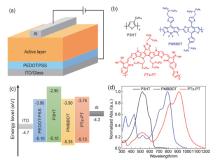
Fig 1
(a) Schematic structure diagram of PM-APDs. (b) Chemical structures of P3HT, PMBBDT, PTz-PT. (c) Energy levels of used materials. (d) Normalized absorption spectra of pure films."
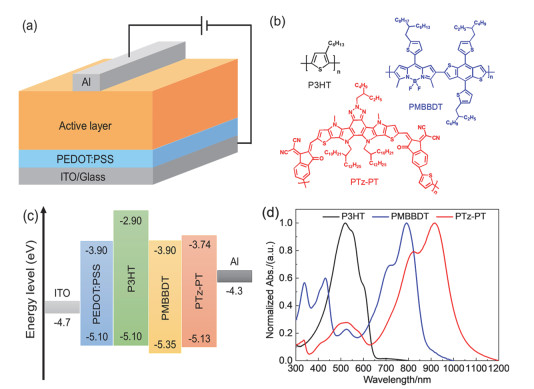
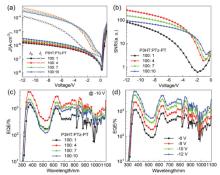
Fig 2
(a) J–V curves in the dark or under 825 nm light illumination with intensity of 46.7 µW·cm−2; (b) SNR−V curves; (c) EQE spectra under −10 V bias of PM-APDs with different P3HT: PTz-PT weight ratios. (d) EQE spectra of the optimal binary PM-APDs under different bias."
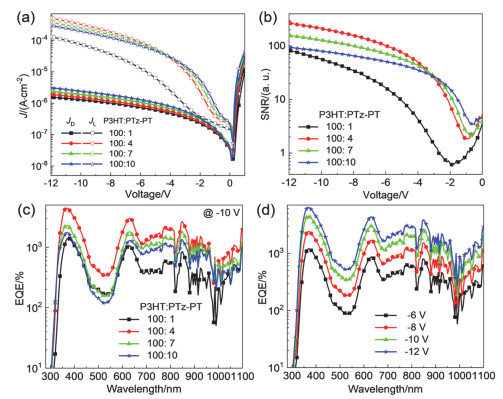
Fig 3
(a) J–V curves in the dark and under 520/825 nm light illumination with intensity of 13.2/46.7 µW∙cm−2; (b) EQE spectra under −10 V bias; (c) Normalized photocurrent under continuous white light illumination with intensity of 1 mW∙cm−2 and −10 V bias of PM-APDs with different PMBBDT contents. (d) EQE spectra of optimal ternary PM-APDs under different bias."
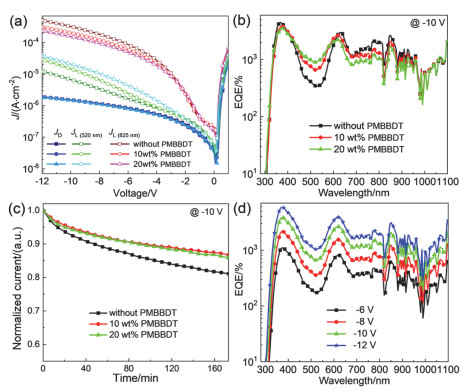
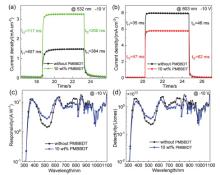
Fig 4
Transient photocurrent density under (a) 532 nm and (b) 803 nm light illumination with intensity of 4.5 mW∙cm−2 and −10 V bias; (c) The R spectra and (d) the Dshot* spectra at −10 V bias of optimal binary and ternary PM-APDs."
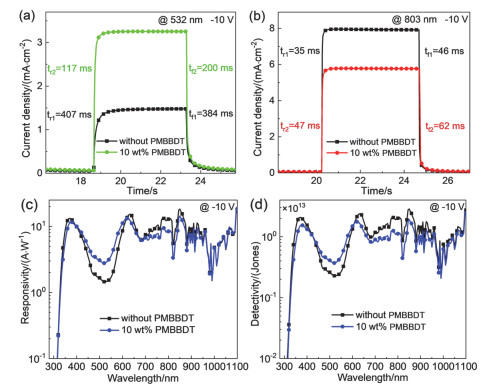
Fig 5
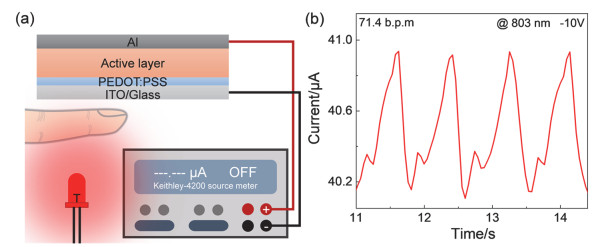
(a) Schematic diagram of PPG measurement system. (b) PPG signal measured from optimal PM-APDs under −10 V bias."
| 1 |
|
|
胡聪; 胡俊斌; 刘梦然; 周玉成; 戎家胜; 周建新. 物理化学学报, 2022, 38 (1), 2012083.
doi: 10.3866/PKU.WHXB202012083 |
|
| 2 |
doi: 10.1002/adfm.202215204 |
| 3 |
|
|
刘佰全; 高桦宇; 胡素娟; 刘川. 物理化学学报, 2022, 38 (12), 2204052.
doi: 10.3866/PKU.WHXB202204052 |
|
| 4 |
doi: 10.1002/adfm.202302746 |
| 5 |
|
|
薛国勇; 李静; 陈俊超; 陈代前; 胡晨吉; 唐凌飞; 陈博文; 易若玮; 沈炎宾; 陈立桅. 物理化学学报, 2023, 39 (8), 2205012.
doi: 10.3866/PKU.WHXB202205012 |
|
| 6 |
doi: 10.1002/advs.202105113 |
| 7 |
doi: 10.1002/adfm.202301538 |
| 8 |
doi: 10.1063/1.5144840 |
| 9 |
doi: 10.1002/aisy.202100167 |
| 10 |
doi: 10.1063/5.0083361 |
| 11 |
doi: 10.1038/srep09181 |
| 12 |
doi: 10.1039/C5CP05557A |
| 13 |
doi: 10.11777/j.issn1000-3304.2021.21328 |
| 14 |
doi: 10.1039/D0TC01793K |
| 15 |
doi: 10.1016/j.cej.2022.138146 |
| 16 |
doi: 10.1039/D0TC02708A |
| 17 |
doi: 10.1021/acs.jpclett.9b03323 |
| 18 |
doi: 10.1021/acsami.1c06486 |
| 19 |
doi: 10.1039/D2TC02144G |
| 20 |
doi: 10.1007/s11426-021-1008-9 |
| 21 |
doi: 10.1002/adma.201903687 |
| 22 |
doi: 10.1002/adfm.202006448 |
| 23 |
doi: 10.1002/adfm.202108839 |
| 24 |
doi: 10.1007/s11426-022-1296-2 |
| 25 |
doi: 10.1063/5.0168626 |
| 26 |
doi: 10.1002/adfm.201706690 |
| 27 |
doi: 10.1002/adma.201702055 |
| 28 |
doi: 10.1002/adfm.201904205 |
| 29 |
doi: 10.1021/acsami.0c13833 |
| 30 |
doi: 10.1002/lpor.202000262 |
| 31 |
doi: 10.1039/c9nr09386a |
| 32 |
doi: 10.1016/j.cej.2023.144711 |
| 33 |
doi: 10.1039/D2TA03941A |
| 34 |
doi: 10.1002/adfm.201907964 |
| 35 |
doi: 10.1002/adom.202001587 |
| 36 |
doi: 10.1039/D1MH00776A |
| 37 |
doi: 10.1038/s41377-020-0264-5 |
| 38 |
doi: 10.1021/acsami.8b06861 |
| 39 |
doi: 10.1038/natrevmats.2016.100 |
| 40 |
doi: 10.1021/acs.jpcc.1c06291 |
| 41 |
doi: 10.1002/adma.202102967 |
| 42 |
doi: 10.1021/acsami.7b15245 |
| 43 |
doi: 10.1002/adfm.201702360 |
| 44 |
doi: 10.1038/s41467-021-24500-2 |
| 45 |
doi: 10.1126/sciadv.adf9861 |
| 46 |
doi: 10.1038/ncomms6745 |
| 47 |
doi: 10.1002/adom.201901989 |
| 48 |
doi: 10.1002/admi.202101897 |
| 49 |
doi: 10.11777/j.issn1000-3304.2021.21391 |
| 50 |
doi: 10.1039/D2TC01297A |
| 51 |
doi: 10.1002/adma.202100582 |
| 52 |
doi: 10.1039/D0MH01234C |
| No related articles found! |
|
||