Acta Phys. -Chim. Sin. ›› 2025, Vol. 41 ›› Issue (10): 100112.doi: 10.1016/j.actphy.2025.100112
• REVIEW • Previous Articles Next Articles
Design of noble metal catalysts and reactors for the electrosynthesis of hydrogen peroxide
Kangjuan Cheng1, Chunxiao Liu1, Youpeng Wang1, Qiu Jiang1, Tingting Zheng1, Xu Li1,*( ), Chuan Xia1,2,*()
- 1 School of Materials and Energy, University of Electronic Science and Technology of China, Chengdu 611731, China
2 Yangtze Delta Region Institute (Huzhou), University of Electronic Science and Technology of China, Huzhou 313001, Zhejiang Province, China
-
Received:2025-03-30Revised:2025-05-20Accepted:2025-06-06Published:2025-09-29 -
Contact:Email: xuli@uestc.edu.cn (Xu Li)chuan.xia@uestc.edu.cn (Chuan Xia) -
Supported by:the National Key Research and Development Program of China(2024YFB4105700); the National Natural Science Foundation of China(22322201); the National Natural Science Foundation of China(52171201); the National Natural Science Foundation of China(22278067); the National Natural Science Foundation of China(22201272); the National Natural Science Foundation of China(22475030); the Central Government Funds of Guiding Local Scientific and Technological Development for Sichuan Province(2024ZYD0152); the Sichuan Science and Technology Program(2024NSFSC1107); the Fundamental Research Funds for the Central Universities(ZYGX2022J012); the University of Electronic Science and Technology of China for startup funding(A1098531023601403)

Cite this article
Kangjuan Cheng, Chunxiao Liu, Youpeng Wang, Qiu Jiang, Tingting Zheng, Xu Li, Chuan Xia. Design of noble metal catalysts and reactors for the electrosynthesis of hydrogen peroxide[J]. Acta Phys. -Chim. Sin. 2025, 41(10), 100112. doi: 10.1016/j.actphy.2025.100112
share this article
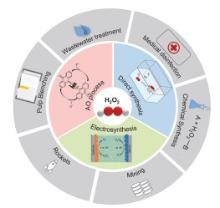
Fig 1
Overview of the synthesis methods and applications of H2O2."
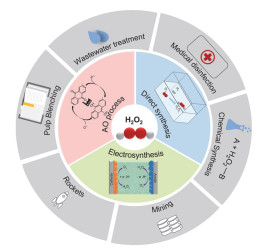
Fig 2
Fundamental mechanism of the 2e− ORR process. (a) Schematic diagram illustrating the O2 adsorption modes on a catalyst surface. (b) Schematic diagram of the ORR pathway; reproduced with permission from Ref. [44], Copyright 2019 American Physical Society. (c) The theoretical volcano plot for the 2e− ORR (blue) and 4e− ORR (red) with the limiting potential plotted as a function of ∆G*OH and ∆G*OOH. (d) Free energy diagram for a number of different catalysts for the 2e− ORR at 0.7 V. (c) and (d) Reproduced with permission from Ref. [43], Copyright 2013 The Electrochemical Society. (e) Limiting potentials for individual steps in Equations (7) and (8), showing the strongly bound *OH region (solid purple line) and weakly bound *OOH region (solid green line) for the 2e− process. The color gradient indicates the strong *OH and weak *OOH binding regions; reproduced with permission from Ref. [45], Copyright 2018 American Chemical Society."
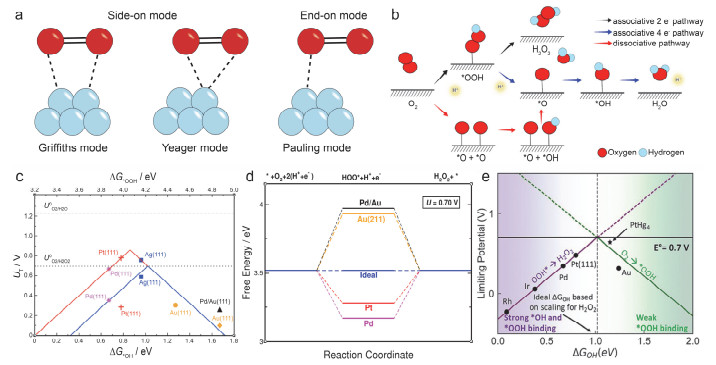
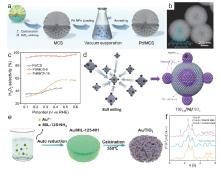
Fig 3
Noble metal nanoparticle catalysts for the 2e− ORR. (a) Schematic illustration of the synthesis of Pd/MCS. (b) HAADF-STEM images of Pd/MCS-8. (c) Corresponding H2O2 selectivities of different electrocatalysts. (a–c) Reproduced with permission from Ref. [62], Copyright 2024 Wiley-VCH. (d) Schematic illustration of the synthesis of Pd/TiO2−x through the ball-milling method; reproduced with permission from Ref. [52], Copyright 2022 American Chemical Society. (e) Schematic diagram of the synthesis of Au/TiO2. (f) FT-EXAFS spectra of the Au LⅢ-edge. (e) and (f) Reproduced with permission from Ref. [63], Copyright 2024 Wiley-VCH."
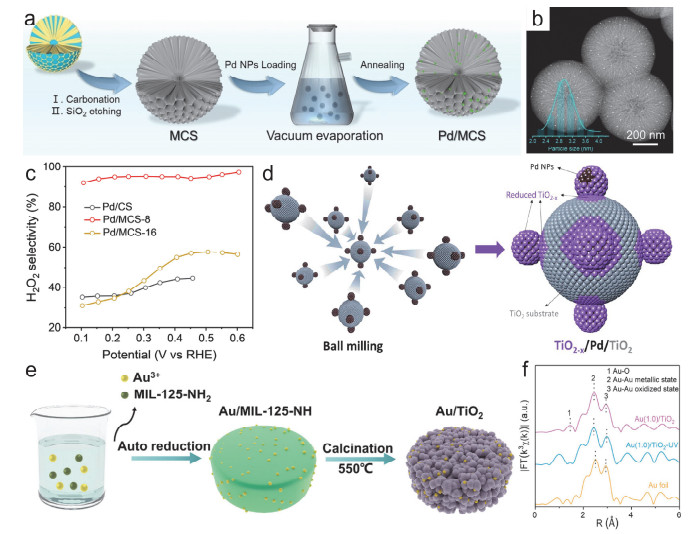
Table 1
Summary of the 2e− ORR performance of noble metal nanoparticles."
| Catalyst | Electrolyte | SH2O2 a (%) | Mass activity | PH2O2 b | Stability | Ref. |
| Pd0.5 μM/graphene | 0.1 mol∙L−1 HClO4 | 94.1 (0–0.3 V) | – | – | – | [ |
| Pd NP-PTH-CNTs | 0.1 mol∙L−1 Na2SO4 | 96 (0.6 V) | – | – | – | [ |
| Pdδ+-OCNT | 0.1 mol∙L−1 HClO4 | 95–98 (0.3–0.7 V) | 1.946 A∙mg−1 (0.45 V) | 1701 mol∙kg−1∙h−1 (0.1 V in H-cell) | 8 h at 0.1 V on RRDE | [ |
| 6 h-Pd/TiC | 0.1 mol∙L−1 KOH | > 90 (FE, 0–0.7 V) | – | 594 mg∙L−1∙h−1 (50 mA in H-cell) | 10 h at 0.7 V on RRDE | [ |
| Pd-Mxene | 0.1 mol∙L−1 KOH | > 60 (0–0.7 V) | 1.43 mol∙g−1∙h−1 (0.4 V in H-cell) | 8 h at 0.4 V on RRDE | [ | |
| Au-ZrO2/PL6C | 0.1 mol∙L−1 K2SO4 | > 82 (0.1–0.3 V) | – | 600 mg∙L−1 (50 mA∙cm−2, 120 min) | 5, 000 cycles on RRDE | [ |
| Au(1.0)/TiO2 | 0.1 mol∙L−1 KOH | 90 (0.2–0.5 V) | – | 72.2 mg∙L−1∙h−1 (0.1 V in H-ell) | 168 h at 0.1 V in H-cell | [ |
| NC-Ag/NHCS | 0.1 mol∙L−1 HClO4 | 89–91 (0.2–0.7 V) | 27.1 A∙g−1 (0.7 V) | 408 mmol∙g−1∙h−1 (0.7 V) | 10, 000 cycles on RRDE | [ |
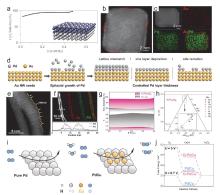
Fig 4
Noble metal alloys for catalyzing the 2e− ORR. (a) H2O2 selectivity as a function of the applied potential (Insert: schematic of the Pt–Hg alloy. Hg, blue; Pt, grey); reproduced with permission from Ref. [18], Copyright 2013 Springer Nature. (b) HAADF-STEM image of Pd@AuxPd1−x. (c) The corresponding EDX mapping. (b) and (b) Reproduced with permission from Ref. [59], Copyright 2021 Wiley-VCH. (d) Schematic illustration of the controlled Pd layer for the Au@Pd NWs; (e) STEM image and (f) EDX mapping of the Au@Pd (15 : 1) NWs. (d), (e) and (f) Reproduced with permission from Ref. [60], Copyright 2024 American Chemical Society. (g) H2O2 selectivity and number of transferred electrons (n) of Au-Pd2Hg5 and Pd2Hg5. (h) Calculated 2e− ORR activity volcano relationship between the limiting potential (UL) and the free energy of *OOH (ΔG*OOH); (g) and (h) Reproduced with permission from Ref. [24], Copyright 2023 Wiley-VCH. (i) Illustration of the ORR on the pure Pd surface and PdCu surface. (j) Calculated free energy diagrams for the 2e− ORR over bare PdCu and O-PdCu. (i) and (j) Reproduced with permission from Ref. [69], Copyright 2023 American Chemical Society."
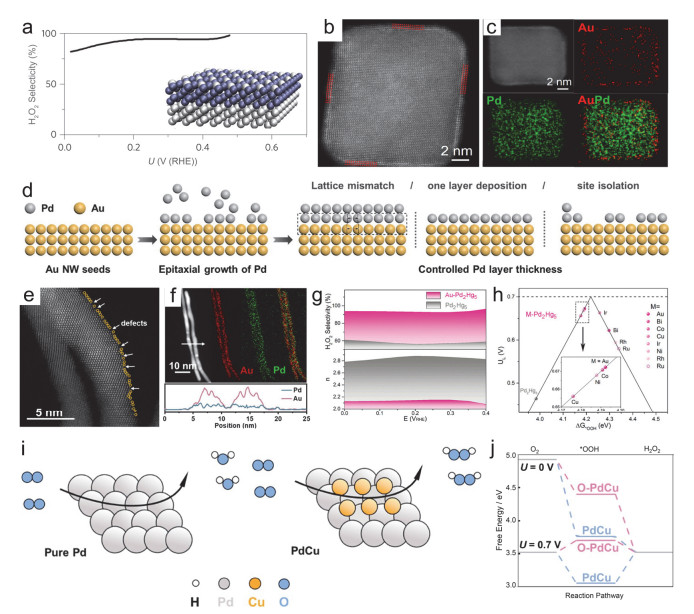
Table 2
Summary of the 2e− ORR performances of noble metal alloys."
| Catalyst | Electrolyte | SH2O2 a (%) | Mass activity | PH2O2 b | Stability | Ref. |
| Au92Pd8/C | 0.1 mol∙L−1 HClO4 | 95 (0 V) | – | – | – | [ |
| PtHg4 | 0.1 mol∙L−1 HClO4 | 96 (0.2–0.4 V) | (26 ± 4) A∙g−1 (0.65 V) | – | 8000 cycles on RRDE | [ |
| Au-Pt-Ni | 0.1 mol∙L−1 KOH | 95 (0.4–0.55 V) | 192.9 A∙g−1 (0.55 V) | 22.2 mg∙L−1 (0.5 V on RRDE) | 10 h at 0.5 V on RRDE | [ |
| PdAu-nf | 0.1 mol∙L−1 HClO4 | > 90 (0–0.5 V) | 10, 000 cycles on RRDE | [ | ||
| Pd@Au0.95Pd0.05 | 0.1 mol∙L−1 HClO4 | 93–100 (0.4–0.7 V) | – | 1.62 mol∙g−1∙h−1 (0.25 V in H-cell) | 10, 000 cycles on RRDE | [ |
| PdCu NWs | 0.1 mol∙L−1 HClO4 | > 85 (0.15–0.6 V) | 1.903 A∙mg−1 (0.25 V) | 1.866 mol∙g−1∙h−1 (0.3 V in H-cell) | 10 h at 0.3 V on RRDE | [ |
| Au–Pd2Hg5 | 0.1 mol∙L−1 HClO4 | 92.8 (0–0.4 V) | 15.6 A∙g−1 (0–0.4 V) | 1.49 mmol∙g−1∙h−1 (0.25 V in H-cell) | 5, 000 cycles on RRDE | [ |
| Au@Pd (15 : 1) | 0.1 mol∙L−1 HClO4 | 95 (0.4 V) | 5.71 A∙g−1 (0.4 V) | 3.55 mol∙g−1∙h−1 (0.25 V in H-cell) | 15 h at 0.35 V on RRDE | [ |
Fig 5
Noble metal compounds for 2e− ORR catalysis. (a) Schematic diagram illustrating the ORR pathways for noble metals and noble metal chalcogenides; reproduced with permission from Ref. [78], Copyright 2023 American Chemical Society. (b) Pd K-edge EXAFS spectra in R space for different materials. (c) The simulated coordination structure of a-PdSe2 NPs and c-PdSe2 NPs, where CN is the coordination number. Blue, Pd; pink, Se; red, O; white, H. (b) and (c) Reproduced with permission from Ref. [26], Copyright 2023 WCH-Wiley. (d) Schematic of the synthesis process for L-PdS-Vs metallene. (e) TEM image of the L-PdS-Vs metallene. (d) and (e) were reproduced with permission from Ref. [79], Copyright 2024 American Chemical Society. (f) Calculated DOS of the d band on the PtSx surfaces. (g) d-band center of the PtSx surfaces vs. the S content. (h) Relationship between the specific activity of H2O2 at 0.6 V and the calculated OOH* free energy. (f), (g) and (h) Reproduced with permission from Ref. [27], Copyright 2024 American Chemical Society."
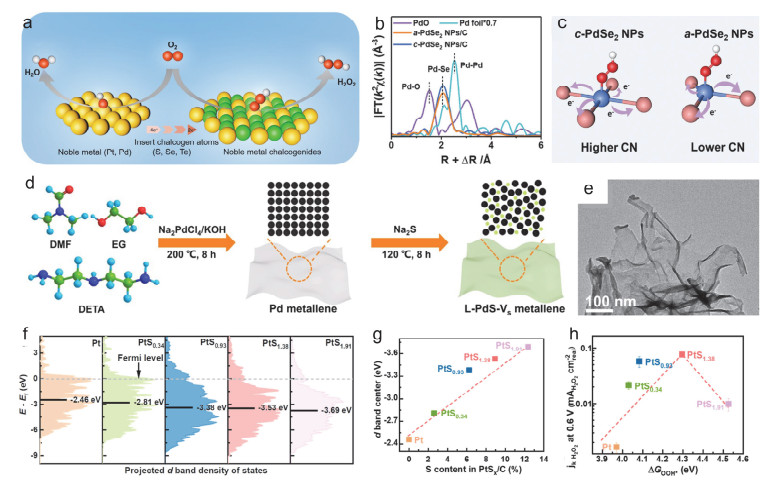
Table 3
Summary of the 2e− ORR performance of noble metal compounds."
| Catalyst | Electrolyte | SH2O2 a (%) | Mass activity | PH2O2 b | Stability | Ref. |
| Pd4Se | 0.1 mol∙L−1 HClO4 | 93.5 (0.4 V) | 21.5 A∙g−1 (0.65 V) | 5.03 mmol∙L−1∙h−1 (0.2 V in H-cell) | 5000 cycles on RRDE | [ |
| 0.1 mol∙L−1 KOH | 89.7 (0.4 V) | 183.6 A∙g−1 (0.65 V) | 9.31 mmol∙L−1∙h−1 (0.2 V in H-cell) | |||
| 0.1 mol∙L−1 KCl | 86.7 (0.4 V) | 165.4 A∙g−1 (0.65 V) | 8.16 mmol∙L−1∙h−1 (0.2 V in H-cell) | |||
| a-PdSe2 | 0.1 mol∙L−1 HClO4 | 95.8 (0–0.3 V) | 69.9 A∙g−1 (0 V) | 1725.5 mmol∙g−1∙h−1 (0 V in H-cell) | 10 h at 0 V on RRDE | [ |
| 0.1 mol∙L−1 KOH | 90 (0.3–0.6 V) | 100.3 A∙g−1 (0.4 V) | 3245.7 mmol∙g−1∙h−1 (0.2 V in H-cell), | 10 h at 0.2 V on RRDE | ||
| 0.1 mol∙L−1 Na2SO4 | 96.3 (0–0.3 V) | 118.8 A∙g−1 (0 V) | 2242.1 mmol∙g−1∙h−1 (0 V in H-cell) | 10 h at 0 V on RRDE | ||
| L-PdS-Vs | 0.1 mol∙L−1 KOH | > 90 (0.3–0.7 V) | – | 1.12 mol∙g−1∙h−1 (0.3 V in H-cell) | 5000 cycles on RRDE | [ |
| PdTe GRC | 0.1 mol∙L−1 H2SO4 | 75 (0.6 V) | – | 0.17 mol∙h−1∙g−1 (0.15 V in H-cell) | – | [ |
| PtSe2 | 0.1 mol∙L−1 PBS | > 80 (0.1–0.6 V) | – | 2.88 mol∙g−1∙h−1 (0.3 V in H-cell) | 2000 cycles on RRDE | [ |
| PtSe2/C | 0.1 mol∙L−1 HClO4 | 91 (0.1–0.6 V) | 439 A∙g−1 (0.65 V) | – | 10, 000 cycles on RRDE | [ |
| Pt1.38S/C | 0.1 mol∙L−1 HClO4 | 92 (0.1–0.68 V) | 70.5 A∙g−1 (0.65 V) | 992 mmol∙g−1∙h−1 (0.2 V in H-cell) | 5000 cycles on RRDE | [ |
| PtP2 NCs | 0.1 mol∙L−1 HClO4 | 98.5 (0.27 V) | – | 2.26 mmol∙h−1∙cm−2 (PEMFC, 150 mA∙cm−2) | 120 h at 0.4 V in PEMFC) | [ |
Fig 6
Noble metal single-atom catalysts for the 2e− ORR process. (a) Aberration-corrected HAADF-STEM image of Pd0.157-NC; reproduced with permission from Ref. [30], Copyright 2022 American Chemical Society. (b) Relationship between ΔG*OOH and the electron population of the Pd center with different coordination environments; reproduced with permission from Ref. [57], Copyright 2024 American Chemical Society. HAADF-STEM images of (c) 0.2% (wt) Pt1/TiC and (d) 0.2% (wt) Pt1/TiN. (c) and (d) Reproduced with permission from Ref. [89], Copyright 2017 American Chemical Society. HAADF-STEM images of (e) Pt-N-CNT_NH3 and (f) Pt-N-CNT_Gly; (g) N 1s XPS spectra; (h) N K-edge XAS spectra. (e), (f), (g), and (h) were reproduced with permission from Ref. [58], Copyright 2024 American Chemical Society. (i) Schematic illustration of the synthesis of h-Pt1-CuSx. The blue, purple, and white balls represent Cu, Pt, and S atoms, respectively; reproduced with permission from Ref. [29], Copyright 2019 the Cell Press. (j) RRDE results of the Pt/C-SCN and Pt/C catalysts in O2-saturated 0.1 mol∙L−1 HClO4 with a rotation speed of 1600 r∙min−1; reproduced with permission from Ref. [90], Copyright 2021 ScienceDirect."
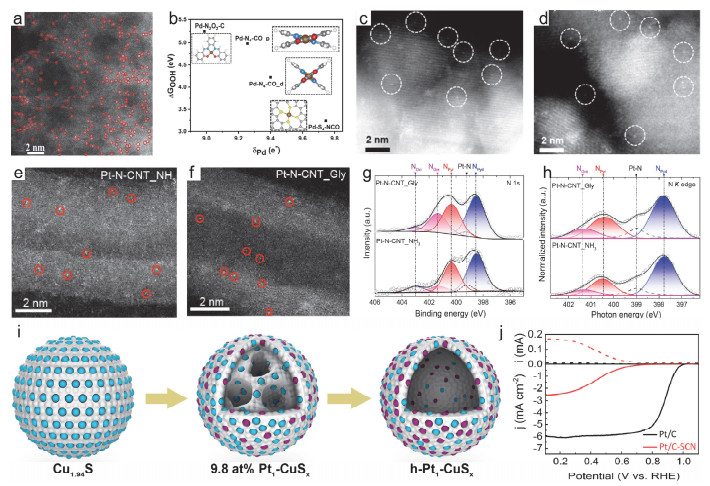
Table 4
Summary of the 2e− ORR performance of noble metal single atoms."
| Catalyst | Electrolyte | SH2O2 a (%) | Mass activity | PH2O2 b | Stability | Ref. |
| PdClx/C | 0.1 mol∙L−1 HClO4 | > 80 (0.1–0.5 V) | 72.8 A∙g−1 (0 V) | – | 1000 cycles on RRDE | [ |
| Pd1/N-C | 0.1 mol∙L−1 HClO4 | 78.9 (FE, ~0.3 V) | – | – | – | [ |
| Pd0.157-NC | 0.1 mol∙L−1 KOH | > 90 (0.1–0.7 V) | – | 30 mmol∙g−1∙h−1 (0.5 V in H-cell) | 8 h at 0.5 V on RRDE | [ |
| Pd-N4-CO | 0.1 mol∙L−1 KOH | 95 (0.2–0.5 V) | – | 150 mol∙g−1∙h−1 (0.4 V H-cell) | 10 h at 0.4 V on RRDE | [ |
| 0.35% Pt/TiN | 0.1 mol∙L−1 HClO4 | 65 (~0.05 V) | 78.0 A∙g−1 (0.65 V) | – | 1 h at 0.3 V on RRDE | [ |
| 0.2% (wt) Pt1/TiC | 0.1 mol∙L−1 HClO4 | 68 (0.2 V) | – | – | 5, 000 cycles on RRDE | [ |
| h-Pt1-CuSx | 0.1 mol∙L−1 HClO4 | 92–96 (0.05–0.7 V) | 35 A∙mg−1 (0.4 V) | (546 ± 30) mol∙kg−1∙h−1 (0.05 V in full cell) | 10, 000 cycles on RRDE | [ |
| Pt/C-SCN | 0.1 mol∙L−1 HClO4 | > 80 (0.1–0.7 V) | 11 A∙g−1 (0.64 V) | – | 30 h at 0.1 V in H-cell | [ |
| PtSCNx-C | 0.1 mol∙L−1 HClO4 | 90 (0.4 V) | – | – | 130.h at 0.2 V in H-cell | [ |
| Pt0.21CN | 0.1 mol∙L−1 KOH | 98 (0.2–0.6 V) | – | 767 mmol∙g−1∙h−1 (0.6 V in H-cell) | 40, 000 cycles on RRDE | [ |
| Au@Cu2−x-S-CNTs | 0.1 mol∙L−1 KOH | > 90 (0.2–0.7 V) | 14 A∙mg−1 (0.6 V) | – | 10 h at 0.5 V on RRDE | [ |
| Au/F-GDY | 0.1 mol∙L−1 KOH | 98 (0.58 V) | 22 A∙g−1 (0.65 V) | 1.9 mmol∙h−1∙cm−2 (0.6 V in MEA) | 80 h at 0.6 V in MEA | [ |
Fig 7
Schematic illustration of different reactors. (a) H-cell; reproduced with permission from Ref. [106], Copyright 2023 ScienceDirect. (b) Flow cell; reproduced with permission from Ref. [107], Copyright 2025 WCH-Wiley. (c) MEA; reproduced with permission from Ref. [104], Copyright 2025 ScienceDirect. (d) Solid-electrolyte cell; reproduced with permission from Ref. [35], Copyright 2021 Springer Nature."
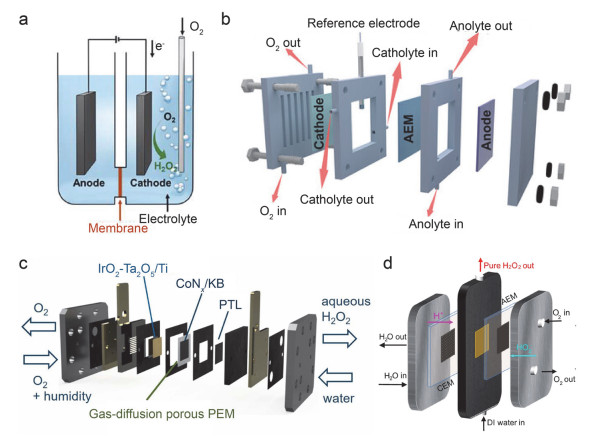
Table 5
Application of SSEs in the synthesis of pure H2O2."
| Catalysts | FE of H2O2 a (%) | PH2O2 b | Stability | Ref. |
| B-C | > 87 (400 mA∙cm−2) | 7.36 mmol∙cm−2∙h−1 (500 mA∙cm−2) | 200 h 30 mA∙cm−2 | [ |
| CB-10% | 90 (200 mA∙cm−2) | 3.4 mmol∙cm−2∙h−1 (200 mA∙cm−2) | > 100 h 30 mA∙cm−2 | [ |
| N, S-TCNTs | 95.1 (150 mA∙cm−2) | 4.35 mmol∙cm−2∙h−1 (300 mA∙cm−2) | 300 h 20 mA∙cm−2 | [ |
| N-C(2 : 3) | 92 (115 mA∙cm−2) | 6.53 mmol∙cm−2∙h−1 (400 mA∙cm−2) | 50 h 70 mA∙cm−2 | [ |
| C-0.1M80 | > 90 (50–250 mA∙cm−2) | – | 100 h 50 mA∙cm−2 | [ |
| XC-37T AEM | 88.1 (200 mA∙cm−2) | – | 1500 h 15 mA∙cm−2 | [ |
| VN4B/NC | 80.2–92.5 (2.0–2.7 V) | 10.18 mmol∙cm−2∙h−1 (401 mA∙cm−2) | 100 h 2.3 V | [ |
| BP2000 | – | – | 1000 h 100 mA∙cm−2 | [ |
| NiFeW LDH/OCNTs | > 80 (1.75–3 V) | 5.29 mmol∙cm−2∙h−1 (300 mA∙cm−2) | 250 h 100 mA∙cm−2 | [ |
| 1 |
S. Yang, A. Verdaguer-Casadevall, L. Arnarson, L. Silvioli, V. Čolić, R. Frydendal, J. Rossmeisl, I. Chorkendorff, I. E. L. Stephens. ACS Catal. 2018, 8, 4064.
doi: 10.1021/acscatal.8b00217 |
| 2 |
Y. H. Yi, L. Wang, G. Li, H. C. Guo. H. Catal. Sci. Technol. 2016, 6, 1593.
doi: 10.1039/C5CY01567G |
| 3 |
Y. H. Tian, D. J. Deng, L. Xu, M. Li, H. Chen, Z. Z. Wu, S. Q. Zhang. Nano-Micro Lett. 2023, 15, 122.
doi: 10.1007/s40820-023-01067-9 |
| 4 |
J. M. Campos-Martin, G. Blanco-Brieva, J. L. G. Fierro. Angew. Chem. Int. Ed. 2006, 45, 6962.
doi: 10.1002/anie.200503779 |
| 5 |
R. J. Lewis, G. J. Hutchings. ChemCatChem 2019, 11, 298.
doi: 10.1002/cctc.201801435 |
| 6 |
J. K. Edwards, G. J. Hutchings. Angew. Chem. Int. Ed. 2008, 47, 9192.
doi: 10.1002/anie.200802818 |
| 7 |
J. K. Edwards, B. Solsona, E. N. N, A. F. Carley, A. A. Herzing, C. J. Kiely, G. J. Hutchings. Science 2009, 323, 1037.
doi: 10.1126/science.1168980 |
| 8 |
J. H. Lunsford. J. Catal. 2003, 216, 455.
doi: 10.1016/S0021-9517(02)00070-2 |
| 9 |
D. P. Dissanayake, J. H. Lunsford. J. Catal. 2002, 206, 173.
doi: 10.1006/jcat.2001.3501 |
| 10 |
R. Burch, P. R. Ellis. Appl. Catal. B Environ. 2003, 42, 203.
doi: 10.1016/S0926-3373(02)00232-1 |
| 11 |
Z. L. Jiang, L. Li, F. Qi, Z. B. Wang, Y. T. Liu, F. Li, H. Wang, Z. Y. Bian, M. S. Zhu, J. Kumirska, E. M. A. Siedlecka. ACS Appl. Mater. Inter. 2025, 17, 42.
doi: 10.1021/acsami.4c14902 |
| 12 |
X. J. Shi, S. Back, T. M. Gill, S. Siahrostami, X. L. Zheng. Chem 2021, 7, 38.
doi: 10.1016/j.chempr.2020.09.013 |
| 13 |
C. A. Martínez-Huitle, M. Panizza. Curr. Opin. Electrochem. 2018, 11, 62.
doi: 10.1016/j.coelec.2018.07.010 |
| 14 |
E. Jung, H. Shin, W. Hooch Antink, Y. E. Sung, T. Hyeon. ACS Energy Lett. 2020, 5, 1881.
doi: 10.1021/acsenergylett.0c00812 |
| 15 |
Z. J. Chen, S. Yun, L. Wu, J. Q. Zhang, X. D. Shi, W. Wei, Y. W. Liu, R. J. Zheng, N. Han, B. J. Ni. Nano-Micro Lett. 2023, 15, 4.
doi: 10.1007/s40820-022-00974-7 |
| 16 |
X. Zhang, Y. Xia, C. Xia, H. T. Wang. Trends Chem. 2020, 2, 942.
doi: 10.1016/j.trechm.2020.07.007 |
| 17 |
S. C. Perry, S. Mavrikis, L. Wang, C. Ponce De León. Curr. Opin. Electrochem. 2021, 30, 100792.
doi: 10.1016/j.coelec.2021.100792 |
| 18 |
S. Siahrostami, A. Verdaguer-Casadevall, M. Karamad, D. Deiana, P. Malacrida, B. Wickman, M. Escudero-Escribano, E. A. Paoli, R. Frydendal, T. W. Hansen, I. Chorkendorff, I. E. L. Stephens, J. Rossmeisl. Nat. Mater. 2013, 12, 1137.
doi: 10.1038/nmat3795 |
| 19 |
T. Ricciardulli, S. Gorthy, J. S. Adams, C. Thompson, A. M. Karim, M. Neurock, D. W. Flaherty. J. Am. Chem. Soc. 2021, 143, 5445.
doi: 10.1021/jacs.1c00539 |
| 20 |
J. S. Jirkovský, M. Halasa, D. J. Schiffrin. Phys. Chem. Chem. Phys. 2010, 12, 8042.
doi: 10.1039/C002416C |
| 21 |
Y. Y. Jiang, P. J. Ni, C. X. Chen, Y. Z. Lu, P. Yang, B. Kong, A. Fisher, X. Wang. Adv. Energy Mater. 2018, 8, 1801909.
doi: 10.1002/aenm.201801909 |
| 22 |
M. J. Gibian, D. L. Elliott, W. R. Hardy. J. Am. Chem. Soc. 1969, 91, 7528.
doi: 10.1021/ja01054a062 |
| 23 |
J. K. Nørskov, J. Rossmeisl, A. Logadottir, L. Lindqvist, J. R. Kitchin, T. Bligaard, H. J. Jónsson. Phys. Chem. B 2004, 108, 17886.
doi: 10.1021/jp047349j |
| 24 |
X. Zhang, C. Wang, K. Chen, A. H. Clark, R. Hübner, J. H. Zhan, L. Zhang, A. Eychmüller, B. Cai. Adv. Mater. 2023, 35, 2211512.
doi: 10.1002/adma.202211512 |
| 25 |
H. Li, P. Wen, D. S. Itanze, Z. D. Hood, S. Adhikari, C. Lu, X. Ma, C. C. Dun, L. Jiang, D. L. Carroll, Y. J. Qiu, S. M. Geyer. Nat. Commun. 2020, 11, 3928.
doi: 10.1038/s41467-020-17584-9 |
| 26 |
Z. Yu, S. Y. Lv, Q. Yao, N. Fang, Y. Xu, Q. Shao, C. W. Pao, J. F. Lee, G. L. Li, L. M. Yang, X. Q. Huang. Adv. Mater. 2023, 35, 2208101.
doi: 10.1002/adma.202208101 |
| 27 |
M. J. Huang, Z. P. Cui, Z. Li, W. C. Sheng. ACS Catal. 2024, 14, 2095.
doi: 10.1021/acscatal.3c05362 |
| 28 |
E. Pizzutilo, S. J. Freakley, S. Cherevko, S. Venkatesan, G. J. Hutchings, C. H. Liebscher, G. Dehm, K. J. J. Mayrhofer. ACS Catal. 2017, 7, 5699.
doi: 10.1021/acscatal.7b01447 |
| 29 |
R. A. Shen, W. X. Chen, Q. Peng, S. Q. Lu, L. R. Zheng, X. Cao, Y. Wang, W. Zhu, J. T. Zhang, Z. B. Zhuang, C. Chen, D. S. Wang, Y. D. Li. Chem. 2019, 5, 2099.
doi: 10.1016/j.chempr.2019.04.024 |
| 30 |
N. Wang, X. H. Zhao, R. Zhang, S. Yu, Z. H. Levell, C. Wang, S. B. Ma, P. C. Zou, L. L. Han, J. Y. Qin, L. Ma, Y. Y. Liu, H. L. Xin. ACS Catal. 2022, 12, 4156.
doi: 10.1021/acscatal.1c05633 |
| 31 |
E. Y. Jung, H. J. Shin, B. H. Lee, V. Efremov, S. Lee, H. S. Lee, J. H. Kim, W. Hooch Antink, S. Park, K. S. Lee, S. P. Cho, J. S. Y Yoo, Y. E. Sung, T. Hyeon. Nat. Mater. 2020, 19, 436.
doi: 10.1038/s41563-019-0571-5 |
| 32 |
H. W. Kim, M. B. Ross, N. Kornienko, L. Zhang, J. H. Guo, P. D. Yang, B. D. McCloskey. Nat. Catal. 2018, 1, 282.
doi: 10.1038/s41929-018-0044-2 |
| 33 |
Z. Y. Lu, G. X. Chen, S. Siahrostami, Z. H. Chen, K. Liu, J. Xie, L. Liao, T. Wu, D. C. Lin, Y. Y. Liu, T. F. Jaramillo, J. K. Nørskov, Y. Cui. Nat. Catal. 2018, 1, 156.
doi: 10.1038/s41929-017-0017-x |
| 34 |
S. C. Chen, Z. H. Chen, S. Siahrostami, D. HigginsD. Nordlund, D. Sokaras, T. R. Kim, Y. Z. Liu, X. Z. Yan, E. Nilsson, R. Sinclair, J. K. Nørskov, T. F. Jaramillo, Z. N. Bao. J. Am. Chem. Soc. 2018, 140, 7851.
doi: 10.1021/jacs.8b02798 |
| 35 |
W. Zhou, X. X. Meng, J. H. Gao, A. N. Alshawabkeh. Chemosphere 2019, 225, 588.
doi: 10.1016/j.chemosphere.2019.03.042 |
| 36 |
W. Zhou, L. Xie, J. H. Gao, R. Nazari, H. Q. Zhao, X. Meng, F. Sun, G. Zhao, J. Ma. Chem. Eng. J. 2021, 410, 128368.
doi: 10.1016/j.cej.2020.128368 |
| 37 |
Y. Xia, X. H. Zhao, C. Xia, Z. Y. Wu, P. Zhu, J. Y. Kim, X. W. Bai, G. H. Gao, Y. F. Hu, J. Zhong, Y. Y. Liu, H. T. Wang. Nat. Commun. 2021, 12, 4225.
doi: 10.1038/s41467-021-24329-9 |
| 38 |
C. Xia, Y. Xia, P. Zhu, L. Fan, H. T. Wang. Science 2019, 366, 226.
doi: 10.1126/science.aay1844 |
| 39 |
J. J. Jia, Z. X. Li, Y. R. Tian, X. Li, R. Chen, J. C. Liu, J. Liang. Energy Rev. 2024, 3, 100069.
doi: 10.1016/j.enrev.2024.100069 |
| 40 |
H. C. Yang, N. D. Lu, J. T. Zhang, R. Wang, S. H. Tian, M. J. Wang, Z. X. Wang, K. Tao, F. Ma, S. L. Peng. Carbon Energy 2023, 5, e337.
doi: 10.1002/cey2.337 |
| 41 |
S. K. Zhang, Y. G. Feng, A. Elgazzar, Y. Xia, C. Qiu, Z. Adler, C. Sellers, H. T. Wang. Joule 2023, 7, 1887.
doi: 10.1016/j.joule.2023.06.022 |
| 42 |
Y. Song, X. Yang, H. Liu, S. X. Liang, Y. F. Cai, W. Q. Yang, K. X. Zhu, L. Yu, X. J. Cui, D. H. Deng. D. J. Am. Chem. Soc. 2024, 146, 5834.
doi: 10.1021/jacs.3c10825 |
| 43 |
S. Siahrostami, A. Verdaguer-Casdevall, M. Karamad, I. Chorkendorff, I. E. L. Stephens, J. Rossmeisl. ECS Trans. 2013, 58, 53.
doi: 10.1149/05802.0053ecst |
| 44 |
X. G. Guo, S. R. Lin, J. X. Gu, S. L. Zhang, Z. F. Chen, S. P. Huang. Simultaneously Achieving ACS Catal. 2019, 9, 11042.
doi: 10.1021/acscatal.9b02778 |
| 45 |
A. Kulkarni, S. Siahrostami, A. Patel, J. K. Nørskov. Chem. Rev. 2018, 118, 2302.
doi: 10.1021/acs.chemrev.7b00488 |
| 46 |
M. M. Montemore, M. A. Van Spronsen, R. J. Madix, C. M. Friend. Chem. Rev. 2018, 118, 2816.
doi: 10.1021/acs.chemrev.7b00217 |
| 47 |
Q. Z. Zhang, M. H. Zhou, G. B. Ren, Y. W. Li, Y. C. Li, X. D. Du. Nat. Commun. 2020, 11, 1731.
doi: 10.1038/s41467-020-15597-y |
| 48 |
H. Y. Zou, S. Y. Shu, W. Q. Yang, Y. C. Chu, M. L. Cheng, H. L. Dong, H. Liu, F. Li, J. H. Hu, Z. B. Wang, W. Liu, H. M. Chen, L. L. Duan. Nat. Commun. 2024, 15, 10818.
doi: 10.1038/s41467-024-55116-x |
| 49 |
H. Z. Yang, S. Kumar, S. Z. Zou. J. Energy Chem 2013, 688, 180.
doi: 10.1016/j.jelechem.2021.115084 |
| 50 |
Y. L. Wang, S. Gurses, N. Felvey, A. Boubnov, S. S. Mao, C. X. Kronawitter. ACS Catal. 2019, 9, 8453.
doi: 10.1021/acscatal.9b01758 |
| 51 |
Q. W. Chang, P. Zhang, A. H. B. Mostaghimi, X. R. Zhao, S. R. Denny, J. H. Lee, H. P. Gao, Y. Zhang, H. L. Xin, S. Siahrostami, J. G. Chen, Z. Chen. Nat. Commun. 2020, 11, 2178.
doi: 10.1038/s41467-020-15843-3 |
| 52 |
J. M. Zhang, J. Ma, T. S. Choksi, D. J. Zhou, S. H. Han, Y. F. Liao, H. B. Yang, D. Liu, Z. P. Zeng, W. Liu, X. M. Sun, X.; T. Y. Zhang, B. Liu. J. Am. Chem. Soc. 2022, 144, 2255.
doi: 10.1021/jacs.1c12157 |
| 53 |
C. Y. Yang, S. X. Bai, Z. Y. Yu, Y. G. Feng, B. L. Huang, Q. Y. Lu, T. Wu, M. Z. Sun, T. Zhu, C. Cheng, L. Zhang, Q. Shao, X. Q. Huang. Nano Energy 2021, 89, 106480.
doi: 10.1016/j.nanoen.2021.106480 |
| 54 |
Y. Lee, J. Koh, H. Ahn, H. Jang, Y. J. Sa. Appl. Surf. Sci. 2024, 647, 158976.
doi: 10.1016/j.apsusc.2023.158976 |
| 55 |
R. D. Ross, K. Lee, G. J. Quintana Cintrón, K. L. Xu, H. Y. Sheng, J. R. Schmidt, S. Jin. J. Am. Chem. Soc. 2024, 146, 15718.
doi: 10.1021/jacs.4c00875 |
| 56 |
J. J. Zhao, C. H. Fu, K. Ye, Z. Liang, F. L. Jiang, S. Y. Shen, X. R. Zhao, L. Ma, Z. Shadike, X. M. Wang, J. L. Zhang, K. Jiang. Nat. Commun. 2022, 13, 685.
doi: 10.1038/s41467-022-28346-0 |
| 57 |
E. A. Moges, C. Y. Chang, W. H. Huang, F. T. Angerasa, K. Lakshmanan, T. M. Hagos, H. G. Edao, W. B. Dilebo, C. W. Pao, M. C. Tsai, W. N. Su, B. J. Hwang. J. Am. Chem. Soc. 2024, 146, 419.
doi: 10.1021/jacs.3c09644 |
| 58 |
B. X. Ni, P. Shen, G. Zhang, J. J. Zhao, H. H. Ding, Y. F. Ye, Z. Y. Yue, H. Yang, H. Wei, K. Jiang. J. Am. Chem. Soc. 2024, 146, 11181.
doi: 10.1021/jacs.3c14186 |
| 59 |
Y. Zhang, Z. H. Lyu, Z. T. Chen, S. Q. Zhu, Y. F. Shi, R. H. Chen, M. H. Xie, Y. Yao, M. F. Chi, M. F. Shao, Y. N. Xia. Angew. Chem. Int. Ed. 2021, 60, 19643.
doi: 10.1002/anie.202105137 |
| 60 |
Z. P. Deng, A. H. B. Mostaghimi, M. Gong, N. Chen, S. Siahrostami, X. L. Wang. J. Am. Chem. Soc. 2024, 146, 2816.
doi: 10.1021/jacs.3c13259 |
| 61 |
J. Y. Zhang, C. Xia, H. F. Wang, C. Tang. J. Energy Chem. 2022, 67, 432.
doi: 10.1016/j.jechem.2021.10.013 |
| 62 |
L. Y. Jing, W. Y. Wang, Q. Tian, Y. Kong, X. S. Ye, H. P. Yang, Q. Hu, C. X. He. Angew. Chem. Int. Ed. 2024, 63, e202403023.
doi: 10.1002/anie.202403023 |
| 63 |
Y. L. He, Y. Z. Wei, Z. M. Wang, T. Xia, F. Rao, Z. F. Song, R. B. Yu. Adv. Func. t Mater. 2024, 34, 2314654.
doi: 10.1002/adfm.202314654 |
| 64 |
M. S. Kronka, G. V. Fortunato, L. Mira, A. J. Dos Santos, M. R. V. Lanza. Chem. Eng. J. 2023, 452, 139598.
doi: 10.1016/j.cej.2022.135318 |
| 65 |
A. P. Reyes-Cruzaley, R. M. Félix-Navarro, B. Trujillo-Navarrete, C. Silva-Carrillo, J. R. Zapata-Fernández, J. M. Romo-Herrera, O. E. Contreras, E. A. Reynoso-Soto. Electrochim. Acta 2019, 296, 575.
doi: 10.1016/j.electacta.2018.11.023 |
| 66 |
X. Sheng, S. Kang, B. X. Li, F. J. Xue, W. Q. Lu. Electrochim. Acta 2023, 472, 143420.
doi: 10.1016/j.electacta.2023.143420 |
| 67 |
M. M. Jin, W. Liu, J. Q. Sun, X. Z. Wang, S. S. Zhang, J. Luo, X. J. Liu. Nano Res. 2022, 15, 5842.
doi: 10.1007/s12274-022-4208-7 |
| 68 |
A. Verdaguer-Casadevall, D. Deiana, M. Karamad, S. Siahrostami, P. Malacrida, T. W. Hansen, J. Rossmeisl, I. Chorkendorff, I. E. L. Stephens. Nano Lett. 2014, 14, 1603.
doi: 10.1021/nl500037x |
| 69 |
J. W. Du, S. H. Jiang, R. Y. Zhang, P. Wang, C. Ma, R. J. Zhao, C. H. Cui, Y. N. Zhang, Y. J. Kang. ACS Catal. 2023, 13, 6887.
doi: 10.1021/acscatal.3c00449 |
| 70 |
B. Cai, A. Eychmüller. Adv. Mater. 2019, 31, 1804881.
doi: 10.1002/adma.201804881 |
| 71 |
N. Zion, D. A. Cullen, P. Zelenay, L. Elbaz. Angew. Chem. Int. Ed. 2020, 59, 2483.
doi: 10.1002/anie.201913521 |
| 72 |
N. Zion, J. C. Douglin, D. A. Cullen, P. Zelenay, D. R. Dekel, L. Elbaz. L. Adv. Funct. Mater. 2021, 31, 2100963.
doi: 10.1002/adfm.202100963 |
| 73 |
Y. Y. Liang, T. Ma, Y. Z. Xiong, L. Z. Qiu, H. Yu, F. Liang. F. Nanoscale 2021, 13, 9960.
doi: 10.1039/D1NR00841B |
| 74 |
Y. Sha, T. H. Yu, B. V. Merinov, W. Goddard. W. A. ACS Catal. 2014, 4, 1189.
doi: 10.1021/cs4009623 |
| 75 |
J. S. Jirkovský, I. Panas, E. Ahlberg, M. Halasa, S. Romani, D. J. Schiffrin. J. Am. Chem. Soc. 2011, 133, 19432.
doi: 10.1021/ja206477z |
| 76 |
Z. K. Zheng, Y. H. Ng, D. W. Wang, R. Amal. Adv. Mater. 2016, 28, 9949.
doi: 10.1002/adma.201603662 |
| 77 |
X. Zhao, H. Yang, J. Xu, T. Cheng, Y. G. Li. ACS Materials Lett. 2021, 3, 996.
doi: 10.1021/acsmaterialslett.1c00263 |
| 78 |
M. Song, M. Chen, C. Zhang, J. J. Zhang, W. Liu, X. H. Huang, J. W. Li, G. Feng, D. L. Wang. ACS Appl. Mater. Inter. 2023, 15, 31375.
doi: 10.1021/acsami.3c02793 |
| 79 |
H. J. Wang, X. Mu, Q. Q. Mao, K. Deng, H. J. Yu, Y. Xu, Z. Q. Wang, L. Wang. L. ACS Appl. Nano Mater. 2024, 7, 881.
doi: 10.1021/acsanm.3c04938 |
| 80 |
H. J. Yu, T. Q. Zhou, Z. Q. Wang, Y. X. Xu, X. N. Li, L. Wang, H. T. Wang. Angew. Chem. Int. Ed. 2021, 60, 12027.
doi: 10.1002/anie.202101019 |
| 81 |
J. C. Fan, Z. P. Feng, Y. J. Mu, X. Ge, D. W. Wang, L. Zhang, X. Zhao, W. Zhang, D. J. Singh, J. Y. Ma, L. R. Zheng, W. T. Zheng, X. Q. Cui. J. Am. Chem. Soc. 2023, 145, 5710.
doi: 10.1021/jacs.2c11692 |
| 82 |
M. H. Xie, S. S. Tang, Z. Li, M. Y. Wang, Z. Y. Jin, P. P. Li, X. Zhan, H. Zhou, G. H. Yu. J. Am. Chem. Soc. 2023, 145, 13957.
doi: 10.1021/jacs.3c03432 |
| 83 |
Q. Q. Mao, X. Mu, W. X. Wang, K. Deng, H. J. Yu, Z. Q. Wang, Y. Xu, L. Wang, H. J. Wang. Nat. Commun. 2023, 14, 5679.
doi: 10.1038/s41467-023-41423-2 |
| 84 |
K. Dong, Z. Q. Xu, X. He, D. L. Zhao, H. J. Chen, J. Liang, Y. S. Luo, S. J. Sun, D. D. Zheng, Q. Liu, A. A. Alshehri, Z. S. Feng, Y. Wang, X. P. Sun. Chem. Commun. 2022, 58, 10683.
doi: 10.1039/D2CC04503F |
| 85 |
B. Yan, D. Krishnamurthy, C. H. Hendon, S. Deshpande, Y. Surendranath, V. Viswanathan. V. Joule 2017, 1, 600.
doi: 10.1016/j.joule.2017.08.020 |
| 86 |
L. L. Han, H. Cheng, W. Liu, H. Q. Li, P. F. Ou, R. Q. Lin, H. T. Wang, C. W. Pao, A. R. Head, C. H. Wang, X. Tong, C. J. Sun, W. F. Pong, J. Luo, J. C. Zheng, H. L. Xin. Nat. Mater. 2022, 21, 681.
doi: 10.1038/s41563-022-01252-y |
| 87 |
M. Ledendecker, E. Pizzutilo, G. Malta, G. V. Fortunato, K. J. J. Mayrhofer, G. J. Hutchings, S. J. Freakley. ACS Catal. 2020, 10, 5928.
doi: 10.1021/acscatal.0c01305 |
| 88 |
S. Yang, J. Kim, Y. J. Tak, A. Soon, H. Lee. H. Angew. Chem. Int. Ed. 2016, 55, 2058.
doi: 10.1002/anie.201509241 |
| 89 |
S. Yang, Y. J. Tak, J. Kim, A. Soon, H. Lee. ACS Catal. 2017, 7, 1301.
doi: 10.1021/acscatal.6b02899 |
| 90 |
D. Q. He, L. J. Zhong, S. Y. Gan, J. X. Xie, W. Wang, Z. B. Liu, W. Guo, X. Yang, L. Niu. Electrochim. Acta 2021, 371, 137721.
doi: 10.1016/j.electacta.2021.137721 |
| 91 |
L. J. Zhong, D. Q. He, J. X. Xie, J. Zhong, Z. H. Kang, X. Yang, P. Y. Liu, Z. H. Sun, A. Mahmood, D. D. Wang, S. Y. Gan, Y. Bao, L. Niu. Chem. Eng. J. 2022, 435, 135105.
doi: 10.1016/j.cej.2022.135105 |
| 92 |
J. B. Xi, S. Yang, L. Silvioli, S. F. Cao, P. Liu, Q. Y Chen, Y. Y. Zhao, H. Y. Sun, J. N. Hansen, J. P. B. Haraldsted, J. Kibsgaard, J. Rossmeisl, S. Bals, S. Wang, I. Chorkendorff. J. Catal. 2021, 393, 313.
doi: 10.1016/j.jcat.2020.11.020 |
| 93 |
A. A. Zhang, Y. Liu, J. F. Wu, J. P. Zhu, S. S. Cheng, Y. Wang, Y. H. Hao, S. H. Zeng. Chem. Eng. J. 2023, 454, 140317.
doi: 10.1016/j.cej.2022.140317 |
| 94 |
H. Y. Zou, L. J. Arachchige, H. Dai, H. Liu, F. F. Jiao, W. Hu, F. Li, S. T. Wei, C. H. Sun, L. L. Duan. Chem. Catal. 2023, 3, 100583.
doi: 10.1016/j.checat.2023.100583 |
| 95 |
Y. C. Wen, T. Zhang, J. Y. Wang, Z. L. Pan, T. F. Wang, H. Yamashita, X. F. Qian, Y. X. Zhao. Angew. Chem. Int. Ed. 2022, 134, e202205972.
doi: 10.1002/ange.202205972 |
| 96 |
C. X. Liu, Y. Ji, T. T. Zheng, C. Xia. C. JASC Au 2025, 5, 521.
doi: 10.1021/jacsau.4c01183 |
| 97 |
Y. F. Bu, Y. B. Wang, G. F. Han, Y. X. Zhao, X. L. Ge, F. Li, Z. H. Zhang, Q. Zhong, J. Baek. Adv. Mater. 2021, 33, 2103266.
doi: 10.1002/adma.202103266 |
| 98 |
I. Yamanaka, T. Murayama. Angew. Chem. Int. Ed. 2008, 47, 1900.
doi: 10.1002/anie.200704431 |
| 99 |
G. B. Chen, P. F. Shao, X. X. Niu, L. Z. Wu, T. R. Zhang. CCS Chem 2025, 7, 1.
doi: 10.31635/ccschem.025.202405369 |
| 100 |
Y. H. Wu, Y. Y. Zhao, Q. X. Yuan, H. Sun, A. Wang, K. Sun, G. I. N. Waterhouse, Z. Y. Wang, J. J. Wu, J. C. Jiang, M. M. Fan. Nat. Commun. 2024, 15, 10843.
doi: 10.1038/s41467-024-55071-7 |
| 101 |
Y. N. Sun, K. Fan, J. Z. Li, L. Wang, Y. S. Yang, Z. H. Li, M. F. Shao, X. Duan. Nat. Commun. 2024, 15, 6098.
doi: 10.1038/s41467-024-50446-2 |
| 102 |
H. J. Shen, N. X. Qiu, L. Yang, X. Y. Guo, K. Zhang, T. J. Thomas, S. Y. Du, Q. F. Zheng, J. P. Attfield, Y. Zhu, M. H. Yang. Small 2022, 18, 2200730.
doi: 10.1002/smll.202200730 |
| 103 |
K. Enomoto, T. Okazaki, K. Beppu, F. Amano. Mater. Today Catal. 2025, 8, 100088.
doi: 10.1016/j.mtcata.2025.100088 |
| 104 |
J. W. Zhang, H. L. Ma, J. Ma, M. X. Hu, Q. H. Li, S. Chen, T. S. Ning, C. X. Ge, C. X. Liu, L. Xiao, L. Zhuang, Y. X. Zhang, L. W. Chen. Acta Phys. Chim. Sin. 2023, 39, 2111037.
doi: 10.3866/PKU.WHXB202111037 |
| 105 |
Z. M. Liu, K. L. Li, L. Liu, H. Song, Y. Zhang, M. Tebyetekerwa, X. W. Zhang, K, Wang, L. L. Xu, J. Wang. Appl. Catal. B Environ. 2024, 357, 124311.
doi: 10.1016/j.apcatb.2024.124311 |
| 106 |
H. Shin, S. B. Lee, Y. E. Sung. Curr. Opin. Electrochem. 2023, 38, 101224.
doi: 10.1016/j.coelec.2023.101224 |
| 107 |
Z. W. Liu, Z. W. Wang, D. D. Lv, H. Y. Yang, Z. H. Kang, S. Ghosh, P. W. Menezes, Z. L. Chen. Adv. Mater. 2025, 37, 2311997.
doi: 10.1002/adma.202311997 |
| 108 |
Y. D. Long, J. G. Lin, F. H. Ye, W. Liu, D. Wang, Q. Q. Cheng, R. Paul, D. J. Cheng, B. G. Mao, R. Q. Yan, L. J. Zhao, D. Liu, F. Liu, C. G. Hu. Adv. Mater. 2023, 35, 2303905.
doi: 10.1002/adma.202303905 |
| 109 |
B. Sabri Rawah, M. Albloushi, W. Z. Li. Chem. Eng. J. 2023, 466, 143282.
doi: 10.1016/j.cej.2023.143282 |
| 110 |
S. Y. Jia, H. M. Yu, J. C. Na, Z. C. Liu, K. Q. Lv, Z. W. Ren, S. C. Sun, Z. G. Shao. ACS Appl. Mater. Inter. 2024, 16, 23099.
doi: 10.1021/acsami.4c00042 |
| 111 |
E. Z. Zhao, Y. X. Zhang, J. H. Zhan, G. S. Xia, G. Yu, Y. J. Wang. Nat. Commun. 2025, 16, 3212.
doi: 10.1038/s41467-025-58385-2 |
| 112 |
D. D. Li, Y. J. Guo, Y. B. Sun, L. Bai, J. W. Shi, G. Chen, J. B. Shi, Y. J. Liu, C. H. Jin, Z. Y. Yue, J. B. Bai, K. Y. Leng, J. Xu, Y. T. Qu. Chem. Eng. J. 2024, 494, 153211.
doi: 10.1016/j.cej.2024.153211 |
| 113 |
Y. Xia, P. Zhu, Y. L. Yang, C. Qiu, H. T. Wang. ACS Catal. 2025, 15, 4560.
doi: 10.1021/acscatal.4c07033 |
| 114 |
S. J. Lin, J. Wang, J. X. Chen, P. Lin, H. B. Wang, J. H. Huang, Z. H. Wen. Angew Chem. Int. Ed. 2025, e202502144.
doi: 10.1002/anie.202502144 |
| 115 |
L. L. Cui, B. Chen, L. S. Zhang, C. He, C. Shu, H. Y. Kang, J. Qiu, W. H. Jing, K. (Ken) Ostrikov, Z. H. Zhang. Energy Environ. Sci. 2024, 17, 655.
doi: 10.1039/D3EE03223J |
| 116 |
J. F. Pérez, J. Llanos, C. Sáez, C. López, P. Cañizares, M. A. Rodrigo. Electrochim. Acta 2017, 246, 466.
doi: 10.1016/j.electacta.2017.06.085 |
| 117 |
H. Pourrahmani, A. Yavarinasab, M. Siavashi, M. Matian, J. Van Herle. Energy Rev. 2022, 1, 100002.
doi: 10.1016/j.enrev.2022.100002 |
| 118 |
W. H. Shi, H. W. Liu, J. W. Zhang, S. Y. Shen, Y. H. Wang, Y. Q. Guo, K. H. Yue, Z. H. Liang, H. Zhang, L. Zhang, F. T. Tan, Z. Q. Liang, Y. J. Liu, Y. Q. Su, D. Su, Y. H. Huang, B. Y. Xia, Y. Y. Yao. Nat. Synth. 2025, 1.
doi: 10.1038/s44160-025-00758-y |
| 119 |
Y. H. Luo, X. H. Du, L. L. Wu, Y. J. Wang, J. D. Li, L. Ricardez-Sandoval. J. Phys. Chem. C 2023, 127, 20372.
doi: 10.1021/acs.jpcc.3c05753 |
| 120 |
L. Xie, W. Zhou, Y. M. Huang, Z. B. Qu, L. H. Li, C. W. Yang, Y. N. Ding, J. F. Li, X. X. Meng, F. Sun, J. H. Gao, G. B. Zhao, Y. K. Qin. Mater. Horiz. 2024, 11, 1719.
doi: 10.1039/D3MH02115G |
| 121 |
R. F. Wei, D. F. Li, X. L. Yin, X. L. Wang, C. Li. Acta Phys. Chim. Sin. 2023, 39, 2207035.
doi: 10.3866/PKU.WHXB202207035 |
| [1] | Ling-Xiao HU,Lian WANG,Fei WANG,Chang-Bin ZHANG,Hong HE. Catalytic Oxidation of o-Xylene over Pd/γ-Al2O3 Catalysts [J]. Acta Phys. -Chim. Sin., 2017, 33(8): 1681-1688. |
| [2] | XU Li, PAN Guo-Shun, LIANG Xiao-Lu, LUO Gui-Hai, ZOU Chun-Li, LUO Hai-Mei. Electrocatalytic Activity of Fe-N/C-TsOH Catalyst for the Oxygen Reduction Reaction in Alkaline Media [J]. Acta Phys. -Chim. Sin., 2014, 30(2): 318-324. |
|
||