Acta Phys. -Chim. Sin. ›› 2025, Vol. 41 ›› Issue (4): 100036.doi: 10.3866/PKU.WHXB202408004
• ARTICLE • Previous Articles Next Articles
Stabilized Rh/hydroxyapatite Catalyst for Furfuryl Alcohol Hydrogenation: Application of Oxidative Strong Metal-Support Interactions in Reducing Conditions
Hailian Tang1,2,*( ), Siyuan Chen2,3, Qiaoyun Liu2,4, Guoyi Bai1, Botao Qiao2,5,*(), Liu Fei2,*()
- 1 School of Chemistry and Chemical Engineering, Tianjin University of Technology, Tianjin 300384, China
2 CAS Key Laboratory of Science and Technology on Applied Catalysis, Dalian Institute of Chemical Physics, Chinese Academy of Sciences, Dalian 116023, Liaoning Province, China
3 College of Chemistry and Materials Science, Hebei University, Baoding 071002, Hebei Province, China
4 College of Chemistry, Zhengzhou University, Zhengzhou 450001, China
5 State Key Laboratory of Catalysis, Dalian Institute of Chemical Physics, Chinese Academy of Sciences, Dalian 116023, Liaoning Province, China
-
Received:2024-08-04Revised:2024-09-14Accepted:2024-10-02Published:2024-12-28 -
Contact:Email: hltang@email.tjut.edu.cn; Tel.: +86-22-60214259 (Hailian Tang)bqiao@dicp.ac.cn; Tel.: +86-411-84379161 (Botao Qiao)fei.liu@dicp.ac.cn; Tel.: +86-411-84379161 (Fei Liu) -
Supported by:the National Key R & D Program of China(2023YFA1506800); National Natural Science Foundation of China(21902040); National Natural Science Foundation of China(22108259); Natural Science Foundation of Hebei Province(B2019201158)

Cite this article
Hailian Tang, Siyuan Chen, Qiaoyun Liu, Guoyi Bai, Botao Qiao, Liu Fei. Stabilized Rh/hydroxyapatite Catalyst for Furfuryl Alcohol Hydrogenation: Application of Oxidative Strong Metal-Support Interactions in Reducing Conditions[J]. Acta Phys. -Chim. Sin. 2025, 41(4), 100036. doi: 10.3866/PKU.WHXB202408004
share this article
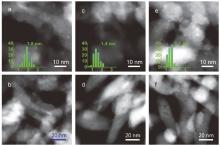
Fig 1
HAADF-STEM images of the Rh/HAP samples and the corresponding size distribution of Rh NPs. (a, b) Rh/HAP-dry, (c, d) Rh /HAP-O, (e, f) Rh /HAP-OR. The ordinates in the size distributions were manifested in percentage form."
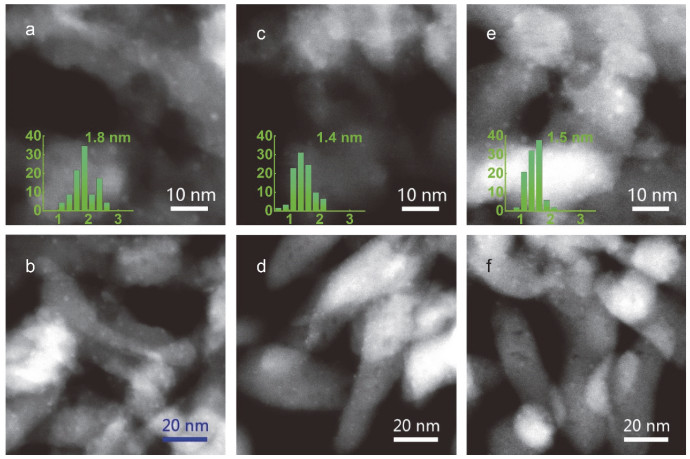
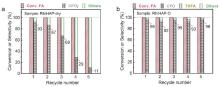
Fig 2
Catalytic performance of the series Rh/HAP samples for hydrogenation of FA; (a) Rh/HAP-dry; (b) Rh/HAP-O. Reaction conditions: 10 mg catalyst was used for each test, 5 g of 2 wt% aqueous solution of FA, pH2 = 3 MPa, 140 ℃, 6 h. Note: Due to the severe condensation of FA, the selectivity calculation for the Rh/HAP-dry sample suffer from a very poor carbon balance."
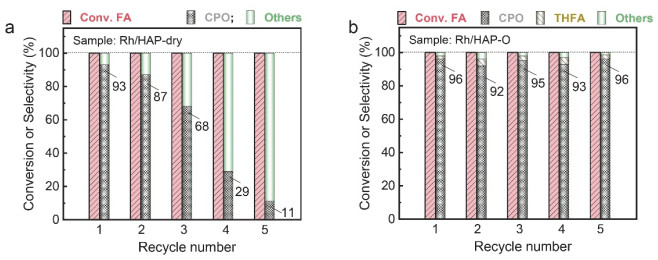
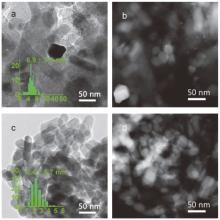
Fig 3
HRTEM and HAADF-STEM images of the Rh/HAP samples after 5 cycles of FA hydrogenation and the corresponding size distribution of Rh NPs. (a, b) spent Rh/HAP-dry; (c, d) spent Rh/HAP-O. The ordinates in the size distributions were manifested in percentage form."
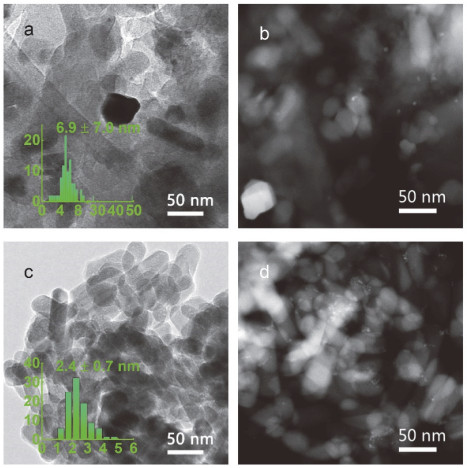
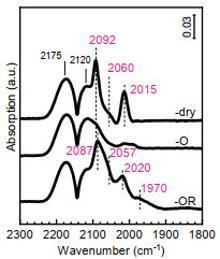
Fig 4
In situ DRIFT spectra of CO adsorption on the Rh/HAP samples obtained at 25 ℃."
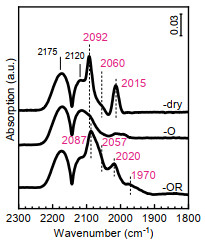
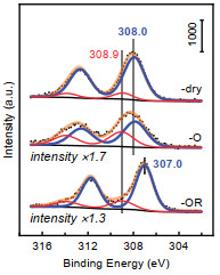
Fig 5
XPS Rh 3d spectra of a variety of Rh/HAP samples."
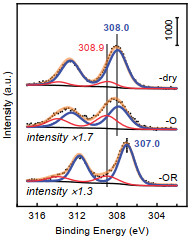
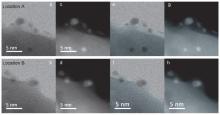
Fig 6
HRTEM and HAADF‑STEM images of the Rh NPs on the Rh/HAP-O sample. Figures e–h is a colored version of Figures a–d with additional colors to highlight the encapsulation layer on the surface of the Rh particles, respectively. Color online."
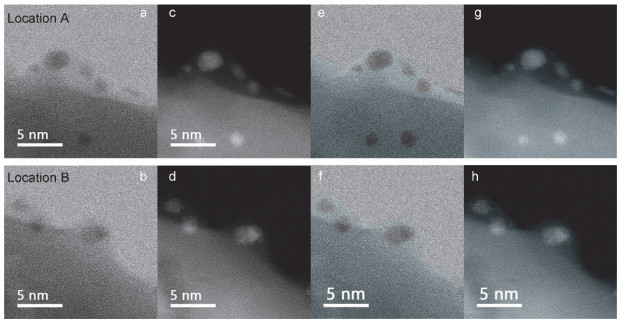
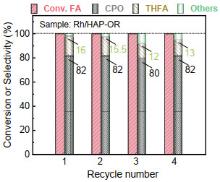
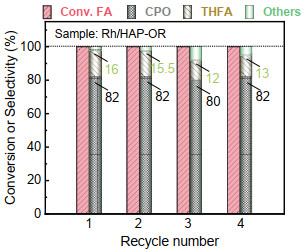
Fig 7
Catalytic performance of the Rh/HAP-OR sample for hydrogenation of FA; Reaction conditions: 10 mg catalyst was used for each test, 5 g of 2 wt% aqueous solution of FA pH2 = 3 MPa, 140 ℃, 6 h."
| 1 |
doi: 10.1021/jacs.3c09102 |
| 2 |
doi: 10.1021/acs.accounts.2c00727 |
| 3 |
doi: 10.1021/ja00469a029 |
| 4 |
doi: 10.1021/acscatal.2c05730 |
| 5 |
doi: 10.1021/jacs.0c08139 |
| 6 |
doi: 10.1002/anie.202214322 |
| 7 |
doi: 10.1038/s41929-021-00611-3 |
| 8 |
doi: 10.1126/sciadv.1700231 |
| 9 |
doi: 10.1021/ja3033235 |
| 10 |
doi: 10.1021/jacs.5b11306 |
| 11 |
doi: 10.1039/c8sc01392f |
| 12 |
doi: 10.1021/acs.jpclett.1c00934 |
| 13 |
doi: 10.1038/NCHEM.2607 |
| 14 |
doi: 10.1038/s41929-018-0067-8 |
| 15 |
doi: 10.1002/anie.201411581 |
| 16 |
doi: 10.1126/science.211.4487.1121 |
| 17 |
doi: 10.1002/smll.202204490 |
| 18 |
doi: 10.1007/s12274-022-4376-5 |
| 19 |
doi: 10.1002/anie.202003208 |
| 20 |
doi: 10.1002/anie.201601823 |
| 21 |
doi: 10.1002/ejoc.200300778 |
| 22 |
doi: 10.1016/s1566-7367(03)00095-5 |
| 23 |
doi: 10.1021/cm061388l |
| 24 |
|
| 25 |
doi: 10.1039/b919543m |
| 26 |
doi: 10.1039/c0cs00117a |
| 27 |
doi: 10.1016/j.jcat.2012.11.019 |
| 28 |
doi: 10.1021/cs5020496 |
| 29 |
doi: 10.1002/anie.201607885 |
| 30 |
doi: 10.1021/acscatal.8b03319 |
| 31 |
doi: 10.3866/PKU.WHXB202302041 |
| 32 |
doi: 10.1016/j.cattod.2013.10.082 |
| 33 |
doi: 10.1021/cm503061g |
| 34 |
doi: 10.1021/jp509649r |
| 35 |
doi: 10.1002/tcr.201600037 |
| 36 |
|
| 37 |
|
| [1] | Lele Feng, Xueying Bai, Jifeng Pang, Hongchen Cao, Xiaoyan Liu, Wenhao Luo, Xiaofeng Yang, Pengfei Wu, Mingyuan Zheng. Single-atom Pd boosted Cu catalysts for ethanol dehydrogenation [J]. Acta Phys. -Chim. Sin., 2025, 41(9): 100100-. |
| [2] | Mingxuan Qi, Lanyu Jin, Honghe Yao, Zipeng Xu, Teng Cheng, Qi Chen, Cheng Zhu, Yang Bai. Recent progress on electrical failure and stability of perovskite solar cells under reverse bias [J]. Acta Phys. -Chim. Sin., 2025, 41(8): 100088-. |
| [3] | Liuyun Chen, Wenju Wang, Tairong Lu, Xuan Luo, Xinling Xie, Kelin Huang, Shanli Qin, Tongming Su, Zuzeng Qin, Hongbing Ji. Soft template-induced deep pore structure of Cu/Al2O3 for promoting plasma-catalyzed CO2 hydrogenation to DME [J]. Acta Phys. -Chim. Sin., 2025, 41(6): 100054-. |
| [4] | Yuchen Zhou, Huanmin Liu, Hongxing Li, Xinyu Song, Yonghua Tang, Peng Zhou. Designing thermodynamically stable noble metal single-atom photocatalysts for highly efficient non-oxidative conversion of ethanol into high-purity hydrogen and value-added acetaldehyde [J]. Acta Phys. -Chim. Sin., 2025, 41(6): 100067-. |
| [5] | Xuejie Wang, Guoqing Cui, Congkai Wang, Yang Yang, Guiyuan Jiang, Chunming Xu. Research Progress on Carbon-based Catalysts for Catalytic Dehydrogenation of Liquid Organic Hydrogen Carriers [J]. Acta Phys. -Chim. Sin., 2025, 41(5): 100044-. |
| [6] | Pei Li, Yuenan Zheng, Zhankai Liu, An-Hui Lu. Boron-Containing MFI Zeolite: Microstructure Control and Its Performance of Propane Oxidative Dehydrogenation [J]. Acta Phys. -Chim. Sin., 2025, 41(4): 100034-. |
| [7] | Xin Zhou, Yiting Huo, Songyu Yang, Bowen He, Xiaojing Wang, Zhen Wu, Jianjun Zhang. Understanding the effect of pH on protonated COF during photocatalytic H2O2 production by femtosecond transient absorption spectroscopy [J]. Acta Phys. -Chim. Sin., 2025, 41(12): 100160-. |
| [8] | Qinhui Guan, Yuhao Guo, Na Li, Jing Li, Tingjiang Yan. Molecular sieve-mediated indium oxide catalysts for enhancing photocatalytic CO2 hydrogenation [J]. Acta Phys. -Chim. Sin., 2025, 41(11): 100133-. |
| [9] | Xiaorui Chen, Xuan Luo, Tongming Su, Xinling Xie, Liuyun Chen, Yuejing Bin, Zuzeng Qin, Hongbing Ji. Ga-doped Cu/γ-Al2O3 bifunctional interface sites promote the direct hydrogenation of CO2 to DME [J]. Acta Phys. -Chim. Sin., 2025, 41(10): 100126-. |
| [10] | Zhiyang Li, Hui Deng, Xinqi Cai, Zhuo Chen. Magnetic Core/Shell-Capsules Locally Neutralize Gastric Acid for Efficient Delivery of Active Probiotics [J]. Acta Phys. -Chim. Sin., 2024, 40(7): 2306051-. |
| [11] | Feifei Yang, Wei Zhou, Chaoran Yang, Tianyu Zhang, Yanqiang Huang. Enhanced Methanol Selectivity in CO2 Hydrogenation by Decoration of K on MoS2 Catalyst [J]. Acta Phys. -Chim. Sin., 2024, 40(7): 2308017-. |
| [12] | Yawen Guo, Dawei Li, Yang Gao, Cuihong Li. Recent Progress on Stability of Organic Solar Cells Based on Non-Fullerene Acceptors [J]. Acta Phys. -Chim. Sin., 2024, 40(6): 2306050-. |
| [13] | Meng-Yin Wang, Ruo-Bei Huang, Jian-Feng Xiong, Jing-Hua Tian, Jian-Feng Li, Zhong-Qun Tian. Critical Role and Recent Development of Separator in Zinc-Air Batteries [J]. Acta Phys. -Chim. Sin., 2024, 40(6): 2307017-. |
| [14] | Yameen Ahmed, Xiangxiang Feng, Yuanji Gao, Yang Ding, Caoyu Long, Mustafa Haider, Hengyue Li, Zhuan Li, Shicheng Huang, Makhsud I. Saidaminov, Junliang Yang. Interface Modification by Ionic Liquid for Efficient and Stable FAPbI3 Perovskite Solar Cells [J]. Acta Phys. -Chim. Sin., 2024, 40(6): 2303057-. |
| [15] | Junjian Wang, Qingquan Yu, Shunyao Liu, Yuke Chen, Xiaoyu Liu, Guodong Li, Xiaoyan Liu, Hong Liu, Weijia Zhou. Laser-Induced Carbonization of Hydroxyapatite Sandwich Paper for Inkless Printing [J]. Acta Phys. -Chim. Sin., 2024, 40(4): 2304024-. |
|
||