Acta Phys. -Chim. Sin. ›› 2022, Vol. 38 ›› Issue (1): 2012006.doi: 10.3866/PKU.WHXB202012006
Special Issue: Graphene: Functions and Applications
• REVIEW • Previous Articles Next Articles
Roles of Transition Metal Substrates in Graphene Chemical Vapor Deposition Growth
Ting Cheng1,2, Luzhao Sun1,2, Zhirong Liu1, Feng Ding3,4,*( ), Zhongfan Liu1,2,*()
- 1 Center for Nanochemistry, Beijing National Laboratory for Molecular Sciences, Academy for Advanced Interdisciplinary Studies, College of Chemistry and Molecular Engineering, Peking University, Beijing 100871, China
2 Beijing Graphene Institute (BGI), Beijing 100095, China
3 Centre for Multidimensional Carbon Materials, Institute for Basic Science, Ulsan 44919, Korea
4 School of Materials Science and Engineering, Ulsan National Institute of Science and Technology, Ulsan 44919, Korea
-
Received:2020-12-02Accepted:2020-12-25Published:2020-12-30 -
Contact:Feng Ding,Zhongfan Liu E-mail:f.ding@unist.ac.kr;zfliu@pku.edu.cn -
About author:Zhongfan Liu, Email: zfliu@pku.edu.cn
Feng Ding, Email: f.ding@unist.ac.kr
-
Supported by:the National Key R & D Program of China(2016YFA0200101);the National Natural Science Foundation of China(21773002);the Beijing National Laboratory for Molecular Sciences, China(BNLMS-CXTD-202001);the Beijing Municipal Science & Technology Commission, China(Z181100004818001);the Beijing Municipal Science & Technology Commission, China(Z191100000819005);the Beijing Municipal Science & Technology Commission, China(Z201100008720005)

Cite this article
Ting Cheng, Luzhao Sun, Zhirong Liu, Feng Ding, Zhongfan Liu. Roles of Transition Metal Substrates in Graphene Chemical Vapor Deposition Growth[J]. Acta Phys. -Chim. Sin. 2022, 38(1), 2012006. doi: 10.3866/PKU.WHXB202012006
share this article
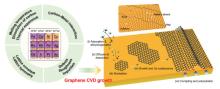
Fig 1
The roles of typical metal substrates in CVD growth of graphene and the elementary steps of graphene growth on metal surfaces."
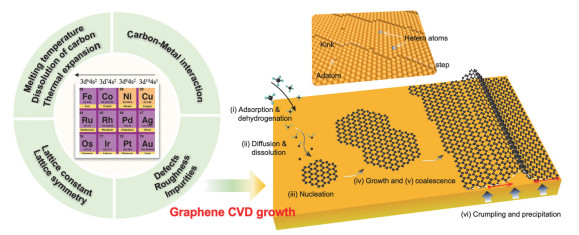
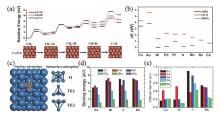
Fig 2
The behaviors of decomposition, absorption, and diffusion of active carbon species on various metal surface 53, 54. (a) Energy profiles and the corresponding structures of the initial and final states during the full decomposition of CH4 on Cu (111) surfaces; (b) Comparison of the activities of various metal surfaces based on the overall reaction energy of CH4 decomposition; (c) Surface and subsurface absorption sites including the top (T), hcp hollow (H), fcc hollow (F), bridge (B) sites, and one octahedral (O), two tetrahedral sites (TE1 and TE2). (d, e) Binding energies (d) and diffusion barriers (e) of various CHi species on four representative metal surfaces (Cu, Ni, Ir and Rh). C-I and C-II represent the carbon atom on the metal surface and subsurface, respectively. (a, b) Adapted with permission from Ref. 53. Copyright 2017, the Royal Society of Chemistry. (c–e) Adapted with permission from Ref. 54. Copyright 2017, the Royal Society of Chemistry."
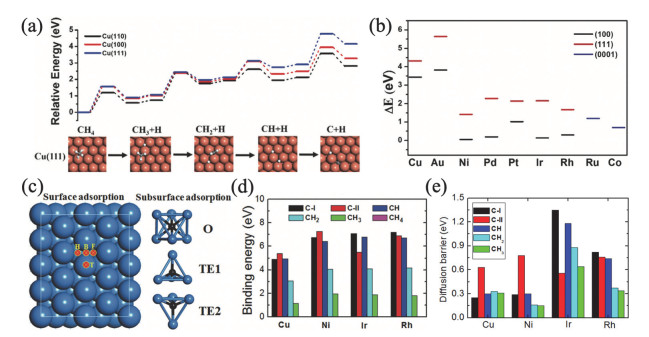
Fig 3
The effects of alloy composition on the nucleation density and domain size of graphene 59. (a) Graphene nucleation density and grain size as a function of Ni content in the CuNi alloy; (b) The formation energies of C24 cluster on CuNi alloy surfaces without/with dissolved C atoms. (c–d) C diffusion on the CuNi alloy surface and through bulk with Ni composition of (c) 12.5% and (d) 25%. Adapted with permission from Ref. 59. Copyright 2018, Wiley-VCH."
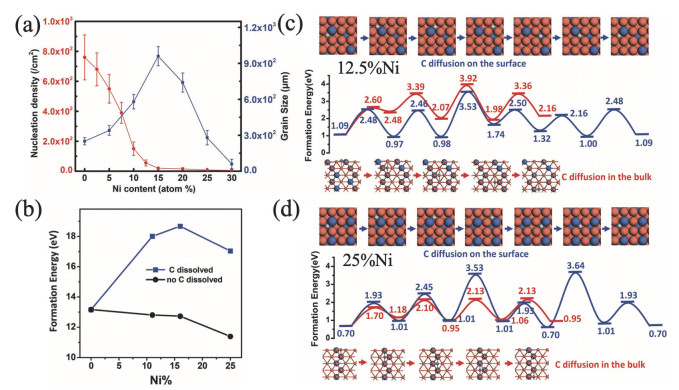
Fig 4
The role of the metal surface in controlling the crystallographic orientation of graphene 60, 61. (a–c) Illustration of single-crystalline graphene growth on a polycrystalline catalyst surface via the edge epitaxy mechanism; (d) Illustration of the three modes of graphene growth: the step-attached (SA) mode, the on-terrace (OT) mode and the sunk (S) mode; (e) Illustration of the two potential combinations of graphene growth modes on different catalyst surface and the consequent large area graphene: SA + OT growth on rigid catalyst surface and SA + S growth on soft catalyst surface; (f) Relationship between formation energy of metal step (EMS) and △E. For metals with small EMS (soft metals such as Au, Pd, and Cu), the S growth mode is prederred, whereas for metals with large EMS (hard metals such as Ni, Rh, Ru, and Ir) the OT growth mode dominates. (a–c) Adapted with permission from Ref. 60. Copyright 2012, American Chemical Society. (d–f) Adapted with permission from Ref. 61. Copyright 2014, American Chemical Society."
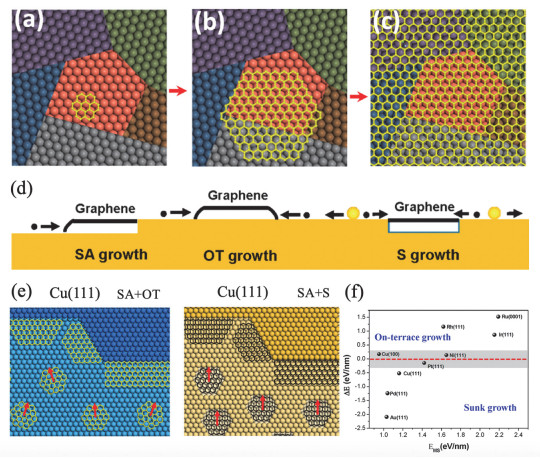
Fig 5
The incorporation of carbon atom of graphene edge assisted by metal atoms 66. (a) Pristine AC graphene edge and AC edge terminated by isolated Cu atoms (labeled by AC-Cu-I). The relative formation energy of each structure relative to pristine AC edge are shown; (b) Formation energies of metal-terminated graphene edges on Au(111), Cu(111), Ni(111) and Rh(111) surfaces as a function of relative binding energy interaction EC/EM.EC and EM are the absorption energy of a carbon atom on metal surfaces and the cohesive energy of bulk metals, respectively; (c) Repeatable cycles of incorporating two C atoms onto Cu-terminated AC graphene edges on the Cu(111) surface. The circled regions represent the growth site. Small black and large orange balls represent C and Cu atoms, respectively. The Cu atoms that terminate the graphene edges are highlighted by green. Adapted with permission from Ref. 66. Copyright 2012, American Chemistry Society."
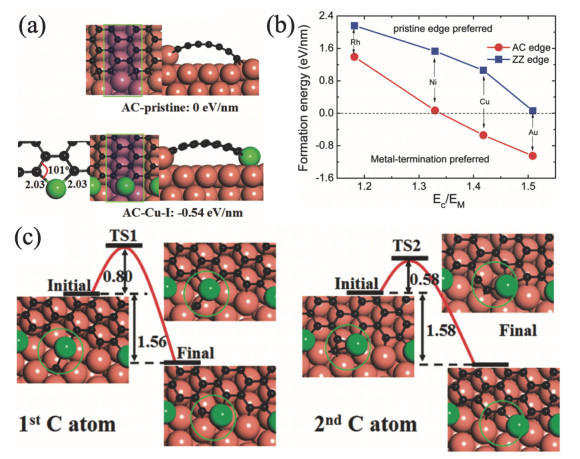
Fig 6
The healing of point defect of graphene assisted by metal atoms 69, 70. (a) Healing barriers of an SW defect without/with the absorption of a Ni atom; (b) Optimized structures of a SV (3DB) and a DV (4DB@M) in graphene on the Cu surface. Carbon atoms around defect and the extra metal adatom in 4DB@M are highlighted by green and blue, respectively; (c) Defect healing process in graphene on Cu(111) and Ni(111) surfaces with two additional carbon atoms.(a) Adapted with permission from Ref. 70. Copyright 2013, American Chemistry Society. (b, c) Adapted with permission from Ref. 69. Copyright 2013, American Chemistry Society."
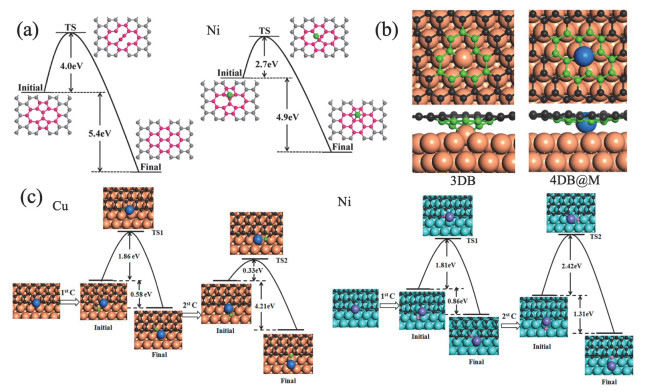
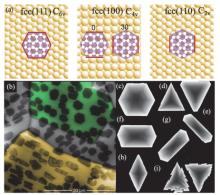
Fig 7
The effect of symmetry of substrate surface on the graphene morphology 74. (a) Alignment of single crystalline graphene islands with various symmetries on low-index fcc surfaces. The < 110 > orientations of substrates are denoted by green lines and islands are represented by purple polygons. The symmetry groups and the number of symmetry operations are provided. (b) Scanning electron microscopy image of graphene grains on a polycrystalline Cu foil with two largest grains highlighted in color; (c–i) Monte Carlo modeling of growth: (c) isotropic kinetics, Cu(111); (d, e) Ni(111): (d) with a 103 difference between growth probabilities for ▽ and △ directions, and (e) a 101 ∆ : ▽ probability ratio; (f) two slow directions representing Cu(100); (g) two slow directions but with two degenerate orientations, Cu(110); (h) same as (g) but with two fast directions; (i) calculations with diffusion. Brightness represents time, lighter cells are more recently added. (b–i) Adapted with permission from Ref. 74. Copyright 2015, American Physics Society."
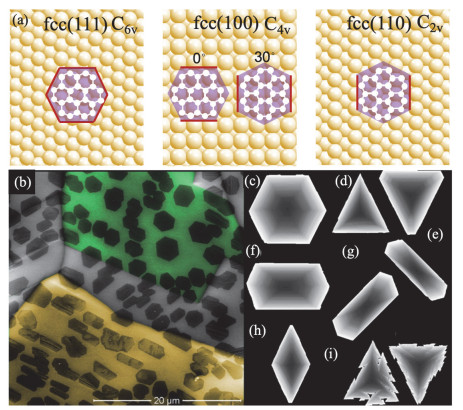
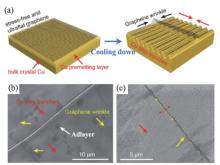
Fig 8
Corrugation of graphene grown on Cu substrates during the cooling process 79. (a) Schematic of ultraflat graphene on Cu with a premelting layer and the corrugation process during cooling. (b) SEM images of graphene grown on polycrystalline Cu foil. The red, yellow, and white arrows showed Cu step bunches, graphene wrinkles, and graphene adlayers, respectively. (c) SEM image of a graphene wrinkle. Adapted with permission from Ref. 79. Copyright 2018, Wiley-VCH."

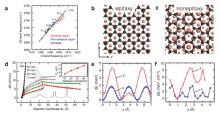
Fig 9
Friction and adhesion effect on the wrinkle formation 83. (a) Correlation between the frequencies of the G and 2D bands acquired from wrinkles, epitaxial, and nonepitaxial graphene regions. The fitted line shows epitaxial graphene that is biaxially strained with ΔωG/Δε= −0.56 cm−1, and Δω2D/Δε= −1.55 cm−1. Structures of (b) epitaxial and (c) nonepitaxial graphene on the Cu(111) surface. (d) The variation of energy of graphene wrinkles of different shapes compared to unstrained flat graphene (ΔE), where the strain energy of a compressed flat graphene is shown for comparison. Representative structures of graphene during wrinkle formation are also shown in the bottom of panel. (e) Epitaxial and (f) nonepitaxial graphene sliding in the x (horizontal) and y (vertical) directions of the Cu(111) surface. Adapted with permission from Ref. 83. Copyright 2018, Wiley-VCH."
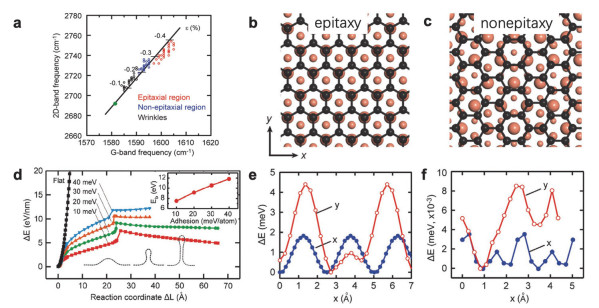
Fig 10
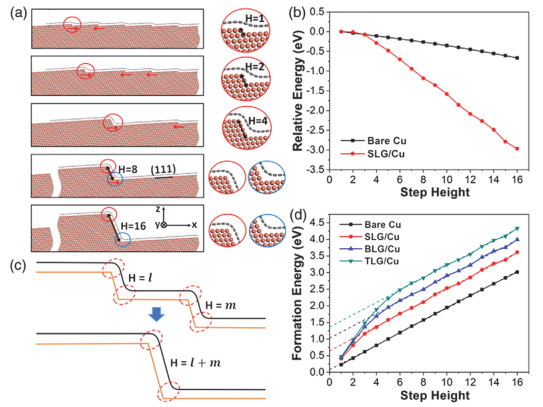
The step-bunching (SB) formation for graphene covered Cu during the cooling process 85. (a) The process of the Cu(111) surface SB beneath a graphene layer. A series of images from top to bottom showing the increase in height of the highest step in each configuration, marked by black arrows with H = 1, 2, 4, 8, 16. (b) The relative energy variation of bare Cu (black line) and SLG-covered Cu (red line) during the SB process. (c) Schematic illustrations showing the different ways of bending of the graphene overlayer during the SB process. (d) Formation energies of bare Cu (black line) and Cu covered by SLG (red line), BLG (blue line), and TLG (green line), as a function of the step height. Adapted with permission from Ref. 85. Copyright 2018, American Physics Society."
| 1 |
Chen J.-H. ; Jang C. ; Xiao S. D. ; Ishigami M. ; Fuhrer M. S. Nat. Nanotechnol. 2008, 3, 206.
doi: 10.1038/nnano.2008.58 |
| 2 |
Balandin A. A. ; Ghosh S. ; Bao W. Z. ; Calizo I. ; Teweldebrhan D. ; Miao F. ; Lau C. N. Nano Lett. 2008, 8, 902.
doi: 10.1021/nl0731872 |
| 3 |
Cheng T. ; Lang H. F. ; Li Z. Z. ; Liu Z. F. ; Liu Z. R. Phys. Chem. Chem. Phys. 2017, 19, 23942.
doi: 10.1039/c7cp03736h |
| 4 |
Lin L. ; Deng B. ; Sun J. Y. ; Peng H. ; Liu Z. Chem. Rev. 2018, 118, 9281.
doi: 10.1021/acs.chemrev.8b00325 |
| 5 |
Nair R. R. ; Blake P. ; Grigorenko A. N. ; Novoselov K. S. ; Booth T. J. ; Stauber T. ; Peres N. M. R. ; Geim A. K. Science 2008, 320, 1308.
doi: 10.1126/science.1156965 |
| 6 |
Lee C. ; Wei X. D. ; Kysar J. W. ; Hone J. Science 2008, 321, 385.
doi: 10.1126/science.1157996 |
| 7 |
Kim K. S. ; Zhao Y. ; Jang H. ; Lee S. Y. ; Kim J. M. ; Kim K. S. ; Ahn J.-H. ; Kim P. ; Choi J.-Y. ; Hong B. H. Nature 2009, 457, 706.
doi: 10.1038/nature07719 |
| 8 |
Novoselov K. S. ; Falko V. I. ; Colombo L. ; Gellert P. R. ; Schwab M. G. ; Kim K. Nature 2012, 490, 192.
doi: 10.1038/nature11458 |
| 9 | Chen X. D. ; Chen Z. L. ; Sun J. Y. ; Zhang Y. F. ; Liu Z. F. Acta Phys. -Chim. Sin. 2016, 32, 14. |
|
陈旭东; 陈召龙; 孙靖宇; 张艳锋; 刘忠范. 物理化学学报, 2016, 32, 14.
doi: 10.3866/PKU.WHXB201511133 |
|
| 10 | Chen Z. L. ; Gao P. ; Liu Z. F. Acta Phys. -Chim. Sin. 2020, 36, 1907004. |
|
陈召龙; 高鹏; 刘忠范. 物理化学学报, 2020, 36, 1907004.
doi: 10.3866/PKU.WHXB201907004 |
|
| 11 |
Deng B. ; Liu Z. ; Peng H. Adv. Mater. 2019, 31, e1800996.
doi: 10.1002/adma.201800996 |
| 12 |
Jia K. C. ; Zhang J. C. ; Lin L. ; Li Z. ; Gao J. ; Sun L. ; Xue R. ; Li J. ; Kang N. ; Luo Z. ; et al J. Am. Chem. Soc. 2019, 141, 7670.
doi: 10.1021/jacs.9b02068 |
| 13 |
Lin L. ; Zhang J. C. ; Su H. S. ; Li J. Y. ; Sun L. Z. ; Wang Z. H. ; Xu F. ; Liu C. ; Lopatin S. ; Zhu Y. H. ; et al Nat. Commun. 2019, 10, 1912.
doi: 10.1038/s41467-019-09565-4 |
| 14 |
Sun L. Z. ; Lin L. ; Wang Z. H. ; Rui D. ; Yu Z. ; Zhang J. ; Li Y. ; Liu X. ; Jia K. ; Wang K. ; et al Adv. Mater. 2019, 31, 1902978.
doi: 10.1002/adma.201902978 |
| 15 |
Zhang J. C. ; Jia K. C. ; Lin L. ; Zhao W. ; Huy Ta Q. ; Sun L. ; Li T. ; Li Z. ; Liu X. ; Zheng L. ; et al Angew. Chem. Int. Ed. 2019, 58, 14446.
doi: 10.1002/anie.201905672 |
| 16 |
Jia K. C. ; Ci H. N. ; Zhang J. C. ; Sun Z. ; Ma Z. ; Zhu Y. ; Liu S. ; Liu J. ; Sun L. ; Liu X. ; et al Angew. Chem. Int. Ed. 2020, 59, 17214.
doi: 10.1002/anie.202005406 |
| 17 |
Jacobberger R. M. ; Arnold M. S. Chem. Mater 2013, 25, 871.
doi: 10.1021/cm303445s |
| 18 |
Meng L. ; Wu R. T. ; Zhang L. Z. ; Li L. F. ; Du S. X. ; Wang Y. L. ; Gao H.-J. J. Phys.: Condens. Matter 2012, 24, 314214.
doi: 10.1088/0953-8984/24/31/314214 |
| 19 | Zhang Y. F. ; Gao T. ; Zhang Y. ; Liu Z. F. Acta Phys. -Chim. Sin. 2012, 28, 2456. |
|
张艳锋; 高腾; 张玉; 刘忠范. 物理化学学报, 2012, 28, 2456.
doi: 10.3866/PKU.WHXB201209062 |
|
| 20 |
Dai B. Y. ; Fu L. ; Zou Z. Y. ; Wang M. ; Xu H. T. ; Wang S. ; Liu Z. F. Nat. Commun. 2011, 2, 522.
doi: 10.1038/ncomms1539 |
| 21 |
Ma T. ; Ren W. C. ; Zhang X. Y. ; Liu Z. ; Gao Y. ; Yin L.-C. ; Ma X.-L. ; Ding F. ; Cheng H.-M. Proc. Natl. Acad. Sci. U.S.A. 2013, 110, 20386.
doi: 10.1073/pnas.1312802110 |
| 22 |
Xu X. Z. ; Zhang Z. H. ; Dong J. C. ; Yi D. ; Niu J. ; Wu M. ; Lin L. ; Yin R. ; Li M. ; Zhou J. ; et al Sci. Bull. 2017, 62, 1074.
doi: 10.1016/j.scib.2017.07.005 |
| 23 |
Deng B. ; Xin Z. W. ; Xue R. W. ; Zhang S. Q. ; Xu X. Z. ; Gao J. ; Tang J. L. ; Qi Y. ; Wang Y. N. ; Zhao Y. ; et al Sci. Bull. 2019, 64, 659.
doi: 10.1016/j.scib.2019.04.030 |
| 24 |
Liu N. ; Fu L. ; Dai B. ; Yan K. ; Liu X. ; Zhao R. ; Zhang Y. ; Liu Z. Nano Lett. 2011, 11, 297.
doi: 10.1021/nl103962a |
| 25 |
Ma W. ; Chen M.-L. ; Yin L. ; Liu Z. ; Li H. ; Xu C. ; Xin X. ; Sun D.-M. ; Cheng H.-M. ; Ren W. Nat. Commun. 2019, 10, 2809.
doi: 10.1038/s41467-019-10691-2 |
| 26 |
Huang M. ; Bakharev P. V. ; Wang Z.-J. ; Biswal M. ; Yang Z. ; Jin S. ; Wang B. ; Park H. J. ; Li Y. ; Qu D. ; et al Nat. Nanotechnol. 2020, 15, 289.
doi: 10.1038/s41565-019-0622-8 |
| 27 |
Van Luan N. ; Dinh Loc D. ; Lee S. H. ; Avila J. ; Han G. ; Kim Y.-M. ; Asensio M. C. ; Jeong S.-Y. ; Lee Y. H. Nat. Nanotechnol. 2020, 15, 861.
doi: 10.1038/s41565-020-0743-0 |
| 28 |
Zhang J. C. ; Sun L. Z. ; Jia K. C. ; Liu X. T. ; Cheng T. ; Peng H. ; Lin L. ; Liu Z. ACS Nano 2020, 14, 10796.
doi: 10.1021/acsnano.0c06141 |
| 29 |
Mattevi C. ; Kim H. ; Chhowalla M. J. Mater. Chem. 2011, 21, 3324.
doi: 10.1039/c0jm02126a |
| 30 | Earnshaw A. ; Harrington T. J. Inorganic Chemistry of the Transition Elements 6th ed. Oxford, UK: Oxford University Press, 1972, pp. 210- 394. |
| 31 |
Qi Y. ; Meng C. X. ; Xu X. Z. ; Deng B. ; Han N. ; Liu M. ; Hong M. ; Ning Y. ; Liu K. ; Zhao J. ; et al J. Am. Chem. Soc. 2017, 139, 17574.
doi: 10.1021/jacs.7b09755 |
| 32 |
Li X. S. ; Cai W. W. ; Colombo L. ; Ruoff R. S. Nano Lett. 2009, 9, 4268.
doi: 10.1021/nl902515k |
| 33 |
Reina A. ; Thiele S. ; Jia X. T. ; Bhaviripudi S. ; Dresselhaus M. S. ; Schaefer J. A. ; Kong J. Nano Res. 2009, 2, 509.
doi: 10.1007/s12274-009-9059-y |
| 34 |
Geng D. C. ; Wu B. ; Guo Y. L. ; Huang L. P. ; Xue Y. Z. ; Chen J. Y. ; Yu G. ; Jiang L. ; Hu W. P. ; Liu Y. Q. Proc. Natl. Acad. Sci. U.S.A. 2012, 109, 7992.
doi: 10.1073/pnas.1200339109 |
| 35 |
Li Y. ; Sun L. ; Liu H. ; Wang Y. ; Liu Z. Inorg. Chem. Front. 2021, 8, 182.
doi: 10.1039/D0QI00923G |
| 36 |
Zhao C. ; Liu F. N. ; Kong X. ; Yan T. ; Ding F. Int. J. Smart Nano Mater. 2020, 11, 277.
doi: 10.1080/19475411.2020.1820621 |
| 37 |
Zhang J. C. ; Lin L. ; Jia K. C. ; Sun L. Z. ; Peng H. L. ; Liu Z. F. Adv. Mater. 2020, 32, 1903266.
doi: 10.1002/adma.201903266 |
| 38 |
Cheng H. M. Nat. Nanotechnol. 2014, 9, 726.
doi: 10.1038/nnano.2014.229 |
| 39 | Wang K. X. ; Shi L. R. ; Wang M. Z. ; Yang H. ; Liu Z. F. ; Peng H. L. Acta Phys. -Chim. Sin. 2019, 35, 1112. |
|
王可心; 史刘嵘; 王铭展; 杨皓; 刘忠范; 彭海琳. 物理化学学报, 2019, 35, 1112.
doi: 10.3866/PKU.WHXB201805032 |
|
| 40 |
Xie Y. D. ; Cheng T. ; Liu C. ; Chen Y. ; Chen Z. L. ; Qiu L. ; Cui G. ; Yu Y. ; Cui L. Z. ; Zhang M. T. ; et al ACS Nano 2019, 13, 10272.
doi: 10.1021/acsnano.9b03596 |
| 41 |
Chen Z. L. ; Chang H. L. ; Cheng T. ; Wei T. ; Wang R. ; Yang S. ; Dou Z. ; Liu B. ; Zhang S. ; Xie Y. ; et al Adv. Funct. Mater. 2020, 30, 2001483.
doi: 10.1002/adfm.202001483 |
| 42 | Cheng Y. ; Wang K. ; Qi Y. ; Liu Z. F. Acta Phys. -Chim. Sin. 2021, 37, 2006046. |
|
程熠; 王坤; 亓月; 刘忠范. 物理化学学报, 2021, 37, 2006046.
doi: 10.3866/PKU.WHXB202006046 |
|
| 43 |
Zhang W. ; Wu P. ; Li Z. ; Yang J. J. Phys. Chem. C 2011, 115, 17782.
doi: 10.1021/jp2006827 |
| 44 | Wang L. ; Gao J. F. ; Ding F. Acta Chim. Sin. 2014, 72, 345. |
|
王璐; 高峻峰; 丁峰. 化学学报, 2014, 72, 345.
doi: 10.6023/a13090984 |
|
| 45 |
Wu P. ; Zhang W. ; Li Z. ; Yang J. Small 2014, 10, 2136.
doi: 10.1002/smll.201303680 |
| 46 | Li P. ; Li Z. ; Yang J. J. Phys. Chem. C 2017, 121, 25949. |
| 47 |
Qiu Z. ; Li P. ; Li Z. ; Yang J. Acc. Chem. Res. 2018, 51, 728.
doi: 10.1021/acs.accounts.7b00592 |
| 48 |
Dong J. C. ; Zhang L. N. ; Ding F. Adv. Mater 2019, 31, 1801583.
doi: 10.1002/adma.201801583 |
| 49 |
Cheng T. ; Tan C. W. ; Zhang S. Q. ; Tu T. ; Peng H. ; Liu Z. J. Phys. Chem. C 2018, 122, 19970.
doi: 10.1021/acs.jpcc.8b05475 |
| 50 |
Cheng T. ; Liu Z. F. ; Liu Z. R. J. Mater. Chem. C 2020, 8, 13819.
doi: 10.1039/d0tc03253k |
| 51 |
Yuan S. ; Meng L. ; Wang J. J. Phys. Chem. C 2013, 117, 14796.
doi: 10.1021/jp400944c |
| 52 |
Wu T. R. ; Zhang X. F. ; Yuan Q. H. ; Xue J. C. ; Liu Z. H. ; Wang H. S. ; Wang H. M. ; Ding F. ; Yu Q. K. ; Xie X. M. ; et al Nat. Mater. 2016, 15, 43.
doi: 10.1038/nmat4477 |
| 53 |
Wang X. L. ; Yuan Q. L. ; Li J. ; Ding F. Nanoscale 2017, 9, 11584.
doi: 10.1039/c7nr02743e |
| 54 |
Shu H. B. ; Tao X.-M. ; Ding F. Nanoscale 2015, 7, 1627.
doi: 10.1039/c4nr05590j |
| 55 |
Wu P. ; Zhang Y. ; Cui P. ; Li Z. Y. ; Yang J. L. ; Zhang Z. Y. Phys. Rev. Lett. 2015, 114, 216102.
doi: 10.1103/PhysRevLett.114.216102 |
| 56 |
Gao J. ; Yip J. ; Zhao J. ; Yakobson B. I. ; Ding F. J. Am. Chem. Soc. 2011, 133, 5009.
doi: 10.1021/ja110927p |
| 57 |
Xu Z. W. ; Yan T. Y. ; Liu G. W. ; Qiao G. ; Ding F. Nanoscale 2016, 8, 921.
doi: 10.1039/c5nr06016h |
| 58 |
Sun L. ; Lin L. ; Zhang J. ; Wang H. ; Peng H. ; Liu Z. Nano Res. 2017, 10, 355.
doi: 10.1007/s12274-016-1297-1 |
| 59 |
Liu Y. ; Wu T. ; Yin Y. ; Zhang X. ; Yu Q. ; Searles D. J. ; Ding F. ; Yuan Q. ; Xie X. Adv. Sci. 2018, 5, 1700961.
doi: 10.1002/advs.201700961 |
| 60 |
Zhang X. Y. ; Xu Z. W. ; Hui L. ; Xin J. ; Ding F. J. Phys. Chem. Lett. 2012, 3, 2822.
doi: 10.1021/jz301029g |
| 61 |
Yuan Q. H. ; Yakobson B. I. ; Ding F. J. Phys. Chem. Lett. 2014, 5, 3093.
doi: 10.1021/jz5015899 |
| 62 |
Xu Z. W. ; Zhao G. H. ; Qiu L. ; Zhang X. Y. ; Ding F. NPJ Comput. Mater. 2020, 6, 14.
doi: 10.1038/s41524-020-0281-1 |
| 63 |
Li Y. ; Sun L. Z. ; Chang Z. H. ; Liu H. Y. ; Wang Y. C. ; Liang Y. ; Chen B. H. ; Ding Q. J. ; Zhao Z. Y. ; Wang R. Y. ; et al Adv. Mater. 2020, 32, 2002034.
doi: 10.1002/adma.202002034 |
| 64 |
Wu M. H. ; Zhang Z. B. ; Xu X. Z. ; Zhang Z. H. ; Dong J. C. ; Qiao R. X. ; You S. F. ; Wang L. ; Qi J. J. ; Zou D. X. ; et al Nature 2020, 581, 406.
doi: 10.1038/s41586-020-2298-5 |
| 65 |
Yang P. ; Zhang S. ; Pan S. ; Tang B. ; Liang Y. ; Zhao X. ; Zhang Z. ; Shi J. ; Huan Y. ; Shi Y. ; et al ACS Nano 2020, 14, 5036.
doi: 10.1021/acsnano.0c01478 |
| 66 |
Shu H. B. ; Chen X. S. ; Tao X. M. ; Ding F. ACS Nano 2012, 6, 3243.
doi: 10.1021/nn300726r |
| 67 |
Li P. ; Li Z. ; Yang J. J. Phys. Chem. C 2017, 121, 25949.
doi: 10.1021/acs.jpcc.7b09622 |
| 68 |
Wu P. ; Jiang H. ; Zhang W. ; Li Z. ; Hou Z. ; Yang J. J. Am. Chem. Soc. 2012, 134, 6045.
doi: 10.1021/ja301791x |
| 69 |
Yazyev O. V. ; Chen Y. P. Nat. Nanotechnol. 2014, 9, 755.
doi: 10.1038/nnano.2014.166 |
| 70 |
Meng L. J. ; Jiang J. ; Wang J. L. ; Ding F. J. Phys. Chem. C 2013, 118, 720.
doi: 10.1021/jp409471a |
| 71 |
Wang L. ; Zhang X. Y. ; Chan H. L. W. ; Yan F. ; Ding F. J. Am. Chem. Soc. 2013, 135, 4476.
doi: 10.1021/ja312687a |
| 72 |
Yuan Q. ; Song G. ; Sun D. ; Ding F. Sci. Rep. 2014, 4, 6541.
doi: 10.1038/srep06541 |
| 73 |
Dong J. ; Zhang L. ; Dai X. ; Ding F. Nat. Commun. 2020, 11, 5862.
doi: 10.1038/s41467-020-19752-3 |
| 74 | Artyukhov V. I. ; Hao Y. F. ; Ruoff R. S. ; Yakobson B. I. Phys. Rev. Lett. 2015, 114, 115502. |
| 75 |
Wang C. ; Liu Y. ; Li L. ; Tan H. Nanoscale 2014, 6, 5703.
doi: 10.1039/c4nr00423j |
| 76 |
Bronsgeest M. S. ; Bendiab N. ; Mathur S. ; Kimouche A. ; Johnson H. T. ; Coraux J. ; Pochet P. Nano Lett. 2015, 15, 5098.
doi: 10.1021/acs.nanolett.5b01246 |
| 77 |
de Lima A. L. ; Mussnich L. A. ; Manhabosco T. M. ; Chacham H. ; Batista R. J. ; de Oliveira A. B. Nanotechnology 2015, 26, 045707.
doi: 10.1088/0957-4484/26/4/045707 |
| 78 |
Shaina P. R. ; George L. ; Yadav V. ; Jaiswal M. J. Phys.-Condes. Matter 2016, 28, 085301.
doi: 10.1088/0953-8984/28/8/085301 |
| 79 |
Deng B. ; Wu J. ; Zhang S. ; Qi Y. ; Zheng L. ; Yang H. ; Tang J. ; Tong L. ; Zhang J. ; Liu Z. ; et al Small 2018, 14, 1800725.
doi: 10.1002/smll.201800725 |
| 80 |
Zhu W. ; Low T. ; Perebeinos V. ; Bol A. A. ; Zhu Y. ; Yan H. ; Tersoff J. ; Avouris P. Nano Lett. 2012, 12, 3431.
doi: 10.1021/nl300563h |
| 81 |
Nicholl R. J. T. ; Conley H. J. ; Lavrik N. V. ; Vlassiouk I. ; Puzyrev Y. S. ; Sreenivas V. P. ; Pantelides S. T. ; Bolotin K. I. Nat. Commun. 2015, 6
doi: 10.1038/ncomms9789 |
| 82 |
Deng B. ; Pang Z. Q. ; Chen S. L. ; Li X. ; Meng C. ; Li J. ; Liu M. ; Wu J. ; Qi Y. ; Dang W. ; et al ACS Nano 2017, 11, 12337.
doi: 10.1021/acsnano.7b06196 |
| 83 |
Li B.-W. ; Luo D. ; Zhu L. Y. ; Zhang X. ; Jin S. ; Huang M. ; Ding F. ; Ruoff R. S. Adv. Mater. 2018, 30, 1706504.
doi: 10.1002/adma.201706504 |
| 84 |
Pang Z. Q. ; Deng B. ; Liu Z. F. ; Peng H. ; Wei Y. Carbon 2019, 143, 736.
doi: 10.1016/j.carbon.2018.11.059 |
| 85 |
Yi D. ; Luo D. ; Wang Z.-J. ; Dong J. C. ; Zhang X. ; Willinger M. G. ; Ruoff R. S. ; Ding F. Phys. Rev. Lett. 2018, 120, 246101.
doi: 10.1103/PhysRevLett.120.246101 |
| [1] | Shiyi Chen, Jialong Fu, Jianping Qiu, Guoju Chang, Shiyou Hao. Waste medical mask-derived carbon quantum dots enhance the photocatalytic degradation of polyethylene terephthalate (PET) over BiOBr/g-C3N4 S-scheme heterojunction [J]. Acta Phys. -Chim. Sin., 2026, 42(1): 100135-. |
| [2] | Chengxiao Zhao, Zhaolin Li, Dongfang Wu, Xiaofei Yang. SBA-15 templated covalent triazine frameworks for boosted photocatalytic hydrogen production [J]. Acta Phys. -Chim. Sin., 2026, 42(1): 100149-. |
| [3] | Jianan Hong, Chenyu Xu, Yan Liu, Changqi Li, Menglin Wang, Yanwei Zhang. Decoding the interfacial competition between hydrogen evolution and CO2 reduction via edge-active-site modulation in photothermal catalysis [J]. Acta Phys. -Chim. Sin., 2025, 41(9): 100099-. |
| [4] | Menglan Wei, Xiaoxia Ou, Yimeng Wang, Mengyuan Zhang, Fei Teng, Kaixuan Wang. S-scheme heterojunction g-C3N4/Bi2WO6 highly efficient degradation of levofloxacin: performance, mechanism and degradation pathway [J]. Acta Phys. -Chim. Sin., 2025, 41(9): 100105-. |
| [5] | Jingping Li, Suding Yan, Jiaxi Wu, Qiang Cheng, Kai Wang. Improving hydrogen peroxide photosynthesis over inorganic/organic S-scheme photocatalyst with LiFePO4 [J]. Acta Phys. -Chim. Sin., 2025, 41(9): 100104-. |
| [6] | Ruizhi Duan, Xiaomei Wang, Panwang Zhou, Yang Liu, Can Li. The role of hydroxyl species in the alkaline hydrogen evolution reaction over transition metal surfaces [J]. Acta Phys. -Chim. Sin., 2025, 41(9): 100111-. |
| [7] | Fengying Zhang, Yanglin Mei, Yuman Jiang, Shenshen Zheng, Kaibo Zheng, Ying Zhou. Research progress of transient absorption spectroscopy in solar energy conversion and utilization [J]. Acta Phys. -Chim. Sin., 2025, 41(9): 100118-. |
| [8] | Jiajie Cai, Chang Cheng, Bowen Liu, Jianjun Zhang, Chuanjia Jiang, Bei Cheng. CdS/DBTSO-BDTO S-scheme photocatalyst for H2 production and its charge transfer dynamics [J]. Acta Phys. -Chim. Sin., 2025, 41(8): 100084-. |
| [9] | Lewang Yuan, Yaoyao Peng, Zong-Jie Guan, Yu Fang. Insights into the development of 2D covalent organic frameworks as photocatalysts in organic synthesis [J]. Acta Phys. -Chim. Sin., 2025, 41(8): 100086-. |
| [10] | Yu Wang, Haiyang Shi, Zihan Chen, Feng Chen, Ping Wang, Xuefei Wang. Hollow AgPt@Pt core-shell cocatalyst with electron-rich Ptδ− shell for boosting selectivity of photocatalytic H2O2 production for faceted BiVO4 [J]. Acta Phys. -Chim. Sin., 2025, 41(7): 100081-. |
| [11] | Honghong Zhang, Zhen Wei, Derek Hao, Lin Jing, Yuxi Liu, Hongxing Dai, Weiqin Wei, Jiguang Deng. Recent advances in synergistic catalytic valorization of CO2 and hydrocarbons by heterogeneous catalysis [J]. Acta Phys. -Chim. Sin., 2025, 41(7): 100073-. |
| [12] | Yadan Luo, Hao Zheng, Xin Li, Fengmin Li, Hua Tang, Xilin She. Modulating reactive oxygen species in O, S co-doped C3N4 to enhance photocatalytic degradation of microplastics [J]. Acta Phys. -Chim. Sin., 2025, 41(6): 100052-. |
| [13] | Liuyun Chen, Wenju Wang, Tairong Lu, Xuan Luo, Xinling Xie, Kelin Huang, Shanli Qin, Tongming Su, Zuzeng Qin, Hongbing Ji. Soft template-induced deep pore structure of Cu/Al2O3 for promoting plasma-catalyzed CO2 hydrogenation to DME [J]. Acta Phys. -Chim. Sin., 2025, 41(6): 100054-. |
| [14] | Yuchen Zhou, Huanmin Liu, Hongxing Li, Xinyu Song, Yonghua Tang, Peng Zhou. Designing thermodynamically stable noble metal single-atom photocatalysts for highly efficient non-oxidative conversion of ethanol into high-purity hydrogen and value-added acetaldehyde [J]. Acta Phys. -Chim. Sin., 2025, 41(6): 100067-. |
| [15] | Jiahao Lu, Xin Ming, Yingjun Liu, Yuanyuan Hao, Peijuan Zhang, Songhan Shi, Yi Mao, Yue Yu, Shengying Cai, Zhen Xu, Chao Gao. High-Precision and Reliable Thermal Conductivity Measurement for Graphene Films Based on an Improved Steady-State Electric Heating Method [J]. Acta Phys. -Chim. Sin., 2025, 41(5): 100045-. |
|
||