Acta Phys. -Chim. Sin. ›› 2025, Vol. 41 ›› Issue (9): 100104.doi: 10.1016/j.actphy.2025.100104
Special Issue: S-scheme heterojunction in photocatalysis
• ARTICLE • Previous Articles Next Articles
Improving hydrogen peroxide photosynthesis over inorganic/organic S-scheme photocatalyst with LiFePO4
Jingping Li, Suding Yan*( ), Jiaxi Wu, Qiang Cheng, Kai Wang*()
- College of Urban and Environmental Sciences, Huangshi Key Laboratory of Prevention and Control of Soil Pollution, Hubei Normal University, Huangshi 435002, Hubei Province, China
-
Received:2025-04-01Revised:2025-05-05Accepted:2025-05-11Published:2025-07-04 -
Contact:Email: yansd@hbnu.edu.cn (Suding Yan)wangkai@hbnu.edu.cn (Kai Wang) -
Supported by:the National Natural Science Foundation of China(22378104); Hubei Provincial Natural Science Foundation of China(2025AFA093); Hubei Provincial Natural Science Foundation of China(2022CFB504); Outstanding Youth Science and Technology Innovation Team in Hubei Province(T2023021)

Cite this article
Jingping Li, Suding Yan, Jiaxi Wu, Qiang Cheng, Kai Wang. Improving hydrogen peroxide photosynthesis over inorganic/organic S-scheme photocatalyst with LiFePO4[J]. Acta Phys. -Chim. Sin. 2025, 41(9), 100104. doi: 10.1016/j.actphy.2025.100104
share this article
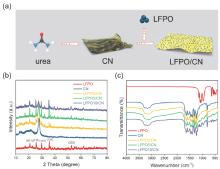
Fig 1
(a) Schematic diagram of the synthesis route of LFPO/CN composites. (b) XRD patterns and (c) FT-IR spectra of LFPO, CN and LFPO/CN samples."
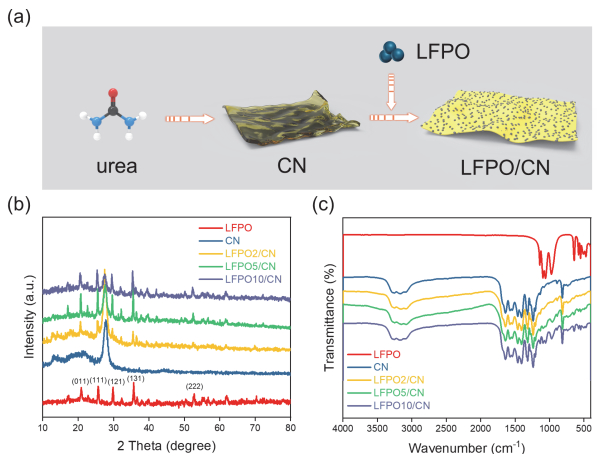
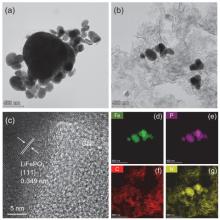
Fig 2
TEM images of (a) LFPO and (b) LFPO5/CN. (c) HRTEM image and (d–g) EDX elemental mapping of LFPO5/CN sample."
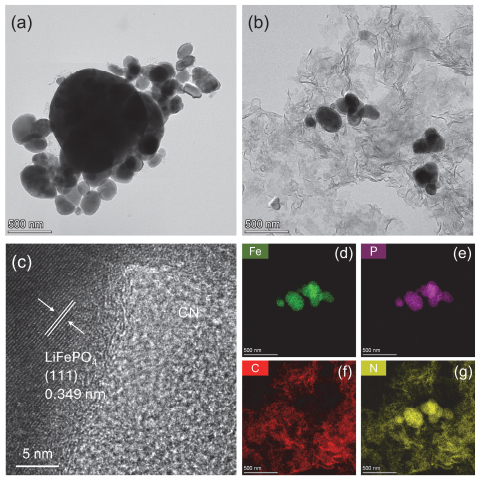
Fig 3
(a) UV-vis DRS spectra of CN and LFPO/CN samples; Mott-Schottky plots of (b) LFPO and (c) CN; (d) Energy band diagrams and H2O2 photosynthesis mechanism of LFPO and CN."
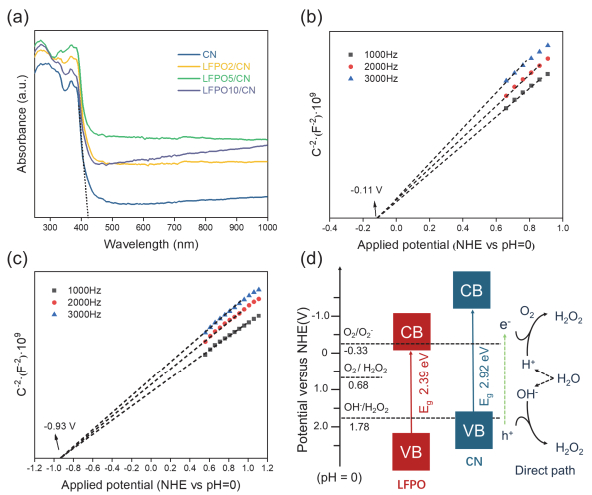
Fig 4
(a) Photocatalytic H2O2-production performance for different samples in an ethanol-water solution (10% vol.) under simulated solar irradiation. (b) Photocatalytic H2O2 production with LFPO5/CN under monochromatic irradiation at 365, 420, and 550 nm. (c) Photocatalytic H2O2-production performance over samples in different atmosphere conditions. (d) The stability evaluation and (e) performance under different water conditions over LFPO5/CN. (f) Photocatalytic antibacterial properties of LFPO, CN and LFPO5/CN."
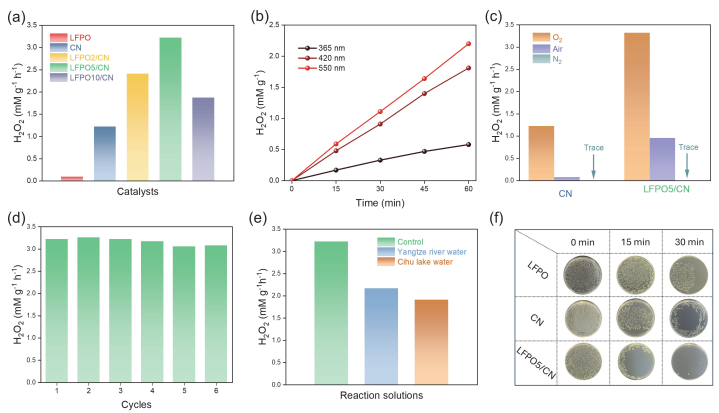
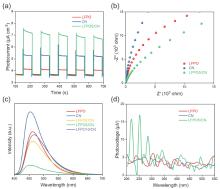
Fig 5
(a) Periodic on/off photocurrent response and (b) electrochemical impedance over LFPO, CN and LFPO5/CN samples. (c) PL spectra and (d) SPV spectra of LFPO, CN and LFPO/CN samples."
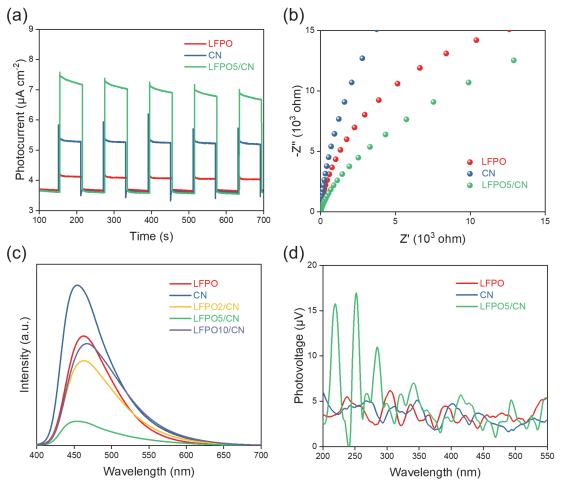
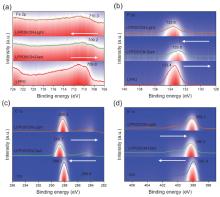
Fig 6
In situ and ex situ XPS spectra of (a) Fe 2p, (b) P 2p, (c) C 1s and (d) N 1s of LFPO, CN, and LFPO5/CN. In situ XPS spectra were collected under UV-vis light irradiation."
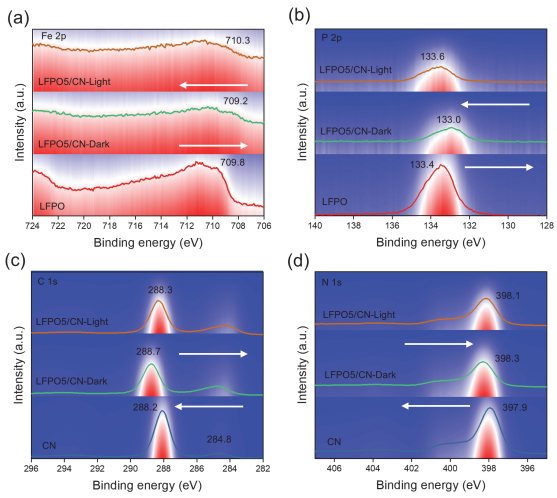
Fig 7
(a) AFM image of LFPO5/CN. Potential difference distribution at the LFPO5/CN interface (b) without light or (c) with light exposure. (d) Schematic showing the S-scheme migration of photogenerated carriersin LFPO/CN interface."
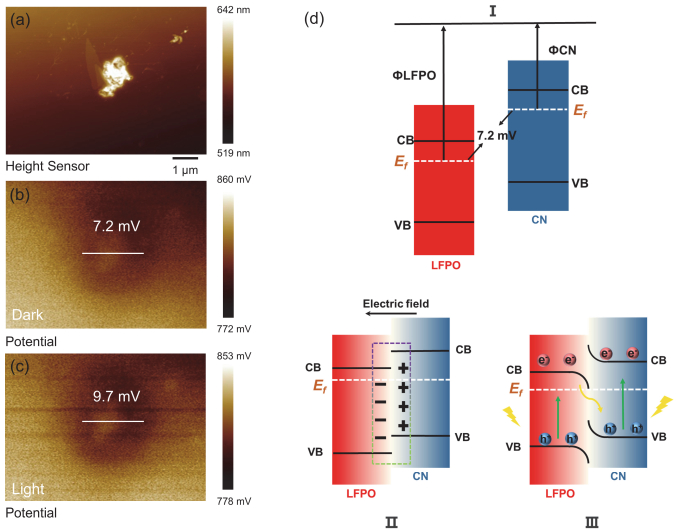
Fig 8
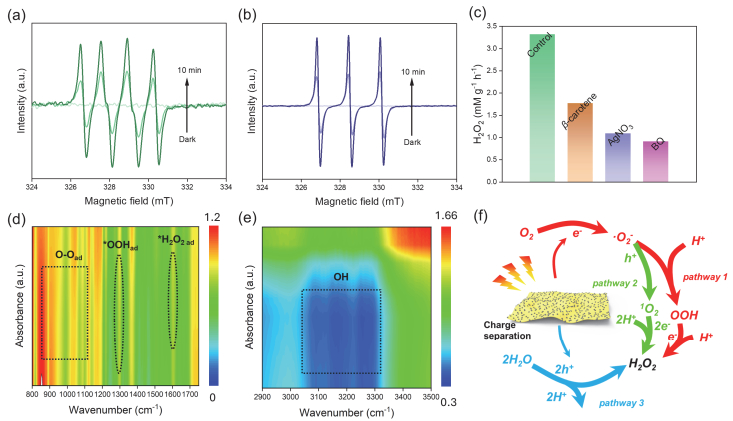
In situ EPR signals of (a) ∙O2− and (b) 1O2 over LFPO5/CN under dark and visible light conditions. (c) Photocatalytic H2O2 evolution for LFPO5/CN in complete photocatalysis, 1 mmol∙L−1 β-carotene, AgNO3 and BQ solutions. In situ DRIFT spectra of LFPO5/CN under illumination. The wavenumber ranges from (d) 800 to 1700 cm−1 and (e) 2900 to 3500 cm−1. (f) Schematics of photocatalytic H2O2 production over LFPO5/CN."
| 1 |
doi: 10.1016/S1872-2067(22)64205-0 |
| 2 |
doi: 10.3866/PKU.WHXB202312007 |
| 3 |
doi: 10.1007/s40843-023-2659-9 |
| 4 |
doi: 10.1016/j.jmst.2024.01.065 |
| 5 |
doi: 10.3866/PKU.WHXB202309020 |
| 6 |
doi: 10.1007/s40242-024-4213-3 |
| 7 |
doi: 10.1016/S1872-2067(24)60077-X |
| 8 |
doi: 10.1016/S1872-2067(23)64580-2 |
| 9 |
doi: 10.1016/j.jmst.2023.09.049 |
| 10 |
doi: 10.1002/advs.202500218 |
| 11 |
doi: 10.1038/s41467-024-49046-x |
| 12 |
doi: 10.3866/PKU.WHXB202403009 |
| 13 |
doi: 10.1038/s41467-024-53896-w |
| 14 |
doi: 10.1038/s41467-024-47624-7 |
| 15 |
doi: 10.1016/S1872-2067(24)60069-0 |
| 16 |
doi: 10.1007/s40843-023-2717-0 |
| 17 |
doi: 10.1016/j.apcatb.2024.123872 |
| 18 |
doi: 10.1038/s41467-024-52158-z |
| 19 |
doi: 10.3866/PKU.WHXB202212010 |
| 20 |
doi: 10.1016/j.apcatb.2023.123349 |
| 21 |
doi: 10.1038/s41467-023-40007-4 |
| 22 |
doi: 10.1016/j.jhazmat.2022.128590 |
| 23 |
doi: 10.1016/j.envres.2022.113780 |
| 24 |
doi: 10.1016/j.cej.2022.138388 |
| 25 |
doi: 10.1016/j.jtice.2016.02.003 |
| 26 |
doi: 10.1016/j.apcatb.2023.122763 |
| 27 |
doi: 10.1016/j.cej.2021.132229 |
| 28 |
doi: 10.1002/cey2.598 |
| 29 |
doi: 10.1016/j.mattod.2025.01.016 |
| 30 |
doi: 10.1016/j.jcis.2021.09.034 |
| 31 |
doi: 10.1016/j.jmst.2021.10.059 |
| 32 |
doi: 10.1016/j.apmate.2024.100243 |
| 33 |
doi: 10.1038/s41467-025-57140-x |
| 34 |
doi: 10.1007/s40843-024-2789-0 |
| 35 |
doi: 10.1016/j.colsurfa.2022.129846 |
| 36 |
doi: 10.1016/j.jmst.2024.12.089 |
| 37 |
doi: 10.1016/j.apcatb.2024.124560 |
| 38 |
doi: 10.1007/s12598-023-02539-y |
| 39 |
doi: 10.1002/adfm.202309603 |
| 40 |
doi: 10.1007/s12598-024-02861-z |
| 41 |
doi: 10.1002/adma.202406460 |
| 42 |
doi: 10.1002/adma.202400288 |
| 43 |
doi: 10.3866/PKU.WHXB202406027 |
| 44 |
doi: 10.3866/PKU.WHXB202312014 |
| 45 |
doi: 10.1016/j.cej.2023.147150 |
| 46 |
doi: 10.1016/j.apcatb.2024.123768 |
| 47 |
doi: 10.1007/s40843-023-2764-8 |
| 48 |
doi: 10.1007/s12598024-02653-5 |
| 49 |
doi: 10.1016/S1872-2067(23)64478-X |
| 50 |
doi: 10.1016/j.jmat.2024.07.004 |
| 51 |
doi: 10.1002/solr.202200963 |
| 52 |
doi: 10.1038/s41467-025-57662-4 |
| 53 |
doi: 10.1016/j.jmst.2025.03.003 |
| 54 |
doi: 10.1002/anie.202414229 |
| 55 |
doi: 10.1016/j.jmst.2024.01.034 |
| 56 |
doi: 10.3866/PKU.WHXB202407020 |
| 57 |
doi: 10.1007/s40843-023-2747-6 |
| 58 |
doi: 10.1002/adfm.202400065 |
| 59 |
doi: 10.1002/adma.202305397 |
| 60 |
doi: 10.1002/adma.202303649 |
| 61 |
doi: 10.1016/j.jmat.2024.100978 |
| 62 |
doi: 10.1016/j.jmat.2024.100985 |
| 63 |
doi: 10.1016/j.jmat.2024.100974 |
| 64 |
doi: 10.1002/adma.202414803 |
| 65 |
doi: 10.1016/j.jmat.2024.100970 |
| 66 |
doi: 10.1016/j.actphy.2025.100064 |
| 67 |
doi: 10.1038/s41467-024-45604-5 |
| 68 |
doi: 10.1016/S1872-2067(23)64610-8 |
| 69 |
doi: 10.3866/PKU.WHXB202312024 |
| 70 |
doi: 10.1038/s41570-025-00698-3 |
| 71 |
doi: 10.1016/j.mattod.2024.11.012 |
| 72 |
doi: 10.1002/anie.202425038 |
|
||