Acta Phys. -Chim. Sin. ›› 2025, Vol. 41 ›› Issue (5): 100039.doi: 10.1016/j.actphy.2024.100039
Special Issue: S-scheme heterojunction in photocatalysis
• REVIEW • Previous Articles Next Articles
Recent Progress of Microstructure-Regulated g-C3N4 in Photocatalytic NO Conversion: The Pivotal Roles of Adsorption/Activation Sites
Hui Wang1, Abdelkader Labidi1, Menghan Ren1, Feroz Shaik2, Chuanyi Wang1,*( )
)
- 1 School of Environmental Science and Engineering, Shaanxi University of Science and Technology, Xi'an 710021, China
2 Department of Mechanical Engineering, Prince Mohammad Bin Fahd University, Al Khobar, 31952, Kingdom of Saudi Arabia
-
Received:2024-11-06Revised:2024-12-03Accepted:2024-12-06Published:2025-04-18 -
Contact:Email: wangchuanyi@sust.edu.cn; Tel.: +86-29-86131724 (Chuanyi Wang) -
Supported by:the National Natural Science Foundation of China(52161145409); the National Natural Science Foundation of China(21976116); SAFEA of China ("Belt and Road" Innovative Talent Exchange Foreign Expert Project)(2023041004L); High-end Foreign Expert Project(G2023041021L); Alexander-von-Humboldt Foundation of Germany (Group-Linkage Program)

Cite this article
Hui Wang, Abdelkader Labidi, Menghan Ren, Feroz Shaik, Chuanyi Wang. Recent Progress of Microstructure-Regulated g-C3N4 in Photocatalytic NO Conversion: The Pivotal Roles of Adsorption/Activation Sites[J]. Acta Phys. -Chim. Sin. 2025, 41(5), 100039. doi: 10.1016/j.actphy.2024.100039
share this article
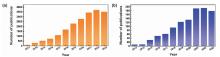
Fig 1
Number of publications per year on g-C3N4 (a) and g-C3N4 and NO (b) according Web of Science."
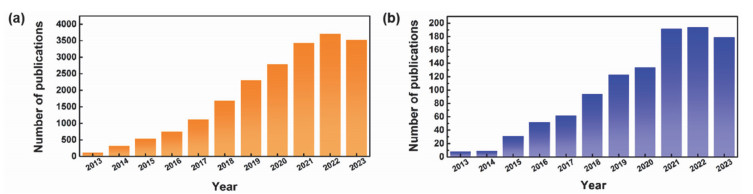
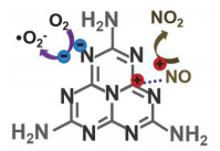
Fig 2
The adsorption model of NO and O2 on g-C3N4."
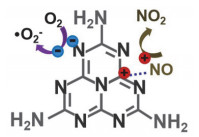

Table 1
Compare the photocatalytic NO conversion efficiency reported by different g-C3N4-based materials in this work."
| No. | Microstructure control method | Type | Photocatalyst amount (g) | Light source | Initial Conc. | Conv. (%) | NO2 Conc. | Ref. |
| 1 | Vacancy engineering | N2C vacancy | 0.1 | 150 W commercial tungsten halogen lamp equipped with a 420 nm cut-off filter | 600 ppb | 41.84 | 77.8 ppb | [ |
| 2 | N3C vacancy | 0.1 | 150 W tungsten halogen lamp | – | 57.1 | 82.15 ppb | [ | |
| 3 | N3C vacancy | 0.2 | 30 W LED (Visible region) | 600 ppb | 66.7 | 26.8 ppb | [ | |
| 4 | N3C vacancy | 0.2 | LED lamp | 600 ppb | 40.3 | 87.7 ppb | [ | |
| 5 | C vacancy | 0.2 | LED lamp (λ ≥ 448 nm) | 600 ppb | 47.0 | 30 ppb | [ | |
| 6 | non-intrinsic O vacancies | 0.1 | 300 W xenon lamp equipped with a cut-off filter (λ>420 nm) | 500 ppb | 47.7 | 25 ppb | [ | |
| 7 | Doping | Sulfur doping | 0.2 | 150 W visible light LED lamp (λ > 400 nm) | 600 ppb | 53 | 58.86 ppb | [ |
| 8 | Boron doping | 0.1 | 500 W Xe lamp | 600 ppb | 54 | – | [ | |
| 9 | Sulfur doping | 0.025 | LED array (450 nm centre wavelength) | 1 ppm | 50 | 200 ppb | [ | |
| 10 | C self doping | 0.2 | 150 W commercial tungsten halogen lamp | 550 ppb | 56.77 | – | [ | |
| 11 | Sulfur doping | 0.2 | Xe lamp | 500 ppb | 78.0 | – | [ | |
| 12 | Na+, Li+ interlayer doping | 0.2 | 30 W visible LED lamp | 600 ppb | 82 | 3.7 ppb | [ | |
| 13 | Zn interlayer doping | 0.1 | 150 W metal halide lamp (λ greater than 420 nm) | 600 ppb | 49 | 5.88 ppb | [ | |
| 14 | Ca interlayer doping | 0.2 | 150 W commercial tungsten halogen lamp | 500 ppb | 54.78 | – | [ | |
| 15 | Sr cavity filling | 0.05 | xenon lamp with a 420 nm filter | 600 ppb | 55 | 66 ppb | [ | |
| 16 | Functional group modification | Oxygenated functional group | 0.2 | 150 W commercial tungsten halogen lamp equipped with a UV light cutoff filter (420 nm) | 500 ppb | 45.5 | – | [ |
| 17 | Cyano and hydroxyl groups | 0.05 | 300 W xenon lamp equipped with a cut-off filter (λ > 420 nm) | 600 ppb | 46.2 | 77.61 ppb | [ | |
| 18 | hydroxyl groups | 0.2 | Visible light LED lamp (λ ≥ 420 nm) | 600 ppb | 65.0 | 117 ppb | [ | |
| 19 | Oxygenated functional group | 0.1 | 150 W commercial tungsten halogen lamp | 500 ppb | 50.4 | – | [ | |
| 20 | Cocatalyst loading | SrSO4 loading | 0.05 | 30 W LED lamp | 600 ppb | 67.5 | 85.05 ppb | [ |
| 21 | CaCO3 loading | 0.2 | LED lamp (λ > 420 nm) | 550 ppb | 51.18 | 107.5 ppb | [ | |
| 22 | ZIF-67/CoOOH loading | 0.2 | 150 W metal halide lamp with a 420 nm cutoff | 500 ppb | 52.5 | 0 | [ | |
| 23 | Au loading | 0.2 | 150 W commercial halogen tungsten lamp | 500 ppb | 41.0 | 10.25 ppb | [ | |
| 24 | Construction of and heterojunctions | (BiO)2CO3@ g-C3N4 heterojunction | – | 150 W commercial tungsten halogen lamp | – | 53.28 | – | [ |
| 25 | g-C3N4/BO0.2N0.8 heterojunction | 0.2 | Metal halide lamp (150 W) was used as the light source with a visible light filter (λ > 420 nm). | 500 ppb | 30.2 | 4.53 ppb | [ | |
| 26 | Pd1/g-C3N4-UiO-66-NH2 heterojunction | 10–40 | 300 W Xenon lamp | 40–70 ppm | 93.91 | 1.02 ppm | [ | |
| 27 | Graphene quantum dots/g-C3N4 | 0.08 | 300 W Xe lamp | 600 ppb | 90.0 | 140.4 ppb | [ | |
| 28 | UiO-67/g-C3N4 S- scheme heterojunction | 0.2 | Tungsten halogen lamp (150 W) | 500 ppb | 60.4 | – | [ | |
| 29 | CeO2/g-C3N4 S- scheme heterojunction | 0.05 | 300 W Xe lamp | 600 ppb | 73.8 | 96 ppb | [ |
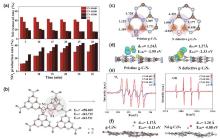
Fig 3
NO oxidation and NO2 fabrication over g-C3N4 and Nd-CN (a); Types of N defects in g-C3N4 structure (b); Carried electrons for pristine g-C3N4 and Nd-CN (c); Optimized structures of O2 adsorption on g-C3N4 and Nd-CN (d); Spin-trapping ESR spectra for •O− and •OH over g-C3N4 and Nd-CN (e); Optimized structure of NO adsorption on g-C3N4 and Nd-CN (f). Reproduced with permission [67]. Copyright 2020, Elsevier."
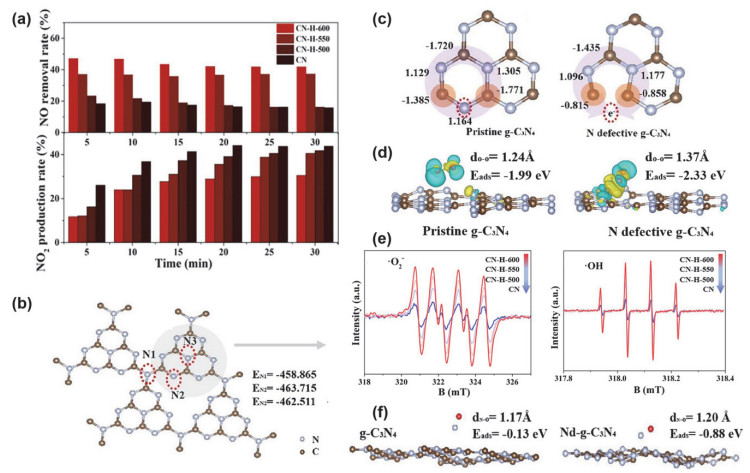
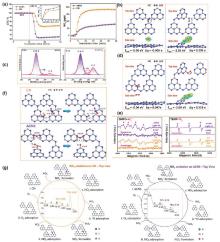
Fig 4
NO oxidation and NO2 fabrication over g-C3N4 and Nd-CN (a); Optimized structure of NO adsorption on g-C3N4 and ACN (b); In situ C 1s XPS spectra of ACN and ACN after 30 minutes of illumination time (c); Optimized structures of O2 adsorption on g-C3N4 and ACN (d); Spin-trapping ESR spectra for •O2− and 1O2 over g-C3N4 and ACN (e); Adsorption configuration of O2 and NO2 molecules on g-C3N4 and ACN (f); Calculation of reaction pathways for NO2 oxidation on g-C3N4 and ACN (g). Reproduced with permission [68]. Copyright 2021, Wiley."
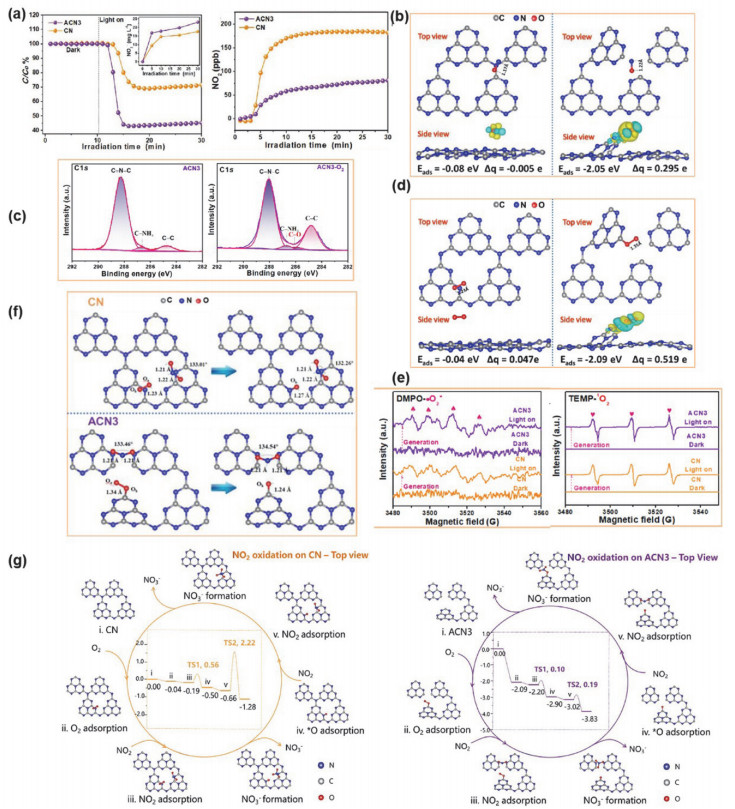
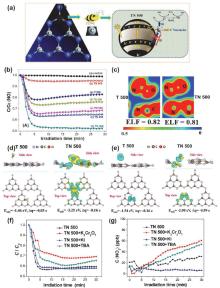
Fig 5
Carbon vacancy modified g-C3N4 nanotubes for selective oxidation of NO to NO2− (a); Photocatalytic NO oxidation over T 500 and TNx (b); Electron localization function (ELF) of T500 and TN500 (c); Optimized structure of NO adsorption on T500 and TN500 (d); Optimized structure of O2 adsorption on T500 and TN500 (e); Photocatalytic NO oxidation (f) and the concentration of NO2 (g) over TN 500 in the presence of different scavengers. Reproduced with permission [71]. Copyright 2020, Elsevier."
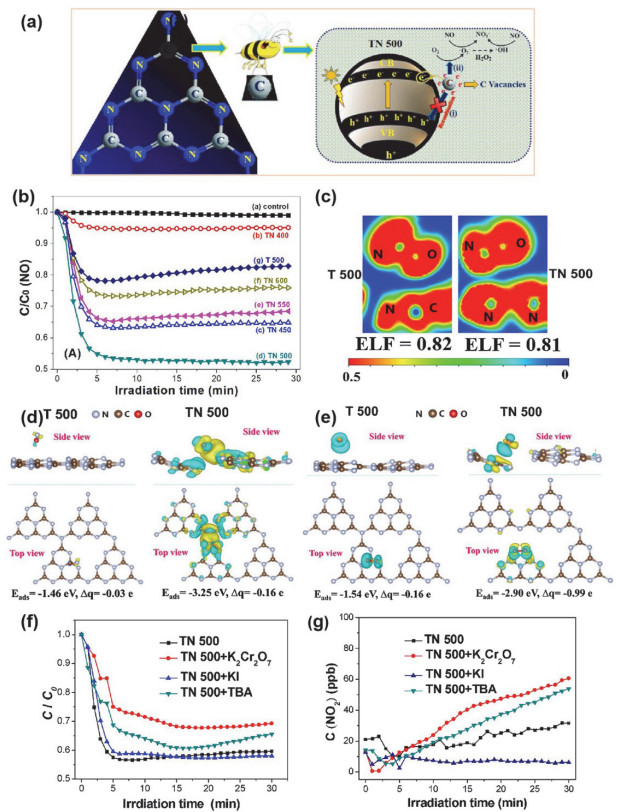
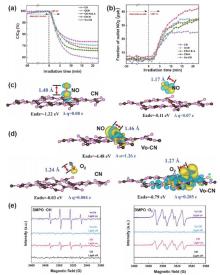
Fig 6
NO oxidation (a) and NO2 fabrication (b) over CN, OCN and VO-CN; Optimized structure of NO adsorption on CN, OCN and VO-CN (c); Optimized structures of O2 adsorption on CN and VO-CN (d); Spin-trapping ESR spectra for •OH and •O2− over CN and VO-CN (e). Reproduced with permission [72]. Copyright 2024, Elsevier."
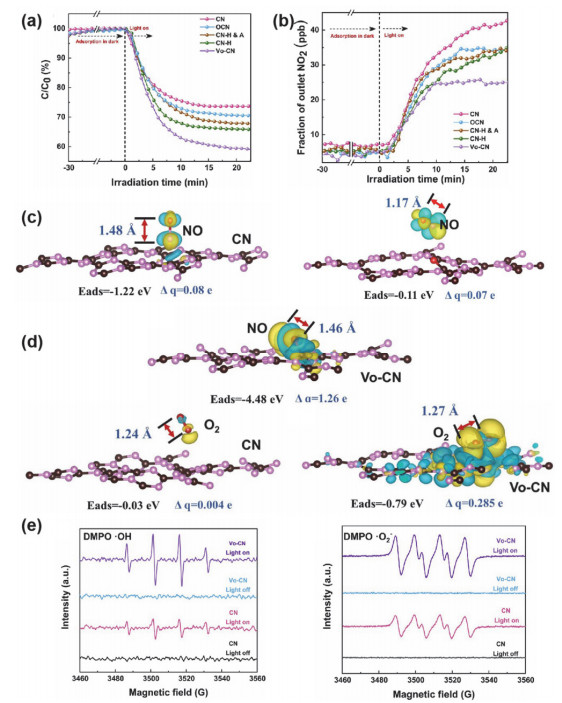
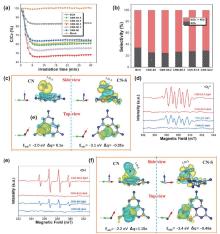
Fig 7
Photocatalytic NO oxidation (a) and selectivity of products (b) over CN and CN-S; Optimized structure of O2 adsorption on CN and CN-S (c); Spin-trapping ESR spectra for •O2− (d) and •OH (e) over CN and CN-S; Optimized structure of NO adsorption on CN and CN-S (f). Reproduced with permission [73]. Copyright 2023, Elsevier."
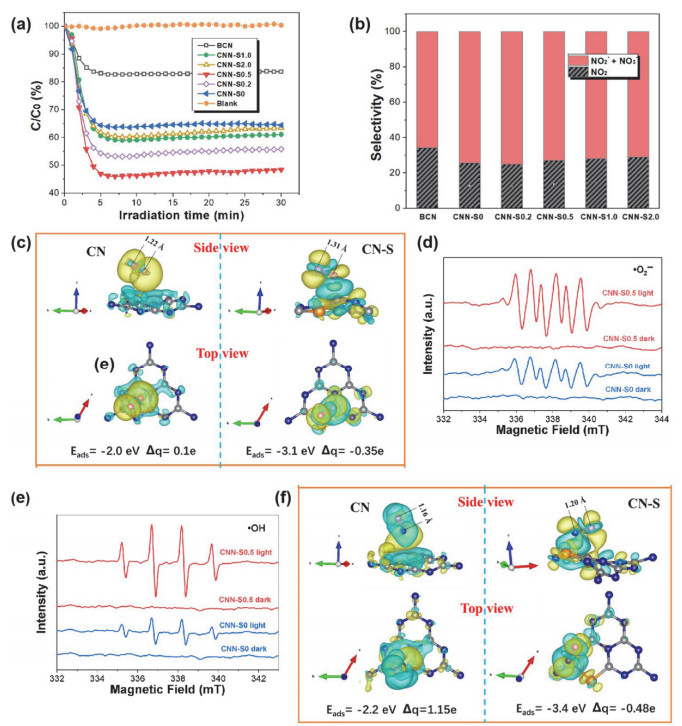
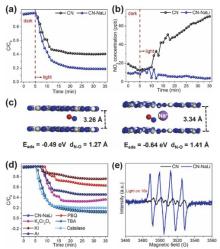
Fig 8
NO oxidation (a) and NO2 fabrication (b) over g-C3N4 and CN-NaLi; Optimized geometric structure of NO molecules adsorption on g-C3N4 and CN-NaLi (c); Photocatalytic NO oxidation over CN-NaLi in the presence of different scavengers (d); Spin-trapping ESR spectrum for •O2− over g-C3N4 and CN-NaLi (e). Reproduced with permission [77]. Copyright 2022, Elsevier."
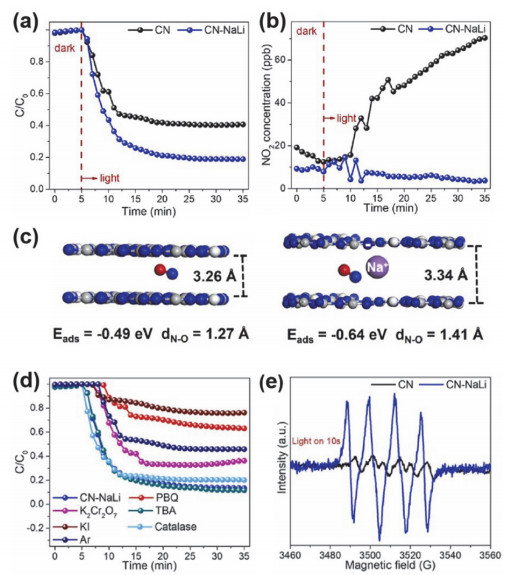
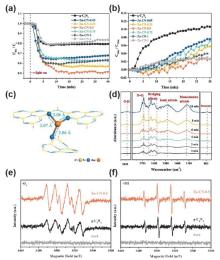
Fig 9
NO oxidation (a) and NO2 fabrication (b) over g-C3N4 and Zn-CN; Zn-CN structure model (c); In situ DRIFTS spectrum of Zn-CN (d); Spin-trapping ESR spectrum for •O2− (e) and •OH (f) over g-C3N4 and Zn-CN. Reproduced with permission [78]. Copyright 2023, Elsevier."
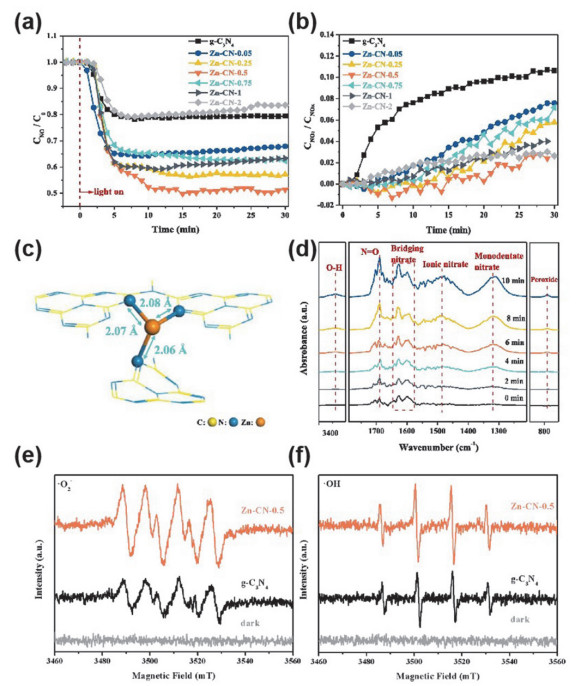
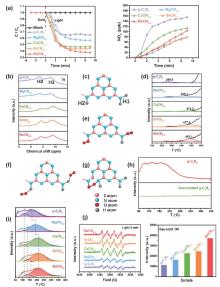
Fig 10
NO oxidation and NO2 fabrication over g-C3N4 and MCN (a); 1H solid-state nuclear magnetic resonance (NMR) spectra of g-C3N4 and MCN (b); The model of H atom existence in g-C3N4 (c); NO-TPD spectra of g-C3N4 and MCN (d); The model for covalent bonding between O2 substituted H atoms and amide or imine groups (e); The model for hydrogen bonding between O2 and amide or imine groups (f); O2-TPD spectra of g-C3N4 and MCN (g); O2 forms covalent bonds with two amidogen groups or imino groups (h); O2-TPD before and after deamination of g-C3N4 (i); Spin-trapping ESR spectra for •O2− and •OH over g-C3N4 and MCN (j). Reproduced with permission [80]. Copyright 2024, American Chemical Society."
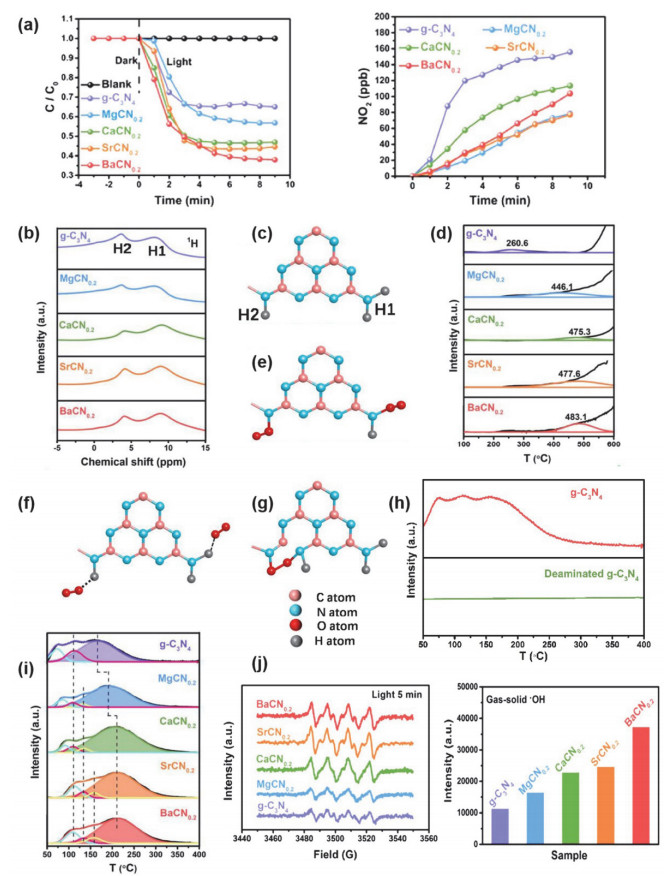
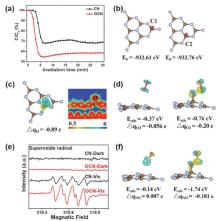
Fig 11
Photocatalytic NO oxidation over g-C3N4 and OCN (a); Optimization of geometric structure of g-C3N4 modified by heteroatom O at C1 and C2 sites (b); Differential charge density between oxygen atoms and g-C3N4 and Electron localization function (ELF) of OCN (c); Optimized geometric structure of O2 molecules adsorption on g-C3N4 and OCN (d); Spin-trapping ESR spectrum for •O2− over g-C3N4 and and OCN (e); Optimized geometric structure of NO molecules adsorption on g-C3N4 and OCN (f). Reproduced with permission [81]. Copyright 2019, Elsevier."
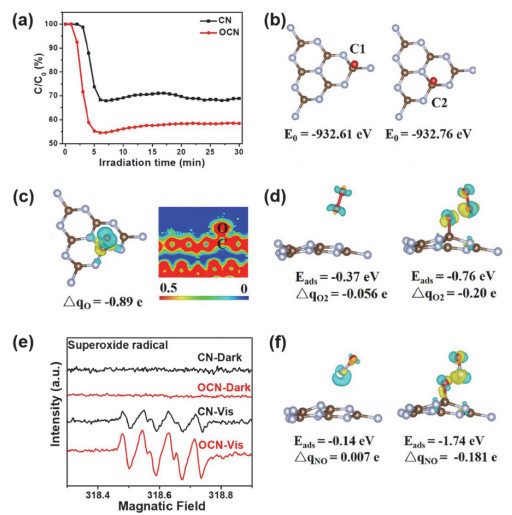
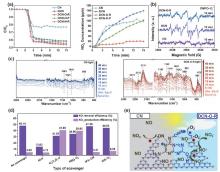
Fig 12
NO oxidation and NO2 fabrication over CN and DCN-O-R (a); DMPO spin-trapping ESR for •O2− detection (b); In situ DRIFTS spectroscopy of CN and DCN-O-R photocatalytic NO conversion (c); The capture experiments for photocatalytic NO conversion over DCN-O-R (d); Mechanism diagram of CN and DCN-O-R photocatalytic conversion of NO (e); Reproduced with permission [82]. Copyright 2023, MDPI."
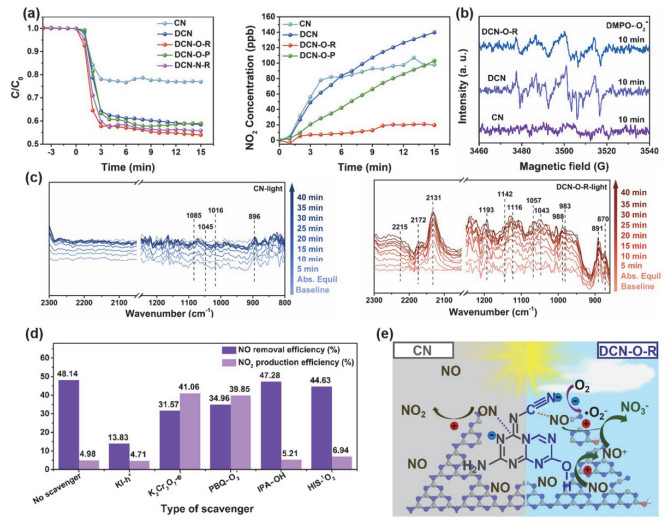
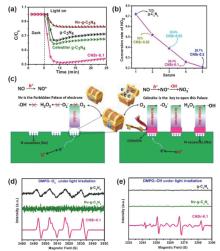
Fig 13
NO oxidation (a) and NO2 fabrication (b) over g-C3N4 and CNSr; Mechanism of photocatalytic NO conversion over g-C3N4 modified by celestite (c); Spin-trapping ESR spectra for •O2− (d) and •OH (e) over g-C3N4 and MCN. Reproduced with permission [85]. Copyright 2019, Elsevier."
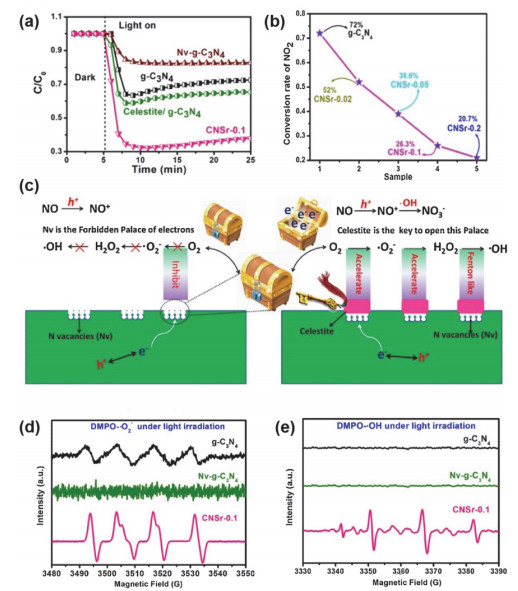
Fig 14
Photocatalytic NO oxidation over g-C3N4 and xCa-CN (a); selectivity of products over g-C3N4 (b) and xCa-CN (c); Spin-trapping ESR spectra for •O2− (d), •OH (e) and 1O2 (f) over g-C3N4 and xCa-CN; Optimized geometric structure of NO molecules adsorption on g-C3N4 and xCa-CN (g); Optimized geometric structure of NO2 molecules adsorption on g-C3N4, CN-cyano group and xCa-CN (h). Reproduced with permission [86]. Copyright 2023, Elsevier."
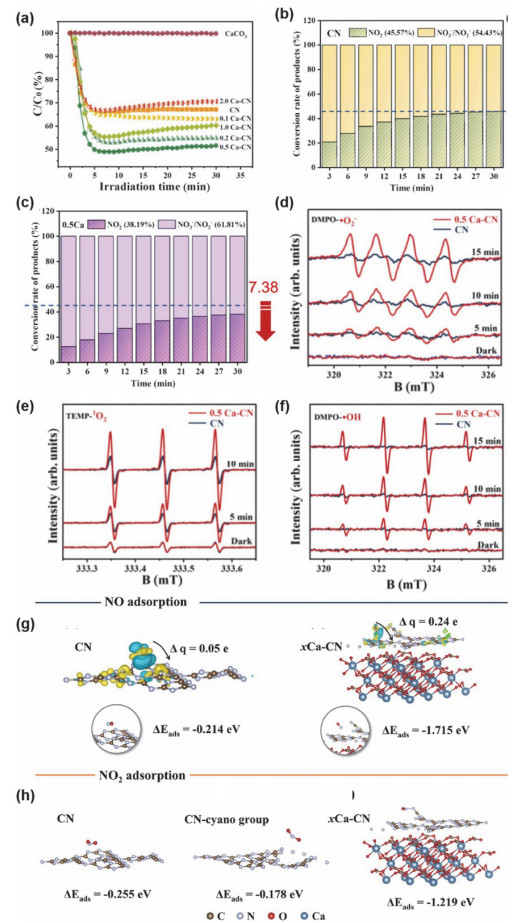
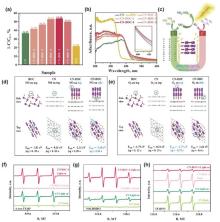
Fig 15
Mechanism diagram of CN-BOC heterojunction photocatalytic removal of NO (a); Photocatalytic NO oxidation over g-C3N4 and CN-BOC (b); UV-Vis DRS (c); Optimized geometric structure of NO (d) and O2 (e) molecules adsorption on g-C3N4 and CN-BOC; Spin-trapping ESR spectra for •O2− (f), •OH (g) and 1O2 (h) over g-C3N4 and CN-BOC. Reproduced with permission [89]. Copyright 2020, Elsevier."
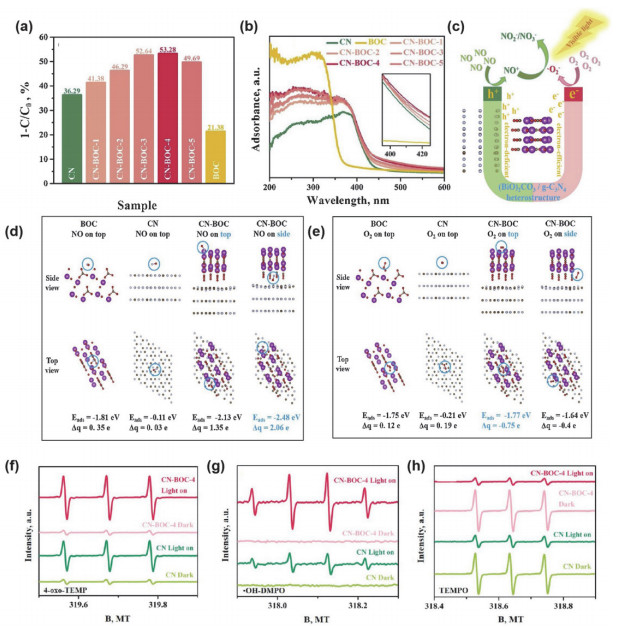
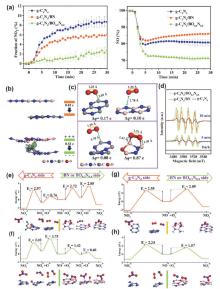
Fig 16
NO oxidation and NO2 fabrication over g-C3N4, g-C3N4/BN and g-C3N4/BO0.2N0.8 (a); Differential charge density of g-C3N4/BN and g-C3N4/BO0.2N0.8 (b); O2 adsorption on the surfaces of g-C3N4/BN and g-C3N4/BO0.2N0.8 (c); Spin-trapping ESR spectrum for •O2− over g-C3N4, g-C3N4/BN and g-C3N4/BO0.2N0.8 (d); The stepwise NO oxidation process on different sides of g-C3N4/BN (e) and g-C3N4/BO0.2N0.8 (f); The entire NO oxidation process on different sides of g-C3N4/BN (g) and g-C3N4/BO0.2N0.8 (h). Reproduced with permission [90]. Copyright 2020, American Chemical Society."
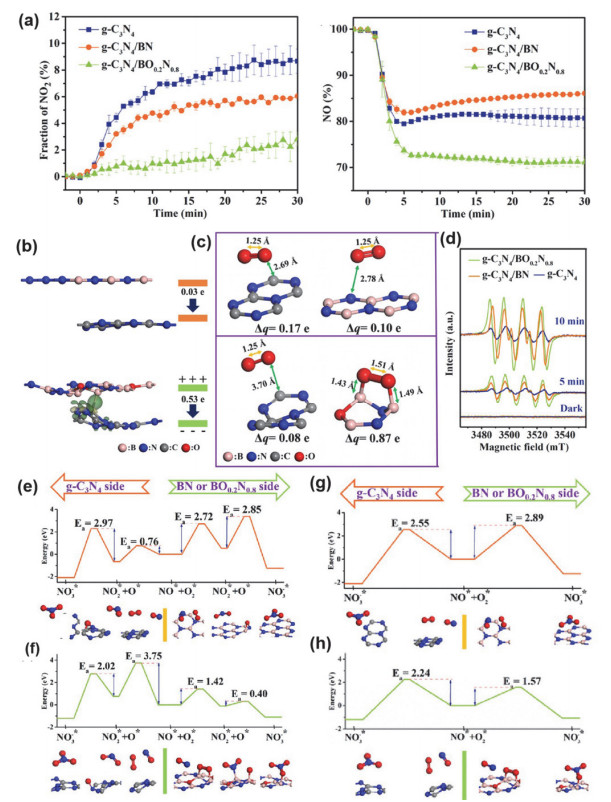
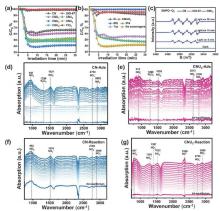
Fig 17
NO oxidation and NO2 fabrication over CN, UiO-67 and CNU (a); The capture experiments for photocatalytic NO conversion over CNU (b); Spin-trapping ESR spectra for •O2− over CN, UiO-67 and CNU (c); In situ DRIFTS spectra of NO absorption (d, e) and photocatalytic reaction (f, g) processes on CN and CNU. Reproduced with permission [93]. Copyright 2024, Elsevier."
| 1 |
doi: 10.1016/j.tox.2004.02.005 |
| 2 |
doi: 10.1016/j.apcatb.2015.11.013 |
| 3 |
doi: 10.1021/acs.iecr.5b02062 |
| 4 |
doi: 10.1016/j.apenergy.2009.03.022 |
| 5 |
doi: 10.1016/j.jhazmat.2007.03.023 |
| 6 |
doi: 10.1126/science.aaa3145 |
| 7 |
doi: 10.1021/es4025595 |
| 8 |
doi: 10.1021/jp200488p |
| 9 |
doi: 10.1021/jp056473f |
| 10 |
doi: 10.1016/S1872-2067(16)62573-1 |
| 11 |
doi: 10.1016/j.jphotochemrev.2012.08.002 |
| 12 |
doi: 10.1016/j.apcatb.2015.09.046 |
| 13 |
doi: 10.1016/j.apcatb.2016.06.027 |
| 14 |
doi: 10.1016/j.apcatb.2014.12.050 |
| 15 |
doi: 10.1016/j.apcatb.2013.09.042 |
| 16 |
doi: 10.1021/ja1068596 |
| 17 |
doi: 10.1006/jcat.2000.3076 |
| 18 |
doi: 10.1021/acsomega.2c02405 |
| 19 |
doi: 10.1016/j.pecs.2023.101098 |
| 20 |
doi: 10.1039/d1cy01776d |
| 21 |
doi: 10.1016/j.apcatb.2024.123734 |
| 22 |
doi: 10.1016/j.apcatb.2022.122238 |
| 23 |
doi: 10.1002/anie.201705772 |
| 24 |
doi: 10.1007/s12274-022-4203-z |
| 25 |
doi: 10.1007/s10934-022-01197-2 |
| 26 |
doi: 10.1016/j.cej.2020.126540 |
| 27 |
doi: 10.1016/j.apcatb.2022.121216 |
| 28 |
doi: 10.1016/j.ijhydene.2021.11.252 |
| 29 |
doi: 10.1002/sstr.202200371 |
| 30 |
doi: 10.1016/j.mattod.2020.09.004 |
| 31 |
doi: 10.1016/j.apcatb.2022.121521 |
| 32 |
doi: 10.1016/j.apcatb.2020.118700 |
| 33 |
doi: 10.1039/d2gc02748h |
| 34 |
doi: 10.1016/j.jiec.2021.09.033 |
| 35 |
doi: 10.1016/j.apsusc.2017.06.073 |
| 36 |
doi: 10.1016/j.apcatb.2017.07.010 |
| 37 |
doi: 10.1016/j.cjche.2020.02.020 |
| 38 |
doi: 10.1016/j.apcatb.2020.119481 |
| 39 |
doi: 10.1038/s41586-021-04229-0 |
| 40 |
doi: 10.1016/j.mtphys.2023.101080 |
| 41 |
doi: 10.1016/j.arabjc.2023.104542 |
| 42 |
doi: 10.1016/j.cej.2019.04.003 |
| 43 |
doi: 10.1016/j.apsusc.2022.153104 |
| 44 |
doi: 10.1016/j.jallcom.2022.163806 |
| 45 |
doi: 10.1021/acs.langmuir.2c00371 |
| 46 |
doi: 10.1016/j.envpol.2021.117510 |
| 47 |
doi: 10.1021/acsami.8b21987 |
| 48 |
doi: 10.1016/j.apsusc.2019.144199 |
| 49 |
doi: 10.1039/d1en00937k |
| 50 |
doi: 10.1016/j.jallcom.2022.164371 |
| 51 |
doi: 10.1016/j.cej.2020.125347 |
| 52 |
doi: 10.1016/j.vacuum.2020.109293 |
| 53 |
doi: 10.1016/j.jphotochem.2023.114965 |
| 54 |
doi: 10.1016/j.apcatb.2023.123604 |
| 55 |
doi: 10.1016/j.ccr.2021.213947 |
| 56 |
doi: 10.1016/j.jece.2023.110164 |
| 57 |
doi: 10.1016/j.nanoen.2022.108032 |
| 58 |
doi: 10.1007/s10311-022-01437-6 |
| 59 |
doi: 10.1002/adma.201500033 |
| 60 |
doi: 10.1016/j.jcis.2019.10.088 |
| 61 |
doi: 10.1021/acs.langmuir.2c03035 |
| 62 |
doi: 10.1016/j.chemosphere.2021.132098 |
| 63 |
doi: 10.1016/j.apcatb.2018.03.054 |
| 64 |
doi: 10.1016/j.apcatb.2018.08.030 |
| 65 |
doi: 10.3866/PKU.WHXB202209037 |
| 66 |
doi: 10.1021/acs.energyfuels.1c00624 |
| 67 |
doi: 10.1016/j.cej.2019.122282 |
| 68 |
doi: 10.1002/aenm.202004001 |
| 69 |
doi: 10.1016/j.mtphys.2024.101487 |
| 70 |
doi: 10.1016/j.cej.2020.124421 |
| 71 |
doi: 10.1016/j.apcatb.2019.118281 |
| 72 |
doi: 10.1016/j.nanoen.2023.109197 |
| 73 |
doi: 10.1016/j.chemosphere.2023.137813 |
| 74 |
doi: 10.3390/ma13133038 |
| 75 |
doi: 10.1039/C8CY0088 |
| 76 |
doi: 10.1016/j.apcatb.2023.122522 |
| 77 |
doi: 10.1016/j.apcatb.2022.121719 |
| 78 |
doi: 10.1016/j.cej.2022.140084 |
| 79 |
doi: 10.1016/j.apcatb.2018.08.019 |
| 80 |
doi: 10.1016/j.apcatb.2020.119007 |
| 81 |
doi: 10.1016/j.cej.2019.03.182 |
| 82 |
doi: 10.3390/catal13111433 |
| 83 |
doi: 10.1016/j.seppur.2024.128695 |
| 84 |
doi: 10.1016/j.apcatb.2018.09.078 |
| 85 |
doi: 10.1016/j.apcatb.2019.01.013 |
| 86 |
doi: 10.1016/j.jhazmat.2022.130040 |
| 87 |
doi: 10.1016/j.jallcom.2021.160318 |
| 88 |
doi: 10.1016/j.cej.2019.122184 |
| 89 |
doi: 10.1016/j.apcatb.2019.118251 |
| 90 |
doi: 10.1021/acsami.0c09216 |
| 91 |
doi: 10.1016/j.cej.2023.146768 |
| 92 |
doi: 10.1016/j.carbon.2022.02.004 |
| 93 |
doi: 10.1016/j.jcis.2024.02.221 |
| 94 |
doi: 10.1016/j.jallcom.2022.167819 |
| 95 |
doi: 10.1016/j.apsusc.2019.143994 |
| 96 |
doi: 10.1016/j.cej.2018.09.208 |
| 97 |
doi: 10.1016/j.jechem.2020.05.001 |
| 98 |
doi: 10.1021/acs.energyfuels.4c00160 |
| 99 |
doi: 10.1002/adfm.202315426 |
| 100 |
doi: 10.19728/j.issn1672-6634.2023080011 |
| 101 |
doi: 10.3866/PKU.WHXB201905080 |
| 102 |
doi: 10.1039/c9cy01030k |
| 103 |
doi: 10.1021/acs.jpclett.3c03621 |
| 104 |
doi: 10.1016/j.cjsc.2023.100202 |
| 105 |
doi: 10.1021/jacs.6b11878 |
| 106 |
doi: 10.1039/C9TA00339H |
| 107 |
doi: 10.1039/C8NJ02991A |
| 108 |
doi: 10.1002/smll.202300109 |
| 109 |
doi: 10.1016/j.apsusc.2021.151299 |
| 110 |
doi: 10.1063/5.0029374 |
| 111 |
doi: 10.1039/D4QI00255E |
| 112 |
doi: 10.19728/j.issn1672-6634.2023040004 |
| 113 |
doi: 10.1016/S1872-2067(23)64496-1 |
| 114 |
doi: 10.1016/j.jmst.2023.11.081 |
| 115 |
doi: 10.3866/PKU.WHXB202309031 |
| 116 |
doi: 10.1016/S1872-2067(24)60072-0 |
| 117 |
doi: 10.1016/S1872-2067(23)64607-8 |
| 118 |
doi: 10.1002/anie.201914949 |
| 119 |
doi: 10.1002/anie.201916012 |
| 120 |
doi: 10.1016/j.jorganchem.2023.122951 |
| 121 |
doi: 10.3866/PKU.WHXB202212016 |
| 122 |
doi: 10.3866/PKU.WHXB202212026 |
| 123 |
doi: 10.1016/j.seppur.2023.125302 |
| 124 |
doi: 10.3390/ma16103745 |
| 125 |
doi: 10.1016/S1872-2067(23)64551-6 |
| 126 |
doi: 10.1007/s10311-023-01583-5 |
| [1] | Yu Liu, Pengfei Li, Yize Liu, Zaicheng Sun. Recent advances in carbon dots as a single photocatalyst [J]. Acta Phys. -Chim. Sin., 2026, 42(2): 100167-. |
| [2] | Yuhang Zhang, Yi Li, Yuehan Cao, Yingjie Shuai, Yu Zhou, Ying Zhou. Regulating the formation type by Ir of intermediates to suppress product overoxidation in photocatalytic methane conversion [J]. Acta Phys. -Chim. Sin., 2026, 42(2): 100173-. |
| [3] | Shiyi Chen, Jialong Fu, Jianping Qiu, Guoju Chang, Shiyou Hao. Waste medical mask-derived carbon quantum dots enhance the photocatalytic degradation of polyethylene terephthalate (PET) over BiOBr/g-C3N4 S-scheme heterojunction [J]. Acta Phys. -Chim. Sin., 2026, 42(1): 100135-. |
| [4] | Chengxiao Zhao, Zhaolin Li, Dongfang Wu, Xiaofei Yang. SBA-15 templated covalent triazine frameworks for boosted photocatalytic hydrogen production [J]. Acta Phys. -Chim. Sin., 2026, 42(1): 100149-. |
| [5] | Menglan Wei, Xiaoxia Ou, Yimeng Wang, Mengyuan Zhang, Fei Teng, Kaixuan Wang. S-scheme heterojunction g-C3N4/Bi2WO6 highly efficient degradation of levofloxacin: performance, mechanism and degradation pathway [J]. Acta Phys. -Chim. Sin., 2025, 41(9): 100105-. |
| [6] | Jingping Li, Suding Yan, Jiaxi Wu, Qiang Cheng, Kai Wang. Improving hydrogen peroxide photosynthesis over inorganic/organic S-scheme photocatalyst with LiFePO4 [J]. Acta Phys. -Chim. Sin., 2025, 41(9): 100104-. |
| [7] | Fengying Zhang, Yanglin Mei, Yuman Jiang, Shenshen Zheng, Kaibo Zheng, Ying Zhou. Research progress of transient absorption spectroscopy in solar energy conversion and utilization [J]. Acta Phys. -Chim. Sin., 2025, 41(9): 100118-. |
| [8] | Lewang Yuan, Yaoyao Peng, Zong-Jie Guan, Yu Fang. Insights into the development of 2D covalent organic frameworks as photocatalysts in organic synthesis [J]. Acta Phys. -Chim. Sin., 2025, 41(8): 100086-. |
| [9] | Jiajie Cai, Chang Cheng, Bowen Liu, Jianjun Zhang, Chuanjia Jiang, Bei Cheng. CdS/DBTSO-BDTO S-scheme photocatalyst for H2 production and its charge transfer dynamics [J]. Acta Phys. -Chim. Sin., 2025, 41(8): 100084-. |
| [10] | Yu Wang, Haiyang Shi, Zihan Chen, Feng Chen, Ping Wang, Xuefei Wang. Hollow AgPt@Pt core-shell cocatalyst with electron-rich Ptδ− shell for boosting selectivity of photocatalytic H2O2 production for faceted BiVO4 [J]. Acta Phys. -Chim. Sin., 2025, 41(7): 100081-. |
| [11] | Jun Huang, Pengfei Nie, Yongchao Lu, Jiayang Li, Yiwen Wang, Jianyun Liu. Efficient adsorption of hardness ions by a mordenite-loaded, nitrogen-doped porous carbon nanofiber cathode in capacitive deionization [J]. Acta Phys. -Chim. Sin., 2025, 41(7): 100066-. |
| [12] | Xueqi Yang, Juntao Zhao, Jiawei Ye, Desen Zhou, Tingmin Di, Jun Zhang. Modulating the d-band center of NNU-55(Fe) for enhanced CO2 adsorption and photocatalytic activity [J]. Acta Phys. -Chim. Sin., 2025, 41(7): 100074-. |
| [13] | Yuchen Zhou, Huanmin Liu, Hongxing Li, Xinyu Song, Yonghua Tang, Peng Zhou. Designing thermodynamically stable noble metal single-atom photocatalysts for highly efficient non-oxidative conversion of ethanol into high-purity hydrogen and value-added acetaldehyde [J]. Acta Phys. -Chim. Sin., 2025, 41(6): 100067-. |
| [14] | Yadan Luo, Hao Zheng, Xin Li, Fengmin Li, Hua Tang, Xilin She. Modulating reactive oxygen species in O, S co-doped C3N4 to enhance photocatalytic degradation of microplastics [J]. Acta Phys. -Chim. Sin., 2025, 41(6): 100052-. |
| [15] | Xianghai Song, Xiaoying Liu, Zhixiang Ren, Xiang Liu, Mei Wang, Yuanfeng Wu, Weiqiang Zhou, Zhi Zhu, Pengwei Huo. Insights into the greatly improved catalytic performance of N-doped BiOBr for CO2 photoreduction [J]. Acta Phys. -Chim. Sin., 2025, 41(6): 100055-. |
|
||