Acta Phys. -Chim. Sin. ›› 2025, Vol. 41 ›› Issue (9): 100105.doi: 10.1016/j.actphy.2025.100105
• ARTICLE • Previous Articles Next Articles
S-scheme heterojunction g-C3N4/Bi2WO6 highly efficient degradation of levofloxacin: performance, mechanism and degradation pathway
Menglan Wei, Xiaoxia Ou*( ), Yimeng Wang, Mengyuan Zhang, Fei Teng, Kaixuan Wang
- College of Environment and Resources, Dalian Minzu University, Dalian 116600, Liaoning Province, China
-
Received:2025-03-05Revised:2025-05-09Accepted:2025-05-12Published:2025-07-04 -
Contact:Email: ouxiaoxia@dlnu.edu.cn (Xiaoxia Ou) -
Supported by:the Liaoning Provincial Science and Technology Program Joint Plan(2023JH2/101800001); the Basic Scientific Research Fund of Liaoning Provincial Education Department(LJKMZ20220396); Dalian Science and Technology Talents Innovation Support Program(2024RQ056)

Cite this article
Menglan Wei, Xiaoxia Ou, Yimeng Wang, Mengyuan Zhang, Fei Teng, Kaixuan Wang. S-scheme heterojunction g-C3N4/Bi2WO6 highly efficient degradation of levofloxacin: performance, mechanism and degradation pathway[J]. Acta Phys. -Chim. Sin. 2025, 41(9), 100105. doi: 10.1016/j.actphy.2025.100105
share this article
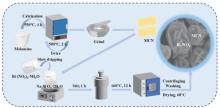
Scheme 1
A schematic representation of the MCN/BWO photocatalyst synthesis process."
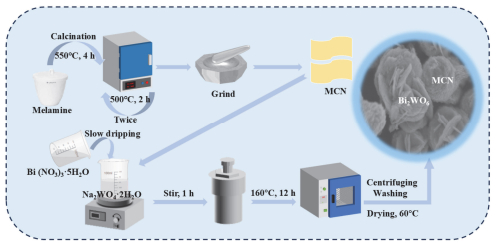
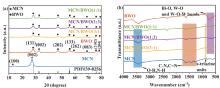
Fig 1
(a) XRD patterns and (b) FT-IR analysis of synthesized material."
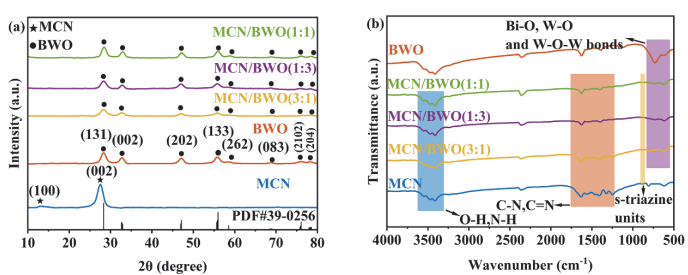
Fig 2
SEM images of (a) MCN/BWO (1 : 1), (b, c) TEM and HR-TEM images of MCN/BWO (1 : 1) and (d, e) EDS of MCN/BWO heterojunction photocatalyst."
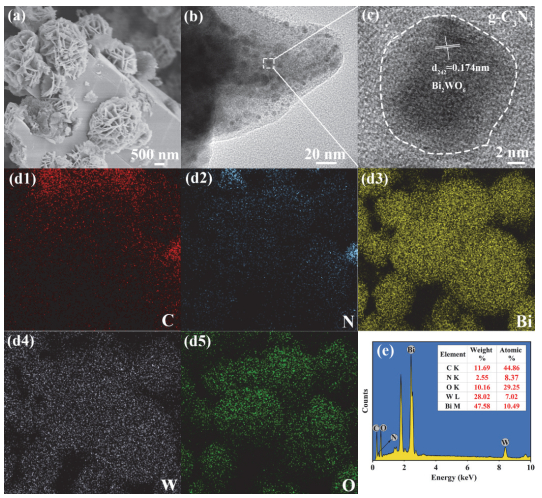
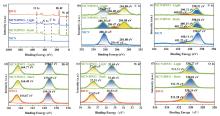
Fig 3
The in situ XPS spectra of the MCN, BWO, and MCN/BWO: (a) survey spectra, (b) C 1s, (c) N 1s, (d) Bi 4f, (e) O 1s and (f) W 4f."
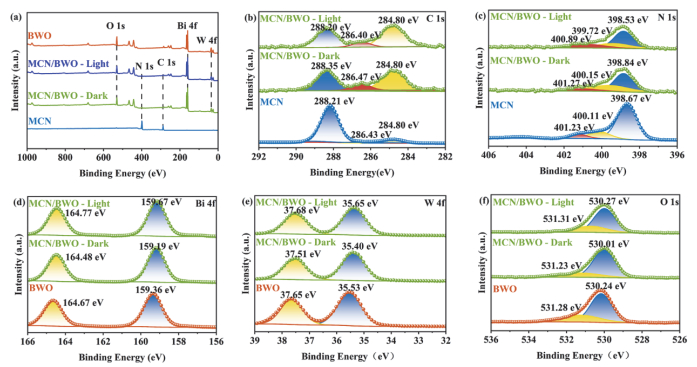
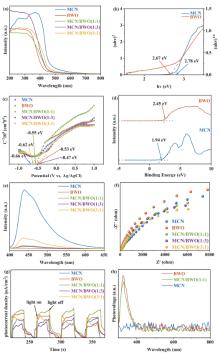
Fig 4
(a) UV-Vis DRS, (b) Tauc plot representing band gap energy, (c) M-S, (d) VB-XPS (e) PL, (f) EIS Nyquist plot, (g) TPC of synthesized materials and (h) SPV spectra of MCN, BWO, and MCN/BWO (1 : 1) composites."
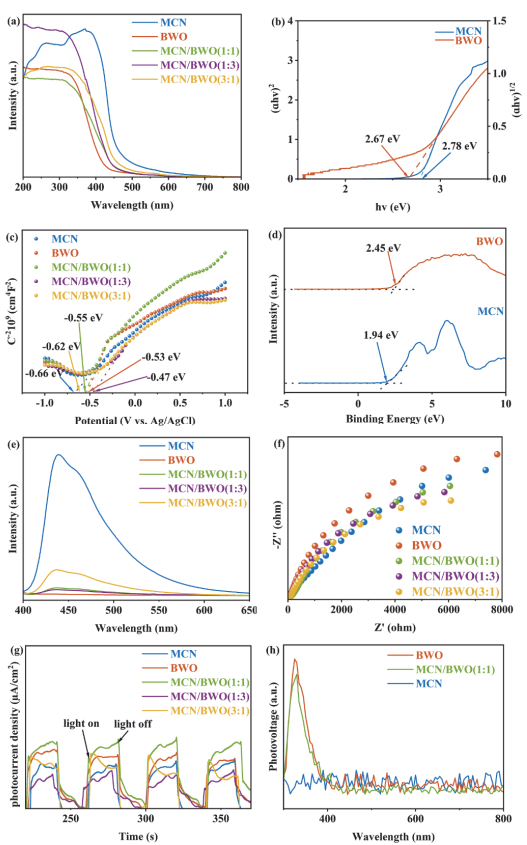
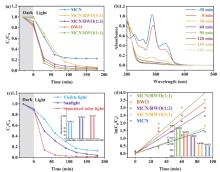
Fig 5
(a) Using different photocatalysts and exposure to sunshine, the photocatalytic degradation profiles of LEV, (b) the variations in LEV absorbance around 288 nm with MCN/BWO (1 : 1), (c) degradation rate of LEV by MCN/BWO (1 : 1) under different light intensity, (d) the corresponding pseudo-first-order kinetic fitting curves."
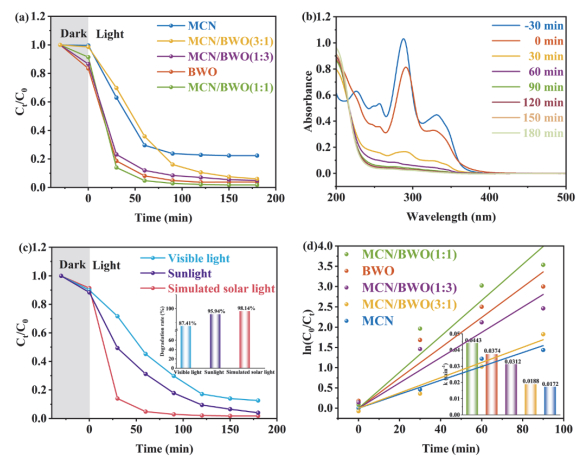
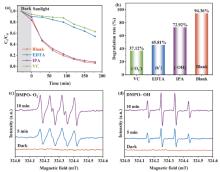
Fig 6
(a) Degradation effect of different quenching agents on MCN/BWO (1 : 1) heterojunction photocatalytic removal of LEV and (b) its corresponding degradation rate; EPR spectra of (c) DMPO-·O2− and (d) DMPO-·OH by MCN/BWO (1 : 1) under dark and light."
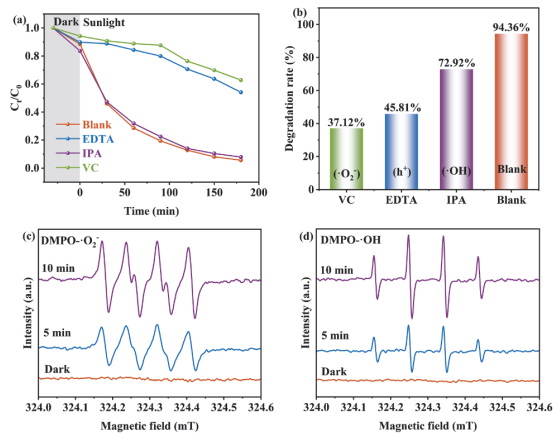
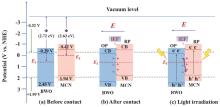
Fig 7
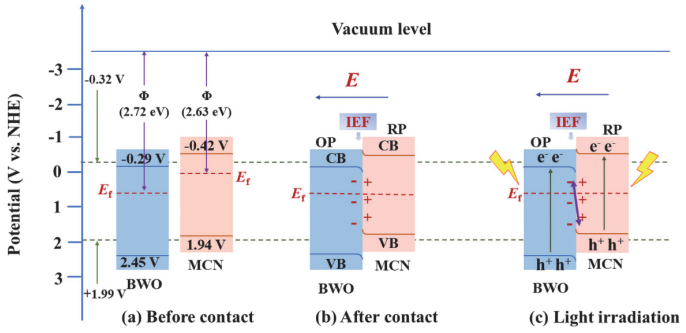
Work function (a) before contact; (b) after contact; (c) light irradiation."
Scheme 2
S-scheme photocatalysis mechanism of MCN/BWO heterojunction."
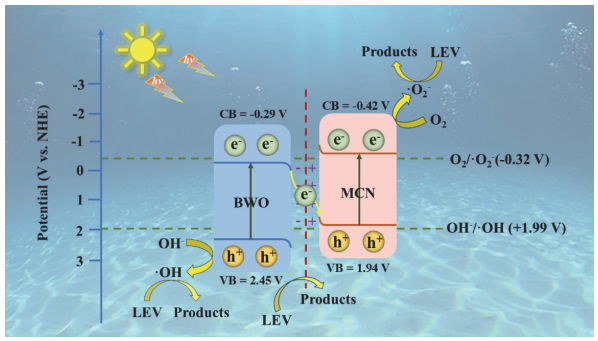
Fig 8
The 3D EEMs of the LEV aqueous solution were obtained as follows: (a) from the original solution, (b) after 30 min of adsorption and (c–h) following sunlight exposure for 30, 60, 120, and 180 min, respectively."
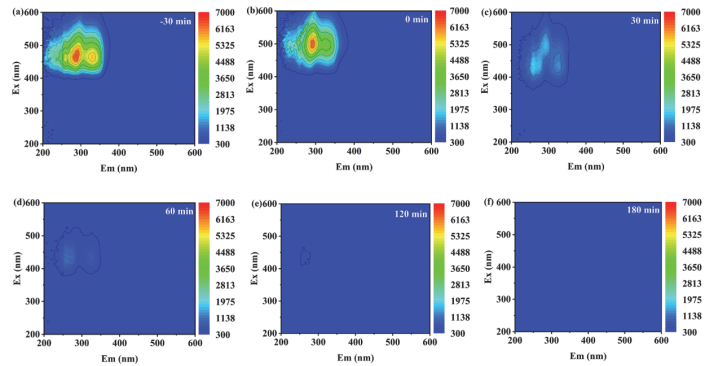
Fig 9
Proposed photocatalytic degradation pathway of LEV."
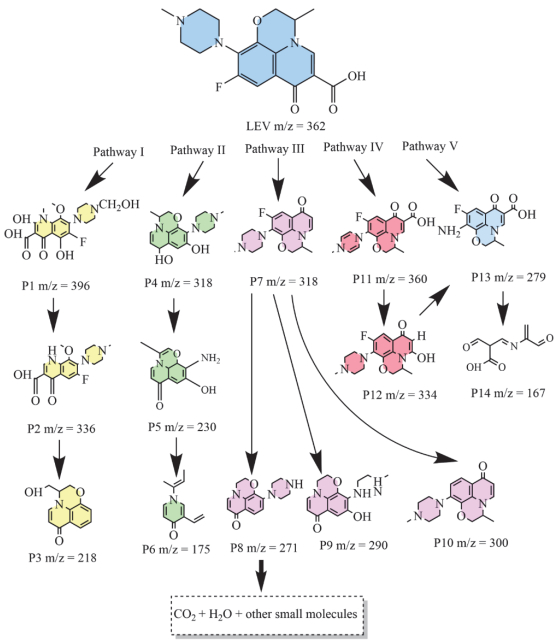
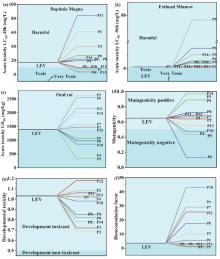
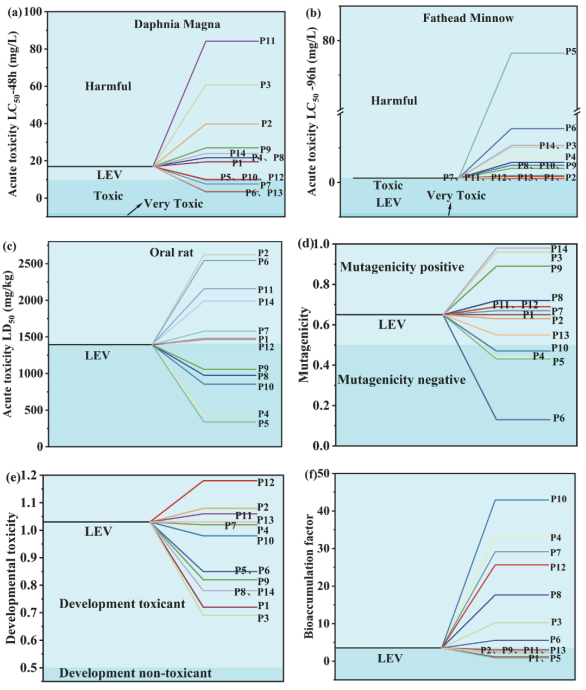
Fig 10
Ecotoxicological assessment of LEV and its degradation byproducts includes: (a) Daphnia magna LC50 (48 h); (b) Fathead minnow LC50 (96 h); (c) Oral rat LD50; (d) Mutagenicity; (e) Developmental toxicity; (f) Bioaccumulation factor."
| 1 |
doi: 10.1016/j.cej.2024.150686 |
| 2 |
doi: 10.1016/j.ijbiomac.2024.131885 |
| 3 |
doi: 10.1016/j.seppur.2024.129959 |
| 4 |
doi: 10.1002/smll.202105715 |
| 5 |
doi: 10.1016/j.chemosphere.2021.132929 |
| 6 |
doi: 10.1016/j.cej.2021.128991 |
| 7 |
doi: 10.1016/j.seppur.2022.122016 |
| 8 |
doi: 10.1016/j.apcatb.2017.12.005 |
| 9 |
doi: 10.1007/s40843-023-2725-y |
| 10 |
doi: 10.1016/j.jece.2024.112939 |
| 11 |
doi: 10.1016/j.seppur.2021.119239 |
| 12 |
doi: 10.1016/j.actphy.2025.100065 |
| 13 |
doi: 10.1016/S1872-2067(23)64607-8 |
| 14 |
doi: 10.3866/PKU.WHXB202403005 |
| 15 |
doi: 10.1007/s40843-023-2764-8 |
| 16 |
doi: 10.1016/j.jmst.2023.05.009 |
| 17 |
doi: 10.1016/j.jes.2024.03.033 |
| 18 |
doi: 10.1016/j.jcis.2021.11.131 |
| 19 |
doi: 10.1016/j.cej.2022.136482 |
| 20 |
doi: 10.1016/S1872-2067(23)64629-7 |
| 21 |
doi: 10.1016/j.chemosphere.2021.133120 |
| 22 |
doi: 10.1016/j.colsurfa.2024.133683 |
| 23 |
doi: 10.1016/j.cej.2023.146225 |
| 24 |
doi: 10.1016/j.ijhydene.2024.05.174 |
| 25 |
doi: 10.1016/j.ccr.2022.214846 |
| 26 |
doi: 10.1016/j.apcatb.2019.02.001 |
| 27 |
doi: 10.1016/j.scitotenv.2023.167685 |
| 28 |
doi: 10.1021/acssuschemeng.8b01499 |
| 29 |
doi: 10.1016/j.seppur.2024.126548 |
| 30 |
doi: 10.1016/j.seppur.2024.127347 |
| 31 |
doi: 10.1016/j.apsusc.2019.143985 |
| 32 |
doi: 10.1016/j.scitotenv.2023.169777 |
| 33 |
doi: 10.3866/PKU.WHXB202405016 |
| 34 |
doi: 10.1016/j.jmat.2024.100996 |
| 35 |
doi: 10.3866/PKU.WHXB202309031 |
| 36 |
doi: 10.3866/PKU.WHXB202407014 |
| 37 |
doi: 10.1016/j.esci.2023.100208 |
| 38 |
doi: 10.1016/S1872-2067(23)64496-1 |
| 39 |
doi: 10.1016/j.chemosphere.2023.139432 |
| 40 |
doi: 10.1016/j.apcatb.2018.11.011 |
| 41 |
doi: 10.1016/j.carbon.2015.12.008 |
| 42 |
doi: 10.1002/adma.201303116 |
| 43 |
doi: 10.1002/anie.201409080 |
| 44 |
doi: 10.1016/j.seppur.2024.127866 |
| 45 |
doi: 10.1016/j.apsusc.2016.10.039 |
| 46 |
doi: 10.1016/j.apcatb.2017.03.019 |
| 47 |
doi: 10.1016/j.cej.2022.139067 |
| 48 |
doi: 10.1016/j.seppur.2022.120507 |
| 49 |
doi: 10.1016/j.apcatb.2019.118426 |
| 50 |
doi: 10.1016/j.jes.2021.10.027 |
| 51 |
doi: 10.1016/j.seppur.2022.120609 |
| 52 |
doi: 10.1016/j.jallcom.2024.176137 |
| 53 |
doi: 10.1016/j.jallcom.2024.177669 |
| 54 |
doi: 10.1016/j.jcis.2018.03.078 |
| 55 |
doi: 10.1016/j.cej.2021.132193 |
| 56 |
doi: 10.1002/adma.201706108.(accessed2024/09/18) |
| 57 |
doi: 10.1016/j.jallcom.2019.152665 |
| 58 |
doi: 10.1016/j.apsusc.2013.05.106 |
| 59 |
doi: 10.1002/adfm.202315426.(accessed2025/03/24) |
| 60 |
doi: 10.1016/j.molliq.2024.126208 |
| 61 |
doi: 10.1007/s40843-023-2770-8 |
| 62 |
doi: 10.1016/j.apcatb.2015.06.057 |
| 63 |
doi: 10.1016/j.jcat.2018.07.027 |
| 64 |
doi: 10.1021/es902852v |
| 65 |
doi: 10.1016/j.scitotenv.2019.02.145 |
| 66 |
doi: 10.1016/j.trechm.2022.08.008 |
| 67 |
doi: 10.3866/pku.whxb202211009 |
| 68 |
doi: 10.1016/j.cej.2023.141456 |
| 69 |
doi: 10.1016/j.jece.2024.114150 |
| 70 |
doi: 10.1016/j.seppur.2024.127157 |
| 71 |
doi: 10.1016/j.cej.2019.123192 |
| 72 |
doi: 10.1016/j.cej.2024.156944 |
| 73 |
doi: 10.1016/j.cej.2022.138271 |
| [1] | Fan Fan, Hao Xiu, Yuting Wang, Yongpeng Cui, Yajun Wang. Construction of NH2-MIL-125/Na-doped g-C3N4 composite S-scheme heterojunction and its performance in photocatalytic hydrogen peroxide production [J]. Acta Phys. -Chim. Sin., 2026, 42(2): 100143-. |
| [2] | Yu Liu, Pengfei Li, Yize Liu, Zaicheng Sun. Recent advances in carbon dots as a single photocatalyst [J]. Acta Phys. -Chim. Sin., 2026, 42(2): 100167-. |
| [3] | Yuhang Zhang, Yi Li, Yuehan Cao, Yingjie Shuai, Yu Zhou, Ying Zhou. Regulating the formation type by Ir of intermediates to suppress product overoxidation in photocatalytic methane conversion [J]. Acta Phys. -Chim. Sin., 2026, 42(2): 100173-. |
| [4] | Shiyi Chen, Jialong Fu, Jianping Qiu, Guoju Chang, Shiyou Hao. Waste medical mask-derived carbon quantum dots enhance the photocatalytic degradation of polyethylene terephthalate (PET) over BiOBr/g-C3N4 S-scheme heterojunction [J]. Acta Phys. -Chim. Sin., 2026, 42(1): 100135-. |
| [5] | Chengxiao Zhao, Zhaolin Li, Dongfang Wu, Xiaofei Yang. SBA-15 templated covalent triazine frameworks for boosted photocatalytic hydrogen production [J]. Acta Phys. -Chim. Sin., 2026, 42(1): 100149-. |
| [6] | Chengyan Ge, Jiawei Hu, Xingyu Liu, Yuxi Song, Chao Liu, Zhigang Zou. Self-integrated black NiO clusters with ZnIn2S4 microspheres for photothermal-assisted hydrogen evolution by S-scheme electron transfer mechanism [J]. Acta Phys. -Chim. Sin., 2026, 42(1): 100154-. |
| [7] | Fengying Zhang, Yanglin Mei, Yuman Jiang, Shenshen Zheng, Kaibo Zheng, Ying Zhou. Research progress of transient absorption spectroscopy in solar energy conversion and utilization [J]. Acta Phys. -Chim. Sin., 2025, 41(9): 100118-. |
| [8] | Wenlong Wang, Wentao Hao, Lang He, Jia Qiao, Ning Li, Chaoqiu Chen, Yong Qin. Bandgap and adsorption engineering of carbon dots/TiO2 S-scheme heterojunctions for enhanced photocatalytic CO2 methanation [J]. Acta Phys. -Chim. Sin., 2025, 41(9): 100116-. |
| [9] | Jingping Li, Suding Yan, Jiaxi Wu, Qiang Cheng, Kai Wang. Improving hydrogen peroxide photosynthesis over inorganic/organic S-scheme photocatalyst with LiFePO4 [J]. Acta Phys. -Chim. Sin., 2025, 41(9): 100104-. |
| [10] | Lewang Yuan, Yaoyao Peng, Zong-Jie Guan, Yu Fang. Insights into the development of 2D covalent organic frameworks as photocatalysts in organic synthesis [J]. Acta Phys. -Chim. Sin., 2025, 41(8): 100086-. |
| [11] | Fanpeng Meng, Fei Zhao, Jingkai Lin, Jinsheng Zhao, Huayang Zhang, Shaobin Wang. Optimizing interfacial electric fields in carbon nitride nanosheet/spherical conjugated polymer S-scheme heterojunction for hydrogen evolution [J]. Acta Phys. -Chim. Sin., 2025, 41(8): 100095-. |
| [12] | Weikang Wang, Yadong Wu, Jianjun Zhang, Kai Meng, Jinhe Li, Lele Wang, Qinqin Liu. Green H2O2 synthesis via melamine-foam supported S-scheme Cd0.5Zn0.5In2S4/S-doped carbon nitride heterojunction: synergistic interfacial charge transfer and local photothermal effect [J]. Acta Phys. -Chim. Sin., 2025, 41(8): 100093-. |
| [13] | Jiajie Cai, Chang Cheng, Bowen Liu, Jianjun Zhang, Chuanjia Jiang, Bei Cheng. CdS/DBTSO-BDTO S-scheme photocatalyst for H2 production and its charge transfer dynamics [J]. Acta Phys. -Chim. Sin., 2025, 41(8): 100084-. |
| [14] | Yu Wang, Haiyang Shi, Zihan Chen, Feng Chen, Ping Wang, Xuefei Wang. Hollow AgPt@Pt core-shell cocatalyst with electron-rich Ptδ− shell for boosting selectivity of photocatalytic H2O2 production for faceted BiVO4 [J]. Acta Phys. -Chim. Sin., 2025, 41(7): 100081-. |
| [15] | Yadan Luo, Hao Zheng, Xin Li, Fengmin Li, Hua Tang, Xilin She. Modulating reactive oxygen species in O, S co-doped C3N4 to enhance photocatalytic degradation of microplastics [J]. Acta Phys. -Chim. Sin., 2025, 41(6): 100052-. |
|
||