Acta Phys. -Chim. Sin. ›› 2024, Vol. 40 ›› Issue (4): 2305019.doi: 10.3866/PKU.WHXB202305019
Special Issue: Multi-Physical Fields Driven Catalysis for Energy Conversion
• REVIEW • Previous Articles Next Articles
Recent Advances in Electrocatalytic Two-Electron Water Oxidation for Green H2O2 Production
Liu Lin1, Zemin Sun1,*( ), Huatian Chen1, Lian Zhao1, Mingyue Sun1, Yitao Yang1, Zhensheng Liao1, Xinyu Wu1, Xinxin Li2, Cheng Tang2,*()
- 1 Center for Advanced Materials Research, College of Arts and Sciences, Beijing Normal University, Zhuhai 519087, Guangdong Province, China
2 Beijing Key Laboratory of Green Chemical Reaction Engineering and Technology, Department of Chemical Engineering, Tsinghua University, Beijing 100084, China
-
Received:2023-05-09Revised:2023-06-05Accepted:2023-06-07Published:2023-06-14 -
Contact:Email: zmsun@mail.bnu.edu.cn (Zemin Sun)cheng-net0@tsinghua.edu.cn (Cheng Tang) -
Supported by:the Natural Science Foundation of Guangdong Province, China(2023A1515010554)

Cite this article
Liu Lin, Zemin Sun, Huatian Chen, Lian Zhao, Mingyue Sun, Yitao Yang, Zhensheng Liao, Xinyu Wu, Xinxin Li, Cheng Tang. Recent Advances in Electrocatalytic Two-Electron Water Oxidation for Green H2O2 Production[J]. Acta Phys. -Chim. Sin. 2024, 40(4), 2305019. doi: 10.3866/PKU.WHXB202305019
share this article
Fig 1
The timeline for the development of selective electrocatalysts for 2e− WOR. Adapted from Royal Society of Chemistry 45, 51, 53, 58, Springer Nature 3, 60, 61, Wiley-VCH 49, and American Chemical Society 4, 31, 52, 57."
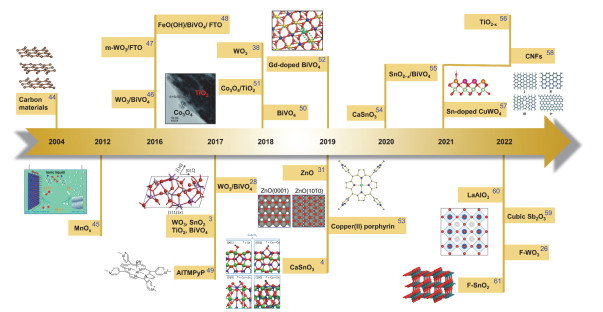
Fig 2
Schematic of three different WOR pathways on the catalytic surface."
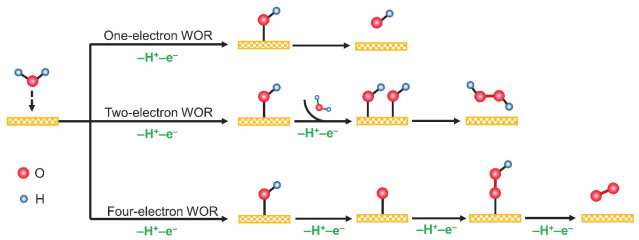
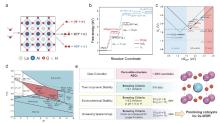
Fig 3
Theoretical studies of WOR electrocatalysts. (a) Different pathways of WOR processes on the LaAlO3 surface. (b) Free energy diagrams of three WOR pathways on LaAlO3. (c) Volcano plots of limiting potentials as a function of ΔGOH*. (d) Pourbaix diagram of 50%–50% Bi-V system in aqueous solution, assuming an ion concentration of 10–5 mol∙kg−1 for both Bi and V. (e) Computational screening strategy to search the most stable perovskite oxide for 2e− WOR at varying pH values. (a–c, e) are adapted from Springer Nature 60. (d) Adapted from Springer Nature 93."
Table 1
Summary of quantitative determination methods of electrochemically generated H2O2."
| Pathway | Electrolyte | Reagent | Method | Reference |
| WOR | 2 mol∙L−1 KHCO3 | Quantofix a | H2O2 strip | |
| WOR | 1 mol∙L−1 Na2CO3 | KMnO4 | Titration | |
| WOR | 2 mol∙L−1 KHCO3 | Iodine | UV-Vis/Titration | |
| WOR | 1 mol∙L−1 NaHCO3 | N, N-diethyl-1,4-phenylene-diamine | UV-Vis | |
| WOR | 2 mol∙L−1 KHCO3 | N, N-diethyl-1,4-phenylene-diamine | UV-Vis | |
| WOR | 2 mol∙L−1 KHCO3 | Quantofix | H2O2 strip | |
| WOR | 2 mol∙L−1 KHCO3 | Quantofix | H2O2 strip | |
| WOR | 0.1 mol∙L−1 HClO4 | KMnO4 | Titration | |
| ORR | 2 mol∙L−1 KHCO3 | Quantofix/KMnO4 | H2O2 strip/Titration | |
| ORR | 0.05 mol∙L−1 H2SO4 | Ce(SO4)2 | UV-Vis | |
| ORR | 0.1 mol∙L−1 HClO4 | Iodine | UV-Vis/Titration |
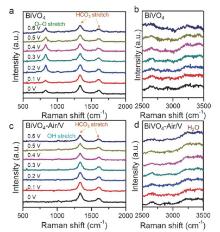
Fig 4
The in situ Raman characterization for 2e− WOR. (a, b) In situ Raman spectra of BiVO4 and (c, d) BiVO4-Air/V with various applied biases in 1.0 mol∙L−1 NaHCO3 electrolyte. Adapted from Wiley-VCH 100."
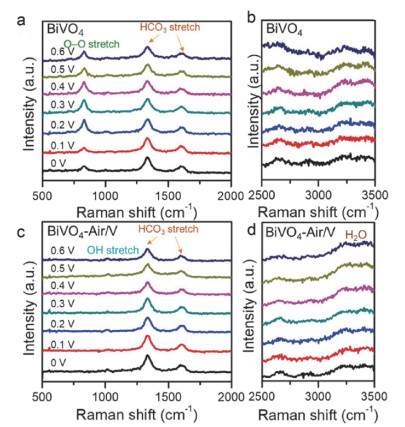
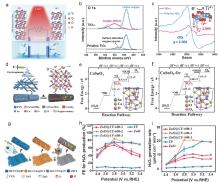
Fig 5
Catalysts design based on defect engineering. (a) A diagram illustrating the electrochemical coupling cell for H2O2 production through 2e− ORR and 2e− WOR reactions. (b) High-resolution O 1s XPS spectra and (c) EPR spectra of pristine TiO2 and TiO2−x. (d) Schematic of the synthetic procedures of CaSnO3@CF. DFT calculated free energy diagram of (e) CaSnO3 and (f) CaSnO3-Ov. (g) Schematic of the synthesis of ZnO@CF. (h) Faraday efficiency and (i) H2O2 production rate of ZnO/CNTs@CF-550-2, 600-2 and 650-2. (a–c) are adapted from Elsevier 56. (d–f) are adapted from Wiley-VCH 96. (g–i) are adapted from Elsevier 30."
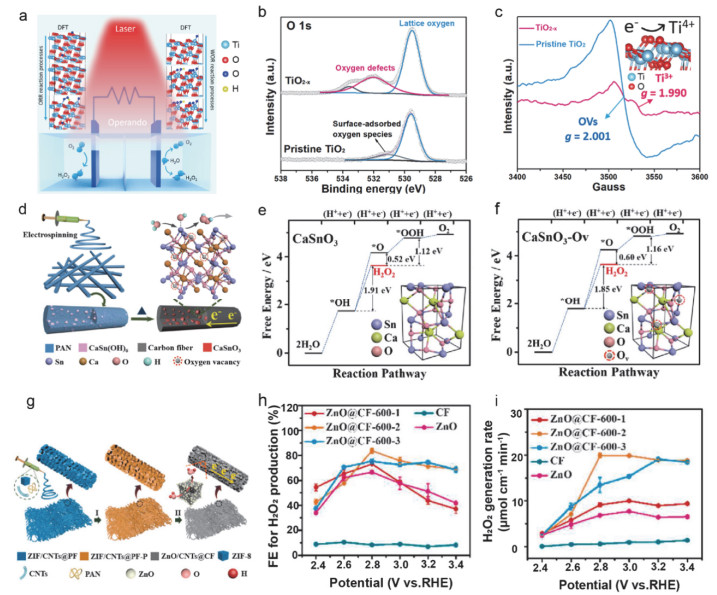
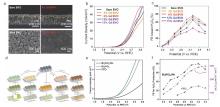
Fig 6
Catalysts design based on doping engineering. (a) Scanning electron microscopy (SEM) images of undoped and Gd-doped BiVO4. (b) Current density versus potential curves and (c) FE towards H2O2 production for BiVO4 with various Gd doping concentrations. (d) Diagram for the preparation process for five Bi-based oxide electrodes. (e) Current density versus potential curves and (f) FE towards H2O2 production for FTO/Bi2WO6 and FTO/Bi2WO6: 5%Mo electrodes. (a–c) are adapted from American Chemical Society 52. (d–f) are adapted from Wiley-VCH 88."
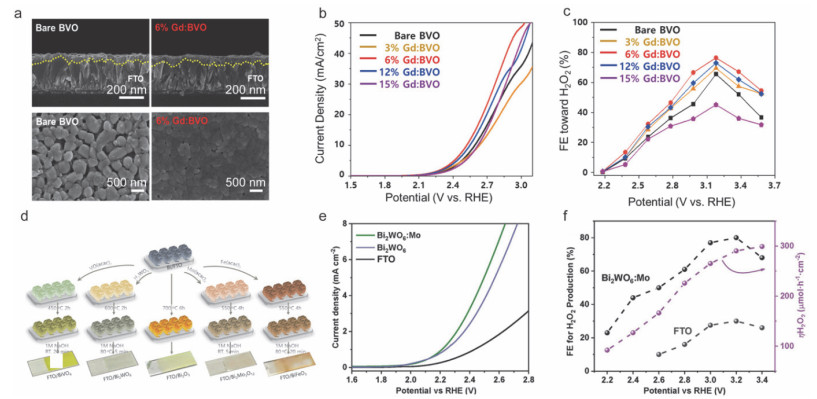
Fig 7
Catalysts design based on facet engineering. (a–c) SEM images and (d) Schematic of (010), (010)/(110), and (110) facet-terminated BiVO4. (e) XRD patterns of BiVO4 photoanodes with different crystal faces. (f) Current density versus potential curves and (g) FE towards H2O2 production of BiVO4 photoanodes with different crystal faces in 1.0 mol∙L−1 NaHCO3 electrolyte under 1.5G AM illumination. (a–g) are adapted from American Chemical Society 117."
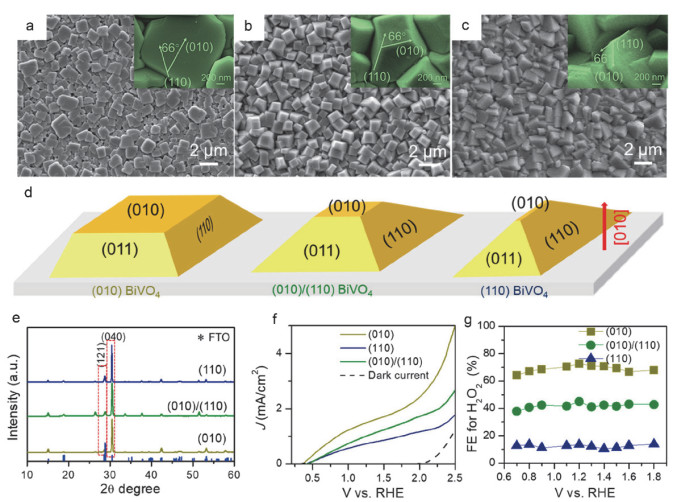
Fig 8
Catalysts design based on interface engineering. (a) Digital images of GC surfaces with both pristine and PTFE-patterned regions were obtained in an electrolyte of 1.0 mol∙L−1 Na2CO3. (b) Measurements of O2 gas bubble adhesive force were conducted on pristine GC, 300-GC, and 200-GC electrodes. The contact angles of O2 bubbles under electrolyte were displayed in the insets. (c) The overall current densities and (d) H2O2 FEs on pristine CFP, CFP-5%, CFP-20% and CFP-60%. (e) The partial current density of ECSA-normalized H2O2 production was plotted against the potential for pristine CFP, CFP-5%, CFP-20% and CFP-60%. (a–e) are adapted from Springer Nature 36."
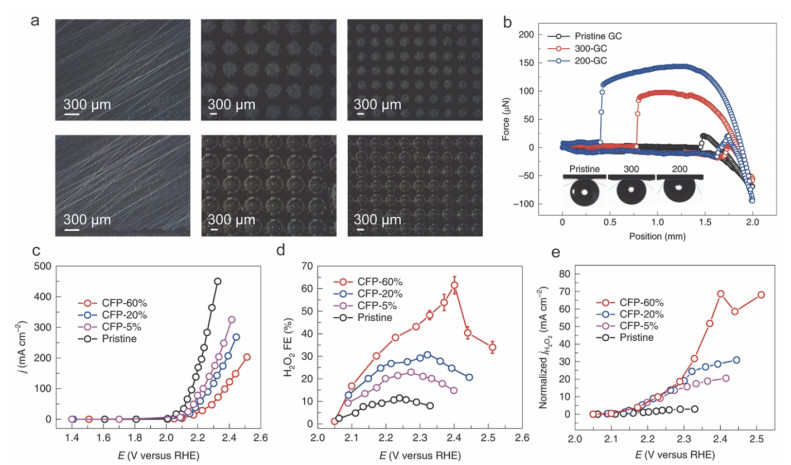
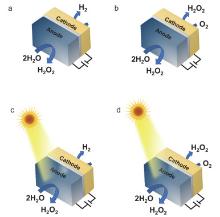
Fig 9
Four types of electrochemical devices for H2O2 production. (a) Electrolyzer for H2O2 production via 2e− WOR at the anode coupled with HER at the cathode. (b) Electrolyzer for two-side H2O2 production via 2e− WOR at the anode and 2e− ORR at the cathode. (c) Light-driven PEC electrolyzer for H2O2 production via 2e− WOR at the anode coupled with HER at the cathode. (d) Light-driven PEC electrolyzer for two-side H2O2 production via 2e− WOR at the anode and 2e− ORR at the cathode."
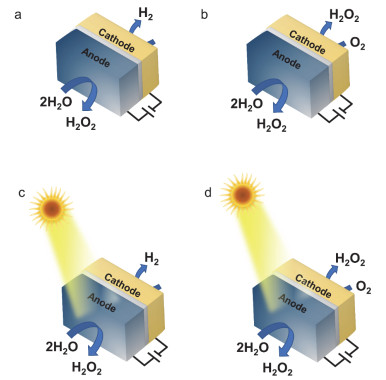
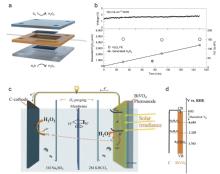
Fig 10
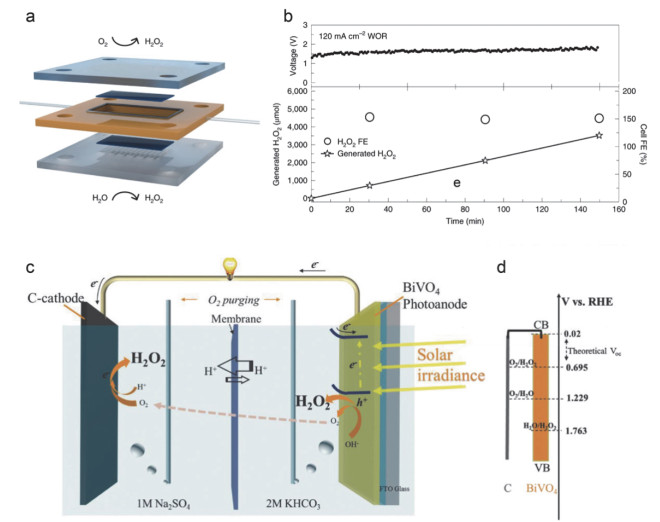
Advanced design of electrochemical devices for H2O2 synthesis. (a) Schematic of a membrane-free flow cell for H2O2 electrosynthesis, and (b) the obtained electrochemical H2O2 production performance. (c) Schematic of the light-driven fuel cell with spontaneous H2O2 and electricity generation. (d) The band diagram of BiVO4 with redox potentials for O2/H2O2 and H2O/H2O2 reaction. (a, b) are reprinted from Springer Nature 36. (c, d) are adapted from Wiley-VCH 50."
| 1 |
doi: 10.1126/science.aay1844 |
| 2 |
doi: 10.1038/nmat3795 |
| 3 |
doi: 10.1038/s41467-017-00585-6 |
| 4 |
doi: 10.1021/acsenergylett.8b02303 |
| 5 |
doi: 10.1002/anie.200503779 |
| 6 |
doi: 10.1002/anie.202101522 |
| 7 |
doi: 10.1021/jacs.1c03135 |
| 8 |
doi: 10.1039/c6re00195e |
| 9 |
doi: 10.1002/anie.202003842 |
| 10 |
doi: 10.1016/j.chempr.2020.09.013 |
| 11 |
doi: 10.1021/acscatal.0c01641 |
| 12 |
doi: 10.1002/aenm.202201466 |
| 13 |
doi: 10.1002/anie.200802818 |
| 14 |
doi: 10.1016/j.cej.2020.126171 |
| 15 |
doi: 10.1002/smll.201902845 |
| 16 |
doi: 10.1021/acsmaterialslett.1c00263 |
| 17 |
doi: 10.1002/aenm.201801909 |
| 18 |
doi: 10.1016/j.jechem.2021.10.013 |
| 19 |
doi: 10.1038/s41467-022-30523-0 |
| 20 |
doi: 10.1038/s41563-019-0571-5 |
| 21 |
doi: 10.1002/anie.202205972 |
| 22 |
doi: 10.1002/adma.202205414 |
| 23 |
doi: 10.1039/d0cs00458h |
| 24 |
doi: 10.1021/acsami.1c11765 |
| 25 |
doi: 10.1016/j.cej.2020.127564 |
| 26 |
doi: 10.1016/j.apcatb.2022.121756 |
| 27 |
doi: 10.1021/acs.jpclett.6b02924 |
| 28 |
doi: 10.1039/c7ra09693c |
| 29 |
doi: 10.1016/j.jallcom.2017.11.181 |
| 30 |
doi: 10.1016/j.envres.2021.112290 |
| 31 |
doi: 10.1021/acscatal.8b04873 |
| 32 |
doi: 10.1039/d1ta07562d |
| 33 |
doi: 10.1021/acs.jpclett.5b02178 |
| 34 |
doi: 10.1002/cssc.202102137 |
| 35 |
doi: 10.1016/j.cossms.2022.100988 |
| 36 |
doi: 10.1038/s41929-019-0402-8 |
| 37 |
doi: 10.1002/slct.201601469 |
| 38 |
doi: 10.1039/c8ta04081h |
| 39 |
doi: 10.1021/acsenergylett.1c00904 |
| 40 |
doi: 10.1016/j.chempr.2017.12.015 |
| 41 |
doi: 10.1038/s41929-020-0486-1 |
| 42 |
doi: 10.1021/acsenergylett.1c01264 |
| 43 |
doi: 10.1021/nl500037x |
| 44 |
doi: 10.1016/j.ijhydene.2004.02.001 |
| 45 |
doi: 10.1039/c2ee21832a |
| 46 |
doi: 10.1039/c6cc01605g |
| 47 |
doi: 10.1038/ncomms11470 |
| 48 |
doi: 10.1021/acsenergylett.6b00415 |
| 49 |
doi: 10.1002/cssc.201700322 |
| 50 |
doi: 10.1002/aenm.201801158 |
| 51 |
doi: 10.1039/c8cc03303j |
| 52 |
doi: 10.1021/acsenergylett.9b00277 |
| 53 |
doi: 10.1039/c8sc04529a |
| 54 |
doi: 10.1021/acssuschemeng.0c05449 |
| 55 |
doi: 10.1021/jacs.9b13410 |
| 56 |
doi: 10.1016/j.checat.2021.10.011 |
| 57 |
doi: 10.1021/acs.chemmater.1c02787 |
| 58 |
doi: 10.1039/d1ta06306e |
| 59 |
doi: 10.1016/j.apsusc.2022.155006 |
| 60 |
doi: 10.1038/s41467-022-34884-4 |
| 61 |
doi: 10.1038/s41467-022-30251-5 |
| 62 |
doi: 10.1002/smll.202104561 |
| 63 |
doi: 10.1021/acssuschemeng.0c07263 |
| 64 |
doi: 10.1038/s41570-019-0110-6 |
| 65 |
doi: 10.1039/c5cy01567g |
| 66 |
doi: 10.1016/j.apsusc.2022.153832 |
| 67 |
doi: 10.1002/adma.201904433 |
| 68 |
doi: 10.1016/j.mtadv.2022.100280 |
| 69 |
doi: 10.1016/j.cej.2021.129722 |
| 70 |
doi: 10.1016/j.carbon.2022.01.019 |
| 71 |
doi: 10.1021/nn501640q |
| 72 |
doi: 10.3390/nano11082045 |
| 73 |
doi: 10.1002/admt.202100708 |
| 74 |
doi: 10.1016/j.cej.2020.127332 |
| 75 |
doi: 10.1016/j.jhazmat.2014.04.054 |
| 76 |
doi: 10.1016/j.watres.2015.11.049 |
| 77 |
doi: 10.1016/j.watres.2016.07.004 |
| 78 |
doi: 10.1016/j.watres.2015.05.019 |
| 79 |
doi: 10.1038/srep09332 |
| 80 |
doi: 10.1063/1.453529 |
| 81 |
doi: 10.1016/j.watres.2021.117338 |
| 82 |
doi: 10.1021/jacs.2c01153 |
| 83 |
doi: 10.1021/ja405997s |
| 84 |
doi: 10.1016/j.jelechem.2006.11.008 |
| 85 |
doi: 10.1002/cctc.201902363 |
| 86 |
doi: 10.1002/aenm.201702774 |
| 87 |
doi: 10.1039/d0ta09122g |
| 88 |
doi: 10.1002/anie.202008031 |
| 89 |
doi: 10.1016/j.apsusc.2022.153634 |
| 90 |
doi: 10.1021/acs.jpcc.9b11418 |
| 91 |
doi: 10.1002/cctc.202300055 |
| 92 |
doi: 10.1016/j.matt.2019.09.011 |
| 93 |
doi: 10.1038/ncomms12012 |
| 94 |
doi: 10.1021/acs.chemmater.7b03980 |
| 95 |
doi: 10.1021/acs.chemmater.0c02010 |
| 96 |
doi: 10.1002/adfm.202100099 |
| 97 |
doi: 10.1038/s41467-020-17782-5 |
| 98 |
doi: 10.1039/d0ee01925a |
| 99 |
doi: 10.1038/s41467-020-175 |
| 100 |
doi: 10.1002/smll.202100400 |
| 101 |
doi: 10.1021/jacs.9b07979 |
| 102 |
doi: 10.1021/acscatal.7b02561 |
| 103 |
doi: 10.1021/jacs.8b08379 |
| 104 |
doi: 10.1002/adfm.201706319 |
| 105 |
doi: 10.1002/jccs.201900001 |
| 106 |
doi: 10.1039/c4sc00565a |
| 107 |
doi: 10.1039/c4cs00236a |
| 108 |
doi: 10.1016/j.nanoen.2020.105126 |
| 109 |
doi: 10.1007/s40820-020-00579-y |
| 110 |
doi: 10.1002/adma.201606459 |
| 111 |
doi: 10.1039/c8ee03276a |
| 112 |
doi: 10.1016/j.nanoen.2020.105514 |
| 113 |
doi: 10.1002/aenm.202003755 |
| 114 |
doi: 10.1002/adfm.201906670 |
| 115 |
doi: 10.1073/pnas.1620787114 |
| 116 |
doi: 10.1021/acsami.9b16937 |
| 117 |
doi: 10.1021/acsenergylett.1c01831 |
| 118 |
doi: 10.1016/j.electacta.2022.141091 |
| 119 |
doi: 10.1021/acsenergylett.9b01758 |
| 120 |
doi: 10.1002/aenm.201903891 |
| 121 |
doi: 10.1002/anie.201602237 |
| 122 |
doi: 10.1016/j.apcatb.2019.01.094 |
| 123 |
doi: 10.1002/advs.202002631 |
| 124 |
doi: 10.1002/cssc.201601182 |
| [1] | Fan Fan, Hao Xiu, Yuting Wang, Yongpeng Cui, Yajun Wang. Construction of NH2-MIL-125/Na-doped g-C3N4 composite S-scheme heterojunction and its performance in photocatalytic hydrogen peroxide production [J]. Acta Phys. -Chim. Sin., 2026, 42(2): 100143-. |
| [2] | Mahmoud Sayed, Han Li, Chuanbiao Bie. Challenges and prospects of photocatalytic H2O2 production [J]. Acta Phys. -Chim. Sin., 2025, 41(9): 100117-. |
| [3] | Yanyan Zhao, Zhen Wu, Yong Zhang, Bicheng Zhu, Jianjun Zhang. Enhancing photocatalytic H2O2 production via dual optimization of charge separation and O2 adsorption in Au-decorated S-vacancy-rich CdIn2S4 [J]. Acta Phys. -Chim. Sin., 2025, 41(11): 100142-. |
| [4] | Kangjuan Cheng, Chunxiao Liu, Youpeng Wang, Qiu Jiang, Tingting Zheng, Xu Li, Chuan Xia. Design of noble metal catalysts and reactors for the electrosynthesis of hydrogen peroxide [J]. Acta Phys. -Chim. Sin., 2025, 41(10): 100112-. |
| [5] | Zhaoyu Wen, Na Han, Yanguang Li. Recent Progress towards the Production of H2O2 by Electrochemical Two-Electron Oxygen Reduction Reaction [J]. Acta Phys. -Chim. Sin., 2024, 40(2): 2304001-. |
| [6] | Ke Li, Chuang Liu, Jingping Li, Guohong Wang, Kai Wang. Architecting Inorganic/Organic S-Scheme Heterojunction of Bi4Ti3O12 Coupling with g-C3N4 for Photocatalytic H2O2 Production from Pure Water [J]. Acta Phys. -Chim. Sin., 2024, 40(11): 2403009-. |
| [7] | Hangyu Lu, Ruilin Hou, Shiyong Chu, Haoshen Zhou, Shaohua Guo. Progress on Modification Strategies of Layered Lithium-Rich Cathode Materials for High Energy Lithium-Ion Batteries [J]. Acta Phys. -Chim. Sin., 2023, 39(7): 2211057-0. |
| [8] | Hui Li,Shuangyu Liu,Tianci Yuan,Bo Wang,Peng Sheng,Li Xu,Guangyao Zhao,Huitao Bai,Xin Chen,Zhongxue Chen,Yuliang Cao. Electrochemical Mechanism of Na0.44MnO2 in Alkaline Aqueous Solution [J]. Acta Physico-Chimica Sinica, 2020, 36(5): 1905027-. |
| [9] | Chunhui SHAN,Ruopeng BAI,Yu LAN. Theoretical Advances of Transition Metals Mediated C―H Bonds Cleavage [J]. Acta Physico-Chimica Sinica, 2019, 35(9): 940-953. |
| [10] | Mingming YUAN,Difan LI,Xiuge ZHAO,Wenbao MA,Kang KONG,Wenxiu NI,Qingwen GU,Zhenshan HOU. Selective Oxidation of Glycerol with Hydrogen Peroxide Using Silica-Encapsulated Heteropolyacid Catalyst [J]. Acta Phys. -Chim. Sin., 2018, 34(8): 886-895. |
| [11] | Yang HUANG,Qing-De SUN,Wen XU,Yao HE,Wan-Jian YIN. Halide Perovskite Materials for Solar Cells: a Theoretical Review [J]. Acta Phys. -Chim. Sin., 2017, 33(9): 1730-1751. |
| [12] | Lei PEI,Gui-Ling ZHANG,Yan SHANG,Cui-Cui SUN,Tian GAN. Silicon Bridge-Tuned Electronic Structures and Transport Properties of Polymetallocenes [J]. Acta Phys. -Chim. Sin., 2016, 32(10): 2495-2502. |
| [13] | Xiao-Feng. WANG,Guo-Fang. ZUO,Zhi-Feng. LI,Hui-Xue. LI. Theoretical Study of the Phosphorescence Spectrum of Tris(2-phenylpyridine)iridium Using the Displaced Harmonic Oscillator Model [J]. Acta Phys. -Chim. Sin., 2015, 31(9): 1667-1676. |
| [14] | LI Hui-Xue, ZUO Guo-Fang, LI Zhi-Feng, WANG Xiao-Feng, ZHENG Ren-Hui. Theoretical Study of Hemicyanine Dye as a Dye-Sensitized Solar Cell Light-Absorbing Material [J]. Acta Phys. -Chim. Sin., 2015, 31(5): 866-876. |
| [15] | KANG Ya-Rong, CHEN Fu-Yi. Synthesis and Application of Ag-Cu Bimetallic Dendrites [J]. Acta Phys. -Chim. Sin., 2013, 29(08): 1712-1718. |
|
||