Acta Phys. -Chim. Sin. ›› 2024, Vol. 40 ›› Issue (5): 2305047.doi: 10.3866/PKU.WHXB202305047
• ARTICLE • Previous Articles Next Articles
S-Doping of the N-Sites of g-C3N4 to Enhance Photocatalytic H2 Evolution Activity
Haitao Wang1, Lianglang Yu1, Jizhou Jiang1,*( ), Arramel2, Jing Zou1
- 1 School of Chemistry and Environmental Engineering, School of Environmental Ecology and Biological Engineering, Key Laboratory of Green Chemical Engineering Process of Ministry of Education, Engineering Research Center of Phosphorus Resources Development and Utilization of Ministry of Education, Novel Catalytic Materials of Hubei Engineering Research Center, Wuhan Institute of Technology, Wuhan 430205, China
2 Nano Center Indonesia, Jalan Raya PUSPIPTEK, South Tangerang, Banten 15314, Indonesia
-
Received:2023-05-26Revised:2023-06-21Accepted:2023-06-21Published:2023-06-26 -
Contact:Email: 027wit@163.com (Jizhou Jiang) -
Supported by:the National Natural Science Foundation of China(62004143); the Key R&D Program of Hubei Province, China(2022BAA084); the Natural Science Foundation of Hubei Province, China(2021CFB133); the National Key R&D Program of China(2022YFC3902703); the Innovation Project of Engineering Research Center of Phosphorus Resources Development and Utilization of Ministry of Education, China(LCX2021003); the Open Research Fund of Key Laboratory of Material Chemistry for Energy Conversion and Storage (HUST), Ministry of Education, China(2021JYBKF05)

Cite this article
Haitao Wang, Lianglang Yu, Jizhou Jiang, Arramel, Jing Zou. S-Doping of the N-Sites of g-C3N4 to Enhance Photocatalytic H2 Evolution Activity[J]. Acta Phys. -Chim. Sin. 2024, 40(5), 2305047. doi: 10.3866/PKU.WHXB202305047
share this article
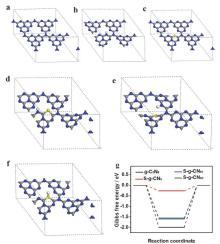
Fig 1
(a) Optimized geometric structures of g-C3N4 and (b) the H* optimal adsorption on the N active sites of g-C3N4. (c) Optimized structures of S-g-CN and the optimal adsorption structures of H* intermediate at (d) N1, (e) N2 and (f) S active sites of S-g-CN. (g) Free energy diagram of HER on g-C3N4 and S-g-CN. Blue, grey, yellow, and white circles respective represent N, C, S, and H atoms. Color online."
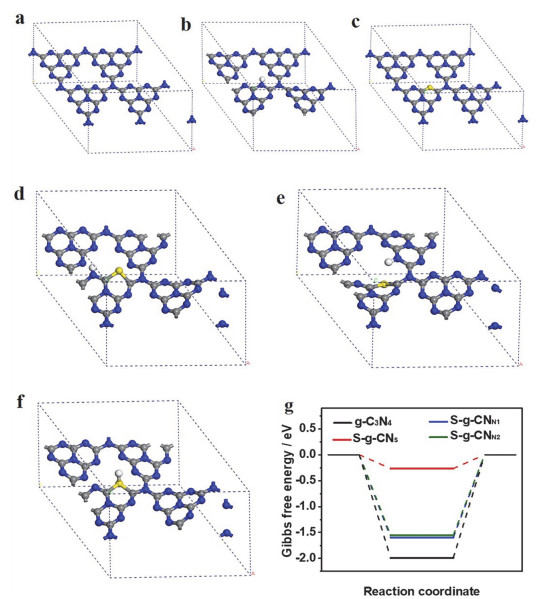
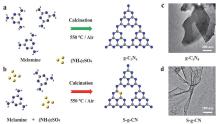
Fig 2
Schematic illustration of (a) g-C3N4 and (b) S-g-CN synthetic routes and (c, d) their corresponding TEM images."
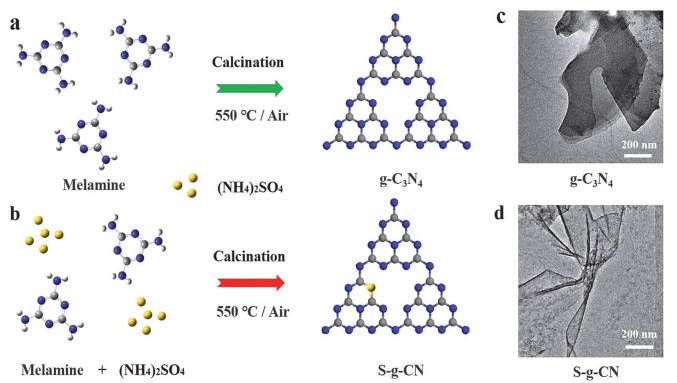
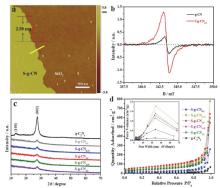
Fig 3
(a) AFM result of S-g-CN. (b) ESR spectra of g-C3N4 and S-CN. (c) XRD patterns and (d) N2 adsorb/desorption isotherms of g-C3N4 and S-g-CNx (inset is the pore size distributions)."

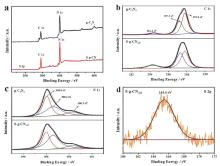
Fig 4
(a) XPS spectra of g-C3N4 and S-CN1.0. (b) High-resolution the core levels of C 1s and (c) N 1s spectra of g-C3N4 and S-CN1.0. (d) High-resolution core levels of S 2p spectrum of S-CN1.0."
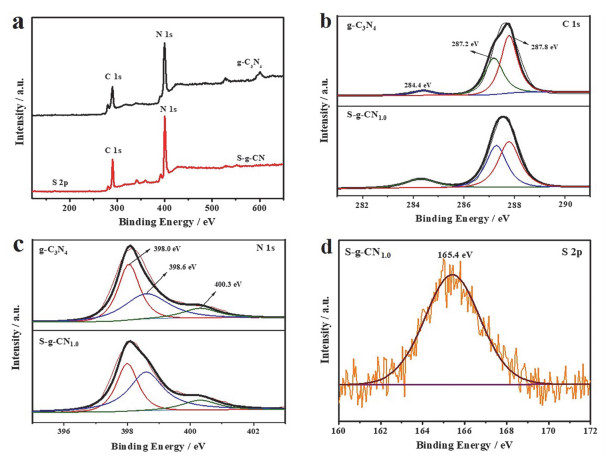
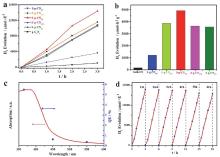
Fig 5
(a) Photocatalytic HER curves and (b) the corresponding H2 generation rates of g-C3N4 and the S-g-CNx. (c) AQE and (d) photocatalytic durability of S-g-CN1.0."

Table 1
An overview of previous work related to the photocatalytic HER activity between S-g-CN1.0 and other S-doped g-C3N4 catalysts at visible light irradiation."
| Photocatalyst | Loading (mg) | Co-catalyst | H2 evolution rate (μmol∙g−1∙h−1) | Reference |
| S-g-CN1.0 | 50 | 1 wt% Pt | 4923 | this work |
| PCNS | 15 | 2 wt% Pt | 880.2 | 44 |
| SPCN0.1 | 50 | 3 wt% Pt | 4200.3 | 45 |
| SCN1.0 | 50 | 3 wt% Pt | 141.9 | 46 |
| SCND-3 | 50 | 3 wt% Pt | 1404 | 47 |
| MA-Fe-S-CN | 50 | – | 2965.5 | 48 |
| g-CN-TM1 | 10 | 0.5 wt% Pt | 4430 | 49 |
| Co-S-CN | 20 | 1 wt% Pt | 910.6 | 50 |
| 0.3S-CN | 10 | 1 wt% Pt | 952 | 51 |
| S@g-C3N4 | 5 | 1 wt% Pt | 736.8 | 52 |
| PSCN | 20 | 3 wt% Pt | 1969 | 53 |
| SS-CN | 50 | 1 wt% Pt | 982.3 | 54 |
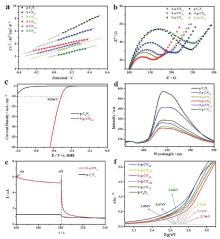
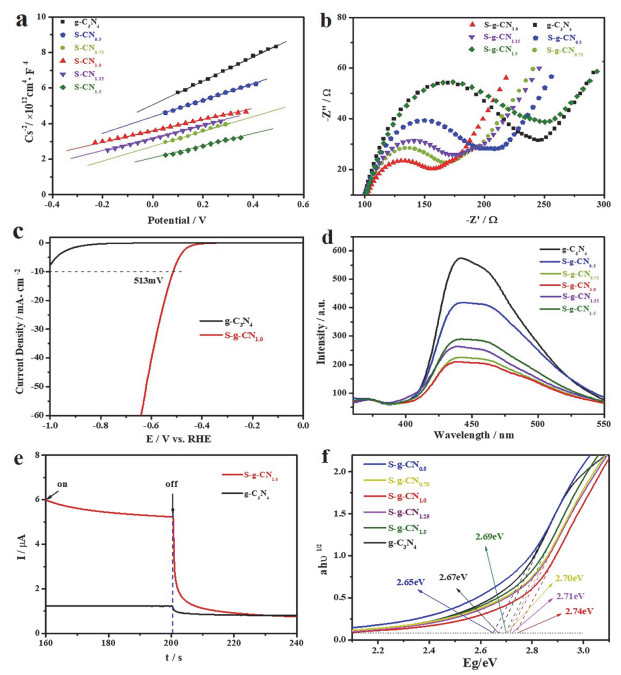
Fig 6
(a) M-S, (b) EIS, (c) linear sweep voltammetry (LSV), (d) photoluminescence (PL), (e) photocurrent (PC) response curves, and (f) estimated energy gaps of g-C3N4 and S-g-CNx."
| 1 |
doi: 10.1002/adfm.202214470 |
| 2 |
doi: 10.3866/PKU.WHXB202009030 |
|
李云锋; 张敏; 周亮; 杨思佳; 武占省; 马玉花.. 物理化学学报, 2021, 37, 2009030.
doi: 10.3866/PKU.WHXB202009030 |
|
| 3 |
doi: 10.1039/D2GC03160D |
| 4 |
doi: 10.21203/rs.3.rs-208751/v1 |
| 5 |
doi: 10.14102/j.cnki.0254-5861.2022-0108 |
| 6 |
doi: 10.14102/j.cnki.0254-5861.2022-0152 |
| 7 |
doi: 10.3866/PKU.WHXB202010030 |
|
李喜宝; 刘积有; 黄军同; 何朝政; 冯志军; 陈智; 万里鹰; 邓芳.. 物理化学学报, 2021, 37, 2010030.
doi: 10.3866/PKU.WHXB202010030 |
|
| 8 |
doi: 10.1016/j.jmst.2021.10.030 |
| 9 |
doi: 10.1007/s40843-020-1456-x |
| 10 |
doi: 10.1016/j.jmst.2020.10.030 |
| 11 |
doi: 10.1007/s12274-022-4799-z |
| 12 |
doi: 10.3866/PKU.WHXB202109023 |
|
刘珊池; 王凯; 杨梦雪; 靳治良.. 物理化学学报, 2022, 38, 2109023.
doi: 10.3866/PKU.WHXB202109023 |
|
| 13 |
doi: 10.1039/d1ta07332j |
| 14 |
doi: 10.1007/s11431-022-2192-6 |
| 15 |
doi: 10.14102/j.cnki.0254-5861.2022-0068 |
| 16 |
doi: 10.1016/s1872-2067(22)64096-8 |
| 17 |
doi: 10.1002/adsu.202100498 |
| 18 |
doi: 10.1016/j.nanoen.2022.108032 |
| 19 |
doi: 10.1016/j.jallcom.2022.165020 |
| 20 |
doi: 10.14102/j.cnki.0254-5861.2021-0039 |
| 21 |
doi: 10.1016/j.apcatb.2018.11.011 |
| 22 |
doi: 10.3866/PKU.WHXB202110014 |
|
沈荣晨; 郝磊; 陈晴; 郑巧清; 张鹏; 李鑫.. 物理化学学报, 2022, 38, 2110014.
doi: 10.3866/PKU.WHXB202110014 |
|
| 23 |
doi: 10.1016/j.jmst.2021.03.025 |
| 24 |
doi: 10.1016/s1872-2067(20)63634-8 |
| 25 |
doi: 10.1016/j.cej.2020.126498 |
| 26 |
doi: 10.1016/j.jmst.2021.12.018 |
| 27 |
doi: 10.1016/j.apcatb.2018.07.023 |
| 28 |
doi: 10.1021/acssuschemeng.8b05374 |
| 29 |
doi: 10.1038/s41699-021-00259-4 |
| 30 |
doi: 10.1002/adfm.202208358 |
| 31 |
doi: 10.1007/s12274-022-4276-8 |
| 32 |
doi: 10.3866/PKU.WHXB202005027 |
|
秦祖赠; 吴靖; 李斌; 苏通明; 纪红兵.. 物理化学学报, 2021, 37, 2005027.
doi: 10.3866/PKU.WHXB202005027 |
|
| 33 |
doi: 10.1016/j.carbon.2018.01.008 |
| 34 |
doi: 10.1016/j.apcatb.2020.119539 |
| 35 |
doi: 10.1016/j.apcatb.2022.121942 |
| 36 |
doi: 10.1016/j.jcis.2019.11.065 |
| 37 |
doi: 10.1016/j.jmst.2023.03.003 |
| 38 |
doi: 10.1016/j.carbon.2014.08.059 |
| 39 |
doi: 10.1039/c9nr00168a |
| 40 |
doi: 10.14102/j.cnki.0254-5861.2022-0103 |
| 41 |
doi: 10.1002/cssc.201402180 |
| 42 |
doi: 10.1016/j.jcis.2020.02.017 |
| 43 |
doi: 10.3389/fchem.2019.00855 |
| 44 |
doi: 10.1016/j.ceramint.2020.09.275 |
| 45 |
doi: 10.1016/j.jcis.2021.10.084 |
| 46 |
doi: 10.1016/j.ijhydene.2021.03.148 |
| 47 |
doi: 10.1016/j.jtice.2020.12.001 |
| 48 |
doi: 10.1016/j.seppur.2023.123618 |
| 49 |
doi: 10.1016/j.matlet.2021.130120 |
| 50 |
doi: 10.1016/j.jallcom.2022.166257 |
| 51 |
doi: 10.1007/s10562-020-03156-5 |
| 52 |
doi: 10.1016/j.synthmet.2022.117100 |
| 53 |
doi: 10.1016/j.jallcom.2020.154259 |
| 54 |
doi: 10.1016/j.apcatb.2020.119539 |
| 55 |
doi: 10.1016/j.cclet.2022.03.101 |
| 56 |
doi: 10.1016/j.jmst.2021.11.046 |
| 57 |
doi: 10.1021/jacs.6b11878 |
| 58 |
doi: 10.1002/adma.201806596 |
| 59 |
doi: 10.1002/adma.202209141 |
| 60 |
doi: 10.1002/anie.201916012 |
| 61 |
doi: 10.1002/smll.202301116 |
| [1] | Yu Liu, Pengfei Li, Yize Liu, Zaicheng Sun. Recent advances in carbon dots as a single photocatalyst [J]. Acta Phys. -Chim. Sin., 2026, 42(2): 100167-. |
| [2] | Yuhang Zhang, Yi Li, Yuehan Cao, Yingjie Shuai, Yu Zhou, Ying Zhou. Regulating the formation type by Ir of intermediates to suppress product overoxidation in photocatalytic methane conversion [J]. Acta Phys. -Chim. Sin., 2026, 42(2): 100173-. |
| [3] | Chengxiao Zhao, Zhaolin Li, Dongfang Wu, Xiaofei Yang. SBA-15 templated covalent triazine frameworks for boosted photocatalytic hydrogen production [J]. Acta Phys. -Chim. Sin., 2026, 42(1): 100149-. |
| [4] | Chengyan Ge, Jiawei Hu, Xingyu Liu, Yuxi Song, Chao Liu, Zhigang Zou. Self-integrated black NiO clusters with ZnIn2S4 microspheres for photothermal-assisted hydrogen evolution by S-scheme electron transfer mechanism [J]. Acta Phys. -Chim. Sin., 2026, 42(1): 100154-. |
| [5] | Huoshuai Huang, Zhidong Wei, Jiawei Yan, Jiasheng Chi, Qianxiang Su, Mingxia Chen, Zhi Jiang, Yangzhou Sun, Wenfeng Shangguan. Unveiling the mechanism of direct-to-indirect bandgap transition in the photocatalytic hydrogen evolution of ZnxCd1−xS solid solution [J]. Acta Phys. -Chim. Sin., 2026, 42(1): 100141-. |
| [6] | Shiyi Chen, Jialong Fu, Jianping Qiu, Guoju Chang, Shiyou Hao. Waste medical mask-derived carbon quantum dots enhance the photocatalytic degradation of polyethylene terephthalate (PET) over BiOBr/g-C3N4 S-scheme heterojunction [J]. Acta Phys. -Chim. Sin., 2026, 42(1): 100135-. |
| [7] | Jianan Hong, Chenyu Xu, Yan Liu, Changqi Li, Menglin Wang, Yanwei Zhang. Decoding the interfacial competition between hydrogen evolution and CO2 reduction via edge-active-site modulation in photothermal catalysis [J]. Acta Phys. -Chim. Sin., 2025, 41(9): 100099-. |
| [8] | Menglan Wei, Xiaoxia Ou, Yimeng Wang, Mengyuan Zhang, Fei Teng, Kaixuan Wang. S-scheme heterojunction g-C3N4/Bi2WO6 highly efficient degradation of levofloxacin: performance, mechanism and degradation pathway [J]. Acta Phys. -Chim. Sin., 2025, 41(9): 100105-. |
| [9] | Jingping Li, Suding Yan, Jiaxi Wu, Qiang Cheng, Kai Wang. Improving hydrogen peroxide photosynthesis over inorganic/organic S-scheme photocatalyst with LiFePO4 [J]. Acta Phys. -Chim. Sin., 2025, 41(9): 100104-. |
| [10] | Fengying Zhang, Yanglin Mei, Yuman Jiang, Shenshen Zheng, Kaibo Zheng, Ying Zhou. Research progress of transient absorption spectroscopy in solar energy conversion and utilization [J]. Acta Phys. -Chim. Sin., 2025, 41(9): 100118-. |
| [11] | Lewang Yuan, Yaoyao Peng, Zong-Jie Guan, Yu Fang. Insights into the development of 2D covalent organic frameworks as photocatalysts in organic synthesis [J]. Acta Phys. -Chim. Sin., 2025, 41(8): 100086-. |
| [12] | Jiajie Cai, Chang Cheng, Bowen Liu, Jianjun Zhang, Chuanjia Jiang, Bei Cheng. CdS/DBTSO-BDTO S-scheme photocatalyst for H2 production and its charge transfer dynamics [J]. Acta Phys. -Chim. Sin., 2025, 41(8): 100084-. |
| [13] | Yu Wang, Haiyang Shi, Zihan Chen, Feng Chen, Ping Wang, Xuefei Wang. Hollow AgPt@Pt core-shell cocatalyst with electron-rich Ptδ− shell for boosting selectivity of photocatalytic H2O2 production for faceted BiVO4 [J]. Acta Phys. -Chim. Sin., 2025, 41(7): 100081-. |
| [14] | Yadan Luo, Hao Zheng, Xin Li, Fengmin Li, Hua Tang, Xilin She. Modulating reactive oxygen species in O, S co-doped C3N4 to enhance photocatalytic degradation of microplastics [J]. Acta Phys. -Chim. Sin., 2025, 41(6): 100052-. |
| [15] | Yuchen Zhou, Huanmin Liu, Hongxing Li, Xinyu Song, Yonghua Tang, Peng Zhou. Designing thermodynamically stable noble metal single-atom photocatalysts for highly efficient non-oxidative conversion of ethanol into high-purity hydrogen and value-added acetaldehyde [J]. Acta Phys. -Chim. Sin., 2025, 41(6): 100067-. |
|
||