Acta Phys. -Chim. Sin. ›› 2024, Vol. 40 ›› Issue (6): 2306054.doi: 10.3866/PKU.WHXB202306054
• ARTICLE • Previous Articles Next Articles
Building P-Poor Ni2P and P-Rich CoP3 Heterojunction Structure with Cation Vacancy for Enhanced Electrocatalytic Hydrazine and Urea Oxidation
Wenjuan Tan, Yong Ye, Xiujuan Sun*( ), Bei Liu*(), Jiajia Zhou, Hailong Liao, Xiulin Wu, Rui Ding, Enhui Liu, Ping Gao
- Key Laboratory of Environmentally Friendly Chemistry and Applications of Ministry of Education, College of Chemistry, Xiangtan University, Xiangtan 411105, Hunan Province, China
-
Received:2023-06-30Revised:2023-08-13Accepted:2023-08-13Published:2023-11-29 -
Contact:Email: sunxj594@xtu.edu.cn; Tel.: +86-136156471 (Xiujuan Sun)liubei@xtu.edu.cn; Tel.: +86-18175631945 (Bei Liu) -
Supported by:the General Project of Education Department of Hunan Province, China(20C1774); the Natural Science Foundation of Hunan Province, China(2021JJ40530); the Natural Science Foundation of Hunan Province, China(2022JJ40428)

Cite this article
Wenjuan Tan, Yong Ye, Xiujuan Sun, Bei Liu, Jiajia Zhou, Hailong Liao, Xiulin Wu, Rui Ding, Enhui Liu, Ping Gao. Building P-Poor Ni2P and P-Rich CoP3 Heterojunction Structure with Cation Vacancy for Enhanced Electrocatalytic Hydrazine and Urea Oxidation[J]. Acta Phys. -Chim. Sin. 2024, 40(6), 2306054. doi: 10.3866/PKU.WHXB202306054
share this article
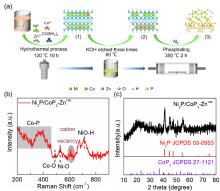
Fig 1
(a) The synthesis sketch of Ni2P/CoP3-Znvac, (b) XRD files and (c) Raman spectrum."
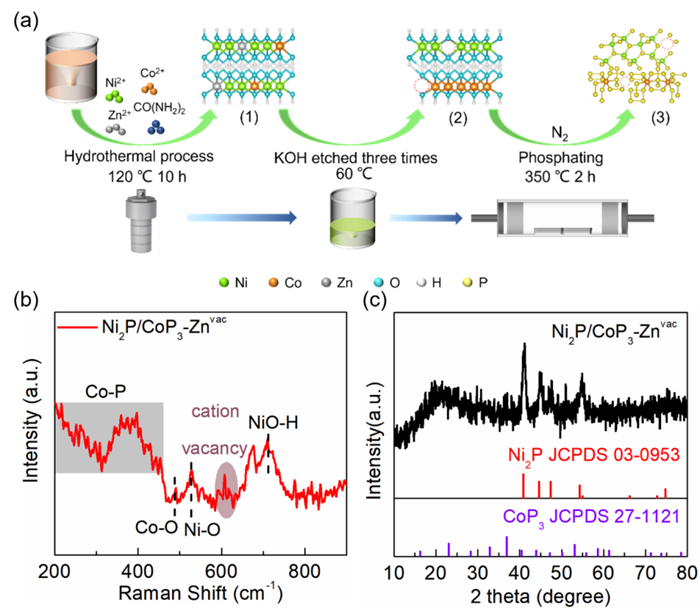
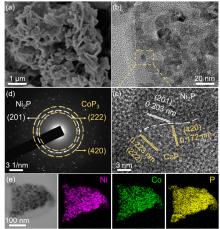
Fig 2
Structure and morphology characterizations of Ni2P/CoP3-Znvac heterojunction. (a) SEM pattern, (b) TEM image, (c) HR-TEM, (d) SAED, and (e) HRTEM-HADDF and element mapping images."
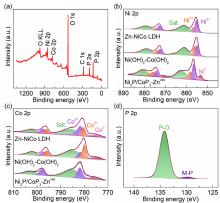
Fig 3
(a) XPS of Ni2P/CoP3-Znvac, (b) Ni 2p and (c) Co 2p and (d) P 2p for Ni2P/CoP3-Znvac."
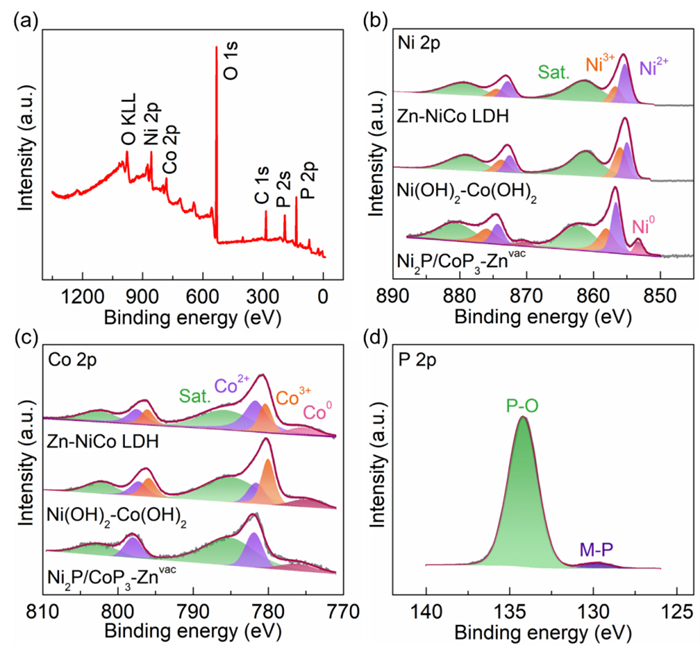
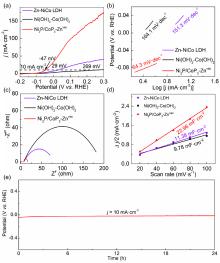
Fig 4
The HzOR performance of Zn-NiCo LDH, Ni(OH)2-Co(OH)2, and Ni2P/CoP3-Znvac. (a) LSV curves and (b) the Tafel plots. (c) EIS tests at a potential of 0.05 V. (d) Double-layer capacitance. (e) Chronopotentiometry (E–t) measurement of Ni2P/CoP3-Znvac under 10 mA·cm−2 for 24 h."
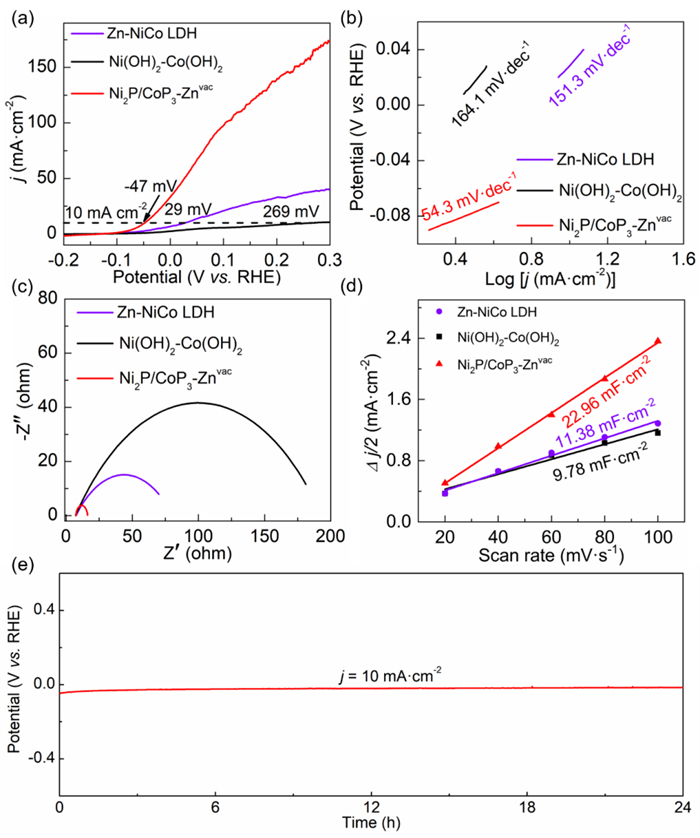
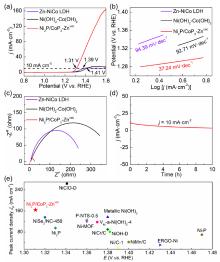
Fig 5
The comparison of UOR activities. (a) LSV curves, (b) Tafel slopes, (c) Nyquist plots, (d) chronoamperometric (i–t) test, (e) comparison of the peak current density (Jp) and the potential at 10 mA·cm−2 (η10) of UOR among various nickel-based catalysts. Electrolyte: 1.0 mol·L−1 KOH + 0.33 mol·L−1 urea."
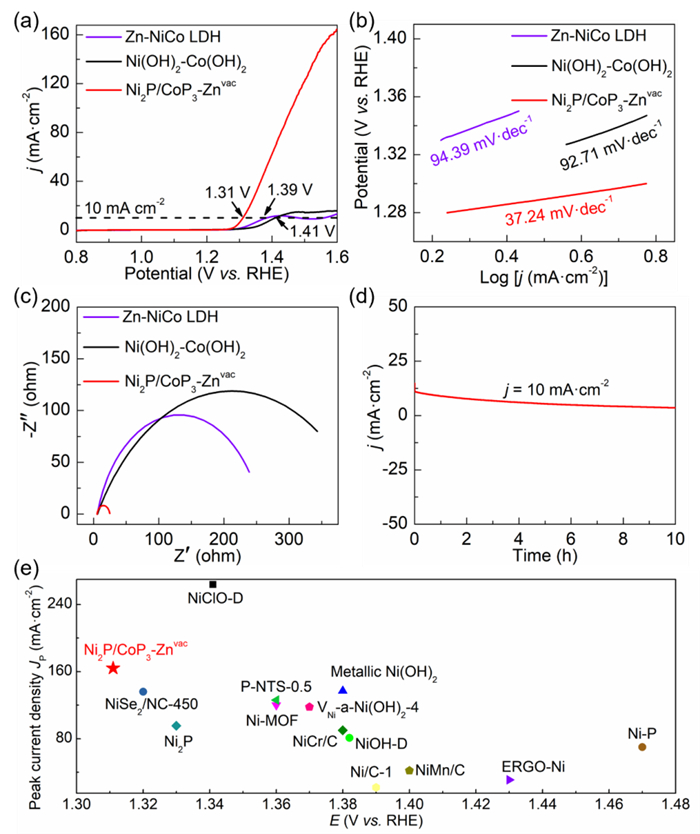
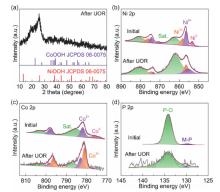
Fig 6
Characterization of Ni2P/CoP3-Znvac after UOR test. (a) XRD pattern. (b) Ni 2p, (c) Co 2p, (d) P 2p XPS spectra."
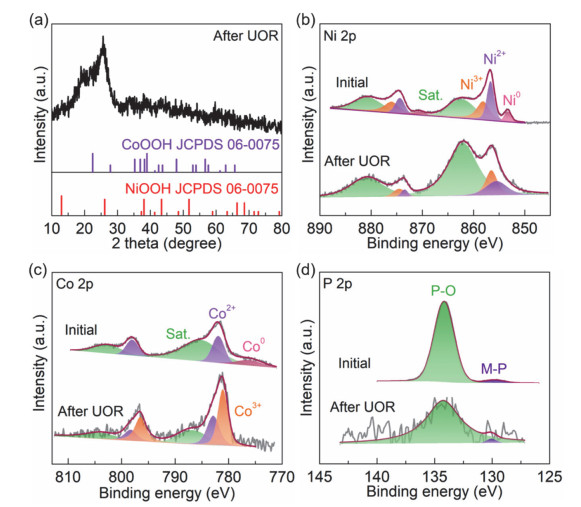
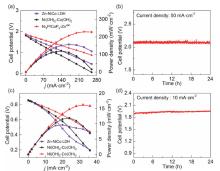
Fig 7
(a) and (c) the DHzFCs/DUHPFCs tests, (b) and (d) the stability measurements of DHzFC/DUHPFC."
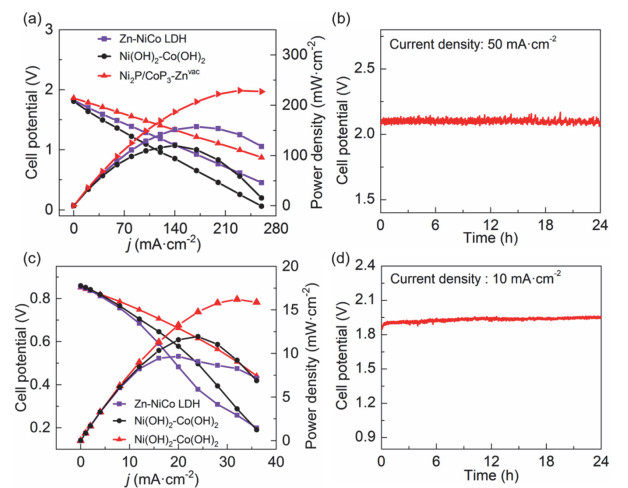
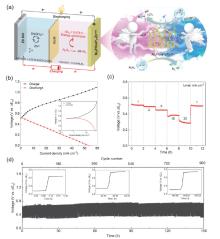
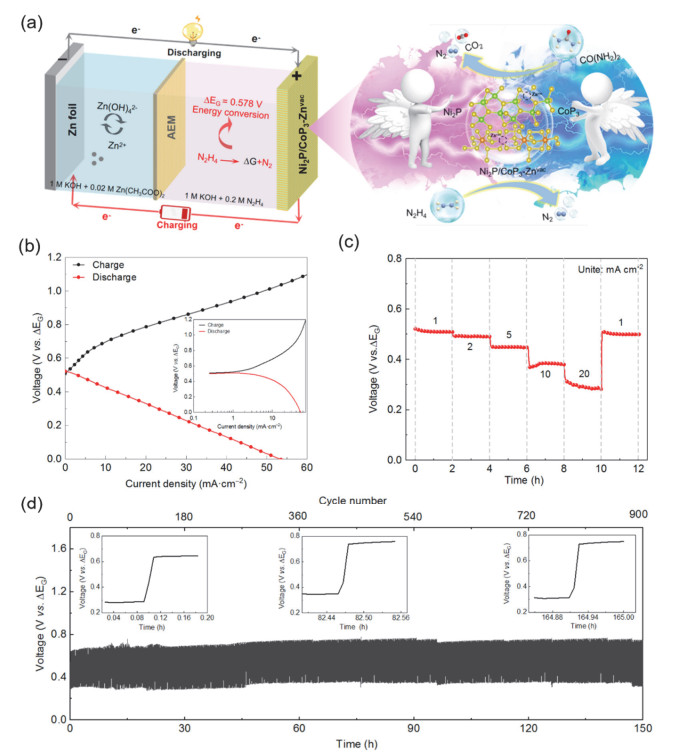
Fig 8
Aqueous Zn-Hz battery with Ni2P/CoP3-Znvac as cathode: (a) Schematic working mechanism of the Ni2P/CoP3-Znvac-based Zn-Hz battery. (b) Charging/discharging polarization profiles. (c) Rate capability. (d) Cycling performance at 10 mA·cm−2."
| 1 |
doi: 10.1016/j.joule.2018.07.020 |
| 2 |
doi: 10.1016/j.scib.2018.07.008 |
| 3 |
doi: 10.1002/cey2.279 |
| 4 |
|
|
刘瑶钰; 王宇辰; 刘碧莹; AmerM.; 严凯. 物理化学学报, 2023, 39 (2), 2205028.
doi: 10.3866/PKU.WHXB202205028 |
|
| 5 |
doi: 10.1016/j.cej.2020.125160 |
| 6 |
doi: 10.1039/c7ta11364a |
| 7 |
doi: 10.1016/j.ensm.2022.10.045 |
| 8 |
|
|
肖瑶; 裴煜; 胡一帆; 马汝广; 王德义; 王家成. 物理化学学报, 2021, 37 (7), 2009051.
doi: 10.3866/PKU.WHXB202009051 |
|
| 9 |
doi: 10.3390/catal5031167 |
| 10 |
doi: 10.1039/d2cc03566a |
| 11 |
doi: 10.1016/j.cej.2022.136165 |
| 12 |
doi: 10.1016/j.cclet.2021.08.042 |
| 13 |
doi: 10.1016/j.apsusc.2022.154484 |
| 14 |
doi: 10.1039/c8ta10985k |
| 15 |
doi: 10.1016/j.jechem.2022.01.031 |
| 16 |
doi: 10.1039/c8ee00521d |
| 17 |
doi: 10.1021/acsaem.2c0100 |
| 18 |
doi: 10.1016/j.cej.2021.130686 |
| 19 |
doi: 10.1016/j.jcis.2019.09.012 |
| 20 |
doi: 10.1039/d0ta08078k |
| 21 |
doi: 10.1039/d0gc03994b |
| 22 |
doi: 10.1021/acs.inorgchem.6b02808 |
| 23 |
doi: 10.1016/j.scib.2021.02.03 |
| 24 |
doi: 10.1021/acssuschemeng.9b04699 |
| 25 |
doi: 10.1016/j.cej.2020.127814 |
| 26 |
doi: 10.1016/j.cej.2021.133829 |
| 27 |
doi: 10.1039/c9ta00481e |
| 28 |
doi: 10.1016/j.apcatb.2022.122207 |
| 29 |
doi: 10.1002/adma.201705366 |
| 30 |
doi: 10.1016/j.cej.2022.138710 |
| 31 |
doi: 10.1039/d0ta05628f |
| 32 |
doi: 10.1016/j.joule.2021.05.018 |
| 33 |
doi: 10.1016/j.electacta.2021.137755 |
| 34 |
doi: 10.1039/d2ta00120a |
| 35 |
doi: 10.1016/j.mtphys.2020.100292 |
| 36 |
doi: 10.1038/s41467-018-06815-9 |
| 37 |
doi: 10.1007/s12274-021-3850-9 |
| 38 |
doi: 10.1039/d0se00240b |
| 39 |
doi: 10.1039/c7cc06278h |
| 40 |
doi: 10.1002/aenm.201700020 |
| 41 |
doi: 10.1016/j.jpowsour.2020.227837 |
| 42 |
doi: 10.1039/c9nr05204f |
| 43 |
doi: 10.1016/j.jpowsour.2019.226754 |
| 44 |
doi: 10.1002/cctc.201900886 |
| 45 |
doi: 10.1002/adfm.202303300 |
| 46 |
doi: 10.1002/adfm.202300625 |
| 47 |
doi: 10.1002/anie.202109938 |
| 48 |
doi: 10.1021/acsami.2c03380 |
| 49 |
doi: 10.1002/anie.201909832 |
| 50 |
doi: 10.1002/anie.201606313 |
| 51 |
doi: 10.1039/c7cc06378d |
| 52 |
doi: 10.1002/cctc.201700451 |
| 53 |
doi: 10.1038/srep05863 |
| 54 |
doi: 10.1016/j.electacta.2012.11.046 |
| 55 |
doi: 10.1021/acsami.7b18650 |
| 56 |
doi: 10.1021/acsenergylett.8b00515 |
| 57 |
doi: 10.1016/j.catcom.2017.03.027 |
| 58 |
doi: 10.1016/j.jallcom.2021.160919 |
| 59 |
doi: 10.1039/d0nr08025j |
| 60 |
doi: 10.1016/j.electacta.2016.10.198 |
| 61 |
doi: 10.1039/d0ta05160h |
| 62 |
doi: 10.1007/s41061-018-0219-y |
| 63 |
doi: 10.1016/j.electacta.2013.06.137 |
| 64 |
doi: 10.1016/j.electacta.2012.07.007 |
| 65 |
doi: 10.1021/jp5052529 |
| 66 |
doi: 10.1039/d0nr01386b |
| 67 |
doi: 10.1039/d2ta05494a |
| 68 |
doi: 10.1016/j.jcis.2022.01.151 |
| 69 |
doi: 10.1016/j.cej.2022.137540 |
| 70 |
doi: 10.1016/j.apcatb.2021.120494 |
| 71 |
doi: 10.1002/adma.202207747 |
| [1] | Mingjie Lei, Wenting Hu, Kexin Lin, Xiujuan Sun, Haoshen Zhang, Ye Qian, Tongyue Kang, Xiulin Wu, Hailong Liao, Yuan Pan, Yuwei Zhang, Diye Wei, Ping Gao. Accelerating the reconstruction of NiSe2 by Co/Mn/Mo doping for enhanced urea electrolysis [J]. Acta Phys. -Chim. Sin., 2025, 41(8): 100083-. |
| [2] | Ruyan Liu, Zhenrui Ni, Olim Ruzimuradov, Khayit Turayev, Tao Liu, Luo Yu, Panyong Kuang. Ni-induced modulation of Pt 5d-H 1s antibonding orbitals for enhanced hydrogen evolution and urea oxidation [J]. Acta Phys. -Chim. Sin., 2025, 41(12): 100159-. |
| [3] | Zheng-Min Wang, Qing-Ling Hong, Xiao-Hui Wang, Hao Huang, Yu Chen, Shu-Ni Li. RuP Nanoparticles Anchored on N-doped Graphene Aerogels for Hydrazine Oxidation-Boosted Hydrogen Production [J]. Acta Phys. -Chim. Sin., 2023, 39(12): 2303028-. |
|
||