Acta Phys. -Chim. Sin. ›› 2024, Vol. 40 ›› Issue (7): 2308017.doi: 10.3866/PKU.WHXB202308017
Special Issue: Carbon Dioxide Valorization
• ARTICLE • Previous Articles
Enhanced Methanol Selectivity in CO2 Hydrogenation by Decoration of K on MoS2 Catalyst
Feifei Yang1,*( ), Wei Zhou1, Chaoran Yang2,3, Tianyu Zhang2,3,*(), Yanqiang Huang4
- 1 School of Chemical Engineering and Technology, China University of Mining and Technology, Xuzhou 221116, Jiangsu Province, China
2 Beijing Key Lab for Source Control Technology of Water Pollution, College of Environmental Science and Engineering, Beijing Forestry University, Beijing 100083, China
3 Engineering Research Center for Water Pollution Source Control & Eco-Remediation, College of Environmental Science and Engineering, Beijing Forestry University, Beijing 100083, China
4 CAS Key Laboratory of Science and Technology on Applied Catalysis, Dalian Institute of Chemical Physics, Chinese Academy of Sciences, Dalian 116023, Liaoning Province, China
-
Received:2023-08-12Revised:2023-09-07Accepted:2023-09-08Published:2023-12-01 -
Contact:Email: feiyang@cumt.edu.cn; Tel.: +86-18222577901 (Feifei Yang)tzhang@bjfu.edu.cn; +86-18811622063 (Tianyu Zhang) -
Supported by:the National Key Research and Development Program of China(2022YFA1506200); National Natural Science Foundation of China(22208021); Natural Science Foundation of Jiangsu Province, China(BK20231075); the Safety Discipline Group Project of China University of Mining and Technology, China(2022ZZX03); the Carbon Peak Carbon Neutrality Technology Innovation Special Fund Project of Jiangsu Province, China(BE2022613); China National Postdoctoral Program for Innovative Talents(BX2021294)

Cite this article
Feifei Yang, Wei Zhou, Chaoran Yang, Tianyu Zhang, Yanqiang Huang. Enhanced Methanol Selectivity in CO2 Hydrogenation by Decoration of K on MoS2 Catalyst[J]. Acta Phys. -Chim. Sin. 2024, 40(7), 2308017. doi: 10.3866/PKU.WHXB202308017
share this article
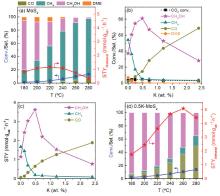
Fig 1
CO2 conversion (Conv.), product selectivity (Sel.), and methanol STY as a function of reaction temperature (180–280 ℃) for CO2 hydrogenation on MoS2 (a); CO2 conversion and product selectivity (b), as well as STY of methanol, CH4 and CO (c) as a function of K loadings for CO2 hydrogenation at 220 ℃; CO2 conversion, product selectivity, and methanol STY as a function of reaction temperature (180–280 ℃) for CO2 hydrogenation on 0.5K-MoS2 (d). Reaction conditions: GHSV = 9000 mL∙g−1∙h−1, P = 5 MPa."
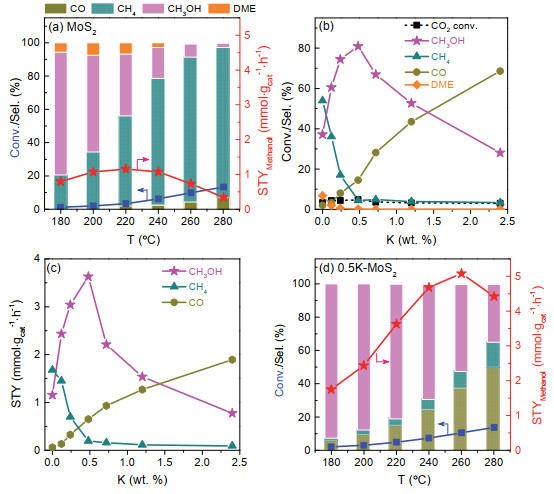
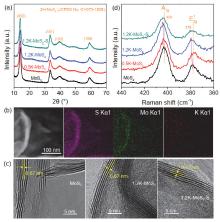
Fig 2
(a) XRD patterns of different catalysts after ex situ reduction, and 1.2K-MoS2 after spent in CO2 hydrogenation (labeled with a -S suffix); (b) EDS mapping of 1.2K-MoS2 after ex situ reduction; (c) HRTEM images of MoS2 and 1.2K-MoS2 after ex situ reduction, and the spent 1.2K-MoS2; (d) Raman spectra of different catalysts after ex situ reduction, and the spent 1.2K-MoS2."
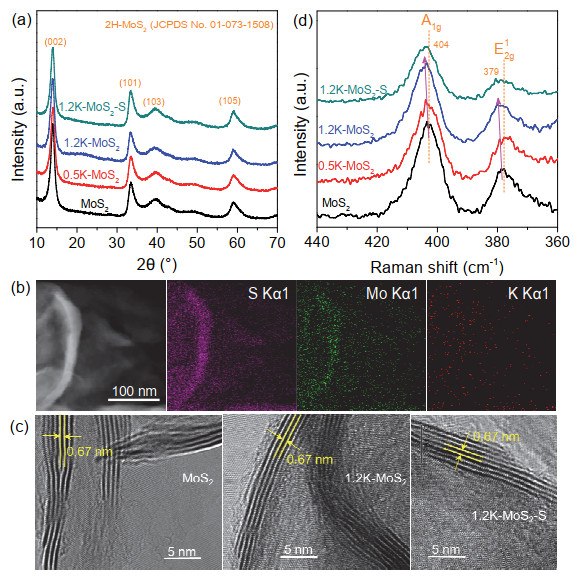
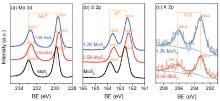
Fig 3
XPS spectra of (a) Mo 3d, (b) S 2p and (c) K 2p of different catalysts after ex situ reduction."
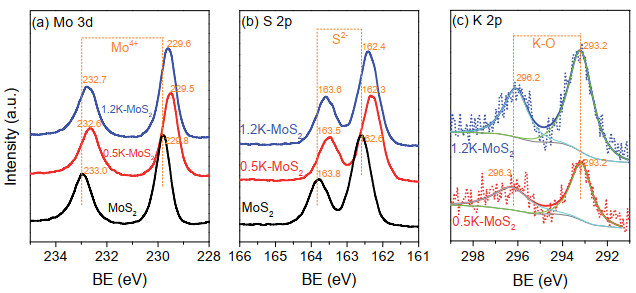
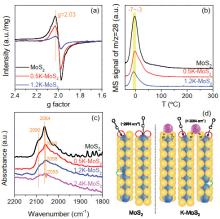
Fig 4
(a) EPR spectra of different catalysts after quasi-in-situ reduction; (b) CO-TPD profile of different catalysts after in situ reduction; (c) in situ CO adsorption DRIFTS spectra of different catalysts after reduction; (d) A schematic diagram of the preferred binding structure of K atoms on MoS2, and the CO adsorption structure on S vacancies on MoS2 and K-MoS2, respectively. The Mo, S, K atoms are in blue, yellow and red, respectively, the red circle represents S vacancy. Color online."
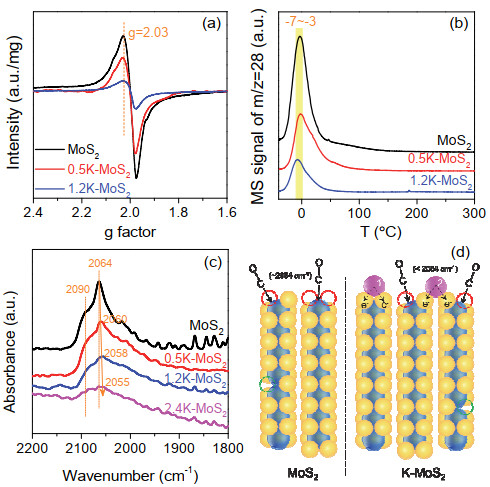
Fig 5
(a) H2, D2 and HD evolution during H2-D2-TPSR measurement over different catalysts after in situ reduction; (b) The correlation between the number of edge S vacancies measured from CO pulse chemisorption and the HD formation rate measured from D2 pulse reaction at 250 ℃."
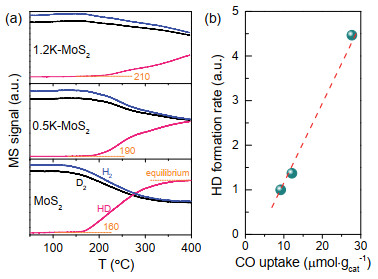
Fig 6
CO2-TPD profile over different catalysts after in situ reduction."
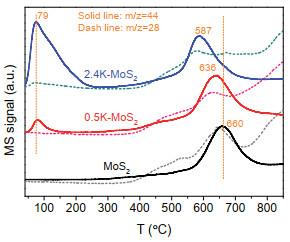
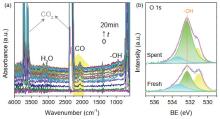
Fig 7
(a) In situ time dependent DRIFTS spectra over 0.5K-MoS2 catalyst at 200 ℃ under the mixture flow of CO2 and H2; (b) XPS spectra of O 1s for 0.5K-MoS2 catalyst after reduction (Fresh) and after spent in CO2 hydrogenation (Spent)."
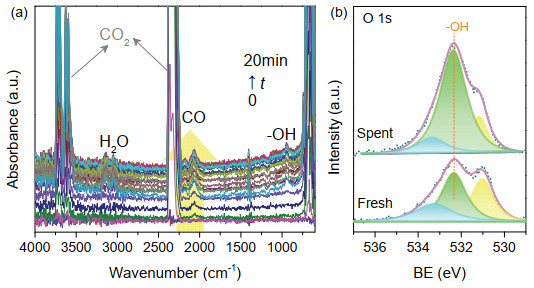
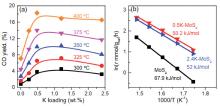
Fig 8
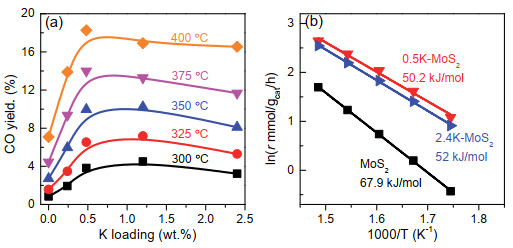
(a) CO yield as a function of K loadings at different reaction temperature, where CO selectivity is > 99% at any case; (b) Arrhenius plots of CO2 hydrogenation to CO on different catalysts at 300–400 ℃. Reaction conditions: GHSV = 15000 mL∙g−1∙h−1, P = 1 atm."
| 1 |
doi: 10.1126/science.1153386 |
| 2 |
doi: 10.1039/C1CS15008A |
| 3 |
doi: 10.1002/anie.200462121 |
| 4 |
doi: 10.3866/PKU.WHXB201911008 |
|
吕翰林; 胡兵; 刘国亮; 洪昕林; 庄林. 物理化学学报, 2021, 36, 1911008.
doi: 10.3866/PKU.WHXB201911008 |
|
| 5 |
doi: 10.1039/C9CS00614A |
| 6 |
doi: 10.3866/PKU.WHXB202010063 |
|
韩布兴. 物理化学学报, 2021, 37, 2010063.
doi: 10.3866/PKU.WHXB202010063 |
|
| 7 |
doi: 10.1002/anie.201600943 |
| 8 |
doi: 10.1016/j.apcatb.2017.06.069 |
| 9 |
doi: 10.1038/s41467-019-11349-9 |
| 10 |
doi: 10.1021/acscatal.0c03665 |
| 11 |
doi: 10.1016/j.jechem.2021.06.039 |
| 12 |
doi: 10.1016/j.apsusc.2021.149925 |
| 13 |
doi: 10.1038/s41929-021-00584-3 |
| 14 |
doi: 10.1021/acscatal.2c02838 |
| 15 |
doi: 10.1016/j.apcatb.2018.12.034 |
| 16 |
doi: 10.1038/s41565-018-0089-z |
| 17 |
doi: 10.1016/j.apsusc.2020.147047 |
| 18 |
doi: 10.1016/j.apsusc.2020.147611 |
| 19 |
doi: 10.1021/jacs.1c01097 |
| 20 |
doi: 10.1006/jcat.1993.1240 |
| 21 |
doi: 10.1021/cs4003518 |
| 22 |
doi: 10.1016/j.jcat.2015.01.015 |
| 23 |
doi: 10.1016/j.apcatb.2019.01.063 |
| 24 |
doi: 10.1039/D0EE01457E |
| 25 |
doi: 10.1016/j.apcatb.2021.120207 |
| 26 |
doi: 10.1002/cssc.201700412 |
| 27 |
doi: 10.1016/j.apcatb.2022.121533 |
| 28 |
doi: 10.1021/jp110069r |
| 29 |
doi: 10.1103/PhysRevB.44.5745 |
| 30 |
doi: 10.1002/adfm.201102111 |
| 31 |
doi: 10.1021/jacs.9b12113 |
| 32 |
doi: 10.1021/acsami.1c18291 |
| 33 |
doi: 10.1021/acscatal.9b03178 |
| 34 |
doi: 10.1016/S0926-860X[01]01011-0 |
| 35 |
doi: 10.1021/ja011634o |
| 36 |
doi: 10.1021/ja5120908 |
| 37 |
doi: 10.1038/nchem.2740 |
| 38 |
doi: 10.1016/0021-9517[86]90082-5 |
| 39 |
doi: 10.1080/01614949508006452 |
| 40 |
doi: 10.1016/j.susc.2003.08.010 |
| 41 |
doi: 10.1016/S0920-5861[01]00422-9 |
| 42 |
doi: 10.1016/j.jcat.2014.10.005 |
| 43 |
doi: 10.1016/j.jcat.2016.04.010 |
| 44 |
doi: 10.1021/jp206555b |
| 45 |
doi: 10.1016/j.catcom.2014.02.011 |
| 46 |
doi: 10.3390/ma15113775 |
| 47 |
doi: 10.1021/jp807705y |
| 48 |
doi: 10.1039/C6RA27422F |
| 49 |
doi: 10.1134/S0023158413020043 |
| [1] | Liuyun Chen, Wenju Wang, Tairong Lu, Xuan Luo, Xinling Xie, Kelin Huang, Shanli Qin, Tongming Su, Zuzeng Qin, Hongbing Ji. Soft template-induced deep pore structure of Cu/Al2O3 for promoting plasma-catalyzed CO2 hydrogenation to DME [J]. Acta Phys. -Chim. Sin., 2025, 41(6): 100054-. |
| [2] | Xue Liu, Lipeng Wang, Luling Li, Kai Wang, Wenju Liu, Biao Hu, Daofan Cao, Fenghao Jiang, Junguo Li, Ke Liu. Research on Cu-Based and Pt-Based Catalysts for Hydrogen Production through Methanol Steam Reforming [J]. Acta Phys. -Chim. Sin., 2025, 41(5): 100049-. |
| [3] | Qinhui Guan, Yuhao Guo, Na Li, Jing Li, Tingjiang Yan. Molecular sieve-mediated indium oxide catalysts for enhancing photocatalytic CO2 hydrogenation [J]. Acta Phys. -Chim. Sin., 2025, 41(11): 100133-. |
| [4] | Xiaorui Chen, Xuan Luo, Tongming Su, Xinling Xie, Liuyun Chen, Yuejing Bin, Zuzeng Qin, Hongbing Ji. Ga-doped Cu/γ-Al2O3 bifunctional interface sites promote the direct hydrogenation of CO2 to DME [J]. Acta Phys. -Chim. Sin., 2025, 41(10): 100126-. |
| [5] | Yongqing Xu, Yuyao Yang, Mengna Wu, Xiaoxiao Yang, Xuan Bie, Shiyu Zhang, Qinghai Li, Yanguo Zhang, Chenwei Zhang, Robert E. Przekop, Bogna Sztorch, Dariusz Brzakalski, Hui Zhou. Review on Using Molybdenum Carbides for the Thermal Catalysis of CO2 Hydrogenation to Produce High-Value-Added Chemicals and Fuels [J]. Acta Phys. -Chim. Sin., 2024, 40(4): 2304003-. |
| [6] | Meng Li, Fulin Yang, Jinfa Chang, Alex Schechter, Ligang Feng. MoP-NC Nanosphere Supported Pt Nanoparticles for Efficient Methanol Electrolysis [J]. Acta Phys. -Chim. Sin., 2023, 39(9): 2301005-0. |
| [7] | Jie Wang, Guigao Liu, Qinbai Yun, Xichen Zhou, Xiaozhi Liu, Ye Chen, Hongfei Cheng, Yiyao Ge, Jingtao Huang, Zhaoning Hu, Bo Chen, Zhanxi Fan, Lin Gu, Hua Zhang. Epitaxial Growth of Unconventional 4H-Pd Based Alloy Nanostructures on 4H-Au Nanoribbons towards Highly Efficient Electrocatalytic Methanol Oxidation [J]. Acta Phys. -Chim. Sin., 2023, 39(10): 2305034-. |
| [8] | Ying Liu, Xiaofang Liu, Lin Xia, Chaojie Huang, Zhaoxuan Wu, Hui Wang, Yuhan Sun. Methanol Synthesis by COx Hydrogenation over Cu/ZnO/Al2O3 Catalyst via Hydrotalcite-Like Precursors: the Role of CO in the Reactant Mixture [J]. Acta Phys. -Chim. Sin., 2022, 38(3): 2002017-. |
| [9] | Lin Lv, Liyang Zhang, Xuebing He, Hong Yuan, Shuxin Ouyang, Tierui Zhang. Energy-Efficient Hydrogen Production via Electrochemical Methanol Oxidation Using a Bifunctional Nickel Nanoparticle-Embedded Carbon Prism-Like Microrod Electrode [J]. Acta Phys. -Chim. Sin., 2021, 37(7): 2007079-. |
| [10] | Congming Li, Kuo Chen, Xiaoyue Wang, Nan Xue, Hengquan Yang. Understanding the Role of Cu/ZnO Interaction in CO2 Hydrogenation to Methanol [J]. Acta Phys. -Chim. Sin., 2021, 37(5): 2009101-. |
| [11] | Yanqiu Wang, Zixin Zhong, Tangkang Liu, Guoliang Liu, Xinlin Hong. Cu@UiO-66 Derived Cu+-ZrO2 Interfacial Sites for Efficient CO2 Hydrogenation to Methanol [J]. Acta Phys. -Chim. Sin., 2021, 37(5): 2007089-. |
| [12] | Sai Zhang, Mingkai Zhang, Yongquan Qu. Solid Frustrated Lewis Pairs Constructed on CeO2 for Small-Molecule Activation [J]. Acta Physico-Chimica Sinica, 2020, 36(9): 1911050-. |
| [13] | Menggang Li, Zhonghong Xia, Yarong Huang, Lu Tao, Yuguang Chao, Kun Yin, Wenxiu Yang, Weiwei Yang, Yongsheng Yu, Shaojun Guo. Rh-Doped PdCu Ordered Intermetallics for Enhanced Oxygen Reduction Electrocatalysis with Superior Methanol Tolerance [J]. Acta Physico-Chimica Sinica, 2020, 36(9): 1912049-. |
| [14] | Zhenmin Xu, Zhenfeng Bian. Photocatalytic Methane Conversion [J]. Acta Phys. -Chim. Sin., 2020, 36(3): 1907013-. |
| [15] | Hanlin Lyu, Bing Hu, Guoliang Liu, Xinlin Hong, Lin Zhuang. Inverse Decoration of ZnO on Small-Sized Cu/Sio2 with Controllable Cu-ZnO Interaction for CO2 Hydrogenation to Produce Methanol [J]. Acta Physico-Chimica Sinica, 2020, 36(11): 1911008-. |
|
||