Acta Phys. -Chim. Sin. ›› 2025, Vol. 41 ›› Issue (1): 100003.doi: 10.3866/PKU.WHXB202309003
Special Issue: Energy Chemistry
• ARTICLE • Previous Articles Next Articles
High-Stable Aqueous Zinc Metal Anodes Enabled by an Oriented ZnQ Zeolite Protective Layer with Facile Ion Migration Kinetics
Shanghua Li1,2, Malin Li1,*( ), Xiwen Chi1,2, Xin Yin1, Zhaodi Luo1, Jihong Yu1,2,*()
- 1 State Key Laboratory of Inorganic Synthesis and Preparative Chemistry, College of Chemistry, Jilin University, Changchun 130012, China
2 International Center of Future Science, Jilin University, Changchun 130012, China
-
Received:2023-09-01Revised:2023-09-25Accepted:2023-10-09Published:2023-12-20 -
Contact:Email: jihong@jlu.edu.cn (Jihong Yu)malinl@jlu.edu.cn (Malin Li) -
Supported by:the National Natural Science Foundation of China(22288101); the National Natural Science Foundation of China(21920102005); the National Natural Science Foundation of China(21835002); the National Natural Science Foundation of China(22109050); the 111 Project(B17020)

Cite this article
Shanghua Li, Malin Li, Xiwen Chi, Xin Yin, Zhaodi Luo, Jihong Yu. High-Stable Aqueous Zinc Metal Anodes Enabled by an Oriented ZnQ Zeolite Protective Layer with Facile Ion Migration Kinetics[J]. Acta Phys. -Chim. Sin. 2025, 41(1), 100003. doi: 10.3866/PKU.WHXB202309003
share this article
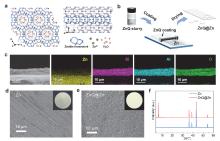
Fig 1
(a) Schematic illustration of the structure of ZnQ zeolite with 12MR and 8MR channels. (b) Schematic illustration of the preparation procedure of ZnQ@Zn. (c) Cross-sectional SEM and the corresponding EDS images of ZnQ@Zn. Top-view SEM images with optical images as the inset of (d) bare Zn and (e) ZnQ@Zn. (f) XRD patterns of bare Zn and ZnQ@Zn."

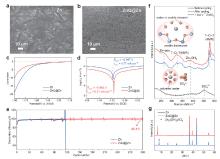
Fig 2
SEM images of (a) bare Zn and (b) ZnQ@Zn after being soaked in 1 mol∙L−1 ZnSO4 electrolyte. (c) LSV curves of bare Zn and ZnQ@Zn in 1 mol∙L−1 Na2SO4 solution. (d) Tafel curves of bare Zn and ZnQ@Zn. (e) Coulombic efficiency of bare Zn//Cu and ZnQ@Zn//Cu half-cells at 1 mA∙cm−2. (f) Raman spectra of ZnQ@Zn before and after cycling, and the spectrum of 1 mol∙L−1 ZnSO4 solution. (g) XRD patterns of bare Zn and ZnQ@Zn in half-cells after 20 cycles."
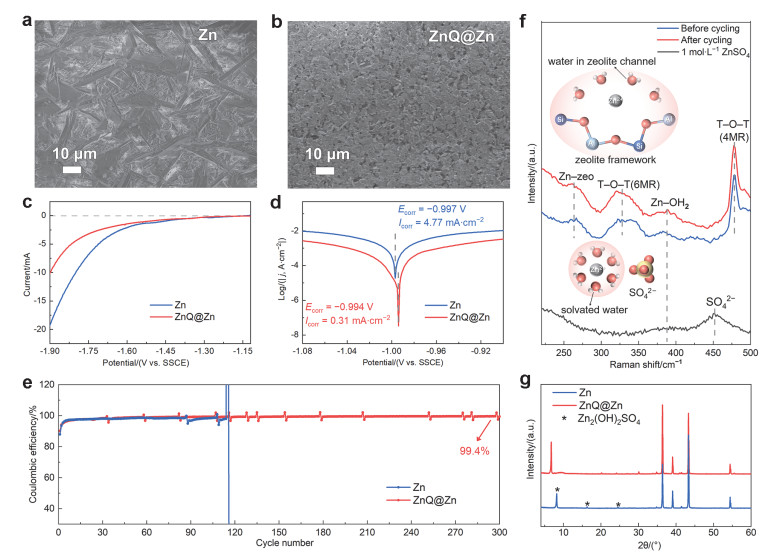
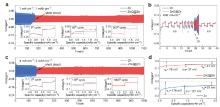
Fig 3
(a) Galvanostatic charge and discharge profiles of bare Zn and ZnQ@Zn symmetric cells at 1 mA∙cm−2 and 1 mAh∙cm−2 with the enlarged charge and discharge profiles as the inset. (b) Rate capability of bare Zn and ZnQ@Zn symmetric cells at 0.5, 1, 4, 10, 20 mA∙cm−2. (c) Galvanostatic charge and discharge profiles of bare Zn and ZnQ@Zn symmetric cells at 4 mA∙cm−2 and 2 mAh∙cm−2 with the enlarged charge and discharge profiles as the inset. (d) Nucleation and growth overpotential analysis of Zn and ZnQ@Zn anodes at 4 mA∙cm−2."
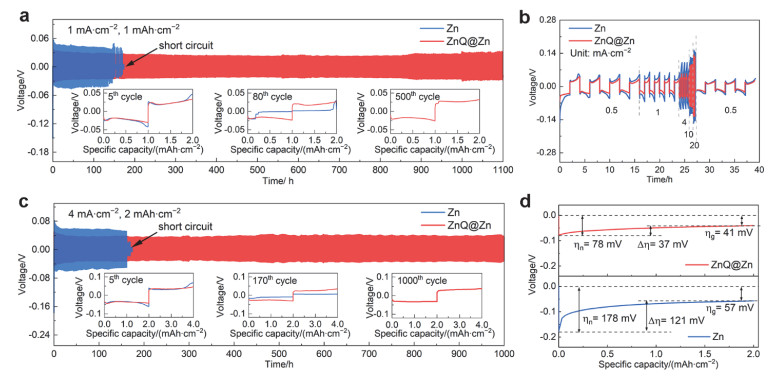
Fig 4
Nyquist plots of symmetric cells with (a) bare Zn and (b) ZnQ@Zn at 30–70 ℃. (c) Ea calculated according to the Arrhenius equation. (d) CA profiles of Zn and ZnQ@Zn under a voltage bias of −200 mV. Surface morphologies of Zn anode after cycling for 25 cycles in symmetric cells with (e) bare Zn and (f) ZnQ@Zn (the separator and protective layer were removed). (g) Current variation with time during polarization and the associated EIS curves of ZnQ@Zn symmetric cells. Schematic illustration of the deposition on (h) bare Zn with corrosion, byproducts and dendrite issues, and (i) ZnQ@Zn, where a uniform ion flux with facile kinetics can be achieved to eliminate the corrosion, byproduct and dendrite."
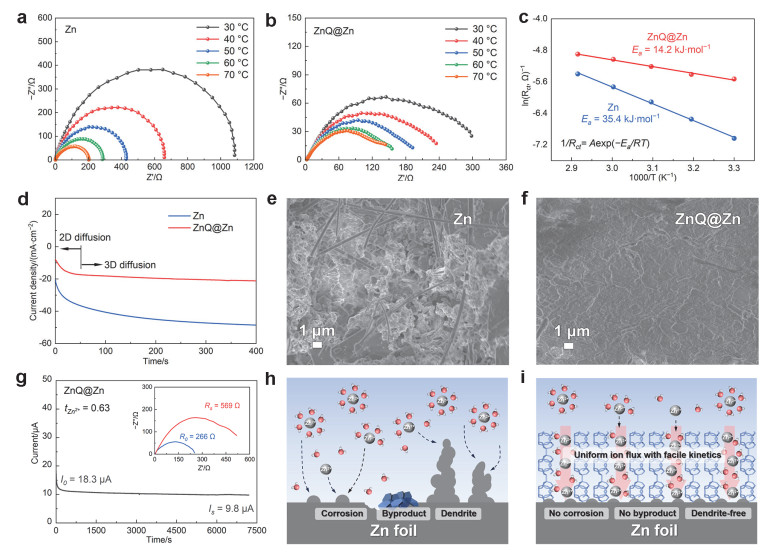
Fig 5
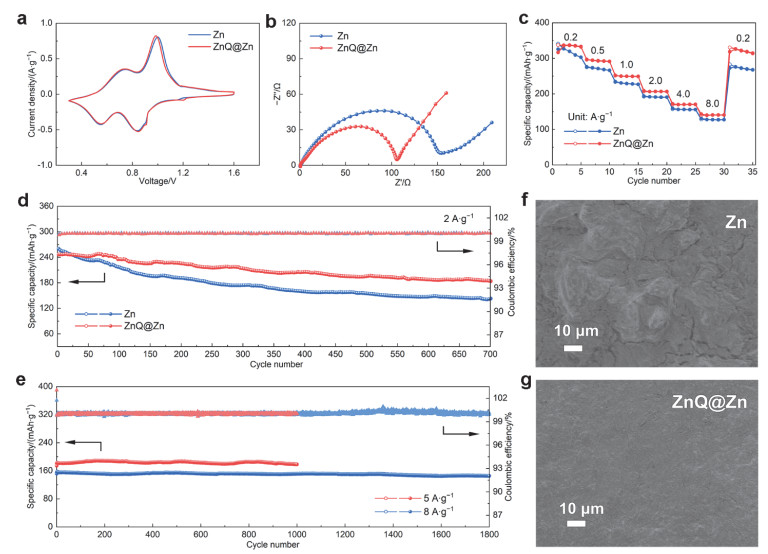
(a) CV profiles of Zn//NVO and ZnQ@Zn//NVO full cells (3rd cycle, 0.2 mV∙s−1). (b) Nyquist plots of Zn//NVO and ZnQ@Zn//NVO full cells before cycling. (c) Rate capability of full cells with bare Zn and ZnQ@Zn electrodes. (d) Long-term cycling performance of Zn//NVO and ZnQ@Zn//NVO full cells at 2 A∙g−1. (e) Long-term cycling performance of ZnQ@Zn//NVO full cells at 5 and 8 A∙g−1. SEM images of (f) bare Zn anode and (g) ZnQ@Zn anode after 500 cycles (the separator and protective layer were removed)."
| 1 |
|
|
黄俊达; 朱宇辉; 冯煜; 韩叶虎; 谷振一; 刘日鑫; 杨冬月; 陈凯; 张相禹; 孙威; 等. 物理化学学报, 2022, 2208008.
doi: 10.3866/PKU.WHXB202208008 |
|
| 2 |
doi: 10.1002/adfm.201802564 |
| 3 |
doi: 10.1016/j.jpowsour.2022.231659 |
| 4 |
doi: 10.1002/anie.201904174 |
| 5 |
doi: 10.1021/acsenergylett.1c00393 |
| 6 |
doi: 10.1016/j.nanoen.2020.104523 |
| 7 |
doi: 10.1016/j.ensm.2020.10.027 |
| 8 |
doi: 10.1016/j.mtener.2021.100692 |
| 9 |
doi: 10.1002/cey2.67 |
| 10 |
doi: 10.1002/aenm.202003065 |
| 11 |
doi: 10.1016/j.enchem.2022.100076 |
| 12 |
doi: 10.1002/aenm.201801090 |
| 13 |
doi: 10.1016/j.surfcoat.2021.127813 |
| 14 |
doi: 10.1002/admi.201800848 |
| 15 |
doi: 10.1002/adfm.201908528 |
| 16 |
doi: 10.1021/jacs.2c13540 |
| 17 |
doi: 10.1021/acsami.2c07551 |
| 18 |
doi: 10.1016/j.cej.2021.128584 |
| 19 |
doi: 10.1021/acsami.2c09909 |
| 20 |
doi: 10.1039/d1ee02021h |
| 21 |
doi: 10.1103/PRXEnergy.1.031001 |
| 22 |
doi: 10.1038/s41586-021-03410-9 |
| 23 |
doi: 10.1016/0144-2449(91)80404-N |
| 24 |
doi: 10.1038/s41467-018-04060-8 |
| 25 |
|
|
齐亚娥; 夏永姚. 物理化学学报, 2023, 39, 2205045.
doi: 10.3866/PKU.WHXB202205045 |
|
| 26 |
doi: 10.1039/d2ee00209d |
| 27 |
doi: 10.1016/0032-3861(87)90394-6 |
| 28 |
Breck, D. W.; Acara, N. A. Crystalline zeolite Q. U.S. Patent US2991151A, 1961-07-04
|
| 29 |
doi: 10.1039/d1ee00030f |
| 30 |
doi: 10.1021/acsaem.2c01340 |
| 31 |
doi: 10.1016/0144-2449(91)80405-O |
| 32 |
doi: 10.1021/acsanm.0c02925 |
| 33 |
doi: 10.1002/adfm.202000599 |
| 34 |
doi: 10.1016/j.clay.2012.02.017 |
| 35 |
doi: 10.1016/j.micromeso.2004.10.022 |
| 36 |
doi: 10.1126/science.1212472 |
| 37 |
doi: 10.1002/adma.201405893 |
| 38 |
doi: 10.1016/j.cej.2023.142912 |
| 39 |
doi: 10.1002/anie.202001844 |
| 40 |
doi: 10.1002/adma.202102415 |
| 41 |
doi: 10.1016/S1387-1811(01)00271-2 |
| 42 |
doi: 10.1016/j.micromeso.2004.08.011 |
| 43 |
doi: 10.1002/anie.202005472 |
| 44 |
doi: 10.1039/d2ee03952d |
| 45 |
doi: 10.1021/acscentsci.6b00260 |
| 46 |
doi: 10.1016/j.joule.2023.05.004 |
| 47 |
doi: 10.1126/sciadv.aau6264 |
| 48 |
doi: 10.1016/j.jechem.2022.10.023 |
| 49 |
doi: 10.1021/acsami.3c00747 |
| 50 |
doi: 10.1016/j.electacta.2006.10.042 |
| [1] | Doudou Qin, Junyang Ding, Chu Liang, Qian Liu, Ligang Feng, Yang Luo, Guangzhi Hu, Jun Luo, Xijun Liu. Addressing Challenges and Enhancing Performance of Manganese-based Cathode Materials in Aqueous Zinc-Ion Batteries [J]. Acta Phys. -Chim. Sin., 2024, 40(10): 2310034-. |
| [2] | Xiao-Xia CHANG,Jin-Long GONG. On the Importance of Surface Reactions on Semiconductor Photocatalysts for Solar Water Splitting [J]. Acta Phys. -Chim. Sin., 2016, 32(1): 2-13. |
|
||