Acta Phys. -Chim. Sin. ›› 2025, Vol. 41 ›› Issue (2): 100010.doi: 10.3866/PKU.WHXB202309041
• ARTICLE • Previous Articles Next Articles
Machine Learning Enables the Prediction of Amide Bond Synthesis Based on Small Datasets
Xinghai Li, Zhisen Wu, Lijing Zhang*( ), Shengyang Tao*()
- School of Chemistry, State Key Laboratory of Fine Chemicals, Frontier Science Center for Smart Materials, Dalian Key Laboratory of Intelligent Chemistry, Dalian University of Technology, Dalian 116024, Liaoning Province, China
-
Received:2023-09-27Revised:2023-11-29Accepted:2023-11-30Published:2024-01-02 -
Contact:Email: zhanglj@dlut.edu.cn (Lijing Zhang)taosy@dlut.edu.cn (Shengyang Tao) -
Supported by:the National Natural Science Foundation of China(22072011); the National Natural Science Foundation of China(22372025); the National Natural Science Foundation of China(22211530456); the Fundamental Research Funds for the Central Universities(DUT22LAB607); the Fundamental Research Funds for the Central Universities(DUT22QN226); Project 1912 Funds provided by the Chinese Aeronautical Establishment

Cite this article
Xinghai Li, Zhisen Wu, Lijing Zhang, Shengyang Tao. Machine Learning Enables the Prediction of Amide Bond Synthesis Based on Small Datasets[J]. Acta Phys. -Chim. Sin. 2025, 41(2), 100010. doi: 10.3866/PKU.WHXB202309041
share this article
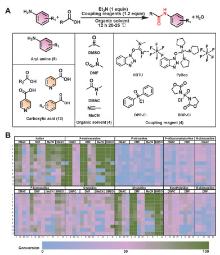
Fig 1
(A) The amide synthesis reaction was used as a model for data collection, including four dimensions of aromatic amine, carboxylic acid, solvent, and coupling reagent. R1: H, OCH3, NO2, CF3, Cl, Br, CH3; R2: CH3, C2H5, CH = CH2, C3H8, C5H11, CH2CHCOCH3; R3: H, Cl, CH3, OCOCH3; the corresponding molecular structures for aromatic amine and carboxylic acid are provided in Fig. S1 and the detail information for solvent, and coupling reagent can be found in Table S1 (Supporting Information). (B) The high-throughput experiments' reaction outcomes were obtained from the reactions of aromatic amines, carboxylic acids, organic solvents, and coupling reagents in different combinations. The first line of horizontal coordinate in the plot is the aromatic amine, the second line is the organic solvent, and the last line is the coupling reagent (represented by Roman numerals, Ⅰ: HBTU, Ⅱ: PyBOP, Ⅲ: DPP-Cl, Ⅳ: BOP-Cl). The longitudinal coordinate is the type of carboxylic acid, the first six are fatty acids, and the last six are aromatic acids (represented by Arabic numerals, 1: Acetic acid, 2: Propionic acid, 3: Acrylic acid, 4: Butyric acid, 5: N-hexanoic acid, 6: Levulinic acid, 7: Benzoic acid, 8: p-chlorobenzoic acid, 9: p-toluic acid, 10: Niacin, 11: Isonicotinic acid, 12: Acetylsalicylic acid)."
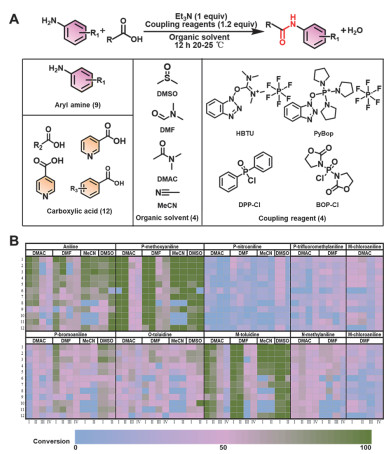
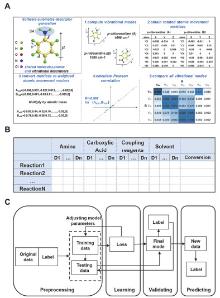
Fig 2
(A) The process of calculation, evaluation, and selection of the molecular atoms and vibrational descriptors is demonstrated by using aromatic amine molecules as an example. SA: surface area; V30 to V40, vibrational modes of atoms; *, the atoms in the structure shared by the same molecules in the reaction participants (Note: The detailed procedure is referenced from online instructions 34). (B) Data structure diagram for machine learning. (C) Plot of the basic operational process of ML."
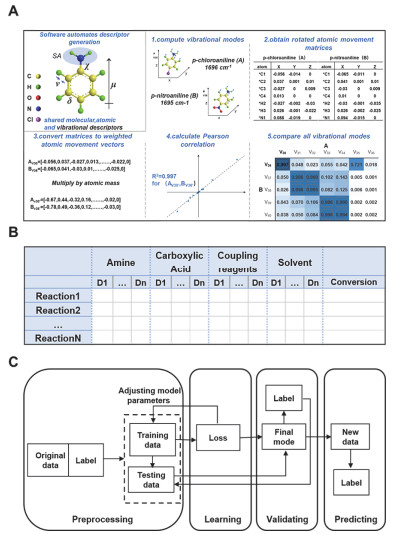
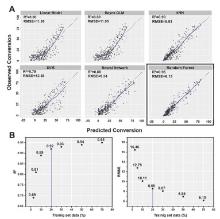
Fig 3
(A) Evaluation plot of six algorithmic models. The horizontal coordinate is the predicted conversion of the model, and the longitudinal coordinate is the experimentally measured conversion. Blue solid line: partially weighted regression best-fit curve; black dashed line: y = x line. The slope of the fitted line for these points should be close to 1 and the intercept close to 0. (B) The evaluation plot versus different ratios of training sets. The prediction performance of the random forest model was evaluated using small sample data. The training sets were selected randomly from the original training data."
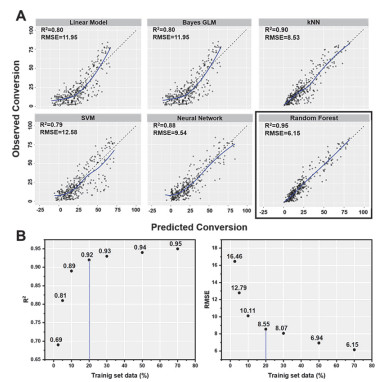
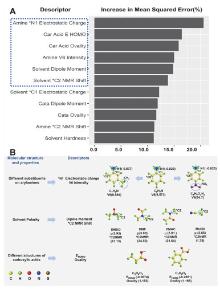
Fig 4
(A) The most important 11 descriptors given by the trained random forest model are determined by rescaling the values of the given descriptors and measuring the percentage increase in mean squared error when retraining the model. E: energy; HOMO: highest occupied molecular orbital; V: the vibration of an atom in a reacting molecule. *, the atoms in the structure shared by the same molecules in the reaction participants. (B) An analytical plot of the molecular structures of representative reactants selected from aromatic amines, carboxylic acids, and solvents, combined with featured descriptors produced by the model."
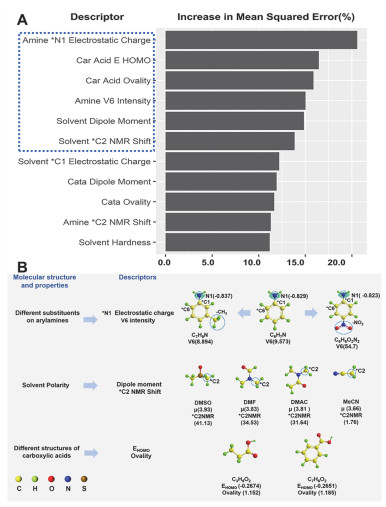
Fig 5
(A) Aromatic amine species in the training set (1 to 9) and the unknown aromatic amine species in the test set (10 to 12). (B) The high-throughput experiments' reaction outcomes were obtained from the reactions of aromatic amines, carboxylic acids, organic solvents, and coupling reagents in different combinations. For the detailed explanation, please refer to Fig. 1B."
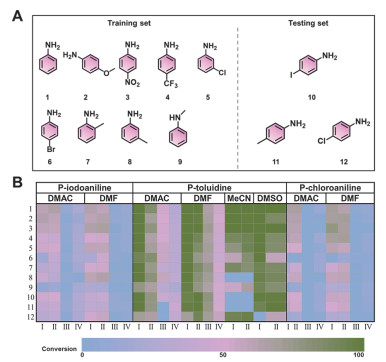
Fig 6
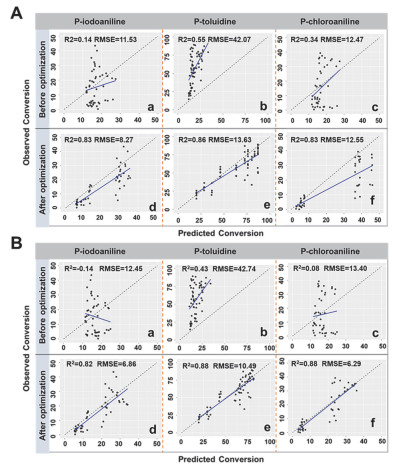
(A) The predictive performance of the random forest for the unknown aromatic amine species; a–c, the predictive performance of the random forest model before optimization; d–f, the predictive performance of the random forest model after optimization. (B) Model predictive performance plot versus reaction data of unknown aromatic amines with different fatty acids added to the training set."
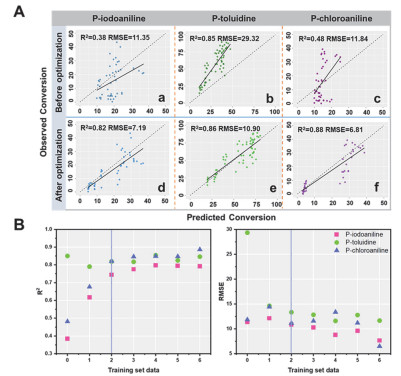
Fig 7
(A) The prediction effect of the random forest model trained by one-hot coding approach to characterize the descriptors of all reaction participants. (B) The prediction effect of the random forest model trained by the hybrid method (one-hot/DFT-mixing), The descriptors of the amines in the reaction were using one-hot encoding, and the descriptors of the rest participants were using DFT."
| 1 |
doi: 10.1126/science.aaa8415 |
| 2 |
doi: 10.1109/mci.2018.2840738 |
| 3 |
doi: 10.1038/s41582-020-0377-8 |
| 4 |
doi: 10.1109/msp.2017.2764116 |
| 5 |
doi: 10.1002/chem.201605499 |
| 6 |
doi: 10.1038/s43586-021-00022-5 |
| 7 |
doi: 10.1038/s41467-017-00839-3 |
| 8 |
doi: 10.1007/s10462-021-10058-4 |
| 9 |
doi: 10.1126/science.aar5169 |
| 10 |
doi: 10.1038/nature17439 |
| 11 |
doi: 10.1021/jacs.9b05895 |
| 12 |
doi: 10.1021/acscentsci.8b00357 |
| 13 |
doi: 10.1126/science.aau5631 |
| 14 |
doi: 10.1038/s41586-019-1384-z |
| 15 |
doi: 10.1038/nature25978 |
| 16 |
doi: 10.1126/science.aax1566 |
| 17 |
doi: 10.1126/science.1259203 |
| 18 |
doi: 10.1021/acs.accounts.7b00428 |
| 19 |
doi: 10.1021/acs.oprd.9b00140 |
| 20 |
doi: 10.1021/acs.jproteome.8b00724 |
| 21 |
doi: 10.1021/acs.chemrev.6b00237 |
| 22 |
doi: 10.1021/jm200187y |
| 23 |
doi: 10.1038/s41929-018-0211-5 |
| 24 |
doi: 10.1021/acs.jmedchem.5b01409 |
| 25 |
doi: 10.1021/acscentsci.2c00369 |
| 26 |
doi: 10.1007/s40265-022-01684-5 |
| 27 |
doi: 10.1021/jo301252c |
| 28 |
doi: 10.1038/nature10702 |
| 29 |
doi: 10.1002/anie.201806920 |
| 30 |
doi: 10.1016/j.jics.2022.100752 |
| 31 |
doi: 10.3390/molecules28165995 |
| 32 |
doi: 10.1038/sdata.2014.22 |
| 33 |
doi: 10.1021/acs.jpclett.8b01837 |
| 34 |
https://github.com/doylelab/rxnpredict (accessed Dec. 28, 2023)
|
| 35 |
doi: 10.1016/j.patrec.2021.02.022 |
| 36 |
|
| 37 |
doi: 10.1016/j.patcog.2013.11.022 |
| 38 |
doi: 10.1021/acs.orglett.9b03905 |
| 39 |
doi: 10.1021/jo400701v |
| 40 |
doi: 10.1016/j.tet.2014.02.042 |
| 41 |
doi: 10.1016/j.tetlet.2013.02.058 |
| [1] | Ying Liang, Yuheng Deng, Shilv Yu, Jiahao Cheng, Jiawei Song, Jun Yao, Yichen Yang, Wanlei Zhang, Wenjing Zhou, Xin Zhang, Wenjian Shen, Guijie Liang, Bin Li, Yong Peng, Run Hu, Wangnan Li. Machine learning-guided antireflection coatings architectures and interface modification for synergistically optimizing efficient and stable perovskite solar cells [J]. Acta Phys. -Chim. Sin., 2025, 41(9): 100098-. |
| [2] | Xiaochen Zhang, Fei Yu, Jie Ma. Cutting-Edge Applications of Multi-Angle Numerical Simulations for Capacitive Deionization [J]. Acta Phys. -Chim. Sin., 2024, 40(11): 2311026-. |
| [3] | Weikaixin Kong, Jingjing Lian, Chao Peng, Jie Zhu, Yulin Zheng, Weiran Huang, Bowen Zhang, Guifang Duan, Lin Ma, Xiaodong Peng, Weining Ma, Sujie Zhu, Zhuo Huang. Identification of Novel GABAA Receptor Positive Allosteric Modulators with Novel Scaffolds via Multistep Virtual Screening [J]. Acta Phys. -Chim. Sin., 2024, 40(1): 2302044-. |
| [4] | Hongyu Liu, Gang Meng, Zanhong Deng, Meng Li, Junqing Chang, Tiantian Dai, Xiaodong Fang. Progress in Research on VOC Molecule Recognition by Semiconductor Sensors [J]. Acta Phys. -Chim. Sin., 2022, 38(5): 2008018-. |
| [5] | Bing. HE,Yong. LUO,Bing-Ke. LI,Ying. XUE,Luo-Ting. YU,Xiao-Long. QIU,Teng-Kuei. YANG. Predicting and Virtually Screening Breast Cancer Targeting Protein HEC1 Inhibitors by Molecular Descriptors and Machine Learning Methods [J]. Acta Phys. -Chim. Sin., 2015, 31(9): 1795-1802. |
| [6] | LI Bing-Ke, CONG Yong, TIAN Zhi-Yue, XUE Ying. Predicting and Virtually Screening the Selective Inhibitors of MMP-13 over MMP-1 by Molecular Descriptors and Machine Learning Methods [J]. Acta Phys. -Chim. Sin., 2014, 30(1): 171-182. |
| [7] | LÜ Wei, XUE Ying, MENG Qing-Wei. Classification Prediction of Inhibitors of H1N1 Neuraminidase by Machine Learning Methods [J]. Acta Phys. -Chim. Sin., 2013, 29(01): 217-223. |
| [8] | Lü Wei, XUE Ying. Prediction of Hepatitis C Virus Non-Structural Proteins 5B Polymerase Inhibitors Using Machine Learning Methods [J]. Acta Phys. -Chim. Sin., 2011, 27(06): 1407-1416. |
| [9] | YANG Guo-Bing, LI Ze-Rong, RAO Han-Bing, LI Xiang-Yuan, CHEN Yu-Zong. Classification Models for Acetylcholinesterase Inhibitors Based on Machine Learning Methods [J]. Acta Phys. -Chim. Sin., 2010, 26(12): 3351-3359. |
| [10] | LV Wei, XUE Ying. Activity Prediction of Hormone-Sensitive Lipase Inhibitors Based on Machine Learning Methods [J]. Acta Phys. -Chim. Sin., 2010, 26(02): 471-477. |
|
||