Acta Phys. -Chim. Sin. ›› 2025, Vol. 41 ›› Issue (4): 100038.doi: 10.3866/PKU.WHXB202408015
• ARTICLE • Previous Articles
Light-Enhanced Direct Epoxidation of Propylene by Molecular Oxygen over CuOx/TiO2 Catalyst
Zhuoyan Lv1,2, Yangming Ding1, Leilei Kang1,*( ), Lin Li1, Xiao Yan Liu1,*(), Aiqin Wang1, Tao Zhang1
- 1 CAS Key Laboratory of Science and Technology on Applied Catalysis, iChEM, Dalian Institute of Chemical Physics, Chinese Academy of Sciences, Dalian 116023, Liaoning Province, China
2 University of Chinese Academy of Sciences, Beijing 100049, China
-
Received:2024-08-27Revised:2024-09-25Accepted:2024-10-02Published:2024-12-28 -
Contact:Email: xyliu2003@dicp.ac.cn; Tel.: +86-411-84379416 (Xiao Yan Liu)leikang@dicp.ac.cn (Leilei Kang) -
Supported by:the NSFC Center for Single-Atom Catalysis(22388102); the Fundamental Research Funds for the Central Universities(20720220009); the DNL Cooperation Fund, CAS(DNL202002); the DNL Cooperation Fund, CAS(XLYC2007070); the Strategic Priority Research Program of the Chinese Academy of Sciences(XDB0540000)

Cite this article
Zhuoyan Lv, Yangming Ding, Leilei Kang, Lin Li, Xiao Yan Liu, Aiqin Wang, Tao Zhang. Light-Enhanced Direct Epoxidation of Propylene by Molecular Oxygen over CuOx/TiO2 Catalyst[J]. Acta Phys. -Chim. Sin. 2025, 41(4), 100038. doi: 10.3866/PKU.WHXB202408015
share this article
Fig 1
Structure characterizations for CuOx/TiO2 catalyst. (a) TEM and (b) EDX images of CuOx/TiO2. (c) XRD patterns of CuOx/TiO2 and TiO2 support. (d) XANES spectra of CuOx/TiO2 and references (Cu foil, Cu2O and CuO) at the K-edge of Cu."
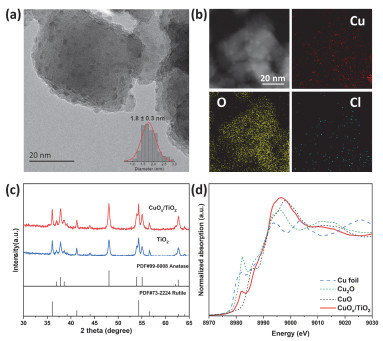
Fig 2
Photocatalytic activity of CuOx/TiO2 catalyst in the DEP reaction. (a) PO formation rate at different temperatures with/without light and (b) Ea under dark and light conditions. (c) Rate of PO formation as a function of light intensity at 200 ℃. (d) The PO formation rate under UV and UV + Vis light at 200 ℃."
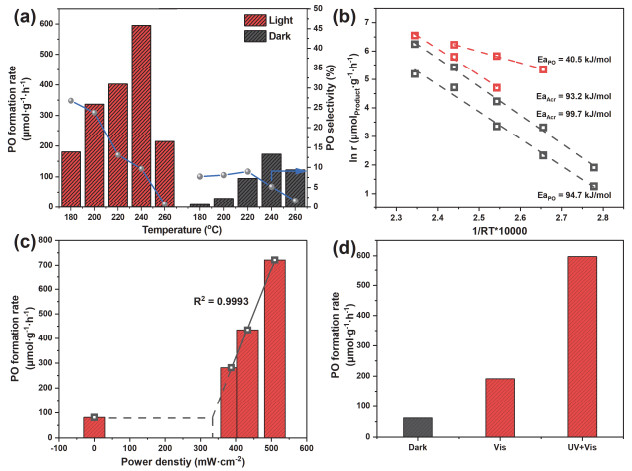
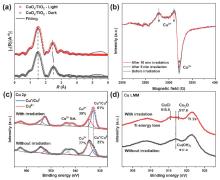
Fig 3
Photo-effect on CuOx/TiO2 catalyst. (a) FT k2-weighted EXAFS spectra and the fitting results at Cu K-edge of CuOx/TiO2 pretreated under dark and light conditions (without phase correction), (b) in situ EPR spectra in the dark and after 10 min of light irradiation, (c) in situ XPS spectra of Cu 2p and (d) Cu LMM with and without light irradiation."
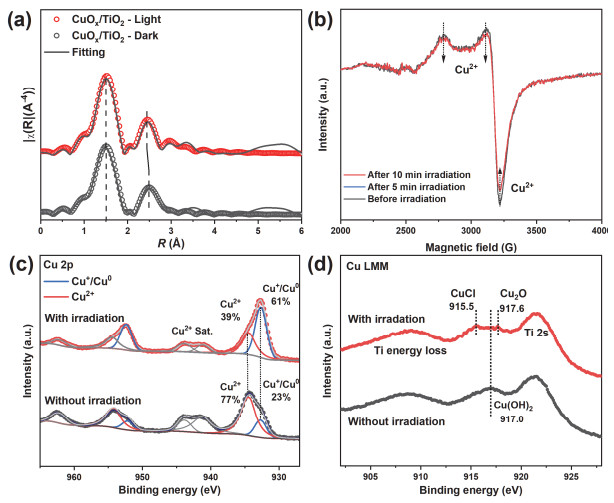
Table 1
EXAFS data fitting results of the CuOx/TiO2 catalyst pretreated under dark and light reaction conditions."
| Sample | Shell | CN a | R (Å) | σ2 | ΔE0 (eV) | R factor (%) |
| CuOx/TiO2-Dark | Cu-O | 3.5 | 1.95 ± 0.004 | 0.005 | −0.8 | 0.2 |
| Cu-Cu1 | 2.0 | 2.92 ± 0.01 | 0.006 | |||
| Cu-Cu2 | 2.0 | 3.07 ± 0.01 | 0.005 | |||
| CuOx/TiO2-Light | Cu-O | 3.5 | 1.95 ± 0.01 | 0.006 | −0.5 | 0.4 |
| Cu-Cu1 | 1.1 | 2.85 ± 0.02 | 0.006 | |||
| Cu-Cu2 | 3.0 | 3.01 ± 0.02 | 0.013 |
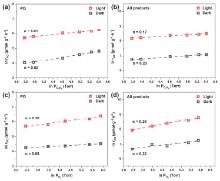
Fig 4
Kinetic measurements for DEP reaction with or without light irradiation. The reaction orders of C3H6 calculated by the formation rates of (a) PO and (b) all products. The reaction orders of O2 calculated by the formation rates of (c) PO and (d) all products, respectively."
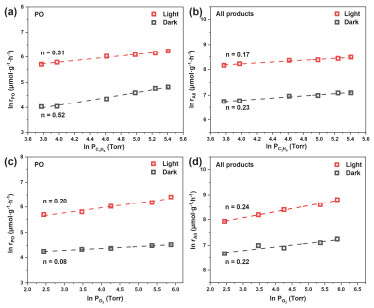
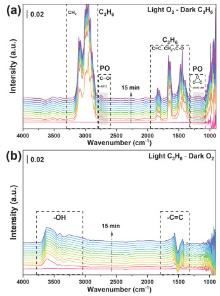
Fig 5
In situ DRIFTS of the CuOx/TiO2 during the DEP reaction. (a) The C3H6 inlet after O2 pretreatment under light irradiation. (b) The O2 inlet after C3H6 pretreatment under light irradiation."
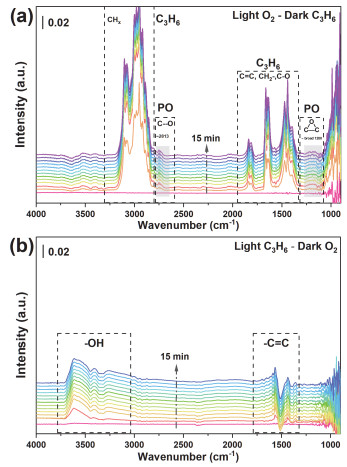
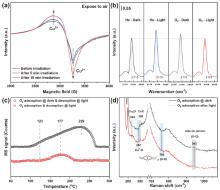
Fig 6
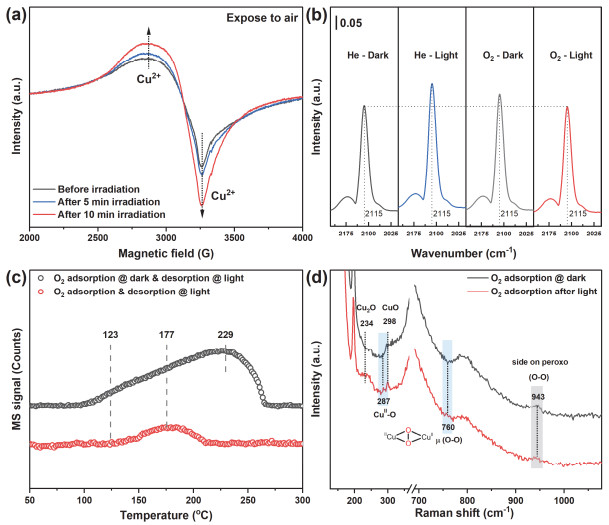
Characterization of O2 activation. (a) In situ EPR spectra in the dark and after 10 minutes of light irradiation. (b) In situ CO-DRIFTS of CuOx/TiO2 under different conditions. (c) O2-TPD profiles of the CuOx/TiO2 catalyst under different conditions. (d) In situ Raman spectroscopy for O2 absorption in darkness and after irradiation."
Scheme 1
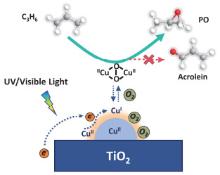
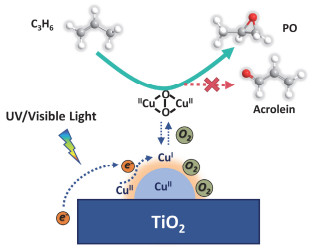
Illustration for possible mechanism for the DEP reaction under light irradiation over the CuOx/TiO2 catalyst."
| 1 |
doi: 10.1080/01614940.2015.1041849 |
| 2 |
doi: 10.1021/acscatal.0c03340 |
| 3 |
doi: 10.1021/acscatal.1c05939 |
| 4 |
doi: 10.1021/acscatal.4c01566 |
| 5 |
doi: 10.1016/j.apcata.2006.10.051 |
| 6 |
|
| 7 |
doi: 10.1007/s11164-011-0424-6 |
| 8 |
doi: 10.1021/ie402416s |
| 9 |
doi: 10.1016/j.jcat.2009.09.017 |
| 10 |
doi: 10.1021/jp800927y |
| 11 |
doi: 10.1021/jacs.0c03882 |
| 12 |
doi: 10.1002/anie.202301497 |
| 13 |
doi: 10.1002/anie.201907443 |
| 14 |
doi: 10.1039/d1cs00782c |
| 15 |
doi: 10.1021/J100487A012 |
| 16 |
doi: 10.1016/0920-5861(93)80069-D |
| 17 |
doi: 10.1021/la0496439 |
| 18 |
doi: 10.1021/jp0277006 |
| 19 |
doi: 10.1016/s0021-9517(03)00292-6 |
| 20 |
doi: 10.1006/jcat.1997.1813 |
| 21 |
doi: 10.1126/science.1231631 |
| 22 |
doi: 10.1021/acscatal.4c01749 |
| 23 |
doi: 10.1002/anie.202001701 |
| 24 |
doi: 10.3866/PKU.WHXB202303003 |
| 25 |
doi: 10.1021/jacs.1c03788 |
| 26 |
doi: 10.1016/j.jcat.2010.12.016 |
| 27 |
doi: 10.1002/anie.200603803 |
| 28 |
doi: 10.1021/acscatal.7b01180 |
| 29 |
doi: 10.1002/adma.202207793 |
| 30 |
doi: 10.1039/b512113b |
| 31 |
doi: 10.1002/anie.201509115 |
| 32 |
doi: 10.1021/jacs.1c09141 |
| 33 |
doi: 10.1038/s41467-021-27698-3 |
| 34 |
doi: 10.1063/1.356160 |
| 35 |
doi: 10.1021/jacs.2c00792 |
| 36 |
doi: 10.1016/j.jcat.2012.11.032 |
| 37 |
doi: 10.1016/j.cej.2016.09.035 |
| 38 |
doi: 10.1038/s41467-021-26257-0 |
| 39 |
doi: 10.1021/jacs.3c10551 |
| 40 |
doi: 10.1021/acscatal.2c02424 |
| 41 |
doi: 10.1002/cctc.201600843 |
| 42 |
doi: 10.1016/s1872-2067(06)60009-0 |
| 43 |
doi: 10.1039/c005500j |
| 44 |
doi: 10.1021/ja020969i |
| 45 |
doi: 10.1073/pnas.0910461106 |
| 46 |
doi: 10.1002/adma.201705197 |
| 47 |
doi: 10.1038/s41560-018-0292-z |
| 48 |
doi: 10.1021/jp8017875 |
| 49 |
doi: 10.1002/ange.200290031 |
| 50 |
doi: 10.1038/s41586-020-2826-3 |
| 51 |
doi: 10.1021/acs.jpcc.8b07044 |
| 52 |
doi: 10.1021/acs.jpcc.0c0629 |
| 53 |
doi: 10.1021/acs.jpcc.4c03206 |
| [1] | Jiali Lei, Juan Wang, Wenhui Zhang, Guohong Wang, Zihui Liang, Jinmao Li. TiO2/CdIn2S4 S-scheme heterojunction photocatalyst promotes photocatalytic hydrogen evolution coupled vanillyl alcohol oxidation [J]. Acta Phys. -Chim. Sin., 2025, 41(12): 100174-. |
| [2] | Ping An, Yu Fu, Danlei Wei, Yanglong Guo, Wangcheng Zhan, Jinshui Zhang. Hollow Nitrogen-Rich Carbon Nanoworms with High Activity for Metal-Free Selective Aerobic Oxidation of Benzyl Alcohol [J]. Acta Phys. -Chim. Sin., 2021, 37(10): 2001025-. |
| [3] | LI Jian-Mei, LIU Jian, REN Li-Wei, LIU Qing-Long, ZHAO Zhen, WEI Yue-Chang, DUAN Ai-Jun, JIANG Gui-Yuan. Selective Oxidation of Ethane to Aldehydes over Potassium-Promoted SBA-15-Supported Molybdenum Oxide Catalysts [J]. Acta Phys. -Chim. Sin., 2014, 30(9): 1736-1744. |
| [4] | YU Wei-Feng, MENG Xiang-Guang, LIU Ying, LI Xiao-Hong. Selective Oxidation of 4-Methoxymandelic Acid Catalyzed by Mononucleonic and Binucleonic Metal Complexes [J]. Acta Phys. -Chim. Sin., 2013, 29(09): 2041-2046. |
| [5] | WANG Chen, WEI Zi-Zhang, LÜ Yong-Kang, XING Bin, WANG Gui-Chang. Theoretical Investigation of Structure-Sensitivity of Styrene Epoxidation on Ag(111) and Ag(110) Surfaces [J]. Acta Phys. -Chim. Sin., 2013, 29(04): 723-730. |
| [6] | LIN Jian, CAI Fan, ZHANG Guo-Yu, YANG Le-Fu, YANG Jin-Yu, FANG Wei-Ping. Preparation of Morphology-Tuned γ-MnO2 and Catalytic Performance for the Liquid-Phase Oxidation of Toluene [J]. Acta Phys. -Chim. Sin., 2013, 29(03): 597-604. |
| [7] | CHEN Wen-Long, LIU Hai-Chao. Relationship between the Structures of Metal Oxide Catalysts and Their Properties in Selective Oxidation of Methanol [J]. Acta Phys. -Chim. Sin., 2012, 28(10): 2315-2326. |
| [8] | LIU Jian, ZHAO Zhen, WANG Hong-Xuan, DUAN Ai-Jun, JIANG Gui-Yuan. Selective Oxidation Performance of Propane over Supported Vanadium Oxide Catalysts [J]. Acta Phys. -Chim. Sin., 2011, 27(11): 2659-2664. |
| [9] | YANG Xin-Li, YIN An-Yuan, DAI Wei-Lin, FAN Kang-Nian. Synthesis of Highly Efficient WO3-Doped MCF Catalyst and Its Application in the Selective Oxidation of Cyclopentene to Glutaraldehyde [J]. Acta Phys. -Chim. Sin., 2011, 27(01): 177-185. |
| [10] | LU Chun-Li, FU Zai-Hui, LIU Ya-Chun, LIU Feng-Lan, QIN Jin-Wei, HE Xiang-Ling, YIN Du-Lin. Selective Oxidation of Ethylbenzene with Hydrogen Peroxide Catalyzed by 5,7-Dibromo-8-quinolinolato Manganese Complexes [J]. Acta Phys. -Chim. Sin., 2010, 26(10): 2705-2710. |
| [11] | ZHANG Sheng-Hong, ZHANG Hong-Peng, LI Wei-Zhen, ZHANG Wei, HUANG Hua, LIU Hai-Chao. Effects of Zirconia Crystallite Phases on the Structures of MoOx/ZrO2 Catalysts and Their Properties in the Selective Oxidation of Methanol [J]. Acta Phys. -Chim. Sin., 2010, 26(07): 1879-1886. |
| [12] | HE Yue, DONG Mei, LI Jun-Fen, WANG Jian-Guo, FAN Wei-Bin. Synthesis and Catalytic Properties of MeAPO-5 Molecular Sieves for Selective Oxidation of Cinnamyl Alcohol [J]. Acta Phys. -Chim. Sin., 2010, 26(05): 1305-1310. |
| [13] | ZHANG Sheng-Hong, LIU Hai-Chao. Relationship between the Structures of Metal Oxide Catalysts and Their Properties in Selective Oxidation of Light Alkanes [J]. Acta Phys. -Chim. Sin., 2010, 26(04): 895-907. |
| [14] | LIU Jian, ZHAO Zhen, ZHANG Zhe, XU Chun-Ming, DUAN Ai-Jun, JIANG Gui-Yuan. Selective Oxidation of Ethane over SBA-15 Mesoporous Zeolite Supported Vanadium-Based Oxide Catalysts [J]. Acta Phys. -Chim. Sin., 2009, 25(12): 2467-2474. |
| [15] | ZHONG Yi-Jun; XU Xiao-Hua; XIAO Qiang; JIANG Li; ZHU Wei-Dong; MA Chun-An. Selective Oxidation of Carbon Monoxide and Ethene Mixture on Zeolite NaA Membranes Coated Catalysts [J]. Acta Phys. -Chim. Sin., 2008, 24(10): 1875-1878. |
|
||