Acta Phys. -Chim. Sin. ›› 2025, Vol. 41 ›› Issue (6): 100067.doi: 10.1016/j.actphy.2025.100067
Special Issue: S-scheme heterojunction in photocatalysis
• ARTICLE • Previous Articles Next Articles
Designing thermodynamically stable noble metal single-atom photocatalysts for highly efficient non-oxidative conversion of ethanol into high-purity hydrogen and value-added acetaldehyde
Yuchen Zhou1,2, Huanmin Liu1, Hongxing Li2,*( ), Xinyu Song1, Yonghua Tang2, Peng Zhou1,*()
- 1 Eco-environment and Resource Efficiency Research Laboratory, School of Environment and Energy, Peking University Shenzhen Graduate School, Shenzhen 518055, Guangdong Province, China
2 School of Physics and Optoelectronics, Xiangtan University, Xiangtan 411105, Hunan Province, China
-
Received:2025-01-18Revised:2025-02-16Accepted:2025-02-17Published:2025-04-19 -
Contact:Email: pengzhou1209@pku.edu.cn (Peng Zhou)hongxinglee@xtu.edu.cn (Hongxing Li) -
Supported by:The project was supported by the start-up support from Peking University Shenzhen Graduate School and the National Natural Science Foundation Excellent Young Scientist Project, PKUSZ, China. The authors would like to thank the calculation support from Shuguang Supercomputer Center

Cite this article
Yuchen Zhou, Huanmin Liu, Hongxing Li, Xinyu Song, Yonghua Tang, Peng Zhou. Designing thermodynamically stable noble metal single-atom photocatalysts for highly efficient non-oxidative conversion of ethanol into high-purity hydrogen and value-added acetaldehyde[J]. Acta Phys. -Chim. Sin. 2025, 41(6), 100067. doi: 10.1016/j.actphy.2025.100067
share this article
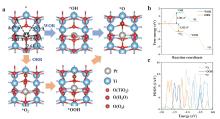
Fig 1
(a) The reaction pathways of PtSA-TiO2 (Pt―O4) through ORR and WOR. Note: the length of Pt―O bond is commonly lower than 2.1 Å. (b) Free energy profiles of PtSA-TiO2 (Pt―O4) through ORR and WOR. (c) Projected density of states of Pt 5d in ORR steps."
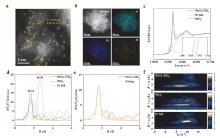
Fig 2
(a) Atomic resolution HAADF-STEM image of PtSA-TiO2. (b) Elemental mapping of PtSA-TiO2. (c) Pt L3-edge XANES spectra and (d) the corresponding k3-weighted FT spectra at R space of PtSA-TiO2. (e) XANES R space fitting curves of PtSA-TiO2. (f) The wavelet transforms (WT) EXAFS of the PtSA-TiO2, PtO2 and Pt foil."
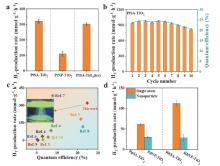
Fig 3
(a) The photocatalytic H2 evolution rate of PtSA-TiO2, PtNP-TiO2 and PtSA-TiO2 (ice) in 25 vol% ethanol solution. (b) The photocatalytic activity of PtSA-TiO2 for ten-cycle experiments. (c) Activity comparison of PtSA-TiO2 with reported photocatalysts. The inset in (c) stands shows the reaction diagram of PtSA-TiO2 in 25 vol% ethanol solution. (d) The photocatalytic H2 evolution rate of PdSA-TiO2, PdNP-TiO2, RuSA-TiO2 and RuNP-TiO2."
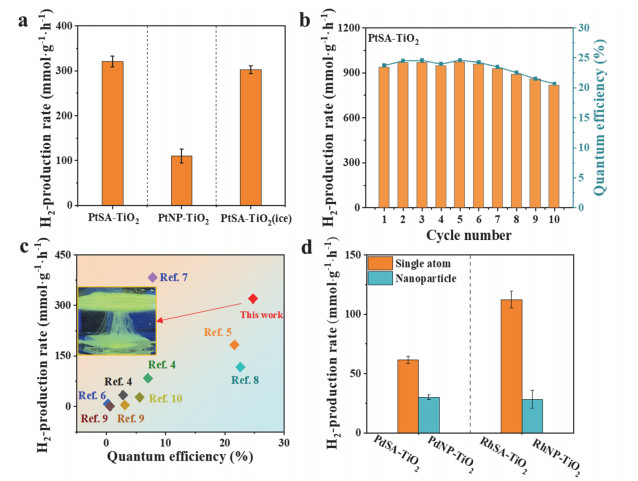
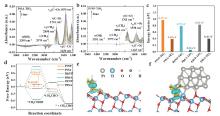
Fig 4
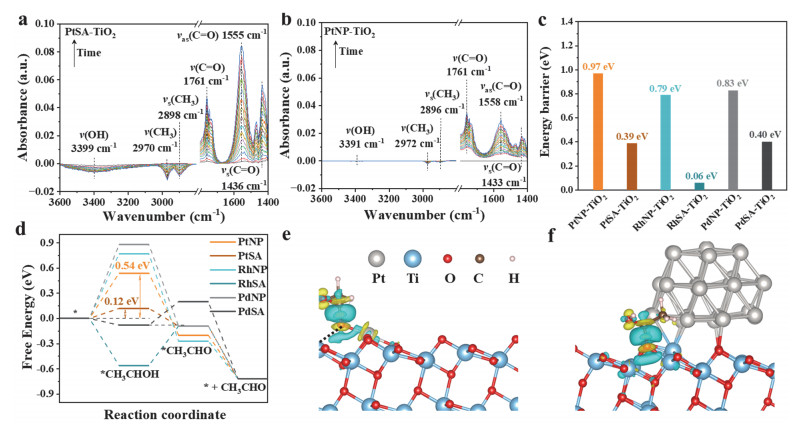
In situ IR spectra of photocatalytic ethanol dehydrogenation over (a) PtSA-TiO2 and (b) PtNP-TiO2. Calculated energy barriers for (c) H2 and (d) acetaldehyde production on PtNP-TiO2, PtSA-TiO2, RhNP-TiO2, RhSA-TiO2, PdNP-TiO2 and PdSA-TiO2. Charge density difference mapping of (e) PtSA-TiO2 and (f) PtNP-TiO2. The sky blue and yellow colors represent the negative and positive charges, respectively. The isosurface of charge density is defined at a value of 0.005 e·Å−3."
| 1 |
doi: 10.1038/s41570-018-0010-1 |
| 2 |
doi: 10.1021/jacs.5b06485 |
| 3 |
doi: 10.1038/s41467-022-29799-z |
| 4 |
doi: 10.3866/PKU.WHXB202212038 |
| 5 |
doi: 10.3866/PKU.WHXB202303003 |
| 6 |
doi: 10.1038/s44160-022-00129-x |
| 7 |
doi: 10.1038/s44160-024-00607-4 |
| 8 |
|
| 9 |
doi: 10.1016/j.joule.2021.12.011 |
| 10 |
doi: 10.1002/adma.201505281 |
| 11 |
doi: 10.1016/j.jmst.2023.11.081 |
| 12 |
doi: 10.1016/s1872-2067(24)60072-0 |
| 13 |
doi: 10.1016/s1872-2067(23)64444-4 |
| 14 |
doi: 10.1016/j.jmst.2023.03.067 |
| 15 |
doi: 10.1016/j.cjsc.2023.100202 |
| 16 |
doi: 10.1021/ja9922476 |
| 17 |
doi: 10.1021/acsnano.5b03429 |
| 18 |
doi: 10.1038/nature21672 |
| 19 |
doi: 10.1126/science.aaf5251 |
| 20 |
doi: 10.1126/science.aaf5251 |
| 21 |
doi: 10.1002/adma.202401163 |
| 22 |
|
| 23 |
doi: 10.3866/pku.Whxb202405016 |
| 24 |
doi: 10.1007/s40843-023-2725-y |
| 25 |
doi: 10.3866/pku.Whxb202309031 |
| 26 |
doi: 10.1016/j.apcatb.2023.123684 |
| 27 |
doi: 10.1002/anie.201907954 |
| 28 |
doi: 10.1016/s1381-1169(00)00362-9 |
| 29 |
doi: 10.1038/s41929-018-0146-x |
| 30 |
doi: 10.1021/acssuschemeng.2c02740 |
| 31 |
doi: 10.1021/jacs.3c10659 |
| 32 |
doi: 10.1016/s0169-4332(00)00831-x |
| 33 |
doi: 10.1021/acscatal.0c01192 |
| 34 |
doi: 10.1016/j.nanoen.2018.11.033 |
| 35 |
doi: 10.1016/j.jcat.2006.11.022 |
| 36 |
doi: 10.1016/j.cattod.2015.07.038 |
| 37 |
doi: 10.1016/j.apcatb.2013.05.022 |
| 38 |
doi: 10.1126/science.aac6368 |
| [1] | Fan Fan, Hao Xiu, Yuting Wang, Yongpeng Cui, Yajun Wang. Construction of NH2-MIL-125/Na-doped g-C3N4 composite S-scheme heterojunction and its performance in photocatalytic hydrogen peroxide production [J]. Acta Phys. -Chim. Sin., 2026, 42(2): 100143-. |
| [2] | Yu Liu, Pengfei Li, Yize Liu, Zaicheng Sun. Recent advances in carbon dots as a single photocatalyst [J]. Acta Phys. -Chim. Sin., 2026, 42(2): 100167-. |
| [3] | Yuhang Zhang, Yi Li, Yuehan Cao, Yingjie Shuai, Yu Zhou, Ying Zhou. Regulating the formation type by Ir of intermediates to suppress product overoxidation in photocatalytic methane conversion [J]. Acta Phys. -Chim. Sin., 2026, 42(2): 100173-. |
| [4] | Chengxiao Zhao, Zhaolin Li, Dongfang Wu, Xiaofei Yang. SBA-15 templated covalent triazine frameworks for boosted photocatalytic hydrogen production [J]. Acta Phys. -Chim. Sin., 2026, 42(1): 100149-. |
| [5] | Chengyan Ge, Jiawei Hu, Xingyu Liu, Yuxi Song, Chao Liu, Zhigang Zou. Self-integrated black NiO clusters with ZnIn2S4 microspheres for photothermal-assisted hydrogen evolution by S-scheme electron transfer mechanism [J]. Acta Phys. -Chim. Sin., 2026, 42(1): 100154-. |
| [6] | Shiyi Chen, Jialong Fu, Jianping Qiu, Guoju Chang, Shiyou Hao. Waste medical mask-derived carbon quantum dots enhance the photocatalytic degradation of polyethylene terephthalate (PET) over BiOBr/g-C3N4 S-scheme heterojunction [J]. Acta Phys. -Chim. Sin., 2026, 42(1): 100135-. |
| [7] | Huoshuai Huang, Zhidong Wei, Jiawei Yan, Jiasheng Chi, Qianxiang Su, Mingxia Chen, Zhi Jiang, Yangzhou Sun, Wenfeng Shangguan. Unveiling the mechanism of direct-to-indirect bandgap transition in the photocatalytic hydrogen evolution of ZnxCd1−xS solid solution [J]. Acta Phys. -Chim. Sin., 2026, 42(1): 100141-. |
| [8] | Lele Feng, Xueying Bai, Jifeng Pang, Hongchen Cao, Xiaoyan Liu, Wenhao Luo, Xiaofeng Yang, Pengfei Wu, Mingyuan Zheng. Single-atom Pd boosted Cu catalysts for ethanol dehydrogenation [J]. Acta Phys. -Chim. Sin., 2025, 41(9): 100100-. |
| [9] | Jianan Hong, Chenyu Xu, Yan Liu, Changqi Li, Menglin Wang, Yanwei Zhang. Decoding the interfacial competition between hydrogen evolution and CO2 reduction via edge-active-site modulation in photothermal catalysis [J]. Acta Phys. -Chim. Sin., 2025, 41(9): 100099-. |
| [10] | Menglan Wei, Xiaoxia Ou, Yimeng Wang, Mengyuan Zhang, Fei Teng, Kaixuan Wang. S-scheme heterojunction g-C3N4/Bi2WO6 highly efficient degradation of levofloxacin: performance, mechanism and degradation pathway [J]. Acta Phys. -Chim. Sin., 2025, 41(9): 100105-. |
| [11] | Jingping Li, Suding Yan, Jiaxi Wu, Qiang Cheng, Kai Wang. Improving hydrogen peroxide photosynthesis over inorganic/organic S-scheme photocatalyst with LiFePO4 [J]. Acta Phys. -Chim. Sin., 2025, 41(9): 100104-. |
| [12] | Xue Wu, Yupeng Liu, Bingzhe Wang, Lingyun Li, Zhenjian Li, Qingcheng Wang, Quansheng Cheng, Guichuan Xing, Songnan Qu. Rationally assembling different surface functionalized carbon dots for enhanced near-infrared tumor photothermal therapy [J]. Acta Phys. -Chim. Sin., 2025, 41(9): 100109-. |
| [13] | Fengying Zhang, Yanglin Mei, Yuman Jiang, Shenshen Zheng, Kaibo Zheng, Ying Zhou. Research progress of transient absorption spectroscopy in solar energy conversion and utilization [J]. Acta Phys. -Chim. Sin., 2025, 41(9): 100118-. |
| [14] | Mahmoud Sayed, Han Li, Chuanbiao Bie. Challenges and prospects of photocatalytic H2O2 production [J]. Acta Phys. -Chim. Sin., 2025, 41(9): 100117-. |
| [15] | Mingjie Lei, Wenting Hu, Kexin Lin, Xiujuan Sun, Haoshen Zhang, Ye Qian, Tongyue Kang, Xiulin Wu, Hailong Liao, Yuan Pan, Yuwei Zhang, Diye Wei, Ping Gao. Accelerating the reconstruction of NiSe2 by Co/Mn/Mo doping for enhanced urea electrolysis [J]. Acta Phys. -Chim. Sin., 2025, 41(8): 100083-. |
|
||