Acta Phys. -Chim. Sin. ›› 2026, Vol. 42 ›› Issue (10): 100229.doi: 10.1016/j.actphy.2025.100229
Special Issue: Solar Energy Conversion and Storage
• ARTICLE • Previous Articles Next Articles
Spacer isomerization engineering in double-cable conjugated polymers for optimized molecular packing and enhanced photovoltaic performance
Wenhao Zhang, Haisheng Fang*( ), Lijuan Liu, Huaihao Tang, Chengyi Xiao, Weiwei Li*()
- Beijing Advanced Innovation Center for Soft Matter Science and Engineering, State Key Laboratory of Organic-Inorganic Composites, Beijing University of Chemical Technology, Beijing 100029, China
-
Received:2025-10-19Revised:2025-11-27Accepted:2025-12-10Published:2026-09-03 -
Contact:Email: 2021410015@mail.buct.edu.cn (Haisheng Fang)liweiwei@iccas.ac.cn (Weiwei Li)

Cite this article
Wenhao Zhang, Haisheng Fang, Lijuan Liu, Huaihao Tang, Chengyi Xiao, Weiwei Li. Spacer isomerization engineering in double-cable conjugated polymers for optimized molecular packing and enhanced photovoltaic performance[J]. Acta Phys. -Chim. Sin. 2026, 42(10), 100229. doi: 10.1016/j.actphy.2025.100229
share this article
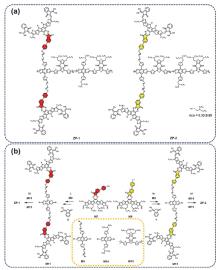
Fig 1
(a) Chemical structures of the double-cable conjugated polymers ZP-1 and ZP-2, and (b) the synthetic routes: (i) K2CO3, DMF, THF at 70 ℃; (ii) CHCl3, pyridine at 50 ℃; (iii) Pd2(dba)3, P(o-tol)3, toluene at 115 ℃; (iv), (v), (vi) are the same as (i), (ii), (iii)."
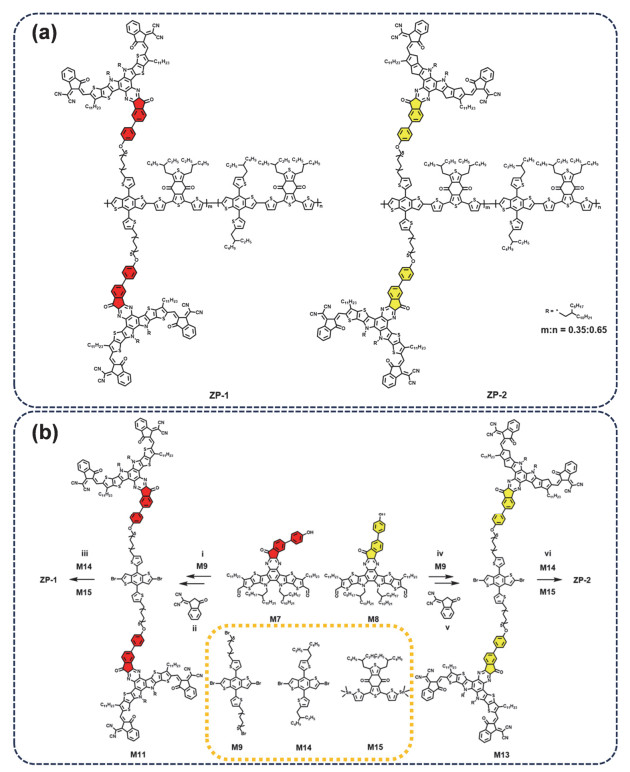
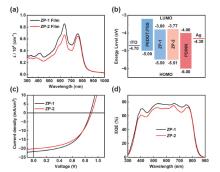
Fig 2
(a) UV-Vis absorption spectra in the thin-film state, and (b) energy level diagrams of ZP-1 and ZP-2, (c) J–V characteristics, and (d) the corresponding external EQE spectra."
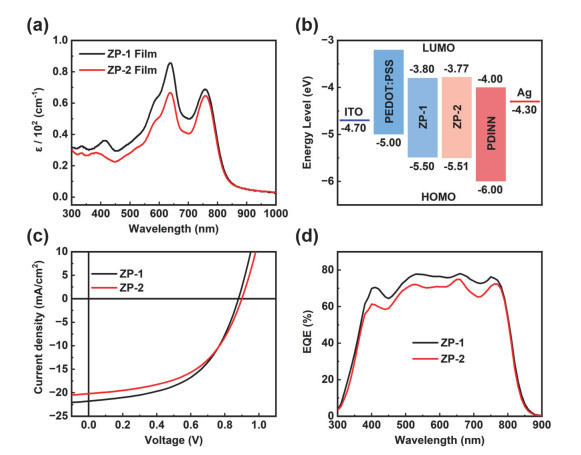

Table 1
Optical and electrochemical properties of ZP-1 and ZP-2."
| Materials | λonsetsol a/nm | λonsetfilm b/nm | Egopt c/eV | EHOMO d/eV | ELUMO e/eV |
| ZP-1 | 802 | 838 | 1.48 | −5.50 | −3.80 |
| ZP-2 | 802 | 838 | 1.48 | −5.51 | −3.77 |
Table 2
Photovoltaic parameters of SCOSCs."
| Active layer | VOC/Ⅴ | JSC/(mA cm−2) | Jcal a/(mA cm−2) | FF | PCE b |
| ZP-1 | 0.885 | 21.79 | 20.70 | 54.11% | 10.43% (10.16%±0.20%) |
| ZP-2 | 0.899 | 20.20 | 19.19 | 51.98% | 9.44% (9.07% ± 0.31%) |
| D18:BTP-eC9 | 0.855 | 27.89 | 26.58 | 79.11% | 18.87% (18.67% ± 0.17%) |
| D18:BTP-eC9:ZP-1 | 0.854 | 28.69 | 27.34 | 80.84% | 19.81% (19.52% ± 0.25%) |
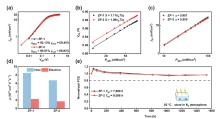
Fig 3
(a) Jph−Veff characteristics, (b) Plight−VOC curves, (c) Plight−JSC curves, (d) column plots of hole and electron mobilities (μh and μe) extracted from SCLC measurements, and (e) thermal stability tests conducted at 65 ℃."
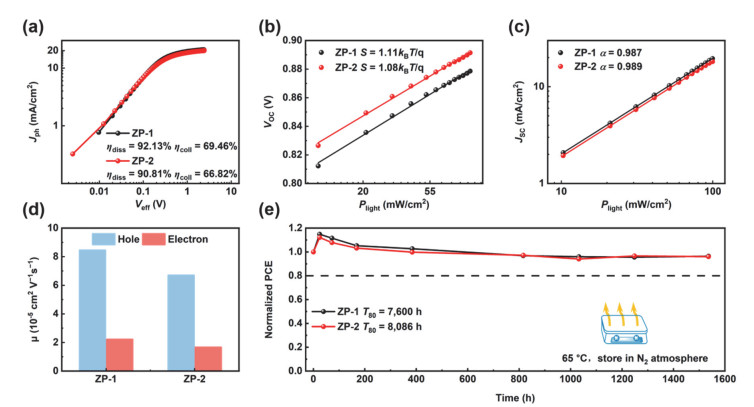
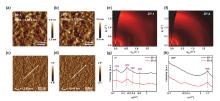
Fig 4
AFM height images of (a) ZP-1 and (b) ZP-2 films, AFM phase images of (c) ZP-1 and (d) ZP-2 films, the GIWAXS patterns of (e) ZP-1 and (f) ZP-2, and the corresponding line-cuts extracted from the IP and OOP directions for (g) ZP-1 and (h) ZP-2 films."
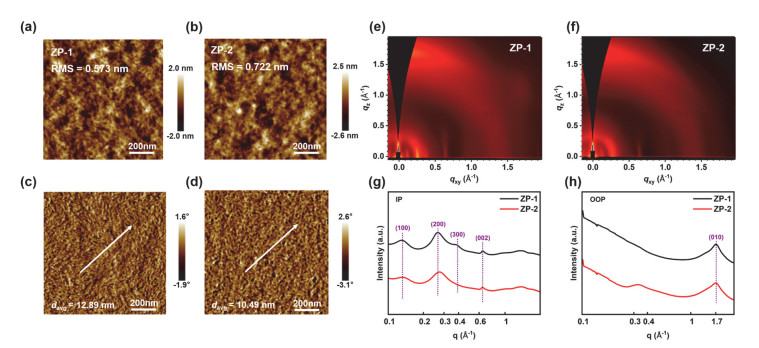
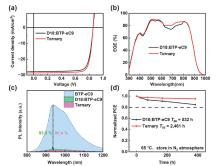
Fig 5
(a) J−V characteristics and (b) the corresponding EQE spectra of OSCs based on D18:BTP-eC9 (1 : 1.2, w/w) and D18:BTP-eC9:ZP-1 (1 : 1.2 : 0.1, w/w/w). (c) PL spectra of the pure films and the blend films for BTP-eC9, D18:BTP-eC9, and the ternary blend at an excitation wavelength of 808 nm. (d) thermal stability tests conducted at 65 ℃."
| 1 |
G. T. Feng, J. Y. Li, Y. K. He, W. Y. Zheng, J. Wang, C. Li, Z. Tang, A. Osvet, N. Li, C. J. Brabec, et al.. Joule 2019, 3, 1765.
doi: 10.1016/j.joule.2019.05.008 |
| 2 |
S. J. Liang, B. Q. Liu, S. Karuthedath, J. Wang, Y. K. He, W. L. Tan, H. Li, Y. H. Xu, N. Li, J. H. Hou, et al.. Angew. Chem. Int. Ed. 2022, 61, e202209316.
doi: 10.1002/anie.202209316 |
| 3 |
B. Q. Liu, S. J. Liang, S. Karuthedath, C. Y. Xiao, J. Wang, W. L. Tan, R. N. Li, H. Li, J. H. Hou, Z. Tang, et al.. J. Mater. Chem. A 2023, 11, 12236.
doi: 10.1039/D3TA01501G |
| 4 |
W. B. Lai, S. Karuthedath, C. Y. Xiao, L. Meng, F. Laquaic, W. W. Li, Y. F. Li. Chin. Chem. Lett. 2024, 35, 108287.
doi: 10.1016/j.cclet.2023.108287 |
| 5 |
Y. K. Wang, Q. M. Chen, S. J. Liang, D. D. Xia, C. W. Zhao, C. R. Mcneill, W. W. Li. Chin. Chem. Lett. 2024, 35, 109164.
doi: 10.1016/j.cclet.2023.109164 |
| 6 |
Y. W. Guo, D. W. Li, Y. Gao, C. H. Li. Acta Phys. Chim. Sin. 2024, 40, 2306050.
doi: 10.3866/PKU.WHXB202306050 |
| 7 |
Y. Li, R. A. Pacalaj, Y. M. Luo, K. R. Ai, Y. L. Hai, S. J. Liang, K. Z. Fan, A. A. Sergeev, R. J. Ma, T. A. Dela Peña, et al.. Adv. Mater. 2025, 37, 2409212.
doi: 10.1002/adma.202409212 |
| 8 |
F. Qi, Y. X. Li, R. Zhang, F. R. Lin, K. K. Liu, Q. P. Fan, A. K.-Y. Jen. Angew. Chem. Int. Ed. 2023, 62, e202303066.
doi: 10.1002/anie.202303066 |
| 9 |
J. Y. Yu, S. X. Li, M. M. Shi, H. M. Zhu, H. Z. Chen. Polymer Science & Technology 2025, 1, 25.
doi: 10.1021/polymscitech.4c00054 |
| 10 |
C. C. Xie, C. Y. Xiao, H. S. Niu, G. T. Feng, W. W. Li. Chin. Chem. Lett. 2024, 35, 109849.
doi: 10.1016/j.cclet.2024.109849 |
| 11 |
R. N. Li, S. J. Liang, Y. H. Xu, C. F. Zhang, Z. Tang, B. Q. Liu, W. W. Li. Acta Phys. Chim. Sin. 2024, 40, 2307037.
doi: 10.3866/PKU.WHXB202307037 |
| 12 |
C. Li, X. X. Wu, X. Y. Sui, H. B. Wu, C. Wang, G. T. Feng, Y. G. Wu, F. Liu, X. F. Liu, Z. Tang, et al.. Angew. Chem. Int. Ed. 2019, 58, 15532.
doi: 10.1002/anie.201910489 |
| 13 |
Z. F. Yang, S. J. Liang, B. Q. Liu, J. Wang, F. Yang, Q. M. Chen, C. Y. Xiao, Z. Tang, W. W. Li. Polym. Chem. 2021, 12, 6865.
doi: 10.1039/D1PY01188J |
| 14 |
S. J. Liang, C. Y. Xiao, C. C. Xie, B. Q. Liu, H. S. Fang, W. W. Li. Adv. Mater. 2023, 35, 2300629.
doi: 10.1002/adma.202300629 |
| 15 |
H. S. Fang, C. Y. Xiao, S. J. Liang, L. H. Liu, J. M. Huang, Y. W. Wang, A. D. Zhang, Y. Li, C. R. Mcneill, H. Cheng, et al.. Angew. Chem. Int. Ed. 2025, 64, e202514735.
doi: 10.1002/anie.202514735 |
| 16 |
M. L. Xie, Z. X. Wei, K. Lu. Chem. Sci. 2024, 15, 8265.
doi: 10.1039/D4SC01481B |
| 17 |
C. Wang, Q. M. Chen, C. F. Zhang, B. Y. Han, X. C. Liu, S. J. Liang, B. Wang, C. Y. Xiao, B. Gao, Z. Tang, et al.. CCS Chem. 2024, 7, 1177.
doi: 10.31635/ccschem.024.202404023 |
| 18 |
Z. H. Wang, W. F. Wei, R. J. Ma, D. Luo, Z. X. Chen, J. Zhang, L. Y. Yu, G. Li, Z. H. Luo. Acta Phys. Chim. Sin. 2026, 42, 100182.
doi: 10.1016/j.actphy.2025.100182 |
| 19 |
G. T. Feng, W. L. Tan, S. Karuthedath, C. Li, X. C. Jiao, A. C. Y. Liu, H. Venugopal, Z. Tang, L. Ye, F. Laquai, et al.. Angew. Chem. Int. Ed. 2021, 60, 25499.
doi: 10.1002/anie.202111192 |
| 20 |
S. J. Liang, J. Wang, Y. N. Ouyang, W. L. Tan, C. R. Mcneill, Q. M. Chen, Z. Tang, W. W. Li. Macromolecules 2022, 55, 2517.
doi: 10.1021/acs.macromol.1c02593 |
| 21 |
Y. L. Fan, K. Ziabrev, S. Y. Zhang, B. P. Lin, S. Barlow, S. R. Marder. ACS Omega 2017, 2, 377.
doi: 10.1021/acsomega.6b00537 |
| 22 |
M. E. Farahat, G. C. Welch. Colorants 2023, 2, 151.
doi: 10.3390/colorants2010011 |
| 23 |
W. F. Wei, C. E. Zhang, Z. X. Chen, W. Chen, G. L. Ran, G. J. Pan, W. K. Zhang, P. Müller-Buschbaum, Z. S. Bo, C. L. Yang, et al.. Angew. Chem. Int. Ed. 2024, 63, e202315625.
doi: 10.1002/anie.202315625 |
| 24 |
P. A. Leermakers, H. T. Thomas, L. D. Weis, F. C. James. J. Am. Chem. Soc. 1966, 88, 5075.
doi: 10.1021/ja00974a006 |
| 25 |
A. Mahmood, A. Irfan. Comput. Theor. Chem. 2020, 1179, 112797.
doi: 10.1016/j.comptc.2020.112797 |
| 26 |
Y. F. Zhu, F. W. Zhao, W. Wang, Y. W. Li, S. M. Zhang, Y. Z. Lin. Adv. Energy Sustainability Res. 2022, 3, 2100184.
doi: 10.1002/aesr.202100184 |
| 27 |
M. Privado, P. De La Cruz, P. Malhotra, G. D. Sharma, F. Langa. Sol. Energy 2021, 221, 393.
doi: 10.1016/j.solener.2021.04.049 |
| 28 |
X. Chang, M. Balooch Qarai, F. C. Spano. J. Chem. Phys. 2021, 155, 034905.
doi: 10.1063/5.0054877 |
| 29 |
J. Q. Du, K. Hu, J. Y. Zhang, L. Meng, J. L. Yue, I. Angunawela, H. P. Yan, S. C. Qin, X. L. Kong, Z. J. Zhang, et al.. Nat. Commun. 2021, 12, 5264.
doi: 10.1038/s41467-021-25638-9 |
| 30 |
G. T. Feng, J. Y. Li, F. J. M. Colberts, M. M. Li, J. Q. Zhang, F. Yang, Y. Z. Jin, F. L. Zhang, R. a. J. Janssen, C. Li, et al.. J. Am. Chem. Soc. 2017, 139, 18647.
doi: 10.1021/jacs.7b10499 |
| 31 |
G. Kupgan, X.-K. Chen, J.-L. Brédas. ACS Appl. Energy Mater. 2021, 4, 4002.
doi: 10.1021/acsaem.1c00375 |
| 32 |
H. FrÖhlich. Nature 1949, 164, 377.
doi: 10.1038/164377a0 |
| 33 |
P. N. Murgatroyd. J. Phys. D: Appl. Phys. 1970, 3, 151.
doi: 10.1088/0022-3727/3/2/308 |
| 34 |
D. H. Li, N. Deng, Y. W. Fu, C. H. Guo, B. J. Zhou, L. Wang, J. Zhou, D. Liu, W. Li, K. Wang, et al.. Adv. Mater. 2023, 35, 2208211.
doi: 10.1002/adma.202208211 |
| 35 |
A. L. Patterson. Phys. Rev. 1939, 56, 978.
doi: 10.1103/PhysRev.56.978 |
| 36 |
M. L. Li, M. Liu, F. Qi, F. R. Lin, A. K. Y. Jen. Chem. Rev. 2024, 124, 2138.
doi: 10.1021/acs.chemrev.3c00396 |
| 37 |
N. K. Elumalai, A. Uddin. Energy Environ. Sci. 2016, 9, 391.
doi: 10.1039/C5EE02871J |
| 38 |
Y. F. Liu, J. Y. Zhang, G. Q. Zhou, F. Liu, X. Z. Zhu, F. L. Zhang. J. Phys. Chem. C 2020, 124, 15132.
doi: 10.1021/acs.jpcc.0c05654 |
| 39 |
D. H. Yun, S. Xuyao, S.-Y. Lee, V. V. Sharma, H. Li, S.-J. Park, Y.-H. Kim, G.-H. Kim. ACS Appl. Energy Mater. 2024, 7, 1243.
doi: 10.1021/acsaem.3c02876 |
| [1] | Xing Yan, Yetai Cheng, Yixun Shu, Luyao Yang, Weidong Wang, Xinlu Bai, Ya-Nan Chen, Hao Lu, Zhishan Bo, Yahui Liu. Highly efficient and stable organic solar cells based on dimeric non-fused ring acceptors as the third component [J]. Acta Phys. -Chim. Sin., 2026, 42(7): 100228-. |
| [2] | Zhenhuan Wang, Weifei Wei, Ruijie Ma, Dou Luo, Zhanxiang Chen, Jun Zhang, Liyang Yu, Gang Li, Zhenghui Luo. Core cyanation of benzo[a]phenazine acceptor enables 19.04% binary organic solar cells with green solvent compatibility [J]. Acta Phys. -Chim. Sin., 2026, 42(2): 100182-. |
| [3] | Chaowei Zhao, Ting Li, Dongdong Xia, Qian Xie, Jie Fang, Yuefeng Zhang, Yu Xie, Alex K.-Y. Jen. Solvatochromic Ti-oxo clusters as cathode interlayer for efficient organic solar cells [J]. Acta Phys. -Chim. Sin., 2026, 42(10): 100280-. |
| [4] | Ruonan Li, Shijie Liang, Yunhua Xu, Cuifen Zhang, Zheng Tang, Baiqiao Liu, Weiwei Li. Chlorine-Substituted Double-Cable Conjugated Polymers with Near-Infrared Absorption for Low Energy Loss Single-Component Organic Solar Cells [J]. Acta Phys. -Chim. Sin., 2024, 40(8): 2307037-. |
| [5] | Qiuju Liang, Yinxia Chang, Chaowei Liang, Haolei Zhu, Zibin Guo, Jiangang Liu. Application of Crystallization Kinetics Strategy in Morphology Control of Solar Cells based on Nonfullerene Blends [J]. Acta Phys. -Chim. Sin., 2023, 39(7): 2212006-0. |
| [6] | Fangbin LIU,Jun LIU,Lixiang WANG. An Organoboron Compound with a Thienyl Substituent as an Electron Acceptor for Organic Solar Cells [J]. Acta Phys. -Chim. Sin., 2019, 35(3): 251-256. |
| [7] | Yang YANG,Xiu JIANG,Xiaowei ZHAN,Xingguo CHEN. Designing an Organic Acceptor with Unsymmetrical Structure Based on Rhodanine and Thiazolidine-2, 4-dione Units to Study the Structure–Property Relationship [J]. Acta Phys. -Chim. Sin., 2019, 35(3): 257-267. |
| [8] | Guoxiao JIA,Shaoqing ZHANG,Liyan YANG,Chang HE,Huili FAN,Jianhui HOU. Development of Benzodithiophene-Based A-D-A Small Molecules with Different Acceptor End Groups for Efficient Organic Solar Cells [J]. Acta Phys. -Chim. Sin., 2019, 35(1): 76-83. |
| [9] | Shichao ZHOU,Guitao FENG,Dongdong XIA,Cheng LI,Yonggang WU,Weiwei LI. Star-Shaped Electron Acceptor based on Naphthalenediimide-Porphyrin for Non-Fullerene Organic Solar Cells [J]. Acta Phys. -Chim. Sin., 2018, 34(4): 344-347. |
| [10] | Ji-Chong LIU,Feng TANG,Feng-Ye YE,Qi CHEN,Li-Wei CHEN. Visualization of Energy Band Alignment in Thin-Film Optoelectronic Devices with Scanning Kelvin Probe Microscopy [J]. Acta Phys. -Chim. Sin., 2017, 33(10): 1934-1943. |
|
||