Acta Phys. -Chim. Sin. ›› 2026, Vol. 42 ›› Issue (9): 100273.doi: 10.1016/j.actphy.2026.100273
• ARTICLE • Previous Articles Next Articles
Preparation and absorption properties of petal-clustered WS2/MnFe2/O4/GNs composite materials
Gengsu Zhu2,3, Yuanyuan Ma2, Chengzhi Sun2, Mengting Li2, Chunyu Wang1,2,*( ), Bo Zhong2,*(), Long Xia2,*()
- 1 State Key Laboratory of Precision Welding & Joining of Materials and Structures, Harbin Institute of Technology (Weihai), Weihai 264209, Shandong Province, China
2 School of Materials Science and Engineering, Harbin Institute of Technology (Weihai), Weihai 264209, Shandong Province, China
3 School of Chemistry and Chemical Engineering, Northwestern Polytechnical University, Xi'an 710072, Shaanxi Province, China
-
Received:2026-01-25Revised:2026-02-26Accepted:2026-03-01Published:2026-07-03 -
Contact:Email: wcyadam@126.com (Chunyu Wang)zhongbo@hit.edu.cn (Bo Zhong)xialong@hit.edu.cn (Long Xia)

Cite this article
Gengsu Zhu, Yuanyuan Ma, Chengzhi Sun, Mengting Li, Chunyu Wang, Bo Zhong, Long Xia. Preparation and absorption properties of petal-clustered WS2/MnFe2/O4/GNs composite materials[J]. Acta Phys. -Chim. Sin. 2026, 42(9), 100273. doi: 10.1016/j.actphy.2026.100273
share this article
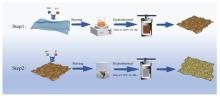
Fig 1
Schematic diagram of WS2/MnFe2O4/GNs composite synthesis."
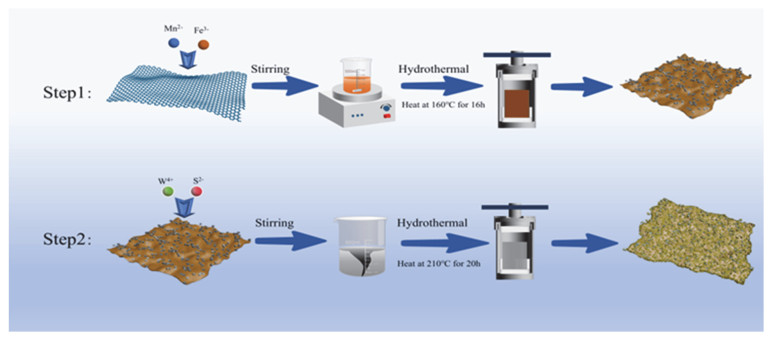
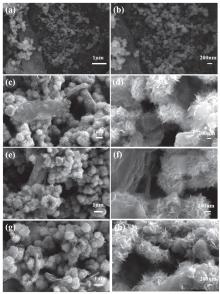
Fig 2
(a, b) SEM image of W-0. (c, d) SEM image of W-1. (e, f) SEM image of W-2. (g, h) SEM image of W-3."
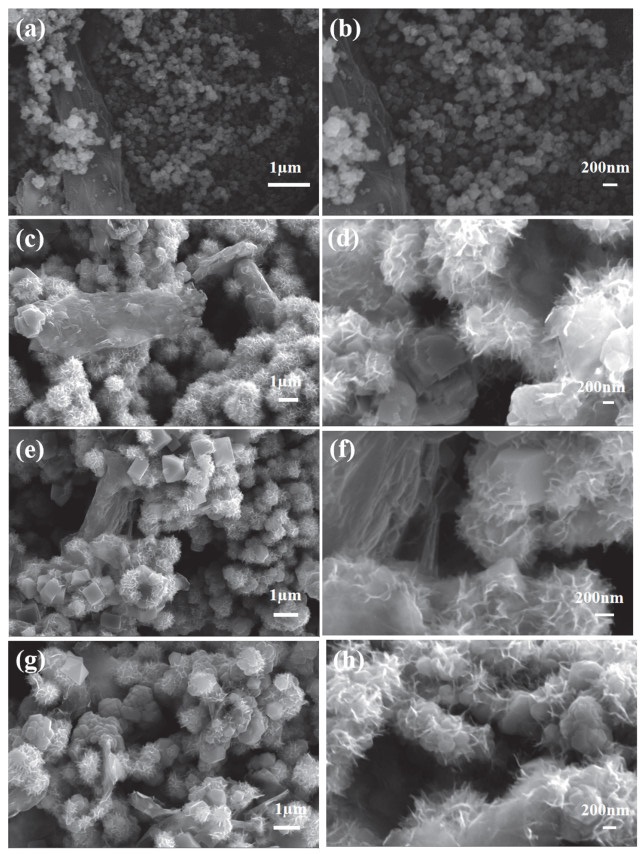
Fig 3
(a–e) The TEM images of WS2/MnFe2O4/GNs with different views. (f) Selected electron diffraction pattern."
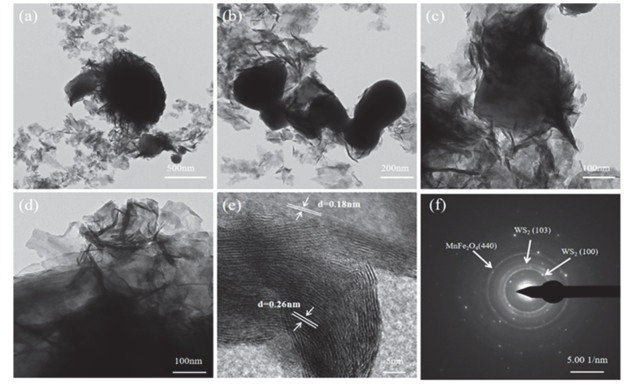
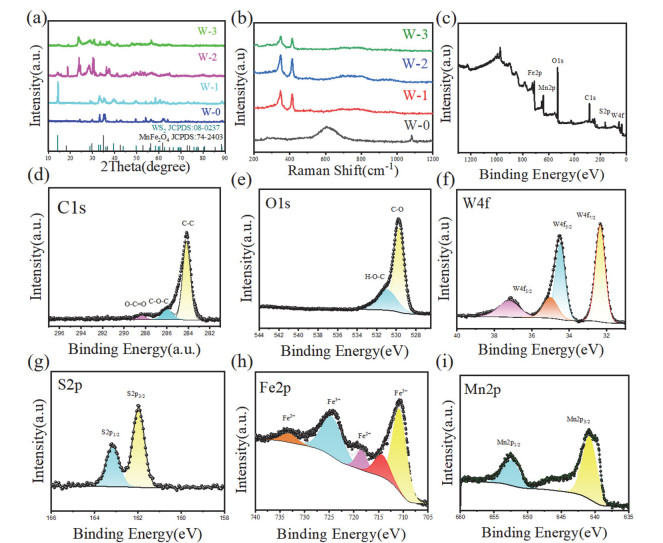
Fig 4
(a) X-ray diffraction pattern. (b) Raman spectrum. (c) Broad-scan XPS spectrum, (d) C spectrum, (e) O spectrum, (f) W spectrum, (g) S spectrum, (h) Fe spectrum, (i) Mn spectrum of WS2/MnFe2O4/GNs."
"
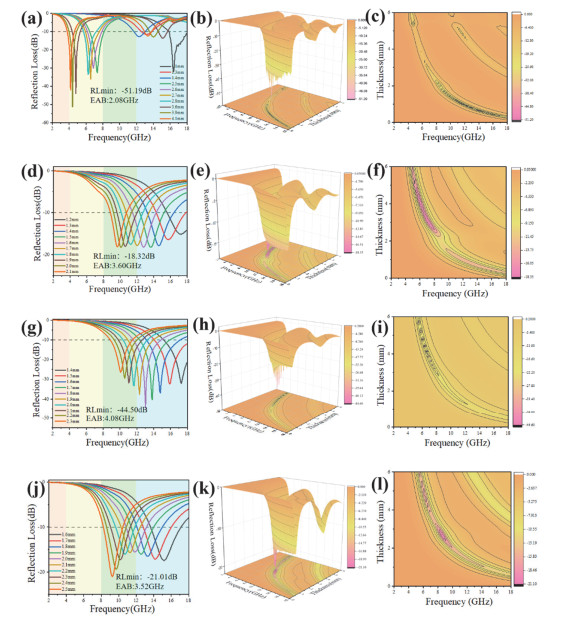
Fig 6
(a) ε' curve, (b) ε'' curve, (c) tanδε curve, (d) µ' curve, (e) µ'' curve, (f) tanδµ curve."
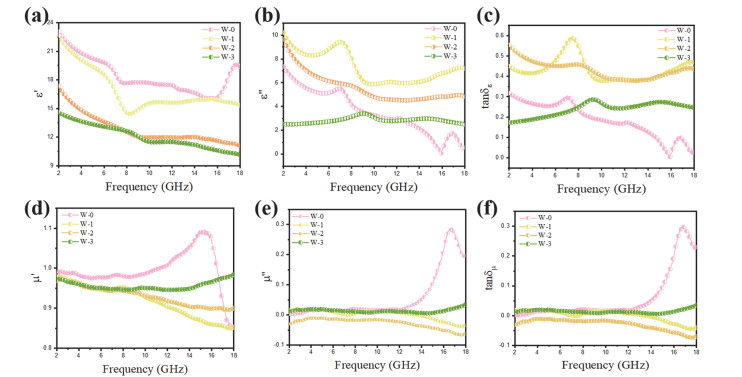
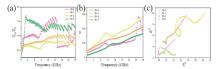
Fig 7
(a) Impedance matching curve, (b) Attenuation constant curve, (c) Cole-Cole curve."
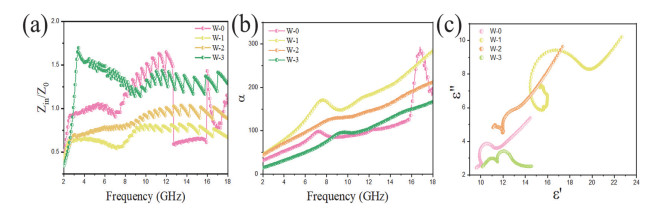
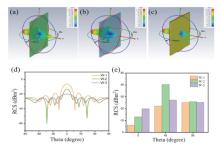
Fig 8
CST simulation of the (a) W-1, (b)W-2, (c) W-3. (d) RCS curve of the samples (e) RCS values of samples at different angles."
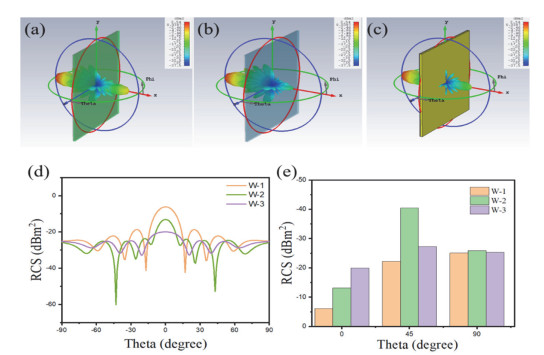
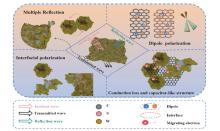
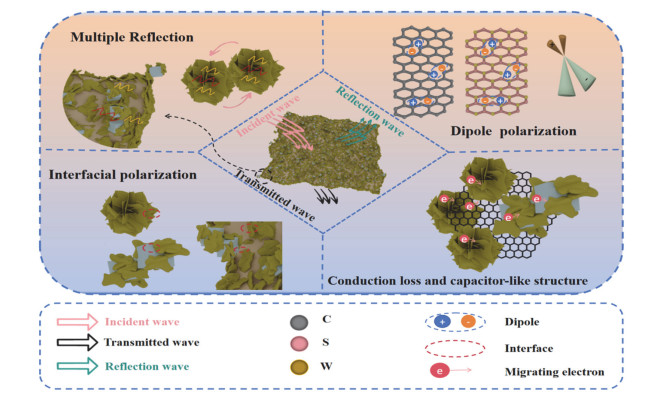
Fig 9
Schematic diagram of microwave absorption mechanism in WS2/MnFe2O4/GNs hybrid composite material."
| 1 |
J. Wen, Y. Liu, S. Hui, L. Deng, L. Zhang, X. Fan, Q. Chen, X. Liu, X. Li, N. Yan; et al.. Matter 2025, 8(9), 12.
doi: 10.1016/j.matt.2025.102151 |
| 2 |
Y. Miao, A. Cui, C. Wang, Z. Tian, T. Wang, J. Liu, Q. Jia, Z. Li, M. Zhang. Adv. Funct. Mater. 2025, 35(33), 11.
doi: 10.1002/adfm.202503394 |
| 3 |
H. Xu, Y. Wang, M. Liu, Y. Zhai. ACS Appl. Mater. Interfaces 2025, 17(33), 47679.
doi: 10.1021/acsami.5c09658 |
| 4 |
Q. Zhang, D. Lan, S. Deng, J. Gu, Y. Wang, J. Ren, G. Wu, Z. Jia. Carbon 2024, 226, 10.
doi: 10.1016/j.carbon.2024.119233 |
| 5 |
M. Shi, Z. Jia, D. Lan, Z. Gao, S. Zhang, G. Wu, Adv. Funct. Mater. (2025) 16, https://doi.org/10.1002/adfm.202528665. . Adv. Funct. Mater. 2025,
doi: 10.1002/adfm.202528665 |
| 6 |
H. Liu, W. Xu, H. Ren, D. Li, J. He, L. Xia, Y. Xu, B. Zeng, C. Yuan, L. Dai. Chem. Eng. J. 2024, 486, 11.
doi: 10.1016/j.cej.2024.150444 |
| 7 |
Z. Jia, J. Liu, Z. Gao, C. Zhang, G. Wu. Adv. Funct. Mater. 2025, 35(18), 13.
doi: 10.1002/adfm.202405523 |
| 8 |
X. Ren, D. Lan, Z. Gao, S. Zhang, Y. Zhang, M. He, Z. Jia, G. Wu. J. Mater. Sci. Technol. 2026, 255, 236.
doi: 10.1016/j.jmst.2025.09.001 |
| 9 |
J. Cheng, Y. Jin, J. Zhao, Q. Jing, B. Gu, J. Wei, S. Yi, M. Li, W. Nie, Q. Qin; et al.. Nano-Micro Lett. 2024, 16(1), 40.
doi: 10.1007/s40820-023-01247-7 |
| 10 |
H. Zhang, J. Cheng, H. Wang, Z. Huang, Q. Zheng, G. Zheng, D. Zhang, R. Che, M. Cao. Adv. Funct. Mater. 2022, 32(6), 10.
doi: 10.1002/adfm.202108194 |
| 11 |
Y. Shen, Z. Ma, F. Yan, C. Zhu, X. Zhang, Y. Chen. Adv. Funct. Mater. 2025, 35(26), 11.
doi: 10.1002/adfm.202423947 |
| 12 |
Q. Wang, X. Su, Y. Jia, Y. Liu, F. Shahzad. Ceram. Int. 2025, 51(8), 9833.
doi: 10.1016/j.ceramint.2024.12.415 |
| 13 |
Z. Jia, J. Li, D. Lan, S. Zhang, Z. Gao, X. Shi, G. Wu. J. Mater. Sci. Technol. 2026, 256, 246.
doi: 10.1016/j.jmst.2025.08.044 |
| 14 |
X. Liu, S. Zhang, M. Yu, X. Zhao, Y. Jia, Y. Huang, M. Zong. Chem. Eng. J. 2023, 465, 10.
doi: 10.1016/j.cej.2023.142932 |
| 15 |
J. Wang, Y. Wang, J. Cheng, Y. Fu, Y. Li, W. Nie, J. Wang, B. Liu, D. Zhang, G. Zheng; et al.. J. Mater. Sci. Technol. 2024, 194, 193.
|
| 16 |
Y. Guo, H. Liu, D. Wang, Z. El-Bahy, J. Althakafy, H. Abo-Dief, Z. Guo, B. Xu, C. Liu, C. Shen. Nano Res. 2022, 15(8), 6841.
|
| 17 |
J. Bai, S. Huang, X. Yao, X. Liu, Z. Huang. J. Mater. Chem. C 2024, 12(16), 5776.
doi: 10.1039/d3tc04672a |
| 18 |
H. Peng, D. Zhang, Z. Xie, S. Lu, Y. Liu, F. Liang. Small 2025, 21(8), 24.
doi: 10.1002/smll.202408570 |
| 19 |
J. Chen, Z. Liu, L. Zhang, C. Liu, C. Zhu, H. Wang, P. Liu. Carbon 2025, 243, 11.
doi: 10.1016/j.carbon.2025.120575 |
| 20 |
H. Xu, H. Zhan, Z. Xu, C. Jing, Q. Chen, M. Zhu, L. Kong, X. Fan, Y. Qing, S. Wen; et al.. Adv. Funct. Mater. 2025, 35(23), 11.
|
| 21 |
Z. Guo, D. Lan, Z. Jia, Z. Gao, X. Shi, M. He, H. Guo, G. Wu, P. Yin. Nano-Micro Lett. 2025, 17(1), 21.
doi: 10.1007/s40820-024-01527-w |
| 22 |
D. Zhang, T. Liu, J. Cheng, Q. Cao, G. Zheng, S. Liang, H. Wang, M. Cao. Nano-Micro Lett. 2019, 11(1), 15.
doi: 10.1007/s40820-019-0270-4 |
| 23 |
J. Zhou, X. Huang, D. Lan, Z. Jia, G. Wu. Carbon 2026, 248, 10.
doi: 10.1016/j.carbon.2025.121143 |
| 24 |
T. Hu, D. Lan, J. Wang, X. Zhong, G. Bu, P. Yin. Carbon 2025, 232, 13.
doi: 10.1016/j.carbon.2024.119798 |
| 25 |
W. Zhao, Z. Guo, D. Lan, Z. Jia, S. Zhang, G. Wu. Small 2025, 21(45), 10.
doi: 10.1002/smll.202509339 |
| 26 |
X. Zhao, Y. Huang, H. Jiang, X. Liu, X. Ma, P. Liu, M. Zong. Compos. Pt. A-Appl. Sci. Manuf. 2025, 188, 9.
doi: 10.1016/j.compositesa.2024.108565 |
| 27 |
D. Mandal, K. Mandal. J. Appl. Phys. 2021, 129(7), 10.
doi: 10.1063/5.0039560 |
| 28 |
Y. Yang, S. Xu, Q. Huang, Q. Ren, S. Chen, Z. Jin, Y. Ge, W. Liao, W. Xu, H. Xu; et al.. Mater. Res. Bull. 2024, 178, 12.
|
| 29 |
C. Li, M. Piao, H. Zhang, X. Wang. J. Alloy. Compd. 2022, 912, 10.
doi: 10.1016/j.jallcom.2022.165269 |
| 30 |
Y. Yang, K. Logesh, S. Mehrez, I. Huynen, I. Elbadawy, V. Mohanavel, S. Alamri. Ceram. Int. 2023, 49(2), 2130.
doi: 10.1016/j.ceramint.2022.09.179 |
| 31 |
D. Zhang, H. Wang, J. Cheng, C. Han, X. Yang, J. Xu, G. Shan, G. Zheng, M. Cao. Appl. Surf. Sci. 2020, 528, 11.
doi: 10.1016/j.apsusc.2020.147052 |
| 32 |
W. Guo, H. Zhu, Q. Ren, S. Chen, Y. Ding, C. Xiong, J. Chen, X. Jia. Solid State Sci. 2023, 138, 107152.
doi: 10.1016/j.solidstatesciences.2023.107152 |
| 33 |
Z. Guo, X. Zhang, C. Lv, S. Zhang, Z. Gao, Z. Jia, D. Lan, G. Wu. Carbon 2025, 234, 9.
doi: 10.1016/j.carbon.2025.120010 |
| 34 |
Y. Guan, R. Shu, B. Liu. Chem. Eng. J. 2025, 505, 12.
doi: 10.1016/j.cej.2025.159819 |
| 35 |
Z. Guo, J. Ren, X. Xu, D. Lan, S. Zhang, M. He, Z. Gao, Z. Jia, G. Wu. J. Mater. Sci. Technol. 2025, 236, 19.
doi: 10.1016/j.jmst.2025.03.020 |
| 36 |
S. Zhang, C. Wang, X. Meng, S. Liu, X. Li, Z. Yao, M. Yu. Carbon 2025, 237, 13.
doi: 10.1016/j.carbon.2025.120176 |
| 37 |
Y. Liu, W. Geng, L. Wang, H. Wang, R. Zhang, D. Lan, B. Fan. Chem. Eng. J. 2025, 505, 12.
doi: 10.1016/j.cej.2025.159489 |
| 38 |
A. Feng, L. Yu, D. Lan, C. Lv, S. Zhang, Z. Gao, Z. Guo, G. Wu. J. Mater. Sci. Technol. 2025, 228, 225.
doi: 10.1016/j.jmst.2025.02.001 |
| 39 |
X. Xie, R. Liu, C. Chen, D. Lan, Z. Chen, W. Du, G. Wu. Int. J. Miner. Metall. Mater. 2025, 32(3), 566.
doi: 10.1007/s12613-024-3024-3 |
| 40 |
Y. Zhang, L. Zhang, H. Si, Y. Zhang, C. Li, L. Zhang, J. Zhang, C. Gong. J. Mater. Sci. Technol. 2025, 233, 69.
doi: 10.1016/j.jmst.2025.01.046 |
| 41 |
Z. Deng, L. Wang, B. Peng, L. Ye, Z. Li, Z. Shi, W. Dong, C. Chen, Y. Hu, S. Rehman. Chem. Eng. J. 2025, 505, 12.
doi: 10.1016/j.cej.2025.159457 |
| 42 |
T. Wang, W. Zhao, Y. Miao, A. Cui, C. Gao, C. Wang, L. Yuan, Z. Tian, A. Meng, Z. Li; et al.. Nano-Micro Lett. 2024, 16(1), 21.
doi: 10.1007/s40820-024-01478-2 |
| 43 |
S. Feng, H. Wang, J. Ma, Z. Lin, C. Wang, X. Li, M. Ma, T. Li, Y. Ma. Compos. Pt. B-Eng. 2024, 275, 14.
doi: 10.1016/j.compositesb.2024.111344 |
| 44 |
L. Zhu, W. Wu, J. Chen, Z. Hu, J. Yu, Y. Wang. Chem. Eng. J. 2024, 488, 9.
doi: 10.1016/j.cej.2024.150649 |
| 45 |
H. Liang, Y. Guo, S. Hui, Z. Hou, Z. Wang, H. Shen, H. Wu. Carbon 2025, 243, 10.
doi: 10.1016/j.carbon.2025.120605 |
| 46 |
D. Wu, C. Fan, W. Luo, Y. Jin, Q. He, Y. Wang. Inorg. Chem. Front. 2025, 12(8), 3083.
doi: 10.1039/d5qi00118h |
| 47 |
X. Zhong, M. He, C. Zhang, Y. Guo, J. Hu, J. Gu. Adv. Funct. Mater. 2024, 34(19), 13.
doi: 10.1002/adfm.202313544 |
| 48 |
C. Wang, W. Kong, G. Li, M. Zhang, Y. Zhang, Z. Liu, L. Zu, W. Ding, H. Zhang, S. Tan. J. Alloy. Compd. 2024, 1005, 11.
doi: 10.1016/j.jallcom.2024.176203 |
| 49 |
J. Zhao, M. He, H. Guo, Y. Zhang, H. Qiu, H. Lai. J. Mater. Sci. Technol. 2025, 218, 35.
doi: 10.1016/j.jmst.2024.08.034 |
| 50 |
S. Yan, S. Shao, Y. Tang, X. Zhang, C. Guo, L. Wang, J. Liu, L. Wu, F. Wang. ACS Appl. Mater. Interfaces 2024, 16(28), 36962.
doi: 10.1021/acsami.4c05903 |
| 51 |
M. Li, F. Wei, Q. Chen, Z. Xue, C. Yao, X. Zhou, M. Liu, B. Fan, S. Xu. Ceram. Int. 2025, 51(15), 21055.
doi: 10.1016/j.ceramint.2025.02.274 |
| 52 |
X. Ren, Z. Jia, Z. Gao, S. Zhang, Y. Zhang, D. Lan, G. Wu. Adv. Funct. Mater. 2025, 11.
doi: 10.1002/adfm.202524264 |
| [1] | Xiaochuang Di, Mushan Yuan, Junyu Lu, Shenquan Yang, Cuiqing Zhou, Yang Chen, Huawei Zou. Navigating the continuous parameter space for ultra-broadband microwave absorption: a sequence-aware deep learning and evolutionary optimization approach [J]. Acta Phys. -Chim. Sin., 2026, 42(9): 100270-. |
| [2] | Liangsen Zhu, Caiyun Cui, Tao Jing, Shihao Tan, Xianguo Liu, Menglin Yu. Strong and broadband microwave absorption under thin thickness induced by multiple dielectric relaxation and multiple magnetic resonances through the dual nanocrystalline phases in amorphous FeSiBCr flakes [J]. Acta Phys. -Chim. Sin., 2026, 42(9): 100331-. |
| [3] | Shihao Tan, Caiyun Cui, Shuwei Ma, Liangsen Zhu, Xianguo Liu. Introducing nanocrystalline/amorphous heterostructures on laminated FeSiBCr to synchronously enhance absorption, expand absorption bandwidth and reduce matching thickness [J]. Acta Phys. -Chim. Sin., 2026, 42(7): 100283-. |
| [4] | Yanan Liu, Xiaogang Su, Di Lan, Jiangyong Liu, Weihai Ma, Yaqing Liu. Bimetallic MOF-derived CoZn-C/MWCNTs composite for lightweight and wideband microwave absorption [J]. Acta Phys. -Chim. Sin., 2026, 42(6): 100276-. |
| [5] | Bo Liang, Yuyijian Zhao, Siyu Wang, Shihan Huang, Fangke Zhou, Chuankun Zhang, Yue Wang, Xiaoming Guo. Synergistic molecular assembly and impedance matching in polyimide-derived porous carbon nanosheets for advanced microwave absorption [J]. Acta Phys. -Chim. Sin., 2026, 42(6): 100285-. |
| [6] | Xinke LIU,Jiale WANG,Chuyu XU,Jiangliu LUO,Disi LIANG,Yunuo CEN,Youming LÜ,Zhiwen LI. Temperature-Dependent Phonon Shifts in Mono-layer, Few-layer, and Bulk WS2 Films [J]. Acta Physico-Chimica Sinica, 2019, 35(10): 1134-1141. |
| [7] | Wei-Yun XU,Li-Li WANG,Yi-Ming MI,Xin-Xin ZHAO. Effect of Adsorption of Fe Atoms on the Structure and Properties of WS2 Monolayer [J]. Acta Phys. -Chim. Sin., 2017, 33(9): 1765-1772. |
| [8] | Guo-Min LI,Bao-Shun ZHU,Li-Ping LIANG,Yu-Ming TIAN,Bao-Liang LÜ,Lian-Cheng WANG. Core-Shell Co3Fe7@C Composite as Efficient Microwave Absorbent [J]. Acta Phys. -Chim. Sin., 2017, 33(8): 1715-1720. |
| [9] | XIA Juan, SONG Le-Xin, DANG Zheng, SHAO Zhi-Cheng. Polyethylene Glycol/Fe3O4 Nanoparticle Composite Materials: Structure, Physical Properties and Application [J]. Acta Phys. -Chim. Sin., 2013, 29(07): 1524-1533. |
| [10] | LI Song-Mei, WANG Bo, LIU Jian-Hua, YU Mei, AN Jun-Wei. Synthesis and Microwave Absorption Properties of Nickel Nanoparticles-Graphene Composites with Different Morphologies [J]. Acta Phys. -Chim. Sin., 2012, 28(11): 2754-2760. |
| [11] | Ruan Sheng-Ping;Wu Feng-Qing;Wang Yong-Wei;Zhang Li;Wu Ri-Na;Xuan Li. Synthesis and Microwave Absorbing Properties of Nanocrystalline Barium Ferrite Composite Material [J]. Acta Phys. -Chim. Sin., 2003, 19(03): 275-277. |
|
||