Acta Phys. -Chim. Sin. ›› 2026, Vol. 42 ›› Issue (9): 100270.doi: 10.1016/j.actphy.2026.100270
• ARTICLE • Previous Articles Next Articles
Navigating the continuous parameter space for ultra-broadband microwave absorption: a sequence-aware deep learning and evolutionary optimization approach
Xiaochuang Di, Mushan Yuan, Junyu Lu, Shenquan Yang, Cuiqing Zhou, Yang Chen*( ), Huawei Zou*()
- The State Key Lab of Polymer Materials Engineering, Polymer Research Institution, Sichuan University, Chengdu 610065, Sichuan Province, China
-
Received:2026-01-13Revised:2026-02-12Accepted:2026-02-27Published:2026-07-03 -
Contact:Email: cy3262276@163.com (Yang Chen)hwzou@163.com (Huawei Zou)

Cite this article
Xiaochuang Di, Mushan Yuan, Junyu Lu, Shenquan Yang, Cuiqing Zhou, Yang Chen, Huawei Zou. Navigating the continuous parameter space for ultra-broadband microwave absorption: a sequence-aware deep learning and evolutionary optimization approach[J]. Acta Phys. -Chim. Sin. 2026, 42(9), 100270. doi: 10.1016/j.actphy.2026.100270
share this article
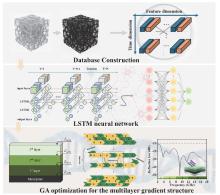
Fig 1
Conceptual schematic of the sequence-aware inverse design framework, illustrating the workflow from impregnation experiments to the final optimal gradient structure."
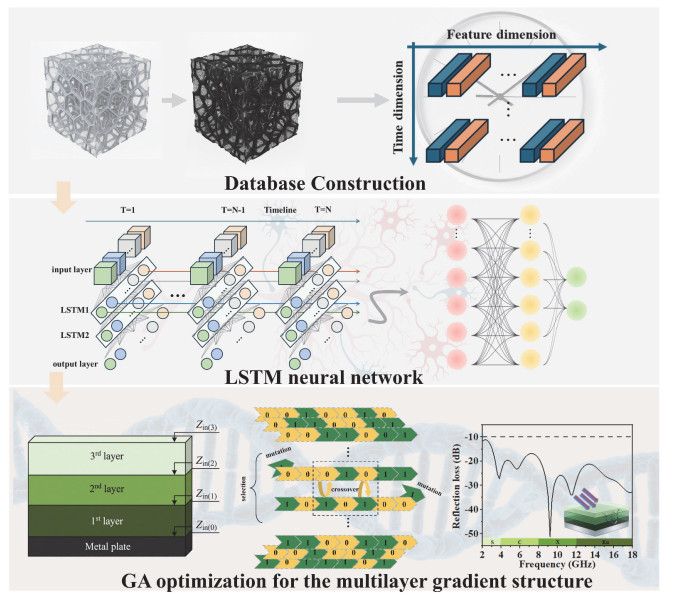
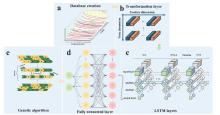
Fig 2
Detailed computational architecture of the hybrid methodology. (a) Structure of the process-property database. (b–d) Internal architecture of the LSTM surrogate model. (e) Workflow of the Genetic Algorithm operators."
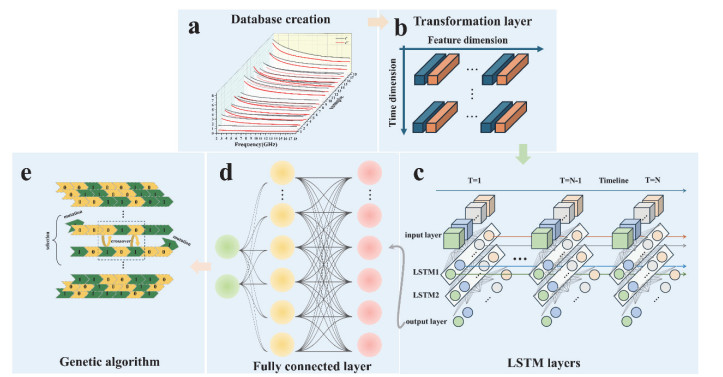
Fig 3
SEM images of (a1‒c1) pure PU foam, (a2‒c2) PU@CNT1, (a3‒c3) PU@CNT22, and (a4‒c4) PU@CNT333. (d) Schematic diagram of CNT coating. (e) EDS elemental analysis."
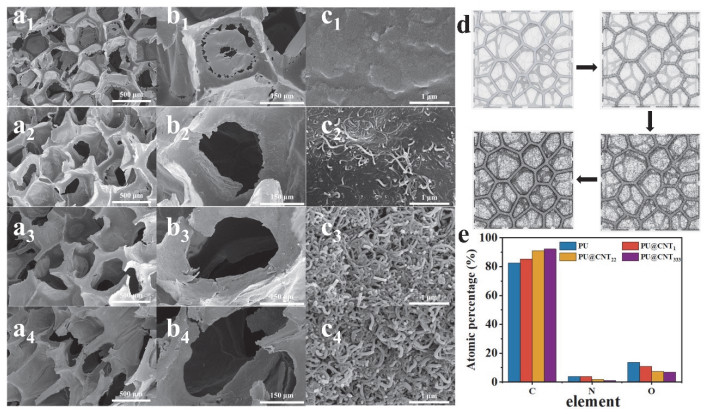
Fig 4
(a) XRD patterns and (b) Raman spectra of the pure PU foam and PU/CNT composites with different impregnation histories (PU@CNT1, PU@CNT22, and PU@CNT333). (c) FTIR spectrum of the pure PU foam skeleton."
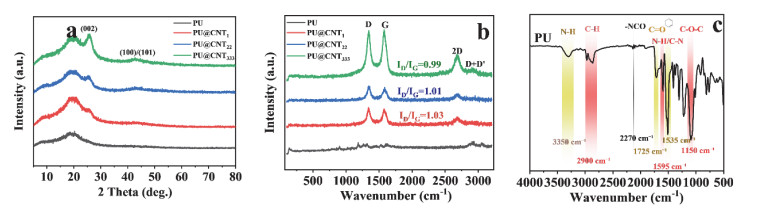
Fig 5
3D waterfall plots of the (a) real part (ε′) and imaginary part (ε′′) of complex permittivity, (b) dielectric loss tangent (tanδε), and (c) RL for the 18 training dataset samples across the 2–18 GHz frequency range."
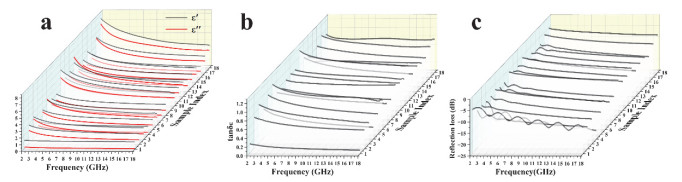
Fig 6
Performance evaluation of the LSTM surrogate model. Regression plots of predicted vs. experimental values for (a) real permittivity (ε′) and (b) imaginary permittivity (ε′′). Comparison of R2 and RMSE metrics for the training and test sets for (c) ε′ and (d) ε′′."
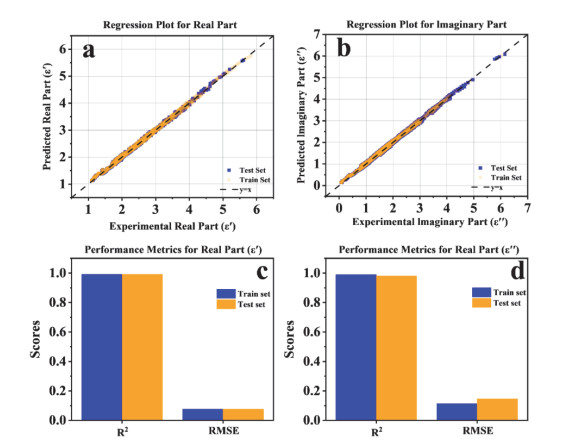
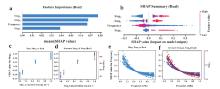
Fig 7
SHAP interpretability analysis for the real part of permittivity (ε′). (a) Feature importance bar chart. (b) SHAP bee swarm plot. (c) Dependence plot for Step2 concentration. (d) Interaction dependence plot for Step2 vs. Frequency. (e) Dependence plot for Frequency. (f) Interaction dependence plot for Frequency vs. Step2."
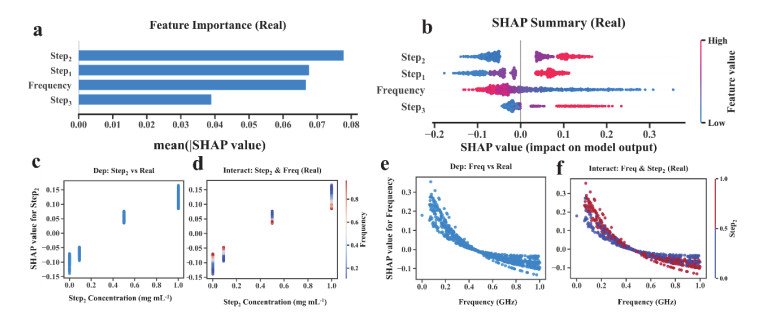
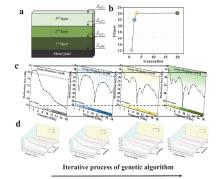
Fig 8
Evolutionary optimization process. (a) Schematic of the three-layer gradient absorbing structure model. (b) Fitness evolution curve over 20 generations. (c) RL curves and (d) 3D permittivity waterfall plots for the best individuals from the 1st, 2nd, 3rd, and 20th generations."
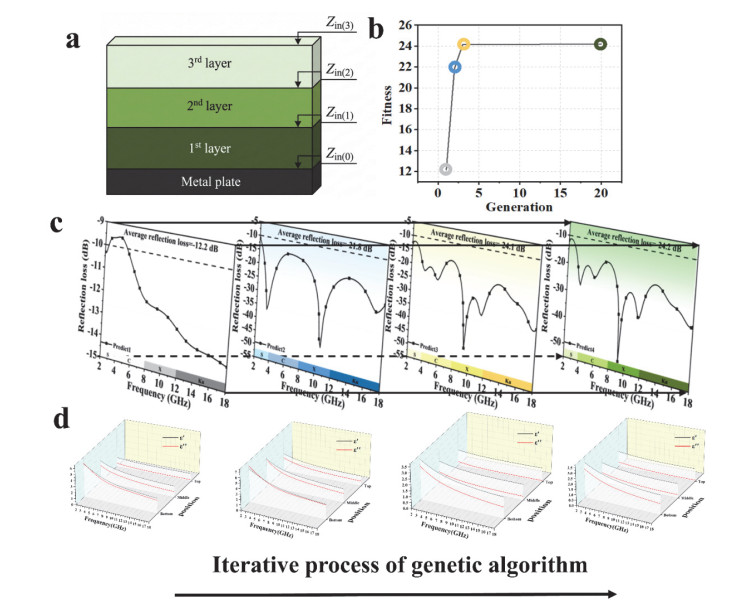
Fig 9
Experimental validation and loss mechanism. (a) Complex permittivity distribution of the optimized three-layer gradient foam. (b) Photograph of the MA measurement setup using the arch method. (c) Comparison between the experimentally measured and LSTM-predicted RL curves. (d) Simulated power loss density distributions inside the gradient foam at 4, 10, and 16 GHz under TE and TM polarizations."
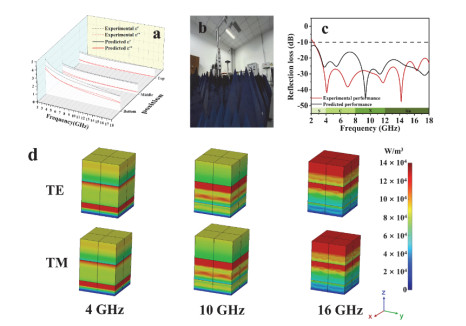
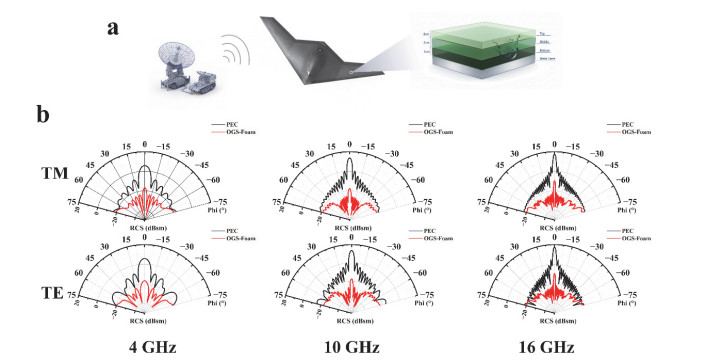
Fig 10
Radar Cross Section (RCS) reduction performance. (a) Schematic illustration of stealth application. (b) Monostatic RCS polar plots of PEC and OGS-Foam at 4, 10, and 16 GHz under TM and TE polarizations."
| 1 |
H. Yan, S. Xuan, X. Fan, Y. Shan, X. Xu, X. Yao. Compos. Sci. Technol. 2024, 248, 110471.
doi: 10.1016/j.compscitech.2024.110471 |
| 2 |
Z. Liu, R. Zhang, S. Wang, W. Zhao, G. Yu, L. Wu. Compos. Sci. Technol. 2023, 240, 110094.
doi: 10.1016/j.compscitech.2023.110094 |
| 3 |
X. Du, F. Yan, M. Cheng, H. Li, C. Peng, Y. Liu, D. Liu, D. Lan, G. Wu, Z. Jia. Int. J. Miner. Metall. Mater. 2025,
doi: 10.1007/s12613-025-3317-1 |
| 4 |
Z. Zhao, Y. Qing, L. Kong, H. Xu, X. Fan, J. Yun, et al.. Adv. Mater. 2024, 36(4), e2304182.
doi: 10.1002/adma.202304182 |
| 5 |
G. Qin, Y. Liu, Y. Yan, Z. Cheng, G. Ma, K. Zhang, X. Huang. Compos. Part B Eng. 2025, 298, 112397.
doi: 10.1016/j.compositesb.2025.112397 |
| 6 |
X. Wang, Y. Yuan, L. Wang, X. Sun, T. Zhang, C. Liu, Y. Li. J. Adv. Ceram. 2025, 14, 112298.
doi: 10.26599/JAC.2025.9221172 |
| 7 |
T. Zhang, J. Qiu, S. Wang, Y. Juan, J. Li, W. Wang. Adv. Funct. Mater. 2025, 35, 2414601.
doi: 10.1002/adfm.202521010 |
| 8 |
G. Qin, Y. Liu, Y. Yan, G. Ma, B. Gao, Z. Cheng, T. Chen. Adv. Funct. Mater. 2025, 35, e19796.
doi: 10.1002/adfm.202519796 |
| 9 |
K. Zhang, Y. Liu, X. Li, X. Wang, J. Liu, X. Liu. Adv. Mater. 2025, 37(35), 2506386.
doi: 10.1002/adma.202506386 |
| 10 |
R. Guo, S. Li, J. Li, L. Wang, W. Jiang. Adv. Colloid Interface Sci. 2025, 344, 103612.
doi: 10.1016/j.cis.2025.103612 |
| 11 |
Q. Jiang, Y. Qiao, C. Xiang, A. Uddin, L. Wu, F. Qin. Adv. Compos. Hybrid Mater. 2022, 5(4), 3190.
doi: 10.1007/s42114-021-00394-y |
| 12 |
Y. Liu, J. Zhou, C. Li, H. Zhang, Y. Wang, Y. Yan, et al.. Nat. Commun. 2025, 16(1), 202.
doi: 10.1038/s41467-024-55776-9 |
| 13 |
C. Li, L. Liang, B. Zhang, Y. Yang, G. Ji. Nano-Micro Lett. 2024, 17(1), 40.
doi: 10.1007/s40820-024-01549-4 |
| 14 |
Z. Liu, B. Wang, S. Wei, W. Huang, Y. Wang, Y. Liang, L. Guo, X. Wang, R. Shi, W. Fu, et al. . Nano Mater. Sci. 2025,
doi: 10.1016/j.nanoms.2025.09.001 |
| 15 |
Y. Ai, R. Xing, N. Ren, R. Huang, M. Cui, R. Su, J. Kong. Matter 2025, 8(9), 102289.
doi: 10.1016/j.matt.2025.102289 |
| 16 |
J. Zhou, X. Huang, D. Lan, Z. Jia, G. Wu. Carbon 2026, 248, 121143.
doi: 10.1016/j.carbon.2025.121143 |
| 17 |
M. Zhang, T. Shang, Y. Wang, Y. Song. Chem. Eng. J. 2025, 523, 168856.
doi: 10.1016/j.cej.2025.168856 |
| 18 |
X. Luo, H. Xie, Y. Ma, D. Lan, G. Wu, Z. Jia. Int. J. Miner. Metall. Mater. 2025,
doi: 10.1007/s12613-025-3252-1 |
| 19 |
H. Wu, X. Ren, W. Hu, Y. Tang, H. Yin, H. Fan, H. Yuan, C. Wang, Y. Xin. Carbon 2025, 233, 119883.
doi: 10.1016/j.carbon.2024.119883 |
| 20 |
X. Zuo, C. Zhou, T. Yuan, N. Wen, C. Sun, H. Zhang, Y. Zhang, J. Tian, C. Li, Z. Fan, et al.. Chem. Eng. J. 2024, 494, 152866.
doi: 10.1016/j.cej.2024.152866 |
| 21 |
M. Han, Z. Jia, D. Lan, Z. Gao, G. Wu. Chin. J. Chem. 2026,
doi: 10.1002/cjoc.70494 |
| 22 |
Y. Huang, Q. Fan, J. Chen, L. Li, M. Chen, L. Tang, D. Fang. Compos. Sci. Technol. 2020, 191, 108066.
doi: 10.1016/j.compscitech.2020.108066 |
| 23 |
X. Ma, Y. Duan, L. Huang, H. Lei, X. Yang. Compos. Part B Eng. 2022, 233, 109659.
doi: 10.1016/j.compositesb.2022.109659 |
| 24 |
X. Li, J. Liu, Z. Jia, D. Lan, D. Ai, Z. Gao, F. Bai, G. Wu. J. Mater. Sci. Technol. 2026, 268, 41.
doi: 10.1016/j.jmst.2025.12.046 |
| 25 |
R. Fan, D. Li, W. Liao, T. Liu, X. Li, T. Tang, et al.. Compos. Part B Eng. 2024, 287, 111880.
doi: 10.1016/j.compositesb.2024.111880 |
| 26 |
L. Liang, Y. Lin, Y. Huang, M. Chen. Compos. Part A Appl. Sci. Manuf. 2022, 160, 107069.
doi: 10.1016/j.compositesa.2022.107069 |
| 27 |
Y. Lin, X. Yang, Y. Huang, M. Chen. Compos. Struct. 2021, 272, 114235.
doi: 10.1016/j.compstruct.2021.114235 |
| 28 |
Y. Huang, X. Yuan, Y. Yuan, J. Liu, X. Fan, L. Zhao, Z. Cheng, X. Li, G. Wu. Carbon 2019, 144, 449.
doi: 10.1016/j.carbon.2018.11.052 |
| 29 |
Y. Huang, D. Wu, M. Chen, K. Zhang, D. Fang. Carbon 2021, 177, 79.
doi: 10.1016/j.carbon.2021.02.066 |
| 30 |
X. Ren, Z. Jia, Z. Gao, S. Zhang, Y. Zhang, D. Lan, G. Wu. Adv. Funct. Mater. 2026, 36, e24264.
doi: 10.1002/adfm.202524264 |
| 31 |
Q. An, D. Li, W. Liao, T. Liu, D. Joralmon, X. Li, J. Zhao. Adv. Mater. 2023, 35, e2300659.
doi: 10.1002/adma.202300659 |
| 32 |
W. Jiang, S. Xu, C. Lv, D. Lan, S. Zhang, Z. Gao, Z. Jia, G. Wu. Carbon 2025, 245, 120784.
doi: 10.1016/j.carbon.2025.120784 |
| 33 |
D. Li, X. Zheng, H. Gu, X. Xuan, B. Liu, H. Feng, M. Chen. Nano Mater. Sci. 2024, 6(4), 456.
doi: 10.1016/j.nanoms.2023.09.005 |
| 34 |
M. Shi, Z. Jia, D. Lan, Z. Gao, S. Zhang, G. Wu. Adv. Funct. Mater. 2026, 36, e28665.
doi: 10.1002/adfm.202528665 |
| 35 |
J. Yang, Y. Guo, X. Li, Y. Qiu, X. Wang, J. Zhou, B. Li, L. Zhang, Y. Bian, X. Xiao, et al.. Adv. Mater. 2026, 38(6), e17422.
doi: 10.1002/adma.202517422 |
| 36 |
J. Liang, F. Ye, Q. Song, Y. Cao, C. Xiao, Y. Qin, Y. Lin, B. Huang, X. Wang, C. Li. Compos. Part B Eng. 2025, 297, 112298.
doi: 10.1016/j.compositesb.2025.112298 |
| 37 |
M. Feng, K. Zhang, J. Xiao, B. Liu, H. Cheng, Y. Li, Z. Zhao, B. Liang. Compos. Part B Eng. 2023, 263, 110862.
doi: 10.1016/j.compositesb.2023.110862 |
| 38 |
Y. Huang, D. Wu, K. Zhang, H. Yang, W. Dong, M. Chen, D. Fang. Compos. Sci. Technol. 2021, 213, 108898.
doi: 10.1016/j.compscitech.2021.108898 |
| 39 |
C. Wang, Z. Lv, M. P. Mohan, Z. Cui, Z. Liu, Y. Jiang, J. Li, C. Wang, S. Pan, M. F. Karim, et al.. Adv. Mater. 2021, 33(41), e2102131.
doi: 10.1002/adma.202102131 |
| 40 |
L. Liang, X. Yang, C. Li, R. Yu, B. Zhang, Y. Yang, G. Ji. Adv. Mater. 2024, 36(24), e2313939.
doi: 10.1002/adma.202313939 |
| 41 |
N. Yang, H. Gao, S. Ju, Z. Zhang, Y. Zhao, X.-W. Guo, S. Xing, J. Liu, J. Zhang, K. Duan, et al.. Compos. Part B Eng. 2025, 307, 112882.
doi: 10.1016/j.compositesb.2025.112882 |
| 42 |
R. Zhang, Y. Yuan, X. Wang, X. Sun, S. Wang, Z. Yang, Y. Ma, E. Zhang, Y. Li. Chem. Eng. J. 2025, 511, 161634.
doi: 10.1016/j.cej.2025.161634 |
| 43 |
T. Zou, J. Shi, M. Wang, C. Lin. Adv. Funct. Mater. 2025, e12788.
doi: 10.1002/adfm.202512788 |
| 44 |
Y. Pan, K. Yu, D. Lan, Z. Zhang, Z. Chen. Carbon 2025, 245, 120824.
doi: 10.1016/j.carbon.2025.120824 |
| 45 |
S. Song, B. Zheng, L. Chen, H. Shu, D. Gao, D. Lan, T. Li, X. Liu, Y. Ma. J. Energy Storage 2025, 134, 118282.
doi: 10.1016/j.est.2025.118282 |
| 46 |
B. Zeng, F. Zhang, K. Zhao, M. Ahmad, J. Wu, L. Zhang, D. Lan, B. Zhang. J. Mater. Sci. Technol. 2026, 251, 193.
doi: 10.1016/j.jmst.2025.07.008 |
| 47 |
B. Zhou, L. Tang, H. Cheng, M. Ahmad, J. Wu, L. Zhang, D. Lan, B. Zhang. Nano Res. 2025, 18(9), 94907739.
doi: 10.26599/NR.2025.94907739 |
| 48 |
S. Xiong, L. Cai, Y. Zhang, Y. Ma, D. Lan, G. Chen, C. Dong, H. Guan. Rare Met. 2025, 44, 7720.
doi: 10.1007/s12598-025-03439-z |
| 49 |
X. Meng, J. Li, S. Zhang, D. Lan, M. Yu, T. Long, C. Wang. Adv. Fiber Mater. 2024, 7(3), 736.
doi: 10.1007/s42765-024-00501-w |
| [1] | Gengsu Zhu, Yuanyuan Ma, Chengzhi Sun, Mengting Li, Chunyu Wang, Bo Zhong, Long Xia. Preparation and absorption properties of petal-clustered WS2/MnFe2/O4/GNs composite materials [J]. Acta Phys. -Chim. Sin., 2026, 42(9): 100273-. |
| [2] | Liangsen Zhu, Caiyun Cui, Tao Jing, Shihao Tan, Xianguo Liu, Menglin Yu. Strong and broadband microwave absorption under thin thickness induced by multiple dielectric relaxation and multiple magnetic resonances through the dual nanocrystalline phases in amorphous FeSiBCr flakes [J]. Acta Phys. -Chim. Sin., 2026, 42(9): 100331-. |
| [3] | Shihao Tan, Caiyun Cui, Shuwei Ma, Liangsen Zhu, Xianguo Liu. Introducing nanocrystalline/amorphous heterostructures on laminated FeSiBCr to synchronously enhance absorption, expand absorption bandwidth and reduce matching thickness [J]. Acta Phys. -Chim. Sin., 2026, 42(7): 100283-. |
| [4] | Yanan Liu, Xiaogang Su, Di Lan, Jiangyong Liu, Weihai Ma, Yaqing Liu. Bimetallic MOF-derived CoZn-C/MWCNTs composite for lightweight and wideband microwave absorption [J]. Acta Phys. -Chim. Sin., 2026, 42(6): 100276-. |
| [5] | Bo Liang, Yuyijian Zhao, Siyu Wang, Shihan Huang, Fangke Zhou, Chuankun Zhang, Yue Wang, Xiaoming Guo. Synergistic molecular assembly and impedance matching in polyimide-derived porous carbon nanosheets for advanced microwave absorption [J]. Acta Phys. -Chim. Sin., 2026, 42(6): 100285-. |
| [6] | Guo-Min LI,Bao-Shun ZHU,Li-Ping LIANG,Yu-Ming TIAN,Bao-Liang LÜ,Lian-Cheng WANG. Core-Shell Co3Fe7@C Composite as Efficient Microwave Absorbent [J]. Acta Phys. -Chim. Sin., 2017, 33(8): 1715-1720. |
| [7] | Hui-Chang NIU,Dan JI,Nai-An LIU. Method for Optimizing the Kinetic Parameters for the Thermal Degradation of Forest Fuels Based on a Hybrid Genetic Algorithm [J]. Acta Phys. -Chim. Sin., 2016, 32(9): 2223-2231. |
| [8] | HUANG Jun, REN Qing-Bo, XU Gang, LIU Xun, MENG Da-Qiao. Numerical Optimization of Redistribution of Solute in Plutonium Metal during Zone Refining [J]. Acta Phys. -Chim. Sin., 2015, 31(Suppl): 69-74. |
| [9] | CONG Yong, XUE Ying. Quantitative Structure-Activity Relationship Study of the Non-Nucleoside Inhibitors of HCV NS5B Polymerase by Machine Learning Methods [J]. Acta Phys. -Chim. Sin., 2013, 29(08): 1639-1647. |
| [10] | XIA Juan, SONG Le-Xin, DANG Zheng, SHAO Zhi-Cheng. Polyethylene Glycol/Fe3O4 Nanoparticle Composite Materials: Structure, Physical Properties and Application [J]. Acta Phys. -Chim. Sin., 2013, 29(07): 1524-1533. |
| [11] | LI Song-Mei, WANG Bo, LIU Jian-Hua, YU Mei, AN Jun-Wei. Synthesis and Microwave Absorption Properties of Nickel Nanoparticles-Graphene Composites with Different Morphologies [J]. Acta Phys. -Chim. Sin., 2012, 28(11): 2754-2760. |
| [12] | ZHANG Xiao-Yi, LIU Bin, HE Hong-Qiu, YANG Dong, WANG Cun-Xin. Human Immunodeficiency Virus Integrase Pharmacophore Model Derived from Diketoacids Inhibitors [J]. Acta Phys. -Chim. Sin., 2009, 25(05): 817-824. |
| [13] | YAN Chao-Qun, WAN Hui, GUAN Guo-Feng. Prediction of Melting Points for 1,3-Disubstituent Imidazolium Ionic Liquids [J]. Acta Phys. -Chim. Sin., 2008, 24(12): 2198-2202. |
| [14] | SONG Yan; CHEN Hong-shan; ZHANG Cai-rong; WANG Guang-hou. Structures and Bonding Properties of (BN)n (n ≤ 12) Clusters [J]. Acta Phys. -Chim. Sin., 2005, 21(07): 735-739. |
| [15] | HUANG Qin; HOU Ting -Jun; XU Xiao-Jie. The Prediction of Caco-2 Permeation Based on Genetic Algorithm [J]. Acta Phys. -Chim. Sin., 2005, 21(04): 372-377. |
|
||