Acta Phys. -Chim. Sin. ›› 2026, Vol. 42 ›› Issue (9): 100331.doi: 10.1016/j.actphy.2026.100331
• ARTICLE • Previous Articles Next Articles
Strong and broadband microwave absorption under thin thickness induced by multiple dielectric relaxation and multiple magnetic resonances through the dual nanocrystalline phases in amorphous FeSiBCr flakes
Liangsen Zhu1, Caiyun Cui2, Tao Jing1, Shihao Tan1, Xianguo Liu1,*( ), Menglin Yu3,*()
- 1 Institute of Advanced Magnetic Materials, College of Materials and Environmental Engineering, Hangzhou Dianzi University, Hangzhou 310012, Zhejiang Province, China
2 School of New Energy, Wanjiang University of Technology, Ma'anshan 243031, Anhui Province, China
3 College of Mechanical Engineering, Hangzhou Dianzi University, Hangzhou 310018, Zhejiang Province, China
-
Received:2026-03-24Revised:2026-05-21Accepted:2026-05-25Published:2026-07-03 -
Contact:Email: liuxg@hdu.edu.cn (Xianguo Liu)menglinyu@hdu.edu.cn (Menglin Yu)

Cite this article
Liangsen Zhu, Caiyun Cui, Tao Jing, Shihao Tan, Xianguo Liu, Menglin Yu. Strong and broadband microwave absorption under thin thickness induced by multiple dielectric relaxation and multiple magnetic resonances through the dual nanocrystalline phases in amorphous FeSiBCr flakes[J]. Acta Phys. -Chim. Sin. 2026, 42(9), 100331. doi: 10.1016/j.actphy.2026.100331
share this article
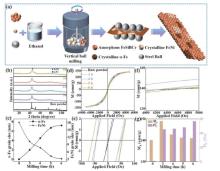
Fig 1
(a) Schematic illustration for fabrication of amorphous FeSiBCr flakes with dual nanophases. (b) XRD patterns and (d) magnetic hysteresis loops, (e) the magnified loops under low field and (f) the corresponding magnifications under high field of raw powder and milled powders. (c) Calculated α-Fe and FeNi grain size with different milling time. (g) Summarized MS and HC values of raw powder and milled powders."
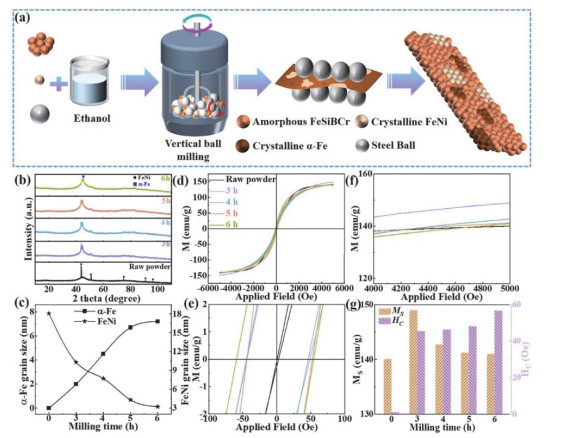
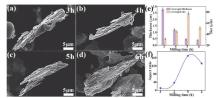
Fig 2
The morphology of powders with milling time of (a) 3 h, (b) 4 h, (c) 5 h and (d) 6 h. (e) the average thickness and size based on statistical data of over 100 particles. (f) the calculated aspect ratio."
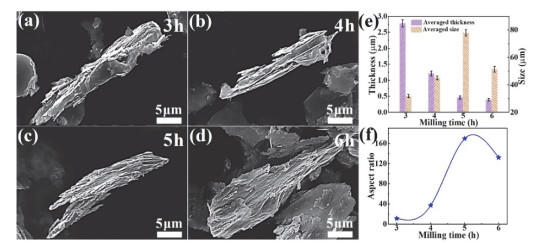
Fig 3
(a) TEM image of powder with 5 h milling. (b) Enlarged view of the red dashed box in (a). (c) the corresponding HAADF image of (b) with the elemental distribution maps. HRTEM images of (d) the surface, (e) FeNi phase and (f) α-Fe nanocrystalline. The insets correspond to the magnified views of the red dashed circles in (e) and (f), respectively."
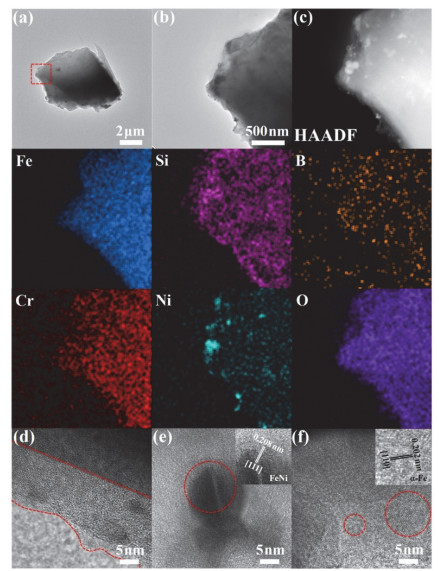
Fig 4
(a) Full spectrum, (b) detailed O 1s spectra, (c) detailed Fe 2p spectra, (d) high-resolution Si 2p spectra, (e) the fitted Cr 2p and (f) high-resolution Ni 2p of powder with ball milling time of 5 h. (g) structural diagram of amorphous FeSiBCr flakes with dual nanophases."
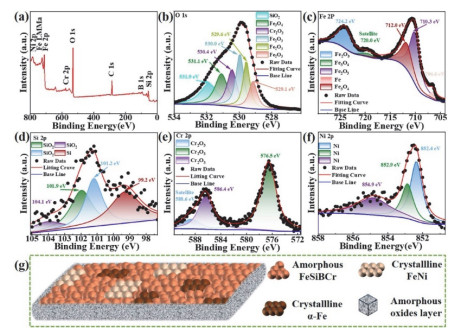
Fig 5
(a) ɛ′, (b) ɛ′′, (c) tanδE and (d) ɛ′ versus ɛ′′ curves of powders with different milling time. (e) dielectric loss mechanism."
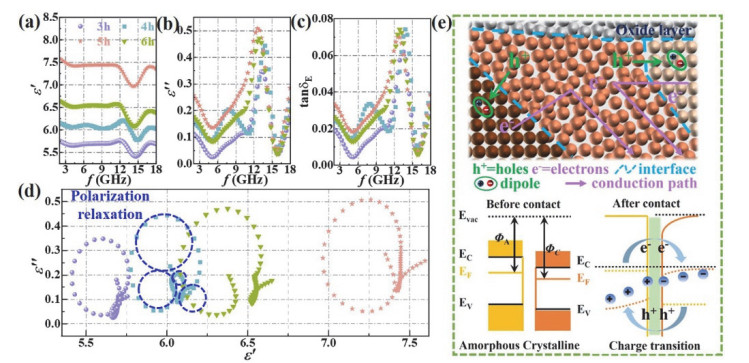
Fig 6
(a) μ′, (b) μ′′, (c) tanδM, (d) C0 and (e) μ′ versus μ′′ curves of powders with different milling time."
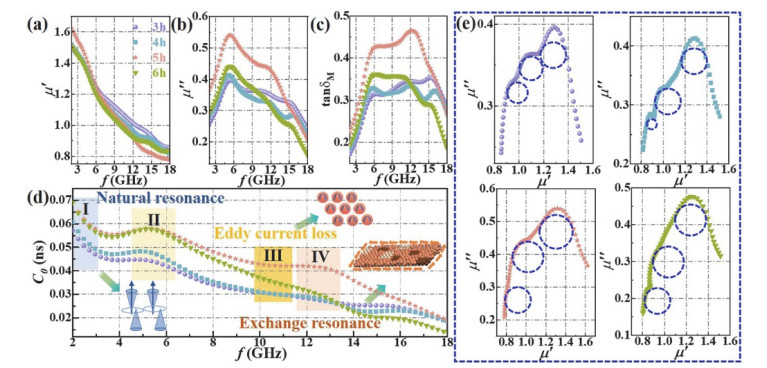
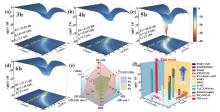
Fig 7
(a–d) 3D images of RL vs. f vs, t for powders with different milling time. (e) A comparison of six parameters is conducted for powders with different milling time. (f) Microwave absorption performances of 5 h milled powder are compared with the reported flaky materials [48–57]."
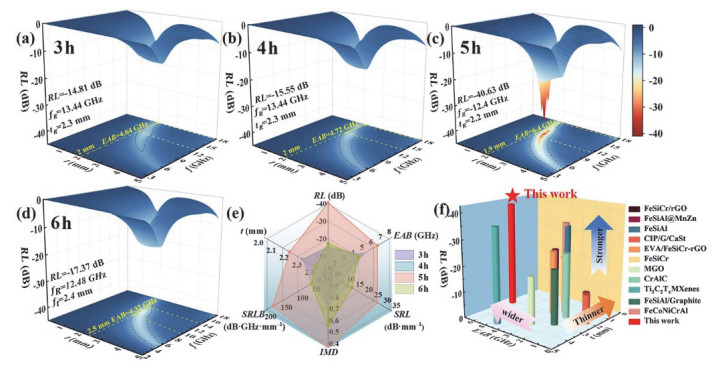
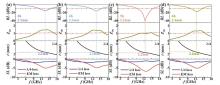
Fig 8
RL, λ/4, Zim and the corresponding loss separation results of RLm curves of powders with milling time of (a) 3 h, (b) 4 h, (c) 5 h and (d) 6 h."
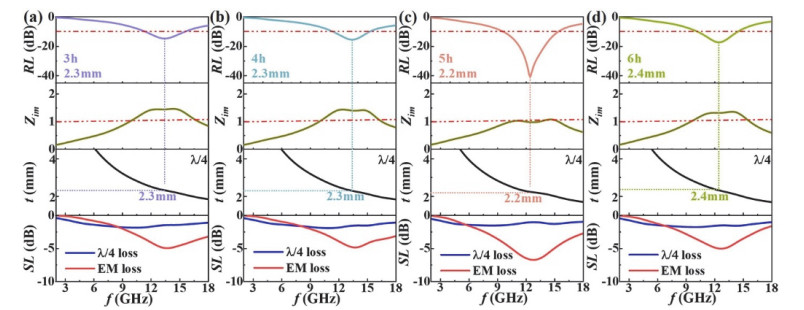
Fig 9
Schematic illustration of possible EM loss mechanism of amorphous FeSiBCr flakes with dual crystalline nanophases."
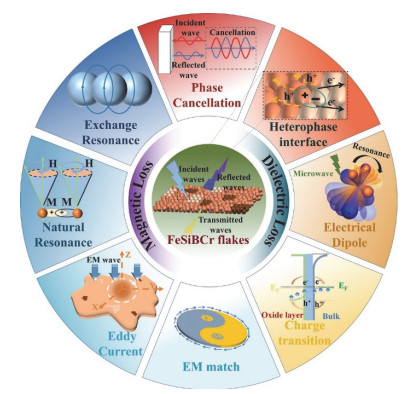
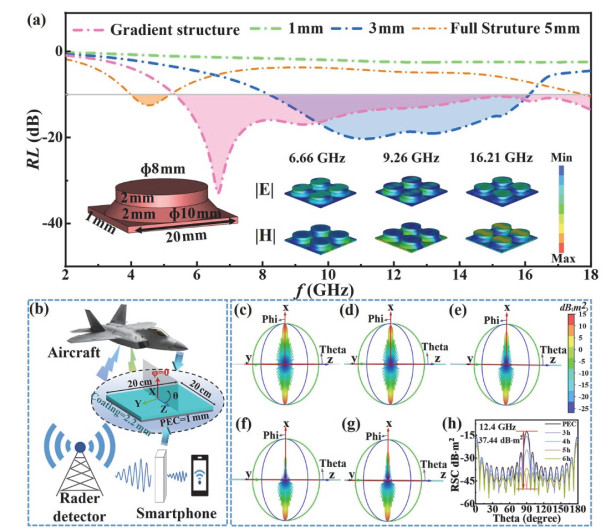
Fig 10
(a) a gradient structure for extending EAB. (b) Working principle of radar detector and absorption coating and RCS simulation model with setting dimensions. 3D radar wave scattering plots for (c) PEC and PEC/powder with milling time of (d) 3 h, (e) 4 h, (f) 5 h, (g) 6 h. (h) RCS simulation curves of PEC and PEC with milled powder coating at different angles."
| 1 |
X.B. Shang, H. Fang, L.Y. Lu, Z. Zhang, P. Ma. Reliab. Eng. Syst. Safe 2026, 270, 112132.
doi: 10.1016/j.ress.2025.112132 |
| 2 |
X.G. Liu, Y.H. Wan, S.M. Tao, P. Cao, Y.L. Liu, F. Zhou. Carbon 2025, 244, 120688.
doi: 10.1016/j.carbon.2025.120688 |
| 3 |
F.Y. Lv, Y.Q. Wang, Q.C. He, D. Lan, G.L. Wu. Adv. Funct. Mater. 2026, e75416.
doi: 10.1002/adfm.75416 |
| 4 |
T.G. Lee, J.B. Kim, T.H. Noh. J. Magn. 2009, 14, 155.
doi: 10.4283/JMAG.2009.14.4.155 |
| 5 |
Y. Yu, C.Y. Wang, W. Wang, K.Q. Lu, Z.F. Chen, D.P. Zhao, B.F. Ju, S.C. Zhou. Compos. Part A-Appl. S. 2026, 207, 109827.
doi: 10.1016/j.compositesa.2026.109827 |
| 6 |
Y.X. Li, Y.J. Liao, L.Z. Ji, C.L. Hu, Z.H. Zhang, Z.Y. Zhang, R.Z. Zhao, H.W. Rong, G.W. Qin, X.F. Zhang. Small 2021, 18, 2107265.
doi: 10.1002/smll.202107265 |
| 7 |
S. Xu, Z.R. Jia, D. Lan, M.J. Shi, Z.G. Gao, G.L. Wu. Adv. Funct. Mater. 2026, e75567.
doi: 10.1002/adfm.75567 |
| 8 |
N.L. Shi, H.J. Xu, C. Chen, Y. Wu, B. Yang, T. Zhang. J. Alloy. Compd. 2019, 797, 39.
doi: 10.1016/j.jallcom.2019.05.061 |
| 9 |
C.H. Wang, H.X. Xu, R.Q. Zhu, H.Y. Ding, B. Li, X.F. Wang, C.H. Yang, Y. Lu. IEEE Trans. Antennas Propag. 2026, 74, 4915.
doi: 10.1109/TAP.2026.3661559 |
| 10 |
C.X. Zhang, Y.H. Li, Y.P. Duan, W. Zhang. J. Magn. Magn. Mater. 2020, 497, 165988.
doi: 10.1016/j.jmmm.2019.165988 |
| 11 |
M.G. Han, H.P. Lu, L.J. Deng. Appl. Phys. Lett. 2010, 97, 192507.
doi: 10.1063/1.3514557 |
| 12 |
R.C. Shi, P.X. Fu, Y.Y. Zhang, Z.H. Huang, J.T. Qi, S.X. Liang, P.J. Tao, Y.Z. Yang. J. Mater. Sci.-Mater. Electron. 2024, 35, 1545.
doi: 10.1007/s10854-024-13253-5 |
| 13 |
Y.H. Wu, M.G. Han, T. Liu, L.J. Deng. J. Appl. Phys. 2015, 118, 023902.
doi: 10.1063/1.4926553 |
| 14 |
C. Ding, Y. Cheng, X.L. Li, C.X. Peng, L. Wang. J. Electron. Mater. 2018, 47, 5981.
doi: 10.1007/s11664-018-6447-7 |
| 15 |
H. Guo, Z.T. Dong, Y.Y. Yang, L. Sui, W.J. Wang, C. Liang, T. Xiong, Y.R. Chen, M. Yan, X.J. Wen, et al.. Appl. Surf. Sci. 2025, 682, 161739.
doi: 10.1016/j.apsusc.2024.161739 |
| 16 |
C.X. Zhang, Y.H. Li, Y.P. Duan, W. Zhang. J. Magn. Magn. Mater. 2020, 497, 165988.
doi: 10.1016/j.jmmm.2019.165988 |
| 17 |
C.X. Wang, S. Xu, X.L. Su, Y. Liu. Compos. Commun. 2026, 64, 102775.
doi: 10.1016/j.coco.2026.102775 |
| 18 |
R.Q. Wang, Y. He, C.H. Tang, X.H. Wu, Q.X. Zhuang, X.Y. Liu, X. Liu, P.Y. Zuo. Carbon 2024, 229, 119494.
doi: 10.1016/j.carbon.2024.119494 |
| 19 |
X.F. Zhang, J.J. Guo, P.F. Guan, G.W. Qin, S.J. Pennycook. Phys. Rev. Lett. 2015, 115, 147601.
doi: 10.1103/PhysRevLett.115.147601 |
| 20 |
J.H. He, W. Wang, A.M. Wang, J.G. Guan. J. Magn. Magn. Mater. 2012, 324, 2902.
doi: 10.1016/j.jmmm.2012.04.036 |
| 21 |
S.W. Ma, T. Jing, Y.H. Wan, F.Y. Shen, X.G. Liu. Appl. Surf. Sci. 2025, 694, 162849.
doi: 10.1016/j.apsusc.2025.162849 |
| 22 |
T. Jing, S.W. Ma, Y.H. Wan, X.G. Liu, M.L. Yu. J. Alloy. Compd. 2025, 1034, 181442.
doi: 10.1016/j.jallcom.2025.181442 |
| 23 |
T. Jing, S.W. Ma, H.Y. Yao, X.G. Liu. J. Alloy. Compd. 2025, 1047, 184496.
doi: 10.1016/j.jallcom.2025.184496 |
| 24 |
S.H. Tan, C.Y. Cui, S.W. Ma, L.S. Zhu, X.G. Liu. Acta Phys.-Chim. Sin. 2026, 42, 100283.
doi: 10.1016/j.actphy.2026.100283 |
| 25 |
Y.H. Wan, F.Y. Shen, Y.P. Sun, X.G. Liu. J. Alloy. Compd. 2024, 1001, 175162.
doi: 10.1016/j.jallcom.2024.175162 |
| 26 |
Q.C. Jia, W.C. Li, Q.X. Zeng, X.J. Qiao. J. Mater. Sci-Mater. Electron. 2022, 33, 14043.
doi: 10.1007/s10854-022-08335-1 |
| 27 |
B.Z. Cui, A.M. Gabay, W.F. Li, M. Marinescu, J.F. Liu, G.C. Hadjipanayis. J. Appl. Phys. 2010, 107, 09A721.
doi: 10.1063/1.3339775 |
| 28 |
Y.H. Wan, T. Jing, S.W. Ma, F.Y. Shen, X.G. Liu. Appl. Surf. Sci. 2025, 687, 1623303.
doi: 10.1016/j.apsusc.2025.162303 |
| 29 |
B. Zhao, Z.Y. Bai, H.L. Lv, Z.K. Yan, Y.Q. Du, X.Q. Guo, J.C. Zhang, L.M. Wu, J.S. Deng, D.W. Zhang, R.C. Che. Nano-Micro Lett. 2023, 15, 79.
doi: 10.1007/s40820-023-01043-3 |
| 30 |
X.W. Yi, Q.B. Li, Y.D. Peng, Y.F. Zhao, S.Z. Zhu. J. Supercond. Nov. Magn. 2021, 34, 2957.
doi: 10.1007/s10948-021-05977-w |
| 31 |
F. Rueda, J. Mendiadua, A. Rodriguez, R. Casanova, Y. Barbaux. J. Electron. Spectrosc. Relat. Phenom. 1996, 82, 135.
doi: 10.1016/S0368-2048(96)03035-6 |
| 32 |
D.Y. Geng, W.Y. Park, J.C. Kim, J.H. Yu, C.J. Choi, Z.D. Zhang. J. Mater. Res. 2005, 20, 2534.
doi: 10.1557/jmr.2005.0304 |
| 33 |
W. Liu, L. Liu, G.B. Ji, D.R. Li, Y.N. Zhang, J.N. Ma, Y.W. Du. ACS Sustain. Chem. Eng. 2017, 5, 7961.
doi: 10.1021/acssuschemeng.7b01514 |
| 34 |
Y.H. Li, C.L. Shi, W. Zhang. Compos. Part A-Appl. S. 2023, 164, 107295.
doi: 10.1016/j.compositesa.2022.107295 |
| 35 |
Y.G. Han, F. Chen, Q. Fu. J. Mater. Chem. A 2024, 12, 25322.
doi: 10.1039/D4TA04820B |
| 36 |
P. Kaspar, D. Sobola, R. Dallaev, S. Ramazanov, A. Nebojsa, S. Rezaee, L. Grmela. Appl. Surf. Sci. 2019, 493, 673.
doi: 10.1016/j.apsusc.2019.07.058 |
| 37 |
T. Hagio, A. Takase, S. Umebayashi. J. Mater. Sci. Lett. 1992, 11, 878.
doi: 10.1007/BF00730493 |
| 38 |
I. Montero, L. Gal´an, E. de la Cal, J.M. Albella, J.C. Pivin. Thin Solid Films. 1990, 193, 325.
doi: 10.1016/S0040-6090(05)80042-2 |
| 39 |
E. Paparazzo. J. Electron Spectrosc. Relat. Phenom. 1987, 43. 97.
doi: 10.1016/0368-2048(87)80022-1 |
| 40 |
Dubé. C. E, Workie. B, Kounaves. S. P, Robbat. A, Aksub. M. L, Davies. G, J. Electrochem. Soc. 142 (1995) 3357, https://iopscience.iop.org/article/10.1149/1.2049987.
|
| 41 |
A. Roustila, C. Severac, J. Chêne, A. Percheron-Guégan. Surface Science 1994, 311, 33.
doi: 10.1016/0039-6028(94)90478-2 |
| 42 |
J.S. Lee, J.W. Kim, J.H. Lee, Y.K. Son, Y.B. Kim, K. Woo, C. Lee, I.I.D. Kim, J.Y. Seok, J.W. Yu, J.H. Park, K.J. Lee. Nano-Micro Lett. 2023, 15, 191.
doi: 10.1007/s40820-023-01157-8 |
| 43 |
Z.H. Wang, Z. Han, D.Y. Geng, Z.D. Zhang. Chem. Phys. Lett. 2010, 489, 187.
doi: 10.1016/j.cplett.2010.02.056 |
| 44 |
X. Yan, X.X. Huang, B. Zhong, T. Wu, H.T. Wang, T. Zhang, N. Bai, G.P. Zhou, H. Pan, G.W. Wen, L. Xia. Chem. Eng. J. 2020, 391, 123538.
doi: 10.1016/j.cej.2019.123538 |
| 45 |
S.Z. Li, L. Ma, Z.X. Lei, A. Hua, A.Q. Zhang, Y.H. Song, F.C. Liu, D.Y. Geng, W. Liu, S. Ma, Z.D. Zhang. Carbon 2022, 186, 520.
doi: 10.1016/j.carbon.2021.10.055 |
| 46 |
H. Wang, Y.Y. Dai, W.J. Gong, D.Y. Geng, S. Ma, D. Li, W. Liu, Z.D. Zhang. Appl. Phys. Lett. 2013, 102, 223113.
doi: 10.1063/1.4809675 |
| 47 |
S.Q. Zheng, T. Jiang, X.Y. Wei, Q.Y. Cai, C. Chen, G. Fang, C.Y. Liu. J. Phys. Chem. C 2023, 127, 1704.
doi: 10.1021/acs.jpcc.2c08060 |
| 48 |
X. Chen, G. Xie, N. Zhang, J. Chen. J. Magn. Magn. Mater. 2024, 596, 171979.
doi: 10.1016/j.jmmm.2024.171979 |
| 49 |
H.Y. Yan, L. Zhong, J.L. Tang, J. Xue, L. Gu, T.D. Zhou. J. Mater. Sci.-Mater. Electron. 2021, 32, 18371.
doi: 10.1007/s10854-021-06380-w |
| 50 |
H.B. Xu, S.W. Bie, J.J. Jiang, W. Yuan, Q. Chen, Y.S. Xu. J. Magn. Magn. Mater. 2015, 395, 288.
doi: 10.1016/j.jmmm.2015.10.093 |
| 51 |
X.Y. Huang, G.Z. Xie, N.Y. Xie, J. Chen. J. Mater. Sci.-Mater. Electron. 2023, 34, 109.
doi: 10.1007/s10854-022-09611-w |
| 52 |
S. Xu, D. Li, W. Wang, L. Lin, Y. Sun, J. Li, L. Li. Polym. Degrad. Stab. 2024, 223, 110730.
doi: 10.1016/j.polymdegradstab.2024.110730 |
| 53 |
Z.Z. Wu, B. Huang, R.Y. Yang, J. Hou, Y. Xu, B.Q. Wang, T.X. Song, Q. Cai, T.D. Zhou, L. Zhong, J.L. Tang. J. Phys. Chem. Solids 2024, 193, 112209.
doi: 10.1016/j.jpcs.2024.112209 |
| 54 |
Y. Zheng, Z.J. Ma, X.Y. Weng, L. Cheng, Z.M. Li. J. Alloys Compd. 2025, 1037, 182603.
doi: 10.1016/j.jallcom.2025.182603 |
| 55 |
Y. Zhang, J. Wen, L. Zhang, H.P. Lu, Y. Guo, X.D. Ma, M. Zhang, J.H. Yin, L.L. Dai, X. Jian, L.J. Yin, J.L. Xie, D.F. Liang, L.J. Deng. J. Alloys Compd. 2021, 860, 157896.
doi: 10.1016/j.jallcom.2020.157896 |
| 56 |
B.B. Fan, N. Li, B.Z. Dai, S.Y. Shang, L. Guan, B. Zhao, X.H. Wang, Z.Y. Bai, R. Zhang. Adv. Powder Technol. 2020, 31, 808.
doi: 10.1016/j.apt.2019.11.035 |
| 57 |
J. Sun, H.L. Xu, Y. Shen, H. Bi, W.F. Liang, R.-B. Yang. J. Alloys Comp. 2013, 548, 18.
doi: 10.1016/j.jallcom.2012.08.114 |
| 58 |
P.P. Yang, Y. Liu, X.C. Zhao, J.W. Cheng, H. Li. Adv. Powder Technol. 2016, 27, 1128.
doi: 10.1016/j.apt.2016.03.023 |
| 59 |
Q. Song, F. Ye, L. Kong, Q.L. Shen, L.Y. Han, L. Feng, G.J. Yu, Y.A. Pan, H.J. Li. Adv. Funct. Mater. 2020, 30(31), 2000475.
doi: 10.1002/adfm.202000475 |
| 60 |
Y. Li, X.F. Liu, X.Y. Nie, W.W. Yang, Y.D. Wang, R.H. Yu, J.L. Shui. Adv. Funct. Mater. 2018, 29, 1807624.
doi: 10.1002/adfm.201807624 |
| 61 |
F. Qin, C. Brosseau. J. Appl. Phys. 2012, 111, 061301.
doi: 10.1063/1.3688435 |
| 62 |
M.J. Shi, Z.R. Jia, S. Xu, Z.G. Gao, G.L. Wu. Adv. Funct. Mater. 2026, 36, e74648.
doi: 10.1002/adfm.74648 |
| 63 |
B.L. Zeng, F.R. Zhang, K.H. Zhao, M. Ahmad, J.F. Wu, L. Zhang, D. Lan, B.L. Zhang. J. Mater. Sci. Technol. 2026, 251, 193.
doi: 10.1016/j.jmst.2025.07.008 |
| 64 |
Z.X. Wang, Z.G. Gao, Z.R. Jia, D. Lan, G.L. Wu. Carbon 2026, 255, 121535.
doi: 10.1016/j.carbon.2026.121535 |
| 65 |
Y.F. Zhang, L. Zhang, B.Q. Zhou, Y.S. Gao, B.L. Zhang. Nano Res. 2024, 17, 5688.
doi: 10.1007/s12274-024-6403-0 |
| 66 |
B. Liu, F.F. Liu, F. Song. Struct. Control Hlth. 2025, 2025, 6688960.
doi: 10.1155/stc/6688960 |
| 67 |
X.W. Gan, Z.J. Chen, Z.Y. Zhang, W.H. Ma, Y.K. Zhang, J.Q. Qu, J.H. Wen. J. Anal. Appl. Pyrol. 2026, 196, 107779.
doi: 10.1016/j.jaap.2026.107779 |
| 68 |
T.B. Zhao, X.M. Guo, Z.G. Gao, Z.R. Jia, D. Lan, G.L. Wu. Carbon 2026, 254, 121509.
doi: 10.1016/j.carbon.2026.121509 |
| 69 |
H.W. Xing, F.J. Ge, H.C. Cheng, Q. Kou, J.F. Wu, B.L. Zhang. Adv. Funct. Mater. 2026, 36, e22523.
doi: 10.1002/adfm.202522523 |
| 70 |
T.Y. Zhang, J.F. Qiu, S.H. Wang, Y. Juan, J.Y. Li. W. Wang. Adv. Funct. Mater. 2026, 36(3), e21010.
doi: 10.1002/adfm.202521010 |
| 71 |
X.F. Liu, C.Y. Wang, C.L. Chen, Z.H. Pan, C.H. Gao, W.Z. Lai, J.J. Zhao, T. Tian, W.C. Xiao. Coord. Chem. Rev. 2025, 544, 216927.
doi: 10.1016/j.ccr.2025.216927 |
| 72 |
Feng. Z, Liu. C, Li. X, Luo. G, Zhai. N, Hu. R, Lin. J, Peng. J, Peng. Y, Che. R. Nano-Micro Lett. 2025, 17, 20.
doi: 10.1007/s40820-024-01513-2 |
| 73 |
L.C. Jiang, H. Fang, X.B. Shang, Z. Zhang. IEEE Trans. Aerosp. Electron. Syst. 2026,
doi: 10.1109/TAES.2026.3678593 |
| 74 |
Y.L. Li, X. Zhang, Z. He, J.P. Xie, Y.L. Zhang, J.J. Wang, J.T. Deng. Chem. Eng. Sci. 2026, 323, 123267.
doi: 10.1016/j.ces.2025.123267 |
| [1] | Xiaochuang Di, Mushan Yuan, Junyu Lu, Shenquan Yang, Cuiqing Zhou, Yang Chen, Huawei Zou. Navigating the continuous parameter space for ultra-broadband microwave absorption: a sequence-aware deep learning and evolutionary optimization approach [J]. Acta Phys. -Chim. Sin., 2026, 42(9): 100270-. |
| [2] | Gengsu Zhu, Yuanyuan Ma, Chengzhi Sun, Mengting Li, Chunyu Wang, Bo Zhong, Long Xia. Preparation and absorption properties of petal-clustered WS2/MnFe2/O4/GNs composite materials [J]. Acta Phys. -Chim. Sin., 2026, 42(9): 100273-. |
| [3] | Shihao Tan, Caiyun Cui, Shuwei Ma, Liangsen Zhu, Xianguo Liu. Introducing nanocrystalline/amorphous heterostructures on laminated FeSiBCr to synchronously enhance absorption, expand absorption bandwidth and reduce matching thickness [J]. Acta Phys. -Chim. Sin., 2026, 42(7): 100283-. |
| [4] | Yanan Liu, Xiaogang Su, Di Lan, Jiangyong Liu, Weihai Ma, Yaqing Liu. Bimetallic MOF-derived CoZn-C/MWCNTs composite for lightweight and wideband microwave absorption [J]. Acta Phys. -Chim. Sin., 2026, 42(6): 100276-. |
| [5] | Bo Liang, Yuyijian Zhao, Siyu Wang, Shihan Huang, Fangke Zhou, Chuankun Zhang, Yue Wang, Xiaoming Guo. Synergistic molecular assembly and impedance matching in polyimide-derived porous carbon nanosheets for advanced microwave absorption [J]. Acta Phys. -Chim. Sin., 2026, 42(6): 100285-. |
| [6] | Guo-Min LI,Bao-Shun ZHU,Li-Ping LIANG,Yu-Ming TIAN,Bao-Liang LÜ,Lian-Cheng WANG. Core-Shell Co3Fe7@C Composite as Efficient Microwave Absorbent [J]. Acta Phys. -Chim. Sin., 2017, 33(8): 1715-1720. |
| [7] | XIA Juan, SONG Le-Xin, DANG Zheng, SHAO Zhi-Cheng. Polyethylene Glycol/Fe3O4 Nanoparticle Composite Materials: Structure, Physical Properties and Application [J]. Acta Phys. -Chim. Sin., 2013, 29(07): 1524-1533. |
| [8] | LI Song-Mei, WANG Bo, LIU Jian-Hua, YU Mei, AN Jun-Wei. Synthesis and Microwave Absorption Properties of Nickel Nanoparticles-Graphene Composites with Different Morphologies [J]. Acta Phys. -Chim. Sin., 2012, 28(11): 2754-2760. |
| [9] | YIN Li-Song;CHEN Min-Tao;LI Ting;ZHOU Ke-Sheng;GAO Song-Hua. Preparation of Rhombic MgO Nanoflakes from Dolomites [J]. Acta Phys. -Chim. Sin., 2007, 23(03): 433-437. |
| [10] | Ruan Sheng-Ping;Wu Feng-Qing;Wang Yong-Wei;Zhang Li;Wu Ri-Na;Xuan Li. Synthesis and Microwave Absorbing Properties of Nanocrystalline Barium Ferrite Composite Material [J]. Acta Phys. -Chim. Sin., 2003, 19(03): 275-277. |
|
||