物理化学学报, 2015, 31(8): 1461-1467 doi: 10.3866/PKU.WHXB201506013

热力学,动力学和结构化学

铵根离子在水溶液中的跳跃转动机理

张强,1, 程程1, 张霞1, 赵东霞2

Jump Rotational Mechanism of Ammonium Ion in Aqueous Solutions

ZHANG Qiang.,1, CHENG Cheng.1, ZHANG Xia.1, ZHAO Dong-Xia.2

收稿日期: 2015-04-17  

基金资助: 教育部留学回国人员科研启动基金.  46批
国家自然科学基金.  21473083

Corresponding authors: ZHANG Qiang, zhangqiang@bhu.edu.cn

Received: 2015-04-17  

Fund supported: theScientificResearchFoundationforReturnedScholars,MinistryofEducationofChina.  46批
NationalNatural Science Foundation of China.  21473083

摘要

铵根离子的动力学行为与生命体内的生物和化学过程密切相关.依据流体力学理论,由于铵根离子与水分子之间存在多个强氢键,其转动应较慢,但实验结果并非如此,其转动的微观机理尚不清晰.本文分子动力学模拟研究表明,水溶液中铵根离子主要以快速、大角度的跳跃方式进行转动,像水分子一样遵从扩展分子跳跃转动模型.通过微观转动模式的分解和两种转动弛豫时间的比较发现,相对其氢键骨架的扩散转动,跳跃转动对其转动速率贡献更大,并随浓度增大不断强化.与水分子氢键交换方式相比,铵根离子更倾向于在非氢键相连的水分子间发生交换.

关键词: 铵根离子 ; 跳跃转动 ; 氢键 ; 分子动力学模拟 ; 扩展跳跃模型

Abstract

The dynamic behavior of the ammonium ion is closely related to the biological and chemical processes of life. A fast rotation of NH4 in aqueous solution has been observed in previous experiments, which is unexpected from hydrodynamic theories because of the multiple strong hydrogen bonds (HBs) between ammonium ion and water. The mechanism behind this rotation is still not well understood. The simulations in this work show that a sudden and large-magnitude angular jump rotation occurs during the hydrogen bond exchange processes of the ammonium ion like water. The rotation of the ammonium ion can be approximately described with the extended jump model, and can be decomposed into two independent contributions: the jump rotation and the diffusive rotation of the HB frame. The rotational mobility of the ammonium ion is determined by fast jump rotation compared with the slow diffusive rotation. In addition, the contribution of the jump rotation increases with increasing NH4 concentration. Compared with water, NH4 prefers to exchange its HB between two water molecules without forming a HB each other.

Keywords: Ammonium ion ; Jump rotation ; Hydrogen bond ; Molecular dynamics simulation ; Extended jump model

PDF (4465KB) 元数据 多维度评价 相关文章 导出 EndNote| Ris| Bibtex  收藏本文

本文引用格式

张强, 程程, 张霞, 赵东霞. 铵根离子在水溶液中的跳跃转动机理. 物理化学学报[J], 2015, 31(8): 1461-1467 doi:10.3866/PKU.WHXB201506013

ZHANG Qiang., CHENG Cheng., ZHANG Xia., ZHAO Dong-Xia.. Jump Rotational Mechanism of Ammonium Ion in Aqueous Solutions. Acta Physico-Chimica Sinica[J], 2015, 31(8): 1461-1467 doi:10.3866/PKU.WHXB201506013

1 Introduction

Ions have significant impact on the structures and dynamics of water in aqueous solution, which have been extensively explored by the experimental and theoretical methods.1, 2, 3, 4, 5, 6, 7, 8, 9, 10 The relevant phenomena are brought into sharp focus in recent years, such as ion pairing5, 6 and ion specific effect on the biological systems.1, 7, 8, 9 In recent years, the ion disturbance on the motion of the water molecules has been extensively explored by the modern spectroscopy techniques3, 4, 10, 11, 12, 13 and the theoretical methods.14, 15 But the dynamic properties of ion itself in aqueous solutions are not well addressed at the microscopic level, for example ammonium ion.

The dynamics of ammonium ion and ammonium moieties plays an important role in the chemical, environmental, and biological processes.16, 17, 18 Ammonium transport across the membranes is a crucial life-process for growth of plants, fungi, and bacteria. The transport mechanism of ammonium ion and ammonia in the protein channels of the ubiquitous ammonium transporter/methylamine permease/rhesus (Amt/MEP/Rh) family is far from understood.18 The previous measurements of the nuclear magnetic resonance (NMR) suggested that the observed solvent dependence of the rotational mobility of ammonium ion showed a poor correlation with the hydrodynamic Stokes-Einstein-Debye (SED) model.19, 20, 21, 22, 23 There is stronger short-range friction between ammonium ion and water due to the multiple strong hydrogen bonds (HBs) than that between ammonium ion and methanol. However, NH4+ rotates rather fast in aqueous solutions comparing to that in other solvents such as methanol. This is unexpected for the hydrodynamic theories. The further simulations with the classical, non-additive, and electronic structure methods show that a discontinuous jump rotation possibly contributes to this unexpected fast rotation in aqueous solution.23, 24, 25, 26, 27, 28, 29, 30, 31 However, the rotational mechanism of ammonium ion at the molecular level, is not well clarified intuitively and quantitatively until now.

The extended jump model (EJM) developed from Ivanov jump model, 32, 33 shows that the rotation of water in aqueous solutions is determined by a large-amplitude angular jump and a less significant diffusive “frame diffusion”.14, 15, 32, 33 It has been applied to explore the rotational mechanism of water in the electrolyte solutions and on the hydrophobic interfaces combined with infrared (IR) spectroscopy and molecular dynamics simulations.32

In this work, the fast rotation of NH4+ in previous experiments was also observed in our simulations. The rotation of ammonium ion in NH4Cl aqueous solutions also follows the EJM like water molecule. It is mainly due to the large-amplitude angular jump during the HB switching processes of NH4+ from one acceptor to another in aqueous solutions. Two characteristic jump angles observed in our simulations are 50° and 65° for water and ammonium ion, respectively. Water prefers the former over the later, but conversely for ammonium ion.

2 Methods

2.1 Rotational correlation function

The rotational correlation function, C2(t), of water along OH bond vector or NH4+ along NH bond vector, u, can be expressed as:

${C_2}(t){\rm{ = }}\left\langle {{P_2}\left[{\mathit{\boldsymbol{u}}(0)\mathit{\boldsymbol{u}}(t)} \right]} \right\rangle $

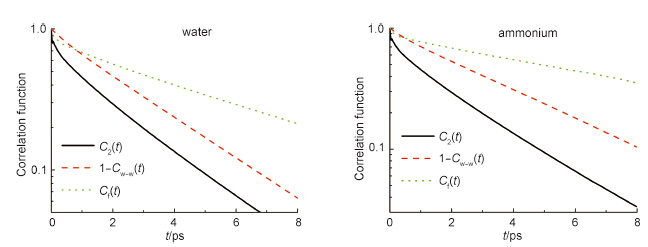
where P2 is the second-rank Legendre polynomial. C2(t) is usually employed to obtain the rotational relaxation time in simulations, which corresponds to the NMR and the ultrafast IR spectrum measurements.32 The rotational correlation functions can be decomposed into two sub-processes (Fig. 1), a short-time libration and a long-time rotational relaxation. The rotational relaxation times of two processes can be approximately obtained by fitting the following function:

${C_2}(t) = [(1-A)\exp (-t/{\tau _1}) + A]\exp ( - t/{\tau _2})$

图1

图1   </b></p> <p class="content-zw-img-shuoming-title-cn"><b>Fig 1   <strong>Rotation correlation functions (<i>C</i>(<i>t</i>)), the HB correlation functions (1―<i>C</i><sub>W-W</sub>(<i>t</i>)) and the rotation correlation functions of HB frame (<i>C</i><sub>f</sub>(<i>t</i>)) of the water and ammonium for the HB exchange between water molecules in NH<sub>4</sub>Cl solution at 0.5 mol·L<sup>-1</sup></strong><br> </b></p> </div> </div> <br> <div class="paragraph"> <div class="content-zw-1"> <p id="C9">where <i>A</i> is a prefactor of the exponential functions. $\tau $<sub>1</sub> is the librational time. $\tau $<sub>2</sub> is the rotational relaxation time related to the measurements of the ultrafast IR spectrum.<sup><a class="demo-basic" href="javascript:;" onmouseover="jjaxxawwhah(this,'b4')">4</a>, <a class="demo-basic" href="javascript:;" onmouseover="jjaxxawwhah(this,'b12')">12</a>, <a class="demo-basic" href="javascript:;" onmouseover="jjaxxawwhah(this,'b13')">13</a>, <a class="demo-basic" href="javascript:;" onmouseover="jjaxxawwhah(this,'b32')">32</a></sup> The integration value of <i>C</i><sub>2</sub>(<i>t</i>) within a long-time window is usually used for the rotational relaxation time by NMR measurements. The parameters in Eq.(2), $\tau $<sub>1</sub> and $\tau $<sub>2</sub> were determined from a fit of equation (2) within 0-8 ps as previous works.<sup><a class="demo-basic" href="javascript:;" onmouseover="jjaxxawwhah(this,'b4')">4</a>, <a class="demo-basic" href="javascript:;" onmouseover="jjaxxawwhah(this,'b12')">12</a>, <a class="demo-basic" href="javascript:;" onmouseover="jjaxxawwhah(this,'b13')">13</a>, <a class="demo-basic" href="javascript:;" onmouseover="jjaxxawwhah(this,'b32')">32</a></sup></p> </div> </div> <h3 class="title-biaoti-1 outline_anchor" level="2" id="outline_anchor_2"> 2.2 Extended jump model </h3> <div class="paragraph"> <div class="content-zw-1"> <p id="C10">The jump rotation of water or ammonium is triggered by the HB switching from initial HB acceptor to a new one (<a class="table-icon" style="color:#2150f9" href="#Fig2"; id="inline_contentFig. 2">Fig. 2</a>).<sup><a class="demo-basic" href="javascript:;" onmouseover="jjaxxawwhah(this,'b32')">32</a></sup> Before a HB exchange (<i>t</i> < 0 for the time window of the HB exchange process), O<sup>*</sup>H<sup>*</sup> or N<sup>*</sup>H<sup>*</sup> rotates diffusively with its HB frame axis of O<sup>*</sup>···O<sup>a</sup> or N<sup>*</sup>···O<sup>a</sup>. The average direction is assumed to be the same as the frame axis, neglecting the libra-tion of O<sup>*</sup>H<sup>*</sup> or N<sup>*</sup>H<sup>*</sup> in local HB frame axis. When a new HB acceptor is available, a fast HB switching happens. H<sup>*</sup> jumps from initial acceptor to a new one within the local frame of O<sup>a</sup>O<sup>*</sup>O<sup>b</sup> or O<sup>a</sup>N<sup>*</sup>O<sup>b</sup> (<a class="table-icon" style="color:#2150f9" href="#Fig2"; id="inline_contentFig. 2">Fig. 2</a>, O<sup>a</sup> and O<sup>b</sup>: the HB initial and final acceptors (oxygen atoms of water); H<sup>*</sup>: the HB donating hydrogen). When a new HB forms, the time window of the HB exchange process takes at <i>t</i> > 0. The middle time between the ending moment of old HB and the beginning time of new HB, is taken as the time origin (<i>t</i> = 0) within the HB exchange process. The jump angle $\phi $ is the angle between initial HB frame vector and the new HB frame vector at <i>t</i> = 0 (<a class="table-icon" style="color:#2150f9" href="#Fig2"; id="inline_contentFig. 2">Fig. 2</a>).</p> </div> </div> <h3 style="position: absolute; opacity: 0; filter:Alpha(opacity=0);">图2</h3> <div class="content-zw-img" id="Fig2"> <div class="content-zw-img-img figure outline_anchor" onmouseleave="likai(this);"> <img src="2015080902.jpg" onclick="clickss(this)" onmouseover="huoqukuanduimg(this);" class="tupian"> <p class="tishi"> <a href="2015080902.jpg.html" target="_blank">新窗口打开</a>| <a href="2015080902.jpg.zip">下载原图ZIP</a>| <a href="2015080902.jpg.ppt">生成PPT</a> </p> </div> <div class="content-zw-img-shuoming"> <p class="content-zw-img-shuoming-title-cn"><b>图2   <title/> </b></p> <p class="content-zw-img-shuoming-title-cn"><b>Fig 2   <strong>Definitions of the geometric variables along the HB exchange path</strong><br> </b></p> <p class="content-zw-img-shuoming-cn"> $\theta $ is the angle between the (N<sup>*</sup>H<sup>*</sup>O<sup>*</sup>H<sup>*</sup>) vector and the bisector plane of O<sup>a</sup>N<sup>*</sup>O<sup>b</sup>(O<sup>a</sup>O<sup>*</sup>O<sup>b</sup>). $\phi $<sub><i>i</i>-<i>j</i></sub> is defined as the jump angle (the angle between the vector O<sup>*</sup>O<sup>a</sup> and vector O<sup>*</sup>O<sup>b</sup> at <i>t</i>=0) during the HB exchange from initial HB acceptor <i>i</i> to final HB acceptor <i>j</i>. Within the local HB frame of NH<sub>4</sub><sup>+</sup>-water, the <i>Z</i> axis is defined as the vector of N<sup>*</sup>H<sup>*</sup> direction. The <i>X</i> axis is defined as the perpendicular vector of <i>Z</i> axis in the plane of HN<sup>*</sup>H<sup>*</sup>. </p> </div> </div> <br> <div class="paragraph"> <div class="content-zw-1"> <p id="C11">Based on the assumptions above, the rotational correlation function of molecule along the vector <i><strong>u</strong></i> (O<sup>*</sup>H<sup>*</sup> and N<sup>*</sup>H<sup>*</sup> bond vectors for water and ammonium ion, respectively), <i>C</i><sub>2</sub>(<i>t</i>), can be further decomposed into two sub-processes after an initial fast libration decay (<a class="table-icon" style="color:#2150f9" href="#Fig2"; id="inline_contentFig. 2">Fig. 2</a>):<sup><a class="demo-basic" href="javascript:;" onmouseover="jjaxxawwhah(this,'b32')">32</a></sup> (1) a sudden large-amplitude angular jump rotation of <i><strong>u</strong></i><sub>v</sub> (<i><strong>u</strong></i><sub>v</sub> is the O<sup>*</sup>H<sup>*</sup> or N<sup>*</sup>H<sup>*</sup> bond vector within the local HB frame <i><strong>u</strong></i><sub>f</sub>, which is the O<sup>*</sup>···O<sup>a</sup> or N<sup>*</sup>···O<sup>a</sup> vector of HB pair) and (2) a slow diffusive rotation of the frame vector <i><strong>u</strong></i><sub>f</sub>. The correlation functions of two sub-processes (a jump rotational correlation function <i>C</i><sub>J</sub>(<i>t</i>) and a frame rotational correlation function <i>C</i><sub>f</sub>(<i>t</i>)) are both assumed to be exponential.</p> </div> </div> <div class="paragraph"> <div class="content-zw-1"> <p><disp-formula> <label>(3)</label> <tex-math id="E3"> $\begin{array}{l}{C_2}(t){\rm{ = }}\left\langle {{P_2}\left[{\mathit{\boldsymbol{u}}(0)\mathit{\boldsymbol{u}}(t)} \right]} \right\rangle \\\;\;\;\;\;\;\;\;{\rm{ = }}\left\langle {{P_2}\left[{{\mathit{\boldsymbol{u}}_v}(0){\mathit{\boldsymbol{u}}_v}(t)} \right]} \right\rangle \left\langle {{P_2}\left[{{\mathit{\boldsymbol{u}}_{\rm{f}}}(0){\mathit{\boldsymbol{u}}_{\rm{f}}}(t)} \right]} \right\rangle \\\;\;\;\;\;\;\;\; = {C_{\rm{J}}}(t){C_{\rm{f}}}(t)\end{array}$ </tex-math></disp-formula></p> </div> </div> <div class="paragraph"> <div class="content-zw-1"> <p id="C12">In NH<sub>4</sub>Cl aqueous solutions, the possible HB donors are the hydrogen atoms of water and NH<sub>4</sub><sup>+</sup>. The possible HB acceptors are the water oxygen and chloride ion. Four HB exchange processes can be defined according to the types of initial and final HB acceptors: from water to water (W-W), from water to Cl<sup>-</sup> (W-Cl), from Cl<sup>-</sup> to water (Cl-W), and from Cl<sup>-</sup> to Cl<sup>-</sup> (Cl-Cl). The HB exchange can be traced along the trajectories of simulations, if the HB criteria are defined. The HB criteria: <i>R</i><sub>O<sup>*</sup>O<sup>a</sup></sub> (<i>R</i><sub>O<sup>*</sup>O<sup>b</sup></sub>) < 0.350 nm, <i>R</i><sub>H<sup>*</sup>O<sup>a</sup></sub> (<i>R</i><sub>H<sup>*</sup>O<sup>b</sup></sub>) < 0.245 nm and the HB angle $\theta $<sub>H<sup>*</sup>O<sup>*</sup>O<sup>b</sup></sub> < 30° for water-water HB as previous work, <sup><a class="demo-basic" href="javascript:;" onmouseover="jjaxxawwhah(this,'b32')">32</a></sup> <i>R</i><sub>O<sup>*</sup>O<sup>a</sup></sub> (<i>R</i><sub>O<sup>*</sup>O<sup>b</sup></sub>) < 0.345 nm, <i>R</i><sub>H<sup>*</sup>O<sup>a</sup></sub> (<i>R</i><sub>H<sup>*</sup>O<sup>a</sup></sub>) < 0.235 nm and the angle <i>θ</i><sub>H<sup>*</sup>O<sup>*</sup>O<sup>b</sup></sub> < 30° for the NH<sub>4</sub><sup>+</sup>-water HB according to the radial distribution functions.<sup><a class="demo-basic" href="javascript:;" onmouseover="jjaxxawwhah(this,'b34')">34</a></sup> <i>R</i><i><sub>ij</sub></i> is the distance between two atoms <i>i</i> and <i>j</i> of two HB connected molecules. <i>θ</i><sub>H<sup>*</sup>O<sup>*</sup>O<sup>b</sup></sub> is the angle between the vectors O<sup>*</sup>H<sup>*</sup> and O<sup>*</sup>O<sup>b</sup>.</p> </div> </div> <div class="paragraph"> <div class="content-zw-1"> <p id="C13">For a HB exchange of O<sup>*</sup>H<sup>*</sup> or N<sup>*</sup>H<sup>*</sup> from initial acceptor <i>i</i> to new acceptor <i>j</i> (<a class="table-icon" style="color:#2150f9" href="#Fig2"; id="inline_contentFig. 2">Fig. 2</a>), the rotational relaxation time $\tau $<sub><i>i</i>-<i>j</i></sub> according to Eq.(3), can be written as</p> </div> </div> <div class="paragraph"> <div class="content-zw-1"> <p><disp-formula> <label>(4)</label> <tex-math id="E4"> $\frac{1}{{{\tau _{i - j}}}} = \frac{1}{{\tau _{i - j}^{\rm{J}}}} + \frac{1}{{\tau _{i - j}^{\rm{f}}}}$ </tex-math></disp-formula></p> </div> </div> <div class="paragraph"> <div class="content-zw-1"> <p id="C14">$\tau _{i {-} j}^{\rm{J}}$is the jump rotational time and $\tau _{i {-} j}^{\rm{f}}$ is the diffusive rotational time of HB frame. The rotational relaxation time ($\tau$<sub>EJM</sub>) of water or ammonium along the O<sup>*</sup>H<sup>*</sup> or N<sup>*</sup>H<sup>*</sup> bond is equal to the weighted contributions from different types of HB exchanges according to the EJM.</p> </div> </div> <div class="paragraph"> <div class="content-zw-1"> <p><disp-formula> <label>(5)</label> <tex-math id="E5"> $\begin{array}{l}{\tau _{{\rm{EJM}}}} = {A_{{\rm{W}} - {\rm{W}}}}{\tau _{{\rm{W}} - {\rm{W}}}} + {A_{{\rm{W}} - {\rm{Cl}}}}{\tau _{{\rm{W}} - {\rm{Cl}}}} + \\\;\;\;\;\;\;\;\;\;{A_{{\rm{Cl}} - {\rm{W}}}}{\tau _{{\rm{Cl}} - {\rm{W}}}} + {A_{{\rm{Cl}} - {\rm{Cl}}}}{\tau _{{\rm{Cl}} - {\rm{Cl}}}}\end{array}$ </tex-math></disp-formula></p> </div> </div> <div class="paragraph"> <div class="content-zw-1"> <p id="C15"><i>A</i><sub><i>i</i>-<i>j</i></sub> and $\tau _{i {-} j}$are the fraction and the rotational time of O<sup>*</sup>H<sup>*</sup> or N<sup>*</sup>H<sup>*</sup> with an initial acceptor <i>i</i> and a final acceptor <i>j</i>.</p> </div> </div> <div class="paragraph"> <div class="content-zw-1"> <p id="C16">According to the Ivanov model, <sup><a class="demo-basic" href="javascript:;" onmouseover="jjaxxawwhah(this,'b33')">33</a></sup> the jump rotational relaxation time $\tau_{i {-} j}^{\rm{J}}$ is derived from</p> </div> </div> <div class="paragraph"> <div class="content-zw-1"> <p><disp-formula> <label>(6)</label> <tex-math id="E6"> $\tau _{i - j}^{\rm{J}} = \tau _{i - j}^0{f_{i - j}}({\phi _{i - j}})$ </tex-math></disp-formula></p> </div> </div> <div class="paragraph"> <div class="content-zw-1"> <p><disp-formula> <label>(7)</label> <tex-math id="E7"> ${f_{i - j}}({\phi _{i - j}}) = {\left\{ {1 - \frac{1}{{2n + 1}}\frac{{\sin [(n + 1/2){\phi _{i-j}}]}}{{\sin ({\phi _{i - j}}/2)}}} \right\}^{ - 1}}$ </tex-math></disp-formula></p> </div> </div> <div class="paragraph"> <div class="content-zw-1"> <p id="C17"><i>f</i><sub><i>i</i>-<i>j</i></sub>($\phi $<sub><i>i</i>-<i>j</i></sub>) is a function of jump angle $\phi $<sub><i>i</i>-<i>j</i></sub> defined in <a class="table-icon" style="color:#2150f9" href="#Fig2"; id="inline_contentFig. 2">Fig. 2</a>. $\phi $<sub><i>i</i>-<i>j</i></sub> is the average value of jump angle during the HB exchange from initial HB acceptor <i>i</i> to final acceptor <i>j</i>. The jump angle has a unsymmetrical distribution around the average value, <sup><a class="demo-basic" href="javascript:;" onmouseover="jjaxxawwhah(this,'b32')">32</a></sup> so a numerical integration value <i>F</i><sub><i>i</i>-<i>j</i></sub>($\phi $) over $\phi $<sub><i>i</i>-<i>j</i></sub> from 0 to π, is adopted in this work instead of the average value in previous work, <sup><a class="demo-basic" href="javascript:;" onmouseover="jjaxxawwhah(this,'b32')">32</a></sup></p> </div> </div> <div class="paragraph"> <div class="content-zw-1"> <p><disp-formula> <label>(8)</label> <tex-math id="E8"> $\tau _{i - j}^{\rm{J}} = \tau _{i - j}^{\rm{0}}{F_{i - j}}({\phi _{i - j}}) = \tau _{i - j}^{\rm{0}}\int_0^\pi {{f_{i - j}}} ({\phi _{i - j}})P({\phi _{i - j}}){\rm{d}}\phi $ </tex-math></disp-formula></p> </div> </div> <div class="paragraph"> <div class="content-zw-1"> <p id="C18"><i>P</i>($\phi $<i><sub>i</sub></i><sub>-</sub><sub><i>j</i></sub>) is the possibility of the HB exchange from <i>i</i> to <i>j</i> with jump angle $\phi $.<sup><a class="demo-basic" href="javascript:;" onmouseover="jjaxxawwhah(this,'b32')">32</a></sup></p> </div> </div> <div class="paragraph"> <div class="content-zw-1"> <p id="C19">The HB relaxation time, $\tau_{i {-} j}^0$, can be derived from a HB exchange correlation function within the time range of 0-8 ps according to the stable state pictures.<sup><a class="demo-basic" href="javascript:;" onmouseover="jjaxxawwhah(this,'b15')">15</a>, <a class="demo-basic" href="javascript:;" onmouseover="jjaxxawwhah(this,'b32')">32</a></sup> The strict HB criteria is used for $\tau_{i {-} j}^0$, so that the HB exchange events really happened and excluded the transient breaking of hydrogen pair.<sup><a class="demo-basic" href="javascript:;" onmouseover="jjaxxawwhah(this,'b32')">32</a></sup> Two water molecules form HB, if <i>R</i><sub>O<sup>*</sup>O<sup>a</sup></sub> (<i>R</i><sub>O<sup>*</sup>O<sup>b</sup></sub>) < 0.31 nm, <i>R</i><sub>H<sup>*</sup>O<sup>a</sup></sub> (<i>R</i><sub>H<sup>*</sup>O<sup>b</sup></sub>) < 0.20 nm and the HB angle <i>θ</i><sub>H<sup>*</sup>O<sup>a</sup>O<sup>b</sup></sub> < 20°. The HB between water and NH<sub>4</sub><sup>+</sup> must satisfy the conditions, <i>R</i><sub>N<sup>*</sup>O<sup>a</sup></sub> (<i>R</i><sub>N<sup>*</sup>O<sup>b</sup></sub>) < 0.30 nm, <i>R</i><sub>H<sup>*</sup>O<sup>a</sup></sub> (<i>R</i><sub>H<sup>*</sup>O<sup>b</sup></sub>) < 0.20 nm, and the HB angle <i>θ</i><sub>H<sup>*</sup>N<sup>*</sup>O<sup>a</sup></sub> (<i>θ</i><sub>H<sup>*</sup>N<sup>*</sup>O<sup>b</sup></sub>) < 20° (<a class="table-icon" style="color:#2150f9" href="#Fig2"; id="inline_contentFig. 2">Fig. 2</a>) according to the pair radial distribution functions between ammonium nitrogen and water oxygen.<sup><a class="demo-basic" href="javascript:;" onmouseover="jjaxxawwhah(this,'b34')">34</a></sup></p> </div> </div> <div class="paragraph"> <div class="content-zw-1"> <p id="C20">The frame rotational time $\tau_{i {-} j}^{\rm{f}}$ is determined from the rotational correlation function of HB frame axis O<sup>*</sup>···O<sup>a</sup> or N<sup>*</sup>···O<sup>a</sup> with equation (2) with the same time window as $\tau_{i {-} j}^{\rm{0}}$.</p> </div> </div> <h3 class="title-biaoti-1 outline_anchor" level="2" id="outline_anchor_2"> 2.3 Simulation protocol </h3> <div class="paragraph"> <div class="content-zw-1"> <p id="C21">The cubic bulks were constructed for pure water and NH<sub>4</sub>Cl aqueous solutions by inserting the water and ions into the empty box randomly, then the simulations were performed. 2000 waters were filled into each sample box, then NH<sub>4</sub><sup>+</sup> and Cl<sup>-</sup> were inserted into the box until the concentration of solution is approximately equal to 0.5, 1, 2, and 5 mol·L<sup>-1</sup>. The SPC/E water model35[]was used and ammonium force field was taken from the previous publication by Jungwirth and his workfellows (Model I).<sup><a class="demo-basic" href="javascript:;" onmouseover="jjaxxawwhah(this,'b34')">34</a></sup> In their work, the properties, such as the solvation structures, ion clustering tendency in ammonium halide aqueous solutions, were well presented with the current combined potentials in this work.<sup><a class="demo-basic" href="javascript:;" onmouseover="jjaxxawwhah(this,'b34')">34</a></sup> Another force field of ammonium (Model II)<sup><a class="demo-basic" href="javascript:;" onmouseover="jjaxxawwhah(this,'b26')">26</a></sup> was used to explore the effect of force field in simulations on the rotation of ammonium ion. The jump behaviors of ammonium ion and water are similar for two models (see Section 3.1). A little shorter HB relaxation time is observed for Model II than that for Model I. Additionally, previous work suggests that a classical force field is sufficient for the jump rotation behavior of water.<sup><a class="demo-basic" href="javascript:;" onmouseover="jjaxxawwhah(this,'b14')">14</a></sup> The jump rotation was also found in <i>ab initio</i> simulations.<sup><a class="demo-basic" href="javascript:;" onmouseover="jjaxxawwhah(this,'b28')">28</a>, <a class="demo-basic" href="javascript:;" onmouseover="jjaxxawwhah(this,'b29')">29</a></sup> The quantum effect on the rotation of ammonium ion should be further discussed, but the rotational mechanism of ammonium ion is expected to be not changed.</p> </div> </div> <div class="paragraph"> <div class="content-zw-1"> <p id="C22">The bond lengths and angles of water and NH<sub>4</sub><sup>+</sup> were fixed at the equilibrium values by the SHAKE algorithm.<sup><a class="demo-basic" href="javascript:;" onmouseover="jjaxxawwhah(this,'b36')">36</a></sup> The Lorentz-Berthelot combination rules<sup><a class="demo-basic" href="javascript:;" onmouseover="jjaxxawwhah(this,'b37')">37</a></sup> were used for the Lennard-Jones interactions. For each sample, a 2 ns isothermal-isobaric ensemble (NPT) equilibration simulation was carried out to generate the proper size of the simulation box, followed by a 2 ns microcanonical ensemble (NVE) simulation to calculate the dynamic properties. For each NPT simulation, the bulk systems were weakly coupled to a bath with the Nose-Hoover thermostats<sup><a class="demo-basic" href="javascript:;" onmouseover="jjaxxawwhah(this,'b38')">38</a>, <a class="demo-basic" href="javascript:;" onmouseover="jjaxxawwhah(this,'b39')">39</a></sup> at the goal temperature with the relaxation time of 0.1 ps. The weak coupling Berendsen scheme was used to control the system pressure at 1.01×10<sup><a class="demo-basic" href="javascript:;" onmouseover="jjaxxawwhah(this,'b5')">5</a></sup> Pa with the coupling time constant of 1 ps.<sup><a class="demo-basic" href="javascript:;" onmouseover="jjaxxawwhah(this,'b40')">40</a></sup> The equations of motion were integrated using the velocity Verlet integration scheme<sup><a class="demo-basic" href="javascript:;" onmouseover="jjaxxawwhah(this,'b37')">37</a></sup> and a time step of 2 fs. The long-range Coulombic forces were calculated using the particle-mesh Ewald method.<sup><a class="demo-basic" href="javascript:;" onmouseover="jjaxxawwhah(this,'b41')">41</a></sup> The non-bonded van der Waals interactions were truncated at 1.2 nm using the switching functions. Minimum image conditions were used.<sup><a class="demo-basic" href="javascript:;" onmouseover="jjaxxawwhah(this,'b37')">37</a></sup> The simulation configures were saved every 20 fs. All simulations were performed with the Tinker simulation code.<sup><a class="demo-basic" href="javascript:;" onmouseover="jjaxxawwhah(this,'b42')">42</a></sup></p> </div> </div> <h3 class="title-biaoti outline_anchor" level="2" id="outline_anchor_2"> 3 Results and discussion </h3> <h3 class="title-biaoti-1 outline_anchor" level="2" id="outline_anchor_2"> 3.1 Jump rotation of NH<sub>4</sub><sup>+</sup> </h3> <div class="paragraph"> <div class="content-zw-1"> <p id="C23">The rotational diffusion constant <i>D</i><sub>R</sub> can be derived from the mean square displacements (MSDs) of the labeled molecule or ion in the solutions, according to the Einstein relation, <sup><a class="demo-basic" href="javascript:;" onmouseover="jjaxxawwhah(this,'b43')">43</a></sup></p> </div> </div> <div class="paragraph"> <div class="content-zw-1"> <p><disp-formula> <label>(9)</label> <tex-math id="E9"> ${D_{\rm{R}}} = \mathop {\lim }\limits_{t \to \infty } \frac{1}{{4t}}\left( {\frac{1}{N}\sum\limits_i {{{\left| {{\varphi _i}(t) - {\varphi _i}(0)} \right|}^2}} } \right)$ </tex-math></disp-formula></p> </div> </div> <div class="paragraph"> <div class="content-zw-1"> <p id="C24">${\varphi _i}(t) = \int_0^t \delta {\varphi _i}(t')dt', \delta {\varphi _i}(t')$ is the rotational vector of NH bond vector <i><strong>P</strong><sub>i</sub></i>(<i>t</i>) within the interval of $[t', t' + \delta t]$ with mode δ$\theta $. The rotational diffusive constants of ammonium ion along <i>Z</i>, <i>X</i>, and <i>Y</i> axes defined in <a class="table-icon" style="color:#2150f9" href="#Fig2"; id="inline_contentFig. 2">Fig. 2</a>, are 0.088 × 10<sup><a class="demo-basic" href="javascript:;" onmouseover="jjaxxawwhah(this,'b12')">12</a></sup>, 0.085, and 0.092 rad<sup>2</sup>·s<sup>-1</sup>. The average value is 0.088 rad<sup>2</sup>·s<sup>-1</sup>, which is in reasonable agreement with the experimental value (0.075 × 10<sup>12</sup> rad<sup>2</sup>·s<sup>-1</sup>).<sup><a class="demo-basic" href="javascript:;" onmouseover="jjaxxawwhah(this,'b19')">19</a>, <a class="demo-basic" href="javascript:;" onmouseover="jjaxxawwhah(this,'b20')">20</a></sup> This suggests that the force field used here is reasonable to describe the rotational dynamic behavior of water and ammonium ion.</p> </div> </div> <div class="paragraph"> <div class="content-zw-1"> <p id="C25">According to the ideal diffusive fluid model, <sup><a class="demo-basic" href="javascript:;" onmouseover="jjaxxawwhah(this,'b44')">44</a></sup> the <i>n</i>th-rank rotational time of NH<sub>4</sub><sup>+</sup> ($\tau _n $) along the NH vector would satisfy the relationship with the rotational diffusion constant <i>D</i><sub>R</sub>, </p> </div> </div> <div class="paragraph"> <div class="content-zw-1"> <p><disp-formula> <label>(10)</label> <tex-math id="E10"> ${\tau _n} = 1/n\left( {n + 1} \right){D_{\rm{R}}}$ </tex-math></disp-formula></p> </div> </div> <div class="paragraph"> <div class="content-zw-1"> <p id="C26">The ratios $\tau _1 / \tau _2$ and $\tau _1 / \tau _3$ should be equal to the constant values, 3 and 6. However they are only 1.97 and 2.71 at 0.50 mol∙L<sup>-1</sup>, which is much lower than the ideal constants. The similar case is also found for water with the values of 1.97 and 2.78. The rotation of NH<sub>4</sub><sup>+</sup> apparently does not follow the diffusive Brownian motion picture.<sup><a class="demo-basic" href="javascript:;" onmouseover="jjaxxawwhah(this,'b44')">44</a>, <a class="demo-basic" href="javascript:;" onmouseover="jjaxxawwhah(this,'b45')">45</a></sup></p> </div> </div> <div class="paragraph"> <div class="content-zw-1"> <p id="C27">Does ammonium ion also follow the EJM like water?<sup><a class="demo-basic" href="javascript:;" onmouseover="jjaxxawwhah(this,'b32')">32</a>, <a class="demo-basic" href="javascript:;" onmouseover="jjaxxawwhah(this,'b33')">33</a></sup> An instantaneous and large-amplitude angular jump of water is motivated by the HB exchanges. The HB exchange can be considered as a chemical reaction from the reactant state O<sup>*</sup>H<sup>*</sup>···O<sup>a</sup> to the product state O<sup>*</sup>H<sup>*</sup>···O<sup>b</sup>. This process passes through an dangling or bifurcated HB state of O<sup>*</sup>H<sup>*</sup>, which is a transition state with a very short lifetime, much shorter than the stable single HB reactant and product states.<sup><a class="demo-basic" href="javascript:;" onmouseover="jjaxxawwhah(this,'b32')">32</a>, <a class="demo-basic" href="javascript:;" onmouseover="jjaxxawwhah(this,'b33')">33</a></sup> Indeed in the NH<sub>4</sub>Cl solution at 1 mol∙L<sup>-1</sup>, a very fast decay of the HB state correlation function to the value below 0.1 is observed within 0.1 ps for ammonium ion hydrogen with the dangling, and bifurcated HBs comparing to the single HB state (<a class="table-icon" style="color:#2150f9" href="#Fig3"; id="inline_contentFig. 3">Fig. 3</a>). The lifetime of NH<sub>4</sub><sup>+</sup> hydrogen with dangling HB state and bifurcated HBs is evidently shorter than those of water correspondingly. The facts above suggest that a transition state passes during the HB exchanges of ammonium ion like water molecule.</p> </div> </div> <h3 style="position: absolute; opacity: 0; filter:Alpha(opacity=0);">图3</h3> <div class="content-zw-img" id="Fig3"> <div class="content-zw-img-img figure outline_anchor" onmouseleave="likai(this);"> <img src="2015080903.jpg" onclick="clickss(this)" onmouseover="huoqukuanduimg(this);" class="tupian"> <p class="tishi"> <a href="2015080903.jpg.html" target="_blank">新窗口打开</a>| <a href="2015080903.jpg.zip">下载原图ZIP</a>| <a href="2015080903.jpg.ppt">生成PPT</a> </p> </div> <div class="content-zw-img-shuoming"> <p class="content-zw-img-shuoming-title-cn"><b>图3   <title/> </b></p> <p class="content-zw-img-shuoming-title-cn"><b>Fig 3   <strong>HB state correlation functions of the hydrogen atom of water and NH<sub>4</sub><sup>+</sup></strong><br> </b></p> <p class="content-zw-img-shuoming-cn">dangling state with HB number <i>n</i>=0, single HB state with HB number <i>n</i>=1, and bifurcated HB state with HB number <i>n</i>=2</p> </div> </div> <br> <div class="paragraph"> <div class="content-zw-1"> <p id="C28">For ammonium ion, we can construct a similar HB exchange reaction system as water molecule. This exchange reaction systemis made of three molecules (ammonium ion, its initial and final HB acceptors). The configurations of remaining water molecules and ions in bulk solution are considered as the average background effect. The reaction coordinates of the HB exchange (<a class="table-icon" style="color:#2150f9" href="#Fig2"; id="inline_contentFig. 2">Fig. 2</a>), which are the distance between N<sup>*</sup> and O<sup>a</sup> (<i>R</i><sub>N<sup>*</sup>O<sup>a</sup></sub>), the distance between N<sup>*</sup> and O<sup>b</sup> (<i>R</i><sub>N<sup>*</sup>O<sup>a</sup></sub>) and the angle ($\theta $) between the N<sup>*</sup>H<sup>*</sup> bond and bisector plane of O<sup>a</sup>N<sup>*</sup>O<sup>b</sup>, are analyzed from more than 250000 successful HB exchanging events. Among the possible HB exchanges in NH<sub>4</sub>Cl solution at 0.5 mol·L<sup>-1</sup>, the fraction of W-W HB exchange of N<sup>*</sup>H<sup>*</sup> (<a class="table-icon" style="color:#2150f9" href="#Fig1"; id="inline_contentFig. 1">Fig. 1</a>) has the highest value, 0.93 (the definitions of HB exchange type in method part).</p> </div> </div> <div class="paragraph"> <div class="content-zw-1"> <p id="C29">An intuitive picture is presented in <a class="table-icon" style="color:#2150f9" href="#Fig4"; id="inline_contentFig. 4">Fig. 4</a> for the HB exchange reaction of ammonium. The departure of initial acceptor O<sup>a</sup> and the arrival of new acceptor O<sup>b</sup> take place cooperatively during the HB exchange process. A sudden and large-amplitude angular rotation of N<sup>*</sup>H<sup>*</sup> within the local HB frame of O<sup>a</sup>N<sup>*</sup>O<sup>b</sup> is observed at <i>t</i> = 0. It is reasonable to assume that the local HB frame of O<sup>a</sup>N<sup>*</sup>O<sup>b</sup> does not change during the transient jump rotation of N<sup>*</sup>H<sup>*</sup>.<sup><a class="demo-basic" href="javascript:;" onmouseover="jjaxxawwhah(this,'b32')">32</a></sup> This is suggested by the value of $\phi $ (definition in <a class="table-icon" style="color:#2150f9" href="#Fig2"; id="inline_contentFig. 2">Fig. 2</a>), which nearly does not change during the W-W HB exchange (<a class="table-icon" style="color:#2150f9" href="#Fig4"; id="inline_contentFig. 4">Fig. 4</a>). Jump angle populations of water and NH<sub>4</sub><sup>+</sup> are shown in <a class="table-icon" style="color:#2150f9" href="#Fig5"; id="inline_contentFig. 5">Fig. 5</a>. For water, a main peak locates at 50° and a shoulder peak at 65º. However, only one peak is visible at 65° for the jump angle of NH<sub>4</sub><sup>+</sup>. The jump angle distribution of NH<sub>4</sub><sup>+</sup> is almost symmetrical around the average value. The different features for the jump angles of water and NH<sub>4</sub><sup>+</sup> suggest that the configurations at the transition state (<i>t</i> = 0) are different. <i>R</i><sub>N<sup>*</sup>O<sup>a</sup></sub> and <i>R</i><sub>N<sup>*</sup>O<sup>b</sup></sub> are not sensitive to the configuration of the transition state due to the strong HB interaction, so the jump angle is mainly determined by the distance (<i>R</i><sub>O<sup>a</sup>O<sup>b</sup></sub>) of HB acceptors, O<sup>a</sup> and O<sup>b</sup>. The possibility of jump angle at about 500 is much lower for ammonium ion than that for water, if a hydrogen bond is formed between the initial HB acceptor water and final HB acceptor water. The distances of N<sup>*</sup>···O<sup>a</sup>, N<sup>*</sup>···O<sup>b</sup>, and O<sup>a</sup>···O<sup>b</sup>, are about 0.31, 0.31, and 0.28 nm for N<sup>*</sup>H<sup>*</sup> (<a class="table-icon" style="color:#2150f9" href="#Fig2"; id="inline_contentFigs. 2">Figs. 2</a> and <a class="table-icon" style="color:#2150f9" href="#Fig4"; id="inline_content4">4</a>). The average jump angle at 65° is identified for both water</p> </div> </div> <h3 style="position: absolute; opacity: 0; filter:Alpha(opacity=0);">图4</h3> <div class="content-zw-img" id="Fig4"> <div class="content-zw-img-img figure outline_anchor" onmouseleave="likai(this);"> <img src="2015080904.jpg" onclick="clickss(this)" onmouseover="huoqukuanduimg(this);" class="tupian"> <p class="tishi"> <a href="2015080904.jpg.html" target="_blank">新窗口打开</a>| <a href="2015080904.jpg.zip">下载原图ZIP</a>| <a href="2015080904.jpg.ppt">生成PPT</a> </p> </div> <div class="content-zw-img-shuoming"> <p class="content-zw-img-shuoming-title-cn"><b>图4   <title/> </b></p> <p class="content-zw-img-shuoming-title-cn"><b>Fig 4   <strong>Reaction coordinates <i>R</i><sub><i>ij</i></sub>, $\theta $, and $ \bf{\phi} $ along the path of the W-W HB exchange of ammonium ion and water</strong><br> </b></p> </div> </div> <br> <h3 style="position: absolute; opacity: 0; filter:Alpha(opacity=0);">图5</h3> <div class="content-zw-img" id="Fig5"> <div class="content-zw-img-img figure outline_anchor" onmouseleave="likai(this);"> <img src="2015080905.jpg" onclick="clickss(this)" onmouseover="huoqukuanduimg(this);" class="tupian"> <p class="tishi"> <a href="2015080905.jpg.html" target="_blank">新窗口打开</a>| <a href="2015080905.jpg.zip">下载原图ZIP</a>| <a href="2015080905.jpg.ppt">生成PPT</a> </p> </div> <div class="content-zw-img-shuoming"> <p class="content-zw-img-shuoming-title-cn"><b>图5   <title/> </b></p> <p class="content-zw-img-shuoming-title-cn"><b>Fig 5   <strong>Jump angle populations of W-W HB switching for water and NH<sub>4</sub><sup>+</sup> ion</strong><br> </b></p> <p class="content-zw-img-shuoming-cn"> <i>P</i>(<i>θ</i>) with Models I and II at 0.5 mol·L<sup>-1</sup>; the populations of jump angle for the HB exchange between two water molecules with HB each other (<i>P</i><sub>1</sub>(<i>θ</i>)) and without HB each other <i>P</i><sub>2</sub>(<i>θ</i>)r</p> </div> </div> <br> <div class="paragraph"> <div class="content-zw-1"> <p id="C30">and ammonium ion for the HB exchange event without hydrogen bond between two HB acceptor water molecules at the transition 46 state. The distances of N<sup>*</sup>···O<sup>a</sup>, N<sup>*</sup>···O<sup>b</sup>, and O<sup>a</sup>···O<sup>b</sup> are about 0.31, 0.31, and 0.35 nm for anmonium ion, about 0.33, 0.33, and 0.38 nm for the water. The possibility of the HB exchange between two HB water molecules without formation of HB each other, is higher for ammonium ion than that for water. This is mainly due to less available new HB acceptor around N<sup>*</sup>H<sup>*</sup> than O<sup>*</sup>H<sup>*</sup>.</p> </div> </div> <h3 class="title-biaoti-1 outline_anchor" level="2" id="outline_anchor_2"> 3.2 Contributions from the jump and frame rotations </h3> <div class="paragraph"> <div class="content-zw-1"> <p id="C31">The rotational relaxation times of water and ammonium directly from equations (1, 2) and from the EJM with equations (3)-(5), are presented in <a class="table-icon" style="color:#2150f9" href="#Fig6"; id="inline_contentFig. 6">Fig. 6</a>. The tendency of the rotational relaxation times with concentration is well reproduced by the EJM. The rotational relaxation times are a little underestimated by the EJM relative to the direct measurements. The results from EJM suggest that the water rotation along the OH vector can be divided into two sub-processes. One is the large-amplitude and fast jump rotation. The other is the diffusive rotation of HB frame O<sup>*</sup>O<sup>a</sup>. In NH<sub>4</sub>Cl solution at the lowest concentration (0.5 mol·L<sup>-1</sup>) of the samples in this work, the jump rotational times of water and ammonium ion are 3.81 and 4.57 ps, respectively. Their frame rotational times are 5.96 and 9.30 ps, respectively. The jump and diffusive rotational times rise to 7.30 and 18.59 ps at 5 mol·L<sup>-1</sup>. The contribution from the jump rotation to the rotational mobility of ammonium increases with concentration. The rotation time of ammonium ion and water is mainly determined by the jump rotation over the whole range of concentration.</p> </div> </div> <h3 style="position: absolute; opacity: 0; filter:Alpha(opacity=0);">图6</h3> <div class="content-zw-img" id="Fig6"> <div class="content-zw-img-img figure outline_anchor" onmouseleave="likai(this);"> <img src="2015080906.jpg" onclick="clickss(this)" onmouseover="huoqukuanduimg(this);" class="tupian"> <p class="tishi"> <a href="2015080906.jpg.html" target="_blank">新窗口打开</a>| <a href="2015080906.jpg.zip">下载原图ZIP</a>| <a href="2015080906.jpg.ppt">生成PPT</a> </p> </div> <div class="content-zw-img-shuoming"> <p class="content-zw-img-shuoming-title-cn"><b>图6   <title/> </b></p> <p class="content-zw-img-shuoming-title-cn"><b>Fig 6   <strong>$\tau _2 $ and $\tau _{\rm{EJM}} $ in the NH<sub>4</sub>Cl solutions at different concentrations</strong><br> </b></p> </div> </div> <br> <div class="paragraph"> <div class="content-zw-1"> <p id="C32">As for the underestimation of the EJM, this is mainly due to the invalidation of its assumption and its intrinsic limitation. For the jump rotation, the average direction used in the EJM is assumed to be the same as the frame vector, neglecting the libration of O<sup>*</sup>H<sup>*</sup> or N<sup>*</sup>H<sup>*</sup> in local HB frame. The jump rotation term in fact covers a part of fast libration contribution in its long-time rotation contribution in equation (2). Additionally, the EJM does not consider the rotations of ammonium and water in local basins suggested in reference.<sup>50</sup> The fast HB exchange in local basin has bigger contribution on the fast decay of the rotational correlation function than the long-time decay.<sup><a class="demo-basic" href="javascript:;" onmouseover="jjaxxawwhah(this,'b47')">47</a></sup> A faster jump rotation is expected for the EJM, given its intrinsic limitations above.</p> </div> </div> <h2 class="title-biaoti outline_anchor" level="1" id="outline_anchor_1"> 4 Conclusions </h2> <div class="paragraph"> <div class="content-zw-1"> <p id="C33">The rotational mechanism of ammonium ion is explored by MD simulations and the extended jump model. The fast rotation of NH<sub>4</sub><sup>+</sup> observed in previous experiments is due to the sudden jump rotation. The jump rotation of NH<sub>4</sub><sup>+</sup> is motivated by the HB exchanges. The rotational behavior can be approximately described with the EJM like water in aqueous solutions. The rotational correlation function can be decomposed into a jump rotation and a diffuse rotation of HB frame based on the EJM. The contribution from the fast jump rotation is bigger than the diffusive part. The jump rotation becomes more and more important with concentration. Comparing to the HB exchange of water, the HB exchange of ammonium ion between two water molecules forming HB each other has a lower possibility than water.</p> </div> </div> <div class="cankaowenxian1"></div> <h2 class="title-biaoti"> <span class="outline_anchor" level="1">参考文献 </span> <div class="btn-group"> <button style="font-size:11px;padding:3px;" type="button" onclick="sddas();" class="btn btn-info dropdown-toggle" data-toggle="dropdown"> View Option <span class="caret"></span> </button> <ul class="dropdown-menu kkaqqqq" role="menu" style="background:#e1e7ea;padding-left:0px !important;"> <li onclick="daxcbdh();"><a href="javascript:;" class="ref_sort" type="1" style="color:#000;">原文顺序</a></li> <li onclick="daxcbdh();"><a href="javascript:;" class="ref_sort" type="2" style="color:#000;">文献年度倒序</a></li> <li onclick="daxcbdh();"><a href="javascript:;" class="ref_sort" type="3" style="color:#000;">文中引用次数倒序</a></li> <li onclick="daxcbdh();"><a href="javascript:;" class="ref_sort" type="4" style="color:#000;">被引期刊影响因子</a></li> </ul> </div> </h2> <div class="cankaowenxian"> <div id="b1" name="b1" magrefid="" class="cankaowenxian-xx"> <label class="lableq"> [1] </label> <div class="cankaowenxian-xx-title"> <mixed-citation publication-type="journal"> <person-group person-group-type="author"> <name> <surname>Nostro</surname> <given-names>P. L.</given-names> </name>; <name> <surname>Ninham</surname> <given-names>B. W.</given-names> </name> </person-group> <source>Chem. Rev</source> <year>2012</year>, <volume>112</volume>, <fpage>2286</fpage>. </mixed-citation> </div> <p class="cankaowenxian-xx-x" id="linked_"> <span class="jcr_"></span> <span class="cjcr_"></span> <span class="cited" id="bd_cited_count_"></span> <span class="cited" id="cited_146313"> <a href="javascript:;" onmouseover="jjaxxawwhah1(this,'b1')" class="bianju"> [本文引用: 2]</a> </span> </p> <div class="xiangxicankao"> <p> </p> </div> </div> <div id="b2" name="b2" magrefid="" class="cankaowenxian-xx"> <label class="lableq"> [2] </label> <div class="cankaowenxian-xx-title"> <mixed-citation publication-type="journal"> <person-group person-group-type="author"> <name> <surname>Marcus</surname> <given-names>Y.</given-names> </name> </person-group> <source>Chem. Rev</source> <year>2009</year>, <volume>109</volume>, <fpage>1346</fpage>. </mixed-citation> </div> <p class="cankaowenxian-xx-x" id="linked_"> <span class="jcr_"></span> <span class="cjcr_"></span> <span class="cited" id="bd_cited_count_"></span> <span class="cited" id="cited_146314"> <a href="javascript:;" onmouseover="jjaxxawwhah1(this,'b2')" class="bianju"> [本文引用: 1]</a> </span> </p> <div class="xiangxicankao"> <p> </p> </div> </div> <div id="b3" name="b3" magrefid="" class="cankaowenxian-xx"> <label class="lableq"> [3] </label> <div class="cankaowenxian-xx-title"> <mixed-citation publication-type="journal"> <person-group person-group-type="author"> <name> <surname>Ohtaki</surname> <given-names>H.</given-names> </name>; <name> <surname>Radnai</surname> <given-names>T.</given-names> </name> </person-group> <source>Chem. Rev</source> <year>1993</year>, <volume>93</volume>, <fpage>1157</fpage>. </mixed-citation> </div> <p class="cankaowenxian-xx-x" id="linked_"> <span class="jcr_"></span> <span class="cjcr_"></span> <span class="cited" id="bd_cited_count_"></span> <span class="cited" id="cited_146315"> <a href="javascript:;" onmouseover="jjaxxawwhah1(this,'b3')" class="bianju"> [本文引用: 2]</a> </span> </p> <div class="xiangxicankao"> <p> </p> </div> </div> <div id="b4" name="b4" magrefid="" class="cankaowenxian-xx"> <label class="lableq"> [4] </label> <div class="cankaowenxian-xx-title"> <mixed-citation publication-type="data">(a) Bakker, H. J.; Skinner, J. L. Chem. Rev. 2010, 110, 1498. doi: 10.1021/cr9001879 (b) Bakker, H. J. Chem. Rev. 2008, 108, 1456</mixed-citation> </div> <p class="cankaowenxian-xx-x" id="linked_"> <span class="jcr_"></span> <span class="cjcr_"></span> <span class="cited" id="bd_cited_count_"></span> <span class="cited" id="cited_146316"> <a href="javascript:;" onmouseover="jjaxxawwhah1(this,'b4')" class="bianju"> [本文引用: 4]</a> </span> </p> <div class="xiangxicankao"> <p> </p> </div> </div> <div id="b5" name="b5" magrefid="" class="cankaowenxian-xx"> <label class="lableq"> [5] </label> <div class="cankaowenxian-xx-title"> <mixed-citation publication-type="journal"> <person-group person-group-type="author"> <name> <surname>Marcus</surname> <given-names>Y.</given-names> </name>; <name> <surname>Hefter</surname> <given-names>G.</given-names> </name> </person-group> <source>Chem. Rev</source> <year>2006</year>, <volume>106</volume>, <fpage>4585</fpage>. </mixed-citation> </div> <p class="cankaowenxian-xx-x" id="linked_"> <span class="jcr_"></span> <span class="cjcr_"></span> <span class="cited" id="bd_cited_count_"></span> <span class="cited" id="cited_146317"> <a href="javascript:;" onmouseover="jjaxxawwhah1(this,'b5')" class="bianju"> [本文引用: 3]</a> </span> </p> <div class="xiangxicankao"> <p> </p> </div> </div> <div id="b6" name="b6" magrefid="" class="cankaowenxian-xx"> <label class="lableq"> [6] </label> <div class="cankaowenxian-xx-title"> <mixed-citation publication-type="journal"> <person-group person-group-type="author"> <name> <surname>Collins</surname> <given-names>K. D.</given-names> </name> </person-group> <source>Biophys. J</source> <year>1997</year>, <volume>72</volume>, <fpage>65</fpage>. </mixed-citation> </div> <p class="cankaowenxian-xx-x" id="linked_"> <span class="jcr_"></span> <span class="cjcr_"></span> <span class="cited" id="bd_cited_count_"></span> <span class="cited" id="cited_146318"> <a href="javascript:;" onmouseover="jjaxxawwhah1(this,'b6')" class="bianju"> [本文引用: 2]</a> </span> </p> <div class="xiangxicankao"> <p> </p> </div> </div> <div id="b7" name="b7" magrefid="" class="cankaowenxian-xx"> <label class="lableq"> [7] </label> <div class="cankaowenxian-xx-title"> <mixed-citation publication-type="journal"> <person-group person-group-type="author"> <name> <surname>Mason</surname> <given-names>P. E.</given-names> </name>; <name> <surname>Dempsey</surname> <given-names>C. E.</given-names> </name>; <name> <surname>Vrbka</surname> <given-names>L.</given-names> </name>; <name> <surname>Heyda</surname> <given-names>J.</given-names> </name>; <name> <surname>Brady</surname> <given-names>J. W.</given-names> </name>; <name> <surname>Jungwirth</surname> <given-names>P.</given-names> </name> </person-group> <source>J.Phys. Chem. B</source> <year>2009</year>, <volume>113</volume>, <fpage>3227</fpage>. </mixed-citation> </div> <p class="cankaowenxian-xx-x" id="linked_"> <span class="jcr_"></span> <span class="cjcr_"></span> <span class="cited" id="bd_cited_count_"></span> <span class="cited" id="cited_146319"> <a href="javascript:;" onmouseover="jjaxxawwhah1(this,'b7')" class="bianju"> [本文引用: 2]</a> </span> </p> <div class="xiangxicankao"> <p> </p> </div> </div> <div id="b8" name="b8" magrefid="" class="cankaowenxian-xx"> <label class="lableq"> [8] </label> <div class="cankaowenxian-xx-title"> <mixed-citation publication-type="data">(a) Yang, L. J.; Fan, Y. B.; Gao, Y. Q. J. Phys. Chem. B 2011, 115, 12456. doi: 10.1021/jp207652h (b) Zhang, Q.; Xie, W.; Bian, H.; Gao, Y. Q.; Zheng, J.; Zhuang, W. J. Phys. Chem. B 2013, 117, 2992.</mixed-citation> </div> <p class="cankaowenxian-xx-x" id="linked_"> <span class="jcr_"></span> <span class="cjcr_"></span> <span class="cited" id="bd_cited_count_"></span> <span class="cited" id="cited_146320"> <a href="javascript:;" onmouseover="jjaxxawwhah1(this,'b8')" class="bianju"> [本文引用: 2]</a> </span> </p> <div class="xiangxicankao"> <p> </p> </div> </div> <div id="b9" name="b9" magrefid="" class="cankaowenxian-xx"> <label class="lableq"> [9] </label> <div class="cankaowenxian-xx-title"> <mixed-citation publication-type="journal"> <person-group person-group-type="author"> <name> <surname>Hofmeister</surname> <given-names>F.</given-names> </name> </person-group> <source>Arch. Exp. Pathol. Pharmakol</source> <year>1888</year>, <volume>24</volume>, <fpage>247</fpage>. </mixed-citation> </div> <p class="cankaowenxian-xx-x" id="linked_"> <span class="jcr_"></span> <span class="cjcr_"></span> <span class="cited" id="bd_cited_count_"></span> <span class="cited" id="cited_146321"> <a href="javascript:;" onmouseover="jjaxxawwhah1(this,'b9')" class="bianju"> [本文引用: 2]</a> </span> </p> <div class="xiangxicankao"> <p> </p> </div> </div> <div id="b10" name="b10" magrefid="" class="cankaowenxian-xx"> <label class="lableq"> [10] </label> <div class="cankaowenxian-xx-title"> <mixed-citation publication-type="journal"> <person-group person-group-type="author"> <name> <surname>Heisler</surname> <given-names>I. A.</given-names> </name>; <name> <surname>Mazur</surname> <given-names>K.</given-names> </name>; <name> <surname>Meech</surname> <given-names>S. R.</given-names> </name> </person-group> <source>J.Phys. Chem. B</source> <year>2011</year>, <volume>115</volume>, <fpage>1863</fpage>. </mixed-citation> </div> <p class="cankaowenxian-xx-x" id="linked_"> <span class="jcr_"></span> <span class="cjcr_"></span> <span class="cited" id="bd_cited_count_"></span> <span class="cited" id="cited_146322"> <a href="javascript:;" onmouseover="jjaxxawwhah1(this,'b10')" class="bianju"> [本文引用: 2]</a> </span> </p> <div class="xiangxicankao"> <p> </p> </div> </div> <div id="b11" name="b11" magrefid="" class="cankaowenxian-xx"> <label class="lableq"> [11] </label> <div class="cankaowenxian-xx-title"> <mixed-citation publication-type="journal"> <person-group person-group-type="author"> <name> <surname>Engel</surname> <given-names>G.</given-names> </name>; <name> <surname>Hertz</surname> <given-names>H. G.</given-names> </name> </person-group> <source>Ber. Bunsen.-Ges. Phys. Chem</source> <year>1968</year>, <volume>72</volume>, <fpage>808</fpage>. </mixed-citation> </div> <p class="cankaowenxian-xx-x" id="linked_"> <span class="jcr_"></span> <span class="cjcr_"></span> <span class="cited" id="bd_cited_count_"></span> <span class="cited" id="cited_146323"> <a href="javascript:;" onmouseover="jjaxxawwhah1(this,'b11')" class="bianju"> [本文引用: 1]</a> </span> </p> <div class="xiangxicankao"> <p> </p> </div> </div> <div id="b12" name="b12" magrefid="" class="cankaowenxian-xx"> <label class="lableq"> [12] </label> <div class="cankaowenxian-xx-title"> <mixed-citation publication-type="journal"> <person-group person-group-type="author"> <name> <surname>Park</surname> <given-names>S.</given-names> </name>; <name> <surname>Fayer</surname> <given-names>M. D.</given-names> </name> </person-group> <source>Proc. Natl. Acad. Sci. U. S. A</source> <year>2007</year>, <volume>104</volume>, <fpage>16731</fpage>. </mixed-citation> </div> <p class="cankaowenxian-xx-x" id="linked_"> <span class="jcr_"></span> <span class="cjcr_"></span> <span class="cited" id="bd_cited_count_"></span> <span class="cited" id="cited_146324"> <a href="javascript:;" onmouseover="jjaxxawwhah1(this,'b12')" class="bianju"> [本文引用: 4]</a> </span> </p> <div class="xiangxicankao"> <p> </p> </div> </div> <div id="b13" name="b13" magrefid="" class="cankaowenxian-xx"> <label class="lableq"> [13] </label> <div class="cankaowenxian-xx-title"> <mixed-citation publication-type="journal"> <person-group person-group-type="author"> <name> <surname>Roberts</surname> <given-names>S. T.</given-names> </name>; <name> <surname>Ramasesha</surname> <given-names>K.</given-names> </name>; <name> <surname>Tokmakoff</surname> <given-names>A.</given-names> </name> </person-group> <source>Accoutns Chem. Res</source> <year>2009</year>, <volume>42</volume>, <fpage>1239</fpage>. </mixed-citation> </div> <p class="cankaowenxian-xx-x" id="linked_"> <span class="jcr_"></span> <span class="cjcr_"></span> <span class="cited" id="bd_cited_count_"></span> <span class="cited" id="cited_146325"> <a href="javascript:;" onmouseover="jjaxxawwhah1(this,'b13')" class="bianju"> [本文引用: 3]</a> </span> </p> <div class="xiangxicankao"> <p> </p> </div> </div> <div id="b14" name="b14" magrefid="" class="cankaowenxian-xx"> <label class="lableq"> [14] </label> <div class="cankaowenxian-xx-title"> <mixed-citation publication-type="journal"> <person-group person-group-type="author"> <name> <surname>Laage</surname> <given-names>D.</given-names> </name>; <name> <surname>Hynes</surname> <given-names>J. T.</given-names> </name> </person-group> <source>Proc. Natl. Acad. Sci. U. S. A</source> <year>2007</year>, <volume>104</volume>, <fpage>11167</fpage>. </mixed-citation> </div> <p class="cankaowenxian-xx-x" id="linked_"> <span class="jcr_"></span> <span class="cjcr_"></span> <span class="cited" id="bd_cited_count_"></span> <span class="cited" id="cited_146326"> <a href="javascript:;" onmouseover="jjaxxawwhah1(this,'b14')" class="bianju"> [本文引用: 3]</a> </span> </p> <div class="xiangxicankao"> <p> </p> </div> </div> <div id="b15" name="b15" magrefid="" class="cankaowenxian-xx"> <label class="lableq"> [15] </label> <div class="cankaowenxian-xx-title"> <mixed-citation publication-type="journal"> <person-group person-group-type="author"> <name> <surname>Stirnemann</surname> <given-names>G.</given-names> </name>; <name> <surname>Wernersson</surname> <given-names>E.</given-names> </name>; <name> <surname>Jungwirth</surname> <given-names>P.</given-names> </name>; <name> <surname>Laage</surname> <given-names>D.</given-names> </name> </person-group> <source>J.Am. Chem. Soc</source> <year>2013</year>, <volume>135</volume>, <fpage>11824</fpage>. </mixed-citation> </div> <p class="cankaowenxian-xx-x" id="linked_"> <span class="jcr_"></span> <span class="cjcr_"></span> <span class="cited" id="bd_cited_count_"></span> <span class="cited" id="cited_146327"> <a href="javascript:;" onmouseover="jjaxxawwhah1(this,'b15')" class="bianju"> [本文引用: 3]</a> </span> </p> <div class="xiangxicankao"> <p> </p> </div> </div> <div id="b16" name="b16" magrefid="" class="cankaowenxian-xx"> <label class="lableq"> [16] </label> <div class="cankaowenxian-xx-title"> <mixed-citation publication-type="journal"> <person-group person-group-type="author"> <name> <surname>Moberg</surname> <given-names>R.</given-names> </name>; <name> <surname>Bokman</surname> <given-names>F.</given-names> </name>; <name> <surname>Bohman</surname> <given-names>O.</given-names> </name>; <name> <surname>Siegbahn</surname> <given-names>H. O. G.</given-names> </name> </person-group> <source>J.Am. Chem. Soc</source> <year>1991</year>, <volume>113</volume>, <fpage>3663</fpage>. </mixed-citation> </div> <p class="cankaowenxian-xx-x" id="linked_"> <span class="jcr_"></span> <span class="cjcr_"></span> <span class="cited" id="bd_cited_count_"></span> <span class="cited" id="cited_146328"> <a href="javascript:;" onmouseover="jjaxxawwhah1(this,'b16')" class="bianju"> [本文引用: 1]</a> </span> </p> <div class="xiangxicankao"> <p> </p> </div> </div> <div id="b17" name="b17" magrefid="" class="cankaowenxian-xx"> <label class="lableq"> [17] </label> <div class="cankaowenxian-xx-title"> <mixed-citation publication-type="journal"> <person-group person-group-type="author"> <name> <surname>Anderson</surname> <given-names>T. L.</given-names> </name>; <name> <surname>Charlson</surname> <given-names>A. J.</given-names> </name>; <name> <surname>Schwartz</surname> <given-names>S. E.</given-names> </name>; <name> <surname>Knutti</surname> <given-names>R.</given-names> </name>; <name> <surname>Boucher</surname> <given-names>O.</given-names> </name>; <name> <surname>Rodhe</surname> <given-names>H.</given-names> </name>; <name> <surname>Heintzenberg</surname> <given-names>J.</given-names> </name> </person-group> <source>Science</source> <year>2003</year>, <volume>300</volume>, <fpage>1103</fpage>. </mixed-citation> </div> <p class="cankaowenxian-xx-x" id="linked_"> <span class="jcr_"></span> <span class="cjcr_"></span> <span class="cited" id="bd_cited_count_"></span> <span class="cited" id="cited_146329"> <a href="javascript:;" onmouseover="jjaxxawwhah1(this,'b17')" class="bianju"> [本文引用: 1]</a> </span> </p> <div class="xiangxicankao"> <p> </p> </div> </div> <div id="b18" name="b18" magrefid="" class="cankaowenxian-xx"> <label class="lableq"> [18] </label> <div class="cankaowenxian-xx-title"> <mixed-citation publication-type="data">(a) Mason, P. E.; Heyda, J.; Fischer, H. E.; Jungwirth, P. J. Phys. Chem. B 2010, 114, 13853. doi: 10.1021/jp104840g (b) Wang, S.; Orabi, E. A.; Baday, S.; Bernèche, S.; Lamoureux, G. J. Am. Chem. Soc. 2012, 134, 10419. (c) Baday, S.; Wang, S.; Lamoureux, G.; Bernèche, S. Biochemistry 2013, 52, 7091.</mixed-citation> </div> <p class="cankaowenxian-xx-x" id="linked_"> <span class="jcr_"></span> <span class="cjcr_"></span> <span class="cited" id="bd_cited_count_"></span> <span class="cited" id="cited_146330"> <a href="javascript:;" onmouseover="jjaxxawwhah1(this,'b18')" class="bianju"> [本文引用: 2]</a> </span> </p> <div class="xiangxicankao"> <p> </p> </div> </div> <div id="b19" name="b19" magrefid="" class="cankaowenxian-xx"> <label class="lableq"> [19] </label> <div class="cankaowenxian-xx-title"> <mixed-citation publication-type="journal"> <person-group person-group-type="author"> <name> <surname>Perrin</surname> <given-names>C. L.</given-names> </name>; <name> <surname>Gipe</surname> <given-names>R. K.</given-names> </name> </person-group> <source>J.Am. Chem. Soc</source> <year>1986</year>, <volume>108</volume>, <fpage>1088</fpage>. </mixed-citation> </div> <p class="cankaowenxian-xx-x" id="linked_"> <span class="jcr_"></span> <span class="cjcr_"></span> <span class="cited" id="bd_cited_count_"></span> <span class="cited" id="cited_146331"> <a href="javascript:;" onmouseover="jjaxxawwhah1(this,'b19')" class="bianju"> [本文引用: 2]</a> </span> </p> <div class="xiangxicankao"> <p> </p> </div> </div> <div id="b20" name="b20" magrefid="" class="cankaowenxian-xx"> <label class="lableq"> [20] </label> <div class="cankaowenxian-xx-title"> <mixed-citation publication-type="journal"> <person-group person-group-type="author"> <name> <surname>Perrin</surname> <given-names>C. L. </given-names> </name>; <name> <surname>Gipe</surname> <given-names>R. K.</given-names> </name> </person-group> <source>Science</source> <year>1987</year>, <volume>238</volume>, <fpage>1393</fpage>. </mixed-citation> </div> <p class="cankaowenxian-xx-x" id="linked_"> <span class="jcr_"></span> <span class="cjcr_"></span> <span class="cited" id="bd_cited_count_"></span> <span class="cited" id="cited_146332"> <a href="javascript:;" onmouseover="jjaxxawwhah1(this,'b20')" class="bianju"> [本文引用: 2]</a> </span> </p> <div class="xiangxicankao"> <p> </p> </div> </div> <div id="b21" name="b21" magrefid="" class="cankaowenxian-xx"> <label class="lableq"> [21] </label> <div class="cankaowenxian-xx-title"> <mixed-citation publication-type="journal"> <person-group person-group-type="author"> <name> <surname>Masuda</surname> <given-names>Y.</given-names> </name> </person-group> <source>J.Phys. Chem. A</source> <year>2001</year>, <volume>105</volume>, <fpage>2989</fpage>. </mixed-citation> </div> <p class="cankaowenxian-xx-x" id="linked_"> <span class="jcr_"></span> <span class="cjcr_"></span> <span class="cited" id="bd_cited_count_"></span> <span class="cited" id="cited_146333"> <a href="javascript:;" onmouseover="jjaxxawwhah1(this,'b21')" class="bianju"> [本文引用: 1]</a> </span> </p> <div class="xiangxicankao"> <p> </p> </div> </div> <div id="b22" name="b22" magrefid="" class="cankaowenxian-xx"> <label class="lableq"> [22] </label> <div class="cankaowenxian-xx-title"> <mixed-citation publication-type="data">Einstein, A. Investigations on the Theory of the Brownian Motion; Dover: New York, 1956.</mixed-citation> </div> <p class="cankaowenxian-xx-x" id="linked_"> <span class="jcr_"></span> <span class="cjcr_"></span> <span class="cited" id="bd_cited_count_"></span> <span class="cited" id="cited_146334"> <a href="javascript:;" onmouseover="jjaxxawwhah1(this,'b22')" class="bianju"> [本文引用: 1]</a> </span> </p> <div class="xiangxicankao"> <p> </p> </div> </div> <div id="b23" name="b23" magrefid="" class="cankaowenxian-xx"> <label class="lableq"> [23] </label> <div class="cankaowenxian-xx-title"> <mixed-citation publication-type="journal"> <person-group person-group-type="author"> <name> <surname>Karim</surname> <given-names>O. A.</given-names> </name>; <name> <surname>Haymet</surname> <given-names>A. D. J.</given-names> </name> </person-group> <source>J.Chem. Phys</source> <year>1990</year>, <volume>93</volume>, <fpage>5961</fpage>. </mixed-citation> </div> <p class="cankaowenxian-xx-x" id="linked_"> <span class="jcr_"></span> <span class="cjcr_"></span> <span class="cited" id="bd_cited_count_"></span> <span class="cited" id="cited_146335"> <a href="javascript:;" onmouseover="jjaxxawwhah1(this,'b23')" class="bianju"> [本文引用: 2]</a> </span> </p> <div class="xiangxicankao"> <p> </p> </div> </div> <div id="b24" name="b24" magrefid="" class="cankaowenxian-xx"> <label class="lableq"> [24] </label> <div class="cankaowenxian-xx-title"> <mixed-citation publication-type="data">(a) Chang, T.; Dang, L. X. J. Chem. Phys. 2003, 118, 8813. (b) Dang, L. X. Chem. Phys. Lett. 1993, 213, 541.</mixed-citation> </div> <p class="cankaowenxian-xx-x" id="linked_"> <span class="jcr_"></span> <span class="cjcr_"></span> <span class="cited" id="bd_cited_count_"></span> <span class="cited" id="cited_146336"> <a href="javascript:;" onmouseover="jjaxxawwhah1(this,'b24')" class="bianju"> [本文引用: 1]</a> </span> </p> <div class="xiangxicankao"> <p> </p> </div> </div> <div id="b25" name="b25" magrefid="" class="cankaowenxian-xx"> <label class="lableq"> [25] </label> <div class="cankaowenxian-xx-title"> <mixed-citation publication-type="journal"> <person-group person-group-type="author"> <name> <surname>Szasz</surname> <given-names>G.</given-names> </name>; <name> <surname>Riede</surname> <given-names>W. O.</given-names> </name>; <name> <surname>Heinzinger</surname> <given-names>K. Z.</given-names> </name> </person-group> <source>Naturforsch. A</source> <year>1979</year>, <volume>34</volume>, <fpage>1083</fpage>. </mixed-citation> </div> <p class="cankaowenxian-xx-x" id="linked_"> <span class="jcr_"></span> <span class="cjcr_"></span> <span class="cited" id="bd_cited_count_"></span> <span class="cited" id="cited_146337"> <a href="javascript:;" onmouseover="jjaxxawwhah1(this,'b25')" class="bianju"> [本文引用: 1]</a> </span> </p> <div class="xiangxicankao"> <p> </p> </div> </div> <div id="b26" name="b26" magrefid="" class="cankaowenxian-xx"> <label class="lableq"> [26] </label> <div class="cankaowenxian-xx-title"> <mixed-citation publication-type="journal"> <person-group person-group-type="author"> <name> <surname>Jorgensen</surname> <given-names>W. L.</given-names> </name>; <name> <surname>Gao</surname> <given-names>J.</given-names> </name> </person-group> <source>J.Phys. Chem</source> <year>1986</year>, <volume>90</volume>, <fpage>2174</fpage>. </mixed-citation> </div> <p class="cankaowenxian-xx-x" id="linked_"> <span class="jcr_"></span> <span class="cjcr_"></span> <span class="cited" id="bd_cited_count_"></span> <span class="cited" id="cited_146338"> <a href="javascript:;" onmouseover="jjaxxawwhah1(this,'b26')" class="bianju"> [本文引用: 2]</a> </span> </p> <div class="xiangxicankao"> <p> </p> </div> </div> <div id="b27" name="b27" magrefid="" class="cankaowenxian-xx"> <label class="lableq"> [27] </label> <div class="cankaowenxian-xx-title"> <mixed-citation publication-type="journal"> <person-group person-group-type="author"> <name> <surname>Jensen</surname> <given-names>K. P.</given-names> </name>; <name> <surname>Jorgensen</surname> <given-names>W. L.</given-names> </name> </person-group> <source>J.Chem. Theory Comput</source> <year>2006</year>, <volume>2</volume>, <fpage>1499</fpage>. </mixed-citation> </div> <p class="cankaowenxian-xx-x" id="linked_"> <span class="jcr_"></span> <span class="cjcr_"></span> <span class="cited" id="bd_cited_count_"></span> <span class="cited" id="cited_146339"> <a href="javascript:;" onmouseover="jjaxxawwhah1(this,'b27')" class="bianju"> [本文引用: 1]</a> </span> </p> <div class="xiangxicankao"> <p> </p> </div> </div> <div id="b28" name="b28" magrefid="" class="cankaowenxian-xx"> <label class="lableq"> [28] </label> <div class="cankaowenxian-xx-title"> <mixed-citation publication-type="journal"> <person-group person-group-type="author"> <name> <surname>Bruge</surname> <given-names>F.</given-names> </name>; <name> <surname>Bernasconi</surname> <given-names>M.</given-names> </name>; <name> <surname>Parrinello</surname> <given-names>M.</given-names> </name> </person-group> <source>J.Am. Chem. Soc</source> <year>1999</year>, <volume>121</volume>, <fpage>10883</fpage>. </mixed-citation> </div> <p class="cankaowenxian-xx-x" id="linked_"> <span class="jcr_"></span> <span class="cjcr_"></span> <span class="cited" id="bd_cited_count_"></span> <span class="cited" id="cited_146340"> <a href="javascript:;" onmouseover="jjaxxawwhah1(this,'b28')" class="bianju"> [本文引用: 2]</a> </span> </p> <div class="xiangxicankao"> <p> </p> </div> </div> <div id="b29" name="b29" magrefid="" class="cankaowenxian-xx"> <label class="lableq"> [29] </label> <div class="cankaowenxian-xx-title"> <mixed-citation publication-type="journal"> <person-group person-group-type="author"> <name> <surname>Bruge</surname> <given-names>F.</given-names> </name>; <name> <surname>Bernasconi</surname> <given-names>M.</given-names> </name>; <name> <surname>Parrinello</surname> <given-names>M.</given-names> </name> </person-group> <source>J.Chem. Phys</source> <year>1999</year>, <volume>110</volume>, <fpage>4734</fpage>. </mixed-citation> </div> <p class="cankaowenxian-xx-x" id="linked_"> <span class="jcr_"></span> <span class="cjcr_"></span> <span class="cited" id="bd_cited_count_"></span> <span class="cited" id="cited_146341"> <a href="javascript:;" onmouseover="jjaxxawwhah1(this,'b29')" class="bianju"> [本文引用: 2]</a> </span> </p> <div class="xiangxicankao"> <p> </p> </div> </div> <div id="b30" name="b30" magrefid="" class="cankaowenxian-xx"> <label class="lableq"> [30] </label> <div class="cankaowenxian-xx-title"> <mixed-citation publication-type="journal"> <person-group person-group-type="author"> <name> <surname>Kassab</surname> <given-names>E.</given-names> </name>; <name> <surname>Evleth</surname> <given-names>E. M.</given-names> </name>; <name> <surname>Hamou-Tahra</surname> <given-names>Z. D.</given-names> </name> </person-group> <source>J.Am. Chem. Soc</source> <year>1990</year>, <volume>112</volume>, <fpage>103</fpage>. </mixed-citation> </div> <p class="cankaowenxian-xx-x" id="linked_"> <span class="jcr_"></span> <span class="cjcr_"></span> <span class="cited" id="bd_cited_count_"></span> <span class="cited" id="cited_146342"> <a href="javascript:;" onmouseover="jjaxxawwhah1(this,'b30')" class="bianju"> [本文引用: 1]</a> </span> </p> <div class="xiangxicankao"> <p> </p> </div> </div> <div id="b31" name="b31" magrefid="" class="cankaowenxian-xx"> <label class="lableq"> [31] </label> <div class="cankaowenxian-xx-title"> <mixed-citation publication-type="journal"> <person-group person-group-type="author"> <name> <surname>Babiaczyk</surname> <given-names>W. I.</given-names> </name>; <name> <surname>Bonella</surname> <given-names>S.</given-names> </name>; <name> <surname>Guidoni</surname> <given-names>L.</given-names> </name>; <name> <surname>Ciccotti</surname> <given-names>G.</given-names> </name> </person-group> <source>J.Phys. Chem. B</source> <year>2010</year>, <volume>114</volume>, <fpage>15018</fpage>. </mixed-citation> </div> <p class="cankaowenxian-xx-x" id="linked_"> <span class="jcr_"></span> <span class="cjcr_"></span> <span class="cited" id="bd_cited_count_"></span> <span class="cited" id="cited_146343"> <a href="javascript:;" onmouseover="jjaxxawwhah1(this,'b31')" class="bianju"> [本文引用: 1]</a> </span> </p> <div class="xiangxicankao"> <p> </p> </div> </div> <div id="b32" name="b32" magrefid="" class="cankaowenxian-xx"> <label class="lableq"> [32] </label> <div class="cankaowenxian-xx-title"> <mixed-citation publication-type="data">(a) Laage, D.; Hynes, J. T. Science 2006, 311, 832. doi: 10.1126/science.1122154 (b) Laage, D.; Stirnemann, G.; Sterpone, F.; Hynes, J. T. Accoutns Chem. Res. 2012, 45, 53.</mixed-citation> </div> <p class="cankaowenxian-xx-x" id="linked_"> <span class="jcr_"></span> <span class="cjcr_"></span> <span class="cited" id="bd_cited_count_"></span> <span class="cited" id="cited_146344"> <a href="javascript:;" onmouseover="jjaxxawwhah1(this,'b32')" class="bianju"> [本文引用: 17]</a> </span> </p> <div class="xiangxicankao"> <p> </p> </div> </div> <div id="b33" name="b33" magrefid="" class="cankaowenxian-xx"> <label class="lableq"> [33] </label> <div class="cankaowenxian-xx-title"> <mixed-citation publication-type="journal"> <person-group person-group-type="author"> <name> <surname>Ivanov</surname> <given-names>E. N.</given-names> </name> </person-group> <source>Sov. Phys. JETP</source> <year>1964</year>, <volume>18</volume>, <fpage>1041</fpage>. </mixed-citation> </div> <p class="cankaowenxian-xx-x" id="linked_"> <span class="jcr_"></span> <span class="cjcr_"></span> <span class="cited" id="bd_cited_count_"></span> <span class="cited" id="cited_146345"> <a href="javascript:;" onmouseover="jjaxxawwhah1(this,'b33')" class="bianju"> [本文引用: 5]</a> </span> </p> <div class="xiangxicankao"> <p> </p> </div> </div> <div id="b34" name="b34" magrefid="" class="cankaowenxian-xx"> <label class="lableq"> [34] </label> <div class="cankaowenxian-xx-title"> <mixed-citation publication-type="journal"> <person-group person-group-type="author"> <name> <surname>Heyda</surname> <given-names>J.</given-names> </name>; <name> <surname>Lund</surname> <given-names>M.</given-names> </name>; <name> <surname>Ončák</surname> <given-names>M.</given-names> </name>; <name> <surname> Slavíček</surname> <given-names>P.</given-names> </name>; <name> <surname>Jungwirth</surname> <given-names>P.</given-names> </name> </person-group> <source>J.Phys. Chem. B</source> <year>2010</year>, <volume>114</volume>, <fpage>10843</fpage>. </mixed-citation> </div> <p class="cankaowenxian-xx-x" id="linked_"> <span class="jcr_"></span> <span class="cjcr_"></span> <span class="cited" id="bd_cited_count_"></span> <span class="cited" id="cited_146346"> <a href="javascript:;" onmouseover="jjaxxawwhah1(this,'b34')" class="bianju"> [本文引用: 4]</a> </span> </p> <div class="xiangxicankao"> <p> </p> </div> </div> <div id="b35" name="b35" magrefid="" class="cankaowenxian-xx"> <label class="lableq"> [35] </label> <div class="cankaowenxian-xx-title"> <mixed-citation publication-type="journal"> <person-group person-group-type="author"> <name> <surname>Berendsen</surname> <given-names>H. J. C.</given-names> </name>; <name> <surname>Grigera</surname> <given-names>J. R.</given-names> </name>; <name> <surname>Straatsma</surname> <given-names>T. P.</given-names> </name> </person-group> <source>J.Phys. Chem</source> <year>1987</year>, <volume>91</volume>, <fpage>6269</fpage>. </mixed-citation> </div> <p class="cankaowenxian-xx-x" id="linked_"> <span class="jcr_"></span> <span class="cjcr_"></span> <span class="cited" id="bd_cited_count_"></span> </p> <div class="xiangxicankao"> <p> </p> </div> </div> <div id="b36" name="b36" magrefid="" class="cankaowenxian-xx"> <label class="lableq"> [36] </label> <div class="cankaowenxian-xx-title"> <mixed-citation publication-type="journal"> <person-group person-group-type="author"> <name> <surname>Andersen</surname> <given-names>H. C.</given-names> </name> </person-group> <source>J.Comput. Phys</source> <year>1983</year>, <volume>52</volume>, <fpage>24</fpage>. </mixed-citation> </div> <p class="cankaowenxian-xx-x" id="linked_"> <span class="jcr_"></span> <span class="cjcr_"></span> <span class="cited" id="bd_cited_count_"></span> <span class="cited" id="cited_146348"> <a href="javascript:;" onmouseover="jjaxxawwhah1(this,'b36')" class="bianju"> [本文引用: 1]</a> </span> </p> <div class="xiangxicankao"> <p> </p> </div> </div> <div id="b37" name="b37" magrefid="" class="cankaowenxian-xx"> <label class="lableq"> [37] </label> <div class="cankaowenxian-xx-title"> <mixed-citation publication-type="data">Allen, M. P.; Tildesley, D. J. Computer Simulation of Liquids; Clarendon Press: Oxford, 1987.</mixed-citation> </div> <p class="cankaowenxian-xx-x" id="linked_"> <span class="jcr_"></span> <span class="cjcr_"></span> <span class="cited" id="bd_cited_count_"></span> <span class="cited" id="cited_146349"> <a href="javascript:;" onmouseover="jjaxxawwhah1(this,'b37')" class="bianju"> [本文引用: 3]</a> </span> </p> <div class="xiangxicankao"> <p> </p> </div> </div> <div id="b38" name="b38" magrefid="" class="cankaowenxian-xx"> <label class="lableq"> [38] </label> <div class="cankaowenxian-xx-title"> <mixed-citation publication-type="journal"> <person-group person-group-type="author"> <name> <surname>Nosé</surname> <given-names>S.</given-names> </name> </person-group> <source>Mol. Phys</source> <year>1984</year>, <volume>52</volume>, <fpage>255</fpage>. </mixed-citation> </div> <p class="cankaowenxian-xx-x" id="linked_"> <span class="jcr_"></span> <span class="cjcr_"></span> <span class="cited" id="bd_cited_count_"></span> <span class="cited" id="cited_146350"> <a href="javascript:;" onmouseover="jjaxxawwhah1(this,'b38')" class="bianju"> [本文引用: 1]</a> </span> </p> <div class="xiangxicankao"> <p> </p> </div> </div> <div id="b39" name="b39" magrefid="" class="cankaowenxian-xx"> <label class="lableq"> [39] </label> <div class="cankaowenxian-xx-title"> <mixed-citation publication-type="journal"> <person-group person-group-type="author"> <name> <surname>Hoover</surname> <given-names>W. G.</given-names> </name> </person-group> <source>Phys. Rev. A</source> <year>1985</year>, <volume>31</volume>, <fpage>1695</fpage>. </mixed-citation> </div> <p class="cankaowenxian-xx-x" id="linked_"> <span class="jcr_"></span> <span class="cjcr_"></span> <span class="cited" id="bd_cited_count_"></span> <span class="cited" id="cited_146351"> <a href="javascript:;" onmouseover="jjaxxawwhah1(this,'b39')" class="bianju"> [本文引用: 1]</a> </span> </p> <div class="xiangxicankao"> <p> </p> </div> </div> <div id="b40" name="b40" magrefid="" class="cankaowenxian-xx"> <label class="lableq"> [40] </label> <div class="cankaowenxian-xx-title"> <mixed-citation publication-type="journal"> <person-group person-group-type="author"> <name> <surname>Berendsen</surname> <given-names>H. J. C.</given-names> </name>; <name> <surname>Postma</surname> <given-names>J. P. M.</given-names> </name>; <name> <surname>van Gunsteren</surname> <given-names>W. F.</given-names> </name>; <name> <surname>DiNola</surname> <given-names>A.</given-names> </name>; <name> <surname>Hauk</surname> <given-names>J. R.</given-names> </name> </person-group> <source>J.Chem. Phys</source> <year>1984</year>, <volume>81</volume>, <fpage>3684</fpage>. </mixed-citation> </div> <p class="cankaowenxian-xx-x" id="linked_"> <span class="jcr_"></span> <span class="cjcr_"></span> <span class="cited" id="bd_cited_count_"></span> <span class="cited" id="cited_146352"> <a href="javascript:;" onmouseover="jjaxxawwhah1(this,'b40')" class="bianju"> [本文引用: 1]</a> </span> </p> <div class="xiangxicankao"> <p> </p> </div> </div> <div id="b41" name="b41" magrefid="" class="cankaowenxian-xx"> <label class="lableq"> [41] </label> <div class="cankaowenxian-xx-title"> <mixed-citation publication-type="journal"> <person-group person-group-type="author"> <name> <surname>Darden</surname> <given-names>T.</given-names> </name>; <name> <surname>York</surname> <given-names>D.</given-names> </name>; <name> <surname>Pedersen</surname> <given-names>L.</given-names> </name> </person-group> <source>J.Chem. Phys</source> <year>1993</year>, <volume>98</volume>, <fpage>10089</fpage>. </mixed-citation> </div> <p class="cankaowenxian-xx-x" id="linked_"> <span class="jcr_"></span> <span class="cjcr_"></span> <span class="cited" id="bd_cited_count_"></span> <span class="cited" id="cited_146353"> <a href="javascript:;" onmouseover="jjaxxawwhah1(this,'b41')" class="bianju"> [本文引用: 1]</a> </span> </p> <div class="xiangxicankao"> <p> </p> </div> </div> <div id="b42" name="b42" magrefid="" class="cankaowenxian-xx"> <label class="lableq"> [42] </label> <div class="cankaowenxian-xx-title"> <mixed-citation publication-type="journal"> <person-group person-group-type="author"> <name> <surname>Ponder</surname> <given-names>J. W.</given-names> </name>; <name> <surname>Richards</surname> <given-names>F. M.</given-names> </name> </person-group> <source>J.Comput. Chem</source> <year>1987</year>, <volume>8</volume>, <fpage>1016</fpage>. </mixed-citation> </div> <p class="cankaowenxian-xx-x" id="linked_"> <span class="jcr_"></span> <span class="cjcr_"></span> <span class="cited" id="bd_cited_count_"></span> <span class="cited" id="cited_146354"> <a href="javascript:;" onmouseover="jjaxxawwhah1(this,'b42')" class="bianju"> [本文引用: 1]</a> </span> </p> <div class="xiangxicankao"> <p> </p> </div> </div> <div id="b43" name="b43" magrefid="" class="cankaowenxian-xx"> <label class="lableq"> [43] </label> <div class="cankaowenxian-xx-title"> <mixed-citation publication-type="journal"> <person-group person-group-type="author"> <name> <surname>Mazza</surname> <given-names>M. G.</given-names> </name>; <name> <surname>Giovambattista</surname> <given-names>N.</given-names> </name>; <name> <surname>Starr</surname> <given-names>F. W.</given-names> </name>;<name> <surname>Stanley</surname> <given-names> H. E.</given-names> </name> </person-group> <source>Phys. Rev. Lett</source> <year>2006</year>, <volume>96</volume>, <fpage>057803</fpage>. </mixed-citation> </div> <p class="cankaowenxian-xx-x" id="linked_"> <span class="jcr_"></span> <span class="cjcr_"></span> <span class="cited" id="bd_cited_count_"></span> <span class="cited" id="cited_146355"> <a href="javascript:;" onmouseover="jjaxxawwhah1(this,'b43')" class="bianju"> [本文引用: 1]</a> </span> </p> <div class="xiangxicankao"> <p> </p> </div> </div> <div id="b44" name="b44" magrefid="" class="cankaowenxian-xx"> <label class="lableq"> [44] </label> <div class="cankaowenxian-xx-title"> <mixed-citation publication-type="data">Hansen, J. P.; McDonald, I. R. Theory of Simple Liquids; Academic: London, 1986.</mixed-citation> </div> <p class="cankaowenxian-xx-x" id="linked_"> <span class="jcr_"></span> <span class="cjcr_"></span> <span class="cited" id="bd_cited_count_"></span> <span class="cited" id="cited_146356"> <a href="javascript:;" onmouseover="jjaxxawwhah1(this,'b44')" class="bianju"> [本文引用: 2]</a> </span> </p> <div class="xiangxicankao"> <p> </p> </div> </div> <div id="b45" name="b45" magrefid="" class="cankaowenxian-xx"> <label class="lableq"> [45] </label> <div class="cankaowenxian-xx-title"> <mixed-citation publication-type="journal"> <person-group person-group-type="author"> <name> <surname>Zasetsky</surname> <given-names>A. Y.</given-names> </name>; <name> <surname>Petelina</surname> <given-names>S. V.</given-names> </name>; <name> <surname>Lyashchenko</surname> <given-names>A. K.</given-names> </name>; <name> <surname>Lileev</surname> <given-names>A. S.</given-names> </name> </person-group> <source>J.Chem. Phys</source> <year>2010</year>, <volume>133</volume>, <fpage>134502</fpage>. </mixed-citation> </div> <p class="cankaowenxian-xx-x" id="linked_"> <span class="jcr_"></span> <span class="cjcr_"></span> <span class="cited" id="bd_cited_count_"></span> <span class="cited" id="cited_146357"> <a href="javascript:;" onmouseover="jjaxxawwhah1(this,'b45')" class="bianju"> [本文引用: 1]</a> </span> </p> <div class="xiangxicankao"> <p> </p> </div> </div> <div id="b46" name="b46" magrefid="" class="cankaowenxian-xx"> <label class="lableq"> [46] </label> <div class="cankaowenxian-xx-title"> <mixed-citation publication-type="data">(a) Zhang, X.; Zhang, Q.; Zhao, D. Acta Chim. Sin. 2012, 70, 365. [张霞,张强,赵东霞.化学学报, 2012, 70, 365.] </mixed-citation> </div> <p class="cankaowenxian-xx-x" id="linked_"> <span class="jcr_"></span> <span class="cjcr_"></span> <span class="cited" id="bd_cited_count_"></span> </p> <div class="xiangxicankao"> <p> </p> </div> <div class="cankaowenxian-xx-title"> <mixed-citation publication-type="data">(b) Zhang, X.; Zhang, Q.; Zhao, D. X. Acta Phys. -Chim. Sin. 2011, 27, 2547.[张霞,张强,赵东霞.物理化学学报, 2011, 27, 2547. doi: 10.3866/PKU.WHXB20111107]</mixed-citation> </div> <p class="cankaowenxian-xx-x" id="linked_"> <span class="jcr_"></span> <span class="cjcr_"></span> <span class="cited" id="bd_cited_count_"></span> </p> <div class="xiangxicankao"> <p> </p> </div> </div> <div id="b47" name="b47" magrefid="" class="cankaowenxian-xx"> <label class="lableq"> [47] </label> <div class="cankaowenxian-xx-title"> <mixed-citation publication-type="journal"> <person-group person-group-type="author"> <name> <surname>Qvist</surname> <given-names>J.</given-names> </name>; <name> <surname>Mattea</surname> <given-names>C.</given-names> </name>; <name> <surname>Sunde</surname> <given-names>E. P.</given-names> </name>; <name> <surname>Halleb</surname> <given-names>B.</given-names> </name> </person-group> <source>J.Chem. Phys</source> <year>2012</year>, <volume>136</volume>, <fpage>204505</fpage>. </mixed-citation> </div> <p class="cankaowenxian-xx-x" id="linked_"> <span class="jcr_"></span> <span class="cjcr_"></span> <span class="cited" id="bd_cited_count_"></span> <span class="cited" id="cited_146360"> <a href="javascript:;" onmouseover="jjaxxawwhah1(this,'b47')" class="bianju"> [本文引用: 1]</a> </span> </p> <div class="xiangxicankao"> <p> </p> </div> <div> <div id="article_reference_meta" style="display: none;"> <div id="article_reference_meta_b1"> <div id="article_reference_meta_b1_title" class="title_"></div> <div id="article_reference_meta_b1_citedNumber">2</div> <div id="article_reference_meta_b1_nian">2012</div> <div id="article_reference_meta_b1_jcr"></div> <div id="article_reference_meta_b1_cjcr"></div> <div id="article_reference_meta_b1_articleCitedText"> <div class="sentence">... id="C3">Ions have significant impact on the structures and dynamics of water in aqueous solution, which have been extensively explored by the experimental and theoretical methods.<sup><xref ref-type="bibr" rid="b1">1</xref>, <xref ref-type="bibr" rid="b2">2</xref>, <xref ref-type="bibr" rid="b3">3</xref>, <xref ref-type="bibr" rid="b4">4</xref>, <xref ref-type="bibr" rid="b5">5</xref>, <xref ref-type="bibr" rid="b6">6</xref>, <xref ref-type="bibr" rid="b7">7</xref>, <xref ref-type="bibr" rid="b8">8</xref>, <xref ref-type="bibr" rid="b9">9</xref>, <xref ref-type="bibr" rid="b10">10</xref></sup> The relevant phenomena are brought into sharp focus in recent years, such as ion pairing<sup><xref ref-type="bibr" rid="b5">5</xref>, <xref ref-type="bibr" rid="b6">6</xref></sup> and ion specific effect on the biological systems.<sup><xref ref-type="bibr" rid="b1">1</xref>, <xref ref-type="bibr" rid="b7">7</xref>, <xref ref-type="bibr" rid="b8">8</xref>, <xref ref-type="bibr" rid="b9">9</xref></sup> In recent years, the ion disturbance on the motion of the water molecules has been extensively explored by the modern spectroscopy techniques<sup><xref ref-type="bibr" rid="b3">3</xref>, <xref ref-type="bibr" rid="b4">4</xref>, <xref ref-type="bibr" rid="b10">10</xref>, <xref ref-type="bibr" rid="b11">11</xref>, <xref ref-type="bibr" rid="b12">12</xref>, <xref ref-type="bibr" rid="b13">13</xref></sup> and the theoretical methods.<sup><xref ref-type="bibr" rid="b14">14</xref>, <xref ref-type="bibr" rid="b15">15</xref></sup> But the dynamic properties of ion itself in aqueous solutions are not well addressed at the microscopic level, for example ammonium ion. ...</div> <div class="boundary"><p class="ty-x"></p></div> <div class="sentence">... <xref ref-type="bibr" rid="b1">1</xref>, <xref ref-type="bibr" rid="b7">7</xref>, <xref ref-type="bibr" rid="b8">8</xref>, <xref ref-type="bibr" rid="b9">9</xref></sup> In recent years, the ion disturbance on the motion of the water molecules has been extensively explored by the modern spectroscopy techniques<sup><xref ref-type="bibr" rid="b3">3</xref>, <xref ref-type="bibr" rid="b4">4</xref>, <xref ref-type="bibr" rid="b10">10</xref>, <xref ref-type="bibr" rid="b11">11</xref>, <xref ref-type="bibr" rid="b12">12</xref>, <xref ref-type="bibr" rid="b13">13</xref></sup> and the theoretical methods.<sup><xref ref-type="bibr" rid="b14">14</xref>, <xref ref-type="bibr" rid="b15">15</xref></sup> But the dynamic properties of ion itself in aqueous solutions are not well addressed at the microscopic level, for example ammonium ion. ...</div> </div> </div> <div id="article_reference_meta_b2"> <div id="article_reference_meta_b2_title" class="title_"></div> <div id="article_reference_meta_b2_citedNumber">1</div> <div id="article_reference_meta_b2_nian">2009</div> <div id="article_reference_meta_b2_jcr"></div> <div id="article_reference_meta_b2_cjcr"></div> <div id="article_reference_meta_b2_articleCitedText"> <div class="sentence">... id="C3">Ions have significant impact on the structures and dynamics of water in aqueous solution, which have been extensively explored by the experimental and theoretical methods.<sup><xref ref-type="bibr" rid="b1">1</xref>, <xref ref-type="bibr" rid="b2">2</xref>, <xref ref-type="bibr" rid="b3">3</xref>, <xref ref-type="bibr" rid="b4">4</xref>, <xref ref-type="bibr" rid="b5">5</xref>, <xref ref-type="bibr" rid="b6">6</xref>, <xref ref-type="bibr" rid="b7">7</xref>, <xref ref-type="bibr" rid="b8">8</xref>, <xref ref-type="bibr" rid="b9">9</xref>, <xref ref-type="bibr" rid="b10">10</xref></sup> The relevant phenomena are brought into sharp focus in recent years, such as ion pairing<sup><xref ref-type="bibr" rid="b5">5</xref>, <xref ref-type="bibr" rid="b6">6</xref></sup> and ion specific effect on the biological systems.<sup><xref ref-type="bibr" rid="b1">1</xref>, <xref ref-type="bibr" rid="b7">7</xref>, <xref ref-type="bibr" rid="b8">8</xref>, <xref ref-type="bibr" rid="b9">9</xref></sup> In recent years, the ion disturbance on the motion of the water molecules has been extensively explored by the modern spectroscopy techniques<sup><xref ref-type="bibr" rid="b3">3</xref>, <xref ref-type="bibr" rid="b4">4</xref>, <xref ref-type="bibr" rid="b10">10</xref>, <xref ref-type="bibr" rid="b11">11</xref>, <xref ref-type="bibr" rid="b12">12</xref>, <xref ref-type="bibr" rid="b13">13</xref></sup> and the theoretical methods.<sup><xref ref-type="bibr" rid="b14">14</xref>, <xref ref-type="bibr" rid="b15">15</xref></sup> But the dynamic properties of ion itself in aqueous solutions are not well addressed at the microscopic level, for example ammonium ion. ...</div> </div> </div> <div id="article_reference_meta_b3"> <div id="article_reference_meta_b3_title" class="title_"></div> <div id="article_reference_meta_b3_citedNumber">2</div> <div id="article_reference_meta_b3_nian">1993</div> <div id="article_reference_meta_b3_jcr"></div> <div id="article_reference_meta_b3_cjcr"></div> <div id="article_reference_meta_b3_articleCitedText"> <div class="sentence">... id="C3">Ions have significant impact on the structures and dynamics of water in aqueous solution, which have been extensively explored by the experimental and theoretical methods.<sup><xref ref-type="bibr" rid="b1">1</xref>, <xref ref-type="bibr" rid="b2">2</xref>, <xref ref-type="bibr" rid="b3">3</xref>, <xref ref-type="bibr" rid="b4">4</xref>, <xref ref-type="bibr" rid="b5">5</xref>, <xref ref-type="bibr" rid="b6">6</xref>, <xref ref-type="bibr" rid="b7">7</xref>, <xref ref-type="bibr" rid="b8">8</xref>, <xref ref-type="bibr" rid="b9">9</xref>, <xref ref-type="bibr" rid="b10">10</xref></sup> The relevant phenomena are brought into sharp focus in recent years, such as ion pairing<sup><xref ref-type="bibr" rid="b5">5</xref>, <xref ref-type="bibr" rid="b6">6</xref></sup> and ion specific effect on the biological systems.<sup><xref ref-type="bibr" rid="b1">1</xref>, <xref ref-type="bibr" rid="b7">7</xref>, <xref ref-type="bibr" rid="b8">8</xref>, <xref ref-type="bibr" rid="b9">9</xref></sup> In recent years, the ion disturbance on the motion of the water molecules has been extensively explored by the modern spectroscopy techniques<sup><xref ref-type="bibr" rid="b3">3</xref>, <xref ref-type="bibr" rid="b4">4</xref>, <xref ref-type="bibr" rid="b10">10</xref>, <xref ref-type="bibr" rid="b11">11</xref>, <xref ref-type="bibr" rid="b12">12</xref>, <xref ref-type="bibr" rid="b13">13</xref></sup> and the theoretical methods.<sup><xref ref-type="bibr" rid="b14">14</xref>, <xref ref-type="bibr" rid="b15">15</xref></sup> But the dynamic properties of ion itself in aqueous solutions are not well addressed at the microscopic level, for example ammonium ion. ...</div> <div class="boundary"><p class="ty-x"></p></div> <div class="sentence">... <xref ref-type="bibr" rid="b3">3</xref>, <xref ref-type="bibr" rid="b4">4</xref>, <xref ref-type="bibr" rid="b10">10</xref>, <xref ref-type="bibr" rid="b11">11</xref>, <xref ref-type="bibr" rid="b12">12</xref>, <xref ref-type="bibr" rid="b13">13</xref></sup> and the theoretical methods.<sup><xref ref-type="bibr" rid="b14">14</xref>, <xref ref-type="bibr" rid="b15">15</xref></sup> But the dynamic properties of ion itself in aqueous solutions are not well addressed at the microscopic level, for example ammonium ion. ...</div> </div> </div> <div id="article_reference_meta_b4"> <div id="article_reference_meta_b4_title" class="title_"></div> <div id="article_reference_meta_b4_citedNumber">4</div> <div id="article_reference_meta_b4_nian"></div> <div id="article_reference_meta_b4_jcr"></div> <div id="article_reference_meta_b4_cjcr"></div> <div id="article_reference_meta_b4_articleCitedText"> <div class="sentence">... id="C3">Ions have significant impact on the structures and dynamics of water in aqueous solution, which have been extensively explored by the experimental and theoretical methods.<sup><xref ref-type="bibr" rid="b1">1</xref>, <xref ref-type="bibr" rid="b2">2</xref>, <xref ref-type="bibr" rid="b3">3</xref>, <xref ref-type="bibr" rid="b4">4</xref>, <xref ref-type="bibr" rid="b5">5</xref>, <xref ref-type="bibr" rid="b6">6</xref>, <xref ref-type="bibr" rid="b7">7</xref>, <xref ref-type="bibr" rid="b8">8</xref>, <xref ref-type="bibr" rid="b9">9</xref>, <xref ref-type="bibr" rid="b10">10</xref></sup> The relevant phenomena are brought into sharp focus in recent years, such as ion pairing<sup><xref ref-type="bibr" rid="b5">5</xref>, <xref ref-type="bibr" rid="b6">6</xref></sup> and ion specific effect on the biological systems.<sup><xref ref-type="bibr" rid="b1">1</xref>, <xref ref-type="bibr" rid="b7">7</xref>, <xref ref-type="bibr" rid="b8">8</xref>, <xref ref-type="bibr" rid="b9">9</xref></sup> In recent years, the ion disturbance on the motion of the water molecules has been extensively explored by the modern spectroscopy techniques<sup><xref ref-type="bibr" rid="b3">3</xref>, <xref ref-type="bibr" rid="b4">4</xref>, <xref ref-type="bibr" rid="b10">10</xref>, <xref ref-type="bibr" rid="b11">11</xref>, <xref ref-type="bibr" rid="b12">12</xref>, <xref ref-type="bibr" rid="b13">13</xref></sup> and the theoretical methods.<sup><xref ref-type="bibr" rid="b14">14</xref>, <xref ref-type="bibr" rid="b15">15</xref></sup> But the dynamic properties of ion itself in aqueous solutions are not well addressed at the microscopic level, for example ammonium ion. ...</div> <div class="boundary"><p class="ty-x"></p></div> <div class="sentence">... , <xref ref-type="bibr" rid="b4">4</xref>, <xref ref-type="bibr" rid="b10">10</xref>, <xref ref-type="bibr" rid="b11">11</xref>, <xref ref-type="bibr" rid="b12">12</xref>, <xref ref-type="bibr" rid="b13">13</xref></sup> and the theoretical methods.<sup><xref ref-type="bibr" rid="b14">14</xref>, <xref ref-type="bibr" rid="b15">15</xref></sup> But the dynamic properties of ion itself in aqueous solutions are not well addressed at the microscopic level, for example ammonium ion. ...</div> <div class="boundary"><p class="ty-x"></p></div> <div class="sentence">... id="C9">where <i>A</i> is a prefactor of the exponential functions. $\tau $<sub>1</sub> is the librational time. $\tau $<sub>2</sub> is the rotational relaxation time related to the measurements of the ultrafast IR spectrum.<sup><xref ref-type="bibr" rid="b4">4</xref>, <xref ref-type="bibr" rid="b12">12</xref>, <xref ref-type="bibr" rid="b13">13</xref>, <xref ref-type="bibr" rid="b32">32</xref></sup> The integration value of <i>C</i><sub>2</sub>(<i>t</i>) within a long-time window is usually used for the rotational relaxation time by NMR measurements. The parameters in Eq.(2), $\tau $<sub>1</sub> and $\tau $<sub>2</sub> were determined from a fit of equation (2) within 0-8 ps as previous works.<sup><xref ref-type="bibr" rid="b4">4</xref>, <xref ref-type="bibr" rid="b12">12</xref>, <xref ref-type="bibr" rid="b13">13</xref>, <xref ref-type="bibr" rid="b32">32</xref></sup> ...</div> <div class="boundary"><p class="ty-x"></p></div> <div class="sentence">... <xref ref-type="bibr" rid="b4">4</xref>, <xref ref-type="bibr" rid="b12">12</xref>, <xref ref-type="bibr" rid="b13">13</xref>, <xref ref-type="bibr" rid="b32">32</xref></sup> ...</div> </div> </div> <div id="article_reference_meta_b5"> <div id="article_reference_meta_b5_title" class="title_"></div> <div id="article_reference_meta_b5_citedNumber">3</div> <div id="article_reference_meta_b5_nian">2006</div> <div id="article_reference_meta_b5_jcr"></div> <div id="article_reference_meta_b5_cjcr"></div> <div id="article_reference_meta_b5_articleCitedText"> <div class="sentence">... id="C3">Ions have significant impact on the structures and dynamics of water in aqueous solution, which have been extensively explored by the experimental and theoretical methods.<sup><xref ref-type="bibr" rid="b1">1</xref>, <xref ref-type="bibr" rid="b2">2</xref>, <xref ref-type="bibr" rid="b3">3</xref>, <xref ref-type="bibr" rid="b4">4</xref>, <xref ref-type="bibr" rid="b5">5</xref>, <xref ref-type="bibr" rid="b6">6</xref>, <xref ref-type="bibr" rid="b7">7</xref>, <xref ref-type="bibr" rid="b8">8</xref>, <xref ref-type="bibr" rid="b9">9</xref>, <xref ref-type="bibr" rid="b10">10</xref></sup> The relevant phenomena are brought into sharp focus in recent years, such as ion pairing<sup><xref ref-type="bibr" rid="b5">5</xref>, <xref ref-type="bibr" rid="b6">6</xref></sup> and ion specific effect on the biological systems.<sup><xref ref-type="bibr" rid="b1">1</xref>, <xref ref-type="bibr" rid="b7">7</xref>, <xref ref-type="bibr" rid="b8">8</xref>, <xref ref-type="bibr" rid="b9">9</xref></sup> In recent years, the ion disturbance on the motion of the water molecules has been extensively explored by the modern spectroscopy techniques<sup><xref ref-type="bibr" rid="b3">3</xref>, <xref ref-type="bibr" rid="b4">4</xref>, <xref ref-type="bibr" rid="b10">10</xref>, <xref ref-type="bibr" rid="b11">11</xref>, <xref ref-type="bibr" rid="b12">12</xref>, <xref ref-type="bibr" rid="b13">13</xref></sup> and the theoretical methods.<sup><xref ref-type="bibr" rid="b14">14</xref>, <xref ref-type="bibr" rid="b15">15</xref></sup> But the dynamic properties of ion itself in aqueous solutions are not well addressed at the microscopic level, for example ammonium ion. ...</div> <div class="boundary"><p class="ty-x"></p></div> <div class="sentence">... <xref ref-type="bibr" rid="b5">5</xref>, <xref ref-type="bibr" rid="b6">6</xref></sup> and ion specific effect on the biological systems.<sup><xref ref-type="bibr" rid="b1">1</xref>, <xref ref-type="bibr" rid="b7">7</xref>, <xref ref-type="bibr" rid="b8">8</xref>, <xref ref-type="bibr" rid="b9">9</xref></sup> In recent years, the ion disturbance on the motion of the water molecules has been extensively explored by the modern spectroscopy techniques<sup><xref ref-type="bibr" rid="b3">3</xref>, <xref ref-type="bibr" rid="b4">4</xref>, <xref ref-type="bibr" rid="b10">10</xref>, <xref ref-type="bibr" rid="b11">11</xref>, <xref ref-type="bibr" rid="b12">12</xref>, <xref ref-type="bibr" rid="b13">13</xref></sup> and the theoretical methods.<sup><xref ref-type="bibr" rid="b14">14</xref>, <xref ref-type="bibr" rid="b15">15</xref></sup> But the dynamic properties of ion itself in aqueous solutions are not well addressed at the microscopic level, for example ammonium ion. ...</div> <div class="boundary"><p class="ty-x"></p></div> <div class="sentence">... id="C22">The bond lengths and angles of water and NH<sub>4</sub><sup>+</sup> were fixed at the equilibrium values by the SHAKE algorithm.<sup><xref ref-type="bibr" rid="b36">36</xref></sup> The Lorentz-Berthelot combination rules<sup><xref ref-type="bibr" rid="b37">37</xref></sup> were used for the Lennard-Jones interactions. For each sample, a 2 ns isothermal-isobaric ensemble (NPT) equilibration simulation was carried out to generate the proper size of the simulation box, followed by a 2 ns microcanonical ensemble (NVE) simulation to calculate the dynamic properties. For each NPT simulation, the bulk systems were weakly coupled to a bath with the Nose-Hoover thermostats<sup><xref ref-type="bibr" rid="b38">38</xref>, <xref ref-type="bibr" rid="b39">39</xref></sup> at the goal temperature with the relaxation time of 0.1 ps. The weak coupling Berendsen scheme was used to control the system pressure at 1.01×10<sup><xref ref-type="bibr" rid="b5">5</xref></sup> Pa with the coupling time constant of 1 ps.<sup><xref ref-type="bibr" rid="b40">40</xref></sup> The equations of motion were integrated using the velocity Verlet integration scheme<sup><xref ref-type="bibr" rid="b37">37</xref></sup> and a time step of 2 fs. The long-range Coulombic forces were calculated using the particle-mesh Ewald method.<sup><xref ref-type="bibr" rid="b41">41</xref></sup> The non-bonded van der Waals interactions were truncated at 1.2 nm using the switching functions. Minimum image conditions were used.<sup><xref ref-type="bibr" rid="b37">37</xref></sup> The simulation configures were saved every 20 fs. All simulations were performed with the Tinker simulation code.<sup><xref ref-type="bibr" rid="b42">42</xref></sup> ...</div> </div> </div> <div id="article_reference_meta_b6"> <div id="article_reference_meta_b6_title" class="title_"></div> <div id="article_reference_meta_b6_citedNumber">2</div> <div id="article_reference_meta_b6_nian">1997</div> <div id="article_reference_meta_b6_jcr"></div> <div id="article_reference_meta_b6_cjcr"></div> <div id="article_reference_meta_b6_articleCitedText"> <div class="sentence">... id="C3">Ions have significant impact on the structures and dynamics of water in aqueous solution, which have been extensively explored by the experimental and theoretical methods.<sup><xref ref-type="bibr" rid="b1">1</xref>, <xref ref-type="bibr" rid="b2">2</xref>, <xref ref-type="bibr" rid="b3">3</xref>, <xref ref-type="bibr" rid="b4">4</xref>, <xref ref-type="bibr" rid="b5">5</xref>, <xref ref-type="bibr" rid="b6">6</xref>, <xref ref-type="bibr" rid="b7">7</xref>, <xref ref-type="bibr" rid="b8">8</xref>, <xref ref-type="bibr" rid="b9">9</xref>, <xref ref-type="bibr" rid="b10">10</xref></sup> The relevant phenomena are brought into sharp focus in recent years, such as ion pairing<sup><xref ref-type="bibr" rid="b5">5</xref>, <xref ref-type="bibr" rid="b6">6</xref></sup> and ion specific effect on the biological systems.<sup><xref ref-type="bibr" rid="b1">1</xref>, <xref ref-type="bibr" rid="b7">7</xref>, <xref ref-type="bibr" rid="b8">8</xref>, <xref ref-type="bibr" rid="b9">9</xref></sup> In recent years, the ion disturbance on the motion of the water molecules has been extensively explored by the modern spectroscopy techniques<sup><xref ref-type="bibr" rid="b3">3</xref>, <xref ref-type="bibr" rid="b4">4</xref>, <xref ref-type="bibr" rid="b10">10</xref>, <xref ref-type="bibr" rid="b11">11</xref>, <xref ref-type="bibr" rid="b12">12</xref>, <xref ref-type="bibr" rid="b13">13</xref></sup> and the theoretical methods.<sup><xref ref-type="bibr" rid="b14">14</xref>, <xref ref-type="bibr" rid="b15">15</xref></sup> But the dynamic properties of ion itself in aqueous solutions are not well addressed at the microscopic level, for example ammonium ion. ...</div> <div class="boundary"><p class="ty-x"></p></div> <div class="sentence">... , <xref ref-type="bibr" rid="b6">6</xref></sup> and ion specific effect on the biological systems.<sup><xref ref-type="bibr" rid="b1">1</xref>, <xref ref-type="bibr" rid="b7">7</xref>, <xref ref-type="bibr" rid="b8">8</xref>, <xref ref-type="bibr" rid="b9">9</xref></sup> In recent years, the ion disturbance on the motion of the water molecules has been extensively explored by the modern spectroscopy techniques<sup><xref ref-type="bibr" rid="b3">3</xref>, <xref ref-type="bibr" rid="b4">4</xref>, <xref ref-type="bibr" rid="b10">10</xref>, <xref ref-type="bibr" rid="b11">11</xref>, <xref ref-type="bibr" rid="b12">12</xref>, <xref ref-type="bibr" rid="b13">13</xref></sup> and the theoretical methods.<sup><xref ref-type="bibr" rid="b14">14</xref>, <xref ref-type="bibr" rid="b15">15</xref></sup> But the dynamic properties of ion itself in aqueous solutions are not well addressed at the microscopic level, for example ammonium ion. ...</div> </div> </div> <div id="article_reference_meta_b7"> <div id="article_reference_meta_b7_title" class="title_"></div> <div id="article_reference_meta_b7_citedNumber">2</div> <div id="article_reference_meta_b7_nian">2009</div> <div id="article_reference_meta_b7_jcr"></div> <div id="article_reference_meta_b7_cjcr"></div> <div id="article_reference_meta_b7_articleCitedText"> <div class="sentence">... id="C3">Ions have significant impact on the structures and dynamics of water in aqueous solution, which have been extensively explored by the experimental and theoretical methods.<sup><xref ref-type="bibr" rid="b1">1</xref>, <xref ref-type="bibr" rid="b2">2</xref>, <xref ref-type="bibr" rid="b3">3</xref>, <xref ref-type="bibr" rid="b4">4</xref>, <xref ref-type="bibr" rid="b5">5</xref>, <xref ref-type="bibr" rid="b6">6</xref>, <xref ref-type="bibr" rid="b7">7</xref>, <xref ref-type="bibr" rid="b8">8</xref>, <xref ref-type="bibr" rid="b9">9</xref>, <xref ref-type="bibr" rid="b10">10</xref></sup> The relevant phenomena are brought into sharp focus in recent years, such as ion pairing<sup><xref ref-type="bibr" rid="b5">5</xref>, <xref ref-type="bibr" rid="b6">6</xref></sup> and ion specific effect on the biological systems.<sup><xref ref-type="bibr" rid="b1">1</xref>, <xref ref-type="bibr" rid="b7">7</xref>, <xref ref-type="bibr" rid="b8">8</xref>, <xref ref-type="bibr" rid="b9">9</xref></sup> In recent years, the ion disturbance on the motion of the water molecules has been extensively explored by the modern spectroscopy techniques<sup><xref ref-type="bibr" rid="b3">3</xref>, <xref ref-type="bibr" rid="b4">4</xref>, <xref ref-type="bibr" rid="b10">10</xref>, <xref ref-type="bibr" rid="b11">11</xref>, <xref ref-type="bibr" rid="b12">12</xref>, <xref ref-type="bibr" rid="b13">13</xref></sup> and the theoretical methods.<sup><xref ref-type="bibr" rid="b14">14</xref>, <xref ref-type="bibr" rid="b15">15</xref></sup> But the dynamic properties of ion itself in aqueous solutions are not well addressed at the microscopic level, for example ammonium ion. ...</div> <div class="boundary"><p class="ty-x"></p></div> <div class="sentence">... , <xref ref-type="bibr" rid="b7">7</xref>, <xref ref-type="bibr" rid="b8">8</xref>, <xref ref-type="bibr" rid="b9">9</xref></sup> In recent years, the ion disturbance on the motion of the water molecules has been extensively explored by the modern spectroscopy techniques<sup><xref ref-type="bibr" rid="b3">3</xref>, <xref ref-type="bibr" rid="b4">4</xref>, <xref ref-type="bibr" rid="b10">10</xref>, <xref ref-type="bibr" rid="b11">11</xref>, <xref ref-type="bibr" rid="b12">12</xref>, <xref ref-type="bibr" rid="b13">13</xref></sup> and the theoretical methods.<sup><xref ref-type="bibr" rid="b14">14</xref>, <xref ref-type="bibr" rid="b15">15</xref></sup> But the dynamic properties of ion itself in aqueous solutions are not well addressed at the microscopic level, for example ammonium ion. ...</div> </div> </div> <div id="article_reference_meta_b8"> <div id="article_reference_meta_b8_title" class="title_"></div> <div id="article_reference_meta_b8_citedNumber">2</div> <div id="article_reference_meta_b8_nian"></div> <div id="article_reference_meta_b8_jcr"></div> <div id="article_reference_meta_b8_cjcr"></div> <div id="article_reference_meta_b8_articleCitedText"> <div class="sentence">... id="C3">Ions have significant impact on the structures and dynamics of water in aqueous solution, which have been extensively explored by the experimental and theoretical methods.<sup><xref ref-type="bibr" rid="b1">1</xref>, <xref ref-type="bibr" rid="b2">2</xref>, <xref ref-type="bibr" rid="b3">3</xref>, <xref ref-type="bibr" rid="b4">4</xref>, <xref ref-type="bibr" rid="b5">5</xref>, <xref ref-type="bibr" rid="b6">6</xref>, <xref ref-type="bibr" rid="b7">7</xref>, <xref ref-type="bibr" rid="b8">8</xref>, <xref ref-type="bibr" rid="b9">9</xref>, <xref ref-type="bibr" rid="b10">10</xref></sup> The relevant phenomena are brought into sharp focus in recent years, such as ion pairing<sup><xref ref-type="bibr" rid="b5">5</xref>, <xref ref-type="bibr" rid="b6">6</xref></sup> and ion specific effect on the biological systems.<sup><xref ref-type="bibr" rid="b1">1</xref>, <xref ref-type="bibr" rid="b7">7</xref>, <xref ref-type="bibr" rid="b8">8</xref>, <xref ref-type="bibr" rid="b9">9</xref></sup> In recent years, the ion disturbance on the motion of the water molecules has been extensively explored by the modern spectroscopy techniques<sup><xref ref-type="bibr" rid="b3">3</xref>, <xref ref-type="bibr" rid="b4">4</xref>, <xref ref-type="bibr" rid="b10">10</xref>, <xref ref-type="bibr" rid="b11">11</xref>, <xref ref-type="bibr" rid="b12">12</xref>, <xref ref-type="bibr" rid="b13">13</xref></sup> and the theoretical methods.<sup><xref ref-type="bibr" rid="b14">14</xref>, <xref ref-type="bibr" rid="b15">15</xref></sup> But the dynamic properties of ion itself in aqueous solutions are not well addressed at the microscopic level, for example ammonium ion. ...</div> <div class="boundary"><p class="ty-x"></p></div> <div class="sentence">... , <xref ref-type="bibr" rid="b8">8</xref>, <xref ref-type="bibr" rid="b9">9</xref></sup> In recent years, the ion disturbance on the motion of the water molecules has been extensively explored by the modern spectroscopy techniques<sup><xref ref-type="bibr" rid="b3">3</xref>, <xref ref-type="bibr" rid="b4">4</xref>, <xref ref-type="bibr" rid="b10">10</xref>, <xref ref-type="bibr" rid="b11">11</xref>, <xref ref-type="bibr" rid="b12">12</xref>, <xref ref-type="bibr" rid="b13">13</xref></sup> and the theoretical methods.<sup><xref ref-type="bibr" rid="b14">14</xref>, <xref ref-type="bibr" rid="b15">15</xref></sup> But the dynamic properties of ion itself in aqueous solutions are not well addressed at the microscopic level, for example ammonium ion. ...</div> </div> </div> <div id="article_reference_meta_b9"> <div id="article_reference_meta_b9_title" class="title_"></div> <div id="article_reference_meta_b9_citedNumber">2</div> <div id="article_reference_meta_b9_nian">1888</div> <div id="article_reference_meta_b9_jcr"></div> <div id="article_reference_meta_b9_cjcr"></div> <div id="article_reference_meta_b9_articleCitedText"> <div class="sentence">... id="C3">Ions have significant impact on the structures and dynamics of water in aqueous solution, which have been extensively explored by the experimental and theoretical methods.<sup><xref ref-type="bibr" rid="b1">1</xref>, <xref ref-type="bibr" rid="b2">2</xref>, <xref ref-type="bibr" rid="b3">3</xref>, <xref ref-type="bibr" rid="b4">4</xref>, <xref ref-type="bibr" rid="b5">5</xref>, <xref ref-type="bibr" rid="b6">6</xref>, <xref ref-type="bibr" rid="b7">7</xref>, <xref ref-type="bibr" rid="b8">8</xref>, <xref ref-type="bibr" rid="b9">9</xref>, <xref ref-type="bibr" rid="b10">10</xref></sup> The relevant phenomena are brought into sharp focus in recent years, such as ion pairing<sup><xref ref-type="bibr" rid="b5">5</xref>, <xref ref-type="bibr" rid="b6">6</xref></sup> and ion specific effect on the biological systems.<sup><xref ref-type="bibr" rid="b1">1</xref>, <xref ref-type="bibr" rid="b7">7</xref>, <xref ref-type="bibr" rid="b8">8</xref>, <xref ref-type="bibr" rid="b9">9</xref></sup> In recent years, the ion disturbance on the motion of the water molecules has been extensively explored by the modern spectroscopy techniques<sup><xref ref-type="bibr" rid="b3">3</xref>, <xref ref-type="bibr" rid="b4">4</xref>, <xref ref-type="bibr" rid="b10">10</xref>, <xref ref-type="bibr" rid="b11">11</xref>, <xref ref-type="bibr" rid="b12">12</xref>, <xref ref-type="bibr" rid="b13">13</xref></sup> and the theoretical methods.<sup><xref ref-type="bibr" rid="b14">14</xref>, <xref ref-type="bibr" rid="b15">15</xref></sup> But the dynamic properties of ion itself in aqueous solutions are not well addressed at the microscopic level, for example ammonium ion. ...</div> <div class="boundary"><p class="ty-x"></p></div> <div class="sentence">... , <xref ref-type="bibr" rid="b9">9</xref></sup> In recent years, the ion disturbance on the motion of the water molecules has been extensively explored by the modern spectroscopy techniques<sup><xref ref-type="bibr" rid="b3">3</xref>, <xref ref-type="bibr" rid="b4">4</xref>, <xref ref-type="bibr" rid="b10">10</xref>, <xref ref-type="bibr" rid="b11">11</xref>, <xref ref-type="bibr" rid="b12">12</xref>, <xref ref-type="bibr" rid="b13">13</xref></sup> and the theoretical methods.<sup><xref ref-type="bibr" rid="b14">14</xref>, <xref ref-type="bibr" rid="b15">15</xref></sup> But the dynamic properties of ion itself in aqueous solutions are not well addressed at the microscopic level, for example ammonium ion. ...</div> </div> </div> <div id="article_reference_meta_b10"> <div id="article_reference_meta_b10_title" class="title_"></div> <div id="article_reference_meta_b10_citedNumber">2</div> <div id="article_reference_meta_b10_nian">2011</div> <div id="article_reference_meta_b10_jcr"></div> <div id="article_reference_meta_b10_cjcr"></div> <div id="article_reference_meta_b10_articleCitedText"> <div class="sentence">... id="C3">Ions have significant impact on the structures and dynamics of water in aqueous solution, which have been extensively explored by the experimental and theoretical methods.<sup><xref ref-type="bibr" rid="b1">1</xref>, <xref ref-type="bibr" rid="b2">2</xref>, <xref ref-type="bibr" rid="b3">3</xref>, <xref ref-type="bibr" rid="b4">4</xref>, <xref ref-type="bibr" rid="b5">5</xref>, <xref ref-type="bibr" rid="b6">6</xref>, <xref ref-type="bibr" rid="b7">7</xref>, <xref ref-type="bibr" rid="b8">8</xref>, <xref ref-type="bibr" rid="b9">9</xref>, <xref ref-type="bibr" rid="b10">10</xref></sup> The relevant phenomena are brought into sharp focus in recent years, such as ion pairing<sup><xref ref-type="bibr" rid="b5">5</xref>, <xref ref-type="bibr" rid="b6">6</xref></sup> and ion specific effect on the biological systems.<sup><xref ref-type="bibr" rid="b1">1</xref>, <xref ref-type="bibr" rid="b7">7</xref>, <xref ref-type="bibr" rid="b8">8</xref>, <xref ref-type="bibr" rid="b9">9</xref></sup> In recent years, the ion disturbance on the motion of the water molecules has been extensively explored by the modern spectroscopy techniques<sup><xref ref-type="bibr" rid="b3">3</xref>, <xref ref-type="bibr" rid="b4">4</xref>, <xref ref-type="bibr" rid="b10">10</xref>, <xref ref-type="bibr" rid="b11">11</xref>, <xref ref-type="bibr" rid="b12">12</xref>, <xref ref-type="bibr" rid="b13">13</xref></sup> and the theoretical methods.<sup><xref ref-type="bibr" rid="b14">14</xref>, <xref ref-type="bibr" rid="b15">15</xref></sup> But the dynamic properties of ion itself in aqueous solutions are not well addressed at the microscopic level, for example ammonium ion. ...</div> <div class="boundary"><p class="ty-x"></p></div> <div class="sentence">... , <xref ref-type="bibr" rid="b10">10</xref>, <xref ref-type="bibr" rid="b11">11</xref>, <xref ref-type="bibr" rid="b12">12</xref>, <xref ref-type="bibr" rid="b13">13</xref></sup> and the theoretical methods.<sup><xref ref-type="bibr" rid="b14">14</xref>, <xref ref-type="bibr" rid="b15">15</xref></sup> But the dynamic properties of ion itself in aqueous solutions are not well addressed at the microscopic level, for example ammonium ion. ...</div> </div> </div> <div id="article_reference_meta_b11"> <div id="article_reference_meta_b11_title" class="title_"></div> <div id="article_reference_meta_b11_citedNumber">1</div> <div id="article_reference_meta_b11_nian">1968</div> <div id="article_reference_meta_b11_jcr"></div> <div id="article_reference_meta_b11_cjcr"></div> <div id="article_reference_meta_b11_articleCitedText"> <div class="sentence">... id="C3">Ions have significant impact on the structures and dynamics of water in aqueous solution, which have been extensively explored by the experimental and theoretical methods.<sup><xref ref-type="bibr" rid="b1">1</xref>, <xref ref-type="bibr" rid="b2">2</xref>, <xref ref-type="bibr" rid="b3">3</xref>, <xref ref-type="bibr" rid="b4">4</xref>, <xref ref-type="bibr" rid="b5">5</xref>, <xref ref-type="bibr" rid="b6">6</xref>, <xref ref-type="bibr" rid="b7">7</xref>, <xref ref-type="bibr" rid="b8">8</xref>, <xref ref-type="bibr" rid="b9">9</xref>, <xref ref-type="bibr" rid="b10">10</xref></sup> The relevant phenomena are brought into sharp focus in recent years, such as ion pairing<sup><xref ref-type="bibr" rid="b5">5</xref>, <xref ref-type="bibr" rid="b6">6</xref></sup> and ion specific effect on the biological systems.<sup><xref ref-type="bibr" rid="b1">1</xref>, <xref ref-type="bibr" rid="b7">7</xref>, <xref ref-type="bibr" rid="b8">8</xref>, <xref ref-type="bibr" rid="b9">9</xref></sup> In recent years, the ion disturbance on the motion of the water molecules has been extensively explored by the modern spectroscopy techniques<sup><xref ref-type="bibr" rid="b3">3</xref>, <xref ref-type="bibr" rid="b4">4</xref>, <xref ref-type="bibr" rid="b10">10</xref>, <xref ref-type="bibr" rid="b11">11</xref>, <xref ref-type="bibr" rid="b12">12</xref>, <xref ref-type="bibr" rid="b13">13</xref></sup> and the theoretical methods.<sup><xref ref-type="bibr" rid="b14">14</xref>, <xref ref-type="bibr" rid="b15">15</xref></sup> But the dynamic properties of ion itself in aqueous solutions are not well addressed at the microscopic level, for example ammonium ion. ...</div> </div> </div> <div id="article_reference_meta_b12"> <div id="article_reference_meta_b12_title" class="title_"></div> <div id="article_reference_meta_b12_citedNumber">4</div> <div id="article_reference_meta_b12_nian">2007</div> <div id="article_reference_meta_b12_jcr"></div> <div id="article_reference_meta_b12_cjcr"></div> <div id="article_reference_meta_b12_articleCitedText"> <div class="sentence">... id="C3">Ions have significant impact on the structures and dynamics of water in aqueous solution, which have been extensively explored by the experimental and theoretical methods.<sup><xref ref-type="bibr" rid="b1">1</xref>, <xref ref-type="bibr" rid="b2">2</xref>, <xref ref-type="bibr" rid="b3">3</xref>, <xref ref-type="bibr" rid="b4">4</xref>, <xref ref-type="bibr" rid="b5">5</xref>, <xref ref-type="bibr" rid="b6">6</xref>, <xref ref-type="bibr" rid="b7">7</xref>, <xref ref-type="bibr" rid="b8">8</xref>, <xref ref-type="bibr" rid="b9">9</xref>, <xref ref-type="bibr" rid="b10">10</xref></sup> The relevant phenomena are brought into sharp focus in recent years, such as ion pairing<sup><xref ref-type="bibr" rid="b5">5</xref>, <xref ref-type="bibr" rid="b6">6</xref></sup> and ion specific effect on the biological systems.<sup><xref ref-type="bibr" rid="b1">1</xref>, <xref ref-type="bibr" rid="b7">7</xref>, <xref ref-type="bibr" rid="b8">8</xref>, <xref ref-type="bibr" rid="b9">9</xref></sup> In recent years, the ion disturbance on the motion of the water molecules has been extensively explored by the modern spectroscopy techniques<sup><xref ref-type="bibr" rid="b3">3</xref>, <xref ref-type="bibr" rid="b4">4</xref>, <xref ref-type="bibr" rid="b10">10</xref>, <xref ref-type="bibr" rid="b11">11</xref>, <xref ref-type="bibr" rid="b12">12</xref>, <xref ref-type="bibr" rid="b13">13</xref></sup> and the theoretical methods.<sup><xref ref-type="bibr" rid="b14">14</xref>, <xref ref-type="bibr" rid="b15">15</xref></sup> But the dynamic properties of ion itself in aqueous solutions are not well addressed at the microscopic level, for example ammonium ion. ...</div> <div class="boundary"><p class="ty-x"></p></div> <div class="sentence">... id="C9">where <i>A</i> is a prefactor of the exponential functions. $\tau $<sub>1</sub> is the librational time. $\tau $<sub>2</sub> is the rotational relaxation time related to the measurements of the ultrafast IR spectrum.<sup><xref ref-type="bibr" rid="b4">4</xref>, <xref ref-type="bibr" rid="b12">12</xref>, <xref ref-type="bibr" rid="b13">13</xref>, <xref ref-type="bibr" rid="b32">32</xref></sup> The integration value of <i>C</i><sub>2</sub>(<i>t</i>) within a long-time window is usually used for the rotational relaxation time by NMR measurements. The parameters in Eq.(2), $\tau $<sub>1</sub> and $\tau $<sub>2</sub> were determined from a fit of equation (2) within 0-8 ps as previous works.<sup><xref ref-type="bibr" rid="b4">4</xref>, <xref ref-type="bibr" rid="b12">12</xref>, <xref ref-type="bibr" rid="b13">13</xref>, <xref ref-type="bibr" rid="b32">32</xref></sup> ...</div> <div class="boundary"><p class="ty-x"></p></div> <div class="sentence">... , <xref ref-type="bibr" rid="b12">12</xref>, <xref ref-type="bibr" rid="b13">13</xref>, <xref ref-type="bibr" rid="b32">32</xref></sup> ...</div> <div class="boundary"><p class="ty-x"></p></div> <div class="sentence">... id="C24">${\varphi _i}(t) = \int_0^t \delta {\varphi _i}(t')dt', \delta {\varphi _i}(t')$ is the rotational vector of NH bond vector <i><strong>P</strong><sub>i</sub></i>(<i>t</i>) within the interval of $[t', t' + \delta t]$ with mode δ$\theta $. The rotational diffusive constants of ammonium ion along <i>Z</i>, <i>X</i>, and <i>Y</i> axes defined in <xref ref-type="fig" rid="Fig2">Fig. 2</xref>, are 0.088 × 10<sup><xref ref-type="bibr" rid="b12">12</xref></sup>, 0.085, and 0.092 rad<sup>2</sup>·s<sup>-1</sup>. The average value is 0.088 rad<sup>2</sup>·s<sup>-1</sup>, which is in reasonable agreement with the experimental value (0.075 × 10<sup>12</sup> rad<sup>2</sup>·s<sup>-1</sup>).<sup><xref ref-type="bibr" rid="b19">19</xref>, <xref ref-type="bibr" rid="b20">20</xref></sup> This suggests that the force field used here is reasonable to describe the rotational dynamic behavior of water and ammonium ion. ...</div> </div> </div> <div id="article_reference_meta_b13"> <div id="article_reference_meta_b13_title" class="title_"></div> <div id="article_reference_meta_b13_citedNumber">3</div> <div id="article_reference_meta_b13_nian">2009</div> <div id="article_reference_meta_b13_jcr"></div> <div id="article_reference_meta_b13_cjcr"></div> <div id="article_reference_meta_b13_articleCitedText"> <div class="sentence">... id="C3">Ions have significant impact on the structures and dynamics of water in aqueous solution, which have been extensively explored by the experimental and theoretical methods.<sup><xref ref-type="bibr" rid="b1">1</xref>, <xref ref-type="bibr" rid="b2">2</xref>, <xref ref-type="bibr" rid="b3">3</xref>, <xref ref-type="bibr" rid="b4">4</xref>, <xref ref-type="bibr" rid="b5">5</xref>, <xref ref-type="bibr" rid="b6">6</xref>, <xref ref-type="bibr" rid="b7">7</xref>, <xref ref-type="bibr" rid="b8">8</xref>, <xref ref-type="bibr" rid="b9">9</xref>, <xref ref-type="bibr" rid="b10">10</xref></sup> The relevant phenomena are brought into sharp focus in recent years, such as ion pairing<sup><xref ref-type="bibr" rid="b5">5</xref>, <xref ref-type="bibr" rid="b6">6</xref></sup> and ion specific effect on the biological systems.<sup><xref ref-type="bibr" rid="b1">1</xref>, <xref ref-type="bibr" rid="b7">7</xref>, <xref ref-type="bibr" rid="b8">8</xref>, <xref ref-type="bibr" rid="b9">9</xref></sup> In recent years, the ion disturbance on the motion of the water molecules has been extensively explored by the modern spectroscopy techniques<sup><xref ref-type="bibr" rid="b3">3</xref>, <xref ref-type="bibr" rid="b4">4</xref>, <xref ref-type="bibr" rid="b10">10</xref>, <xref ref-type="bibr" rid="b11">11</xref>, <xref ref-type="bibr" rid="b12">12</xref>, <xref ref-type="bibr" rid="b13">13</xref></sup> and the theoretical methods.<sup><xref ref-type="bibr" rid="b14">14</xref>, <xref ref-type="bibr" rid="b15">15</xref></sup> But the dynamic properties of ion itself in aqueous solutions are not well addressed at the microscopic level, for example ammonium ion. ...</div> <div class="boundary"><p class="ty-x"></p></div> <div class="sentence">... id="C9">where <i>A</i> is a prefactor of the exponential functions. $\tau $<sub>1</sub> is the librational time. $\tau $<sub>2</sub> is the rotational relaxation time related to the measurements of the ultrafast IR spectrum.<sup><xref ref-type="bibr" rid="b4">4</xref>, <xref ref-type="bibr" rid="b12">12</xref>, <xref ref-type="bibr" rid="b13">13</xref>, <xref ref-type="bibr" rid="b32">32</xref></sup> The integration value of <i>C</i><sub>2</sub>(<i>t</i>) within a long-time window is usually used for the rotational relaxation time by NMR measurements. The parameters in Eq.(2), $\tau $<sub>1</sub> and $\tau $<sub>2</sub> were determined from a fit of equation (2) within 0-8 ps as previous works.<sup><xref ref-type="bibr" rid="b4">4</xref>, <xref ref-type="bibr" rid="b12">12</xref>, <xref ref-type="bibr" rid="b13">13</xref>, <xref ref-type="bibr" rid="b32">32</xref></sup> ...</div> <div class="boundary"><p class="ty-x"></p></div> <div class="sentence">... , <xref ref-type="bibr" rid="b13">13</xref>, <xref ref-type="bibr" rid="b32">32</xref></sup> ...</div> </div> </div> <div id="article_reference_meta_b14"> <div id="article_reference_meta_b14_title" class="title_"></div> <div id="article_reference_meta_b14_citedNumber">3</div> <div id="article_reference_meta_b14_nian">2007</div> <div id="article_reference_meta_b14_jcr"></div> <div id="article_reference_meta_b14_cjcr"></div> <div id="article_reference_meta_b14_articleCitedText"> <div class="sentence">... id="C3">Ions have significant impact on the structures and dynamics of water in aqueous solution, which have been extensively explored by the experimental and theoretical methods.<sup><xref ref-type="bibr" rid="b1">1</xref>, <xref ref-type="bibr" rid="b2">2</xref>, <xref ref-type="bibr" rid="b3">3</xref>, <xref ref-type="bibr" rid="b4">4</xref>, <xref ref-type="bibr" rid="b5">5</xref>, <xref ref-type="bibr" rid="b6">6</xref>, <xref ref-type="bibr" rid="b7">7</xref>, <xref ref-type="bibr" rid="b8">8</xref>, <xref ref-type="bibr" rid="b9">9</xref>, <xref ref-type="bibr" rid="b10">10</xref></sup> The relevant phenomena are brought into sharp focus in recent years, such as ion pairing<sup><xref ref-type="bibr" rid="b5">5</xref>, <xref ref-type="bibr" rid="b6">6</xref></sup> and ion specific effect on the biological systems.<sup><xref ref-type="bibr" rid="b1">1</xref>, <xref ref-type="bibr" rid="b7">7</xref>, <xref ref-type="bibr" rid="b8">8</xref>, <xref ref-type="bibr" rid="b9">9</xref></sup> In recent years, the ion disturbance on the motion of the water molecules has been extensively explored by the modern spectroscopy techniques<sup><xref ref-type="bibr" rid="b3">3</xref>, <xref ref-type="bibr" rid="b4">4</xref>, <xref ref-type="bibr" rid="b10">10</xref>, <xref ref-type="bibr" rid="b11">11</xref>, <xref ref-type="bibr" rid="b12">12</xref>, <xref ref-type="bibr" rid="b13">13</xref></sup> and the theoretical methods.<sup><xref ref-type="bibr" rid="b14">14</xref>, <xref ref-type="bibr" rid="b15">15</xref></sup> But the dynamic properties of ion itself in aqueous solutions are not well addressed at the microscopic level, for example ammonium ion. ...</div> <div class="boundary"><p class="ty-x"></p></div> <div class="sentence">... id="C5">The extended jump model (EJM) developed from Ivanov jump model, <sup><xref ref-type="bibr" rid="b32">32</xref>, <xref ref-type="bibr" rid="b33">33</xref></sup> shows that the rotation of water in aqueous solutions is determined by a large-amplitude angular jump and a less significant diffusive “frame diffusion”.<sup><xref ref-type="bibr" rid="b14">14</xref>, <xref ref-type="bibr" rid="b15">15</xref>, <xref ref-type="bibr" rid="b32">32</xref>, <xref ref-type="bibr" rid="b33">33</xref></sup> It has been applied to explore the rotational mechanism of water in the electrolyte solutions and on the hydrophobic interfaces combined with infrared (IR) spectroscopy and molecular dynamics simulations.<sup><xref ref-type="bibr" rid="b32">32</xref></sup> ...</div> <div class="boundary"><p class="ty-x"></p></div> <div class="sentence">... id="C21">The cubic bulks were constructed for pure water and NH<sub>4</sub>Cl aqueous solutions by inserting the water and ions into the empty box randomly, then the simulations were performed. 2000 waters were filled into each sample box, then NH<sub>4</sub><sup>+</sup> and Cl<sup>-</sup> were inserted into the box until the concentration of solution is approximately equal to 0.5, 1, 2, and 5 mol·L<sup>-1</sup>. The SPC/E water model35[]was used and ammonium force field was taken from the previous publication by Jungwirth and his workfellows (Model I).<sup><xref ref-type="bibr" rid="b34">34</xref></sup> In their work, the properties, such as the solvation structures, ion clustering tendency in ammonium halide aqueous solutions, were well presented with the current combined potentials in this work.<sup><xref ref-type="bibr" rid="b34">34</xref></sup> Another force field of ammonium (Model II)<sup><xref ref-type="bibr" rid="b26">26</xref></sup> was used to explore the effect of force field in simulations on the rotation of ammonium ion. The jump behaviors of ammonium ion and water are similar for two models (see Section 3.1). A little shorter HB relaxation time is observed for Model II than that for Model I. Additionally, previous work suggests that a classical force field is sufficient for the jump rotation behavior of water.<sup><xref ref-type="bibr" rid="b14">14</xref></sup> The jump rotation was also found in <i>ab initio</i> simulations.<sup><xref ref-type="bibr" rid="b28">28</xref>, <xref ref-type="bibr" rid="b29">29</xref></sup> The quantum effect on the rotation of ammonium ion should be further discussed, but the rotational mechanism of ammonium ion is expected to be not changed. ...</div> </div> </div> <div id="article_reference_meta_b15"> <div id="article_reference_meta_b15_title" class="title_"></div> <div id="article_reference_meta_b15_citedNumber">3</div> <div id="article_reference_meta_b15_nian">2013</div> <div id="article_reference_meta_b15_jcr"></div> <div id="article_reference_meta_b15_cjcr"></div> <div id="article_reference_meta_b15_articleCitedText"> <div class="sentence">... id="C3">Ions have significant impact on the structures and dynamics of water in aqueous solution, which have been extensively explored by the experimental and theoretical methods.<sup><xref ref-type="bibr" rid="b1">1</xref>, <xref ref-type="bibr" rid="b2">2</xref>, <xref ref-type="bibr" rid="b3">3</xref>, <xref ref-type="bibr" rid="b4">4</xref>, <xref ref-type="bibr" rid="b5">5</xref>, <xref ref-type="bibr" rid="b6">6</xref>, <xref ref-type="bibr" rid="b7">7</xref>, <xref ref-type="bibr" rid="b8">8</xref>, <xref ref-type="bibr" rid="b9">9</xref>, <xref ref-type="bibr" rid="b10">10</xref></sup> The relevant phenomena are brought into sharp focus in recent years, such as ion pairing<sup><xref ref-type="bibr" rid="b5">5</xref>, <xref ref-type="bibr" rid="b6">6</xref></sup> and ion specific effect on the biological systems.<sup><xref ref-type="bibr" rid="b1">1</xref>, <xref ref-type="bibr" rid="b7">7</xref>, <xref ref-type="bibr" rid="b8">8</xref>, <xref ref-type="bibr" rid="b9">9</xref></sup> In recent years, the ion disturbance on the motion of the water molecules has been extensively explored by the modern spectroscopy techniques<sup><xref ref-type="bibr" rid="b3">3</xref>, <xref ref-type="bibr" rid="b4">4</xref>, <xref ref-type="bibr" rid="b10">10</xref>, <xref ref-type="bibr" rid="b11">11</xref>, <xref ref-type="bibr" rid="b12">12</xref>, <xref ref-type="bibr" rid="b13">13</xref></sup> and the theoretical methods.<sup><xref ref-type="bibr" rid="b14">14</xref>, <xref ref-type="bibr" rid="b15">15</xref></sup> But the dynamic properties of ion itself in aqueous solutions are not well addressed at the microscopic level, for example ammonium ion. ...</div> <div class="boundary"><p class="ty-x"></p></div> <div class="sentence">... id="C5">The extended jump model (EJM) developed from Ivanov jump model, <sup><xref ref-type="bibr" rid="b32">32</xref>, <xref ref-type="bibr" rid="b33">33</xref></sup> shows that the rotation of water in aqueous solutions is determined by a large-amplitude angular jump and a less significant diffusive “frame diffusion”.<sup><xref ref-type="bibr" rid="b14">14</xref>, <xref ref-type="bibr" rid="b15">15</xref>, <xref ref-type="bibr" rid="b32">32</xref>, <xref ref-type="bibr" rid="b33">33</xref></sup> It has been applied to explore the rotational mechanism of water in the electrolyte solutions and on the hydrophobic interfaces combined with infrared (IR) spectroscopy and molecular dynamics simulations.<sup><xref ref-type="bibr" rid="b32">32</xref></sup> ...</div> <div class="boundary"><p class="ty-x"></p></div> <div class="sentence">... id="C19">The HB relaxation time, $\tau_{i {-} j}^0$, can be derived from a HB exchange correlation function within the time range of 0-8 ps according to the stable state pictures.<sup><xref ref-type="bibr" rid="b15">15</xref>, <xref ref-type="bibr" rid="b32">32</xref></sup> The strict HB criteria is used for $\tau_{i {-} j}^0$, so that the HB exchange events really happened and excluded the transient breaking of hydrogen pair.<sup><xref ref-type="bibr" rid="b32">32</xref></sup> Two water molecules form HB, if <i>R</i><sub>O<sup>*</sup>O<sup>a</sup></sub> (<i>R</i><sub>O<sup>*</sup>O<sup>b</sup></sub>) < 0.31 nm, <i>R</i><sub>H<sup>*</sup>O<sup>a</sup></sub> (<i>R</i><sub>H<sup>*</sup>O<sup>b</sup></sub>) < 0.20 nm and the HB angle <i>θ</i><sub>H<sup>*</sup>O<sup>a</sup>O<sup>b</sup></sub> < 20°. The HB between water and NH<sub>4</sub><sup>+</sup> must satisfy the conditions, <i>R</i><sub>N<sup>*</sup>O<sup>a</sup></sub> (<i>R</i><sub>N<sup>*</sup>O<sup>b</sup></sub>) < 0.30 nm, <i>R</i><sub>H<sup>*</sup>O<sup>a</sup></sub> (<i>R</i><sub>H<sup>*</sup>O<sup>b</sup></sub>) < 0.20 nm, and the HB angle <i>θ</i><sub>H<sup>*</sup>N<sup>*</sup>O<sup>a</sup></sub> (<i>θ</i><sub>H<sup>*</sup>N<sup>*</sup>O<sup>b</sup></sub>) < 20° (<xref ref-type="fig" rid="Fig2">Fig. 2</xref>) according to the pair radial distribution functions between ammonium nitrogen and water oxygen.<sup><xref ref-type="bibr" rid="b34">34</xref></sup> ...</div> </div> </div> <div id="article_reference_meta_b16"> <div id="article_reference_meta_b16_title" class="title_"></div> <div id="article_reference_meta_b16_citedNumber">1</div> <div id="article_reference_meta_b16_nian">1991</div> <div id="article_reference_meta_b16_jcr"></div> <div id="article_reference_meta_b16_cjcr"></div> <div id="article_reference_meta_b16_articleCitedText"> <div class="sentence">... id="C4">The dynamics of ammonium ion and ammonium moieties plays an important role in the chemical, environmental, and biological processes.<sup><xref ref-type="bibr" rid="b16">16</xref>, <xref ref-type="bibr" rid="b17">17</xref>, <xref ref-type="bibr" rid="b18">18</xref></sup> Ammonium transport across the membranes is a crucial life-process for growth of plants, fungi, and bacteria. The transport mechanism of ammonium ion and ammonia in the protein channels of the ubiquitous ammonium transporter/methylamine permease/rhesus (Amt/MEP/Rh) family is far from understood.<sup><xref ref-type="bibr" rid="b18">18</xref></sup> The previous measurements of the nuclear magnetic resonance (NMR) suggested that the observed solvent dependence of the rotational mobility of ammonium ion showed a poor correlation with the hydrodynamic Stokes-Einstein-Debye (SED) model.<sup><xref ref-type="bibr" rid="b19">19</xref>, <xref ref-type="bibr" rid="b20">20</xref>, <xref ref-type="bibr" rid="b21">21</xref>, <xref ref-type="bibr" rid="b22">22</xref>, <xref ref-type="bibr" rid="b23">23</xref></sup> There is stronger short-range friction between ammonium ion and water due to the multiple strong hydrogen bonds (HBs) than that between ammonium ion and methanol. However, NH<sub>4</sub><sup>+</sup> rotates rather fast in aqueous solutions comparing to that in other solvents such as methanol. This is unexpected for the hydrodynamic theories. The further simulations with the classical, non-additive, and electronic structure methods show that a discontinuous jump rotation possibly contributes to this unexpected fast rotation in aqueous solution.<sup><xref ref-type="bibr" rid="b23">23</xref>, <xref ref-type="bibr" rid="b24">24</xref>, <xref ref-type="bibr" rid="b25">25</xref>, <xref ref-type="bibr" rid="b26">26</xref>, <xref ref-type="bibr" rid="b27">27</xref>, <xref ref-type="bibr" rid="b28">28</xref>, <xref ref-type="bibr" rid="b29">29</xref>, <xref ref-type="bibr" rid="b30">30</xref>, <xref ref-type="bibr" rid="b31">31</xref></sup> However, the rotational mechanism of ammonium ion at the molecular level, is not well clarified intuitively and quantitatively until now. ...</div> </div> </div> <div id="article_reference_meta_b17"> <div id="article_reference_meta_b17_title" class="title_"></div> <div id="article_reference_meta_b17_citedNumber">1</div> <div id="article_reference_meta_b17_nian">2003</div> <div id="article_reference_meta_b17_jcr"></div> <div id="article_reference_meta_b17_cjcr"></div> <div id="article_reference_meta_b17_articleCitedText"> <div class="sentence">... id="C4">The dynamics of ammonium ion and ammonium moieties plays an important role in the chemical, environmental, and biological processes.<sup><xref ref-type="bibr" rid="b16">16</xref>, <xref ref-type="bibr" rid="b17">17</xref>, <xref ref-type="bibr" rid="b18">18</xref></sup> Ammonium transport across the membranes is a crucial life-process for growth of plants, fungi, and bacteria. The transport mechanism of ammonium ion and ammonia in the protein channels of the ubiquitous ammonium transporter/methylamine permease/rhesus (Amt/MEP/Rh) family is far from understood.<sup><xref ref-type="bibr" rid="b18">18</xref></sup> The previous measurements of the nuclear magnetic resonance (NMR) suggested that the observed solvent dependence of the rotational mobility of ammonium ion showed a poor correlation with the hydrodynamic Stokes-Einstein-Debye (SED) model.<sup><xref ref-type="bibr" rid="b19">19</xref>, <xref ref-type="bibr" rid="b20">20</xref>, <xref ref-type="bibr" rid="b21">21</xref>, <xref ref-type="bibr" rid="b22">22</xref>, <xref ref-type="bibr" rid="b23">23</xref></sup> There is stronger short-range friction between ammonium ion and water due to the multiple strong hydrogen bonds (HBs) than that between ammonium ion and methanol. However, NH<sub>4</sub><sup>+</sup> rotates rather fast in aqueous solutions comparing to that in other solvents such as methanol. This is unexpected for the hydrodynamic theories. The further simulations with the classical, non-additive, and electronic structure methods show that a discontinuous jump rotation possibly contributes to this unexpected fast rotation in aqueous solution.<sup><xref ref-type="bibr" rid="b23">23</xref>, <xref ref-type="bibr" rid="b24">24</xref>, <xref ref-type="bibr" rid="b25">25</xref>, <xref ref-type="bibr" rid="b26">26</xref>, <xref ref-type="bibr" rid="b27">27</xref>, <xref ref-type="bibr" rid="b28">28</xref>, <xref ref-type="bibr" rid="b29">29</xref>, <xref ref-type="bibr" rid="b30">30</xref>, <xref ref-type="bibr" rid="b31">31</xref></sup> However, the rotational mechanism of ammonium ion at the molecular level, is not well clarified intuitively and quantitatively until now. ...</div> </div> </div> <div id="article_reference_meta_b18"> <div id="article_reference_meta_b18_title" class="title_"></div> <div id="article_reference_meta_b18_citedNumber">2</div> <div id="article_reference_meta_b18_nian"></div> <div id="article_reference_meta_b18_jcr"></div> <div id="article_reference_meta_b18_cjcr"></div> <div id="article_reference_meta_b18_articleCitedText"> <div class="sentence">... id="C4">The dynamics of ammonium ion and ammonium moieties plays an important role in the chemical, environmental, and biological processes.<sup><xref ref-type="bibr" rid="b16">16</xref>, <xref ref-type="bibr" rid="b17">17</xref>, <xref ref-type="bibr" rid="b18">18</xref></sup> Ammonium transport across the membranes is a crucial life-process for growth of plants, fungi, and bacteria. The transport mechanism of ammonium ion and ammonia in the protein channels of the ubiquitous ammonium transporter/methylamine permease/rhesus (Amt/MEP/Rh) family is far from understood.<sup><xref ref-type="bibr" rid="b18">18</xref></sup> The previous measurements of the nuclear magnetic resonance (NMR) suggested that the observed solvent dependence of the rotational mobility of ammonium ion showed a poor correlation with the hydrodynamic Stokes-Einstein-Debye (SED) model.<sup><xref ref-type="bibr" rid="b19">19</xref>, <xref ref-type="bibr" rid="b20">20</xref>, <xref ref-type="bibr" rid="b21">21</xref>, <xref ref-type="bibr" rid="b22">22</xref>, <xref ref-type="bibr" rid="b23">23</xref></sup> There is stronger short-range friction between ammonium ion and water due to the multiple strong hydrogen bonds (HBs) than that between ammonium ion and methanol. However, NH<sub>4</sub><sup>+</sup> rotates rather fast in aqueous solutions comparing to that in other solvents such as methanol. This is unexpected for the hydrodynamic theories. The further simulations with the classical, non-additive, and electronic structure methods show that a discontinuous jump rotation possibly contributes to this unexpected fast rotation in aqueous solution.<sup><xref ref-type="bibr" rid="b23">23</xref>, <xref ref-type="bibr" rid="b24">24</xref>, <xref ref-type="bibr" rid="b25">25</xref>, <xref ref-type="bibr" rid="b26">26</xref>, <xref ref-type="bibr" rid="b27">27</xref>, <xref ref-type="bibr" rid="b28">28</xref>, <xref ref-type="bibr" rid="b29">29</xref>, <xref ref-type="bibr" rid="b30">30</xref>, <xref ref-type="bibr" rid="b31">31</xref></sup> However, the rotational mechanism of ammonium ion at the molecular level, is not well clarified intuitively and quantitatively until now. ...</div> <div class="boundary"><p class="ty-x"></p></div> <div class="sentence">... <xref ref-type="bibr" rid="b18">18</xref></sup> The previous measurements of the nuclear magnetic resonance (NMR) suggested that the observed solvent dependence of the rotational mobility of ammonium ion showed a poor correlation with the hydrodynamic Stokes-Einstein-Debye (SED) model.<sup><xref ref-type="bibr" rid="b19">19</xref>, <xref ref-type="bibr" rid="b20">20</xref>, <xref ref-type="bibr" rid="b21">21</xref>, <xref ref-type="bibr" rid="b22">22</xref>, <xref ref-type="bibr" rid="b23">23</xref></sup> There is stronger short-range friction between ammonium ion and water due to the multiple strong hydrogen bonds (HBs) than that between ammonium ion and methanol. However, NH<sub>4</sub><sup>+</sup> rotates rather fast in aqueous solutions comparing to that in other solvents such as methanol. This is unexpected for the hydrodynamic theories. The further simulations with the classical, non-additive, and electronic structure methods show that a discontinuous jump rotation possibly contributes to this unexpected fast rotation in aqueous solution.<sup><xref ref-type="bibr" rid="b23">23</xref>, <xref ref-type="bibr" rid="b24">24</xref>, <xref ref-type="bibr" rid="b25">25</xref>, <xref ref-type="bibr" rid="b26">26</xref>, <xref ref-type="bibr" rid="b27">27</xref>, <xref ref-type="bibr" rid="b28">28</xref>, <xref ref-type="bibr" rid="b29">29</xref>, <xref ref-type="bibr" rid="b30">30</xref>, <xref ref-type="bibr" rid="b31">31</xref></sup> However, the rotational mechanism of ammonium ion at the molecular level, is not well clarified intuitively and quantitatively until now. ...</div> </div> </div> <div id="article_reference_meta_b19"> <div id="article_reference_meta_b19_title" class="title_"></div> <div id="article_reference_meta_b19_citedNumber">2</div> <div id="article_reference_meta_b19_nian">1986</div> <div id="article_reference_meta_b19_jcr"></div> <div id="article_reference_meta_b19_cjcr"></div> <div id="article_reference_meta_b19_articleCitedText"> <div class="sentence">... id="C4">The dynamics of ammonium ion and ammonium moieties plays an important role in the chemical, environmental, and biological processes.<sup><xref ref-type="bibr" rid="b16">16</xref>, <xref ref-type="bibr" rid="b17">17</xref>, <xref ref-type="bibr" rid="b18">18</xref></sup> Ammonium transport across the membranes is a crucial life-process for growth of plants, fungi, and bacteria. The transport mechanism of ammonium ion and ammonia in the protein channels of the ubiquitous ammonium transporter/methylamine permease/rhesus (Amt/MEP/Rh) family is far from understood.<sup><xref ref-type="bibr" rid="b18">18</xref></sup> The previous measurements of the nuclear magnetic resonance (NMR) suggested that the observed solvent dependence of the rotational mobility of ammonium ion showed a poor correlation with the hydrodynamic Stokes-Einstein-Debye (SED) model.<sup><xref ref-type="bibr" rid="b19">19</xref>, <xref ref-type="bibr" rid="b20">20</xref>, <xref ref-type="bibr" rid="b21">21</xref>, <xref ref-type="bibr" rid="b22">22</xref>, <xref ref-type="bibr" rid="b23">23</xref></sup> There is stronger short-range friction between ammonium ion and water due to the multiple strong hydrogen bonds (HBs) than that between ammonium ion and methanol. However, NH<sub>4</sub><sup>+</sup> rotates rather fast in aqueous solutions comparing to that in other solvents such as methanol. This is unexpected for the hydrodynamic theories. The further simulations with the classical, non-additive, and electronic structure methods show that a discontinuous jump rotation possibly contributes to this unexpected fast rotation in aqueous solution.<sup><xref ref-type="bibr" rid="b23">23</xref>, <xref ref-type="bibr" rid="b24">24</xref>, <xref ref-type="bibr" rid="b25">25</xref>, <xref ref-type="bibr" rid="b26">26</xref>, <xref ref-type="bibr" rid="b27">27</xref>, <xref ref-type="bibr" rid="b28">28</xref>, <xref ref-type="bibr" rid="b29">29</xref>, <xref ref-type="bibr" rid="b30">30</xref>, <xref ref-type="bibr" rid="b31">31</xref></sup> However, the rotational mechanism of ammonium ion at the molecular level, is not well clarified intuitively and quantitatively until now. ...</div> <div class="boundary"><p class="ty-x"></p></div> <div class="sentence">... id="C24">${\varphi _i}(t) = \int_0^t \delta {\varphi _i}(t')dt', \delta {\varphi _i}(t')$ is the rotational vector of NH bond vector <i><strong>P</strong><sub>i</sub></i>(<i>t</i>) within the interval of $[t', t' + \delta t]$ with mode δ$\theta $. The rotational diffusive constants of ammonium ion along <i>Z</i>, <i>X</i>, and <i>Y</i> axes defined in <xref ref-type="fig" rid="Fig2">Fig. 2</xref>, are 0.088 × 10<sup><xref ref-type="bibr" rid="b12">12</xref></sup>, 0.085, and 0.092 rad<sup>2</sup>·s<sup>-1</sup>. The average value is 0.088 rad<sup>2</sup>·s<sup>-1</sup>, which is in reasonable agreement with the experimental value (0.075 × 10<sup>12</sup> rad<sup>2</sup>·s<sup>-1</sup>).<sup><xref ref-type="bibr" rid="b19">19</xref>, <xref ref-type="bibr" rid="b20">20</xref></sup> This suggests that the force field used here is reasonable to describe the rotational dynamic behavior of water and ammonium ion. ...</div> </div> </div> <div id="article_reference_meta_b20"> <div id="article_reference_meta_b20_title" class="title_"></div> <div id="article_reference_meta_b20_citedNumber">2</div> <div id="article_reference_meta_b20_nian">1987</div> <div id="article_reference_meta_b20_jcr"></div> <div id="article_reference_meta_b20_cjcr"></div> <div id="article_reference_meta_b20_articleCitedText"> <div class="sentence">... id="C4">The dynamics of ammonium ion and ammonium moieties plays an important role in the chemical, environmental, and biological processes.<sup><xref ref-type="bibr" rid="b16">16</xref>, <xref ref-type="bibr" rid="b17">17</xref>, <xref ref-type="bibr" rid="b18">18</xref></sup> Ammonium transport across the membranes is a crucial life-process for growth of plants, fungi, and bacteria. The transport mechanism of ammonium ion and ammonia in the protein channels of the ubiquitous ammonium transporter/methylamine permease/rhesus (Amt/MEP/Rh) family is far from understood.<sup><xref ref-type="bibr" rid="b18">18</xref></sup> The previous measurements of the nuclear magnetic resonance (NMR) suggested that the observed solvent dependence of the rotational mobility of ammonium ion showed a poor correlation with the hydrodynamic Stokes-Einstein-Debye (SED) model.<sup><xref ref-type="bibr" rid="b19">19</xref>, <xref ref-type="bibr" rid="b20">20</xref>, <xref ref-type="bibr" rid="b21">21</xref>, <xref ref-type="bibr" rid="b22">22</xref>, <xref ref-type="bibr" rid="b23">23</xref></sup> There is stronger short-range friction between ammonium ion and water due to the multiple strong hydrogen bonds (HBs) than that between ammonium ion and methanol. However, NH<sub>4</sub><sup>+</sup> rotates rather fast in aqueous solutions comparing to that in other solvents such as methanol. This is unexpected for the hydrodynamic theories. The further simulations with the classical, non-additive, and electronic structure methods show that a discontinuous jump rotation possibly contributes to this unexpected fast rotation in aqueous solution.<sup><xref ref-type="bibr" rid="b23">23</xref>, <xref ref-type="bibr" rid="b24">24</xref>, <xref ref-type="bibr" rid="b25">25</xref>, <xref ref-type="bibr" rid="b26">26</xref>, <xref ref-type="bibr" rid="b27">27</xref>, <xref ref-type="bibr" rid="b28">28</xref>, <xref ref-type="bibr" rid="b29">29</xref>, <xref ref-type="bibr" rid="b30">30</xref>, <xref ref-type="bibr" rid="b31">31</xref></sup> However, the rotational mechanism of ammonium ion at the molecular level, is not well clarified intuitively and quantitatively until now. ...</div> <div class="boundary"><p class="ty-x"></p></div> <div class="sentence">... id="C24">${\varphi _i}(t) = \int_0^t \delta {\varphi _i}(t')dt', \delta {\varphi _i}(t')$ is the rotational vector of NH bond vector <i><strong>P</strong><sub>i</sub></i>(<i>t</i>) within the interval of $[t', t' + \delta t]$ with mode δ$\theta $. The rotational diffusive constants of ammonium ion along <i>Z</i>, <i>X</i>, and <i>Y</i> axes defined in <xref ref-type="fig" rid="Fig2">Fig. 2</xref>, are 0.088 × 10<sup><xref ref-type="bibr" rid="b12">12</xref></sup>, 0.085, and 0.092 rad<sup>2</sup>·s<sup>-1</sup>. The average value is 0.088 rad<sup>2</sup>·s<sup>-1</sup>, which is in reasonable agreement with the experimental value (0.075 × 10<sup>12</sup> rad<sup>2</sup>·s<sup>-1</sup>).<sup><xref ref-type="bibr" rid="b19">19</xref>, <xref ref-type="bibr" rid="b20">20</xref></sup> This suggests that the force field used here is reasonable to describe the rotational dynamic behavior of water and ammonium ion. ...</div> </div> </div> <div id="article_reference_meta_b21"> <div id="article_reference_meta_b21_title" class="title_"></div> <div id="article_reference_meta_b21_citedNumber">1</div> <div id="article_reference_meta_b21_nian">2001</div> <div id="article_reference_meta_b21_jcr"></div> <div id="article_reference_meta_b21_cjcr"></div> <div id="article_reference_meta_b21_articleCitedText"> <div class="sentence">... id="C4">The dynamics of ammonium ion and ammonium moieties plays an important role in the chemical, environmental, and biological processes.<sup><xref ref-type="bibr" rid="b16">16</xref>, <xref ref-type="bibr" rid="b17">17</xref>, <xref ref-type="bibr" rid="b18">18</xref></sup> Ammonium transport across the membranes is a crucial life-process for growth of plants, fungi, and bacteria. The transport mechanism of ammonium ion and ammonia in the protein channels of the ubiquitous ammonium transporter/methylamine permease/rhesus (Amt/MEP/Rh) family is far from understood.<sup><xref ref-type="bibr" rid="b18">18</xref></sup> The previous measurements of the nuclear magnetic resonance (NMR) suggested that the observed solvent dependence of the rotational mobility of ammonium ion showed a poor correlation with the hydrodynamic Stokes-Einstein-Debye (SED) model.<sup><xref ref-type="bibr" rid="b19">19</xref>, <xref ref-type="bibr" rid="b20">20</xref>, <xref ref-type="bibr" rid="b21">21</xref>, <xref ref-type="bibr" rid="b22">22</xref>, <xref ref-type="bibr" rid="b23">23</xref></sup> There is stronger short-range friction between ammonium ion and water due to the multiple strong hydrogen bonds (HBs) than that between ammonium ion and methanol. However, NH<sub>4</sub><sup>+</sup> rotates rather fast in aqueous solutions comparing to that in other solvents such as methanol. This is unexpected for the hydrodynamic theories. The further simulations with the classical, non-additive, and electronic structure methods show that a discontinuous jump rotation possibly contributes to this unexpected fast rotation in aqueous solution.<sup><xref ref-type="bibr" rid="b23">23</xref>, <xref ref-type="bibr" rid="b24">24</xref>, <xref ref-type="bibr" rid="b25">25</xref>, <xref ref-type="bibr" rid="b26">26</xref>, <xref ref-type="bibr" rid="b27">27</xref>, <xref ref-type="bibr" rid="b28">28</xref>, <xref ref-type="bibr" rid="b29">29</xref>, <xref ref-type="bibr" rid="b30">30</xref>, <xref ref-type="bibr" rid="b31">31</xref></sup> However, the rotational mechanism of ammonium ion at the molecular level, is not well clarified intuitively and quantitatively until now. ...</div> </div> </div> <div id="article_reference_meta_b22"> <div id="article_reference_meta_b22_title" class="title_"></div> <div id="article_reference_meta_b22_citedNumber">1</div> <div id="article_reference_meta_b22_nian"></div> <div id="article_reference_meta_b22_jcr"></div> <div id="article_reference_meta_b22_cjcr"></div> <div id="article_reference_meta_b22_articleCitedText"> <div class="sentence">... id="C4">The dynamics of ammonium ion and ammonium moieties plays an important role in the chemical, environmental, and biological processes.<sup><xref ref-type="bibr" rid="b16">16</xref>, <xref ref-type="bibr" rid="b17">17</xref>, <xref ref-type="bibr" rid="b18">18</xref></sup> Ammonium transport across the membranes is a crucial life-process for growth of plants, fungi, and bacteria. The transport mechanism of ammonium ion and ammonia in the protein channels of the ubiquitous ammonium transporter/methylamine permease/rhesus (Amt/MEP/Rh) family is far from understood.<sup><xref ref-type="bibr" rid="b18">18</xref></sup> The previous measurements of the nuclear magnetic resonance (NMR) suggested that the observed solvent dependence of the rotational mobility of ammonium ion showed a poor correlation with the hydrodynamic Stokes-Einstein-Debye (SED) model.<sup><xref ref-type="bibr" rid="b19">19</xref>, <xref ref-type="bibr" rid="b20">20</xref>, <xref ref-type="bibr" rid="b21">21</xref>, <xref ref-type="bibr" rid="b22">22</xref>, <xref ref-type="bibr" rid="b23">23</xref></sup> There is stronger short-range friction between ammonium ion and water due to the multiple strong hydrogen bonds (HBs) than that between ammonium ion and methanol. However, NH<sub>4</sub><sup>+</sup> rotates rather fast in aqueous solutions comparing to that in other solvents such as methanol. This is unexpected for the hydrodynamic theories. The further simulations with the classical, non-additive, and electronic structure methods show that a discontinuous jump rotation possibly contributes to this unexpected fast rotation in aqueous solution.<sup><xref ref-type="bibr" rid="b23">23</xref>, <xref ref-type="bibr" rid="b24">24</xref>, <xref ref-type="bibr" rid="b25">25</xref>, <xref ref-type="bibr" rid="b26">26</xref>, <xref ref-type="bibr" rid="b27">27</xref>, <xref ref-type="bibr" rid="b28">28</xref>, <xref ref-type="bibr" rid="b29">29</xref>, <xref ref-type="bibr" rid="b30">30</xref>, <xref ref-type="bibr" rid="b31">31</xref></sup> However, the rotational mechanism of ammonium ion at the molecular level, is not well clarified intuitively and quantitatively until now. ...</div> </div> </div> <div id="article_reference_meta_b23"> <div id="article_reference_meta_b23_title" class="title_"></div> <div id="article_reference_meta_b23_citedNumber">2</div> <div id="article_reference_meta_b23_nian">1990</div> <div id="article_reference_meta_b23_jcr"></div> <div id="article_reference_meta_b23_cjcr"></div> <div id="article_reference_meta_b23_articleCitedText"> <div class="sentence">... id="C4">The dynamics of ammonium ion and ammonium moieties plays an important role in the chemical, environmental, and biological processes.<sup><xref ref-type="bibr" rid="b16">16</xref>, <xref ref-type="bibr" rid="b17">17</xref>, <xref ref-type="bibr" rid="b18">18</xref></sup> Ammonium transport across the membranes is a crucial life-process for growth of plants, fungi, and bacteria. The transport mechanism of ammonium ion and ammonia in the protein channels of the ubiquitous ammonium transporter/methylamine permease/rhesus (Amt/MEP/Rh) family is far from understood.<sup><xref ref-type="bibr" rid="b18">18</xref></sup> The previous measurements of the nuclear magnetic resonance (NMR) suggested that the observed solvent dependence of the rotational mobility of ammonium ion showed a poor correlation with the hydrodynamic Stokes-Einstein-Debye (SED) model.<sup><xref ref-type="bibr" rid="b19">19</xref>, <xref ref-type="bibr" rid="b20">20</xref>, <xref ref-type="bibr" rid="b21">21</xref>, <xref ref-type="bibr" rid="b22">22</xref>, <xref ref-type="bibr" rid="b23">23</xref></sup> There is stronger short-range friction between ammonium ion and water due to the multiple strong hydrogen bonds (HBs) than that between ammonium ion and methanol. However, NH<sub>4</sub><sup>+</sup> rotates rather fast in aqueous solutions comparing to that in other solvents such as methanol. This is unexpected for the hydrodynamic theories. The further simulations with the classical, non-additive, and electronic structure methods show that a discontinuous jump rotation possibly contributes to this unexpected fast rotation in aqueous solution.<sup><xref ref-type="bibr" rid="b23">23</xref>, <xref ref-type="bibr" rid="b24">24</xref>, <xref ref-type="bibr" rid="b25">25</xref>, <xref ref-type="bibr" rid="b26">26</xref>, <xref ref-type="bibr" rid="b27">27</xref>, <xref ref-type="bibr" rid="b28">28</xref>, <xref ref-type="bibr" rid="b29">29</xref>, <xref ref-type="bibr" rid="b30">30</xref>, <xref ref-type="bibr" rid="b31">31</xref></sup> However, the rotational mechanism of ammonium ion at the molecular level, is not well clarified intuitively and quantitatively until now. ...</div> <div class="boundary"><p class="ty-x"></p></div> <div class="sentence">... <xref ref-type="bibr" rid="b23">23</xref>, <xref ref-type="bibr" rid="b24">24</xref>, <xref ref-type="bibr" rid="b25">25</xref>, <xref ref-type="bibr" rid="b26">26</xref>, <xref ref-type="bibr" rid="b27">27</xref>, <xref ref-type="bibr" rid="b28">28</xref>, <xref ref-type="bibr" rid="b29">29</xref>, <xref ref-type="bibr" rid="b30">30</xref>, <xref ref-type="bibr" rid="b31">31</xref></sup> However, the rotational mechanism of ammonium ion at the molecular level, is not well clarified intuitively and quantitatively until now. ...</div> </div> </div> <div id="article_reference_meta_b24"> <div id="article_reference_meta_b24_title" class="title_"></div> <div id="article_reference_meta_b24_citedNumber">1</div> <div id="article_reference_meta_b24_nian"></div> <div id="article_reference_meta_b24_jcr"></div> <div id="article_reference_meta_b24_cjcr"></div> <div id="article_reference_meta_b24_articleCitedText"> <div class="sentence">... id="C4">The dynamics of ammonium ion and ammonium moieties plays an important role in the chemical, environmental, and biological processes.<sup><xref ref-type="bibr" rid="b16">16</xref>, <xref ref-type="bibr" rid="b17">17</xref>, <xref ref-type="bibr" rid="b18">18</xref></sup> Ammonium transport across the membranes is a crucial life-process for growth of plants, fungi, and bacteria. The transport mechanism of ammonium ion and ammonia in the protein channels of the ubiquitous ammonium transporter/methylamine permease/rhesus (Amt/MEP/Rh) family is far from understood.<sup><xref ref-type="bibr" rid="b18">18</xref></sup> The previous measurements of the nuclear magnetic resonance (NMR) suggested that the observed solvent dependence of the rotational mobility of ammonium ion showed a poor correlation with the hydrodynamic Stokes-Einstein-Debye (SED) model.<sup><xref ref-type="bibr" rid="b19">19</xref>, <xref ref-type="bibr" rid="b20">20</xref>, <xref ref-type="bibr" rid="b21">21</xref>, <xref ref-type="bibr" rid="b22">22</xref>, <xref ref-type="bibr" rid="b23">23</xref></sup> There is stronger short-range friction between ammonium ion and water due to the multiple strong hydrogen bonds (HBs) than that between ammonium ion and methanol. However, NH<sub>4</sub><sup>+</sup> rotates rather fast in aqueous solutions comparing to that in other solvents such as methanol. This is unexpected for the hydrodynamic theories. The further simulations with the classical, non-additive, and electronic structure methods show that a discontinuous jump rotation possibly contributes to this unexpected fast rotation in aqueous solution.<sup><xref ref-type="bibr" rid="b23">23</xref>, <xref ref-type="bibr" rid="b24">24</xref>, <xref ref-type="bibr" rid="b25">25</xref>, <xref ref-type="bibr" rid="b26">26</xref>, <xref ref-type="bibr" rid="b27">27</xref>, <xref ref-type="bibr" rid="b28">28</xref>, <xref ref-type="bibr" rid="b29">29</xref>, <xref ref-type="bibr" rid="b30">30</xref>, <xref ref-type="bibr" rid="b31">31</xref></sup> However, the rotational mechanism of ammonium ion at the molecular level, is not well clarified intuitively and quantitatively until now. ...</div> </div> </div> <div id="article_reference_meta_b25"> <div id="article_reference_meta_b25_title" class="title_"></div> <div id="article_reference_meta_b25_citedNumber">1</div> <div id="article_reference_meta_b25_nian">1979</div> <div id="article_reference_meta_b25_jcr"></div> <div id="article_reference_meta_b25_cjcr"></div> <div id="article_reference_meta_b25_articleCitedText"> <div class="sentence">... id="C4">The dynamics of ammonium ion and ammonium moieties plays an important role in the chemical, environmental, and biological processes.<sup><xref ref-type="bibr" rid="b16">16</xref>, <xref ref-type="bibr" rid="b17">17</xref>, <xref ref-type="bibr" rid="b18">18</xref></sup> Ammonium transport across the membranes is a crucial life-process for growth of plants, fungi, and bacteria. The transport mechanism of ammonium ion and ammonia in the protein channels of the ubiquitous ammonium transporter/methylamine permease/rhesus (Amt/MEP/Rh) family is far from understood.<sup><xref ref-type="bibr" rid="b18">18</xref></sup> The previous measurements of the nuclear magnetic resonance (NMR) suggested that the observed solvent dependence of the rotational mobility of ammonium ion showed a poor correlation with the hydrodynamic Stokes-Einstein-Debye (SED) model.<sup><xref ref-type="bibr" rid="b19">19</xref>, <xref ref-type="bibr" rid="b20">20</xref>, <xref ref-type="bibr" rid="b21">21</xref>, <xref ref-type="bibr" rid="b22">22</xref>, <xref ref-type="bibr" rid="b23">23</xref></sup> There is stronger short-range friction between ammonium ion and water due to the multiple strong hydrogen bonds (HBs) than that between ammonium ion and methanol. However, NH<sub>4</sub><sup>+</sup> rotates rather fast in aqueous solutions comparing to that in other solvents such as methanol. This is unexpected for the hydrodynamic theories. The further simulations with the classical, non-additive, and electronic structure methods show that a discontinuous jump rotation possibly contributes to this unexpected fast rotation in aqueous solution.<sup><xref ref-type="bibr" rid="b23">23</xref>, <xref ref-type="bibr" rid="b24">24</xref>, <xref ref-type="bibr" rid="b25">25</xref>, <xref ref-type="bibr" rid="b26">26</xref>, <xref ref-type="bibr" rid="b27">27</xref>, <xref ref-type="bibr" rid="b28">28</xref>, <xref ref-type="bibr" rid="b29">29</xref>, <xref ref-type="bibr" rid="b30">30</xref>, <xref ref-type="bibr" rid="b31">31</xref></sup> However, the rotational mechanism of ammonium ion at the molecular level, is not well clarified intuitively and quantitatively until now. ...</div> </div> </div> <div id="article_reference_meta_b26"> <div id="article_reference_meta_b26_title" class="title_"></div> <div id="article_reference_meta_b26_citedNumber">2</div> <div id="article_reference_meta_b26_nian">1986</div> <div id="article_reference_meta_b26_jcr"></div> <div id="article_reference_meta_b26_cjcr"></div> <div id="article_reference_meta_b26_articleCitedText"> <div class="sentence">... id="C4">The dynamics of ammonium ion and ammonium moieties plays an important role in the chemical, environmental, and biological processes.<sup><xref ref-type="bibr" rid="b16">16</xref>, <xref ref-type="bibr" rid="b17">17</xref>, <xref ref-type="bibr" rid="b18">18</xref></sup> Ammonium transport across the membranes is a crucial life-process for growth of plants, fungi, and bacteria. The transport mechanism of ammonium ion and ammonia in the protein channels of the ubiquitous ammonium transporter/methylamine permease/rhesus (Amt/MEP/Rh) family is far from understood.<sup><xref ref-type="bibr" rid="b18">18</xref></sup> The previous measurements of the nuclear magnetic resonance (NMR) suggested that the observed solvent dependence of the rotational mobility of ammonium ion showed a poor correlation with the hydrodynamic Stokes-Einstein-Debye (SED) model.<sup><xref ref-type="bibr" rid="b19">19</xref>, <xref ref-type="bibr" rid="b20">20</xref>, <xref ref-type="bibr" rid="b21">21</xref>, <xref ref-type="bibr" rid="b22">22</xref>, <xref ref-type="bibr" rid="b23">23</xref></sup> There is stronger short-range friction between ammonium ion and water due to the multiple strong hydrogen bonds (HBs) than that between ammonium ion and methanol. However, NH<sub>4</sub><sup>+</sup> rotates rather fast in aqueous solutions comparing to that in other solvents such as methanol. This is unexpected for the hydrodynamic theories. The further simulations with the classical, non-additive, and electronic structure methods show that a discontinuous jump rotation possibly contributes to this unexpected fast rotation in aqueous solution.<sup><xref ref-type="bibr" rid="b23">23</xref>, <xref ref-type="bibr" rid="b24">24</xref>, <xref ref-type="bibr" rid="b25">25</xref>, <xref ref-type="bibr" rid="b26">26</xref>, <xref ref-type="bibr" rid="b27">27</xref>, <xref ref-type="bibr" rid="b28">28</xref>, <xref ref-type="bibr" rid="b29">29</xref>, <xref ref-type="bibr" rid="b30">30</xref>, <xref ref-type="bibr" rid="b31">31</xref></sup> However, the rotational mechanism of ammonium ion at the molecular level, is not well clarified intuitively and quantitatively until now. ...</div> <div class="boundary"><p class="ty-x"></p></div> <div class="sentence">... id="C21">The cubic bulks were constructed for pure water and NH<sub>4</sub>Cl aqueous solutions by inserting the water and ions into the empty box randomly, then the simulations were performed. 2000 waters were filled into each sample box, then NH<sub>4</sub><sup>+</sup> and Cl<sup>-</sup> were inserted into the box until the concentration of solution is approximately equal to 0.5, 1, 2, and 5 mol·L<sup>-1</sup>. The SPC/E water model35[]was used and ammonium force field was taken from the previous publication by Jungwirth and his workfellows (Model I).<sup><xref ref-type="bibr" rid="b34">34</xref></sup> In their work, the properties, such as the solvation structures, ion clustering tendency in ammonium halide aqueous solutions, were well presented with the current combined potentials in this work.<sup><xref ref-type="bibr" rid="b34">34</xref></sup> Another force field of ammonium (Model II)<sup><xref ref-type="bibr" rid="b26">26</xref></sup> was used to explore the effect of force field in simulations on the rotation of ammonium ion. The jump behaviors of ammonium ion and water are similar for two models (see Section 3.1). A little shorter HB relaxation time is observed for Model II than that for Model I. Additionally, previous work suggests that a classical force field is sufficient for the jump rotation behavior of water.<sup><xref ref-type="bibr" rid="b14">14</xref></sup> The jump rotation was also found in <i>ab initio</i> simulations.<sup><xref ref-type="bibr" rid="b28">28</xref>, <xref ref-type="bibr" rid="b29">29</xref></sup> The quantum effect on the rotation of ammonium ion should be further discussed, but the rotational mechanism of ammonium ion is expected to be not changed. ...</div> </div> </div> <div id="article_reference_meta_b27"> <div id="article_reference_meta_b27_title" class="title_"></div> <div id="article_reference_meta_b27_citedNumber">1</div> <div id="article_reference_meta_b27_nian">2006</div> <div id="article_reference_meta_b27_jcr"></div> <div id="article_reference_meta_b27_cjcr"></div> <div id="article_reference_meta_b27_articleCitedText"> <div class="sentence">... id="C4">The dynamics of ammonium ion and ammonium moieties plays an important role in the chemical, environmental, and biological processes.<sup><xref ref-type="bibr" rid="b16">16</xref>, <xref ref-type="bibr" rid="b17">17</xref>, <xref ref-type="bibr" rid="b18">18</xref></sup> Ammonium transport across the membranes is a crucial life-process for growth of plants, fungi, and bacteria. The transport mechanism of ammonium ion and ammonia in the protein channels of the ubiquitous ammonium transporter/methylamine permease/rhesus (Amt/MEP/Rh) family is far from understood.<sup><xref ref-type="bibr" rid="b18">18</xref></sup> The previous measurements of the nuclear magnetic resonance (NMR) suggested that the observed solvent dependence of the rotational mobility of ammonium ion showed a poor correlation with the hydrodynamic Stokes-Einstein-Debye (SED) model.<sup><xref ref-type="bibr" rid="b19">19</xref>, <xref ref-type="bibr" rid="b20">20</xref>, <xref ref-type="bibr" rid="b21">21</xref>, <xref ref-type="bibr" rid="b22">22</xref>, <xref ref-type="bibr" rid="b23">23</xref></sup> There is stronger short-range friction between ammonium ion and water due to the multiple strong hydrogen bonds (HBs) than that between ammonium ion and methanol. However, NH<sub>4</sub><sup>+</sup> rotates rather fast in aqueous solutions comparing to that in other solvents such as methanol. This is unexpected for the hydrodynamic theories. The further simulations with the classical, non-additive, and electronic structure methods show that a discontinuous jump rotation possibly contributes to this unexpected fast rotation in aqueous solution.<sup><xref ref-type="bibr" rid="b23">23</xref>, <xref ref-type="bibr" rid="b24">24</xref>, <xref ref-type="bibr" rid="b25">25</xref>, <xref ref-type="bibr" rid="b26">26</xref>, <xref ref-type="bibr" rid="b27">27</xref>, <xref ref-type="bibr" rid="b28">28</xref>, <xref ref-type="bibr" rid="b29">29</xref>, <xref ref-type="bibr" rid="b30">30</xref>, <xref ref-type="bibr" rid="b31">31</xref></sup> However, the rotational mechanism of ammonium ion at the molecular level, is not well clarified intuitively and quantitatively until now. ...</div> </div> </div> <div id="article_reference_meta_b28"> <div id="article_reference_meta_b28_title" class="title_"></div> <div id="article_reference_meta_b28_citedNumber">2</div> <div id="article_reference_meta_b28_nian">1999</div> <div id="article_reference_meta_b28_jcr"></div> <div id="article_reference_meta_b28_cjcr"></div> <div id="article_reference_meta_b28_articleCitedText"> <div class="sentence">... id="C4">The dynamics of ammonium ion and ammonium moieties plays an important role in the chemical, environmental, and biological processes.<sup><xref ref-type="bibr" rid="b16">16</xref>, <xref ref-type="bibr" rid="b17">17</xref>, <xref ref-type="bibr" rid="b18">18</xref></sup> Ammonium transport across the membranes is a crucial life-process for growth of plants, fungi, and bacteria. The transport mechanism of ammonium ion and ammonia in the protein channels of the ubiquitous ammonium transporter/methylamine permease/rhesus (Amt/MEP/Rh) family is far from understood.<sup><xref ref-type="bibr" rid="b18">18</xref></sup> The previous measurements of the nuclear magnetic resonance (NMR) suggested that the observed solvent dependence of the rotational mobility of ammonium ion showed a poor correlation with the hydrodynamic Stokes-Einstein-Debye (SED) model.<sup><xref ref-type="bibr" rid="b19">19</xref>, <xref ref-type="bibr" rid="b20">20</xref>, <xref ref-type="bibr" rid="b21">21</xref>, <xref ref-type="bibr" rid="b22">22</xref>, <xref ref-type="bibr" rid="b23">23</xref></sup> There is stronger short-range friction between ammonium ion and water due to the multiple strong hydrogen bonds (HBs) than that between ammonium ion and methanol. However, NH<sub>4</sub><sup>+</sup> rotates rather fast in aqueous solutions comparing to that in other solvents such as methanol. This is unexpected for the hydrodynamic theories. The further simulations with the classical, non-additive, and electronic structure methods show that a discontinuous jump rotation possibly contributes to this unexpected fast rotation in aqueous solution.<sup><xref ref-type="bibr" rid="b23">23</xref>, <xref ref-type="bibr" rid="b24">24</xref>, <xref ref-type="bibr" rid="b25">25</xref>, <xref ref-type="bibr" rid="b26">26</xref>, <xref ref-type="bibr" rid="b27">27</xref>, <xref ref-type="bibr" rid="b28">28</xref>, <xref ref-type="bibr" rid="b29">29</xref>, <xref ref-type="bibr" rid="b30">30</xref>, <xref ref-type="bibr" rid="b31">31</xref></sup> However, the rotational mechanism of ammonium ion at the molecular level, is not well clarified intuitively and quantitatively until now. ...</div> <div class="boundary"><p class="ty-x"></p></div> <div class="sentence">... id="C21">The cubic bulks were constructed for pure water and NH<sub>4</sub>Cl aqueous solutions by inserting the water and ions into the empty box randomly, then the simulations were performed. 2000 waters were filled into each sample box, then NH<sub>4</sub><sup>+</sup> and Cl<sup>-</sup> were inserted into the box until the concentration of solution is approximately equal to 0.5, 1, 2, and 5 mol·L<sup>-1</sup>. The SPC/E water model35[]was used and ammonium force field was taken from the previous publication by Jungwirth and his workfellows (Model I).<sup><xref ref-type="bibr" rid="b34">34</xref></sup> In their work, the properties, such as the solvation structures, ion clustering tendency in ammonium halide aqueous solutions, were well presented with the current combined potentials in this work.<sup><xref ref-type="bibr" rid="b34">34</xref></sup> Another force field of ammonium (Model II)<sup><xref ref-type="bibr" rid="b26">26</xref></sup> was used to explore the effect of force field in simulations on the rotation of ammonium ion. The jump behaviors of ammonium ion and water are similar for two models (see Section 3.1). A little shorter HB relaxation time is observed for Model II than that for Model I. Additionally, previous work suggests that a classical force field is sufficient for the jump rotation behavior of water.<sup><xref ref-type="bibr" rid="b14">14</xref></sup> The jump rotation was also found in <i>ab initio</i> simulations.<sup><xref ref-type="bibr" rid="b28">28</xref>, <xref ref-type="bibr" rid="b29">29</xref></sup> The quantum effect on the rotation of ammonium ion should be further discussed, but the rotational mechanism of ammonium ion is expected to be not changed. ...</div> </div> </div> <div id="article_reference_meta_b29"> <div id="article_reference_meta_b29_title" class="title_"></div> <div id="article_reference_meta_b29_citedNumber">2</div> <div id="article_reference_meta_b29_nian">1999</div> <div id="article_reference_meta_b29_jcr"></div> <div id="article_reference_meta_b29_cjcr"></div> <div id="article_reference_meta_b29_articleCitedText"> <div class="sentence">... id="C4">The dynamics of ammonium ion and ammonium moieties plays an important role in the chemical, environmental, and biological processes.<sup><xref ref-type="bibr" rid="b16">16</xref>, <xref ref-type="bibr" rid="b17">17</xref>, <xref ref-type="bibr" rid="b18">18</xref></sup> Ammonium transport across the membranes is a crucial life-process for growth of plants, fungi, and bacteria. The transport mechanism of ammonium ion and ammonia in the protein channels of the ubiquitous ammonium transporter/methylamine permease/rhesus (Amt/MEP/Rh) family is far from understood.<sup><xref ref-type="bibr" rid="b18">18</xref></sup> The previous measurements of the nuclear magnetic resonance (NMR) suggested that the observed solvent dependence of the rotational mobility of ammonium ion showed a poor correlation with the hydrodynamic Stokes-Einstein-Debye (SED) model.<sup><xref ref-type="bibr" rid="b19">19</xref>, <xref ref-type="bibr" rid="b20">20</xref>, <xref ref-type="bibr" rid="b21">21</xref>, <xref ref-type="bibr" rid="b22">22</xref>, <xref ref-type="bibr" rid="b23">23</xref></sup> There is stronger short-range friction between ammonium ion and water due to the multiple strong hydrogen bonds (HBs) than that between ammonium ion and methanol. However, NH<sub>4</sub><sup>+</sup> rotates rather fast in aqueous solutions comparing to that in other solvents such as methanol. This is unexpected for the hydrodynamic theories. The further simulations with the classical, non-additive, and electronic structure methods show that a discontinuous jump rotation possibly contributes to this unexpected fast rotation in aqueous solution.<sup><xref ref-type="bibr" rid="b23">23</xref>, <xref ref-type="bibr" rid="b24">24</xref>, <xref ref-type="bibr" rid="b25">25</xref>, <xref ref-type="bibr" rid="b26">26</xref>, <xref ref-type="bibr" rid="b27">27</xref>, <xref ref-type="bibr" rid="b28">28</xref>, <xref ref-type="bibr" rid="b29">29</xref>, <xref ref-type="bibr" rid="b30">30</xref>, <xref ref-type="bibr" rid="b31">31</xref></sup> However, the rotational mechanism of ammonium ion at the molecular level, is not well clarified intuitively and quantitatively until now. ...</div> <div class="boundary"><p class="ty-x"></p></div> <div class="sentence">... id="C21">The cubic bulks were constructed for pure water and NH<sub>4</sub>Cl aqueous solutions by inserting the water and ions into the empty box randomly, then the simulations were performed. 2000 waters were filled into each sample box, then NH<sub>4</sub><sup>+</sup> and Cl<sup>-</sup> were inserted into the box until the concentration of solution is approximately equal to 0.5, 1, 2, and 5 mol·L<sup>-1</sup>. The SPC/E water model35[]was used and ammonium force field was taken from the previous publication by Jungwirth and his workfellows (Model I).<sup><xref ref-type="bibr" rid="b34">34</xref></sup> In their work, the properties, such as the solvation structures, ion clustering tendency in ammonium halide aqueous solutions, were well presented with the current combined potentials in this work.<sup><xref ref-type="bibr" rid="b34">34</xref></sup> Another force field of ammonium (Model II)<sup><xref ref-type="bibr" rid="b26">26</xref></sup> was used to explore the effect of force field in simulations on the rotation of ammonium ion. The jump behaviors of ammonium ion and water are similar for two models (see Section 3.1). A little shorter HB relaxation time is observed for Model II than that for Model I. Additionally, previous work suggests that a classical force field is sufficient for the jump rotation behavior of water.<sup><xref ref-type="bibr" rid="b14">14</xref></sup> The jump rotation was also found in <i>ab initio</i> simulations.<sup><xref ref-type="bibr" rid="b28">28</xref>, <xref ref-type="bibr" rid="b29">29</xref></sup> The quantum effect on the rotation of ammonium ion should be further discussed, but the rotational mechanism of ammonium ion is expected to be not changed. ...</div> </div> </div> <div id="article_reference_meta_b30"> <div id="article_reference_meta_b30_title" class="title_"></div> <div id="article_reference_meta_b30_citedNumber">1</div> <div id="article_reference_meta_b30_nian">1990</div> <div id="article_reference_meta_b30_jcr"></div> <div id="article_reference_meta_b30_cjcr"></div> <div id="article_reference_meta_b30_articleCitedText"> <div class="sentence">... id="C4">The dynamics of ammonium ion and ammonium moieties plays an important role in the chemical, environmental, and biological processes.<sup><xref ref-type="bibr" rid="b16">16</xref>, <xref ref-type="bibr" rid="b17">17</xref>, <xref ref-type="bibr" rid="b18">18</xref></sup> Ammonium transport across the membranes is a crucial life-process for growth of plants, fungi, and bacteria. The transport mechanism of ammonium ion and ammonia in the protein channels of the ubiquitous ammonium transporter/methylamine permease/rhesus (Amt/MEP/Rh) family is far from understood.<sup><xref ref-type="bibr" rid="b18">18</xref></sup> The previous measurements of the nuclear magnetic resonance (NMR) suggested that the observed solvent dependence of the rotational mobility of ammonium ion showed a poor correlation with the hydrodynamic Stokes-Einstein-Debye (SED) model.<sup><xref ref-type="bibr" rid="b19">19</xref>, <xref ref-type="bibr" rid="b20">20</xref>, <xref ref-type="bibr" rid="b21">21</xref>, <xref ref-type="bibr" rid="b22">22</xref>, <xref ref-type="bibr" rid="b23">23</xref></sup> There is stronger short-range friction between ammonium ion and water due to the multiple strong hydrogen bonds (HBs) than that between ammonium ion and methanol. However, NH<sub>4</sub><sup>+</sup> rotates rather fast in aqueous solutions comparing to that in other solvents such as methanol. This is unexpected for the hydrodynamic theories. The further simulations with the classical, non-additive, and electronic structure methods show that a discontinuous jump rotation possibly contributes to this unexpected fast rotation in aqueous solution.<sup><xref ref-type="bibr" rid="b23">23</xref>, <xref ref-type="bibr" rid="b24">24</xref>, <xref ref-type="bibr" rid="b25">25</xref>, <xref ref-type="bibr" rid="b26">26</xref>, <xref ref-type="bibr" rid="b27">27</xref>, <xref ref-type="bibr" rid="b28">28</xref>, <xref ref-type="bibr" rid="b29">29</xref>, <xref ref-type="bibr" rid="b30">30</xref>, <xref ref-type="bibr" rid="b31">31</xref></sup> However, the rotational mechanism of ammonium ion at the molecular level, is not well clarified intuitively and quantitatively until now. ...</div> </div> </div> <div id="article_reference_meta_b31"> <div id="article_reference_meta_b31_title" class="title_"></div> <div id="article_reference_meta_b31_citedNumber">1</div> <div id="article_reference_meta_b31_nian">2010</div> <div id="article_reference_meta_b31_jcr"></div> <div id="article_reference_meta_b31_cjcr"></div> <div id="article_reference_meta_b31_articleCitedText"> <div class="sentence">... id="C4">The dynamics of ammonium ion and ammonium moieties plays an important role in the chemical, environmental, and biological processes.<sup><xref ref-type="bibr" rid="b16">16</xref>, <xref ref-type="bibr" rid="b17">17</xref>, <xref ref-type="bibr" rid="b18">18</xref></sup> Ammonium transport across the membranes is a crucial life-process for growth of plants, fungi, and bacteria. The transport mechanism of ammonium ion and ammonia in the protein channels of the ubiquitous ammonium transporter/methylamine permease/rhesus (Amt/MEP/Rh) family is far from understood.<sup><xref ref-type="bibr" rid="b18">18</xref></sup> The previous measurements of the nuclear magnetic resonance (NMR) suggested that the observed solvent dependence of the rotational mobility of ammonium ion showed a poor correlation with the hydrodynamic Stokes-Einstein-Debye (SED) model.<sup><xref ref-type="bibr" rid="b19">19</xref>, <xref ref-type="bibr" rid="b20">20</xref>, <xref ref-type="bibr" rid="b21">21</xref>, <xref ref-type="bibr" rid="b22">22</xref>, <xref ref-type="bibr" rid="b23">23</xref></sup> There is stronger short-range friction between ammonium ion and water due to the multiple strong hydrogen bonds (HBs) than that between ammonium ion and methanol. However, NH<sub>4</sub><sup>+</sup> rotates rather fast in aqueous solutions comparing to that in other solvents such as methanol. This is unexpected for the hydrodynamic theories. The further simulations with the classical, non-additive, and electronic structure methods show that a discontinuous jump rotation possibly contributes to this unexpected fast rotation in aqueous solution.<sup><xref ref-type="bibr" rid="b23">23</xref>, <xref ref-type="bibr" rid="b24">24</xref>, <xref ref-type="bibr" rid="b25">25</xref>, <xref ref-type="bibr" rid="b26">26</xref>, <xref ref-type="bibr" rid="b27">27</xref>, <xref ref-type="bibr" rid="b28">28</xref>, <xref ref-type="bibr" rid="b29">29</xref>, <xref ref-type="bibr" rid="b30">30</xref>, <xref ref-type="bibr" rid="b31">31</xref></sup> However, the rotational mechanism of ammonium ion at the molecular level, is not well clarified intuitively and quantitatively until now. ...</div> </div> </div> <div id="article_reference_meta_b32"> <div id="article_reference_meta_b32_title" class="title_"></div> <div id="article_reference_meta_b32_citedNumber">17</div> <div id="article_reference_meta_b32_nian"></div> <div id="article_reference_meta_b32_jcr"></div> <div id="article_reference_meta_b32_cjcr"></div> <div id="article_reference_meta_b32_articleCitedText"> <div class="sentence">... id="C5">The extended jump model (EJM) developed from Ivanov jump model, <sup><xref ref-type="bibr" rid="b32">32</xref>, <xref ref-type="bibr" rid="b33">33</xref></sup> shows that the rotation of water in aqueous solutions is determined by a large-amplitude angular jump and a less significant diffusive “frame diffusion”.<sup><xref ref-type="bibr" rid="b14">14</xref>, <xref ref-type="bibr" rid="b15">15</xref>, <xref ref-type="bibr" rid="b32">32</xref>, <xref ref-type="bibr" rid="b33">33</xref></sup> It has been applied to explore the rotational mechanism of water in the electrolyte solutions and on the hydrophobic interfaces combined with infrared (IR) spectroscopy and molecular dynamics simulations.<sup><xref ref-type="bibr" rid="b32">32</xref></sup> ...</div> <div class="boundary"><p class="ty-x"></p></div> <div class="sentence">... , <xref ref-type="bibr" rid="b32">32</xref>, <xref ref-type="bibr" rid="b33">33</xref></sup> It has been applied to explore the rotational mechanism of water in the electrolyte solutions and on the hydrophobic interfaces combined with infrared (IR) spectroscopy and molecular dynamics simulations.<sup><xref ref-type="bibr" rid="b32">32</xref></sup> ...</div> <div class="boundary"><p class="ty-x"></p></div> <div class="sentence">... <xref ref-type="bibr" rid="b32">32</xref></sup> ...</div> <div class="boundary"><p class="ty-x"></p></div> <div class="sentence">... id="C8">where <i>P</i><sub>2</sub> is the second-rank Legendre polynomial. <i>C</i><sub>2</sub>(<i>t</i>) is usually employed to obtain the rotational relaxation time in simulations, which corresponds to the NMR and the ultrafast IR spectrum measurements.<sup><xref ref-type="bibr" rid="b32">32</xref></sup> The rotational correlation functions can be decomposed into two sub-processes (<xref ref-type="fig" rid="Fig1">Fig. 1</xref>), a short-time libration and a long-time rotational relaxation. The rotational relaxation times of two processes can be approximately obtained by fitting the following function: ...</div> <div class="boundary"><p class="ty-x"></p></div> <div class="sentence">... id="C9">where <i>A</i> is a prefactor of the exponential functions. $\tau $<sub>1</sub> is the librational time. $\tau $<sub>2</sub> is the rotational relaxation time related to the measurements of the ultrafast IR spectrum.<sup><xref ref-type="bibr" rid="b4">4</xref>, <xref ref-type="bibr" rid="b12">12</xref>, <xref ref-type="bibr" rid="b13">13</xref>, <xref ref-type="bibr" rid="b32">32</xref></sup> The integration value of <i>C</i><sub>2</sub>(<i>t</i>) within a long-time window is usually used for the rotational relaxation time by NMR measurements. The parameters in Eq.(2), $\tau $<sub>1</sub> and $\tau $<sub>2</sub> were determined from a fit of equation (2) within 0-8 ps as previous works.<sup><xref ref-type="bibr" rid="b4">4</xref>, <xref ref-type="bibr" rid="b12">12</xref>, <xref ref-type="bibr" rid="b13">13</xref>, <xref ref-type="bibr" rid="b32">32</xref></sup> ...</div> <div class="boundary"><p class="ty-x"></p></div> <div class="sentence">... , <xref ref-type="bibr" rid="b32">32</xref></sup> ...</div> <div class="boundary"><p class="ty-x"></p></div> <div class="sentence">... id="C10">The jump rotation of water or ammonium is triggered by the HB switching from initial HB acceptor to a new one (<xref ref-type="fig" rid="Fig2">Fig. 2</xref>).<sup><xref ref-type="bibr" rid="b32">32</xref></sup> Before a HB exchange (<i>t</i> < 0 for the time window of the HB exchange process), O<sup>*</sup>H<sup>*</sup> or N<sup>*</sup>H<sup>*</sup> rotates diffusively with its HB frame axis of O<sup>*</sup>···O<sup>a</sup> or N<sup>*</sup>···O<sup>a</sup>. The average direction is assumed to be the same as the frame axis, neglecting the libra-tion of O<sup>*</sup>H<sup>*</sup> or N<sup>*</sup>H<sup>*</sup> in local HB frame axis. When a new HB acceptor is available, a fast HB switching happens. H<sup>*</sup> jumps from initial acceptor to a new one within the local frame of O<sup>a</sup>O<sup>*</sup>O<sup>b</sup> or O<sup>a</sup>N<sup>*</sup>O<sup>b</sup> (<xref ref-type="fig" rid="Fig2">Fig. 2</xref>, O<sup>a</sup> and O<sup>b</sup>: the HB initial and final acceptors (oxygen atoms of water); H<sup>*</sup>: the HB donating hydrogen). When a new HB forms, the time window of the HB exchange process takes at <i>t</i> > 0. The middle time between the ending moment of old HB and the beginning time of new HB, is taken as the time origin (<i>t</i> = 0) within the HB exchange process. The jump angle $\phi $ is the angle between initial HB frame vector and the new HB frame vector at <i>t</i> = 0 (<xref ref-type="fig" rid="Fig2">Fig. 2</xref>). ...</div> <div class="boundary"><p class="ty-x"></p></div> <div class="sentence">... id="C11">Based on the assumptions above, the rotational correlation function of molecule along the vector <i><strong>u</strong></i> (O<sup>*</sup>H<sup>*</sup> and N<sup>*</sup>H<sup>*</sup> bond vectors for water and ammonium ion, respectively), <i>C</i><sub>2</sub>(<i>t</i>), can be further decomposed into two sub-processes after an initial fast libration decay (<xref ref-type="fig" rid="Fig2">Fig. 2</xref>):<sup><xref ref-type="bibr" rid="b32">32</xref></sup> (1) a sudden large-amplitude angular jump rotation of <i><strong>u</strong></i><sub>v</sub> (<i><strong>u</strong></i><sub>v</sub> is the O<sup>*</sup>H<sup>*</sup> or N<sup>*</sup>H<sup>*</sup> bond vector within the local HB frame <i><strong>u</strong></i><sub>f</sub>, which is the O<sup>*</sup>···O<sup>a</sup> or N<sup>*</sup>···O<sup>a</sup> vector of HB pair) and (2) a slow diffusive rotation of the frame vector <i><strong>u</strong></i><sub>f</sub>. The correlation functions of two sub-processes (a jump rotational correlation function <i>C</i><sub>J</sub>(<i>t</i>) and a frame rotational correlation function <i>C</i><sub>f</sub>(<i>t</i>)) are both assumed to be exponential. ...</div> <div class="boundary"><p class="ty-x"></p></div> <div class="sentence">... id="C12">In NH<sub>4</sub>Cl aqueous solutions, the possible HB donors are the hydrogen atoms of water and NH<sub>4</sub><sup>+</sup>. The possible HB acceptors are the water oxygen and chloride ion. Four HB exchange processes can be defined according to the types of initial and final HB acceptors: from water to water (W-W), from water to Cl<sup>-</sup> (W-Cl), from Cl<sup>-</sup> to water (Cl-W), and from Cl<sup>-</sup> to Cl<sup>-</sup> (Cl-Cl). The HB exchange can be traced along the trajectories of simulations, if the HB criteria are defined. The HB criteria: <i>R</i><sub>O<sup>*</sup>O<sup>a</sup></sub> (<i>R</i><sub>O<sup>*</sup>O<sup>b</sup></sub>) < 0.350 nm, <i>R</i><sub>H<sup>*</sup>O<sup>a</sup></sub> (<i>R</i><sub>H<sup>*</sup>O<sup>b</sup></sub>) < 0.245 nm and the HB angle $\theta $<sub>H<sup>*</sup>O<sup>*</sup>O<sup>b</sup></sub> < 30° for water-water HB as previous work, <sup><xref ref-type="bibr" rid="b32">32</xref></sup> <i>R</i><sub>O<sup>*</sup>O<sup>a</sup></sub> (<i>R</i><sub>O<sup>*</sup>O<sup>b</sup></sub>) < 0.345 nm, <i>R</i><sub>H<sup>*</sup>O<sup>a</sup></sub> (<i>R</i><sub>H<sup>*</sup>O<sup>a</sup></sub>) < 0.235 nm and the angle <i>θ</i><sub>H<sup>*</sup>O<sup>*</sup>O<sup>b</sup></sub> < 30° for the NH<sub>4</sub><sup>+</sup>-water HB according to the radial distribution functions.<sup><xref ref-type="bibr" rid="b34">34</xref></sup> <i>R</i><i><sub>ij</sub></i> is the distance between two atoms <i>i</i> and <i>j</i> of two HB connected molecules. <i>θ</i><sub>H<sup>*</sup>O<sup>*</sup>O<sup>b</sup></sub> is the angle between the vectors O<sup>*</sup>H<sup>*</sup> and O<sup>*</sup>O<sup>b</sup>. ...</div> <div class="boundary"><p class="ty-x"></p></div> <div class="sentence">... id="C17"><i>f</i><sub><i>i</i>-<i>j</i></sub>($\phi $<sub><i>i</i>-<i>j</i></sub>) is a function of jump angle $\phi $<sub><i>i</i>-<i>j</i></sub> defined in <xref ref-type="fig" rid="Fig2">Fig. 2</xref>. $\phi $<sub><i>i</i>-<i>j</i></sub> is the average value of jump angle during the HB exchange from initial HB acceptor <i>i</i> to final acceptor <i>j</i>. The jump angle has a unsymmetrical distribution around the average value, <sup><xref ref-type="bibr" rid="b32">32</xref></sup> so a numerical integration value <i>F</i><sub><i>i</i>-<i>j</i></sub>($\phi $) over $\phi $<sub><i>i</i>-<i>j</i></sub> from 0 to π, is adopted in this work instead of the average value in previous work, <sup><xref ref-type="bibr" rid="b32">32</xref></sup> ...</div> <div class="boundary"><p class="ty-x"></p></div> <div class="sentence">... <xref ref-type="bibr" rid="b32">32</xref></sup> ...</div> <div class="boundary"><p class="ty-x"></p></div> <div class="sentence">... id="C18"><i>P</i>($\phi $<i><sub>i</sub></i><sub>-</sub><sub><i>j</i></sub>) is the possibility of the HB exchange from <i>i</i> to <i>j</i> with jump angle $\phi $.<sup><xref ref-type="bibr" rid="b32">32</xref></sup> ...</div> <div class="boundary"><p class="ty-x"></p></div> <div class="sentence">... id="C19">The HB relaxation time, $\tau_{i {-} j}^0$, can be derived from a HB exchange correlation function within the time range of 0-8 ps according to the stable state pictures.<sup><xref ref-type="bibr" rid="b15">15</xref>, <xref ref-type="bibr" rid="b32">32</xref></sup> The strict HB criteria is used for $\tau_{i {-} j}^0$, so that the HB exchange events really happened and excluded the transient breaking of hydrogen pair.<sup><xref ref-type="bibr" rid="b32">32</xref></sup> Two water molecules form HB, if <i>R</i><sub>O<sup>*</sup>O<sup>a</sup></sub> (<i>R</i><sub>O<sup>*</sup>O<sup>b</sup></sub>) < 0.31 nm, <i>R</i><sub>H<sup>*</sup>O<sup>a</sup></sub> (<i>R</i><sub>H<sup>*</sup>O<sup>b</sup></sub>) < 0.20 nm and the HB angle <i>θ</i><sub>H<sup>*</sup>O<sup>a</sup>O<sup>b</sup></sub> < 20°. The HB between water and NH<sub>4</sub><sup>+</sup> must satisfy the conditions, <i>R</i><sub>N<sup>*</sup>O<sup>a</sup></sub> (<i>R</i><sub>N<sup>*</sup>O<sup>b</sup></sub>) < 0.30 nm, <i>R</i><sub>H<sup>*</sup>O<sup>a</sup></sub> (<i>R</i><sub>H<sup>*</sup>O<sup>b</sup></sub>) < 0.20 nm, and the HB angle <i>θ</i><sub>H<sup>*</sup>N<sup>*</sup>O<sup>a</sup></sub> (<i>θ</i><sub>H<sup>*</sup>N<sup>*</sup>O<sup>b</sup></sub>) < 20° (<xref ref-type="fig" rid="Fig2">Fig. 2</xref>) according to the pair radial distribution functions between ammonium nitrogen and water oxygen.<sup><xref ref-type="bibr" rid="b34">34</xref></sup> ...</div> <div class="boundary"><p class="ty-x"></p></div> <div class="sentence">... <xref ref-type="bibr" rid="b32">32</xref></sup> Two water molecules form HB, if <i>R</i><sub>O<sup>*</sup>O<sup>a</sup></sub> (<i>R</i><sub>O<sup>*</sup>O<sup>b</sup></sub>) < 0.31 nm, <i>R</i><sub>H<sup>*</sup>O<sup>a</sup></sub> (<i>R</i><sub>H<sup>*</sup>O<sup>b</sup></sub>) < 0.20 nm and the HB angle <i>θ</i><sub>H<sup>*</sup>O<sup>a</sup>O<sup>b</sup></sub> < 20°. The HB between water and NH<sub>4</sub><sup>+</sup> must satisfy the conditions, <i>R</i><sub>N<sup>*</sup>O<sup>a</sup></sub> (<i>R</i><sub>N<sup>*</sup>O<sup>b</sup></sub>) < 0.30 nm, <i>R</i><sub>H<sup>*</sup>O<sup>a</sup></sub> (<i>R</i><sub>H<sup>*</sup>O<sup>b</sup></sub>) < 0.20 nm, and the HB angle <i>θ</i><sub>H<sup>*</sup>N<sup>*</sup>O<sup>a</sup></sub> (<i>θ</i><sub>H<sup>*</sup>N<sup>*</sup>O<sup>b</sup></sub>) < 20° (<xref ref-type="fig" rid="Fig2">Fig. 2</xref>) according to the pair radial distribution functions between ammonium nitrogen and water oxygen.<sup><xref ref-type="bibr" rid="b34">34</xref></sup> ...</div> <div class="boundary"><p class="ty-x"></p></div> <div class="sentence">... id="C27">Does ammonium ion also follow the EJM like water?<sup><xref ref-type="bibr" rid="b32">32</xref>, <xref ref-type="bibr" rid="b33">33</xref></sup> An instantaneous and large-amplitude angular jump of water is motivated by the HB exchanges. The HB exchange can be considered as a chemical reaction from the reactant state O<sup>*</sup>H<sup>*</sup>···O<sup>a</sup> to the product state O<sup>*</sup>H<sup>*</sup>···O<sup>b</sup>. This process passes through an dangling or bifurcated HB state of O<sup>*</sup>H<sup>*</sup>, which is a transition state with a very short lifetime, much shorter than the stable single HB reactant and product states.<sup><xref ref-type="bibr" rid="b32">32</xref>, <xref ref-type="bibr" rid="b33">33</xref></sup> Indeed in the NH<sub>4</sub>Cl solution at 1 mol∙L<sup>-1</sup>, a very fast decay of the HB state correlation function to the value below 0.1 is observed within 0.1 ps for ammonium ion hydrogen with the dangling, and bifurcated HBs comparing to the single HB state (<xref ref-type="fig" rid="Fig3">Fig. 3</xref>). The lifetime of NH<sub>4</sub><sup>+</sup> hydrogen with dangling HB state and bifurcated HBs is evidently shorter than those of water correspondingly. The facts above suggest that a transition state passes during the HB exchanges of ammonium ion like water molecule. ...</div> <div class="boundary"><p class="ty-x"></p></div> <div class="sentence">... <xref ref-type="bibr" rid="b32">32</xref>, <xref ref-type="bibr" rid="b33">33</xref></sup> Indeed in the NH<sub>4</sub>Cl solution at 1 mol∙L<sup>-1</sup>, a very fast decay of the HB state correlation function to the value below 0.1 is observed within 0.1 ps for ammonium ion hydrogen with the dangling, and bifurcated HBs comparing to the single HB state (<xref ref-type="fig" rid="Fig3">Fig. 3</xref>). The lifetime of NH<sub>4</sub><sup>+</sup> hydrogen with dangling HB state and bifurcated HBs is evidently shorter than those of water correspondingly. The facts above suggest that a transition state passes during the HB exchanges of ammonium ion like water molecule. ...</div> <div class="boundary"><p class="ty-x"></p></div> <div class="sentence">... id="C29">An intuitive picture is presented in <xref ref-type="fig" rid="Fig4">Fig. 4</xref> for the HB exchange reaction of ammonium. The departure of initial acceptor O<sup>a</sup> and the arrival of new acceptor O<sup>b</sup> take place cooperatively during the HB exchange process. A sudden and large-amplitude angular rotation of N<sup>*</sup>H<sup>*</sup> within the local HB frame of O<sup>a</sup>N<sup>*</sup>O<sup>b</sup> is observed at <i>t</i> = 0. It is reasonable to assume that the local HB frame of O<sup>a</sup>N<sup>*</sup>O<sup>b</sup> does not change during the transient jump rotation of N<sup>*</sup>H<sup>*</sup>.<sup><xref ref-type="bibr" rid="b32">32</xref></sup> This is suggested by the value of $\phi $ (definition in <xref ref-type="fig" rid="Fig2">Fig. 2</xref>), which nearly does not change during the W-W HB exchange (<xref ref-type="fig" rid="Fig4">Fig. 4</xref>). Jump angle populations of water and NH<sub>4</sub><sup>+</sup> are shown in <xref ref-type="fig" rid="Fig5">Fig. 5</xref>. For water, a main peak locates at 50° and a shoulder peak at 65º. However, only one peak is visible at 65° for the jump angle of NH<sub>4</sub><sup>+</sup>. The jump angle distribution of NH<sub>4</sub><sup>+</sup> is almost symmetrical around the average value. The different features for the jump angles of water and NH<sub>4</sub><sup>+</sup> suggest that the configurations at the transition state (<i>t</i> = 0) are different. <i>R</i><sub>N<sup>*</sup>O<sup>a</sup></sub> and <i>R</i><sub>N<sup>*</sup>O<sup>b</sup></sub> are not sensitive to the configuration of the transition state due to the strong HB interaction, so the jump angle is mainly determined by the distance (<i>R</i><sub>O<sup>a</sup>O<sup>b</sup></sub>) of HB acceptors, O<sup>a</sup> and O<sup>b</sup>. The possibility of jump angle at about 500 is much lower for ammonium ion than that for water, if a hydrogen bond is formed between the initial HB acceptor water and final HB acceptor water. The distances of N<sup>*</sup>···O<sup>a</sup>, N<sup>*</sup>···O<sup>b</sup>, and O<sup>a</sup>···O<sup>b</sup>, are about 0.31, 0.31, and 0.28 nm for N<sup>*</sup>H<sup>*</sup> (<xref ref-type="fig" rid="Fig2">Figs. 2</xref> and <xref ref-type="fig" rid="Fig4">4</xref>). The average jump angle at 65° is identified for both water ...</div> </div> </div> <div id="article_reference_meta_b33"> <div id="article_reference_meta_b33_title" class="title_"></div> <div id="article_reference_meta_b33_citedNumber">5</div> <div id="article_reference_meta_b33_nian">1964</div> <div id="article_reference_meta_b33_jcr"></div> <div id="article_reference_meta_b33_cjcr"></div> <div id="article_reference_meta_b33_articleCitedText"> <div class="sentence">... id="C5">The extended jump model (EJM) developed from Ivanov jump model, <sup><xref ref-type="bibr" rid="b32">32</xref>, <xref ref-type="bibr" rid="b33">33</xref></sup> shows that the rotation of water in aqueous solutions is determined by a large-amplitude angular jump and a less significant diffusive “frame diffusion”.<sup><xref ref-type="bibr" rid="b14">14</xref>, <xref ref-type="bibr" rid="b15">15</xref>, <xref ref-type="bibr" rid="b32">32</xref>, <xref ref-type="bibr" rid="b33">33</xref></sup> It has been applied to explore the rotational mechanism of water in the electrolyte solutions and on the hydrophobic interfaces combined with infrared (IR) spectroscopy and molecular dynamics simulations.<sup><xref ref-type="bibr" rid="b32">32</xref></sup> ...</div> <div class="boundary"><p class="ty-x"></p></div> <div class="sentence">... , <xref ref-type="bibr" rid="b33">33</xref></sup> It has been applied to explore the rotational mechanism of water in the electrolyte solutions and on the hydrophobic interfaces combined with infrared (IR) spectroscopy and molecular dynamics simulations.<sup><xref ref-type="bibr" rid="b32">32</xref></sup> ...</div> <div class="boundary"><p class="ty-x"></p></div> <div class="sentence">... id="C16">According to the Ivanov model, <sup><xref ref-type="bibr" rid="b33">33</xref></sup> the jump rotational relaxation time $\tau_{i {-} j}^{\rm{J}}$ is derived from ...</div> <div class="boundary"><p class="ty-x"></p></div> <div class="sentence">... id="C27">Does ammonium ion also follow the EJM like water?<sup><xref ref-type="bibr" rid="b32">32</xref>, <xref ref-type="bibr" rid="b33">33</xref></sup> An instantaneous and large-amplitude angular jump of water is motivated by the HB exchanges. The HB exchange can be considered as a chemical reaction from the reactant state O<sup>*</sup>H<sup>*</sup>···O<sup>a</sup> to the product state O<sup>*</sup>H<sup>*</sup>···O<sup>b</sup>. This process passes through an dangling or bifurcated HB state of O<sup>*</sup>H<sup>*</sup>, which is a transition state with a very short lifetime, much shorter than the stable single HB reactant and product states.<sup><xref ref-type="bibr" rid="b32">32</xref>, <xref ref-type="bibr" rid="b33">33</xref></sup> Indeed in the NH<sub>4</sub>Cl solution at 1 mol∙L<sup>-1</sup>, a very fast decay of the HB state correlation function to the value below 0.1 is observed within 0.1 ps for ammonium ion hydrogen with the dangling, and bifurcated HBs comparing to the single HB state (<xref ref-type="fig" rid="Fig3">Fig. 3</xref>). The lifetime of NH<sub>4</sub><sup>+</sup> hydrogen with dangling HB state and bifurcated HBs is evidently shorter than those of water correspondingly. The facts above suggest that a transition state passes during the HB exchanges of ammonium ion like water molecule. ...</div> <div class="boundary"><p class="ty-x"></p></div> <div class="sentence">... , <xref ref-type="bibr" rid="b33">33</xref></sup> Indeed in the NH<sub>4</sub>Cl solution at 1 mol∙L<sup>-1</sup>, a very fast decay of the HB state correlation function to the value below 0.1 is observed within 0.1 ps for ammonium ion hydrogen with the dangling, and bifurcated HBs comparing to the single HB state (<xref ref-type="fig" rid="Fig3">Fig. 3</xref>). The lifetime of NH<sub>4</sub><sup>+</sup> hydrogen with dangling HB state and bifurcated HBs is evidently shorter than those of water correspondingly. The facts above suggest that a transition state passes during the HB exchanges of ammonium ion like water molecule. ...</div> </div> </div> <div id="article_reference_meta_b34"> <div id="article_reference_meta_b34_title" class="title_"></div> <div id="article_reference_meta_b34_citedNumber">4</div> <div id="article_reference_meta_b34_nian">2010</div> <div id="article_reference_meta_b34_jcr"></div> <div id="article_reference_meta_b34_cjcr"></div> <div id="article_reference_meta_b34_articleCitedText"> <div class="sentence">... id="C12">In NH<sub>4</sub>Cl aqueous solutions, the possible HB donors are the hydrogen atoms of water and NH<sub>4</sub><sup>+</sup>. The possible HB acceptors are the water oxygen and chloride ion. Four HB exchange processes can be defined according to the types of initial and final HB acceptors: from water to water (W-W), from water to Cl<sup>-</sup> (W-Cl), from Cl<sup>-</sup> to water (Cl-W), and from Cl<sup>-</sup> to Cl<sup>-</sup> (Cl-Cl). The HB exchange can be traced along the trajectories of simulations, if the HB criteria are defined. The HB criteria: <i>R</i><sub>O<sup>*</sup>O<sup>a</sup></sub> (<i>R</i><sub>O<sup>*</sup>O<sup>b</sup></sub>) < 0.350 nm, <i>R</i><sub>H<sup>*</sup>O<sup>a</sup></sub> (<i>R</i><sub>H<sup>*</sup>O<sup>b</sup></sub>) < 0.245 nm and the HB angle $\theta $<sub>H<sup>*</sup>O<sup>*</sup>O<sup>b</sup></sub> < 30° for water-water HB as previous work, <sup><xref ref-type="bibr" rid="b32">32</xref></sup> <i>R</i><sub>O<sup>*</sup>O<sup>a</sup></sub> (<i>R</i><sub>O<sup>*</sup>O<sup>b</sup></sub>) < 0.345 nm, <i>R</i><sub>H<sup>*</sup>O<sup>a</sup></sub> (<i>R</i><sub>H<sup>*</sup>O<sup>a</sup></sub>) < 0.235 nm and the angle <i>θ</i><sub>H<sup>*</sup>O<sup>*</sup>O<sup>b</sup></sub> < 30° for the NH<sub>4</sub><sup>+</sup>-water HB according to the radial distribution functions.<sup><xref ref-type="bibr" rid="b34">34</xref></sup> <i>R</i><i><sub>ij</sub></i> is the distance between two atoms <i>i</i> and <i>j</i> of two HB connected molecules. <i>θ</i><sub>H<sup>*</sup>O<sup>*</sup>O<sup>b</sup></sub> is the angle between the vectors O<sup>*</sup>H<sup>*</sup> and O<sup>*</sup>O<sup>b</sup>. ...</div> <div class="boundary"><p class="ty-x"></p></div> <div class="sentence">... id="C19">The HB relaxation time, $\tau_{i {-} j}^0$, can be derived from a HB exchange correlation function within the time range of 0-8 ps according to the stable state pictures.<sup><xref ref-type="bibr" rid="b15">15</xref>, <xref ref-type="bibr" rid="b32">32</xref></sup> The strict HB criteria is used for $\tau_{i {-} j}^0$, so that the HB exchange events really happened and excluded the transient breaking of hydrogen pair.<sup><xref ref-type="bibr" rid="b32">32</xref></sup> Two water molecules form HB, if <i>R</i><sub>O<sup>*</sup>O<sup>a</sup></sub> (<i>R</i><sub>O<sup>*</sup>O<sup>b</sup></sub>) < 0.31 nm, <i>R</i><sub>H<sup>*</sup>O<sup>a</sup></sub> (<i>R</i><sub>H<sup>*</sup>O<sup>b</sup></sub>) < 0.20 nm and the HB angle <i>θ</i><sub>H<sup>*</sup>O<sup>a</sup>O<sup>b</sup></sub> < 20°. The HB between water and NH<sub>4</sub><sup>+</sup> must satisfy the conditions, <i>R</i><sub>N<sup>*</sup>O<sup>a</sup></sub> (<i>R</i><sub>N<sup>*</sup>O<sup>b</sup></sub>) < 0.30 nm, <i>R</i><sub>H<sup>*</sup>O<sup>a</sup></sub> (<i>R</i><sub>H<sup>*</sup>O<sup>b</sup></sub>) < 0.20 nm, and the HB angle <i>θ</i><sub>H<sup>*</sup>N<sup>*</sup>O<sup>a</sup></sub> (<i>θ</i><sub>H<sup>*</sup>N<sup>*</sup>O<sup>b</sup></sub>) < 20° (<xref ref-type="fig" rid="Fig2">Fig. 2</xref>) according to the pair radial distribution functions between ammonium nitrogen and water oxygen.<sup><xref ref-type="bibr" rid="b34">34</xref></sup> ...</div> <div class="boundary"><p class="ty-x"></p></div> <div class="sentence">... id="C21">The cubic bulks were constructed for pure water and NH<sub>4</sub>Cl aqueous solutions by inserting the water and ions into the empty box randomly, then the simulations were performed. 2000 waters were filled into each sample box, then NH<sub>4</sub><sup>+</sup> and Cl<sup>-</sup> were inserted into the box until the concentration of solution is approximately equal to 0.5, 1, 2, and 5 mol·L<sup>-1</sup>. The SPC/E water model35[]was used and ammonium force field was taken from the previous publication by Jungwirth and his workfellows (Model I).<sup><xref ref-type="bibr" rid="b34">34</xref></sup> In their work, the properties, such as the solvation structures, ion clustering tendency in ammonium halide aqueous solutions, were well presented with the current combined potentials in this work.<sup><xref ref-type="bibr" rid="b34">34</xref></sup> Another force field of ammonium (Model II)<sup><xref ref-type="bibr" rid="b26">26</xref></sup> was used to explore the effect of force field in simulations on the rotation of ammonium ion. The jump behaviors of ammonium ion and water are similar for two models (see Section 3.1). A little shorter HB relaxation time is observed for Model II than that for Model I. Additionally, previous work suggests that a classical force field is sufficient for the jump rotation behavior of water.<sup><xref ref-type="bibr" rid="b14">14</xref></sup> The jump rotation was also found in <i>ab initio</i> simulations.<sup><xref ref-type="bibr" rid="b28">28</xref>, <xref ref-type="bibr" rid="b29">29</xref></sup> The quantum effect on the rotation of ammonium ion should be further discussed, but the rotational mechanism of ammonium ion is expected to be not changed. ...</div> <div class="boundary"><p class="ty-x"></p></div> <div class="sentence">... <xref ref-type="bibr" rid="b34">34</xref></sup> Another force field of ammonium (Model II)<sup><xref ref-type="bibr" rid="b26">26</xref></sup> was used to explore the effect of force field in simulations on the rotation of ammonium ion. The jump behaviors of ammonium ion and water are similar for two models (see Section 3.1). A little shorter HB relaxation time is observed for Model II than that for Model I. Additionally, previous work suggests that a classical force field is sufficient for the jump rotation behavior of water.<sup><xref ref-type="bibr" rid="b14">14</xref></sup> The jump rotation was also found in <i>ab initio</i> simulations.<sup><xref ref-type="bibr" rid="b28">28</xref>, <xref ref-type="bibr" rid="b29">29</xref></sup> The quantum effect on the rotation of ammonium ion should be further discussed, but the rotational mechanism of ammonium ion is expected to be not changed. ...</div> </div> </div> <div id="article_reference_meta_b35"> <div id="article_reference_meta_b35_title" class="title_"></div> <div id="article_reference_meta_b35_citedNumber">0</div> <div id="article_reference_meta_b35_nian">1987</div> <div id="article_reference_meta_b35_jcr"></div> <div id="article_reference_meta_b35_cjcr"></div> </div> <div id="article_reference_meta_b36"> <div id="article_reference_meta_b36_title" class="title_"></div> <div id="article_reference_meta_b36_citedNumber">1</div> <div id="article_reference_meta_b36_nian">1983</div> <div id="article_reference_meta_b36_jcr"></div> <div id="article_reference_meta_b36_cjcr"></div> <div id="article_reference_meta_b36_articleCitedText"> <div class="sentence">... id="C22">The bond lengths and angles of water and NH<sub>4</sub><sup>+</sup> were fixed at the equilibrium values by the SHAKE algorithm.<sup><xref ref-type="bibr" rid="b36">36</xref></sup> The Lorentz-Berthelot combination rules<sup><xref ref-type="bibr" rid="b37">37</xref></sup> were used for the Lennard-Jones interactions. For each sample, a 2 ns isothermal-isobaric ensemble (NPT) equilibration simulation was carried out to generate the proper size of the simulation box, followed by a 2 ns microcanonical ensemble (NVE) simulation to calculate the dynamic properties. For each NPT simulation, the bulk systems were weakly coupled to a bath with the Nose-Hoover thermostats<sup><xref ref-type="bibr" rid="b38">38</xref>, <xref ref-type="bibr" rid="b39">39</xref></sup> at the goal temperature with the relaxation time of 0.1 ps. The weak coupling Berendsen scheme was used to control the system pressure at 1.01×10<sup><xref ref-type="bibr" rid="b5">5</xref></sup> Pa with the coupling time constant of 1 ps.<sup><xref ref-type="bibr" rid="b40">40</xref></sup> The equations of motion were integrated using the velocity Verlet integration scheme<sup><xref ref-type="bibr" rid="b37">37</xref></sup> and a time step of 2 fs. The long-range Coulombic forces were calculated using the particle-mesh Ewald method.<sup><xref ref-type="bibr" rid="b41">41</xref></sup> The non-bonded van der Waals interactions were truncated at 1.2 nm using the switching functions. Minimum image conditions were used.<sup><xref ref-type="bibr" rid="b37">37</xref></sup> The simulation configures were saved every 20 fs. All simulations were performed with the Tinker simulation code.<sup><xref ref-type="bibr" rid="b42">42</xref></sup> ...</div> </div> </div> <div id="article_reference_meta_b37"> <div id="article_reference_meta_b37_title" class="title_"></div> <div id="article_reference_meta_b37_citedNumber">3</div> <div id="article_reference_meta_b37_nian"></div> <div id="article_reference_meta_b37_jcr"></div> <div id="article_reference_meta_b37_cjcr"></div> <div id="article_reference_meta_b37_articleCitedText"> <div class="sentence">... id="C22">The bond lengths and angles of water and NH<sub>4</sub><sup>+</sup> were fixed at the equilibrium values by the SHAKE algorithm.<sup><xref ref-type="bibr" rid="b36">36</xref></sup> The Lorentz-Berthelot combination rules<sup><xref ref-type="bibr" rid="b37">37</xref></sup> were used for the Lennard-Jones interactions. For each sample, a 2 ns isothermal-isobaric ensemble (NPT) equilibration simulation was carried out to generate the proper size of the simulation box, followed by a 2 ns microcanonical ensemble (NVE) simulation to calculate the dynamic properties. For each NPT simulation, the bulk systems were weakly coupled to a bath with the Nose-Hoover thermostats<sup><xref ref-type="bibr" rid="b38">38</xref>, <xref ref-type="bibr" rid="b39">39</xref></sup> at the goal temperature with the relaxation time of 0.1 ps. The weak coupling Berendsen scheme was used to control the system pressure at 1.01×10<sup><xref ref-type="bibr" rid="b5">5</xref></sup> Pa with the coupling time constant of 1 ps.<sup><xref ref-type="bibr" rid="b40">40</xref></sup> The equations of motion were integrated using the velocity Verlet integration scheme<sup><xref ref-type="bibr" rid="b37">37</xref></sup> and a time step of 2 fs. The long-range Coulombic forces were calculated using the particle-mesh Ewald method.<sup><xref ref-type="bibr" rid="b41">41</xref></sup> The non-bonded van der Waals interactions were truncated at 1.2 nm using the switching functions. Minimum image conditions were used.<sup><xref ref-type="bibr" rid="b37">37</xref></sup> The simulation configures were saved every 20 fs. All simulations were performed with the Tinker simulation code.<sup><xref ref-type="bibr" rid="b42">42</xref></sup> ...</div> <div class="boundary"><p class="ty-x"></p></div> <div class="sentence">... <xref ref-type="bibr" rid="b37">37</xref></sup> and a time step of 2 fs. The long-range Coulombic forces were calculated using the particle-mesh Ewald method.<sup><xref ref-type="bibr" rid="b41">41</xref></sup> The non-bonded van der Waals interactions were truncated at 1.2 nm using the switching functions. Minimum image conditions were used.<sup><xref ref-type="bibr" rid="b37">37</xref></sup> The simulation configures were saved every 20 fs. All simulations were performed with the Tinker simulation code.<sup><xref ref-type="bibr" rid="b42">42</xref></sup> ...</div> <div class="boundary"><p class="ty-x"></p></div> <div class="sentence">... <xref ref-type="bibr" rid="b37">37</xref></sup> The simulation configures were saved every 20 fs. All simulations were performed with the Tinker simulation code.<sup><xref ref-type="bibr" rid="b42">42</xref></sup> ...</div> </div> </div> <div id="article_reference_meta_b38"> <div id="article_reference_meta_b38_title" class="title_"></div> <div id="article_reference_meta_b38_citedNumber">1</div> <div id="article_reference_meta_b38_nian">1984</div> <div id="article_reference_meta_b38_jcr"></div> <div id="article_reference_meta_b38_cjcr"></div> <div id="article_reference_meta_b38_articleCitedText"> <div class="sentence">... id="C22">The bond lengths and angles of water and NH<sub>4</sub><sup>+</sup> were fixed at the equilibrium values by the SHAKE algorithm.<sup><xref ref-type="bibr" rid="b36">36</xref></sup> The Lorentz-Berthelot combination rules<sup><xref ref-type="bibr" rid="b37">37</xref></sup> were used for the Lennard-Jones interactions. For each sample, a 2 ns isothermal-isobaric ensemble (NPT) equilibration simulation was carried out to generate the proper size of the simulation box, followed by a 2 ns microcanonical ensemble (NVE) simulation to calculate the dynamic properties. For each NPT simulation, the bulk systems were weakly coupled to a bath with the Nose-Hoover thermostats<sup><xref ref-type="bibr" rid="b38">38</xref>, <xref ref-type="bibr" rid="b39">39</xref></sup> at the goal temperature with the relaxation time of 0.1 ps. The weak coupling Berendsen scheme was used to control the system pressure at 1.01×10<sup><xref ref-type="bibr" rid="b5">5</xref></sup> Pa with the coupling time constant of 1 ps.<sup><xref ref-type="bibr" rid="b40">40</xref></sup> The equations of motion were integrated using the velocity Verlet integration scheme<sup><xref ref-type="bibr" rid="b37">37</xref></sup> and a time step of 2 fs. The long-range Coulombic forces were calculated using the particle-mesh Ewald method.<sup><xref ref-type="bibr" rid="b41">41</xref></sup> The non-bonded van der Waals interactions were truncated at 1.2 nm using the switching functions. Minimum image conditions were used.<sup><xref ref-type="bibr" rid="b37">37</xref></sup> The simulation configures were saved every 20 fs. All simulations were performed with the Tinker simulation code.<sup><xref ref-type="bibr" rid="b42">42</xref></sup> ...</div> </div> </div> <div id="article_reference_meta_b39"> <div id="article_reference_meta_b39_title" class="title_"></div> <div id="article_reference_meta_b39_citedNumber">1</div> <div id="article_reference_meta_b39_nian">1985</div> <div id="article_reference_meta_b39_jcr"></div> <div id="article_reference_meta_b39_cjcr"></div> <div id="article_reference_meta_b39_articleCitedText"> <div class="sentence">... id="C22">The bond lengths and angles of water and NH<sub>4</sub><sup>+</sup> were fixed at the equilibrium values by the SHAKE algorithm.<sup><xref ref-type="bibr" rid="b36">36</xref></sup> The Lorentz-Berthelot combination rules<sup><xref ref-type="bibr" rid="b37">37</xref></sup> were used for the Lennard-Jones interactions. For each sample, a 2 ns isothermal-isobaric ensemble (NPT) equilibration simulation was carried out to generate the proper size of the simulation box, followed by a 2 ns microcanonical ensemble (NVE) simulation to calculate the dynamic properties. For each NPT simulation, the bulk systems were weakly coupled to a bath with the Nose-Hoover thermostats<sup><xref ref-type="bibr" rid="b38">38</xref>, <xref ref-type="bibr" rid="b39">39</xref></sup> at the goal temperature with the relaxation time of 0.1 ps. The weak coupling Berendsen scheme was used to control the system pressure at 1.01×10<sup><xref ref-type="bibr" rid="b5">5</xref></sup> Pa with the coupling time constant of 1 ps.<sup><xref ref-type="bibr" rid="b40">40</xref></sup> The equations of motion were integrated using the velocity Verlet integration scheme<sup><xref ref-type="bibr" rid="b37">37</xref></sup> and a time step of 2 fs. The long-range Coulombic forces were calculated using the particle-mesh Ewald method.<sup><xref ref-type="bibr" rid="b41">41</xref></sup> The non-bonded van der Waals interactions were truncated at 1.2 nm using the switching functions. Minimum image conditions were used.<sup><xref ref-type="bibr" rid="b37">37</xref></sup> The simulation configures were saved every 20 fs. All simulations were performed with the Tinker simulation code.<sup><xref ref-type="bibr" rid="b42">42</xref></sup> ...</div> </div> </div> <div id="article_reference_meta_b40"> <div id="article_reference_meta_b40_title" class="title_"></div> <div id="article_reference_meta_b40_citedNumber">1</div> <div id="article_reference_meta_b40_nian">1984</div> <div id="article_reference_meta_b40_jcr"></div> <div id="article_reference_meta_b40_cjcr"></div> <div id="article_reference_meta_b40_articleCitedText"> <div class="sentence">... id="C22">The bond lengths and angles of water and NH<sub>4</sub><sup>+</sup> were fixed at the equilibrium values by the SHAKE algorithm.<sup><xref ref-type="bibr" rid="b36">36</xref></sup> The Lorentz-Berthelot combination rules<sup><xref ref-type="bibr" rid="b37">37</xref></sup> were used for the Lennard-Jones interactions. For each sample, a 2 ns isothermal-isobaric ensemble (NPT) equilibration simulation was carried out to generate the proper size of the simulation box, followed by a 2 ns microcanonical ensemble (NVE) simulation to calculate the dynamic properties. For each NPT simulation, the bulk systems were weakly coupled to a bath with the Nose-Hoover thermostats<sup><xref ref-type="bibr" rid="b38">38</xref>, <xref ref-type="bibr" rid="b39">39</xref></sup> at the goal temperature with the relaxation time of 0.1 ps. The weak coupling Berendsen scheme was used to control the system pressure at 1.01×10<sup><xref ref-type="bibr" rid="b5">5</xref></sup> Pa with the coupling time constant of 1 ps.<sup><xref ref-type="bibr" rid="b40">40</xref></sup> The equations of motion were integrated using the velocity Verlet integration scheme<sup><xref ref-type="bibr" rid="b37">37</xref></sup> and a time step of 2 fs. The long-range Coulombic forces were calculated using the particle-mesh Ewald method.<sup><xref ref-type="bibr" rid="b41">41</xref></sup> The non-bonded van der Waals interactions were truncated at 1.2 nm using the switching functions. Minimum image conditions were used.<sup><xref ref-type="bibr" rid="b37">37</xref></sup> The simulation configures were saved every 20 fs. All simulations were performed with the Tinker simulation code.<sup><xref ref-type="bibr" rid="b42">42</xref></sup> ...</div> </div> </div> <div id="article_reference_meta_b41"> <div id="article_reference_meta_b41_title" class="title_"></div> <div id="article_reference_meta_b41_citedNumber">1</div> <div id="article_reference_meta_b41_nian">1993</div> <div id="article_reference_meta_b41_jcr"></div> <div id="article_reference_meta_b41_cjcr"></div> <div id="article_reference_meta_b41_articleCitedText"> <div class="sentence">... id="C22">The bond lengths and angles of water and NH<sub>4</sub><sup>+</sup> were fixed at the equilibrium values by the SHAKE algorithm.<sup><xref ref-type="bibr" rid="b36">36</xref></sup> The Lorentz-Berthelot combination rules<sup><xref ref-type="bibr" rid="b37">37</xref></sup> were used for the Lennard-Jones interactions. For each sample, a 2 ns isothermal-isobaric ensemble (NPT) equilibration simulation was carried out to generate the proper size of the simulation box, followed by a 2 ns microcanonical ensemble (NVE) simulation to calculate the dynamic properties. For each NPT simulation, the bulk systems were weakly coupled to a bath with the Nose-Hoover thermostats<sup><xref ref-type="bibr" rid="b38">38</xref>, <xref ref-type="bibr" rid="b39">39</xref></sup> at the goal temperature with the relaxation time of 0.1 ps. The weak coupling Berendsen scheme was used to control the system pressure at 1.01×10<sup><xref ref-type="bibr" rid="b5">5</xref></sup> Pa with the coupling time constant of 1 ps.<sup><xref ref-type="bibr" rid="b40">40</xref></sup> The equations of motion were integrated using the velocity Verlet integration scheme<sup><xref ref-type="bibr" rid="b37">37</xref></sup> and a time step of 2 fs. The long-range Coulombic forces were calculated using the particle-mesh Ewald method.<sup><xref ref-type="bibr" rid="b41">41</xref></sup> The non-bonded van der Waals interactions were truncated at 1.2 nm using the switching functions. Minimum image conditions were used.<sup><xref ref-type="bibr" rid="b37">37</xref></sup> The simulation configures were saved every 20 fs. All simulations were performed with the Tinker simulation code.<sup><xref ref-type="bibr" rid="b42">42</xref></sup> ...</div> </div> </div> <div id="article_reference_meta_b42"> <div id="article_reference_meta_b42_title" class="title_"></div> <div id="article_reference_meta_b42_citedNumber">1</div> <div id="article_reference_meta_b42_nian">1987</div> <div id="article_reference_meta_b42_jcr"></div> <div id="article_reference_meta_b42_cjcr"></div> <div id="article_reference_meta_b42_articleCitedText"> <div class="sentence">... id="C22">The bond lengths and angles of water and NH<sub>4</sub><sup>+</sup> were fixed at the equilibrium values by the SHAKE algorithm.<sup><xref ref-type="bibr" rid="b36">36</xref></sup> The Lorentz-Berthelot combination rules<sup><xref ref-type="bibr" rid="b37">37</xref></sup> were used for the Lennard-Jones interactions. For each sample, a 2 ns isothermal-isobaric ensemble (NPT) equilibration simulation was carried out to generate the proper size of the simulation box, followed by a 2 ns microcanonical ensemble (NVE) simulation to calculate the dynamic properties. For each NPT simulation, the bulk systems were weakly coupled to a bath with the Nose-Hoover thermostats<sup><xref ref-type="bibr" rid="b38">38</xref>, <xref ref-type="bibr" rid="b39">39</xref></sup> at the goal temperature with the relaxation time of 0.1 ps. The weak coupling Berendsen scheme was used to control the system pressure at 1.01×10<sup><xref ref-type="bibr" rid="b5">5</xref></sup> Pa with the coupling time constant of 1 ps.<sup><xref ref-type="bibr" rid="b40">40</xref></sup> The equations of motion were integrated using the velocity Verlet integration scheme<sup><xref ref-type="bibr" rid="b37">37</xref></sup> and a time step of 2 fs. The long-range Coulombic forces were calculated using the particle-mesh Ewald method.<sup><xref ref-type="bibr" rid="b41">41</xref></sup> The non-bonded van der Waals interactions were truncated at 1.2 nm using the switching functions. Minimum image conditions were used.<sup><xref ref-type="bibr" rid="b37">37</xref></sup> The simulation configures were saved every 20 fs. All simulations were performed with the Tinker simulation code.<sup><xref ref-type="bibr" rid="b42">42</xref></sup> ...</div> </div> </div> <div id="article_reference_meta_b43"> <div id="article_reference_meta_b43_title" class="title_"></div> <div id="article_reference_meta_b43_citedNumber">1</div> <div id="article_reference_meta_b43_nian">2006</div> <div id="article_reference_meta_b43_jcr"></div> <div id="article_reference_meta_b43_cjcr"></div> <div id="article_reference_meta_b43_articleCitedText"> <div class="sentence">... id="C23">The rotational diffusion constant <i>D</i><sub>R</sub> can be derived from the mean square displacements (MSDs) of the labeled molecule or ion in the solutions, according to the Einstein relation, <sup><xref ref-type="bibr" rid="b43">43</xref></sup> ...</div> </div> </div> <div id="article_reference_meta_b44"> <div id="article_reference_meta_b44_title" class="title_"></div> <div id="article_reference_meta_b44_citedNumber">2</div> <div id="article_reference_meta_b44_nian"></div> <div id="article_reference_meta_b44_jcr"></div> <div id="article_reference_meta_b44_cjcr"></div> <div id="article_reference_meta_b44_articleCitedText"> <div class="sentence">... id="C25">According to the ideal diffusive fluid model, <sup><xref ref-type="bibr" rid="b44">44</xref></sup> the <i>n</i>th-rank rotational time of NH<sub>4</sub><sup>+</sup> ($\tau _n $) along the NH vector would satisfy the relationship with the rotational diffusion constant <i>D</i><sub>R</sub>, ...</div> <div class="boundary"><p class="ty-x"></p></div> <div class="sentence">... id="C26">The ratios $\tau _1 / \tau _2$ and $\tau _1 / \tau _3$ should be equal to the constant values, 3 and 6. However they are only 1.97 and 2.71 at 0.50 mol∙L<sup>-1</sup>, which is much lower than the ideal constants. The similar case is also found for water with the values of 1.97 and 2.78. The rotation of NH<sub>4</sub><sup>+</sup> apparently does not follow the diffusive Brownian motion picture.<sup><xref ref-type="bibr" rid="b44">44</xref>, <xref ref-type="bibr" rid="b45">45</xref></sup> ...</div> </div> </div> <div id="article_reference_meta_b45"> <div id="article_reference_meta_b45_title" class="title_"></div> <div id="article_reference_meta_b45_citedNumber">1</div> <div id="article_reference_meta_b45_nian">2010</div> <div id="article_reference_meta_b45_jcr"></div> <div id="article_reference_meta_b45_cjcr"></div> <div id="article_reference_meta_b45_articleCitedText"> <div class="sentence">... id="C26">The ratios $\tau _1 / \tau _2$ and $\tau _1 / \tau _3$ should be equal to the constant values, 3 and 6. However they are only 1.97 and 2.71 at 0.50 mol∙L<sup>-1</sup>, which is much lower than the ideal constants. The similar case is also found for water with the values of 1.97 and 2.78. The rotation of NH<sub>4</sub><sup>+</sup> apparently does not follow the diffusive Brownian motion picture.<sup><xref ref-type="bibr" rid="b44">44</xref>, <xref ref-type="bibr" rid="b45">45</xref></sup> ...</div> </div> </div> <div id="article_reference_meta_b46"> <div id="article_reference_meta_b46_title" class="title_"></div> <div id="article_reference_meta_b46_citedNumber">0</div> <div id="article_reference_meta_b46_nian"></div> <div id="article_reference_meta_b46_jcr"></div> <div id="article_reference_meta_b46_cjcr"></div> </div> <div id="article_reference_meta_b46"> <div id="article_reference_meta_b46_title" class="title_"></div> <div id="article_reference_meta_b46_citedNumber">0</div> <div id="article_reference_meta_b46_nian"></div> <div id="article_reference_meta_b46_jcr"></div> <div id="article_reference_meta_b46_cjcr"></div> </div> <div id="article_reference_meta_b47"> <div id="article_reference_meta_b47_title" class="title_"></div> <div id="article_reference_meta_b47_citedNumber">1</div> <div id="article_reference_meta_b47_nian">2012</div> <div id="article_reference_meta_b47_jcr"></div> <div id="article_reference_meta_b47_cjcr"></div> <div id="article_reference_meta_b47_articleCitedText"> <div class="sentence">... id="C32">As for the underestimation of the EJM, this is mainly due to the invalidation of its assumption and its intrinsic limitation. For the jump rotation, the average direction used in the EJM is assumed to be the same as the frame vector, neglecting the libration of O<sup>*</sup>H<sup>*</sup> or N<sup>*</sup>H<sup>*</sup> in local HB frame. The jump rotation term in fact covers a part of fast libration contribution in its long-time rotation contribution in equation (2). Additionally, the EJM does not consider the rotations of ammonium and water in local basins suggested in reference.<sup>50</sup> The fast HB exchange in local basin has bigger contribution on the fast decay of the rotational correlation function than the long-time decay.<sup><xref ref-type="bibr" rid="b47">47</xref></sup> A faster jump rotation is expected for the EJM, given its intrinsic limitations above. ...</div> </div> </div> </div> </div> </div> </div> <div class="cankaowenxian1"></div> <div class="col-xs-3"> <div class="slide" style="top: 367px; display: block;"> <div id="sideToolbar"> <div id="sideCatalog" class="sideCatalogBg"> <div id="sideCatalog-sidebar"> <div class="sideCatalog-sidebar-top"></div> <div class="sideCatalog-sidebar-bottom"></div> </div> <div id="sideCatalog-updown"> <div id="sideCatalog-up" class="sideCatalog-up-disable" title="up"></div> <div id="sideCatalog-down" class="sideCatalog-down-enable" title="down"></div> </div> <div id="sideCatalog-catalog"> <dl style="width: 175px; zoom: 1; top: 0px;" id="outline_dl"> </dl> </div> </div> <i id="sideToolbar-up" style="float:left;"></i> <i id="sideCatalogBtn" style="float:left;"></i> </div> </div> </div> </div> </div> </div> </div> <div class="motaikuang" onclick="guanbiann()"></div> <div class="tupiankuang"> <i class="glyphicon glyphicon-remove-circle guanbi" onclick="guanbiann();"></i> <p class="biaotitupiana"> <span class="yige"></span>/<span class="zongdea"></span> </p> <div class="imgaesa"> <table class="haoshi"> <tr> <td onclick="shang();" class="zuo" > 〈 </td> <td class="zhong"> <img src="" class="tp" onload="xianss2()"> </td> <td onclick="xia();" class="you" > 〉 </td> </tr> </table> </div> <div class="neirong"></div> </div> <div class="biaokuang"> <i class="glyphicon glyphicon-remove-circle guanbi" onclick="guanbiann();"></i> <div class="tuti"></div> <div class="table-responsive liuliu"></div> <div class="biaoshuo"> <p class="mtk-biaoshoen"></p> <p class="mtk-biaoshocn"></p> </div> </div> <div class="qipao-zong" onmouseleave="yichu()"> <div class="qipao-content"> </div> <div class="qipao-jiantou"> <img src="../../../richhtml/1000-6818/richHtml_jats1_1/images/1.png"> </div> </div> </div> </body> <script type="text/javascript" src="../../../richhtml/1000-6818/richHtml_jats1_1/js/wangkan.js"></script> <script src="../../../richhtml/1000-6818/richHtml_jats1_1/js/qrcode.js"></script> <script type="text/javascript" src="https://cdn.mathjax.org/mathjax/latest/MathJax.js?config=TeX-AMS-MML_HTMLorMML"></script> <script type="text/x-mathjax-config"> MathJax.Hub.Config({ extensions: ["tex2jax.js"], jax: ["input/TeX", "output/HTML-CSS"], tex2jax: {inlineMath: [ ['$','$'], ["\\(","\\)"] ],displayMath: [ ['$$','$$'], ["\\[","\\]"] ],processEscapes: true}, "HTML-CSS": { availableFonts: ["TeX"] }, TeX: {equationNumbers: {autoNumber: ["AMS"], useLabelIds: true}}, "HTML-CSS": {linebreaks: {automatic: true}}, SVG: {linebreaks: {automatic: true}} }); $(function() { $(".keyword").each(function() { // key var key = $(this); // value var value = key.text(); // 添加点击事件 $(key).click(function() { // 创建一个form表单 var form = document.createElement("form"); form.method = "post"; form.action = "http://www.whxb.pku.edu.cn/CN/article/searchArticleResult.do"; form.target = "_blank"; // 将form表单添加到body标签中 document.body.appendChild(form); // 新建表单标签 var formElement = document.createElement("input"); formElement.name = "searchSQL"; formElement.type = "hidden"; formElement.value = "(" + value + "[Keyword])"; form.appendChild(formElement); form.submit(); }); }); }); function sddas(){ $('.kkaqqqq').toggle(); } </script> </html>