


List of symbols: AH, value of Debye-Hückel parameter of enthalpy; ΔsHm, molar enthalpy of solution; ΔsHm0, molar solution enthalpy at infinite dilution; I: ionic strength; ФL, apparent relative molar enthalpy; Qs, enthalpy of solution of the sample; QE, electric energy calibration; ΔTE*, adiabatic temperature change of electric calibration; ΔTs*, adiabatic temperature change of the solution process; α, Pitzer parameter; βMX(0)L, Pitzer parameter; βMX(1)L, Pitzer parameter; CMXϕ, Pitzer parameter.
1 Introduction
Ionic liquids (ILs) are composed of ions and their melting temperatures are below 100 ℃ 1-5. ILs can be expected to find application in all of the biological, medical, and pharmaceutical sciences. According to their unique properties, acidic ILs have been applied in desulfuration process widely. Some companies have applied the technology in industry. Phosphoric acid IL is one kind of acidic ILs, which are also stable and economical efficiency. In recent research on its desulfuration process, the heat bring force from its solution in system damaged the mass balance. So there must have been some detailed problems in the dissolution system. The solution heat of the progress caused pipeline and reaction still exothermic or heating, which are big trouble in technological design. Detailed knowledge of the solution enthalpy of ILs in water is very important for many technological processes 6-10. Moreover, the fundamental physical properties of an IL are extremely important in determining if a particular IL is appropriate for a given application.
In this paper, we report the molar enthalpies of solution of ionic liquids (ILs) [Cnmim][H2PO4] (n = 3, 4, 5, 6) (1-alkyl-3-methylimidazolium phosphonate), which are good catalysis for desulfurization, at various molalities in water determined by solution-reaction isoperibol calorimeter 11, 12 at 298.15 K. The standard molar enthalpies of solution of ILs, ΔsolHm0, and Pitzer's parameters:βMX(0)L, βMX(1)L, and CMXϕ, and are obtained. Comparing the experimental data in literature, the mean contribution per methylene (―CH2―) group to the standard molar solution enthalpies of ILs is discussed.
2 Experimental
2.1 Chemicals
1-Methylimidazole (99.5%) was obtained from ACROS and was distilled at reduced pressure prior to be used. Ethyl acetate (99.5%), acetone (99.5%) and acetonitrile (99.5%), all from Shanghai Reagent Co. Ltd., were distilled and then stored over molecular sieves in tightly sealed glass bottles, respectively. 1-bromopropane (99.5%), 1-bromobutane (99.5%), 1-bromopentane (99.5%), 1-bromohexane (99.5%), all from Shanghai Reagent Co. Ltd., were refined before use. KCl, with a purity more than 99.99% was dried in a vacuum oven at 408 K for 6 h, THAM (tris-(hydroxymethyl)aminomethane) (99.9%) was dried in a vacuum oven before use. Double-distilled water was used.
2.2 Preparation of [Cnmim]X
According to literature 13, [Cnmim]X was synthesized by refluxing the 1-methylimidazole with a large excess of the haloalkane at 60 ℃ for 48 h. The excess haloalkane were removed by evaporation and the crude product was recystallized triply from acetonitrile and ethyl acetate. The product was a slightly yellow liquid and then dried in vacuo for 24 h. The yield was approximately 80%.
Then aqueous 1-alkyl-3-methylimidazolium hydroxide ([Cnmim][OH]) were prepared from [Cnmim]X using activated anion-exchange resin over a 100 cm column. The onium hydroxide aqueous solution was added dropwise to a slightly excess phosphoric acid solution. The mixture was stirred under cooling for 12 h. Then water and reactant were evaporated under reduced pressure at 75–80 ℃ and 0.01 MPa. The mixture was added some acetate then separated excess phosphoric acid. Filtrate was evaporated to remove solvents. The products [Cnmim][H2PO4] (n = 3, 4, 5, 6) were dried in vacuo for 2 days at 80 ℃ (see Fig. 1). Structures of the resulting products were confirmed by 1H NMR (see Figs. S1–S4 in Supporting Information). The anion was verified by an ion chromatography, and remained Br− was determined by dripping the silver nitrate solution, which confirmed the structure of synthesized ILs. The water content were determined by a Karl Fischer moisture titrator (ZSD-2 type), which all showed under 2000 × 10−6.
Fig 1

2.3 Determination of the molar enthalpies of solution
On the basis of other calorimetric apparatus 11, 12, an on-line solution-reaction isoperibol calorimeter was constructed. It consists of a water thermostat, a 200 mL pyrex-glass plated silver Dewar, a 4 mL glass sample cell, a calibration heater, a glass-sheathed thermistor probe, an amplifier, a circuit used as an A/D converter and a personal computer for data acquisition and processing. 150 g of solvent (water) was placed in the Dewar and (0.1 to 2) g of solute (KCl, THAM or [Cnmim][H2PO4]) in the sample cell. The inevitable heat transfer and heat generations owing to friction were compensated and the corrected temperature change (the adiabatic temperature change) ΔT* was obtained according to conventional method (the equal area method) 6. The enthalpies of solution were calculated from the equation:
where Qs is the enthalpy of solution of the sample, ΔTs* is the adiabatic temperature change of the solution process, QE is the electric energy calibration, and ΔTE* is the adiabatic temperature change of electric calibration.
Table 1 Values of molar enthalpy of solution in water of KCl, ΔsolHm, at 298.15 K
| WKCl/(g) | ΔsolHm/(J·mol−1) | δ/(J·mol−1) |
| 0.5556 | 17557 | 14 |
| 0.5552 | 17546 | 4 |
| 0.5570 | 17547 | 4 |
| 0.5563 | 17563 | 20 |
| 0.5532 | 17505 | -37 |
| 0.5528 | 17557 | 15 |
| 0.5524 | 17565 | 23 |
| 0.5512 | 17546 | 4 |
The molar mass of KCl, MKCl =74.551 g·mol−1; WKCl(g), the mass of KCl; ΔsolHm(J·mol−1), molar enthalpy of solution; δ, deviation of ΔsolHm(J·mol−1) from average. Standard uncertainties u are u(T) = 0.05 K, u(p) = 10 kPa (0.95 level of confidence)
Table 2 Enthalpy of the reaction of THAM in 0.1 mol∙dm−3 of HCl(aq), at 298.15 K
| WTHAM/(g) | ΔsolHm/(J·mol−1) | δ/(J-mol-1) |
| 0.7504 | -29756 | 7 |
| 0.7506 | -29756 | 7 |
| 0.7502 | -29737 | 25 |
| 0.7510 | -29751 | 11.3 |
| 0.7522 | -29787 | -25 |
| 0.7515 | -29784 | -22 |
| 0.7534 | -29756 | 7 |
| 0.7519 | -29737 | 25 |
| 0.7525 | -29751 | 11 |
| 0.7500 | -29777 | -15 |
| 0.7535 | -29794 | -32 |
The molar mass of THAM MTHAM =121.14 g·mol−1, WTHAM (g), the mass of THAM, ΔsolHm(J·mol−1) molar enthalpy of solution; δ, deviation of ΔsolHm(J·mol−1) from average. Standard uncertainties u are u(T) = 0.05 K, u(p) = 10 kPa (0.95 level of confidence)
From both tables, the mean molar solution enthalpies are ΔsolHm = (17542 ± 31) J∙mol−1 for KCl and (−29794 ± 28) J∙mol−1 for THAM, which are in good agreement with the published data (17536 ± 9) J∙mol−1 for KCl 14, 15 and (−29766 ± 31.5) J∙mol−1 for THAM 16. Then, the molar enthalpies of solution in water of the ionic liquid [Cnmim][H2PO4](n = 3, 4, 5, 6) was measured at different molalities. The values of molar enthalpies of solution in water of [Cnmim][H2PO4](n= 3, 4, 5, 6) with various molalities at 298.15 K are listed in Table 3.
Table 3 Values of molar enthalpy of solution in water of [Cnmim][H2PO4](n = 3, 4, 5, 6) with various molalities at 298.15 K
| [C3mim][H2PO4] | [C4mim][H2PO4] | [C5mim][H2PO4] | [C6mim][H2PO4] | |||||||
| m/(mol·kg-1) | ΔsolHm/(kJ·mol−1) | m/(mol·kg-1) | ΔsolHm/(kJ·mol−1) | m/(mol·kg-1) | ΔsolHm/(kJ·mol−1) | m/(mol·kg-1) | ΔsolHm/(kJ·mol−1) | |||
| 0.001352 | -5.604 | 0.002576 | -5.518 | 0.001450 | -4.645 | 0.003606 | -3.160 | |||
| 0.002568 | -5.695 | 0.004157 | -5.648 | 0.002412 | -5.043 | 0.001427 | -2.778 | |||
| 0.003105 | -5.840 | 0.001992 | -5.397 | 0.001586 | -4.571 | 0.001615 | -2.882 | |||
| 0.003201 | -5.864 | 0.002992 | -5.606 | 0.001867 | -4.813 | 0.002017 | -2.991 | |||
| 0.003600 | -5.919 | 0.003265 | -5.649 | 0.002011 | -4.876 | 0.002404 | -3.114 | |||
| 0.003999 | -5.990 | 0.003581 | -5.687 | 0.00264 | -5.310 | 0.002834 | -3.172 | |||
| 0.004223 | -6.169 | 0.004691 | -5.745 | 0.002963 | -5.401 | 0.003308 | -3.068 | |||
| 0.004785 | -6.219 | 0.005436 | -5.893 | 0.003312 | -5.509 | 0.004098 | -3.259 | |||
| 0.005036 | -6.244 | 0.004916 | -5.818 | 0.003562 | -5.573 | 0.005917 | -3.803 | |||
| 0.005406 | -6.271 | 0.005948 | -5.900 | 0.004000 | -5.652 | 0.004171 | -3.278 | |||
| 0.006024 | -6.426 | 0.005800 | -6.051 | 0.004204 | -3.245 | |||||
| 0.006352 | -6.533 | 0.005020 | -5.900 | 0.004615 | -3.389 | |||||
| 0.005420 | -5.956 | 0.005188 | -3.593 | |||||||
| 0.004181 | -5.700 | 0.005497 | -3.606 | |||||||
| 0.004675 | -5.817 | |||||||||
Standard uncertainties u are u(T) = 0.05 K, u(p) = 10 kPa (0.95 level of confidence).
3 Results and discussion
3.1 Review of Pitzer's equation
From Table 3, the solution processes of the ionic liquids are exothermic, also the solution enthalpy of [Cnmim][H2PO4](n= 3, 4, 5, 6) increased with decreasing molality.
The molar solution enthalpy of [Cnmim][H2PO4] (n = 3, 4, 5, 6) is expressed:
where ΔsolHm0 is the standard molar solution enthalpy at infinite dilution, ΦL is the apparent relative molar enthalpy. According to Pitzer's theory 17, we have:
where I means ionic strength, m is molality, R is gas constant, other symbols are defined by following equations:
where subscripts M and X mean cation and anion, respectively, vM and vX are the numbers of cation and anion in the formula MX; βMX(0)L, βMX(1)L, show different kinds of reactions of short-distance among ions, CMXϕ is triple-ionic action term, which indicates the important interaction in higher molalities; for [Cnmim][H2PO4](n = 3, 4, 5, 6), α = 2.0. The values of Pitzer's parameters, , βMX(0)L, βMX(1)L and CMXϕ, were obtained from the experimental data of osmotic coefficient by the least-squares method. The value of Debye-Hückel parameter of enthalpy, AH, was taken from literature 17.
3.2 The molar solution enthalpy of [Cnmim][H2PO4] at infinite dilution
From Eqs. (3 and 4), the working equation to determine the standard molar solution enthalpy and Pitzer's parameters was obtained 18:
where Y is the extrapolating function, which can be obtained with the experimental data. Parameters a0 and y' in the Eq. (8) are defined by following equations, respectively:
Molar enthalpies of solution of [Cnmim][H2PO4] (n = 3, 4, 5, 6) were fit to Eq. (8). The values of the parameters are listed in Table 4.
Table 4 Values of standard molar enthalpy of solution and Pitzer equation parameters of [Cnmim][H2PO4] (n = 3, 4, 5, 6)
| a0 | βMX(0)L | βMX(1)L | CMXϕL | R2 | s | ΔsolHm0/(kJ-mol-1) | |
| [C3mim][H2PO4] | -0.00403 | 11.556 | -12.164 | -168.85 | 0.98 | 3.13 × 10⁻⁵ | -5.9568 |
| [C4mim][H2PO4] | -0.00268 | -20.416 | 21.897 | 297.76 | 0.97 | 2.73 × 10⁻⁵ | -3.9614 |
| [C5mim][H2PO4] | -0.00196 | -16.005 | 17.543 | 181.98 | 0.99 | 3.81 × 10⁻⁵ | -2.8971 |
| [C6mim][H2PO4] | -7.87 × 10⁻⁴ | -44.978 | 47.780 | 741.52 | 0.96 | 4.45 × 10⁻⁵ | -1.1634 |
The standard molar enthalpy of solution of [Cnmim][H2PO4] (n = 3, 4, 5, 6) were calculated from the parameter a0, and also listed in Table 4. We can see that the standard molar enthalpies of solution of [Cnmim][H2PO4] (n = 3, 4, 5, 6) decreases with increasing alkyl chain length. When we make a plot with the standard molar enthalpy of solution vs. carbon number in alkyl chains of the ionic liquid, a straight line was obtained with a correlation coefficient 0.99 and a slope of 1.54, see Fig. 2. We can draw a conclusion that each mole of methylene group contributes to the standard molar enthalpy of solution of [Cnmim][H2PO4] (n = 3, 4, 5, 6) is about 1.54 kJ·mol–1.
Fig 2
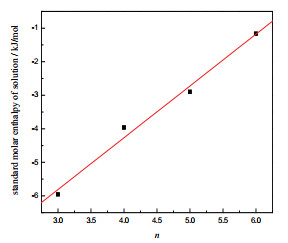
Fig 2
Plot of standard molar enthalpy vs number of carbons (n) in the alkyl chains of [Cnmim][H2PO4] (n= 3, 4, 5, 6)
y = 1.54445n − 10.44467, with s = 0.26947 and r = 0.99.
4 Conclusions
In order to investigate the heat caused by solution process of acidic ILs in desulfurization technology, a series of molar enthalpies of solution of ILs [Cnmim][H2PO4] (n = 3, 4, 5, 6) at various molalities in water were measured by a solution-reaction isoperibol calorimeter at 298.15 K. The molar standard enthalpy of solution of [Cnmim][H2PO4] (n = 3, 4, 5, 6), DsolHm0, were calculated by Pitzer's electrolyte solution theory. The mean contribution per methylene (―CH2―) group to the standard molar enthalpies of solution of [Cnmim][H2PO4] (n = 3, 4, 5, 6) is also obtained as 1.54 kJ∙mol−1, which will give reliable estimation of other IL properties 19-25.
Supporting Information: available free of charge via the internet at http://www.whxb.pku.edu.cn.
参考文献


