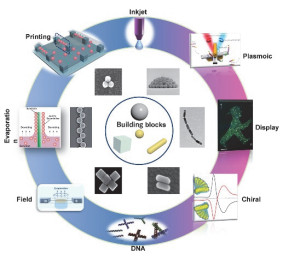
Nanoparticles (NPs) are ideal building blocks for constructing functional materials and devices due to their unique optical, electronic, magnetic, and mechanical properties. The precise assembly and patterning of NPs to obtain ordered structures are vital to explore the special properties of NPs. The specific configurations of large-scale NP assemblies from two-dimensional (2D) NP patterns to one-dimensional (1D) NP arrays on substrates are considered the ideal platform for many technological devices, such as solar cells, magnetic memory, switching devices, and sensing devices, due to their unique transport phenomena and the cooperative properties of NPs in assemblies. Regulation with high-precision control over the orientation and spatial arrangement of nanoarchitecture is required to achieve the coupling and collecting between NPs and thereby translate the properties of the individual NPs to the functions of the macroscopic materials. Therefore, the development of effective methods to build and implement ordered nanocomposites has been accelerated considerably over the last decade. However, due to the complex physics and thermodynamics of the NP assembly, precise control over the orientation and spatial distribution of nanoassemblies with a large area and high homogeneity remains a challenge. In order to tune the position and shape of the NPs into desired structures, a series of strategies and methods have been proposed and developed. These strategies include manipulation of interparticle physical interactions, modification of NP surface chemistry, effect of external fields, utilization of physically or chemically patterned templates, and application of an inkjet printing technique to achieve the desired level of spatial and orientational control over the assembly of NPs. In this paper, we summarized the typical morphologies and the precise control of the architectures prepared by the NPs self-assembly. The particle density, particle size, and interparticle distance of the NP assemblies were strongly controlled. Then the bottom-up strategies for positioning NPs into desired structures with high resolution and considerable throughput were shown. In addition, we discussed the unique functions and diverse applications of the ordered NP assemblies. Both the strong surface plasmon resonance coupling and directional electron transport between particles were studied, which was of highly significance in the development of many technological devices and of great scientific interest. Finally, we investigated the challenges and opportunities of the precise assembly of NPs, which could provide insight and guidance for the future development of functional nanoassembly devices.
Fig 1
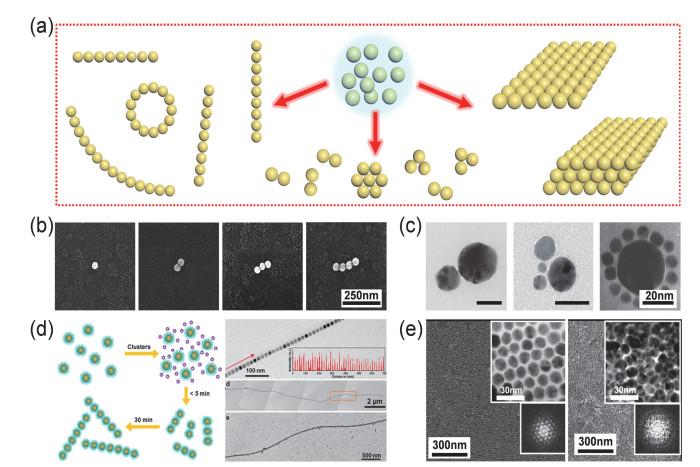
The self-assembly morphology of isotropic nanoparticles
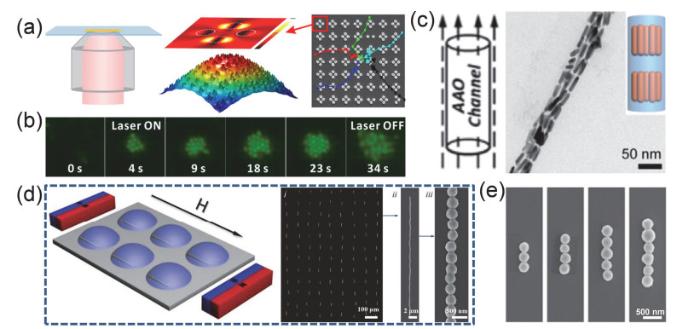
(a) Schematic view of the assembled structures with the isotropic nanoparticles; (b) SEM images of precise assembled structures with controlled gold nanospheres; (c) TEM images of specific plasmonic nanostructures with different nanoparticles; (d) Schematic view and TEM images of the single nanoparticle chain assembled from 15 nm Fe3O4 nanoparticles; (e) SEM and TEM (inset) images of long-range-ordered monolayer assemblies. (b) Reprinted with permission from Ref. 65. Copyright 2011 American Chemical Society. (c) Reprinted with permission from Ref. 67. Copyright 1998 American Chemical Society. (d) Reprinted with permission from Ref. 72. Copyright 2016 American Chemical Society. (e) Reprinted with permission from Ref. 73. Copyright 2007 American Chemical Society.
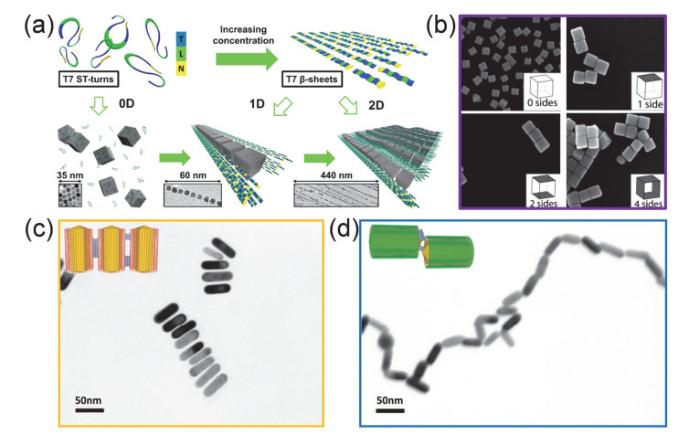
以立方单晶结构为例,各向异性的纳米粒子通常无法以密堆积的方式进行排列(图2a) 90,且由于结构本身的不对称性,立方体会随机排布成如边缘-边缘(edge to edge)、面-面(face to face)、边缘-面(edge to face)等组装形式91。Tao等利用对立方单晶进行亲水聚合物(PEG,PVP)接枝的方法,通过控制接枝聚合物链的长度、接枝密度,实现了对立方体之间取向的精细调控,得到了粒子之间以面-面、边缘-边缘,组装取向均可控制的一维长链结构92。夏幼男课题组在贵金属纳米立方体的合成与组装方面做出了许多代表性的工作93,他们通过对纳米银立方体的表面进行选择性亲疏水修饰,利用疏水作用可以使立方体排列成独特的结构(图2b) 91。对于棒状的纳米粒子,由于其在两个维度上的高度不对称,其自组装形式也较为多样化94-96。对于棒状纳米粒子自组装形貌的精细排布,主要存在两种形式,肩并肩(side by side)与头对头(end to end) 97-102。肩并肩是指棒状纳米粒子以长边垂直于排列方向的形式进行组装,常见于单层条纹图案的组装中103。这是由粒子之间的极化作用与范德华力共同作用的,肩并肩的组装形式相对于头对头的组装而言,是一种更加稳定的热力学状态,因此高径比较大的一维棒状粒子多以肩并肩的方式进行组装104, 105。为了精确控制纳米粒子的组装取向,通常要对纳米粒子的界面与端面进行选择性修饰,改变纳米粒子的表面化学性质。Lavrentovich等通过向带有不同电荷的金纳米棒溶液添加色甘酸二钠分子,使纳米棒的顶面与侧面获得了各向异性的静电作用,实现了对金纳米棒肩并肩与头对头自组装形貌的精准控制(图2c,d) 97。此外对金纳米棒进行巯基或者油酸修饰106-108;或者对纳米粒子的端面进行疏水聚合物包覆,其他部位进行亲水接枝109-111;并利用对溶剂性质的调控也可以实现对棒状粒子的取向与构型的调控112-117。
Fig 2
The self-assembly morphology of anisotropic nanoparticles
(a) Schematic illustration the assembly of Pt cubic nanocrystal in 1D and 2D; (b) SEM images of the assemblies with the silver nanocubes of a mean edge length of (97 ± 6) nm and. The number of faces on each cube that were rendered hydrophobic is indicated in the bottom right corner of each panel, the remaining faces on the cube were rendered hydrophilic. (c) Schematic representations and TEM image of the assembled structures based on side-by-side alignments. (d) Schematic representations and TEM image of the assembled structures based on end-to-end alignments that are created by Au nanorods. (a) Reprinted with permission from Ref. 90. Copyright 2019 American Chemical Society. (b) Reprinted with permission from Ref. 91. Copyright 2008 John Wiley and Sons. (c, d) Reprinted with permission from Ref. 97. Copyright 2008 American Chemical Society.
通过对纳米粒子自组装形貌的精准调控,还可以实现更多高级复杂结构的有效制备118-123。美国密歇根大学Nicholas A. Kotov教授利用半导体纳米粒子的自组装构造了多种复杂组装体。他们利用与蛋白质尺寸以及表面化学结构相近的CdTe纳米粒子实现了自由漂浮的纳米片层组装体的制备124;利用光照对CdTe纳米粒子中Te离子的缓慢氧化作用,实现了一维扭曲结构的组装制备;通过对水溶性CdS纳米颗粒与自约束球形胶囊的结合;在没有添加稳定剂的情况下,通过对溶液内pH值的调控,便可使多分散无机纳米粒子自发组装成多孔纳米壳125。这些研究丰富了无机纳米粒子自组装系统,为纳米粒子组装体的复杂功能化与器件化提供了思路126-128。
Fig 3
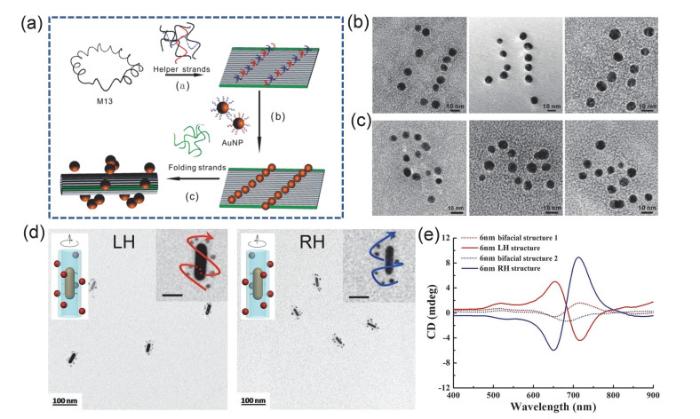
The programming self-assembly of nanoparticles induced by DNA molecular templates
(a) Illustration of the rolling process. (b) TEM images of the rectangular DNA origami dressed with two chains of AuNPs. (c) TEM images of the tubular DNA origami dressed with AuNPs, which form 3D AuNP helices. (d) Left: Schematic model (inset) and corresponding TEM images of the self-assembled LH gold nanorods (AuNRs) and gold nanoparticles (AuNPs) nanostructures. Right: Schematic model (inset) and corresponding TEM images of the self-assembled RH AuNR and AuNP nanostructures. Scale bars in the insets are 25 nm. (e) The measured CD spectra of the LH and RH helical superstructures and the corresponding bifacial structures. (a–c) Reprinted with permission from Ref. 140. Copyright 2012 American Chemical Society. (d, e) Reprinted with permission from Ref. 136. Copyright 2017 John Wiley and Sons.
Fig 4
The precise assembly regulated by the external field
(a, b) The transport and trapping behavior of nanospheres (500 nm in diameter) controlled by optical tweezer in a plasmon enhanced two-dimensional optical lattice. (c) TEM images of AuNRs assembly under parallel EF. Insets are the cartoons showing the assembly of AuNRs. (d) Schematic representation of the assembly of magnetite particles in the presence of a magnetizing field and the large-scale 1D assemblies under magnetic guiding. (e) SEM images of 1D assemblies with controllable particle number. (a, b) Reprinted with permission from Ref. 152. Copyright 2013 American Chemical Society. (c) Reprinted with permission from Ref. 154. Copyright 2016 American Chemical Society. (d, e) Reprinted with permission from Ref. 157. Copyright 2018 John Wiley and Sons.
Fig 5
The regulation of nanoparticles assembly by confining evaporation
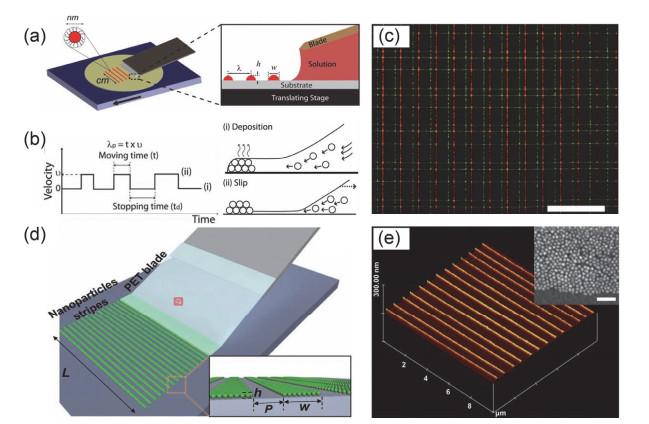
(a) Schematic diagram of the confined evaporation for generating stripe patterns of CdSe QDs on a silicon wafer. (b) The velocity profile of the translation stage for manipulating the stick-and-slip motion of the contact line. Schematic illustration of QD deposition at intermittent stopping times (ⅰ) and slipping of the contact line upon stage translation (ⅱ). (c) A fluorescent microscopy image of grid patterns. Scale bar, 200 μm. (d) Schematic diagram depicting the flexible-blade flow-coating process. Inset: illustration of a NP ribbon. (e) AFM image of OA-QD ribbons showing well-ordered structures. Inset: SEM image of the edge of a NP ribbon showing approximately monolayer particle packing (scale bar: 50 nm). (a–c) Reprinted with permission from Ref. 164. Copyright 2010 John Wiley and Sons. (c) Reprinted with permission from Ref. 165. Copyright 2010 John Wiley and Sons.
Fig 6
The precise assembly of nanoparticles by nanoscale template
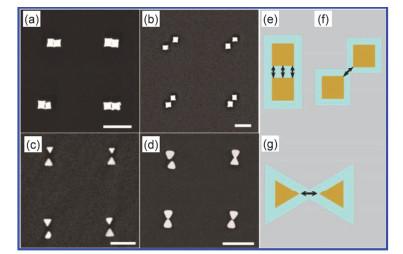
(a-d) Representative SEM images of nanoparticle dimers consisting of concave cubes (a: face-to-face; b: edge-to-edge) and nanoprism bowties (c, d) confined by the topographical templates. Scale bars, 500 nm. (e–g) Schematic drawings of the pulling force to form intimate contact. (a–g) Reprinted with permission from Ref. 172. Copyright 2006 American Chemical Society.
Fig 7
The precise regulation of nanoparticles assembly by microscale template
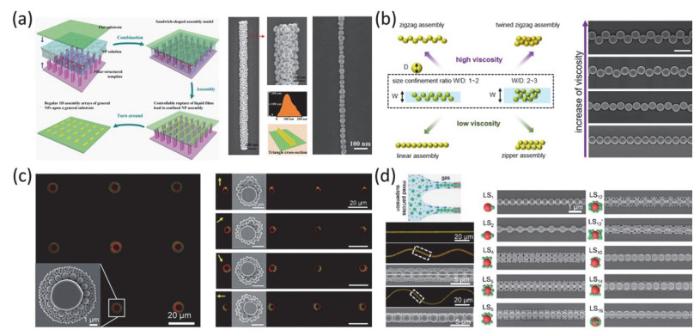
(a) Schematic of the liquid-based nanoparticles assembly induced by the microscale template and SEM images of the assembled morphologies. (b) Schematic of the precise assembly of particles by modulating the viscosity of the system and SEM images from linear to zigzag patterns. Scale bar, 2 μm. (c) The laser scanning confocal microscope images and the inset SEM images show the dual-ring assembly patterns by the co-assembly of binary particles. (d) The programmed co-assembly of one-dimensional binary assembled superstructures and the corresponding SEM images. (a) Reprinted with permission from Ref. 177. Copyright 2014 John Wiley and Sons. (b) Reprinted with permission from Ref. 180. Copyright 2017 John Wiley and Sons. (c) Reprinted with permission from Ref. 181. Copyright 2018 John Wiley and Sons. (d) Reprinted with permission from Ref. 182. Copyright 2017 American Chemical Society.
Fig 8
The fine regulation of 3D nanoparticles assembly by electrohydrodynamic jet printing
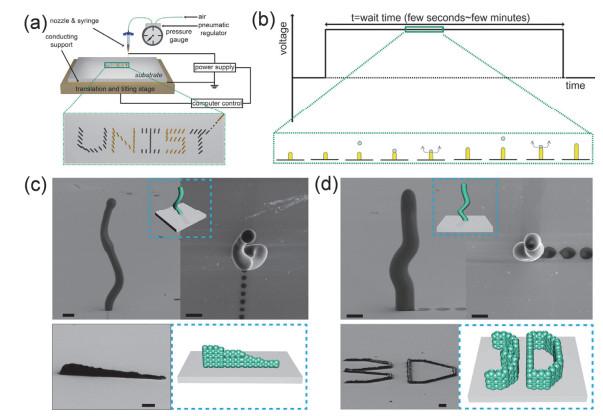
(a) Schematic illustration of electrohydrodynamic jet system. (b) Waveform of applied voltage to print 3D structures. (c-d) SEM images of 3D wall structures made of anthracene and TIPS-pentacene. (c) Side (left) and top (right) views of a helix-shaped anthracene pillar and side (bottom) view of inclined TIPS-pentacene wall. All scale bars are 10 µm. (d) Side (left) and top (right) views of a zigzag-shaped anthracene pillar and side (bottom) view of "3D"-shaped TIPS-pentacene wall. All scale bars are 10 µm. (a–d) Reprinted with permission from Ref. 187. Copyright 2015 John Wiley and Sons.
Fig 9
The precise assembly of particles by controlling the evaporation of droplet
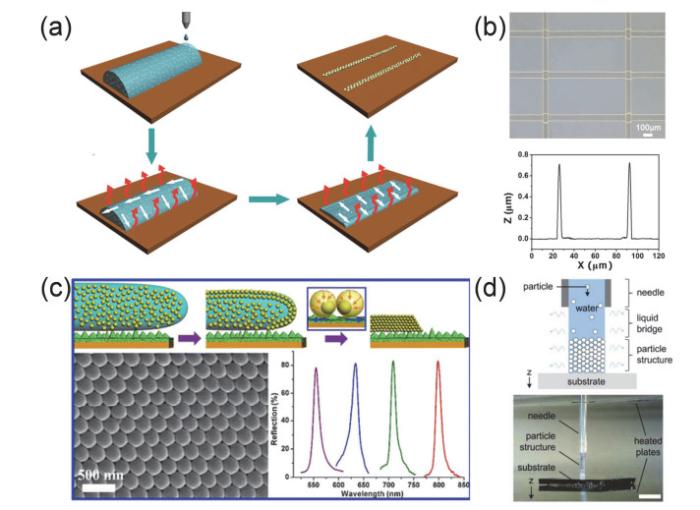
(a, b) Schematic illustration of inkjet printing of silver-nanoparticle patterns induced by the coffee-ring effect and their morphology. (c) The assembly of colloidal photonic crystals with narrow stopbands controlled by the low-adhesive superhydrophobic substrates. (d) Direct-write colloidal assembly of macroscale freestanding colloidal crystal structures. (a-b) Reprinted with permission from Ref. 190. Copyright 2013 John Wiley and Sons. (c) Reprinted with permission from Ref. 191. Copyright 2012 American Chemical Society. (d) Reprinted with permission from Ref. 192. Copyright 2018 John Wiley and Sons.
Fig 10
The optical properties of the precise assemblies and the application in detection
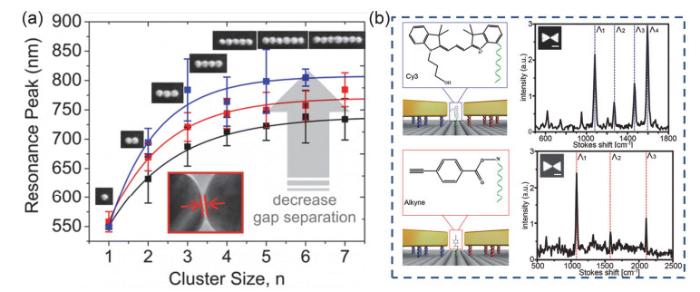
(a) The resonance and corresponding SEM images of 1D clusters of various sizeselectric, magnetic, and Fano-like resonances of different assembled clusters. (b) Unpolarized Raman spectra of individual bowtie nanostructures with two different Raman probe molecules. Scale bars, 50 nm. (a) Reprinted with permission from Ref. 199. Copyright 2013 American Chemical Society. (b) Reprinted with permission from Ref. 201. Copyright 2018 John Wiley and Sons.
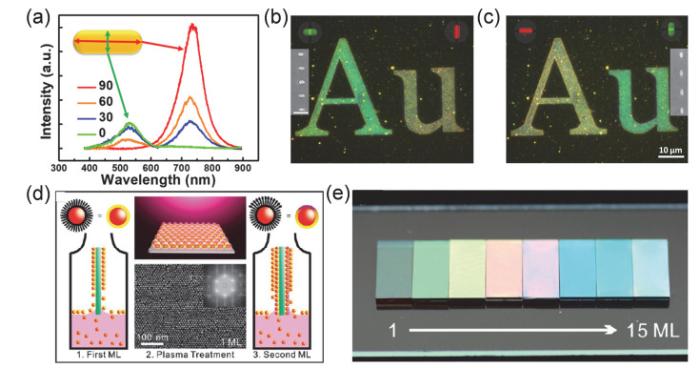
Mulvaney等还将各向异性的金纳米棒粒子利用电泳的方法,精确组装在了PMMA的凹槽结构中。由于金纳米棒在横向与纵向各向异性的特征,所激发的等离激元模式会随偏振光角度的改变而变化,其散射光谱强度会随偏振光的角度的改变而发生明显的迁移。因此通过模板限域对金纳米棒的排列方式进行精准调控,可以实现其在不同偏振光作用下的特异性显示(图11a,c) 202。除了对各向异性纳米粒子等离激元激发模式的调控,各向同性的纳米粒子等离激元的性质也可以实现调控并加以利用。利用层层组装的方法(layer by layer),各向同性的金纳米粒子可以被精确组装为不同厚度的二维薄膜结构(图11d)。金纳米薄膜在层内与层间展现出了完全不同的近场耦合模式。通过对组装层数的精准控制,纳米薄膜的等离激元模式得到了调控,其颜色展现出了的明显的层数依赖性(图11e) 203。
Fig 11
The plasmon excititation modes of the precise assemblies and the application in display
(a) Scattering spectra of a single gold NR at different polarization angles. (b, c) Dark-field images at 0° (left) and 90° (right) polarization angles of the letters "A" and "u" assembled from gold NR arrays with perpendicular orientations. Insets: corresponding scanning electron microscope images of parts of the arrays containing the letters "A" (b) and "u" (c) respectively. Scale bar, 300 nm. (d) Schematic illustration of the plasma-assisted LbL assembly process and SEM image of the first monolayer of Au nanoparticles after plasma treatment. (e) Optical reflection from AgNP (6 nm in diameter) films with thicknesses of 1, 3, 5, 7, 9, 11, 13, and 15 ML in sequence. (a-c) Reprinted with permission from Ref. 202. Copyright 2018 American Chemical Society. (d, e) Reprinted with permission from Ref. 203. Copyright 2010 American Chemical Society.
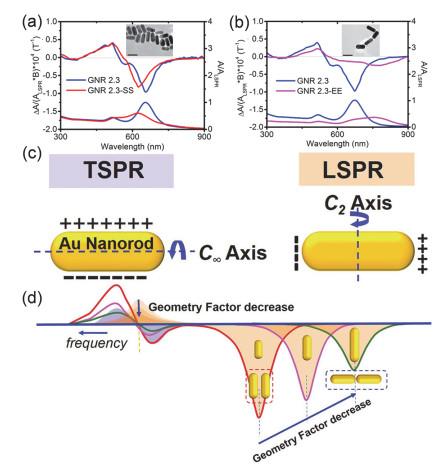
手性作为物体与其镜像不对称的结构特性,是科学界一个非常重要且广泛的研究领域204-206。手性在生物化学、有机化学、催化、药学等多个领域,意义重大207。其中手性超材料凭借优异的光操控能力,使其在偏振控制、负折射率和手性传感等方面受到广泛研究208。利用纳米粒子自组装体的电磁场增强效应可以将手性分子诱导的光学信号放大209-212。利用各向异性的金纳米棒与手性分子构建的自组装结构,可以实现等离子体圆二色(CD)信号的大范围调控213,为研制光学器件提供了新思路。此外国家纳米中心的唐智勇教授还将纳米粒子的精准组装结构应用到了对磁圆信号的调控214。利用对金纳米棒进行有机基团修饰的方法,精准调控了纳米棒肩并肩(SS)与头对头(EE)的组装方式。不同手性的金纳米棒组装体(SS和EE)可以非常敏感地实现对磁圆信号的响应(图12a,b)。这是由于组装体在不同位置的精准调控可以改变金纳米棒在横轴与纵轴方向的有效长度,SS (side by side)组装,增大了金纳米棒的“直径”,而不改变高度,因此降低了组装结构的高径比;而EE (end to end)的组装结构,在不改变粒子直径的基础上增大了金纳米棒的“高度”,放大了组装结构的高径比。而磁圆信号的响应与组装体内部结构的光学对称性和几何因子联系紧密(图12c,d) 215。因此通过对纳米粒子精准组装,可以实现其对磁圆信号的有效调节,为可调谐的磁性等离激元响应以及纳米光学器件的设计开辟新的道路214。
Fig 12
The regulation of magnetic circular dichroism (MCD) by the precise assemblies
(a, b) CD spectra (top curves) and UV-Vis-NIR spectra (bottom curves) of side by side (SS) assembly (red curves in (a)) or end to end assembly (EE) (pink curves in (b)) by GNRs. Blue curves stand for the corresponding spectra of dispersed GNRs, as reference. Inside are TEM images of SS GNR assembly and EE GNR assembly. Scale bars, 50 nm. (c) Scheme showing the symmetry of TSPR (left) or LSPR (right) mode in single gold nanorods. (d) Diagram of the effect of geometry factor on magnetoplasmonic CD signal upon tuning the aspect ratio or assembly conformation. (a–d) Reprinted with permission from Ref. 215. Copyright 2017 American Chemical Society.
... (a) Schematic view of the assembled structures with the isotropic nanoparticles; (b) SEM images of precise assembled structures with controlled gold nanospheres; (c) TEM images of specific plasmonic nanostructures with different nanoparticles; (d) Schematic view and TEM images of the single nanoparticle chain assembled from 15 nm Fe3O4 nanoparticles; (e) SEM and TEM (inset) images of long-range-ordered monolayer assemblies. (b) Reprinted with permission from Ref. 65. Copyright 2011 American Chemical Society. (c) Reprinted with permission from Ref. 67. Copyright 1998 American Chemical Society. (d) Reprinted with permission from Ref. 72. Copyright 2016 American Chemical Society. (e) Reprinted with permission from Ref. 73. Copyright 2007 American Chemical Society. ...
... (a) Schematic view of the assembled structures with the isotropic nanoparticles; (b) SEM images of precise assembled structures with controlled gold nanospheres; (c) TEM images of specific plasmonic nanostructures with different nanoparticles; (d) Schematic view and TEM images of the single nanoparticle chain assembled from 15 nm Fe3O4 nanoparticles; (e) SEM and TEM (inset) images of long-range-ordered monolayer assemblies. (b) Reprinted with permission from Ref. 65. Copyright 2011 American Chemical Society. (c) Reprinted with permission from Ref. 67. Copyright 1998 American Chemical Society. (d) Reprinted with permission from Ref. 72. Copyright 2016 American Chemical Society. (e) Reprinted with permission from Ref. 73. Copyright 2007 American Chemical Society. ...
... (a) Schematic view of the assembled structures with the isotropic nanoparticles; (b) SEM images of precise assembled structures with controlled gold nanospheres; (c) TEM images of specific plasmonic nanostructures with different nanoparticles; (d) Schematic view and TEM images of the single nanoparticle chain assembled from 15 nm Fe3O4 nanoparticles; (e) SEM and TEM (inset) images of long-range-ordered monolayer assemblies. (b) Reprinted with permission from Ref. 65. Copyright 2011 American Chemical Society. (c) Reprinted with permission from Ref. 67. Copyright 1998 American Chemical Society. (d) Reprinted with permission from Ref. 72. Copyright 2016 American Chemical Society. (e) Reprinted with permission from Ref. 73. Copyright 2007 American Chemical Society. ...
... (a) Schematic view of the assembled structures with the isotropic nanoparticles; (b) SEM images of precise assembled structures with controlled gold nanospheres; (c) TEM images of specific plasmonic nanostructures with different nanoparticles; (d) Schematic view and TEM images of the single nanoparticle chain assembled from 15 nm Fe3O4 nanoparticles; (e) SEM and TEM (inset) images of long-range-ordered monolayer assemblies. (b) Reprinted with permission from Ref. 65. Copyright 2011 American Chemical Society. (c) Reprinted with permission from Ref. 67. Copyright 1998 American Chemical Society. (d) Reprinted with permission from Ref. 72. Copyright 2016 American Chemical Society. (e) Reprinted with permission from Ref. 73. Copyright 2007 American Chemical Society. ...
... 以立方单晶结构为例,各向异性的纳米粒子通常无法以密堆积的方式进行排列(图2a) 90,且由于结构本身的不对称性,立方体会随机排布成如边缘-边缘(edge to edge)、面-面(face to face)、边缘-面(edge to face)等组装形式91.Tao等利用对立方单晶进行亲水聚合物(PEG,PVP)接枝的方法,通过控制接枝聚合物链的长度、接枝密度,实现了对立方体之间取向的精细调控,得到了粒子之间以面-面、边缘-边缘,组装取向均可控制的一维长链结构92.夏幼男课题组在贵金属纳米立方体的合成与组装方面做出了许多代表性的工作93,他们通过对纳米银立方体的表面进行选择性亲疏水修饰,利用疏水作用可以使立方体排列成独特的结构(图2b) 91.对于棒状的纳米粒子,由于其在两个维度上的高度不对称,其自组装形式也较为多样化94-96.对于棒状纳米粒子自组装形貌的精细排布,主要存在两种形式,肩并肩(side by side)与头对头(end to end) 97-102.肩并肩是指棒状纳米粒子以长边垂直于排列方向的形式进行组装,常见于单层条纹图案的组装中103.这是由粒子之间的极化作用与范德华力共同作用的,肩并肩的组装形式相对于头对头的组装而言,是一种更加稳定的热力学状态,因此高径比较大的一维棒状粒子多以肩并肩的方式进行组装104, 105.为了精确控制纳米粒子的组装取向,通常要对纳米粒子的界面与端面进行选择性修饰,改变纳米粒子的表面化学性质.Lavrentovich等通过向带有不同电荷的金纳米棒溶液添加色甘酸二钠分子,使纳米棒的顶面与侧面获得了各向异性的静电作用,实现了对金纳米棒肩并肩与头对头自组装形貌的精准控制(图2c,d) 97.此外对金纳米棒进行巯基或者油酸修饰106-108;或者对纳米粒子的端面进行疏水聚合物包覆,其他部位进行亲水接枝109-111;并利用对溶剂性质的调控也可以实现对棒状粒子的取向与构型的调控112-117. ...
... (a) Schematic illustration the assembly of Pt cubic nanocrystal in 1D and 2D; (b) SEM images of the assemblies with the silver nanocubes of a mean edge length of (97 ± 6) nm and. The number of faces on each cube that were rendered hydrophobic is indicated in the bottom right corner of each panel, the remaining faces on the cube were rendered hydrophilic. (c) Schematic representations and TEM image of the assembled structures based on side-by-side alignments. (d) Schematic representations and TEM image of the assembled structures based on end-to-end alignments that are created by Au nanorods. (a) Reprinted with permission from Ref. 90. Copyright 2019 American Chemical Society. (b) Reprinted with permission from Ref. 91. Copyright 2008 John Wiley and Sons. (c, d) Reprinted with permission from Ref. 97. Copyright 2008 American Chemical Society. ...
3
2008
... 以立方单晶结构为例,各向异性的纳米粒子通常无法以密堆积的方式进行排列(图2a) 90,且由于结构本身的不对称性,立方体会随机排布成如边缘-边缘(edge to edge)、面-面(face to face)、边缘-面(edge to face)等组装形式91.Tao等利用对立方单晶进行亲水聚合物(PEG,PVP)接枝的方法,通过控制接枝聚合物链的长度、接枝密度,实现了对立方体之间取向的精细调控,得到了粒子之间以面-面、边缘-边缘,组装取向均可控制的一维长链结构92.夏幼男课题组在贵金属纳米立方体的合成与组装方面做出了许多代表性的工作93,他们通过对纳米银立方体的表面进行选择性亲疏水修饰,利用疏水作用可以使立方体排列成独特的结构(图2b) 91.对于棒状的纳米粒子,由于其在两个维度上的高度不对称,其自组装形式也较为多样化94-96.对于棒状纳米粒子自组装形貌的精细排布,主要存在两种形式,肩并肩(side by side)与头对头(end to end) 97-102.肩并肩是指棒状纳米粒子以长边垂直于排列方向的形式进行组装,常见于单层条纹图案的组装中103.这是由粒子之间的极化作用与范德华力共同作用的,肩并肩的组装形式相对于头对头的组装而言,是一种更加稳定的热力学状态,因此高径比较大的一维棒状粒子多以肩并肩的方式进行组装104, 105.为了精确控制纳米粒子的组装取向,通常要对纳米粒子的界面与端面进行选择性修饰,改变纳米粒子的表面化学性质.Lavrentovich等通过向带有不同电荷的金纳米棒溶液添加色甘酸二钠分子,使纳米棒的顶面与侧面获得了各向异性的静电作用,实现了对金纳米棒肩并肩与头对头自组装形貌的精准控制(图2c,d) 97.此外对金纳米棒进行巯基或者油酸修饰106-108;或者对纳米粒子的端面进行疏水聚合物包覆,其他部位进行亲水接枝109-111;并利用对溶剂性质的调控也可以实现对棒状粒子的取向与构型的调控112-117. ...
... 91.对于棒状的纳米粒子,由于其在两个维度上的高度不对称,其自组装形式也较为多样化94-96.对于棒状纳米粒子自组装形貌的精细排布,主要存在两种形式,肩并肩(side by side)与头对头(end to end) 97-102.肩并肩是指棒状纳米粒子以长边垂直于排列方向的形式进行组装,常见于单层条纹图案的组装中103.这是由粒子之间的极化作用与范德华力共同作用的,肩并肩的组装形式相对于头对头的组装而言,是一种更加稳定的热力学状态,因此高径比较大的一维棒状粒子多以肩并肩的方式进行组装104, 105.为了精确控制纳米粒子的组装取向,通常要对纳米粒子的界面与端面进行选择性修饰,改变纳米粒子的表面化学性质.Lavrentovich等通过向带有不同电荷的金纳米棒溶液添加色甘酸二钠分子,使纳米棒的顶面与侧面获得了各向异性的静电作用,实现了对金纳米棒肩并肩与头对头自组装形貌的精准控制(图2c,d) 97.此外对金纳米棒进行巯基或者油酸修饰106-108;或者对纳米粒子的端面进行疏水聚合物包覆,其他部位进行亲水接枝109-111;并利用对溶剂性质的调控也可以实现对棒状粒子的取向与构型的调控112-117. ...
... (a) Schematic illustration the assembly of Pt cubic nanocrystal in 1D and 2D; (b) SEM images of the assemblies with the silver nanocubes of a mean edge length of (97 ± 6) nm and. The number of faces on each cube that were rendered hydrophobic is indicated in the bottom right corner of each panel, the remaining faces on the cube were rendered hydrophilic. (c) Schematic representations and TEM image of the assembled structures based on side-by-side alignments. (d) Schematic representations and TEM image of the assembled structures based on end-to-end alignments that are created by Au nanorods. (a) Reprinted with permission from Ref. 90. Copyright 2019 American Chemical Society. (b) Reprinted with permission from Ref. 91. Copyright 2008 John Wiley and Sons. (c, d) Reprinted with permission from Ref. 97. Copyright 2008 American Chemical Society. ...
1
2012
... 以立方单晶结构为例,各向异性的纳米粒子通常无法以密堆积的方式进行排列(图2a) 90,且由于结构本身的不对称性,立方体会随机排布成如边缘-边缘(edge to edge)、面-面(face to face)、边缘-面(edge to face)等组装形式91.Tao等利用对立方单晶进行亲水聚合物(PEG,PVP)接枝的方法,通过控制接枝聚合物链的长度、接枝密度,实现了对立方体之间取向的精细调控,得到了粒子之间以面-面、边缘-边缘,组装取向均可控制的一维长链结构92.夏幼男课题组在贵金属纳米立方体的合成与组装方面做出了许多代表性的工作93,他们通过对纳米银立方体的表面进行选择性亲疏水修饰,利用疏水作用可以使立方体排列成独特的结构(图2b) 91.对于棒状的纳米粒子,由于其在两个维度上的高度不对称,其自组装形式也较为多样化94-96.对于棒状纳米粒子自组装形貌的精细排布,主要存在两种形式,肩并肩(side by side)与头对头(end to end) 97-102.肩并肩是指棒状纳米粒子以长边垂直于排列方向的形式进行组装,常见于单层条纹图案的组装中103.这是由粒子之间的极化作用与范德华力共同作用的,肩并肩的组装形式相对于头对头的组装而言,是一种更加稳定的热力学状态,因此高径比较大的一维棒状粒子多以肩并肩的方式进行组装104, 105.为了精确控制纳米粒子的组装取向,通常要对纳米粒子的界面与端面进行选择性修饰,改变纳米粒子的表面化学性质.Lavrentovich等通过向带有不同电荷的金纳米棒溶液添加色甘酸二钠分子,使纳米棒的顶面与侧面获得了各向异性的静电作用,实现了对金纳米棒肩并肩与头对头自组装形貌的精准控制(图2c,d) 97.此外对金纳米棒进行巯基或者油酸修饰106-108;或者对纳米粒子的端面进行疏水聚合物包覆,其他部位进行亲水接枝109-111;并利用对溶剂性质的调控也可以实现对棒状粒子的取向与构型的调控112-117. ...
1
2002
... 以立方单晶结构为例,各向异性的纳米粒子通常无法以密堆积的方式进行排列(图2a) 90,且由于结构本身的不对称性,立方体会随机排布成如边缘-边缘(edge to edge)、面-面(face to face)、边缘-面(edge to face)等组装形式91.Tao等利用对立方单晶进行亲水聚合物(PEG,PVP)接枝的方法,通过控制接枝聚合物链的长度、接枝密度,实现了对立方体之间取向的精细调控,得到了粒子之间以面-面、边缘-边缘,组装取向均可控制的一维长链结构92.夏幼男课题组在贵金属纳米立方体的合成与组装方面做出了许多代表性的工作93,他们通过对纳米银立方体的表面进行选择性亲疏水修饰,利用疏水作用可以使立方体排列成独特的结构(图2b) 91.对于棒状的纳米粒子,由于其在两个维度上的高度不对称,其自组装形式也较为多样化94-96.对于棒状纳米粒子自组装形貌的精细排布,主要存在两种形式,肩并肩(side by side)与头对头(end to end) 97-102.肩并肩是指棒状纳米粒子以长边垂直于排列方向的形式进行组装,常见于单层条纹图案的组装中103.这是由粒子之间的极化作用与范德华力共同作用的,肩并肩的组装形式相对于头对头的组装而言,是一种更加稳定的热力学状态,因此高径比较大的一维棒状粒子多以肩并肩的方式进行组装104, 105.为了精确控制纳米粒子的组装取向,通常要对纳米粒子的界面与端面进行选择性修饰,改变纳米粒子的表面化学性质.Lavrentovich等通过向带有不同电荷的金纳米棒溶液添加色甘酸二钠分子,使纳米棒的顶面与侧面获得了各向异性的静电作用,实现了对金纳米棒肩并肩与头对头自组装形貌的精准控制(图2c,d) 97.此外对金纳米棒进行巯基或者油酸修饰106-108;或者对纳米粒子的端面进行疏水聚合物包覆,其他部位进行亲水接枝109-111;并利用对溶剂性质的调控也可以实现对棒状粒子的取向与构型的调控112-117. ...
1
2009
... 以立方单晶结构为例,各向异性的纳米粒子通常无法以密堆积的方式进行排列(图2a) 90,且由于结构本身的不对称性,立方体会随机排布成如边缘-边缘(edge to edge)、面-面(face to face)、边缘-面(edge to face)等组装形式91.Tao等利用对立方单晶进行亲水聚合物(PEG,PVP)接枝的方法,通过控制接枝聚合物链的长度、接枝密度,实现了对立方体之间取向的精细调控,得到了粒子之间以面-面、边缘-边缘,组装取向均可控制的一维长链结构92.夏幼男课题组在贵金属纳米立方体的合成与组装方面做出了许多代表性的工作93,他们通过对纳米银立方体的表面进行选择性亲疏水修饰,利用疏水作用可以使立方体排列成独特的结构(图2b) 91.对于棒状的纳米粒子,由于其在两个维度上的高度不对称,其自组装形式也较为多样化94-96.对于棒状纳米粒子自组装形貌的精细排布,主要存在两种形式,肩并肩(side by side)与头对头(end to end) 97-102.肩并肩是指棒状纳米粒子以长边垂直于排列方向的形式进行组装,常见于单层条纹图案的组装中103.这是由粒子之间的极化作用与范德华力共同作用的,肩并肩的组装形式相对于头对头的组装而言,是一种更加稳定的热力学状态,因此高径比较大的一维棒状粒子多以肩并肩的方式进行组装104, 105.为了精确控制纳米粒子的组装取向,通常要对纳米粒子的界面与端面进行选择性修饰,改变纳米粒子的表面化学性质.Lavrentovich等通过向带有不同电荷的金纳米棒溶液添加色甘酸二钠分子,使纳米棒的顶面与侧面获得了各向异性的静电作用,实现了对金纳米棒肩并肩与头对头自组装形貌的精准控制(图2c,d) 97.此外对金纳米棒进行巯基或者油酸修饰106-108;或者对纳米粒子的端面进行疏水聚合物包覆,其他部位进行亲水接枝109-111;并利用对溶剂性质的调控也可以实现对棒状粒子的取向与构型的调控112-117. ...
0
2013
1
2010
... 以立方单晶结构为例,各向异性的纳米粒子通常无法以密堆积的方式进行排列(图2a) 90,且由于结构本身的不对称性,立方体会随机排布成如边缘-边缘(edge to edge)、面-面(face to face)、边缘-面(edge to face)等组装形式91.Tao等利用对立方单晶进行亲水聚合物(PEG,PVP)接枝的方法,通过控制接枝聚合物链的长度、接枝密度,实现了对立方体之间取向的精细调控,得到了粒子之间以面-面、边缘-边缘,组装取向均可控制的一维长链结构92.夏幼男课题组在贵金属纳米立方体的合成与组装方面做出了许多代表性的工作93,他们通过对纳米银立方体的表面进行选择性亲疏水修饰,利用疏水作用可以使立方体排列成独特的结构(图2b) 91.对于棒状的纳米粒子,由于其在两个维度上的高度不对称,其自组装形式也较为多样化94-96.对于棒状纳米粒子自组装形貌的精细排布,主要存在两种形式,肩并肩(side by side)与头对头(end to end) 97-102.肩并肩是指棒状纳米粒子以长边垂直于排列方向的形式进行组装,常见于单层条纹图案的组装中103.这是由粒子之间的极化作用与范德华力共同作用的,肩并肩的组装形式相对于头对头的组装而言,是一种更加稳定的热力学状态,因此高径比较大的一维棒状粒子多以肩并肩的方式进行组装104, 105.为了精确控制纳米粒子的组装取向,通常要对纳米粒子的界面与端面进行选择性修饰,改变纳米粒子的表面化学性质.Lavrentovich等通过向带有不同电荷的金纳米棒溶液添加色甘酸二钠分子,使纳米棒的顶面与侧面获得了各向异性的静电作用,实现了对金纳米棒肩并肩与头对头自组装形貌的精准控制(图2c,d) 97.此外对金纳米棒进行巯基或者油酸修饰106-108;或者对纳米粒子的端面进行疏水聚合物包覆,其他部位进行亲水接枝109-111;并利用对溶剂性质的调控也可以实现对棒状粒子的取向与构型的调控112-117. ...
3
2008
... 以立方单晶结构为例,各向异性的纳米粒子通常无法以密堆积的方式进行排列(图2a) 90,且由于结构本身的不对称性,立方体会随机排布成如边缘-边缘(edge to edge)、面-面(face to face)、边缘-面(edge to face)等组装形式91.Tao等利用对立方单晶进行亲水聚合物(PEG,PVP)接枝的方法,通过控制接枝聚合物链的长度、接枝密度,实现了对立方体之间取向的精细调控,得到了粒子之间以面-面、边缘-边缘,组装取向均可控制的一维长链结构92.夏幼男课题组在贵金属纳米立方体的合成与组装方面做出了许多代表性的工作93,他们通过对纳米银立方体的表面进行选择性亲疏水修饰,利用疏水作用可以使立方体排列成独特的结构(图2b) 91.对于棒状的纳米粒子,由于其在两个维度上的高度不对称,其自组装形式也较为多样化94-96.对于棒状纳米粒子自组装形貌的精细排布,主要存在两种形式,肩并肩(side by side)与头对头(end to end) 97-102.肩并肩是指棒状纳米粒子以长边垂直于排列方向的形式进行组装,常见于单层条纹图案的组装中103.这是由粒子之间的极化作用与范德华力共同作用的,肩并肩的组装形式相对于头对头的组装而言,是一种更加稳定的热力学状态,因此高径比较大的一维棒状粒子多以肩并肩的方式进行组装104, 105.为了精确控制纳米粒子的组装取向,通常要对纳米粒子的界面与端面进行选择性修饰,改变纳米粒子的表面化学性质.Lavrentovich等通过向带有不同电荷的金纳米棒溶液添加色甘酸二钠分子,使纳米棒的顶面与侧面获得了各向异性的静电作用,实现了对金纳米棒肩并肩与头对头自组装形貌的精准控制(图2c,d) 97.此外对金纳米棒进行巯基或者油酸修饰106-108;或者对纳米粒子的端面进行疏水聚合物包覆,其他部位进行亲水接枝109-111;并利用对溶剂性质的调控也可以实现对棒状粒子的取向与构型的调控112-117. ...
... (a) Schematic illustration the assembly of Pt cubic nanocrystal in 1D and 2D; (b) SEM images of the assemblies with the silver nanocubes of a mean edge length of (97 ± 6) nm and. The number of faces on each cube that were rendered hydrophobic is indicated in the bottom right corner of each panel, the remaining faces on the cube were rendered hydrophilic. (c) Schematic representations and TEM image of the assembled structures based on side-by-side alignments. (d) Schematic representations and TEM image of the assembled structures based on end-to-end alignments that are created by Au nanorods. (a) Reprinted with permission from Ref. 90. Copyright 2019 American Chemical Society. (b) Reprinted with permission from Ref. 91. Copyright 2008 John Wiley and Sons. (c, d) Reprinted with permission from Ref. 97. Copyright 2008 American Chemical Society. ...
0
2010
0
2005
0
2009
0
2005
1
2011
... 以立方单晶结构为例,各向异性的纳米粒子通常无法以密堆积的方式进行排列(图2a) 90,且由于结构本身的不对称性,立方体会随机排布成如边缘-边缘(edge to edge)、面-面(face to face)、边缘-面(edge to face)等组装形式91.Tao等利用对立方单晶进行亲水聚合物(PEG,PVP)接枝的方法,通过控制接枝聚合物链的长度、接枝密度,实现了对立方体之间取向的精细调控,得到了粒子之间以面-面、边缘-边缘,组装取向均可控制的一维长链结构92.夏幼男课题组在贵金属纳米立方体的合成与组装方面做出了许多代表性的工作93,他们通过对纳米银立方体的表面进行选择性亲疏水修饰,利用疏水作用可以使立方体排列成独特的结构(图2b) 91.对于棒状的纳米粒子,由于其在两个维度上的高度不对称,其自组装形式也较为多样化94-96.对于棒状纳米粒子自组装形貌的精细排布,主要存在两种形式,肩并肩(side by side)与头对头(end to end) 97-102.肩并肩是指棒状纳米粒子以长边垂直于排列方向的形式进行组装,常见于单层条纹图案的组装中103.这是由粒子之间的极化作用与范德华力共同作用的,肩并肩的组装形式相对于头对头的组装而言,是一种更加稳定的热力学状态,因此高径比较大的一维棒状粒子多以肩并肩的方式进行组装104, 105.为了精确控制纳米粒子的组装取向,通常要对纳米粒子的界面与端面进行选择性修饰,改变纳米粒子的表面化学性质.Lavrentovich等通过向带有不同电荷的金纳米棒溶液添加色甘酸二钠分子,使纳米棒的顶面与侧面获得了各向异性的静电作用,实现了对金纳米棒肩并肩与头对头自组装形貌的精准控制(图2c,d) 97.此外对金纳米棒进行巯基或者油酸修饰106-108;或者对纳米粒子的端面进行疏水聚合物包覆,其他部位进行亲水接枝109-111;并利用对溶剂性质的调控也可以实现对棒状粒子的取向与构型的调控112-117. ...
1
2006
... 以立方单晶结构为例,各向异性的纳米粒子通常无法以密堆积的方式进行排列(图2a) 90,且由于结构本身的不对称性,立方体会随机排布成如边缘-边缘(edge to edge)、面-面(face to face)、边缘-面(edge to face)等组装形式91.Tao等利用对立方单晶进行亲水聚合物(PEG,PVP)接枝的方法,通过控制接枝聚合物链的长度、接枝密度,实现了对立方体之间取向的精细调控,得到了粒子之间以面-面、边缘-边缘,组装取向均可控制的一维长链结构92.夏幼男课题组在贵金属纳米立方体的合成与组装方面做出了许多代表性的工作93,他们通过对纳米银立方体的表面进行选择性亲疏水修饰,利用疏水作用可以使立方体排列成独特的结构(图2b) 91.对于棒状的纳米粒子,由于其在两个维度上的高度不对称,其自组装形式也较为多样化94-96.对于棒状纳米粒子自组装形貌的精细排布,主要存在两种形式,肩并肩(side by side)与头对头(end to end) 97-102.肩并肩是指棒状纳米粒子以长边垂直于排列方向的形式进行组装,常见于单层条纹图案的组装中103.这是由粒子之间的极化作用与范德华力共同作用的,肩并肩的组装形式相对于头对头的组装而言,是一种更加稳定的热力学状态,因此高径比较大的一维棒状粒子多以肩并肩的方式进行组装104, 105.为了精确控制纳米粒子的组装取向,通常要对纳米粒子的界面与端面进行选择性修饰,改变纳米粒子的表面化学性质.Lavrentovich等通过向带有不同电荷的金纳米棒溶液添加色甘酸二钠分子,使纳米棒的顶面与侧面获得了各向异性的静电作用,实现了对金纳米棒肩并肩与头对头自组装形貌的精准控制(图2c,d) 97.此外对金纳米棒进行巯基或者油酸修饰106-108;或者对纳米粒子的端面进行疏水聚合物包覆,其他部位进行亲水接枝109-111;并利用对溶剂性质的调控也可以实现对棒状粒子的取向与构型的调控112-117. ...
1
2011
... 以立方单晶结构为例,各向异性的纳米粒子通常无法以密堆积的方式进行排列(图2a) 90,且由于结构本身的不对称性,立方体会随机排布成如边缘-边缘(edge to edge)、面-面(face to face)、边缘-面(edge to face)等组装形式91.Tao等利用对立方单晶进行亲水聚合物(PEG,PVP)接枝的方法,通过控制接枝聚合物链的长度、接枝密度,实现了对立方体之间取向的精细调控,得到了粒子之间以面-面、边缘-边缘,组装取向均可控制的一维长链结构92.夏幼男课题组在贵金属纳米立方体的合成与组装方面做出了许多代表性的工作93,他们通过对纳米银立方体的表面进行选择性亲疏水修饰,利用疏水作用可以使立方体排列成独特的结构(图2b) 91.对于棒状的纳米粒子,由于其在两个维度上的高度不对称,其自组装形式也较为多样化94-96.对于棒状纳米粒子自组装形貌的精细排布,主要存在两种形式,肩并肩(side by side)与头对头(end to end) 97-102.肩并肩是指棒状纳米粒子以长边垂直于排列方向的形式进行组装,常见于单层条纹图案的组装中103.这是由粒子之间的极化作用与范德华力共同作用的,肩并肩的组装形式相对于头对头的组装而言,是一种更加稳定的热力学状态,因此高径比较大的一维棒状粒子多以肩并肩的方式进行组装104, 105.为了精确控制纳米粒子的组装取向,通常要对纳米粒子的界面与端面进行选择性修饰,改变纳米粒子的表面化学性质.Lavrentovich等通过向带有不同电荷的金纳米棒溶液添加色甘酸二钠分子,使纳米棒的顶面与侧面获得了各向异性的静电作用,实现了对金纳米棒肩并肩与头对头自组装形貌的精准控制(图2c,d) 97.此外对金纳米棒进行巯基或者油酸修饰106-108;或者对纳米粒子的端面进行疏水聚合物包覆,其他部位进行亲水接枝109-111;并利用对溶剂性质的调控也可以实现对棒状粒子的取向与构型的调控112-117. ...
1
2009
... 以立方单晶结构为例,各向异性的纳米粒子通常无法以密堆积的方式进行排列(图2a) 90,且由于结构本身的不对称性,立方体会随机排布成如边缘-边缘(edge to edge)、面-面(face to face)、边缘-面(edge to face)等组装形式91.Tao等利用对立方单晶进行亲水聚合物(PEG,PVP)接枝的方法,通过控制接枝聚合物链的长度、接枝密度,实现了对立方体之间取向的精细调控,得到了粒子之间以面-面、边缘-边缘,组装取向均可控制的一维长链结构92.夏幼男课题组在贵金属纳米立方体的合成与组装方面做出了许多代表性的工作93,他们通过对纳米银立方体的表面进行选择性亲疏水修饰,利用疏水作用可以使立方体排列成独特的结构(图2b) 91.对于棒状的纳米粒子,由于其在两个维度上的高度不对称,其自组装形式也较为多样化94-96.对于棒状纳米粒子自组装形貌的精细排布,主要存在两种形式,肩并肩(side by side)与头对头(end to end) 97-102.肩并肩是指棒状纳米粒子以长边垂直于排列方向的形式进行组装,常见于单层条纹图案的组装中103.这是由粒子之间的极化作用与范德华力共同作用的,肩并肩的组装形式相对于头对头的组装而言,是一种更加稳定的热力学状态,因此高径比较大的一维棒状粒子多以肩并肩的方式进行组装104, 105.为了精确控制纳米粒子的组装取向,通常要对纳米粒子的界面与端面进行选择性修饰,改变纳米粒子的表面化学性质.Lavrentovich等通过向带有不同电荷的金纳米棒溶液添加色甘酸二钠分子,使纳米棒的顶面与侧面获得了各向异性的静电作用,实现了对金纳米棒肩并肩与头对头自组装形貌的精准控制(图2c,d) 97.此外对金纳米棒进行巯基或者油酸修饰106-108;或者对纳米粒子的端面进行疏水聚合物包覆,其他部位进行亲水接枝109-111;并利用对溶剂性质的调控也可以实现对棒状粒子的取向与构型的调控112-117. ...
1
2014
... 以立方单晶结构为例,各向异性的纳米粒子通常无法以密堆积的方式进行排列(图2a) 90,且由于结构本身的不对称性,立方体会随机排布成如边缘-边缘(edge to edge)、面-面(face to face)、边缘-面(edge to face)等组装形式91.Tao等利用对立方单晶进行亲水聚合物(PEG,PVP)接枝的方法,通过控制接枝聚合物链的长度、接枝密度,实现了对立方体之间取向的精细调控,得到了粒子之间以面-面、边缘-边缘,组装取向均可控制的一维长链结构92.夏幼男课题组在贵金属纳米立方体的合成与组装方面做出了许多代表性的工作93,他们通过对纳米银立方体的表面进行选择性亲疏水修饰,利用疏水作用可以使立方体排列成独特的结构(图2b) 91.对于棒状的纳米粒子,由于其在两个维度上的高度不对称,其自组装形式也较为多样化94-96.对于棒状纳米粒子自组装形貌的精细排布,主要存在两种形式,肩并肩(side by side)与头对头(end to end) 97-102.肩并肩是指棒状纳米粒子以长边垂直于排列方向的形式进行组装,常见于单层条纹图案的组装中103.这是由粒子之间的极化作用与范德华力共同作用的,肩并肩的组装形式相对于头对头的组装而言,是一种更加稳定的热力学状态,因此高径比较大的一维棒状粒子多以肩并肩的方式进行组装104, 105.为了精确控制纳米粒子的组装取向,通常要对纳米粒子的界面与端面进行选择性修饰,改变纳米粒子的表面化学性质.Lavrentovich等通过向带有不同电荷的金纳米棒溶液添加色甘酸二钠分子,使纳米棒的顶面与侧面获得了各向异性的静电作用,实现了对金纳米棒肩并肩与头对头自组装形貌的精准控制(图2c,d) 97.此外对金纳米棒进行巯基或者油酸修饰106-108;或者对纳米粒子的端面进行疏水聚合物包覆,其他部位进行亲水接枝109-111;并利用对溶剂性质的调控也可以实现对棒状粒子的取向与构型的调控112-117. ...
0
2012
1
2008
... 以立方单晶结构为例,各向异性的纳米粒子通常无法以密堆积的方式进行排列(图2a) 90,且由于结构本身的不对称性,立方体会随机排布成如边缘-边缘(edge to edge)、面-面(face to face)、边缘-面(edge to face)等组装形式91.Tao等利用对立方单晶进行亲水聚合物(PEG,PVP)接枝的方法,通过控制接枝聚合物链的长度、接枝密度,实现了对立方体之间取向的精细调控,得到了粒子之间以面-面、边缘-边缘,组装取向均可控制的一维长链结构92.夏幼男课题组在贵金属纳米立方体的合成与组装方面做出了许多代表性的工作93,他们通过对纳米银立方体的表面进行选择性亲疏水修饰,利用疏水作用可以使立方体排列成独特的结构(图2b) 91.对于棒状的纳米粒子,由于其在两个维度上的高度不对称,其自组装形式也较为多样化94-96.对于棒状纳米粒子自组装形貌的精细排布,主要存在两种形式,肩并肩(side by side)与头对头(end to end) 97-102.肩并肩是指棒状纳米粒子以长边垂直于排列方向的形式进行组装,常见于单层条纹图案的组装中103.这是由粒子之间的极化作用与范德华力共同作用的,肩并肩的组装形式相对于头对头的组装而言,是一种更加稳定的热力学状态,因此高径比较大的一维棒状粒子多以肩并肩的方式进行组装104, 105.为了精确控制纳米粒子的组装取向,通常要对纳米粒子的界面与端面进行选择性修饰,改变纳米粒子的表面化学性质.Lavrentovich等通过向带有不同电荷的金纳米棒溶液添加色甘酸二钠分子,使纳米棒的顶面与侧面获得了各向异性的静电作用,实现了对金纳米棒肩并肩与头对头自组装形貌的精准控制(图2c,d) 97.此外对金纳米棒进行巯基或者油酸修饰106-108;或者对纳米粒子的端面进行疏水聚合物包覆,其他部位进行亲水接枝109-111;并利用对溶剂性质的调控也可以实现对棒状粒子的取向与构型的调控112-117. ...
1
2005
... 以立方单晶结构为例,各向异性的纳米粒子通常无法以密堆积的方式进行排列(图2a) 90,且由于结构本身的不对称性,立方体会随机排布成如边缘-边缘(edge to edge)、面-面(face to face)、边缘-面(edge to face)等组装形式91.Tao等利用对立方单晶进行亲水聚合物(PEG,PVP)接枝的方法,通过控制接枝聚合物链的长度、接枝密度,实现了对立方体之间取向的精细调控,得到了粒子之间以面-面、边缘-边缘,组装取向均可控制的一维长链结构92.夏幼男课题组在贵金属纳米立方体的合成与组装方面做出了许多代表性的工作93,他们通过对纳米银立方体的表面进行选择性亲疏水修饰,利用疏水作用可以使立方体排列成独特的结构(图2b) 91.对于棒状的纳米粒子,由于其在两个维度上的高度不对称,其自组装形式也较为多样化94-96.对于棒状纳米粒子自组装形貌的精细排布,主要存在两种形式,肩并肩(side by side)与头对头(end to end) 97-102.肩并肩是指棒状纳米粒子以长边垂直于排列方向的形式进行组装,常见于单层条纹图案的组装中103.这是由粒子之间的极化作用与范德华力共同作用的,肩并肩的组装形式相对于头对头的组装而言,是一种更加稳定的热力学状态,因此高径比较大的一维棒状粒子多以肩并肩的方式进行组装104, 105.为了精确控制纳米粒子的组装取向,通常要对纳米粒子的界面与端面进行选择性修饰,改变纳米粒子的表面化学性质.Lavrentovich等通过向带有不同电荷的金纳米棒溶液添加色甘酸二钠分子,使纳米棒的顶面与侧面获得了各向异性的静电作用,实现了对金纳米棒肩并肩与头对头自组装形貌的精准控制(图2c,d) 97.此外对金纳米棒进行巯基或者油酸修饰106-108;或者对纳米粒子的端面进行疏水聚合物包覆,其他部位进行亲水接枝109-111;并利用对溶剂性质的调控也可以实现对棒状粒子的取向与构型的调控112-117. ...
0
2005
1
2012
... 以立方单晶结构为例,各向异性的纳米粒子通常无法以密堆积的方式进行排列(图2a) 90,且由于结构本身的不对称性,立方体会随机排布成如边缘-边缘(edge to edge)、面-面(face to face)、边缘-面(edge to face)等组装形式91.Tao等利用对立方单晶进行亲水聚合物(PEG,PVP)接枝的方法,通过控制接枝聚合物链的长度、接枝密度,实现了对立方体之间取向的精细调控,得到了粒子之间以面-面、边缘-边缘,组装取向均可控制的一维长链结构92.夏幼男课题组在贵金属纳米立方体的合成与组装方面做出了许多代表性的工作93,他们通过对纳米银立方体的表面进行选择性亲疏水修饰,利用疏水作用可以使立方体排列成独特的结构(图2b) 91.对于棒状的纳米粒子,由于其在两个维度上的高度不对称,其自组装形式也较为多样化94-96.对于棒状纳米粒子自组装形貌的精细排布,主要存在两种形式,肩并肩(side by side)与头对头(end to end) 97-102.肩并肩是指棒状纳米粒子以长边垂直于排列方向的形式进行组装,常见于单层条纹图案的组装中103.这是由粒子之间的极化作用与范德华力共同作用的,肩并肩的组装形式相对于头对头的组装而言,是一种更加稳定的热力学状态,因此高径比较大的一维棒状粒子多以肩并肩的方式进行组装104, 105.为了精确控制纳米粒子的组装取向,通常要对纳米粒子的界面与端面进行选择性修饰,改变纳米粒子的表面化学性质.Lavrentovich等通过向带有不同电荷的金纳米棒溶液添加色甘酸二钠分子,使纳米棒的顶面与侧面获得了各向异性的静电作用,实现了对金纳米棒肩并肩与头对头自组装形貌的精准控制(图2c,d) 97.此外对金纳米棒进行巯基或者油酸修饰106-108;或者对纳米粒子的端面进行疏水聚合物包覆,其他部位进行亲水接枝109-111;并利用对溶剂性质的调控也可以实现对棒状粒子的取向与构型的调控112-117. ...
1
2007
... 以立方单晶结构为例,各向异性的纳米粒子通常无法以密堆积的方式进行排列(图2a) 90,且由于结构本身的不对称性,立方体会随机排布成如边缘-边缘(edge to edge)、面-面(face to face)、边缘-面(edge to face)等组装形式91.Tao等利用对立方单晶进行亲水聚合物(PEG,PVP)接枝的方法,通过控制接枝聚合物链的长度、接枝密度,实现了对立方体之间取向的精细调控,得到了粒子之间以面-面、边缘-边缘,组装取向均可控制的一维长链结构92.夏幼男课题组在贵金属纳米立方体的合成与组装方面做出了许多代表性的工作93,他们通过对纳米银立方体的表面进行选择性亲疏水修饰,利用疏水作用可以使立方体排列成独特的结构(图2b) 91.对于棒状的纳米粒子,由于其在两个维度上的高度不对称,其自组装形式也较为多样化94-96.对于棒状纳米粒子自组装形貌的精细排布,主要存在两种形式,肩并肩(side by side)与头对头(end to end) 97-102.肩并肩是指棒状纳米粒子以长边垂直于排列方向的形式进行组装,常见于单层条纹图案的组装中103.这是由粒子之间的极化作用与范德华力共同作用的,肩并肩的组装形式相对于头对头的组装而言,是一种更加稳定的热力学状态,因此高径比较大的一维棒状粒子多以肩并肩的方式进行组装104, 105.为了精确控制纳米粒子的组装取向,通常要对纳米粒子的界面与端面进行选择性修饰,改变纳米粒子的表面化学性质.Lavrentovich等通过向带有不同电荷的金纳米棒溶液添加色甘酸二钠分子,使纳米棒的顶面与侧面获得了各向异性的静电作用,实现了对金纳米棒肩并肩与头对头自组装形貌的精准控制(图2c,d) 97.此外对金纳米棒进行巯基或者油酸修饰106-108;或者对纳米粒子的端面进行疏水聚合物包覆,其他部位进行亲水接枝109-111;并利用对溶剂性质的调控也可以实现对棒状粒子的取向与构型的调控112-117. ...
0
2001
0
2003
0
2010
0
2007
1
2014
... 以立方单晶结构为例,各向异性的纳米粒子通常无法以密堆积的方式进行排列(图2a) 90,且由于结构本身的不对称性,立方体会随机排布成如边缘-边缘(edge to edge)、面-面(face to face)、边缘-面(edge to face)等组装形式91.Tao等利用对立方单晶进行亲水聚合物(PEG,PVP)接枝的方法,通过控制接枝聚合物链的长度、接枝密度,实现了对立方体之间取向的精细调控,得到了粒子之间以面-面、边缘-边缘,组装取向均可控制的一维长链结构92.夏幼男课题组在贵金属纳米立方体的合成与组装方面做出了许多代表性的工作93,他们通过对纳米银立方体的表面进行选择性亲疏水修饰,利用疏水作用可以使立方体排列成独特的结构(图2b) 91.对于棒状的纳米粒子,由于其在两个维度上的高度不对称,其自组装形式也较为多样化94-96.对于棒状纳米粒子自组装形貌的精细排布,主要存在两种形式,肩并肩(side by side)与头对头(end to end) 97-102.肩并肩是指棒状纳米粒子以长边垂直于排列方向的形式进行组装,常见于单层条纹图案的组装中103.这是由粒子之间的极化作用与范德华力共同作用的,肩并肩的组装形式相对于头对头的组装而言,是一种更加稳定的热力学状态,因此高径比较大的一维棒状粒子多以肩并肩的方式进行组装104, 105.为了精确控制纳米粒子的组装取向,通常要对纳米粒子的界面与端面进行选择性修饰,改变纳米粒子的表面化学性质.Lavrentovich等通过向带有不同电荷的金纳米棒溶液添加色甘酸二钠分子,使纳米棒的顶面与侧面获得了各向异性的静电作用,实现了对金纳米棒肩并肩与头对头自组装形貌的精准控制(图2c,d) 97.此外对金纳米棒进行巯基或者油酸修饰106-108;或者对纳米粒子的端面进行疏水聚合物包覆,其他部位进行亲水接枝109-111;并利用对溶剂性质的调控也可以实现对棒状粒子的取向与构型的调控112-117. ...
1
2013
... 通过对纳米粒子自组装形貌的精准调控,还可以实现更多高级复杂结构的有效制备118-123.美国密歇根大学Nicholas A. Kotov教授利用半导体纳米粒子的自组装构造了多种复杂组装体.他们利用与蛋白质尺寸以及表面化学结构相近的CdTe纳米粒子实现了自由漂浮的纳米片层组装体的制备124;利用光照对CdTe纳米粒子中Te离子的缓慢氧化作用,实现了一维扭曲结构的组装制备;通过对水溶性CdS纳米颗粒与自约束球形胶囊的结合;在没有添加稳定剂的情况下,通过对溶液内pH值的调控,便可使多分散无机纳米粒子自发组装成多孔纳米壳125.这些研究丰富了无机纳米粒子自组装系统,为纳米粒子组装体的复杂功能化与器件化提供了思路126-128. ...
0
2002
0
2016
0
2009
0
2010
1
2016
... 通过对纳米粒子自组装形貌的精准调控,还可以实现更多高级复杂结构的有效制备118-123.美国密歇根大学Nicholas A. Kotov教授利用半导体纳米粒子的自组装构造了多种复杂组装体.他们利用与蛋白质尺寸以及表面化学结构相近的CdTe纳米粒子实现了自由漂浮的纳米片层组装体的制备124;利用光照对CdTe纳米粒子中Te离子的缓慢氧化作用,实现了一维扭曲结构的组装制备;通过对水溶性CdS纳米颗粒与自约束球形胶囊的结合;在没有添加稳定剂的情况下,通过对溶液内pH值的调控,便可使多分散无机纳米粒子自发组装成多孔纳米壳125.这些研究丰富了无机纳米粒子自组装系统,为纳米粒子组装体的复杂功能化与器件化提供了思路126-128. ...
1
2006
... 通过对纳米粒子自组装形貌的精准调控,还可以实现更多高级复杂结构的有效制备118-123.美国密歇根大学Nicholas A. Kotov教授利用半导体纳米粒子的自组装构造了多种复杂组装体.他们利用与蛋白质尺寸以及表面化学结构相近的CdTe纳米粒子实现了自由漂浮的纳米片层组装体的制备124;利用光照对CdTe纳米粒子中Te离子的缓慢氧化作用,实现了一维扭曲结构的组装制备;通过对水溶性CdS纳米颗粒与自约束球形胶囊的结合;在没有添加稳定剂的情况下,通过对溶液内pH值的调控,便可使多分散无机纳米粒子自发组装成多孔纳米壳125.这些研究丰富了无机纳米粒子自组装系统,为纳米粒子组装体的复杂功能化与器件化提供了思路126-128. ...
1
2017
... 通过对纳米粒子自组装形貌的精准调控,还可以实现更多高级复杂结构的有效制备118-123.美国密歇根大学Nicholas A. Kotov教授利用半导体纳米粒子的自组装构造了多种复杂组装体.他们利用与蛋白质尺寸以及表面化学结构相近的CdTe纳米粒子实现了自由漂浮的纳米片层组装体的制备124;利用光照对CdTe纳米粒子中Te离子的缓慢氧化作用,实现了一维扭曲结构的组装制备;通过对水溶性CdS纳米颗粒与自约束球形胶囊的结合;在没有添加稳定剂的情况下,通过对溶液内pH值的调控,便可使多分散无机纳米粒子自发组装成多孔纳米壳125.这些研究丰富了无机纳米粒子自组装系统,为纳米粒子组装体的复杂功能化与器件化提供了思路126-128. ...
1
2011
... 通过对纳米粒子自组装形貌的精准调控,还可以实现更多高级复杂结构的有效制备118-123.美国密歇根大学Nicholas A. Kotov教授利用半导体纳米粒子的自组装构造了多种复杂组装体.他们利用与蛋白质尺寸以及表面化学结构相近的CdTe纳米粒子实现了自由漂浮的纳米片层组装体的制备124;利用光照对CdTe纳米粒子中Te离子的缓慢氧化作用,实现了一维扭曲结构的组装制备;通过对水溶性CdS纳米颗粒与自约束球形胶囊的结合;在没有添加稳定剂的情况下,通过对溶液内pH值的调控,便可使多分散无机纳米粒子自发组装成多孔纳米壳125.这些研究丰富了无机纳米粒子自组装系统,为纳米粒子组装体的复杂功能化与器件化提供了思路126-128. ...
0
2016
1
2007
... 通过对纳米粒子自组装形貌的精准调控,还可以实现更多高级复杂结构的有效制备118-123.美国密歇根大学Nicholas A. Kotov教授利用半导体纳米粒子的自组装构造了多种复杂组装体.他们利用与蛋白质尺寸以及表面化学结构相近的CdTe纳米粒子实现了自由漂浮的纳米片层组装体的制备124;利用光照对CdTe纳米粒子中Te离子的缓慢氧化作用,实现了一维扭曲结构的组装制备;通过对水溶性CdS纳米颗粒与自约束球形胶囊的结合;在没有添加稳定剂的情况下,通过对溶液内pH值的调控,便可使多分散无机纳米粒子自发组装成多孔纳米壳125.这些研究丰富了无机纳米粒子自组装系统,为纳米粒子组装体的复杂功能化与器件化提供了思路126-128. ...
... (a) Illustration of the rolling process. (b) TEM images of the rectangular DNA origami dressed with two chains of AuNPs. (c) TEM images of the tubular DNA origami dressed with AuNPs, which form 3D AuNP helices. (d) Left: Schematic model (inset) and corresponding TEM images of the self-assembled LH gold nanorods (AuNRs) and gold nanoparticles (AuNPs) nanostructures. Right: Schematic model (inset) and corresponding TEM images of the self-assembled RH AuNR and AuNP nanostructures. Scale bars in the insets are 25 nm. (e) The measured CD spectra of the LH and RH helical superstructures and the corresponding bifacial structures. (a–c) Reprinted with permission from Ref. 140. Copyright 2012 American Chemical Society. (d, e) Reprinted with permission from Ref. 136. Copyright 2017 John Wiley and Sons. ...
... (a) Illustration of the rolling process. (b) TEM images of the rectangular DNA origami dressed with two chains of AuNPs. (c) TEM images of the tubular DNA origami dressed with AuNPs, which form 3D AuNP helices. (d) Left: Schematic model (inset) and corresponding TEM images of the self-assembled LH gold nanorods (AuNRs) and gold nanoparticles (AuNPs) nanostructures. Right: Schematic model (inset) and corresponding TEM images of the self-assembled RH AuNR and AuNP nanostructures. Scale bars in the insets are 25 nm. (e) The measured CD spectra of the LH and RH helical superstructures and the corresponding bifacial structures. (a–c) Reprinted with permission from Ref. 140. Copyright 2012 American Chemical Society. (d, e) Reprinted with permission from Ref. 136. Copyright 2017 John Wiley and Sons. ...
... (a, b) The transport and trapping behavior of nanospheres (500 nm in diameter) controlled by optical tweezer in a plasmon enhanced two-dimensional optical lattice. (c) TEM images of AuNRs assembly under parallel EF. Insets are the cartoons showing the assembly of AuNRs. (d) Schematic representation of the assembly of magnetite particles in the presence of a magnetizing field and the large-scale 1D assemblies under magnetic guiding. (e) SEM images of 1D assemblies with controllable particle number. (a, b) Reprinted with permission from Ref. 152. Copyright 2013 American Chemical Society. (c) Reprinted with permission from Ref. 154. Copyright 2016 American Chemical Society. (d, e) Reprinted with permission from Ref. 157. Copyright 2018 John Wiley and Sons. ...
... (a, b) The transport and trapping behavior of nanospheres (500 nm in diameter) controlled by optical tweezer in a plasmon enhanced two-dimensional optical lattice. (c) TEM images of AuNRs assembly under parallel EF. Insets are the cartoons showing the assembly of AuNRs. (d) Schematic representation of the assembly of magnetite particles in the presence of a magnetizing field and the large-scale 1D assemblies under magnetic guiding. (e) SEM images of 1D assemblies with controllable particle number. (a, b) Reprinted with permission from Ref. 152. Copyright 2013 American Chemical Society. (c) Reprinted with permission from Ref. 154. Copyright 2016 American Chemical Society. (d, e) Reprinted with permission from Ref. 157. Copyright 2018 John Wiley and Sons. ...
... (a, b) The transport and trapping behavior of nanospheres (500 nm in diameter) controlled by optical tweezer in a plasmon enhanced two-dimensional optical lattice. (c) TEM images of AuNRs assembly under parallel EF. Insets are the cartoons showing the assembly of AuNRs. (d) Schematic representation of the assembly of magnetite particles in the presence of a magnetizing field and the large-scale 1D assemblies under magnetic guiding. (e) SEM images of 1D assemblies with controllable particle number. (a, b) Reprinted with permission from Ref. 152. Copyright 2013 American Chemical Society. (c) Reprinted with permission from Ref. 154. Copyright 2016 American Chemical Society. (d, e) Reprinted with permission from Ref. 157. Copyright 2018 John Wiley and Sons. ...
... (a) Schematic diagram of the confined evaporation for generating stripe patterns of CdSe QDs on a silicon wafer. (b) The velocity profile of the translation stage for manipulating the stick-and-slip motion of the contact line. Schematic illustration of QD deposition at intermittent stopping times (ⅰ) and slipping of the contact line upon stage translation (ⅱ). (c) A fluorescent microscopy image of grid patterns. Scale bar, 200 μm. (d) Schematic diagram depicting the flexible-blade flow-coating process. Inset: illustration of a NP ribbon. (e) AFM image of OA-QD ribbons showing well-ordered structures. Inset: SEM image of the edge of a NP ribbon showing approximately monolayer particle packing (scale bar: 50 nm). (a–c) Reprinted with permission from Ref. 164. Copyright 2010 John Wiley and Sons. (c) Reprinted with permission from Ref. 165. Copyright 2010 John Wiley and Sons. ...
... (a) Schematic diagram of the confined evaporation for generating stripe patterns of CdSe QDs on a silicon wafer. (b) The velocity profile of the translation stage for manipulating the stick-and-slip motion of the contact line. Schematic illustration of QD deposition at intermittent stopping times (ⅰ) and slipping of the contact line upon stage translation (ⅱ). (c) A fluorescent microscopy image of grid patterns. Scale bar, 200 μm. (d) Schematic diagram depicting the flexible-blade flow-coating process. Inset: illustration of a NP ribbon. (e) AFM image of OA-QD ribbons showing well-ordered structures. Inset: SEM image of the edge of a NP ribbon showing approximately monolayer particle packing (scale bar: 50 nm). (a–c) Reprinted with permission from Ref. 164. Copyright 2010 John Wiley and Sons. (c) Reprinted with permission from Ref. 165. Copyright 2010 John Wiley and Sons. ...
... (a-d) Representative SEM images of nanoparticle dimers consisting of concave cubes (a: face-to-face; b: edge-to-edge) and nanoprism bowties (c, d) confined by the topographical templates. Scale bars, 500 nm. (e–g) Schematic drawings of the pulling force to form intimate contact. (a–g) Reprinted with permission from Ref. 172. Copyright 2006 American Chemical Society. ...
... (a) Schematic of the liquid-based nanoparticles assembly induced by the microscale template and SEM images of the assembled morphologies. (b) Schematic of the precise assembly of particles by modulating the viscosity of the system and SEM images from linear to zigzag patterns. Scale bar, 2 μm. (c) The laser scanning confocal microscope images and the inset SEM images show the dual-ring assembly patterns by the co-assembly of binary particles. (d) The programmed co-assembly of one-dimensional binary assembled superstructures and the corresponding SEM images. (a) Reprinted with permission from Ref. 177. Copyright 2014 John Wiley and Sons. (b) Reprinted with permission from Ref. 180. Copyright 2017 John Wiley and Sons. (c) Reprinted with permission from Ref. 181. Copyright 2018 John Wiley and Sons. (d) Reprinted with permission from Ref. 182. Copyright 2017 American Chemical Society. ...
... (a) Schematic of the liquid-based nanoparticles assembly induced by the microscale template and SEM images of the assembled morphologies. (b) Schematic of the precise assembly of particles by modulating the viscosity of the system and SEM images from linear to zigzag patterns. Scale bar, 2 μm. (c) The laser scanning confocal microscope images and the inset SEM images show the dual-ring assembly patterns by the co-assembly of binary particles. (d) The programmed co-assembly of one-dimensional binary assembled superstructures and the corresponding SEM images. (a) Reprinted with permission from Ref. 177. Copyright 2014 John Wiley and Sons. (b) Reprinted with permission from Ref. 180. Copyright 2017 John Wiley and Sons. (c) Reprinted with permission from Ref. 181. Copyright 2018 John Wiley and Sons. (d) Reprinted with permission from Ref. 182. Copyright 2017 American Chemical Society. ...
... (a) Schematic of the liquid-based nanoparticles assembly induced by the microscale template and SEM images of the assembled morphologies. (b) Schematic of the precise assembly of particles by modulating the viscosity of the system and SEM images from linear to zigzag patterns. Scale bar, 2 μm. (c) The laser scanning confocal microscope images and the inset SEM images show the dual-ring assembly patterns by the co-assembly of binary particles. (d) The programmed co-assembly of one-dimensional binary assembled superstructures and the corresponding SEM images. (a) Reprinted with permission from Ref. 177. Copyright 2014 John Wiley and Sons. (b) Reprinted with permission from Ref. 180. Copyright 2017 John Wiley and Sons. (c) Reprinted with permission from Ref. 181. Copyright 2018 John Wiley and Sons. (d) Reprinted with permission from Ref. 182. Copyright 2017 American Chemical Society. ...
... (a) Schematic of the liquid-based nanoparticles assembly induced by the microscale template and SEM images of the assembled morphologies. (b) Schematic of the precise assembly of particles by modulating the viscosity of the system and SEM images from linear to zigzag patterns. Scale bar, 2 μm. (c) The laser scanning confocal microscope images and the inset SEM images show the dual-ring assembly patterns by the co-assembly of binary particles. (d) The programmed co-assembly of one-dimensional binary assembled superstructures and the corresponding SEM images. (a) Reprinted with permission from Ref. 177. Copyright 2014 John Wiley and Sons. (b) Reprinted with permission from Ref. 180. Copyright 2017 John Wiley and Sons. (c) Reprinted with permission from Ref. 181. Copyright 2018 John Wiley and Sons. (d) Reprinted with permission from Ref. 182. Copyright 2017 American Chemical Society. ...
... (a) Schematic illustration of electrohydrodynamic jet system. (b) Waveform of applied voltage to print 3D structures. (c-d) SEM images of 3D wall structures made of anthracene and TIPS-pentacene. (c) Side (left) and top (right) views of a helix-shaped anthracene pillar and side (bottom) view of inclined TIPS-pentacene wall. All scale bars are 10 µm. (d) Side (left) and top (right) views of a zigzag-shaped anthracene pillar and side (bottom) view of "3D"-shaped TIPS-pentacene wall. All scale bars are 10 µm. (a–d) Reprinted with permission from Ref. 187. Copyright 2015 John Wiley and Sons. ...
... (a, b) Schematic illustration of inkjet printing of silver-nanoparticle patterns induced by the coffee-ring effect and their morphology. (c) The assembly of colloidal photonic crystals with narrow stopbands controlled by the low-adhesive superhydrophobic substrates. (d) Direct-write colloidal assembly of macroscale freestanding colloidal crystal structures. (a-b) Reprinted with permission from Ref. 190. Copyright 2013 John Wiley and Sons. (c) Reprinted with permission from Ref. 191. Copyright 2012 American Chemical Society. (d) Reprinted with permission from Ref. 192. Copyright 2018 John Wiley and Sons. ...
... (a, b) Schematic illustration of inkjet printing of silver-nanoparticle patterns induced by the coffee-ring effect and their morphology. (c) The assembly of colloidal photonic crystals with narrow stopbands controlled by the low-adhesive superhydrophobic substrates. (d) Direct-write colloidal assembly of macroscale freestanding colloidal crystal structures. (a-b) Reprinted with permission from Ref. 190. Copyright 2013 John Wiley and Sons. (c) Reprinted with permission from Ref. 191. Copyright 2012 American Chemical Society. (d) Reprinted with permission from Ref. 192. Copyright 2018 John Wiley and Sons. ...
... (a, b) Schematic illustration of inkjet printing of silver-nanoparticle patterns induced by the coffee-ring effect and their morphology. (c) The assembly of colloidal photonic crystals with narrow stopbands controlled by the low-adhesive superhydrophobic substrates. (d) Direct-write colloidal assembly of macroscale freestanding colloidal crystal structures. (a-b) Reprinted with permission from Ref. 190. Copyright 2013 John Wiley and Sons. (c) Reprinted with permission from Ref. 191. Copyright 2012 American Chemical Society. (d) Reprinted with permission from Ref. 192. Copyright 2018 John Wiley and Sons. ...
... (a) The resonance and corresponding SEM images of 1D clusters of various sizeselectric, magnetic, and Fano-like resonances of different assembled clusters. (b) Unpolarized Raman spectra of individual bowtie nanostructures with two different Raman probe molecules. Scale bars, 50 nm. (a) Reprinted with permission from Ref. 199. Copyright 2013 American Chemical Society. (b) Reprinted with permission from Ref. 201. Copyright 2018 John Wiley and Sons. ...
... (a) The resonance and corresponding SEM images of 1D clusters of various sizeselectric, magnetic, and Fano-like resonances of different assembled clusters. (b) Unpolarized Raman spectra of individual bowtie nanostructures with two different Raman probe molecules. Scale bars, 50 nm. (a) Reprinted with permission from Ref. 199. Copyright 2013 American Chemical Society. (b) Reprinted with permission from Ref. 201. Copyright 2018 John Wiley and Sons. ...
2
2018
... Mulvaney等还将各向异性的金纳米棒粒子利用电泳的方法,精确组装在了PMMA的凹槽结构中.由于金纳米棒在横向与纵向各向异性的特征,所激发的等离激元模式会随偏振光角度的改变而变化,其散射光谱强度会随偏振光的角度的改变而发生明显的迁移.因此通过模板限域对金纳米棒的排列方式进行精准调控,可以实现其在不同偏振光作用下的特异性显示(图11a,c) 202.除了对各向异性纳米粒子等离激元激发模式的调控,各向同性的纳米粒子等离激元的性质也可以实现调控并加以利用.利用层层组装的方法(layer by layer),各向同性的金纳米粒子可以被精确组装为不同厚度的二维薄膜结构(图11d).金纳米薄膜在层内与层间展现出了完全不同的近场耦合模式.通过对组装层数的精准控制,纳米薄膜的等离激元模式得到了调控,其颜色展现出了的明显的层数依赖性(图11e) 203. ...
... (a) Scattering spectra of a single gold NR at different polarization angles. (b, c) Dark-field images at 0° (left) and 90° (right) polarization angles of the letters "A" and "u" assembled from gold NR arrays with perpendicular orientations. Insets: corresponding scanning electron microscope images of parts of the arrays containing the letters "A" (b) and "u" (c) respectively. Scale bar, 300 nm. (d) Schematic illustration of the plasma-assisted LbL assembly process and SEM image of the first monolayer of Au nanoparticles after plasma treatment. (e) Optical reflection from AgNP (6 nm in diameter) films with thicknesses of 1, 3, 5, 7, 9, 11, 13, and 15 ML in sequence. (a-c) Reprinted with permission from Ref. 202. Copyright 2018 American Chemical Society. (d, e) Reprinted with permission from Ref. 203. Copyright 2010 American Chemical Society. ...
2
2010
... Mulvaney等还将各向异性的金纳米棒粒子利用电泳的方法,精确组装在了PMMA的凹槽结构中.由于金纳米棒在横向与纵向各向异性的特征,所激发的等离激元模式会随偏振光角度的改变而变化,其散射光谱强度会随偏振光的角度的改变而发生明显的迁移.因此通过模板限域对金纳米棒的排列方式进行精准调控,可以实现其在不同偏振光作用下的特异性显示(图11a,c) 202.除了对各向异性纳米粒子等离激元激发模式的调控,各向同性的纳米粒子等离激元的性质也可以实现调控并加以利用.利用层层组装的方法(layer by layer),各向同性的金纳米粒子可以被精确组装为不同厚度的二维薄膜结构(图11d).金纳米薄膜在层内与层间展现出了完全不同的近场耦合模式.通过对组装层数的精准控制,纳米薄膜的等离激元模式得到了调控,其颜色展现出了的明显的层数依赖性(图11e) 203. ...
... (a) Scattering spectra of a single gold NR at different polarization angles. (b, c) Dark-field images at 0° (left) and 90° (right) polarization angles of the letters "A" and "u" assembled from gold NR arrays with perpendicular orientations. Insets: corresponding scanning electron microscope images of parts of the arrays containing the letters "A" (b) and "u" (c) respectively. Scale bar, 300 nm. (d) Schematic illustration of the plasma-assisted LbL assembly process and SEM image of the first monolayer of Au nanoparticles after plasma treatment. (e) Optical reflection from AgNP (6 nm in diameter) films with thicknesses of 1, 3, 5, 7, 9, 11, 13, and 15 ML in sequence. (a-c) Reprinted with permission from Ref. 202. Copyright 2018 American Chemical Society. (d, e) Reprinted with permission from Ref. 203. Copyright 2010 American Chemical Society. ...
1
2018
... 手性作为物体与其镜像不对称的结构特性,是科学界一个非常重要且广泛的研究领域204-206.手性在生物化学、有机化学、催化、药学等多个领域,意义重大207.其中手性超材料凭借优异的光操控能力,使其在偏振控制、负折射率和手性传感等方面受到广泛研究208.利用纳米粒子自组装体的电磁场增强效应可以将手性分子诱导的光学信号放大209-212.利用各向异性的金纳米棒与手性分子构建的自组装结构,可以实现等离子体圆二色(CD)信号的大范围调控213,为研制光学器件提供了新思路.此外国家纳米中心的唐智勇教授还将纳米粒子的精准组装结构应用到了对磁圆信号的调控214.利用对金纳米棒进行有机基团修饰的方法,精准调控了纳米棒肩并肩(SS)与头对头(EE)的组装方式.不同手性的金纳米棒组装体(SS和EE)可以非常敏感地实现对磁圆信号的响应(图12a,b).这是由于组装体在不同位置的精准调控可以改变金纳米棒在横轴与纵轴方向的有效长度,SS (side by side)组装,增大了金纳米棒的“直径”,而不改变高度,因此降低了组装结构的高径比;而EE (end to end)的组装结构,在不改变粒子直径的基础上增大了金纳米棒的“高度”,放大了组装结构的高径比.而磁圆信号的响应与组装体内部结构的光学对称性和几何因子联系紧密(图12c,d) 215.因此通过对纳米粒子精准组装,可以实现其对磁圆信号的有效调节,为可调谐的磁性等离激元响应以及纳米光学器件的设计开辟新的道路214. ...
0
2013
1
2015
... 手性作为物体与其镜像不对称的结构特性,是科学界一个非常重要且广泛的研究领域204-206.手性在生物化学、有机化学、催化、药学等多个领域,意义重大207.其中手性超材料凭借优异的光操控能力,使其在偏振控制、负折射率和手性传感等方面受到广泛研究208.利用纳米粒子自组装体的电磁场增强效应可以将手性分子诱导的光学信号放大209-212.利用各向异性的金纳米棒与手性分子构建的自组装结构,可以实现等离子体圆二色(CD)信号的大范围调控213,为研制光学器件提供了新思路.此外国家纳米中心的唐智勇教授还将纳米粒子的精准组装结构应用到了对磁圆信号的调控214.利用对金纳米棒进行有机基团修饰的方法,精准调控了纳米棒肩并肩(SS)与头对头(EE)的组装方式.不同手性的金纳米棒组装体(SS和EE)可以非常敏感地实现对磁圆信号的响应(图12a,b).这是由于组装体在不同位置的精准调控可以改变金纳米棒在横轴与纵轴方向的有效长度,SS (side by side)组装,增大了金纳米棒的“直径”,而不改变高度,因此降低了组装结构的高径比;而EE (end to end)的组装结构,在不改变粒子直径的基础上增大了金纳米棒的“高度”,放大了组装结构的高径比.而磁圆信号的响应与组装体内部结构的光学对称性和几何因子联系紧密(图12c,d) 215.因此通过对纳米粒子精准组装,可以实现其对磁圆信号的有效调节,为可调谐的磁性等离激元响应以及纳米光学器件的设计开辟新的道路214. ...
1
2017
... 手性作为物体与其镜像不对称的结构特性,是科学界一个非常重要且广泛的研究领域204-206.手性在生物化学、有机化学、催化、药学等多个领域,意义重大207.其中手性超材料凭借优异的光操控能力,使其在偏振控制、负折射率和手性传感等方面受到广泛研究208.利用纳米粒子自组装体的电磁场增强效应可以将手性分子诱导的光学信号放大209-212.利用各向异性的金纳米棒与手性分子构建的自组装结构,可以实现等离子体圆二色(CD)信号的大范围调控213,为研制光学器件提供了新思路.此外国家纳米中心的唐智勇教授还将纳米粒子的精准组装结构应用到了对磁圆信号的调控214.利用对金纳米棒进行有机基团修饰的方法,精准调控了纳米棒肩并肩(SS)与头对头(EE)的组装方式.不同手性的金纳米棒组装体(SS和EE)可以非常敏感地实现对磁圆信号的响应(图12a,b).这是由于组装体在不同位置的精准调控可以改变金纳米棒在横轴与纵轴方向的有效长度,SS (side by side)组装,增大了金纳米棒的“直径”,而不改变高度,因此降低了组装结构的高径比;而EE (end to end)的组装结构,在不改变粒子直径的基础上增大了金纳米棒的“高度”,放大了组装结构的高径比.而磁圆信号的响应与组装体内部结构的光学对称性和几何因子联系紧密(图12c,d) 215.因此通过对纳米粒子精准组装,可以实现其对磁圆信号的有效调节,为可调谐的磁性等离激元响应以及纳米光学器件的设计开辟新的道路214. ...
1
2018
... 手性作为物体与其镜像不对称的结构特性,是科学界一个非常重要且广泛的研究领域204-206.手性在生物化学、有机化学、催化、药学等多个领域,意义重大207.其中手性超材料凭借优异的光操控能力,使其在偏振控制、负折射率和手性传感等方面受到广泛研究208.利用纳米粒子自组装体的电磁场增强效应可以将手性分子诱导的光学信号放大209-212.利用各向异性的金纳米棒与手性分子构建的自组装结构,可以实现等离子体圆二色(CD)信号的大范围调控213,为研制光学器件提供了新思路.此外国家纳米中心的唐智勇教授还将纳米粒子的精准组装结构应用到了对磁圆信号的调控214.利用对金纳米棒进行有机基团修饰的方法,精准调控了纳米棒肩并肩(SS)与头对头(EE)的组装方式.不同手性的金纳米棒组装体(SS和EE)可以非常敏感地实现对磁圆信号的响应(图12a,b).这是由于组装体在不同位置的精准调控可以改变金纳米棒在横轴与纵轴方向的有效长度,SS (side by side)组装,增大了金纳米棒的“直径”,而不改变高度,因此降低了组装结构的高径比;而EE (end to end)的组装结构,在不改变粒子直径的基础上增大了金纳米棒的“高度”,放大了组装结构的高径比.而磁圆信号的响应与组装体内部结构的光学对称性和几何因子联系紧密(图12c,d) 215.因此通过对纳米粒子精准组装,可以实现其对磁圆信号的有效调节,为可调谐的磁性等离激元响应以及纳米光学器件的设计开辟新的道路214. ...
1
2012
... 手性作为物体与其镜像不对称的结构特性,是科学界一个非常重要且广泛的研究领域204-206.手性在生物化学、有机化学、催化、药学等多个领域,意义重大207.其中手性超材料凭借优异的光操控能力,使其在偏振控制、负折射率和手性传感等方面受到广泛研究208.利用纳米粒子自组装体的电磁场增强效应可以将手性分子诱导的光学信号放大209-212.利用各向异性的金纳米棒与手性分子构建的自组装结构,可以实现等离子体圆二色(CD)信号的大范围调控213,为研制光学器件提供了新思路.此外国家纳米中心的唐智勇教授还将纳米粒子的精准组装结构应用到了对磁圆信号的调控214.利用对金纳米棒进行有机基团修饰的方法,精准调控了纳米棒肩并肩(SS)与头对头(EE)的组装方式.不同手性的金纳米棒组装体(SS和EE)可以非常敏感地实现对磁圆信号的响应(图12a,b).这是由于组装体在不同位置的精准调控可以改变金纳米棒在横轴与纵轴方向的有效长度,SS (side by side)组装,增大了金纳米棒的“直径”,而不改变高度,因此降低了组装结构的高径比;而EE (end to end)的组装结构,在不改变粒子直径的基础上增大了金纳米棒的“高度”,放大了组装结构的高径比.而磁圆信号的响应与组装体内部结构的光学对称性和几何因子联系紧密(图12c,d) 215.因此通过对纳米粒子精准组装,可以实现其对磁圆信号的有效调节,为可调谐的磁性等离激元响应以及纳米光学器件的设计开辟新的道路214. ...
0
2019
0
2016
1
2017
... 手性作为物体与其镜像不对称的结构特性,是科学界一个非常重要且广泛的研究领域204-206.手性在生物化学、有机化学、催化、药学等多个领域,意义重大207.其中手性超材料凭借优异的光操控能力,使其在偏振控制、负折射率和手性传感等方面受到广泛研究208.利用纳米粒子自组装体的电磁场增强效应可以将手性分子诱导的光学信号放大209-212.利用各向异性的金纳米棒与手性分子构建的自组装结构,可以实现等离子体圆二色(CD)信号的大范围调控213,为研制光学器件提供了新思路.此外国家纳米中心的唐智勇教授还将纳米粒子的精准组装结构应用到了对磁圆信号的调控214.利用对金纳米棒进行有机基团修饰的方法,精准调控了纳米棒肩并肩(SS)与头对头(EE)的组装方式.不同手性的金纳米棒组装体(SS和EE)可以非常敏感地实现对磁圆信号的响应(图12a,b).这是由于组装体在不同位置的精准调控可以改变金纳米棒在横轴与纵轴方向的有效长度,SS (side by side)组装,增大了金纳米棒的“直径”,而不改变高度,因此降低了组装结构的高径比;而EE (end to end)的组装结构,在不改变粒子直径的基础上增大了金纳米棒的“高度”,放大了组装结构的高径比.而磁圆信号的响应与组装体内部结构的光学对称性和几何因子联系紧密(图12c,d) 215.因此通过对纳米粒子精准组装,可以实现其对磁圆信号的有效调节,为可调谐的磁性等离激元响应以及纳米光学器件的设计开辟新的道路214. ...
1
2013
... 手性作为物体与其镜像不对称的结构特性,是科学界一个非常重要且广泛的研究领域204-206.手性在生物化学、有机化学、催化、药学等多个领域,意义重大207.其中手性超材料凭借优异的光操控能力,使其在偏振控制、负折射率和手性传感等方面受到广泛研究208.利用纳米粒子自组装体的电磁场增强效应可以将手性分子诱导的光学信号放大209-212.利用各向异性的金纳米棒与手性分子构建的自组装结构,可以实现等离子体圆二色(CD)信号的大范围调控213,为研制光学器件提供了新思路.此外国家纳米中心的唐智勇教授还将纳米粒子的精准组装结构应用到了对磁圆信号的调控214.利用对金纳米棒进行有机基团修饰的方法,精准调控了纳米棒肩并肩(SS)与头对头(EE)的组装方式.不同手性的金纳米棒组装体(SS和EE)可以非常敏感地实现对磁圆信号的响应(图12a,b).这是由于组装体在不同位置的精准调控可以改变金纳米棒在横轴与纵轴方向的有效长度,SS (side by side)组装,增大了金纳米棒的“直径”,而不改变高度,因此降低了组装结构的高径比;而EE (end to end)的组装结构,在不改变粒子直径的基础上增大了金纳米棒的“高度”,放大了组装结构的高径比.而磁圆信号的响应与组装体内部结构的光学对称性和几何因子联系紧密(图12c,d) 215.因此通过对纳米粒子精准组装,可以实现其对磁圆信号的有效调节,为可调谐的磁性等离激元响应以及纳米光学器件的设计开辟新的道路214. ...
2
2018
... 手性作为物体与其镜像不对称的结构特性,是科学界一个非常重要且广泛的研究领域204-206.手性在生物化学、有机化学、催化、药学等多个领域,意义重大207.其中手性超材料凭借优异的光操控能力,使其在偏振控制、负折射率和手性传感等方面受到广泛研究208.利用纳米粒子自组装体的电磁场增强效应可以将手性分子诱导的光学信号放大209-212.利用各向异性的金纳米棒与手性分子构建的自组装结构,可以实现等离子体圆二色(CD)信号的大范围调控213,为研制光学器件提供了新思路.此外国家纳米中心的唐智勇教授还将纳米粒子的精准组装结构应用到了对磁圆信号的调控214.利用对金纳米棒进行有机基团修饰的方法,精准调控了纳米棒肩并肩(SS)与头对头(EE)的组装方式.不同手性的金纳米棒组装体(SS和EE)可以非常敏感地实现对磁圆信号的响应(图12a,b).这是由于组装体在不同位置的精准调控可以改变金纳米棒在横轴与纵轴方向的有效长度,SS (side by side)组装,增大了金纳米棒的“直径”,而不改变高度,因此降低了组装结构的高径比;而EE (end to end)的组装结构,在不改变粒子直径的基础上增大了金纳米棒的“高度”,放大了组装结构的高径比.而磁圆信号的响应与组装体内部结构的光学对称性和几何因子联系紧密(图12c,d) 215.因此通过对纳米粒子精准组装,可以实现其对磁圆信号的有效调节,为可调谐的磁性等离激元响应以及纳米光学器件的设计开辟新的道路214. ...
... 214. ...
2
2017
... 手性作为物体与其镜像不对称的结构特性,是科学界一个非常重要且广泛的研究领域204-206.手性在生物化学、有机化学、催化、药学等多个领域,意义重大207.其中手性超材料凭借优异的光操控能力,使其在偏振控制、负折射率和手性传感等方面受到广泛研究208.利用纳米粒子自组装体的电磁场增强效应可以将手性分子诱导的光学信号放大209-212.利用各向异性的金纳米棒与手性分子构建的自组装结构,可以实现等离子体圆二色(CD)信号的大范围调控213,为研制光学器件提供了新思路.此外国家纳米中心的唐智勇教授还将纳米粒子的精准组装结构应用到了对磁圆信号的调控214.利用对金纳米棒进行有机基团修饰的方法,精准调控了纳米棒肩并肩(SS)与头对头(EE)的组装方式.不同手性的金纳米棒组装体(SS和EE)可以非常敏感地实现对磁圆信号的响应(图12a,b).这是由于组装体在不同位置的精准调控可以改变金纳米棒在横轴与纵轴方向的有效长度,SS (side by side)组装,增大了金纳米棒的“直径”,而不改变高度,因此降低了组装结构的高径比;而EE (end to end)的组装结构,在不改变粒子直径的基础上增大了金纳米棒的“高度”,放大了组装结构的高径比.而磁圆信号的响应与组装体内部结构的光学对称性和几何因子联系紧密(图12c,d) 215.因此通过对纳米粒子精准组装,可以实现其对磁圆信号的有效调节,为可调谐的磁性等离激元响应以及纳米光学器件的设计开辟新的道路214. ...
... (a, b) CD spectra (top curves) and UV-Vis-NIR spectra (bottom curves) of side by side (SS) assembly (red curves in (a)) or end to end assembly (EE) (pink curves in (b)) by GNRs. Blue curves stand for the corresponding spectra of dispersed GNRs, as reference. Inside are TEM images of SS GNR assembly and EE GNR assembly. Scale bars, 50 nm. (c) Scheme showing the symmetry of TSPR (left) or LSPR (right) mode in single gold nanorods. (d) Diagram of the effect of geometry factor on magnetoplasmonic CD signal upon tuning the aspect ratio or assembly conformation. (a–d) Reprinted with permission from Ref. 215. Copyright 2017 American Chemical Society. ...