Approaches for the Synthesis of High-Melting Waxes: A Review
Lang Xueling1,2, Lei Shutao1,2, Li Bolong1,2, Li Xiaohong1,2, Ma Bing,1,2, Zhao Chen,1,2
1 Shanghai Key Laboratory of Green Chemistry and Chemical Processes, School of Chemistry and Molecular Engineering, East China Normal University, Shanghai 200062, China
2 Institute of Eco-Chongming, Shanghai 202162, China
the National Key R & D Program of China. 2016YFB0701100
Abstract
High-melting hydrocarbon waxes (melting point: > 80 ℃), consisting of saturated alkanes with carbon numbers greater than 40, exhibit unique features including high melting points, high stability, low penetration, high viscosity, as well as good wear resistance and hardness. These features make high-melting waxes suitable for use in foods, cosmetics, materials processing, electronic machinery, national defense, aviation, medical fields, etc. Considering the fast growth of technology and the electronics industry, the world's economy relies on the production and utilization of high-quality high-melting waxes. However, most waxes in the world's current markets are prepared from mineral oils, and such commercial waxes have melting points in the range of 50–70 ℃. Considering the rapid consumption of high-melting waxes and specialty waxes, their supply insufficiency is anticipated to exceed 700000 t. High-melting waxes are divided into polyethylene (PE) wax and Fischer-Tropsch synthesis (FTS) wax, based on synthesis methodology. PE wax can be obtained via the polymerization of ethylene and can also be prepared via the thermal or catalytic cracking of plastics. PE cracking to form waxes, with the advantage of low cost, can effectively solve the problem of "white pollution" and make use of existing catalytic cracking units. However, this process results in high energy consumption to achieve waste polymer depolymerization and exhibits some drawbacks, such as a wide carbon number distribution and high impurity content in the obtained PE waxes. However, there are some new methods for synthesizing PE waxes, such as cross alkane metathesis. The FTS, which uses carbon monoxide and hydrogen as raw materials, realizes the synthesis of waxes through carbon chain growth. Although the high-melting FTS waxes display excellent performance and the technology is gradually maturing, FTS waxes with different melting points are produced by rectification of products with various carbon chain lengths. Nonetheless, PE and FTS waxes are widely used in various industries because of their excellent properties. However, their synthesis is based on petroleum and coal-derived chemical products. Biomass-derived waxes have a narrow melting range due to their precise carbon chain growth process. Based on different application demands, small biomass platform molecules can be functionalized to fabricate biomass-derived waxes with special functions. More importantly, the biomass-based synthesis route is sustainable and in-line with the global values for mitigating carbon dioxide emissions and achieving carbon neutrality. This review discusses the recent advances in the synthesis techniques for high-melting waxes, including PE waxes, FTS waxes, and biomass-derived waxes. Furthermore, the catalysts and reaction mechanisms involved in the synthesis of high-melting waxes are discussed in detail. Finally, the perspectives and trends of high-melting waxes are reviewed to promote the emergence of new processes and technical routes.
Lang Xueling. Approaches for the Synthesis of High-Melting Waxes: A Review. Acta Physico-Chimica Sinica[J], 2022, 38(10): 2204045. doi:10.3866/PKU.WHXB202204045
1 Introduction
High-melting hydrocarbon waxes (melting point > 80 ℃), consisting of saturated alkanes with carbon number greater than 40 exhibit unique features including high melting points, high stability, low penetration, low mobility, good wear resistance and hardness. These features make them widely used in food, cosmetics, material processing, electronic machinery, national defense, aviation and medical fields, etc. With the economic growth and the development of national defense technology in China, the demand for high-melting waxes has been increasing. For instance, the supply insufficiency of rubber protective waxes reached 48000 tons in China in 2014. There is also a supply insufficiency with 500000 tons in market demand for specialty waxes such as polypropylene wax, anti-rust wax, fruit preservation wax, and power capacitor wax. It is estimated that the supply insufficiency of high-melting waxes and specialty waxes in China will exceed 700000 tons in 2030 1. Up to 2021, the total production capacity of paraffin wax in China is about 210 × 104 t∙a−1. Nevertheless, the variety distribution is not reasonable. The specialty waxes and high-melting waxes with high economic value have to rely on import due to the lack of enough supply in China 2. In order to ensure the stable development of the national economy and national defense security, production of high-melting waxes with excellent performance is very urgent.
At present, the high-melting synthetic waxes on the market mainly include polyethylene (PE) waxes and Fischer-Tropsch (FT) synthetic waxes. There are a few routes to obtain the polyethylene waxes. The one is the cracking of white plastics (PE) via thermal cracking, catalytic cracking or alkane metathesis. Thermal cracking needs to be carried out at high temperatures, and catalytic cracking makes the reaction conditions milder 3. The other one is the polymerization of ethylene. However, the PE waxes obtained from the above routes have more branched chains and display a wide distribution in carbon numbers and melting points 4. The FT synthetic waxes are obtained from the FT synthesis processes with syngas or natural gas (CO and H2) as raw materials and the carbon chain is extended according to the following equation nCO + (2n + 1)H2 → CnH2n+2 + nH2O. Then, the mixed linear alkanes with high melting point (≥ 85 ℃) are achieved after refining and separation. Nonetheless, harsh conditions including high temperature and pressure are employed during the synthesis of FT synthetic waxes. Additionally, both PE waxes and FT synthetic waxes are derived from fossil resources such as petroleum and coal. However, carbon neutrality and petrochemical resource shortage have obvious constraints on the world economy and science & technology. Therefore, synthesis of high-melting waxes using biomass-based monomers as structural units has also become a new competitive green route. This review covers the synthesis of high-melting waxes (melting point > 80 ℃) by PE synthesis, FT synthesis and biomass-based synthesis methods, and provides some perspectives and trends in the synthesis of high-melting synthetic waxes.
2 PE waxes via cracking of PE
Synthesis of high-melting waxes via cracking refers to that the waxes are obtained from the cracking of pure PE resin or waste plastics at a certain temperature and pressure. At present, PE waxes in China are mainly produced by the cracking method. In the natural environment, the self-degradation of plastics is extremely slow, which has brought great pressure on the environment and caused "white pollution". Therefore, transformation of waste PE to waxes provides a better alternative for waxes production, which not only alleviates the environment pressure by reducing the waste emissions, but also makes waste profitable. Furthermore, compared with the polymerization process, this cracking technology is cost-effective.
PE waxes can be divided into thermal cracking PE waxes and catalytic cracking PE waxes. The catalysts for the cracking of PE and the cracked products distribution are summarized in Table 1.
Table 1
Table 1Catalysts of cracked polyethylene wax and distribution of cracked products.
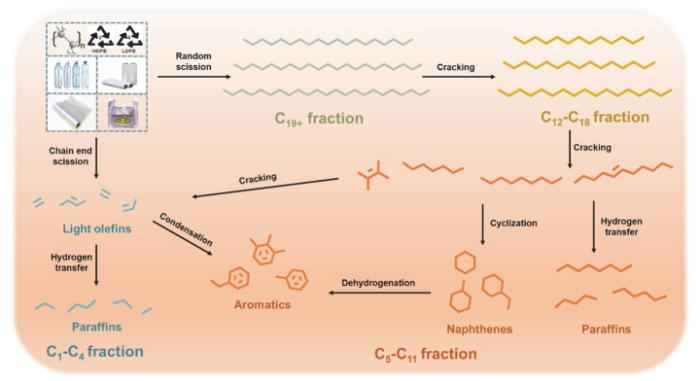
The procedures of PE cracking are shown in Fig. 15. There are two main types of PE macromolecules cracking to form hydrocarbons. One is the random scission mechanism to form long-chain hydrocarbons 6, and the other is the chain end scission mechanism to produce light hydrocarbons 7. Random scission is the main route of thermal cracking to give primary wax products. However, long-chain hydrocarbons will continue to crack into fragments of short-chain molecules, and short-chain hydrocarbons may undergo side reactions such as cyclization and dehydrogenation. If the primary waxes with suitable carbon chains are the goal products, the over-cracking of intermediates should be inhibited. Of course, chain end scission also occurs in PE cracking, which directly produces C1–C4 fraction, and also generates aromatics with side reactions such as condensation 8. In addition to the cracking reaction, the cracking mechanism (thermal cracking and catalytic cracking) also contains isomerization, hydrogen transfer, cyclization, aromatization or condensation reactions. The enhancement or inhibition of the reactions involved in cracking is affected by operation conditions, acidity and shape selectivity of each catalyst 9, 10. The secondary reactions can be adjusted by controlling the operation conditions in order to produce high-melting waxes.
During the thermal cracking of polyolefin, the yield of wax is influenced by the reaction temperature. Grause et al.11 studied the cracking temperatures can regulate the product distribution of continuous thermal cracking of plastic mixtures (65% polyolefin, 20% polystyrene and 15% poly (ethylene terephthalate)) using a fluidized bed reactor with hard burnt lime (HBL) as bed material. At 600 ℃, low boiling oil and waxes were obtained as the main products with about 45% and 36% (mass fraction), respectively. By raising the temperature to 700 ℃, the yield of wax drops sharply, from 36% to 9.8%, while the yield of gaseous product increases from 18% to 51%. Therefore, the increased temperature led to the deep thermal cracking. Due to the poor thermal conductivity of the plastic, the excessively high reaction temperature and the prolongation of the reaction time led to coking easily during the reaction. Berrueco et al.12 investigated the temperature effect on the product distribution for the continuous thermal cracking of high density polyethylene (HDPE) in a fluidized bed in the range of 640–850 ℃. Notably, the cracked product distribution is mainly chain hydrocarbons at 650 ℃, in which the proportion of wax and oil reaches 79.7%, and the gaseous products are 20.3%. It is worth noting that the wax yield of C33–C60 fraction is 28.8%. With the reaction temperature increasing, the yield of C33–C60 fraction obviously decreases. At 685 ℃, the C33–C60 fraction is hardly detected while the gaseous products are more than twice of those obtained at 650 ℃. Clearly, the reaction temperature and time are key factors to affect the PE wax yield in the thermal cracking of PE.
2.2 Catalytic cracking to PE waxes
As mentioned above, the direct thermal cracking of PE to PE waxes requires high reaction temperature. In order to operate the thermal cracking of PE under mild conditions, a suitable catalyst is usually applied during the cracking to reduce the activation energy and further regulate the product distribution. In the cracking of polymers, solid acidic catalysts 13, especially zeolites, play an important role in the cracking of PE plastics. The pore structure and acid strength of zeolites have a great influence on the product distribution. Therefore, how to construct zeolite catalysts with suitable microporous network, acid strength and acid quantity for the catalytic cracking of PE is very important 14.
For instance, Zhao 15 adopted Y and ZSM-5 zeolites to crack PE into PE waxes. As a result, Y zeolite with larger pore size showed higher selectivity to PE waxes. In another case, Elordi et al.16 explored the product distribution in the continuous catalytic cracking of HDPE over HZSM-5, HY and Hβ zeolite at 500 ℃ in a conical spouted bed reactor (CSBR). Similarly, PE was mainly converted to heavy fraction over the larger-pore zeolites such as HY and Hβ and the PE wax yields over the HY and Hβ zeolites reached 23% (w, mass fraction) with the prolonged reaction time. By contrast, short-chain hydrocarbons were obtained on HZSM-5 with a 10-member ring channel. Borsella et al.17 compared the iron-alumina pillared montmorillonite (FAMO) with HZSM-5 in the catalytic cracking of HDPE. The results show that gaseous compounds were mainly obtained on HZSM-5 (> 74% (w)), while the FAMO catalyst afforded a 55% yield of PE wax along with a low gaseous product selectivity. The authors ascribed the differences in product distribution over FAMO and HZSM-5 to the lower acid strength of FAMO, strongly associated with the selectivity to wax.
Besides the catalysts, the raw materials of PE also affect the properties of the resultant PE wax. Grieken et al.18 investigated the catalytic cracking of HDPE and low density PE (LDPE) under mild conditions, respectively. The relevant catalysts included n-HZSM-5, HY, amorphous SiO2-Al2O3, commercial Pd/C and MCM-41. As a result, the PE wax obtained with MCM-41 exhibited better stability, comparable with those commercialized PE wax. In addition, the wax obtained from HDPE cracking possess higher homogeneity than that derived from LDPE.
2.3 New method for synthesis of PE wax
For the past few years, researchers have devoted themselves to exploiting new method to synthesize PE waxes. Cross alkane metathesis (CAM), including alkane dehydrogenation and olefin metathesis, is a highly-effective process to convert hydrocarbons into its lower and higher congeners using low value hydrocarbons as solvents under mild conditions. This method is beneficial to formation of straight chain hydrocarbons under mild conditions. Jia et al.19 developed a dual catalyst system containing a pincer-ligated iridium complex and Re2O7/γ-Al2O3 for the CAM of PE. The highly efficient degradation of PE was realized under mild condition in this dual catalyst system. As a result, 120 mg of HDPE was converted to 53 mg of hydrocarbons and 43% of PE was degraded to wax at 150 ℃. The relationship between the degradation product distribution and catalyst structure was also explored. The degradation of commercial PE plastic wastes, such as postconsumer PE bottles, bags, and films, to high value liquid fuels and waxes can be accomplished using this CAM method.
Synthesis of PE waxes via solvent-assisted PE cracking has received great attention. Yuan et al.20 designed a green route for the depolymerization of PE. The authors found that using water as solvent was helpful for the decomposition of PE via avoiding the coke deposition caused by local overheat. However, too much water would increase the separation cost. Under optimal conditions, gray white PE wax was obtained when 50%–75% water was added as solvent. The corresponding PE wax showed high thermal stability with melting point of 104–110 ℃, acid value of 0.0143 mg∙g−1, and viscosity average molecular weight of 3426.4. In another case, Wang et al. 21 adopted mixed xylene as solvent to assist the cracking of PE at 425 ℃. As a result, 88% yield of PE wax with the melting point of 97.8 ℃ and the viscosity average molecular weight of 1264.6 was achieved. In addition, the mixed xylene could be totally recovered after utilization. Nevertheless, because PE contained colorant and other additives, there was pungent odour during the decomposition of PE, and the resultant PE wax was faint yellow, which affected the product property inevitably. Considering these influences, Yao et al.22 employed supercritical fluid extraction (SCFE) technology to purify waxes which were derived from PE and polypropylene plastics. The SCFE technology can efficiently eliminate the organic and inorganic contaminants and greatly enhance the wax quality. Accordingly, high-value water white waxes were obtained from waste polymeric feedstock using the SCFE technology. Under the optimal conditions, wax with 97% yield was extracted from polypropylene plastics.
3 Polymeric PE waxes
The development of PE technology facilitates the synthesis of PE wax. Compared with the top-down PE cracking to synthesize waxes, polymeric PE wax, derived from the down-up polymerization of ethylene, possesses better qualities in color and performance. The catalysts for synthesis of polymeric PE wax are mainly divided into two categories: metallocene and non-metallocene. The catalysts and properties of the products, including reaction conditions, molecular weights, are summarized in Table 2.
Table 2
Table 2The main components of the catalyst and the properties of the product.
Ziegler-Natta catalyst is one of the common catalysts which can be applied to ethylene polymerization for synthesis of PE wax. However, the PE wax products obtained by this route have a wide molecular weight distribution 23. In contrast, metallocene catalysts with lower dosage but higher activity have attracted much attention recently.
Finlayson et al.24 fabricated a unique metallocene catalyst to synthesize linear PE wax with low molecular weight and high crystallinity by using methylaluminoxane (MAO) as a promoter. Gao et al.25 adopted metallocene catalysts containing Ti, Zr or Hf to ethylene polymerization in a new double loop reactor, and the results showed that the resultant PE wax had a narrow molecular weight distribution and excellent performance. Tang et al.26 invented a supported metallocene catalyst containing magnesium compound using silica gel as support for the synthesis of PE was in a slurry reactor. With auxiliary of alkyl aluminum, PE wax with controllable molecular weight was afforded over this catalyst system. In addition, this polymerization technology is simple and easy to operate and no impurities were introduced to make the whole reaction environmentally benign. In order to make the catalyst recyclable, Moreira et al.27 prepared NaMOR mordenite (Si/Al = 5)-supported metallocene Cp2ZrCl2 and applied to the oligomerization of ethylene. The results indicated that PE wax with large molecular weight was obtained over this supported metallocene catalyst, and high amount of zirconium incorporated in the catalyst resulted in lower polymerization activity.
Although PE wax prepared using metallocene catalyst has excellent performance with controllable molecular weight, the stability, efficiency and high price of metallocene catalysts force researchers to develop more suitable catalysts for ethylene polymerization.
3.2 Non-metallocene catalysts
Non-metallocene catalysts have been focused on by many researchers due to their excellent reactivity and diverse ligand structures, and more and more attention have been paid to out in-depth research on non-metallocene catalysts. The characteristics comparison of metallocene catalysts and non-metallocene catalysts is shown in Fig. 228, 29.
Fig 2
Comparison of the characteristics of metallocene and non-metallocene catalysts.
Adapted with permission from Ref. 28 for left of Fig. 2. Copyright 2020, American Chemical Society. Adapted with permission from Ref. Fig. 2. Copyright 2018, Wiley-VCH Verlag GmbH & Co. KGaA, Weinheim.
Umare et al.30 conducted extensive studies on non-metallocene catalysts. They developed a titanium-biphenolate-ethylaluminum sesquichloride based catalyst system for the controllable synthesis of low molecular weight PE waxes (Mw = 1800–3400). The results showed that the catalyst activity was significantly affected by the reaction temperature and Al/Ti molar ratios. The resultant PE wax has high crystallinities and narrow PDs, similar to those commercial available synthetic waxes, which brings hope to explore alternative and cheaper catalysts.
Bollmann et al.31 for the first time reported a Cr-based catalyst with a variety of diphoshinoamine (PNP) ligands in combination with Cr(Ⅲ) compounds activated by aluminoxanes, exhibiting an unprecedented ethylene tetramerization to produce 1-octene. In addition, the authors indicated that the Cr-catalyst supported by PNP ligands is favorable for the formation of PE wax with narrow molecular weight distribution during the polymerization of ethylene. Inspired by this study, Huang et al.32 synthesized five structurally similar Cr(Ⅲ) complexes (Cr1–Cr5). The N atoms on each complex are in the different chemical environments leading to the diversity of spatial effects and electronic properties of nitrogen atoms. The results demonstrated that the five chromium complexes showed the best ethylene polymerization performance at 80 ℃, and the products exhibited low molecular weight and narrow molecular weight distribution. This series of catalysts exhibit excellent thermal stability while maintaining high catalytic activity.
In addition to Cr element, Co and Ni-based catalysts also can catalyze the growth of ethylene chains to prepare PE wax. Zhang et al.33 investigated the catalytic activity and stability of a series of divalent cobalt chloride complexes (Co1–Co6) in the polymerization of ethylene to PE wax. The catalysts treated by MAO or MMAO showed very high ethylene polymerization activity. The catalytic activity of Co4/MAO with cumene as the substituent was the highest. However, decomposition and deactivation of the catalysts at high temperature is unavoidable.
The related nickel-based complexes for catalyzing ethylene polymerization to PE wax have also attracted the attention of researchers. Johnson et al.34 discovered that the dichloride of nickel diimide displayed high activity for ethylene polymerization. Yu et al.35 prepared a series of N-(5, 6, 7-trihydroquinolin-8-ylidene)arylamine derivatives by condensation with 5, 6, 7-trihydroquinolin-8-one and different aromatic amines, and then the corresponding catalysts were obtained by coordination of these arylamine derivatives with nickel dichloride. The complexes after treatment by alkylaluminum showed high activity (107 gPE⋅molNi−1∙h−1), but the PE wax was highly branched.
In addition to the basic researches on ethylene polymerization to PE wax, the relatively mature technologies of ethylene polymerization to PE wax have been developed by some companies in the world. For instance, DuPont in the United States utilized ethylene as raw material to prepare PE wax with peroxide catalysts under 50–100 MPa and at 49–100 ℃ 15. United Chemical produced PE wax with molecular weight of about 2000 by high-pressure polymerization. Although these processes need high cost, they can prepare high-quality and high-performance PE wax products. Up to now, United Chemical Company of the United States is still the largest producer of PE wax in the world. In addition, Japan's Mitsui, Sanyo Chemical, German companies and Hearst companies also produce PE products with lower molecular weight.
4 Fischer-Tropsch synthesis to FT synthetic waxes
Fischer-Tropsch (FT) synthetic waxes are obtained by distillation of high carbon numbers fraction of Fischer-Tropsch synthesis (FTS). The melting point of high-melting FT synthetic wax, containing linear saturated alkanes with relative molecular weight of 500–1000, is as high as 85–120 ℃. The high-melting FT synthetic waxes bear unique features including high stability, hardness, wear resistance, high melting point, fine crystal structure and narrow melting point range, which have unique application in hot-melt adhesives and coatings. Although several sets of FT synthesis units have been built in China and the high-melting FT synthetic waxes can be provided, the properties in product quality and index stability of home-made FT synthetic waxes are inferior to those imported waxes from Shell and Sasol. Hence, it is still necessary to further develop the catalyst system and reactor technology systematically and deeply.
4.1 Mechanism and catalysts for synthesis of high-melting FT synthetic waxes
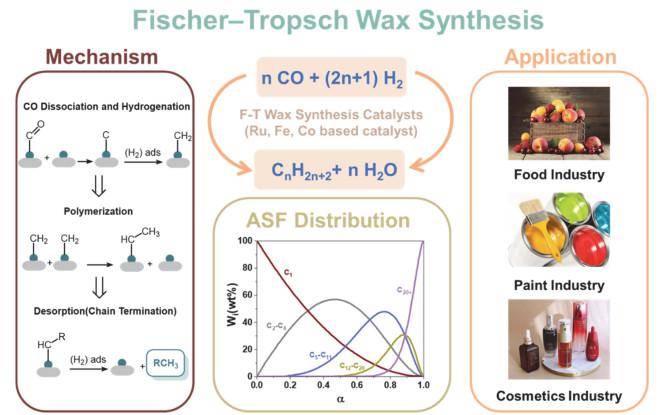
FTS is an essential catalytic process that converts syngas into fuels and chemicals and has been thoroughly explored and used commercially for decades. However, many details regarding the mechanism are still debatable points. Generally, the carbide mechanism proposed by Fischer and Tropsch 36, 37 (Fig. 338, 39) has been widely recognized. Two separate theories, i.e., the carbide mechanism and CO insertion, have been proposed to reveal the carbon initiation and chain growth steps. The carbide mechanism indicated that CO molecules are dissociatively adsorbed on the surface, and the surface carbon atoms are subsequently hydrogenated to form methylene (CH2) groups, which are considered as chain-propagating monomers. Although extensive experimental results support this mechanism, it fails to elucidate the formation of oxygenates. The mechanism of FTS is still ambiguous, although many significant experiments and theories have been done to investigate the reaction mechanism of the complicated FTS.
Fig 3
Fischer-Tropsch synthesis mechanism, ASF distribution and application of FTS waxes.
Adapted with permission from Ref. 39. Copyright 2018, Wiley-VCH Verlag GmbH & Co. KGaA, Weinheim.
There are abundant FTS products, including methane, alkenes and various alkanes with different carbon numbers. Therefore, it is vital to select a suitable catalyst to regulate the content of heavy wax by inhibiting the formation of CH4 and other short-chain hydrocarbons in order to obtain high-melting long chain hydrocarbon wax by FTS technology. At present, noble metal Ru-based and base metals Fe and Co-based catalysts are applied to synthesis of high-melting FT synthetic waxes 40, 41. For clarity, the catalysts and product distributions of the high-melting FT synthetic waxes are listed in Table 3.
Table 3
Table 3Catalysts and product distributions of high-melting waxes by Fischer-Tropsch synthesis.
Many studies have demonstrated that Ru-based catalysts show high initial activity 42, 43, but relatively poor stability due to metal agglomeration, particle oxidation and carbon coking at high temperatures. In addition, restricted by the high cost and scarcity of noble metal Ru, Co and Fe-based catalysts 44, 45 can also convert syngas into high-melting waxes. Ma et al.46 prepared Fe-based catalyst via the precipitation method to catalyze FTS to produce high-carbon alkanes. The industrial tests showed that the yield of wax product is about 31% (w). It should be pointed out that Fe-based catalysts can only produce waxes with melting points below 105 ℃. The research results from Shell showed that the appearance and performance of the FTS wax using Co-based catalyst are better than those using Fe-based catalyst. They found that higher probability of chain growth was observed over the Co-ZrO2-SiO2 catalyst prepared by an impregnation method than that over the conventional catalysts, therefore, high carbon number alkane waxes are likely to be formed over the Co-ZrO2-SiO2 catalyst 47.
In order to improve the activity of catalysts and product selectivity, the positive effect of promoters was also investigated 48, 49. Yang et al.50 applied K element-modified Fe-Mn catalysts to FTS. The results showed that the addition of K increased the CO/H2 molar ratio on the catalyst surface, inhibited the formation of methane and light hydrocarbons, and led to an increase in higher molecular weight hydrocarbons. Shah et al.51 studied the effect of Th, Mn, Mg and other promoters on Co-based catalysts on FTS. They found that addition of Th would increase the selectivity to wax, increase the sensitivity of the catalyst to temperature, and decrease the influence of impurities on the catalyst. Modification of Mn to Co-based catalysts improves the wax yield at lower temperature, but it also caused the disadvantages such as reduced hardness and heat sensitivity of the catalyst. Addition of MgO to the catalyst increased the catalyst strength and reduced powder generation during the reaction. Guo et al.52 applied density functional theory (DFT) calculations to reveal that the introduction of Ba to the catalyst system can regulate the surface electron density of Co atom in Co/γ-Al2O3, affecting the adsorption of H2 and CO on the catalyst surface. Correspondingly, the selectivity to C19+ alkanes is significantly improved, and the yield of C19+ alkanes reaches above 38%.
Besides the active sites and promoters, the porous structure of the support also affects the wax/oil ratio of FTS products. Yang et al.53 constructed two Ru-in/TNT and Ru-out/TNT catalysts, in another word, Ru nanoparticles deposited in the inner and outer pores of TiO2 nanotubes, respectively. The Ru-in/TNT catalyst displayed high CO conversion, while the Ru-out/TNT catalyst displayed the deactivation-resist ability. Compared with Ru-out/TNT catalysts, the Ru-in/TNT catalyst facilitated the formation of long-chain (C19+) products. The authors considered that enhanced activity and selectivity of the Ru-in/TNT catalyst was ascribed to strengthen charge transfer and modulate the electronic properties of Ru nanoparticles. Subramanian et al.54 designed a nanoreactor with Co nanoparticles as core and porous SiO2 as shell (Co@SiO2). Compared with Co/SiO2 prepared by an impregnation method, which afforded the solid wax products, the Co@SiO2 exhibited a high yield of short-chain hydrocarbons due to the steric restriction of nanoreactor diameter for the formation of long-chain hydrocarbon (C30H62), which changed the traditional ASF distribution law of products.
4.2 Technology of high-melting FTS waxes
Synthesis of high-melting FT synthetic waxes provides high requirement to catalysts and reactors. At present, only Sasol (South Africa) and Shell (the Netherlands) have their own industrialized FTS technology and large-scale synthesis units 55. Synthesis of high-melting wax in Sasol mainly relies on low-temperature synthesis technology using Arge fixed-bed reactor and SPD™ slurry-bed reactor. The subsequent hydrocracking unit is also employed to produce heavy wax according to market demand. The updated SPD technology adopts more advanced slurry bed reactors, which has a good advantage of excellent material mixing 56. Preheated syngas is pumped to the slurry-bed reactor from the bottom. Bubbled syngas passed through the slurry phase and then diffuses and converts into wax. This kind of reactor has many advantages including easy installation, excellent heat transfer and controllable reaction temperature. According to the statistics, the production capacity of FT synthetic wax in Sasol is about 70, 000 t∙a−157.
Shell successfully developed the Shell middle distillate synthesis (SMDS) technology in 1990, and they built the first natural gas FT synthetic oil unit in Malaysia in 1993 58. In 2000, after the equipment upgrade of SMDS technology, the production capacity has been increased from 500, 000 to 700, 000 t∙a−1. SMDS adopted a tubular fixed-bed reactor to produce high-melting FT synthetic wax by using low-temperature synthesis technology. At the end of 2011, Pearl GTL Plant based on the second generation SMDS unit was completed and put into operation, on the basis of the improvement of the first set of SMDS, co-built by Qatar and Shell. According to the statistics, the production capacity of FT synthetic wax in Shell is about 50, 000 t∙a−1.
In the early 1980s, Shanxi Institute of Coal Chemistry of the Chinese Academy of Sciences developed the MFT technology containing a fixed-bed two-stage synthesis technology, in combination with traditional FTS with shape selectivity of zeolite. The wax obtained using precipitated Fe catalyst in the first stage accounts for 31% (w) of total products. This technology has completed the pilot test in Shanxi in 1993 59. This technology authorized Shanxi Lu'an Coal-based Synthetic Oil Co. Ltd. has already realized the distillation of refinery of high-melting FT synthetic wax and they can provide the standard FT synthetic wax product although they haven't accomplished the large-scale production yet. In addition, the low-temperature slurry-bed FTS industrial demonstration unit of the National Energy Group has also been successfully operated 60.
Synthesis of high-melting waxes by FTS is one of the most common approaches with high economic value in industry at present. The research and development of catalysts and reactors are also relatively complete. However, there are still some deficiencies such as complicated reaction equipment, many impurities in the FT synthetic wax and cumbersome separation technology. For fixed beds, the demand for reaction temperatures and pressure makes the manufacturing cost of the reaction device high and the reaction device relatively complicated. Many side reactions occur during the preparation of high-melting waxes, and the length of the generated carbon chain is different. The obtained product contains many impurities, resulting in a cumbersome separation process.
5 Biomass-based synthesis to wax
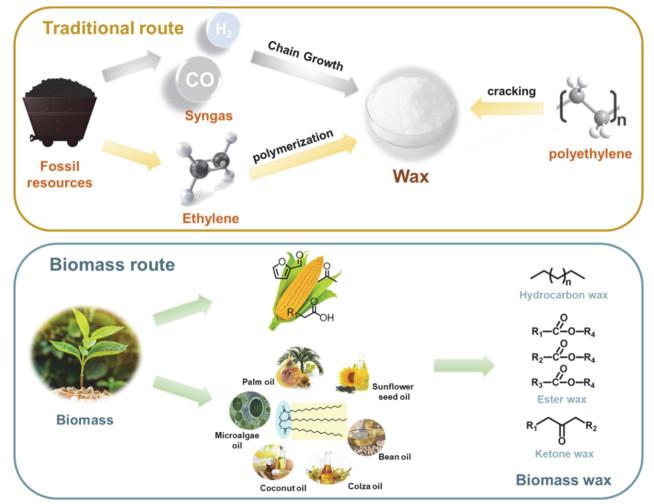
The FT synthetic waxes and PE waxes are obtained at the expense of fossil resources such as petroleum and coal. However, the policy of peak carbon dioxide emissions and carbon neutrality restricts the development of fossil resource-consuming technologies. Renewable biomass resources can be converted into fuels and chemicals, which could be integrated into the current energy system. Transformation of vegetable oil and biomass platform-derived chemicals to biomass-based waxes can replace traditional FT synthetic waxes and PE waxes 61. A summary of PE cracking, ethylene polymerization, FTS, and biomass-based methods for synthesizing high-melting waxes is shown in Fig. 4.
Fig 4
Summary of the processes for preparing high-melting waxes via different routes.
Natural oils containing C12–C18 fatty acids are ideal building blocks for biomass-based waxes. Through the ketonization reaction, two molecules of C12–C18 fatty acids are converted to C23–C35 ketones by eliminating a carbonyl group in the presence of an alkaline catalyst. After subsequent hydrogenation, C23–C35 bio-based waxes can be obtained 62.
Boekaerts et al.63 evaluated the ketonization reaction of C12–C18 fatty acids on anatase and rutile TiO2 catalysts. Rutile-type TiO2, with higher Lewis acid density, exhibited high ketonization activity. However, the catalytic activity suffers from stronger product inhibition by ketones, CO2 and H2O. With continuous flush of formed H2O and CO2 with inert gas, the conversion was distinctly increased. The kinetic models and experimental data inferred that C―C coupling of intermediate species is the rate-determining step in the ketonization mechanism. Corma et al.64 designed a single-tube double-bed catalytic system, consisting of the first layer of MgO ketonation catalyst and the second layer of Pd/MgO hydrogenation catalyst. This fixed-bed system successfully converted lauric acid into C23 straight-chain alkanes with a yield of 63%.
Although the chain growth of long chain hydrocarbon can be achieved by ketolation of fatty acids, the carbon number of the product is between C20–C35 and the melting point is only 40–65 ℃, which cannot meet the requirements of high-melting waxes. In addition, the ketonation reaction between diacids hardly occurs, so more means to extend the carbon chain need to be further exploited. In recent years, the strategy of extending the carbon chain using furfural as the basic unit to construct fuels and lubricating oils by aldehyde-ketone condensation has been widely reported 65-67. Inspired by these findings, Zhao's group 68 at East China Normal University ingeniously designed a route to prepare long-chain high-melting waxes with excellent performance, starting from cheap and readily available bio-derived small molecules such as C1 formaldehyde, C3 acetone, C5 furfural and C18 fatty acids. They carried out carbon chain coupling through reasonable carbon chain extension methods such as acylation, ketonation, aldol condensation, etc., and then obtained two types of high-melting wax precursors through the selective hydrogenation/selective hydrodeoxygenation reactions, followed by further hydrodeoxygenation to C45–C49 high-melting waxes. The biomass-based high-melting wax product synthesized by this route has controllable carbon chain length and structure, high melting point, less impurities and pure color, and belongs to the category of high-quality biomass-based special wax.
6 Summary and outlook
Considering the ever-growing demand of high-melting waxes in food, medicine, textile and other industries and rational consumption of resource under peak carbon dioxide emissions and carbon neutrality, high efficiency synthesis methods for high-melting waxes are imminent. In this review, we summarized the four synthetic methods for the construction of high-melting wax according to chemical principles and catalytic systems. Four synthetic strategies include PE cracking into waxes, polymerization of ethylene to waxes, syngas to waxes and biomass-based waxes. Despite some of significant progresses have been industrialized, there are still several challenges to be further considered.
PE cracking to waxes with the advantages of low cost can effectively solve "white pollution", and directly use the existing catalytic cracking units. However, this process needs high energy consumption to achieve waste polymer depolymerization, and exhibits the drawbacks such as wider carbon number distribution and high impurity content in the obtained PE waxes. With regards to PE waxes obtained from ethylene polymerization, the complex technology and expensive catalytic system such as metallocene and non-metallocene complex in the ethylene polymerization method hinder its industrialization. At present, high-melting waxes are generated as by-products of ethylene polymerization. Similar with the PE cracking, the products of ethylene polymerization cannot be regulated selectively to the range of high-melting waxes. The product exhibits wide range melting point and poor quality leading to mismatch with the high-end requirements. Compared with PE waxes, there are no branches and carbon-carbon double bonds in the wax prepared by FTS, so the high-melting FT synthetic waxes show various benefits including lower molecular weight and viscosity, smaller penetration and narrower melting range. With the transformation and upgrading of the domestic manufacturer, the downstream products are developing towards precision and high-end. Demand for high-melting FTS waxes has grown rapidly. Many domestic enterprises such as Shanxi Lu'an Group and Shaanxi Future Energy Company have built and operated several sets of FT synthetic wax production units, and the vacancy of high-melting synthetic waxes has been filled in China. However, the performance of high-melting waxes is inferior to foreign high-end products, and the high-end high-melting waxes still rely heavily on import. Related technologies need to be further developed urgently to meet the demand of the domestic market.
Although the high-melting FTS waxes display excellent performance and the technology is gradually mature, FT wax with different melting points are produced by rectification of products with various carbon chain lengths. The products are mixture containing various alkanes with relatively wide melting range. Additionally, raw materials of ethylene polymerization and FTS are derived from petroleum and coal resources, which are not in line with sustainable development concept and peak carbon dioxide emissions and carbon neutrality. Therefore, construction of high-melting waxes with established carbon number and well-defined structure from small molecules on a renewable biomass platform has become an important scientific frontier.
Fatty acids containing long-chain alkyl groups are ideal candidates for the fabrication of high-melting waxes. The carbon growth, by acylation and aldol condensation between fatty acids and biomass-based C5–C6 furfural and 5-hydroxymethyl furfural followed by hydrodeoxygenation, provides opportunities for construction of biomass-based waxes. Biomass-based waxes have a narrower melting range due to the precise carbon growth process. Based on the different application demands, the biomass platform small molecules can be functionalized to fabricate biomass-based wax with a special function. More importantly, biomass-based synthesis route is sustainable and accords with peak carbon dioxide emissions and carbon neutrality. We believe that a combination of multi-step reactions, ingenious catalytic system design, together with reaction mechanistic investigation, will make biomass-based high-melting waxes flourishing.
Zhao, C. S. Research of Manufacturing Macromolecule Wax and Styrenefrom Cracking Waste Plastics. M. S. Dissertation, East China University of Science and Technology, Shanghai, 2014.
Finlayson, M. F.; Garrison, C. C.; Guerra, R. E.; Guest, M. J.; Kolthammer, B. W. S.; Parikh, D. R.; Ueligger, S. M. Manufacture of Nonpourable, Homogeneous, Ultra-Low-Molecular-Weight Ethylene Polymers. WO9726287A1, 1997.
... High-melting hydrocarbon waxes (melting point > 80 ℃), consisting of saturated alkanes with carbon number greater than 40 exhibit unique features including high melting points, high stability, low penetration, low mobility, good wear resistance and hardness. These features make them widely used in food, cosmetics, material processing, electronic machinery, national defense, aviation and medical fields, etc. With the economic growth and the development of national defense technology in China, the demand for high-melting waxes has been increasing. For instance, the supply insufficiency of rubber protective waxes reached 48000 tons in China in 2014. There is also a supply insufficiency with 500000 tons in market demand for specialty waxes such as polypropylene wax, anti-rust wax, fruit preservation wax, and power capacitor wax. It is estimated that the supply insufficiency of high-melting waxes and specialty waxes in China will exceed 700000 tons in 2030 1. Up to 2021, the total production capacity of paraffin wax in China is about 210 × 104 t∙a−1. Nevertheless, the variety distribution is not reasonable. The specialty waxes and high-melting waxes with high economic value have to rely on import due to the lack of enough supply in China 2. In order to ensure the stable development of the national economy and national defense security, production of high-melting waxes with excellent performance is very urgent. ...
1
2012
... High-melting hydrocarbon waxes (melting point > 80 ℃), consisting of saturated alkanes with carbon number greater than 40 exhibit unique features including high melting points, high stability, low penetration, low mobility, good wear resistance and hardness. These features make them widely used in food, cosmetics, material processing, electronic machinery, national defense, aviation and medical fields, etc. With the economic growth and the development of national defense technology in China, the demand for high-melting waxes has been increasing. For instance, the supply insufficiency of rubber protective waxes reached 48000 tons in China in 2014. There is also a supply insufficiency with 500000 tons in market demand for specialty waxes such as polypropylene wax, anti-rust wax, fruit preservation wax, and power capacitor wax. It is estimated that the supply insufficiency of high-melting waxes and specialty waxes in China will exceed 700000 tons in 2030 1. Up to 2021, the total production capacity of paraffin wax in China is about 210 × 104 t∙a−1. Nevertheless, the variety distribution is not reasonable. The specialty waxes and high-melting waxes with high economic value have to rely on import due to the lack of enough supply in China 2. In order to ensure the stable development of the national economy and national defense security, production of high-melting waxes with excellent performance is very urgent. ...
1
2021
... High-melting hydrocarbon waxes (melting point > 80 ℃), consisting of saturated alkanes with carbon number greater than 40 exhibit unique features including high melting points, high stability, low penetration, low mobility, good wear resistance and hardness. These features make them widely used in food, cosmetics, material processing, electronic machinery, national defense, aviation and medical fields, etc. With the economic growth and the development of national defense technology in China, the demand for high-melting waxes has been increasing. For instance, the supply insufficiency of rubber protective waxes reached 48000 tons in China in 2014. There is also a supply insufficiency with 500000 tons in market demand for specialty waxes such as polypropylene wax, anti-rust wax, fruit preservation wax, and power capacitor wax. It is estimated that the supply insufficiency of high-melting waxes and specialty waxes in China will exceed 700000 tons in 2030 1. Up to 2021, the total production capacity of paraffin wax in China is about 210 × 104 t∙a−1. Nevertheless, the variety distribution is not reasonable. The specialty waxes and high-melting waxes with high economic value have to rely on import due to the lack of enough supply in China 2. In order to ensure the stable development of the national economy and national defense security, production of high-melting waxes with excellent performance is very urgent. ...
1
2018
... At present, the high-melting synthetic waxes on the market mainly include polyethylene (PE) waxes and Fischer-Tropsch (FT) synthetic waxes. There are a few routes to obtain the polyethylene waxes. The one is the cracking of white plastics (PE) via thermal cracking, catalytic cracking or alkane metathesis. Thermal cracking needs to be carried out at high temperatures, and catalytic cracking makes the reaction conditions milder 3. The other one is the polymerization of ethylene. However, the PE waxes obtained from the above routes have more branched chains and display a wide distribution in carbon numbers and melting points 4. The FT synthetic waxes are obtained from the FT synthesis processes with syngas or natural gas (CO and H2) as raw materials and the carbon chain is extended according to the following equation nCO + (2n + 1)H2 → CnH2n+2 + nH2O. Then, the mixed linear alkanes with high melting point (≥ 85 ℃) are achieved after refining and separation. Nonetheless, harsh conditions including high temperature and pressure are employed during the synthesis of FT synthetic waxes. Additionally, both PE waxes and FT synthetic waxes are derived from fossil resources such as petroleum and coal. However, carbon neutrality and petrochemical resource shortage have obvious constraints on the world economy and science & technology. Therefore, synthesis of high-melting waxes using biomass-based monomers as structural units has also become a new competitive green route. This review covers the synthesis of high-melting waxes (melting point > 80 ℃) by PE synthesis, FT synthesis and biomass-based synthesis methods, and provides some perspectives and trends in the synthesis of high-melting synthetic waxes. ...
1
2015
... At present, the high-melting synthetic waxes on the market mainly include polyethylene (PE) waxes and Fischer-Tropsch (FT) synthetic waxes. There are a few routes to obtain the polyethylene waxes. The one is the cracking of white plastics (PE) via thermal cracking, catalytic cracking or alkane metathesis. Thermal cracking needs to be carried out at high temperatures, and catalytic cracking makes the reaction conditions milder 3. The other one is the polymerization of ethylene. However, the PE waxes obtained from the above routes have more branched chains and display a wide distribution in carbon numbers and melting points 4. The FT synthetic waxes are obtained from the FT synthesis processes with syngas or natural gas (CO and H2) as raw materials and the carbon chain is extended according to the following equation nCO + (2n + 1)H2 → CnH2n+2 + nH2O. Then, the mixed linear alkanes with high melting point (≥ 85 ℃) are achieved after refining and separation. Nonetheless, harsh conditions including high temperature and pressure are employed during the synthesis of FT synthetic waxes. Additionally, both PE waxes and FT synthetic waxes are derived from fossil resources such as petroleum and coal. However, carbon neutrality and petrochemical resource shortage have obvious constraints on the world economy and science & technology. Therefore, synthesis of high-melting waxes using biomass-based monomers as structural units has also become a new competitive green route. This review covers the synthesis of high-melting waxes (melting point > 80 ℃) by PE synthesis, FT synthesis and biomass-based synthesis methods, and provides some perspectives and trends in the synthesis of high-melting synthetic waxes. ...
2
2021
... The procedures of PE cracking are shown in Fig. 15. There are two main types of PE macromolecules cracking to form hydrocarbons. One is the random scission mechanism to form long-chain hydrocarbons 6, and the other is the chain end scission mechanism to produce light hydrocarbons 7. Random scission is the main route of thermal cracking to give primary wax products. However, long-chain hydrocarbons will continue to crack into fragments of short-chain molecules, and short-chain hydrocarbons may undergo side reactions such as cyclization and dehydrogenation. If the primary waxes with suitable carbon chains are the goal products, the over-cracking of intermediates should be inhibited. Of course, chain end scission also occurs in PE cracking, which directly produces C1–C4 fraction, and also generates aromatics with side reactions such as condensation 8. In addition to the cracking reaction, the cracking mechanism (thermal cracking and catalytic cracking) also contains isomerization, hydrogen transfer, cyclization, aromatization or condensation reactions. The enhancement or inhibition of the reactions involved in cracking is affected by operation conditions, acidity and shape selectivity of each catalyst 9, 10. The secondary reactions can be adjusted by controlling the operation conditions in order to produce high-melting waxes. ...
... Adapted from Ref. 5. ...
1
2009
... The procedures of PE cracking are shown in Fig. 15. There are two main types of PE macromolecules cracking to form hydrocarbons. One is the random scission mechanism to form long-chain hydrocarbons 6, and the other is the chain end scission mechanism to produce light hydrocarbons 7. Random scission is the main route of thermal cracking to give primary wax products. However, long-chain hydrocarbons will continue to crack into fragments of short-chain molecules, and short-chain hydrocarbons may undergo side reactions such as cyclization and dehydrogenation. If the primary waxes with suitable carbon chains are the goal products, the over-cracking of intermediates should be inhibited. Of course, chain end scission also occurs in PE cracking, which directly produces C1–C4 fraction, and also generates aromatics with side reactions such as condensation 8. In addition to the cracking reaction, the cracking mechanism (thermal cracking and catalytic cracking) also contains isomerization, hydrogen transfer, cyclization, aromatization or condensation reactions. The enhancement or inhibition of the reactions involved in cracking is affected by operation conditions, acidity and shape selectivity of each catalyst 9, 10. The secondary reactions can be adjusted by controlling the operation conditions in order to produce high-melting waxes. ...
1
2012
... The procedures of PE cracking are shown in Fig. 15. There are two main types of PE macromolecules cracking to form hydrocarbons. One is the random scission mechanism to form long-chain hydrocarbons 6, and the other is the chain end scission mechanism to produce light hydrocarbons 7. Random scission is the main route of thermal cracking to give primary wax products. However, long-chain hydrocarbons will continue to crack into fragments of short-chain molecules, and short-chain hydrocarbons may undergo side reactions such as cyclization and dehydrogenation. If the primary waxes with suitable carbon chains are the goal products, the over-cracking of intermediates should be inhibited. Of course, chain end scission also occurs in PE cracking, which directly produces C1–C4 fraction, and also generates aromatics with side reactions such as condensation 8. In addition to the cracking reaction, the cracking mechanism (thermal cracking and catalytic cracking) also contains isomerization, hydrogen transfer, cyclization, aromatization or condensation reactions. The enhancement or inhibition of the reactions involved in cracking is affected by operation conditions, acidity and shape selectivity of each catalyst 9, 10. The secondary reactions can be adjusted by controlling the operation conditions in order to produce high-melting waxes. ...
1
2010
... The procedures of PE cracking are shown in Fig. 15. There are two main types of PE macromolecules cracking to form hydrocarbons. One is the random scission mechanism to form long-chain hydrocarbons 6, and the other is the chain end scission mechanism to produce light hydrocarbons 7. Random scission is the main route of thermal cracking to give primary wax products. However, long-chain hydrocarbons will continue to crack into fragments of short-chain molecules, and short-chain hydrocarbons may undergo side reactions such as cyclization and dehydrogenation. If the primary waxes with suitable carbon chains are the goal products, the over-cracking of intermediates should be inhibited. Of course, chain end scission also occurs in PE cracking, which directly produces C1–C4 fraction, and also generates aromatics with side reactions such as condensation 8. In addition to the cracking reaction, the cracking mechanism (thermal cracking and catalytic cracking) also contains isomerization, hydrogen transfer, cyclization, aromatization or condensation reactions. The enhancement or inhibition of the reactions involved in cracking is affected by operation conditions, acidity and shape selectivity of each catalyst 9, 10. The secondary reactions can be adjusted by controlling the operation conditions in order to produce high-melting waxes. ...
1
2020
... The procedures of PE cracking are shown in Fig. 15. There are two main types of PE macromolecules cracking to form hydrocarbons. One is the random scission mechanism to form long-chain hydrocarbons 6, and the other is the chain end scission mechanism to produce light hydrocarbons 7. Random scission is the main route of thermal cracking to give primary wax products. However, long-chain hydrocarbons will continue to crack into fragments of short-chain molecules, and short-chain hydrocarbons may undergo side reactions such as cyclization and dehydrogenation. If the primary waxes with suitable carbon chains are the goal products, the over-cracking of intermediates should be inhibited. Of course, chain end scission also occurs in PE cracking, which directly produces C1–C4 fraction, and also generates aromatics with side reactions such as condensation 8. In addition to the cracking reaction, the cracking mechanism (thermal cracking and catalytic cracking) also contains isomerization, hydrogen transfer, cyclization, aromatization or condensation reactions. The enhancement or inhibition of the reactions involved in cracking is affected by operation conditions, acidity and shape selectivity of each catalyst 9, 10. The secondary reactions can be adjusted by controlling the operation conditions in order to produce high-melting waxes. ...
1
2011
... During the thermal cracking of polyolefin, the yield of wax is influenced by the reaction temperature. Grause et al.11 studied the cracking temperatures can regulate the product distribution of continuous thermal cracking of plastic mixtures (65% polyolefin, 20% polystyrene and 15% poly (ethylene terephthalate)) using a fluidized bed reactor with hard burnt lime (HBL) as bed material. At 600 ℃, low boiling oil and waxes were obtained as the main products with about 45% and 36% (mass fraction), respectively. By raising the temperature to 700 ℃, the yield of wax drops sharply, from 36% to 9.8%, while the yield of gaseous product increases from 18% to 51%. Therefore, the increased temperature led to the deep thermal cracking. Due to the poor thermal conductivity of the plastic, the excessively high reaction temperature and the prolongation of the reaction time led to coking easily during the reaction. Berrueco et al.12 investigated the temperature effect on the product distribution for the continuous thermal cracking of high density polyethylene (HDPE) in a fluidized bed in the range of 640–850 ℃. Notably, the cracked product distribution is mainly chain hydrocarbons at 650 ℃, in which the proportion of wax and oil reaches 79.7%, and the gaseous products are 20.3%. It is worth noting that the wax yield of C33–C60 fraction is 28.8%. With the reaction temperature increasing, the yield of C33–C60 fraction obviously decreases. At 685 ℃, the C33–C60 fraction is hardly detected while the gaseous products are more than twice of those obtained at 650 ℃. Clearly, the reaction temperature and time are key factors to affect the PE wax yield in the thermal cracking of PE. ...
2
2002
... Catalysts of cracked polyethylene wax and distribution of cracked products.
Method
Catalyst
Condition
Yield of wax (%)
Product distribution (%, mass fraction)
Molecular weight/ (g∙mol−1)
Tm/℃
Researcher
Gas
Oil
Wax
Other
thermal cracking
–
650 ℃
28.8
20.3
50.9
28.8
0
–
–
Berrueco et al.12
catalytic cracking
HY
380 ℃ 30 min
45.5
5.7
43
45.5
5.8
2000–4000
110
Zhao15
HZSM-5
500 ℃ 30 min
2
73
25
2
0
–
–
Elordi et al.16
Hβ
23
32
45
23
0
HY
23
22
55
23
0
FAMO
500 ℃
60
2
43
55
0
400–1400
–
Borsella et al.17
MCM-41
380 ℃ 360 min
41.2
35.9
22.9
41.2
0
–
–
Grieken et al.18
2.1 Thermal cracking to PE waxes
The procedures of PE cracking are shown in Fig. 15. There are two main types of PE macromolecules cracking to form hydrocarbons. One is the random scission mechanism to form long-chain hydrocarbons 6, and the other is the chain end scission mechanism to produce light hydrocarbons 7. Random scission is the main route of thermal cracking to give primary wax products. However, long-chain hydrocarbons will continue to crack into fragments of short-chain molecules, and short-chain hydrocarbons may undergo side reactions such as cyclization and dehydrogenation. If the primary waxes with suitable carbon chains are the goal products, the over-cracking of intermediates should be inhibited. Of course, chain end scission also occurs in PE cracking, which directly produces C1–C4 fraction, and also generates aromatics with side reactions such as condensation 8. In addition to the cracking reaction, the cracking mechanism (thermal cracking and catalytic cracking) also contains isomerization, hydrogen transfer, cyclization, aromatization or condensation reactions. The enhancement or inhibition of the reactions involved in cracking is affected by operation conditions, acidity and shape selectivity of each catalyst 9, 10. The secondary reactions can be adjusted by controlling the operation conditions in order to produce high-melting waxes. ...
... During the thermal cracking of polyolefin, the yield of wax is influenced by the reaction temperature. Grause et al.11 studied the cracking temperatures can regulate the product distribution of continuous thermal cracking of plastic mixtures (65% polyolefin, 20% polystyrene and 15% poly (ethylene terephthalate)) using a fluidized bed reactor with hard burnt lime (HBL) as bed material. At 600 ℃, low boiling oil and waxes were obtained as the main products with about 45% and 36% (mass fraction), respectively. By raising the temperature to 700 ℃, the yield of wax drops sharply, from 36% to 9.8%, while the yield of gaseous product increases from 18% to 51%. Therefore, the increased temperature led to the deep thermal cracking. Due to the poor thermal conductivity of the plastic, the excessively high reaction temperature and the prolongation of the reaction time led to coking easily during the reaction. Berrueco et al.12 investigated the temperature effect on the product distribution for the continuous thermal cracking of high density polyethylene (HDPE) in a fluidized bed in the range of 640–850 ℃. Notably, the cracked product distribution is mainly chain hydrocarbons at 650 ℃, in which the proportion of wax and oil reaches 79.7%, and the gaseous products are 20.3%. It is worth noting that the wax yield of C33–C60 fraction is 28.8%. With the reaction temperature increasing, the yield of C33–C60 fraction obviously decreases. At 685 ℃, the C33–C60 fraction is hardly detected while the gaseous products are more than twice of those obtained at 650 ℃. Clearly, the reaction temperature and time are key factors to affect the PE wax yield in the thermal cracking of PE. ...
1
2018
... As mentioned above, the direct thermal cracking of PE to PE waxes requires high reaction temperature. In order to operate the thermal cracking of PE under mild conditions, a suitable catalyst is usually applied during the cracking to reduce the activation energy and further regulate the product distribution. In the cracking of polymers, solid acidic catalysts 13, especially zeolites, play an important role in the cracking of PE plastics. The pore structure and acid strength of zeolites have a great influence on the product distribution. Therefore, how to construct zeolite catalysts with suitable microporous network, acid strength and acid quantity for the catalytic cracking of PE is very important 14. ...
1
2022
... As mentioned above, the direct thermal cracking of PE to PE waxes requires high reaction temperature. In order to operate the thermal cracking of PE under mild conditions, a suitable catalyst is usually applied during the cracking to reduce the activation energy and further regulate the product distribution. In the cracking of polymers, solid acidic catalysts 13, especially zeolites, play an important role in the cracking of PE plastics. The pore structure and acid strength of zeolites have a great influence on the product distribution. Therefore, how to construct zeolite catalysts with suitable microporous network, acid strength and acid quantity for the catalytic cracking of PE is very important 14. ...
3
... Catalysts of cracked polyethylene wax and distribution of cracked products.
Method
Catalyst
Condition
Yield of wax (%)
Product distribution (%, mass fraction)
Molecular weight/ (g∙mol−1)
Tm/℃
Researcher
Gas
Oil
Wax
Other
thermal cracking
–
650 ℃
28.8
20.3
50.9
28.8
0
–
–
Berrueco et al.12
catalytic cracking
HY
380 ℃ 30 min
45.5
5.7
43
45.5
5.8
2000–4000
110
Zhao15
HZSM-5
500 ℃ 30 min
2
73
25
2
0
–
–
Elordi et al.16
Hβ
23
32
45
23
0
HY
23
22
55
23
0
FAMO
500 ℃
60
2
43
55
0
400–1400
–
Borsella et al.17
MCM-41
380 ℃ 360 min
41.2
35.9
22.9
41.2
0
–
–
Grieken et al.18
2.1 Thermal cracking to PE waxes
The procedures of PE cracking are shown in Fig. 15. There are two main types of PE macromolecules cracking to form hydrocarbons. One is the random scission mechanism to form long-chain hydrocarbons 6, and the other is the chain end scission mechanism to produce light hydrocarbons 7. Random scission is the main route of thermal cracking to give primary wax products. However, long-chain hydrocarbons will continue to crack into fragments of short-chain molecules, and short-chain hydrocarbons may undergo side reactions such as cyclization and dehydrogenation. If the primary waxes with suitable carbon chains are the goal products, the over-cracking of intermediates should be inhibited. Of course, chain end scission also occurs in PE cracking, which directly produces C1–C4 fraction, and also generates aromatics with side reactions such as condensation 8. In addition to the cracking reaction, the cracking mechanism (thermal cracking and catalytic cracking) also contains isomerization, hydrogen transfer, cyclization, aromatization or condensation reactions. The enhancement or inhibition of the reactions involved in cracking is affected by operation conditions, acidity and shape selectivity of each catalyst 9, 10. The secondary reactions can be adjusted by controlling the operation conditions in order to produce high-melting waxes. ...
... For instance, Zhao 15 adopted Y and ZSM-5 zeolites to crack PE into PE waxes. As a result, Y zeolite with larger pore size showed higher selectivity to PE waxes. In another case, Elordi et al.16 explored the product distribution in the continuous catalytic cracking of HDPE over HZSM-5, HY and Hβ zeolite at 500 ℃ in a conical spouted bed reactor (CSBR). Similarly, PE was mainly converted to heavy fraction over the larger-pore zeolites such as HY and Hβ and the PE wax yields over the HY and Hβ zeolites reached 23% (w, mass fraction) with the prolonged reaction time. By contrast, short-chain hydrocarbons were obtained on HZSM-5 with a 10-member ring channel. Borsella et al.17 compared the iron-alumina pillared montmorillonite (FAMO) with HZSM-5 in the catalytic cracking of HDPE. The results show that gaseous compounds were mainly obtained on HZSM-5 (> 74% (w)), while the FAMO catalyst afforded a 55% yield of PE wax along with a low gaseous product selectivity. The authors ascribed the differences in product distribution over FAMO and HZSM-5 to the lower acid strength of FAMO, strongly associated with the selectivity to wax. ...
... In addition to the basic researches on ethylene polymerization to PE wax, the relatively mature technologies of ethylene polymerization to PE wax have been developed by some companies in the world. For instance, DuPont in the United States utilized ethylene as raw material to prepare PE wax with peroxide catalysts under 50–100 MPa and at 49–100 ℃ 15. United Chemical produced PE wax with molecular weight of about 2000 by high-pressure polymerization. Although these processes need high cost, they can prepare high-quality and high-performance PE wax products. Up to now, United Chemical Company of the United States is still the largest producer of PE wax in the world. In addition, Japan's Mitsui, Sanyo Chemical, German companies and Hearst companies also produce PE products with lower molecular weight. ...
2
2009
... Catalysts of cracked polyethylene wax and distribution of cracked products.
Method
Catalyst
Condition
Yield of wax (%)
Product distribution (%, mass fraction)
Molecular weight/ (g∙mol−1)
Tm/℃
Researcher
Gas
Oil
Wax
Other
thermal cracking
–
650 ℃
28.8
20.3
50.9
28.8
0
–
–
Berrueco et al.12
catalytic cracking
HY
380 ℃ 30 min
45.5
5.7
43
45.5
5.8
2000–4000
110
Zhao15
HZSM-5
500 ℃ 30 min
2
73
25
2
0
–
–
Elordi et al.16
Hβ
23
32
45
23
0
HY
23
22
55
23
0
FAMO
500 ℃
60
2
43
55
0
400–1400
–
Borsella et al.17
MCM-41
380 ℃ 360 min
41.2
35.9
22.9
41.2
0
–
–
Grieken et al.18
2.1 Thermal cracking to PE waxes
The procedures of PE cracking are shown in Fig. 15. There are two main types of PE macromolecules cracking to form hydrocarbons. One is the random scission mechanism to form long-chain hydrocarbons 6, and the other is the chain end scission mechanism to produce light hydrocarbons 7. Random scission is the main route of thermal cracking to give primary wax products. However, long-chain hydrocarbons will continue to crack into fragments of short-chain molecules, and short-chain hydrocarbons may undergo side reactions such as cyclization and dehydrogenation. If the primary waxes with suitable carbon chains are the goal products, the over-cracking of intermediates should be inhibited. Of course, chain end scission also occurs in PE cracking, which directly produces C1–C4 fraction, and also generates aromatics with side reactions such as condensation 8. In addition to the cracking reaction, the cracking mechanism (thermal cracking and catalytic cracking) also contains isomerization, hydrogen transfer, cyclization, aromatization or condensation reactions. The enhancement or inhibition of the reactions involved in cracking is affected by operation conditions, acidity and shape selectivity of each catalyst 9, 10. The secondary reactions can be adjusted by controlling the operation conditions in order to produce high-melting waxes. ...
... For instance, Zhao 15 adopted Y and ZSM-5 zeolites to crack PE into PE waxes. As a result, Y zeolite with larger pore size showed higher selectivity to PE waxes. In another case, Elordi et al.16 explored the product distribution in the continuous catalytic cracking of HDPE over HZSM-5, HY and Hβ zeolite at 500 ℃ in a conical spouted bed reactor (CSBR). Similarly, PE was mainly converted to heavy fraction over the larger-pore zeolites such as HY and Hβ and the PE wax yields over the HY and Hβ zeolites reached 23% (w, mass fraction) with the prolonged reaction time. By contrast, short-chain hydrocarbons were obtained on HZSM-5 with a 10-member ring channel. Borsella et al.17 compared the iron-alumina pillared montmorillonite (FAMO) with HZSM-5 in the catalytic cracking of HDPE. The results show that gaseous compounds were mainly obtained on HZSM-5 (> 74% (w)), while the FAMO catalyst afforded a 55% yield of PE wax along with a low gaseous product selectivity. The authors ascribed the differences in product distribution over FAMO and HZSM-5 to the lower acid strength of FAMO, strongly associated with the selectivity to wax. ...
2
2018
... Catalysts of cracked polyethylene wax and distribution of cracked products.
Method
Catalyst
Condition
Yield of wax (%)
Product distribution (%, mass fraction)
Molecular weight/ (g∙mol−1)
Tm/℃
Researcher
Gas
Oil
Wax
Other
thermal cracking
–
650 ℃
28.8
20.3
50.9
28.8
0
–
–
Berrueco et al.12
catalytic cracking
HY
380 ℃ 30 min
45.5
5.7
43
45.5
5.8
2000–4000
110
Zhao15
HZSM-5
500 ℃ 30 min
2
73
25
2
0
–
–
Elordi et al.16
Hβ
23
32
45
23
0
HY
23
22
55
23
0
FAMO
500 ℃
60
2
43
55
0
400–1400
–
Borsella et al.17
MCM-41
380 ℃ 360 min
41.2
35.9
22.9
41.2
0
–
–
Grieken et al.18
2.1 Thermal cracking to PE waxes
The procedures of PE cracking are shown in Fig. 15. There are two main types of PE macromolecules cracking to form hydrocarbons. One is the random scission mechanism to form long-chain hydrocarbons 6, and the other is the chain end scission mechanism to produce light hydrocarbons 7. Random scission is the main route of thermal cracking to give primary wax products. However, long-chain hydrocarbons will continue to crack into fragments of short-chain molecules, and short-chain hydrocarbons may undergo side reactions such as cyclization and dehydrogenation. If the primary waxes with suitable carbon chains are the goal products, the over-cracking of intermediates should be inhibited. Of course, chain end scission also occurs in PE cracking, which directly produces C1–C4 fraction, and also generates aromatics with side reactions such as condensation 8. In addition to the cracking reaction, the cracking mechanism (thermal cracking and catalytic cracking) also contains isomerization, hydrogen transfer, cyclization, aromatization or condensation reactions. The enhancement or inhibition of the reactions involved in cracking is affected by operation conditions, acidity and shape selectivity of each catalyst 9, 10. The secondary reactions can be adjusted by controlling the operation conditions in order to produce high-melting waxes. ...
... For instance, Zhao 15 adopted Y and ZSM-5 zeolites to crack PE into PE waxes. As a result, Y zeolite with larger pore size showed higher selectivity to PE waxes. In another case, Elordi et al.16 explored the product distribution in the continuous catalytic cracking of HDPE over HZSM-5, HY and Hβ zeolite at 500 ℃ in a conical spouted bed reactor (CSBR). Similarly, PE was mainly converted to heavy fraction over the larger-pore zeolites such as HY and Hβ and the PE wax yields over the HY and Hβ zeolites reached 23% (w, mass fraction) with the prolonged reaction time. By contrast, short-chain hydrocarbons were obtained on HZSM-5 with a 10-member ring channel. Borsella et al.17 compared the iron-alumina pillared montmorillonite (FAMO) with HZSM-5 in the catalytic cracking of HDPE. The results show that gaseous compounds were mainly obtained on HZSM-5 (> 74% (w)), while the FAMO catalyst afforded a 55% yield of PE wax along with a low gaseous product selectivity. The authors ascribed the differences in product distribution over FAMO and HZSM-5 to the lower acid strength of FAMO, strongly associated with the selectivity to wax. ...
2
2001
... Catalysts of cracked polyethylene wax and distribution of cracked products.
Method
Catalyst
Condition
Yield of wax (%)
Product distribution (%, mass fraction)
Molecular weight/ (g∙mol−1)
Tm/℃
Researcher
Gas
Oil
Wax
Other
thermal cracking
–
650 ℃
28.8
20.3
50.9
28.8
0
–
–
Berrueco et al.12
catalytic cracking
HY
380 ℃ 30 min
45.5
5.7
43
45.5
5.8
2000–4000
110
Zhao15
HZSM-5
500 ℃ 30 min
2
73
25
2
0
–
–
Elordi et al.16
Hβ
23
32
45
23
0
HY
23
22
55
23
0
FAMO
500 ℃
60
2
43
55
0
400–1400
–
Borsella et al.17
MCM-41
380 ℃ 360 min
41.2
35.9
22.9
41.2
0
–
–
Grieken et al.18
2.1 Thermal cracking to PE waxes
The procedures of PE cracking are shown in Fig. 15. There are two main types of PE macromolecules cracking to form hydrocarbons. One is the random scission mechanism to form long-chain hydrocarbons 6, and the other is the chain end scission mechanism to produce light hydrocarbons 7. Random scission is the main route of thermal cracking to give primary wax products. However, long-chain hydrocarbons will continue to crack into fragments of short-chain molecules, and short-chain hydrocarbons may undergo side reactions such as cyclization and dehydrogenation. If the primary waxes with suitable carbon chains are the goal products, the over-cracking of intermediates should be inhibited. Of course, chain end scission also occurs in PE cracking, which directly produces C1–C4 fraction, and also generates aromatics with side reactions such as condensation 8. In addition to the cracking reaction, the cracking mechanism (thermal cracking and catalytic cracking) also contains isomerization, hydrogen transfer, cyclization, aromatization or condensation reactions. The enhancement or inhibition of the reactions involved in cracking is affected by operation conditions, acidity and shape selectivity of each catalyst 9, 10. The secondary reactions can be adjusted by controlling the operation conditions in order to produce high-melting waxes. ...
... Besides the catalysts, the raw materials of PE also affect the properties of the resultant PE wax. Grieken et al.18 investigated the catalytic cracking of HDPE and low density PE (LDPE) under mild conditions, respectively. The relevant catalysts included n-HZSM-5, HY, amorphous SiO2-Al2O3, commercial Pd/C and MCM-41. As a result, the PE wax obtained with MCM-41 exhibited better stability, comparable with those commercialized PE wax. In addition, the wax obtained from HDPE cracking possess higher homogeneity than that derived from LDPE. ...
1
2016
... For the past few years, researchers have devoted themselves to exploiting new method to synthesize PE waxes. Cross alkane metathesis (CAM), including alkane dehydrogenation and olefin metathesis, is a highly-effective process to convert hydrocarbons into its lower and higher congeners using low value hydrocarbons as solvents under mild conditions. This method is beneficial to formation of straight chain hydrocarbons under mild conditions. Jia et al.19 developed a dual catalyst system containing a pincer-ligated iridium complex and Re2O7/γ-Al2O3 for the CAM of PE. The highly efficient degradation of PE was realized under mild condition in this dual catalyst system. As a result, 120 mg of HDPE was converted to 53 mg of hydrocarbons and 43% of PE was degraded to wax at 150 ℃. The relationship between the degradation product distribution and catalyst structure was also explored. The degradation of commercial PE plastic wastes, such as postconsumer PE bottles, bags, and films, to high value liquid fuels and waxes can be accomplished using this CAM method. ...
1
2015
... Synthesis of PE waxes via solvent-assisted PE cracking has received great attention. Yuan et al.20 designed a green route for the depolymerization of PE. The authors found that using water as solvent was helpful for the decomposition of PE via avoiding the coke deposition caused by local overheat. However, too much water would increase the separation cost. Under optimal conditions, gray white PE wax was obtained when 50%–75% water was added as solvent. The corresponding PE wax showed high thermal stability with melting point of 104–110 ℃, acid value of 0.0143 mg∙g−1, and viscosity average molecular weight of 3426.4. In another case, Wang et al. 21 adopted mixed xylene as solvent to assist the cracking of PE at 425 ℃. As a result, 88% yield of PE wax with the melting point of 97.8 ℃ and the viscosity average molecular weight of 1264.6 was achieved. In addition, the mixed xylene could be totally recovered after utilization. Nevertheless, because PE contained colorant and other additives, there was pungent odour during the decomposition of PE, and the resultant PE wax was faint yellow, which affected the product property inevitably. Considering these influences, Yao et al.22 employed supercritical fluid extraction (SCFE) technology to purify waxes which were derived from PE and polypropylene plastics. The SCFE technology can efficiently eliminate the organic and inorganic contaminants and greatly enhance the wax quality. Accordingly, high-value water white waxes were obtained from waste polymeric feedstock using the SCFE technology. Under the optimal conditions, wax with 97% yield was extracted from polypropylene plastics. ...
1
2010
... Synthesis of PE waxes via solvent-assisted PE cracking has received great attention. Yuan et al.20 designed a green route for the depolymerization of PE. The authors found that using water as solvent was helpful for the decomposition of PE via avoiding the coke deposition caused by local overheat. However, too much water would increase the separation cost. Under optimal conditions, gray white PE wax was obtained when 50%–75% water was added as solvent. The corresponding PE wax showed high thermal stability with melting point of 104–110 ℃, acid value of 0.0143 mg∙g−1, and viscosity average molecular weight of 3426.4. In another case, Wang et al. 21 adopted mixed xylene as solvent to assist the cracking of PE at 425 ℃. As a result, 88% yield of PE wax with the melting point of 97.8 ℃ and the viscosity average molecular weight of 1264.6 was achieved. In addition, the mixed xylene could be totally recovered after utilization. Nevertheless, because PE contained colorant and other additives, there was pungent odour during the decomposition of PE, and the resultant PE wax was faint yellow, which affected the product property inevitably. Considering these influences, Yao et al.22 employed supercritical fluid extraction (SCFE) technology to purify waxes which were derived from PE and polypropylene plastics. The SCFE technology can efficiently eliminate the organic and inorganic contaminants and greatly enhance the wax quality. Accordingly, high-value water white waxes were obtained from waste polymeric feedstock using the SCFE technology. Under the optimal conditions, wax with 97% yield was extracted from polypropylene plastics. ...
1
2019
... Synthesis of PE waxes via solvent-assisted PE cracking has received great attention. Yuan et al.20 designed a green route for the depolymerization of PE. The authors found that using water as solvent was helpful for the decomposition of PE via avoiding the coke deposition caused by local overheat. However, too much water would increase the separation cost. Under optimal conditions, gray white PE wax was obtained when 50%–75% water was added as solvent. The corresponding PE wax showed high thermal stability with melting point of 104–110 ℃, acid value of 0.0143 mg∙g−1, and viscosity average molecular weight of 3426.4. In another case, Wang et al. 21 adopted mixed xylene as solvent to assist the cracking of PE at 425 ℃. As a result, 88% yield of PE wax with the melting point of 97.8 ℃ and the viscosity average molecular weight of 1264.6 was achieved. In addition, the mixed xylene could be totally recovered after utilization. Nevertheless, because PE contained colorant and other additives, there was pungent odour during the decomposition of PE, and the resultant PE wax was faint yellow, which affected the product property inevitably. Considering these influences, Yao et al.22 employed supercritical fluid extraction (SCFE) technology to purify waxes which were derived from PE and polypropylene plastics. The SCFE technology can efficiently eliminate the organic and inorganic contaminants and greatly enhance the wax quality. Accordingly, high-value water white waxes were obtained from waste polymeric feedstock using the SCFE technology. Under the optimal conditions, wax with 97% yield was extracted from polypropylene plastics. ...
1
... Ziegler-Natta catalyst is one of the common catalysts which can be applied to ethylene polymerization for synthesis of PE wax. However, the PE wax products obtained by this route have a wide molecular weight distribution 23. In contrast, metallocene catalysts with lower dosage but higher activity have attracted much attention recently. ...
1
... Finlayson et al.24 fabricated a unique metallocene catalyst to synthesize linear PE wax with low molecular weight and high crystallinity by using methylaluminoxane (MAO) as a promoter. Gao et al.25 adopted metallocene catalysts containing Ti, Zr or Hf to ethylene polymerization in a new double loop reactor, and the results showed that the resultant PE wax had a narrow molecular weight distribution and excellent performance. Tang et al.26 invented a supported metallocene catalyst containing magnesium compound using silica gel as support for the synthesis of PE was in a slurry reactor. With auxiliary of alkyl aluminum, PE wax with controllable molecular weight was afforded over this catalyst system. In addition, this polymerization technology is simple and easy to operate and no impurities were introduced to make the whole reaction environmentally benign. In order to make the catalyst recyclable, Moreira et al.27 prepared NaMOR mordenite (Si/Al = 5)-supported metallocene Cp2ZrCl2 and applied to the oligomerization of ethylene. The results indicated that PE wax with large molecular weight was obtained over this supported metallocene catalyst, and high amount of zirconium incorporated in the catalyst resulted in lower polymerization activity. ...
2
... The main components of the catalyst and the properties of the product.
Catalyst
Condition/℃
Catalyst activity
Molecular weight/(g∙mol−1)
PDI (Mw/Mn)
Tm/℃
Researcher
CAT-1
85
6.0 × 10³ g (PE)∙g−1 (Cat.)
2700–6200
2.03–2.33
–
Tang et al.26
Cp2ZrCl2
50
1.89 × 10⁵ g (PE)∙mol−1 (Zr)∙h−1
1500–9000
2.3–3.5
135
Moreira et al.27
Ti-Biphenolate-EASC
100
1.88 × 10⁴ g (PE)∙g−1 (Ti)·h−1
1800–3400
1.3–1.9
129
Umare et al.30
Cr2 (2, 6-Et2Ph)
80
1.6 × 10⁷ g (PE)∙mol−1 (Cr)∙h−1
720–1780
1.1–1.8
130
Huang et al. 32
LCoCl2
70
1.19 × 10⁷ g (PE)∙mol−1 (Co)·h−1
9000–16000
2.2–3.7
131
Zhang et al.33
Ni3·CH3OH
20
1.24 × 10⁷ g (PE)∙mol−1 (Ni)·h−1
1800–9200
1.6–4.3
112
Yu et al.35
3.1 Metallocene catalysts
Ziegler-Natta catalyst is one of the common catalysts which can be applied to ethylene polymerization for synthesis of PE wax. However, the PE wax products obtained by this route have a wide molecular weight distribution 23. In contrast, metallocene catalysts with lower dosage but higher activity have attracted much attention recently. ...
... Finlayson et al.24 fabricated a unique metallocene catalyst to synthesize linear PE wax with low molecular weight and high crystallinity by using methylaluminoxane (MAO) as a promoter. Gao et al.25 adopted metallocene catalysts containing Ti, Zr or Hf to ethylene polymerization in a new double loop reactor, and the results showed that the resultant PE wax had a narrow molecular weight distribution and excellent performance. Tang et al.26 invented a supported metallocene catalyst containing magnesium compound using silica gel as support for the synthesis of PE was in a slurry reactor. With auxiliary of alkyl aluminum, PE wax with controllable molecular weight was afforded over this catalyst system. In addition, this polymerization technology is simple and easy to operate and no impurities were introduced to make the whole reaction environmentally benign. In order to make the catalyst recyclable, Moreira et al.27 prepared NaMOR mordenite (Si/Al = 5)-supported metallocene Cp2ZrCl2 and applied to the oligomerization of ethylene. The results indicated that PE wax with large molecular weight was obtained over this supported metallocene catalyst, and high amount of zirconium incorporated in the catalyst resulted in lower polymerization activity. ...
2
2001
... The main components of the catalyst and the properties of the product.
Catalyst
Condition/℃
Catalyst activity
Molecular weight/(g∙mol−1)
PDI (Mw/Mn)
Tm/℃
Researcher
CAT-1
85
6.0 × 10³ g (PE)∙g−1 (Cat.)
2700–6200
2.03–2.33
–
Tang et al.26
Cp2ZrCl2
50
1.89 × 10⁵ g (PE)∙mol−1 (Zr)∙h−1
1500–9000
2.3–3.5
135
Moreira et al.27
Ti-Biphenolate-EASC
100
1.88 × 10⁴ g (PE)∙g−1 (Ti)·h−1
1800–3400
1.3–1.9
129
Umare et al.30
Cr2 (2, 6-Et2Ph)
80
1.6 × 10⁷ g (PE)∙mol−1 (Cr)∙h−1
720–1780
1.1–1.8
130
Huang et al. 32
LCoCl2
70
1.19 × 10⁷ g (PE)∙mol−1 (Co)·h−1
9000–16000
2.2–3.7
131
Zhang et al.33
Ni3·CH3OH
20
1.24 × 10⁷ g (PE)∙mol−1 (Ni)·h−1
1800–9200
1.6–4.3
112
Yu et al.35
3.1 Metallocene catalysts
Ziegler-Natta catalyst is one of the common catalysts which can be applied to ethylene polymerization for synthesis of PE wax. However, the PE wax products obtained by this route have a wide molecular weight distribution 23. In contrast, metallocene catalysts with lower dosage but higher activity have attracted much attention recently. ...
... Finlayson et al.24 fabricated a unique metallocene catalyst to synthesize linear PE wax with low molecular weight and high crystallinity by using methylaluminoxane (MAO) as a promoter. Gao et al.25 adopted metallocene catalysts containing Ti, Zr or Hf to ethylene polymerization in a new double loop reactor, and the results showed that the resultant PE wax had a narrow molecular weight distribution and excellent performance. Tang et al.26 invented a supported metallocene catalyst containing magnesium compound using silica gel as support for the synthesis of PE was in a slurry reactor. With auxiliary of alkyl aluminum, PE wax with controllable molecular weight was afforded over this catalyst system. In addition, this polymerization technology is simple and easy to operate and no impurities were introduced to make the whole reaction environmentally benign. In order to make the catalyst recyclable, Moreira et al.27 prepared NaMOR mordenite (Si/Al = 5)-supported metallocene Cp2ZrCl2 and applied to the oligomerization of ethylene. The results indicated that PE wax with large molecular weight was obtained over this supported metallocene catalyst, and high amount of zirconium incorporated in the catalyst resulted in lower polymerization activity. ...
2
2020
... Non-metallocene catalysts have been focused on by many researchers due to their excellent reactivity and diverse ligand structures, and more and more attention have been paid to out in-depth research on non-metallocene catalysts. The characteristics comparison of metallocene catalysts and non-metallocene catalysts is shown in Fig. 228, 29. ...
... Adapted with permission from Ref. 28 for left of Fig. 2. Copyright 2020, American Chemical Society. Adapted with permission from Ref. Fig. 2. Copyright 2018, Wiley-VCH Verlag GmbH & Co. KGaA, Weinheim. ...
1
2018
... Non-metallocene catalysts have been focused on by many researchers due to their excellent reactivity and diverse ligand structures, and more and more attention have been paid to out in-depth research on non-metallocene catalysts. The characteristics comparison of metallocene catalysts and non-metallocene catalysts is shown in Fig. 228, 29. ...
2
2007
... The main components of the catalyst and the properties of the product.
Catalyst
Condition/℃
Catalyst activity
Molecular weight/(g∙mol−1)
PDI (Mw/Mn)
Tm/℃
Researcher
CAT-1
85
6.0 × 10³ g (PE)∙g−1 (Cat.)
2700–6200
2.03–2.33
–
Tang et al.26
Cp2ZrCl2
50
1.89 × 10⁵ g (PE)∙mol−1 (Zr)∙h−1
1500–9000
2.3–3.5
135
Moreira et al.27
Ti-Biphenolate-EASC
100
1.88 × 10⁴ g (PE)∙g−1 (Ti)·h−1
1800–3400
1.3–1.9
129
Umare et al.30
Cr2 (2, 6-Et2Ph)
80
1.6 × 10⁷ g (PE)∙mol−1 (Cr)∙h−1
720–1780
1.1–1.8
130
Huang et al. 32
LCoCl2
70
1.19 × 10⁷ g (PE)∙mol−1 (Co)·h−1
9000–16000
2.2–3.7
131
Zhang et al.33
Ni3·CH3OH
20
1.24 × 10⁷ g (PE)∙mol−1 (Ni)·h−1
1800–9200
1.6–4.3
112
Yu et al.35
3.1 Metallocene catalysts
Ziegler-Natta catalyst is one of the common catalysts which can be applied to ethylene polymerization for synthesis of PE wax. However, the PE wax products obtained by this route have a wide molecular weight distribution 23. In contrast, metallocene catalysts with lower dosage but higher activity have attracted much attention recently. ...
... Umare et al.30 conducted extensive studies on non-metallocene catalysts. They developed a titanium-biphenolate-ethylaluminum sesquichloride based catalyst system for the controllable synthesis of low molecular weight PE waxes (Mw = 1800–3400). The results showed that the catalyst activity was significantly affected by the reaction temperature and Al/Ti molar ratios. The resultant PE wax has high crystallinities and narrow PDs, similar to those commercial available synthetic waxes, which brings hope to explore alternative and cheaper catalysts. ...
1
2004
... Bollmann et al.31 for the first time reported a Cr-based catalyst with a variety of diphoshinoamine (PNP) ligands in combination with Cr(Ⅲ) compounds activated by aluminoxanes, exhibiting an unprecedented ethylene tetramerization to produce 1-octene. In addition, the authors indicated that the Cr-catalyst supported by PNP ligands is favorable for the formation of PE wax with narrow molecular weight distribution during the polymerization of ethylene. Inspired by this study, Huang et al.32 synthesized five structurally similar Cr(Ⅲ) complexes (Cr1–Cr5). The N atoms on each complex are in the different chemical environments leading to the diversity of spatial effects and electronic properties of nitrogen atoms. The results demonstrated that the five chromium complexes showed the best ethylene polymerization performance at 80 ℃, and the products exhibited low molecular weight and narrow molecular weight distribution. This series of catalysts exhibit excellent thermal stability while maintaining high catalytic activity. ...
2
2017
... The main components of the catalyst and the properties of the product.
Catalyst
Condition/℃
Catalyst activity
Molecular weight/(g∙mol−1)
PDI (Mw/Mn)
Tm/℃
Researcher
CAT-1
85
6.0 × 10³ g (PE)∙g−1 (Cat.)
2700–6200
2.03–2.33
–
Tang et al.26
Cp2ZrCl2
50
1.89 × 10⁵ g (PE)∙mol−1 (Zr)∙h−1
1500–9000
2.3–3.5
135
Moreira et al.27
Ti-Biphenolate-EASC
100
1.88 × 10⁴ g (PE)∙g−1 (Ti)·h−1
1800–3400
1.3–1.9
129
Umare et al.30
Cr2 (2, 6-Et2Ph)
80
1.6 × 10⁷ g (PE)∙mol−1 (Cr)∙h−1
720–1780
1.1–1.8
130
Huang et al. 32
LCoCl2
70
1.19 × 10⁷ g (PE)∙mol−1 (Co)·h−1
9000–16000
2.2–3.7
131
Zhang et al.33
Ni3·CH3OH
20
1.24 × 10⁷ g (PE)∙mol−1 (Ni)·h−1
1800–9200
1.6–4.3
112
Yu et al.35
3.1 Metallocene catalysts
Ziegler-Natta catalyst is one of the common catalysts which can be applied to ethylene polymerization for synthesis of PE wax. However, the PE wax products obtained by this route have a wide molecular weight distribution 23. In contrast, metallocene catalysts with lower dosage but higher activity have attracted much attention recently. ...
... Bollmann et al.31 for the first time reported a Cr-based catalyst with a variety of diphoshinoamine (PNP) ligands in combination with Cr(Ⅲ) compounds activated by aluminoxanes, exhibiting an unprecedented ethylene tetramerization to produce 1-octene. In addition, the authors indicated that the Cr-catalyst supported by PNP ligands is favorable for the formation of PE wax with narrow molecular weight distribution during the polymerization of ethylene. Inspired by this study, Huang et al.32 synthesized five structurally similar Cr(Ⅲ) complexes (Cr1–Cr5). The N atoms on each complex are in the different chemical environments leading to the diversity of spatial effects and electronic properties of nitrogen atoms. The results demonstrated that the five chromium complexes showed the best ethylene polymerization performance at 80 ℃, and the products exhibited low molecular weight and narrow molecular weight distribution. This series of catalysts exhibit excellent thermal stability while maintaining high catalytic activity. ...
2
2019
... The main components of the catalyst and the properties of the product.
Catalyst
Condition/℃
Catalyst activity
Molecular weight/(g∙mol−1)
PDI (Mw/Mn)
Tm/℃
Researcher
CAT-1
85
6.0 × 10³ g (PE)∙g−1 (Cat.)
2700–6200
2.03–2.33
–
Tang et al.26
Cp2ZrCl2
50
1.89 × 10⁵ g (PE)∙mol−1 (Zr)∙h−1
1500–9000
2.3–3.5
135
Moreira et al.27
Ti-Biphenolate-EASC
100
1.88 × 10⁴ g (PE)∙g−1 (Ti)·h−1
1800–3400
1.3–1.9
129
Umare et al.30
Cr2 (2, 6-Et2Ph)
80
1.6 × 10⁷ g (PE)∙mol−1 (Cr)∙h−1
720–1780
1.1–1.8
130
Huang et al. 32
LCoCl2
70
1.19 × 10⁷ g (PE)∙mol−1 (Co)·h−1
9000–16000
2.2–3.7
131
Zhang et al.33
Ni3·CH3OH
20
1.24 × 10⁷ g (PE)∙mol−1 (Ni)·h−1
1800–9200
1.6–4.3
112
Yu et al.35
3.1 Metallocene catalysts
Ziegler-Natta catalyst is one of the common catalysts which can be applied to ethylene polymerization for synthesis of PE wax. However, the PE wax products obtained by this route have a wide molecular weight distribution 23. In contrast, metallocene catalysts with lower dosage but higher activity have attracted much attention recently. ...
... In addition to Cr element, Co and Ni-based catalysts also can catalyze the growth of ethylene chains to prepare PE wax. Zhang et al.33 investigated the catalytic activity and stability of a series of divalent cobalt chloride complexes (Co1–Co6) in the polymerization of ethylene to PE wax. The catalysts treated by MAO or MMAO showed very high ethylene polymerization activity. The catalytic activity of Co4/MAO with cumene as the substituent was the highest. However, decomposition and deactivation of the catalysts at high temperature is unavoidable. ...
1
1995
... The related nickel-based complexes for catalyzing ethylene polymerization to PE wax have also attracted the attention of researchers. Johnson et al.34 discovered that the dichloride of nickel diimide displayed high activity for ethylene polymerization. Yu et al.35 prepared a series of N-(5, 6, 7-trihydroquinolin-8-ylidene)arylamine derivatives by condensation with 5, 6, 7-trihydroquinolin-8-one and different aromatic amines, and then the corresponding catalysts were obtained by coordination of these arylamine derivatives with nickel dichloride. The complexes after treatment by alkylaluminum showed high activity (107 gPE⋅molNi−1∙h−1), but the PE wax was highly branched. ...
2
2011
... The main components of the catalyst and the properties of the product.
Catalyst
Condition/℃
Catalyst activity
Molecular weight/(g∙mol−1)
PDI (Mw/Mn)
Tm/℃
Researcher
CAT-1
85
6.0 × 10³ g (PE)∙g−1 (Cat.)
2700–6200
2.03–2.33
–
Tang et al.26
Cp2ZrCl2
50
1.89 × 10⁵ g (PE)∙mol−1 (Zr)∙h−1
1500–9000
2.3–3.5
135
Moreira et al.27
Ti-Biphenolate-EASC
100
1.88 × 10⁴ g (PE)∙g−1 (Ti)·h−1
1800–3400
1.3–1.9
129
Umare et al.30
Cr2 (2, 6-Et2Ph)
80
1.6 × 10⁷ g (PE)∙mol−1 (Cr)∙h−1
720–1780
1.1–1.8
130
Huang et al. 32
LCoCl2
70
1.19 × 10⁷ g (PE)∙mol−1 (Co)·h−1
9000–16000
2.2–3.7
131
Zhang et al.33
Ni3·CH3OH
20
1.24 × 10⁷ g (PE)∙mol−1 (Ni)·h−1
1800–9200
1.6–4.3
112
Yu et al.35
3.1 Metallocene catalysts
Ziegler-Natta catalyst is one of the common catalysts which can be applied to ethylene polymerization for synthesis of PE wax. However, the PE wax products obtained by this route have a wide molecular weight distribution 23. In contrast, metallocene catalysts with lower dosage but higher activity have attracted much attention recently. ...
... The related nickel-based complexes for catalyzing ethylene polymerization to PE wax have also attracted the attention of researchers. Johnson et al.34 discovered that the dichloride of nickel diimide displayed high activity for ethylene polymerization. Yu et al.35 prepared a series of N-(5, 6, 7-trihydroquinolin-8-ylidene)arylamine derivatives by condensation with 5, 6, 7-trihydroquinolin-8-one and different aromatic amines, and then the corresponding catalysts were obtained by coordination of these arylamine derivatives with nickel dichloride. The complexes after treatment by alkylaluminum showed high activity (107 gPE⋅molNi−1∙h−1), but the PE wax was highly branched. ...
1
1926
... FTS is an essential catalytic process that converts syngas into fuels and chemicals and has been thoroughly explored and used commercially for decades. However, many details regarding the mechanism are still debatable points. Generally, the carbide mechanism proposed by Fischer and Tropsch 36, 37 (Fig. 338, 39) has been widely recognized. Two separate theories, i.e., the carbide mechanism and CO insertion, have been proposed to reveal the carbon initiation and chain growth steps. The carbide mechanism indicated that CO molecules are dissociatively adsorbed on the surface, and the surface carbon atoms are subsequently hydrogenated to form methylene (CH2) groups, which are considered as chain-propagating monomers. Although extensive experimental results support this mechanism, it fails to elucidate the formation of oxygenates. The mechanism of FTS is still ambiguous, although many significant experiments and theories have been done to investigate the reaction mechanism of the complicated FTS. ...
1
2020
... FTS is an essential catalytic process that converts syngas into fuels and chemicals and has been thoroughly explored and used commercially for decades. However, many details regarding the mechanism are still debatable points. Generally, the carbide mechanism proposed by Fischer and Tropsch 36, 37 (Fig. 338, 39) has been widely recognized. Two separate theories, i.e., the carbide mechanism and CO insertion, have been proposed to reveal the carbon initiation and chain growth steps. The carbide mechanism indicated that CO molecules are dissociatively adsorbed on the surface, and the surface carbon atoms are subsequently hydrogenated to form methylene (CH2) groups, which are considered as chain-propagating monomers. Although extensive experimental results support this mechanism, it fails to elucidate the formation of oxygenates. The mechanism of FTS is still ambiguous, although many significant experiments and theories have been done to investigate the reaction mechanism of the complicated FTS. ...
2
2018
... FTS is an essential catalytic process that converts syngas into fuels and chemicals and has been thoroughly explored and used commercially for decades. However, many details regarding the mechanism are still debatable points. Generally, the carbide mechanism proposed by Fischer and Tropsch 36, 37 (Fig. 338, 39) has been widely recognized. Two separate theories, i.e., the carbide mechanism and CO insertion, have been proposed to reveal the carbon initiation and chain growth steps. The carbide mechanism indicated that CO molecules are dissociatively adsorbed on the surface, and the surface carbon atoms are subsequently hydrogenated to form methylene (CH2) groups, which are considered as chain-propagating monomers. Although extensive experimental results support this mechanism, it fails to elucidate the formation of oxygenates. The mechanism of FTS is still ambiguous, although many significant experiments and theories have been done to investigate the reaction mechanism of the complicated FTS. ...
... Adapted with permission from Ref. 39. Copyright 2018, Wiley-VCH Verlag GmbH & Co. KGaA, Weinheim. ...
1
2012
... There are abundant FTS products, including methane, alkenes and various alkanes with different carbon numbers. Therefore, it is vital to select a suitable catalyst to regulate the content of heavy wax by inhibiting the formation of CH4 and other short-chain hydrocarbons in order to obtain high-melting long chain hydrocarbon wax by FTS technology. At present, noble metal Ru-based and base metals Fe and Co-based catalysts are applied to synthesis of high-melting FT synthetic waxes 40, 41. For clarity, the catalysts and product distributions of the high-melting FT synthetic waxes are listed in Table 3. ...
1
2001
... There are abundant FTS products, including methane, alkenes and various alkanes with different carbon numbers. Therefore, it is vital to select a suitable catalyst to regulate the content of heavy wax by inhibiting the formation of CH4 and other short-chain hydrocarbons in order to obtain high-melting long chain hydrocarbon wax by FTS technology. At present, noble metal Ru-based and base metals Fe and Co-based catalysts are applied to synthesis of high-melting FT synthetic waxes 40, 41. For clarity, the catalysts and product distributions of the high-melting FT synthetic waxes are listed in Table 3. ...
1
2015
... Many studies have demonstrated that Ru-based catalysts show high initial activity 42, 43, but relatively poor stability due to metal agglomeration, particle oxidation and carbon coking at high temperatures. In addition, restricted by the high cost and scarcity of noble metal Ru, Co and Fe-based catalysts 44, 45 can also convert syngas into high-melting waxes. Ma et al.46 prepared Fe-based catalyst via the precipitation method to catalyze FTS to produce high-carbon alkanes. The industrial tests showed that the yield of wax product is about 31% (w). It should be pointed out that Fe-based catalysts can only produce waxes with melting points below 105 ℃. The research results from Shell showed that the appearance and performance of the FTS wax using Co-based catalyst are better than those using Fe-based catalyst. They found that higher probability of chain growth was observed over the Co-ZrO2-SiO2 catalyst prepared by an impregnation method than that over the conventional catalysts, therefore, high carbon number alkane waxes are likely to be formed over the Co-ZrO2-SiO2 catalyst 47. ...
1
2020
... Many studies have demonstrated that Ru-based catalysts show high initial activity 42, 43, but relatively poor stability due to metal agglomeration, particle oxidation and carbon coking at high temperatures. In addition, restricted by the high cost and scarcity of noble metal Ru, Co and Fe-based catalysts 44, 45 can also convert syngas into high-melting waxes. Ma et al.46 prepared Fe-based catalyst via the precipitation method to catalyze FTS to produce high-carbon alkanes. The industrial tests showed that the yield of wax product is about 31% (w). It should be pointed out that Fe-based catalysts can only produce waxes with melting points below 105 ℃. The research results from Shell showed that the appearance and performance of the FTS wax using Co-based catalyst are better than those using Fe-based catalyst. They found that higher probability of chain growth was observed over the Co-ZrO2-SiO2 catalyst prepared by an impregnation method than that over the conventional catalysts, therefore, high carbon number alkane waxes are likely to be formed over the Co-ZrO2-SiO2 catalyst 47. ...
1
2006
... Many studies have demonstrated that Ru-based catalysts show high initial activity 42, 43, but relatively poor stability due to metal agglomeration, particle oxidation and carbon coking at high temperatures. In addition, restricted by the high cost and scarcity of noble metal Ru, Co and Fe-based catalysts 44, 45 can also convert syngas into high-melting waxes. Ma et al.46 prepared Fe-based catalyst via the precipitation method to catalyze FTS to produce high-carbon alkanes. The industrial tests showed that the yield of wax product is about 31% (w). It should be pointed out that Fe-based catalysts can only produce waxes with melting points below 105 ℃. The research results from Shell showed that the appearance and performance of the FTS wax using Co-based catalyst are better than those using Fe-based catalyst. They found that higher probability of chain growth was observed over the Co-ZrO2-SiO2 catalyst prepared by an impregnation method than that over the conventional catalysts, therefore, high carbon number alkane waxes are likely to be formed over the Co-ZrO2-SiO2 catalyst 47. ...
1
2015
... Many studies have demonstrated that Ru-based catalysts show high initial activity 42, 43, but relatively poor stability due to metal agglomeration, particle oxidation and carbon coking at high temperatures. In addition, restricted by the high cost and scarcity of noble metal Ru, Co and Fe-based catalysts 44, 45 can also convert syngas into high-melting waxes. Ma et al.46 prepared Fe-based catalyst via the precipitation method to catalyze FTS to produce high-carbon alkanes. The industrial tests showed that the yield of wax product is about 31% (w). It should be pointed out that Fe-based catalysts can only produce waxes with melting points below 105 ℃. The research results from Shell showed that the appearance and performance of the FTS wax using Co-based catalyst are better than those using Fe-based catalyst. They found that higher probability of chain growth was observed over the Co-ZrO2-SiO2 catalyst prepared by an impregnation method than that over the conventional catalysts, therefore, high carbon number alkane waxes are likely to be formed over the Co-ZrO2-SiO2 catalyst 47. ...
1
1998
... Many studies have demonstrated that Ru-based catalysts show high initial activity 42, 43, but relatively poor stability due to metal agglomeration, particle oxidation and carbon coking at high temperatures. In addition, restricted by the high cost and scarcity of noble metal Ru, Co and Fe-based catalysts 44, 45 can also convert syngas into high-melting waxes. Ma et al.46 prepared Fe-based catalyst via the precipitation method to catalyze FTS to produce high-carbon alkanes. The industrial tests showed that the yield of wax product is about 31% (w). It should be pointed out that Fe-based catalysts can only produce waxes with melting points below 105 ℃. The research results from Shell showed that the appearance and performance of the FTS wax using Co-based catalyst are better than those using Fe-based catalyst. They found that higher probability of chain growth was observed over the Co-ZrO2-SiO2 catalyst prepared by an impregnation method than that over the conventional catalysts, therefore, high carbon number alkane waxes are likely to be formed over the Co-ZrO2-SiO2 catalyst 47. ...
1
1990
... Many studies have demonstrated that Ru-based catalysts show high initial activity 42, 43, but relatively poor stability due to metal agglomeration, particle oxidation and carbon coking at high temperatures. In addition, restricted by the high cost and scarcity of noble metal Ru, Co and Fe-based catalysts 44, 45 can also convert syngas into high-melting waxes. Ma et al.46 prepared Fe-based catalyst via the precipitation method to catalyze FTS to produce high-carbon alkanes. The industrial tests showed that the yield of wax product is about 31% (w). It should be pointed out that Fe-based catalysts can only produce waxes with melting points below 105 ℃. The research results from Shell showed that the appearance and performance of the FTS wax using Co-based catalyst are better than those using Fe-based catalyst. They found that higher probability of chain growth was observed over the Co-ZrO2-SiO2 catalyst prepared by an impregnation method than that over the conventional catalysts, therefore, high carbon number alkane waxes are likely to be formed over the Co-ZrO2-SiO2 catalyst 47. ...
1
2020
... In order to improve the activity of catalysts and product selectivity, the positive effect of promoters was also investigated 48, 49. Yang et al.50 applied K element-modified Fe-Mn catalysts to FTS. The results showed that the addition of K increased the CO/H2 molar ratio on the catalyst surface, inhibited the formation of methane and light hydrocarbons, and led to an increase in higher molecular weight hydrocarbons. Shah et al.51 studied the effect of Th, Mn, Mg and other promoters on Co-based catalysts on FTS. They found that addition of Th would increase the selectivity to wax, increase the sensitivity of the catalyst to temperature, and decrease the influence of impurities on the catalyst. Modification of Mn to Co-based catalysts improves the wax yield at lower temperature, but it also caused the disadvantages such as reduced hardness and heat sensitivity of the catalyst. Addition of MgO to the catalyst increased the catalyst strength and reduced powder generation during the reaction. Guo et al.52 applied density functional theory (DFT) calculations to reveal that the introduction of Ba to the catalyst system can regulate the surface electron density of Co atom in Co/γ-Al2O3, affecting the adsorption of H2 and CO on the catalyst surface. Correspondingly, the selectivity to C19+ alkanes is significantly improved, and the yield of C19+ alkanes reaches above 38%. ...
1
2019
... In order to improve the activity of catalysts and product selectivity, the positive effect of promoters was also investigated 48, 49. Yang et al.50 applied K element-modified Fe-Mn catalysts to FTS. The results showed that the addition of K increased the CO/H2 molar ratio on the catalyst surface, inhibited the formation of methane and light hydrocarbons, and led to an increase in higher molecular weight hydrocarbons. Shah et al.51 studied the effect of Th, Mn, Mg and other promoters on Co-based catalysts on FTS. They found that addition of Th would increase the selectivity to wax, increase the sensitivity of the catalyst to temperature, and decrease the influence of impurities on the catalyst. Modification of Mn to Co-based catalysts improves the wax yield at lower temperature, but it also caused the disadvantages such as reduced hardness and heat sensitivity of the catalyst. Addition of MgO to the catalyst increased the catalyst strength and reduced powder generation during the reaction. Guo et al.52 applied density functional theory (DFT) calculations to reveal that the introduction of Ba to the catalyst system can regulate the surface electron density of Co atom in Co/γ-Al2O3, affecting the adsorption of H2 and CO on the catalyst surface. Correspondingly, the selectivity to C19+ alkanes is significantly improved, and the yield of C19+ alkanes reaches above 38%. ...
2
2004
... Catalysts and product distributions of high-melting waxes by Fischer-Tropsch synthesis.
Catalyst
Condition
Yield of wax/%
Product distribution
Researcher
CH4
C2–4
C5–11
C12–18
C19+
Fe/Mn/K
270 ℃, 2.5 MPa, H2/CO = 2/1
29.1
8.0
27.0
13.7
22.2
29.1
Yang et al.50
Ba-Co/Al2O3
225 ℃, 2 MPa, H2/CO = 2/1
38
9.8
8.0
12.4
31.7
38.1
Guo et al.52
Co/SiO2
240 ℃, 2 MPa, H2/CO = 2/1
–
8.2
7.3
82.8
Subramanian et al.54
Many studies have demonstrated that Ru-based catalysts show high initial activity 42, 43, but relatively poor stability due to metal agglomeration, particle oxidation and carbon coking at high temperatures. In addition, restricted by the high cost and scarcity of noble metal Ru, Co and Fe-based catalysts 44, 45 can also convert syngas into high-melting waxes. Ma et al.46 prepared Fe-based catalyst via the precipitation method to catalyze FTS to produce high-carbon alkanes. The industrial tests showed that the yield of wax product is about 31% (w). It should be pointed out that Fe-based catalysts can only produce waxes with melting points below 105 ℃. The research results from Shell showed that the appearance and performance of the FTS wax using Co-based catalyst are better than those using Fe-based catalyst. They found that higher probability of chain growth was observed over the Co-ZrO2-SiO2 catalyst prepared by an impregnation method than that over the conventional catalysts, therefore, high carbon number alkane waxes are likely to be formed over the Co-ZrO2-SiO2 catalyst 47. ...
... In order to improve the activity of catalysts and product selectivity, the positive effect of promoters was also investigated 48, 49. Yang et al.50 applied K element-modified Fe-Mn catalysts to FTS. The results showed that the addition of K increased the CO/H2 molar ratio on the catalyst surface, inhibited the formation of methane and light hydrocarbons, and led to an increase in higher molecular weight hydrocarbons. Shah et al.51 studied the effect of Th, Mn, Mg and other promoters on Co-based catalysts on FTS. They found that addition of Th would increase the selectivity to wax, increase the sensitivity of the catalyst to temperature, and decrease the influence of impurities on the catalyst. Modification of Mn to Co-based catalysts improves the wax yield at lower temperature, but it also caused the disadvantages such as reduced hardness and heat sensitivity of the catalyst. Addition of MgO to the catalyst increased the catalyst strength and reduced powder generation during the reaction. Guo et al.52 applied density functional theory (DFT) calculations to reveal that the introduction of Ba to the catalyst system can regulate the surface electron density of Co atom in Co/γ-Al2O3, affecting the adsorption of H2 and CO on the catalyst surface. Correspondingly, the selectivity to C19+ alkanes is significantly improved, and the yield of C19+ alkanes reaches above 38%. ...
1
1976
... In order to improve the activity of catalysts and product selectivity, the positive effect of promoters was also investigated 48, 49. Yang et al.50 applied K element-modified Fe-Mn catalysts to FTS. The results showed that the addition of K increased the CO/H2 molar ratio on the catalyst surface, inhibited the formation of methane and light hydrocarbons, and led to an increase in higher molecular weight hydrocarbons. Shah et al.51 studied the effect of Th, Mn, Mg and other promoters on Co-based catalysts on FTS. They found that addition of Th would increase the selectivity to wax, increase the sensitivity of the catalyst to temperature, and decrease the influence of impurities on the catalyst. Modification of Mn to Co-based catalysts improves the wax yield at lower temperature, but it also caused the disadvantages such as reduced hardness and heat sensitivity of the catalyst. Addition of MgO to the catalyst increased the catalyst strength and reduced powder generation during the reaction. Guo et al.52 applied density functional theory (DFT) calculations to reveal that the introduction of Ba to the catalyst system can regulate the surface electron density of Co atom in Co/γ-Al2O3, affecting the adsorption of H2 and CO on the catalyst surface. Correspondingly, the selectivity to C19+ alkanes is significantly improved, and the yield of C19+ alkanes reaches above 38%. ...
2
2019
... Catalysts and product distributions of high-melting waxes by Fischer-Tropsch synthesis.
Catalyst
Condition
Yield of wax/%
Product distribution
Researcher
CH4
C2–4
C5–11
C12–18
C19+
Fe/Mn/K
270 ℃, 2.5 MPa, H2/CO = 2/1
29.1
8.0
27.0
13.7
22.2
29.1
Yang et al.50
Ba-Co/Al2O3
225 ℃, 2 MPa, H2/CO = 2/1
38
9.8
8.0
12.4
31.7
38.1
Guo et al.52
Co/SiO2
240 ℃, 2 MPa, H2/CO = 2/1
–
8.2
7.3
82.8
Subramanian et al.54
Many studies have demonstrated that Ru-based catalysts show high initial activity 42, 43, but relatively poor stability due to metal agglomeration, particle oxidation and carbon coking at high temperatures. In addition, restricted by the high cost and scarcity of noble metal Ru, Co and Fe-based catalysts 44, 45 can also convert syngas into high-melting waxes. Ma et al.46 prepared Fe-based catalyst via the precipitation method to catalyze FTS to produce high-carbon alkanes. The industrial tests showed that the yield of wax product is about 31% (w). It should be pointed out that Fe-based catalysts can only produce waxes with melting points below 105 ℃. The research results from Shell showed that the appearance and performance of the FTS wax using Co-based catalyst are better than those using Fe-based catalyst. They found that higher probability of chain growth was observed over the Co-ZrO2-SiO2 catalyst prepared by an impregnation method than that over the conventional catalysts, therefore, high carbon number alkane waxes are likely to be formed over the Co-ZrO2-SiO2 catalyst 47. ...
... In order to improve the activity of catalysts and product selectivity, the positive effect of promoters was also investigated 48, 49. Yang et al.50 applied K element-modified Fe-Mn catalysts to FTS. The results showed that the addition of K increased the CO/H2 molar ratio on the catalyst surface, inhibited the formation of methane and light hydrocarbons, and led to an increase in higher molecular weight hydrocarbons. Shah et al.51 studied the effect of Th, Mn, Mg and other promoters on Co-based catalysts on FTS. They found that addition of Th would increase the selectivity to wax, increase the sensitivity of the catalyst to temperature, and decrease the influence of impurities on the catalyst. Modification of Mn to Co-based catalysts improves the wax yield at lower temperature, but it also caused the disadvantages such as reduced hardness and heat sensitivity of the catalyst. Addition of MgO to the catalyst increased the catalyst strength and reduced powder generation during the reaction. Guo et al.52 applied density functional theory (DFT) calculations to reveal that the introduction of Ba to the catalyst system can regulate the surface electron density of Co atom in Co/γ-Al2O3, affecting the adsorption of H2 and CO on the catalyst surface. Correspondingly, the selectivity to C19+ alkanes is significantly improved, and the yield of C19+ alkanes reaches above 38%. ...
1
2016
... Besides the active sites and promoters, the porous structure of the support also affects the wax/oil ratio of FTS products. Yang et al.53 constructed two Ru-in/TNT and Ru-out/TNT catalysts, in another word, Ru nanoparticles deposited in the inner and outer pores of TiO2 nanotubes, respectively. The Ru-in/TNT catalyst displayed high CO conversion, while the Ru-out/TNT catalyst displayed the deactivation-resist ability. Compared with Ru-out/TNT catalysts, the Ru-in/TNT catalyst facilitated the formation of long-chain (C19+) products. The authors considered that enhanced activity and selectivity of the Ru-in/TNT catalyst was ascribed to strengthen charge transfer and modulate the electronic properties of Ru nanoparticles. Subramanian et al.54 designed a nanoreactor with Co nanoparticles as core and porous SiO2 as shell (Co@SiO2). Compared with Co/SiO2 prepared by an impregnation method, which afforded the solid wax products, the Co@SiO2 exhibited a high yield of short-chain hydrocarbons due to the steric restriction of nanoreactor diameter for the formation of long-chain hydrocarbon (C30H62), which changed the traditional ASF distribution law of products. ...
2
2016
... Catalysts and product distributions of high-melting waxes by Fischer-Tropsch synthesis.
Catalyst
Condition
Yield of wax/%
Product distribution
Researcher
CH4
C2–4
C5–11
C12–18
C19+
Fe/Mn/K
270 ℃, 2.5 MPa, H2/CO = 2/1
29.1
8.0
27.0
13.7
22.2
29.1
Yang et al.50
Ba-Co/Al2O3
225 ℃, 2 MPa, H2/CO = 2/1
38
9.8
8.0
12.4
31.7
38.1
Guo et al.52
Co/SiO2
240 ℃, 2 MPa, H2/CO = 2/1
–
8.2
7.3
82.8
Subramanian et al.54
Many studies have demonstrated that Ru-based catalysts show high initial activity 42, 43, but relatively poor stability due to metal agglomeration, particle oxidation and carbon coking at high temperatures. In addition, restricted by the high cost and scarcity of noble metal Ru, Co and Fe-based catalysts 44, 45 can also convert syngas into high-melting waxes. Ma et al.46 prepared Fe-based catalyst via the precipitation method to catalyze FTS to produce high-carbon alkanes. The industrial tests showed that the yield of wax product is about 31% (w). It should be pointed out that Fe-based catalysts can only produce waxes with melting points below 105 ℃. The research results from Shell showed that the appearance and performance of the FTS wax using Co-based catalyst are better than those using Fe-based catalyst. They found that higher probability of chain growth was observed over the Co-ZrO2-SiO2 catalyst prepared by an impregnation method than that over the conventional catalysts, therefore, high carbon number alkane waxes are likely to be formed over the Co-ZrO2-SiO2 catalyst 47. ...
... Besides the active sites and promoters, the porous structure of the support also affects the wax/oil ratio of FTS products. Yang et al.53 constructed two Ru-in/TNT and Ru-out/TNT catalysts, in another word, Ru nanoparticles deposited in the inner and outer pores of TiO2 nanotubes, respectively. The Ru-in/TNT catalyst displayed high CO conversion, while the Ru-out/TNT catalyst displayed the deactivation-resist ability. Compared with Ru-out/TNT catalysts, the Ru-in/TNT catalyst facilitated the formation of long-chain (C19+) products. The authors considered that enhanced activity and selectivity of the Ru-in/TNT catalyst was ascribed to strengthen charge transfer and modulate the electronic properties of Ru nanoparticles. Subramanian et al.54 designed a nanoreactor with Co nanoparticles as core and porous SiO2 as shell (Co@SiO2). Compared with Co/SiO2 prepared by an impregnation method, which afforded the solid wax products, the Co@SiO2 exhibited a high yield of short-chain hydrocarbons due to the steric restriction of nanoreactor diameter for the formation of long-chain hydrocarbon (C30H62), which changed the traditional ASF distribution law of products. ...
1
2017
... Synthesis of high-melting FT synthetic waxes provides high requirement to catalysts and reactors. At present, only Sasol (South Africa) and Shell (the Netherlands) have their own industrialized FTS technology and large-scale synthesis units 55. Synthesis of high-melting wax in Sasol mainly relies on low-temperature synthesis technology using Arge fixed-bed reactor and SPD™ slurry-bed reactor. The subsequent hydrocracking unit is also employed to produce heavy wax according to market demand. The updated SPD technology adopts more advanced slurry bed reactors, which has a good advantage of excellent material mixing 56. Preheated syngas is pumped to the slurry-bed reactor from the bottom. Bubbled syngas passed through the slurry phase and then diffuses and converts into wax. This kind of reactor has many advantages including easy installation, excellent heat transfer and controllable reaction temperature. According to the statistics, the production capacity of FT synthetic wax in Sasol is about 70, 000 t∙a−157. ...
1
1997
... Synthesis of high-melting FT synthetic waxes provides high requirement to catalysts and reactors. At present, only Sasol (South Africa) and Shell (the Netherlands) have their own industrialized FTS technology and large-scale synthesis units 55. Synthesis of high-melting wax in Sasol mainly relies on low-temperature synthesis technology using Arge fixed-bed reactor and SPD™ slurry-bed reactor. The subsequent hydrocracking unit is also employed to produce heavy wax according to market demand. The updated SPD technology adopts more advanced slurry bed reactors, which has a good advantage of excellent material mixing 56. Preheated syngas is pumped to the slurry-bed reactor from the bottom. Bubbled syngas passed through the slurry phase and then diffuses and converts into wax. This kind of reactor has many advantages including easy installation, excellent heat transfer and controllable reaction temperature. According to the statistics, the production capacity of FT synthetic wax in Sasol is about 70, 000 t∙a−157. ...
1
2004
... Synthesis of high-melting FT synthetic waxes provides high requirement to catalysts and reactors. At present, only Sasol (South Africa) and Shell (the Netherlands) have their own industrialized FTS technology and large-scale synthesis units 55. Synthesis of high-melting wax in Sasol mainly relies on low-temperature synthesis technology using Arge fixed-bed reactor and SPD™ slurry-bed reactor. The subsequent hydrocracking unit is also employed to produce heavy wax according to market demand. The updated SPD technology adopts more advanced slurry bed reactors, which has a good advantage of excellent material mixing 56. Preheated syngas is pumped to the slurry-bed reactor from the bottom. Bubbled syngas passed through the slurry phase and then diffuses and converts into wax. This kind of reactor has many advantages including easy installation, excellent heat transfer and controllable reaction temperature. According to the statistics, the production capacity of FT synthetic wax in Sasol is about 70, 000 t∙a−157. ...
1
2002
... Shell successfully developed the Shell middle distillate synthesis (SMDS) technology in 1990, and they built the first natural gas FT synthetic oil unit in Malaysia in 1993 58. In 2000, after the equipment upgrade of SMDS technology, the production capacity has been increased from 500, 000 to 700, 000 t∙a−1. SMDS adopted a tubular fixed-bed reactor to produce high-melting FT synthetic wax by using low-temperature synthesis technology. At the end of 2011, Pearl GTL Plant based on the second generation SMDS unit was completed and put into operation, on the basis of the improvement of the first set of SMDS, co-built by Qatar and Shell. According to the statistics, the production capacity of FT synthetic wax in Shell is about 50, 000 t∙a−1. ...
1
2010
... In the early 1980s, Shanxi Institute of Coal Chemistry of the Chinese Academy of Sciences developed the MFT technology containing a fixed-bed two-stage synthesis technology, in combination with traditional FTS with shape selectivity of zeolite. The wax obtained using precipitated Fe catalyst in the first stage accounts for 31% (w) of total products. This technology has completed the pilot test in Shanxi in 1993 59. This technology authorized Shanxi Lu'an Coal-based Synthetic Oil Co. Ltd. has already realized the distillation of refinery of high-melting FT synthetic wax and they can provide the standard FT synthetic wax product although they haven't accomplished the large-scale production yet. In addition, the low-temperature slurry-bed FTS industrial demonstration unit of the National Energy Group has also been successfully operated 60. ...
1
2002
... In the early 1980s, Shanxi Institute of Coal Chemistry of the Chinese Academy of Sciences developed the MFT technology containing a fixed-bed two-stage synthesis technology, in combination with traditional FTS with shape selectivity of zeolite. The wax obtained using precipitated Fe catalyst in the first stage accounts for 31% (w) of total products. This technology has completed the pilot test in Shanxi in 1993 59. This technology authorized Shanxi Lu'an Coal-based Synthetic Oil Co. Ltd. has already realized the distillation of refinery of high-melting FT synthetic wax and they can provide the standard FT synthetic wax product although they haven't accomplished the large-scale production yet. In addition, the low-temperature slurry-bed FTS industrial demonstration unit of the National Energy Group has also been successfully operated 60. ...
1
2016
... The FT synthetic waxes and PE waxes are obtained at the expense of fossil resources such as petroleum and coal. However, the policy of peak carbon dioxide emissions and carbon neutrality restricts the development of fossil resource-consuming technologies. Renewable biomass resources can be converted into fuels and chemicals, which could be integrated into the current energy system. Transformation of vegetable oil and biomass platform-derived chemicals to biomass-based waxes can replace traditional FT synthetic waxes and PE waxes 61. A summary of PE cracking, ethylene polymerization, FTS, and biomass-based methods for synthesizing high-melting waxes is shown in Fig. 4. ...
1
2017
... Natural oils containing C12–C18 fatty acids are ideal building blocks for biomass-based waxes. Through the ketonization reaction, two molecules of C12–C18 fatty acids are converted to C23–C35 ketones by eliminating a carbonyl group in the presence of an alkaline catalyst. After subsequent hydrogenation, C23–C35 bio-based waxes can be obtained 62. ...
1
2022
... Boekaerts et al.63 evaluated the ketonization reaction of C12–C18 fatty acids on anatase and rutile TiO2 catalysts. Rutile-type TiO2, with higher Lewis acid density, exhibited high ketonization activity. However, the catalytic activity suffers from stronger product inhibition by ketones, CO2 and H2O. With continuous flush of formed H2O and CO2 with inert gas, the conversion was distinctly increased. The kinetic models and experimental data inferred that C―C coupling of intermediate species is the rate-determining step in the ketonization mechanism. Corma et al.64 designed a single-tube double-bed catalytic system, consisting of the first layer of MgO ketonation catalyst and the second layer of Pd/MgO hydrogenation catalyst. This fixed-bed system successfully converted lauric acid into C23 straight-chain alkanes with a yield of 63%. ...
1
2008
... Boekaerts et al.63 evaluated the ketonization reaction of C12–C18 fatty acids on anatase and rutile TiO2 catalysts. Rutile-type TiO2, with higher Lewis acid density, exhibited high ketonization activity. However, the catalytic activity suffers from stronger product inhibition by ketones, CO2 and H2O. With continuous flush of formed H2O and CO2 with inert gas, the conversion was distinctly increased. The kinetic models and experimental data inferred that C―C coupling of intermediate species is the rate-determining step in the ketonization mechanism. Corma et al.64 designed a single-tube double-bed catalytic system, consisting of the first layer of MgO ketonation catalyst and the second layer of Pd/MgO hydrogenation catalyst. This fixed-bed system successfully converted lauric acid into C23 straight-chain alkanes with a yield of 63%. ...
1
2022
... Although the chain growth of long chain hydrocarbon can be achieved by ketolation of fatty acids, the carbon number of the product is between C20–C35 and the melting point is only 40–65 ℃, which cannot meet the requirements of high-melting waxes. In addition, the ketonation reaction between diacids hardly occurs, so more means to extend the carbon chain need to be further exploited. In recent years, the strategy of extending the carbon chain using furfural as the basic unit to construct fuels and lubricating oils by aldehyde-ketone condensation has been widely reported 65-67. Inspired by these findings, Zhao's group 68 at East China Normal University ingeniously designed a route to prepare long-chain high-melting waxes with excellent performance, starting from cheap and readily available bio-derived small molecules such as C1 formaldehyde, C3 acetone, C5 furfural and C18 fatty acids. They carried out carbon chain coupling through reasonable carbon chain extension methods such as acylation, ketonation, aldol condensation, etc., and then obtained two types of high-melting wax precursors through the selective hydrogenation/selective hydrodeoxygenation reactions, followed by further hydrodeoxygenation to C45–C49 high-melting waxes. The biomass-based high-melting wax product synthesized by this route has controllable carbon chain length and structure, high melting point, less impurities and pure color, and belongs to the category of high-quality biomass-based special wax. ...
0
2020
1
2021
... Although the chain growth of long chain hydrocarbon can be achieved by ketolation of fatty acids, the carbon number of the product is between C20–C35 and the melting point is only 40–65 ℃, which cannot meet the requirements of high-melting waxes. In addition, the ketonation reaction between diacids hardly occurs, so more means to extend the carbon chain need to be further exploited. In recent years, the strategy of extending the carbon chain using furfural as the basic unit to construct fuels and lubricating oils by aldehyde-ketone condensation has been widely reported 65-67. Inspired by these findings, Zhao's group 68 at East China Normal University ingeniously designed a route to prepare long-chain high-melting waxes with excellent performance, starting from cheap and readily available bio-derived small molecules such as C1 formaldehyde, C3 acetone, C5 furfural and C18 fatty acids. They carried out carbon chain coupling through reasonable carbon chain extension methods such as acylation, ketonation, aldol condensation, etc., and then obtained two types of high-melting wax precursors through the selective hydrogenation/selective hydrodeoxygenation reactions, followed by further hydrodeoxygenation to C45–C49 high-melting waxes. The biomass-based high-melting wax product synthesized by this route has controllable carbon chain length and structure, high melting point, less impurities and pure color, and belongs to the category of high-quality biomass-based special wax. ...
1
... Although the chain growth of long chain hydrocarbon can be achieved by ketolation of fatty acids, the carbon number of the product is between C20–C35 and the melting point is only 40–65 ℃, which cannot meet the requirements of high-melting waxes. In addition, the ketonation reaction between diacids hardly occurs, so more means to extend the carbon chain need to be further exploited. In recent years, the strategy of extending the carbon chain using furfural as the basic unit to construct fuels and lubricating oils by aldehyde-ketone condensation has been widely reported 65-67. Inspired by these findings, Zhao's group 68 at East China Normal University ingeniously designed a route to prepare long-chain high-melting waxes with excellent performance, starting from cheap and readily available bio-derived small molecules such as C1 formaldehyde, C3 acetone, C5 furfural and C18 fatty acids. They carried out carbon chain coupling through reasonable carbon chain extension methods such as acylation, ketonation, aldol condensation, etc., and then obtained two types of high-melting wax precursors through the selective hydrogenation/selective hydrodeoxygenation reactions, followed by further hydrodeoxygenation to C45–C49 high-melting waxes. The biomass-based high-melting wax product synthesized by this route has controllable carbon chain length and structure, high melting point, less impurities and pure color, and belongs to the category of high-quality biomass-based special wax. ...