the National Natural Science Foundation of China. 51874142 the Fundamental Research Funds for the Central Universities. 2019JQ09 the Tip-top Scientific and Technical Innovative Youth Talents of Guangdong Special Support Program. 2019TQ05L903 the Young Elite Scientists Sponsorship Program by CAST. 2019QNRC001
Abstract
Driven by the excessive environmental pollution caused by the over-use of non-renewable fossil-derived energy, renewable energy and electrochemical energy storage devices have made great progress in the past decades. Electrochemical energy storage devices, such as lithium-ion batteries, have the advantages of high capacity, long life cycle, and good safety performance; therefore, they have been used in various applications. For example, economical and environment-friendly electric vehicles have recently taken up increasing market share. However, when compared with vehicles propelled using fossil-derived energy, the slow charging speed of electric vehicles has always restricted their further promotion. The realization of rapid charging for electric vehicles can alleviate the high-pressure usage of charging piles as well as increase the application and market share of electric vehicles. Therefore, it is important to develop high-performance lithium-ion batteries with rapid charge and discharge capacities. The fast-charging capacity of lithium-ion batteries is limited by the slow migration of lithium ions in the electrode and the electrode/electrolyte interface. Therefore, the key to developing fast-charging lithium-ion batteries lies in the successful design of suitable electrode materials. Because of its low cost and excellent electrochemical performance, graphite has been widely used to develop the cathode of lithium-ion batteries. However, the migration of lithium ions in graphite is slow, resulting in large polarization during the high-current charge and discharge processes. In addition, the low lithium intercalation potential of graphite leads to lithium precipitation during fast charging, which can decrease the electrochemical performance and cause potential safety hazards. Therefore, graphite must be improved to meet the needs of such fast-charging devices. In this article, we systematically introduce the research progress made in recent years within the scope of rapid-charging improvement of graphite(-based) cathodes and then highlight the modification strategies for graphite with the goal of achieving functional coating, desired morphological and structural design, optimized electrolyte properties, and an improved charging protocol. Additionally, this article evaluates the advantages and disadvantages of the modification strategies as well as their application prospects. The scheme of functional coating for modifying graphite must simplify the process and improve production efficiency to meet the needs of industrial development. Morphology design should ensure satisfactory initial Coulomb efficiency, while the improvement of the electrolyte properties and optimization of the charging protocol need to consider the commercialization costs. Finally, this paper proposes further evaluation of the effects of the modification strategies based on soft-pack or cylindrical batteries to strengthen the commercialization prospect of the modification strategies.
Keywords:Graphite
;
Negative pole
;
Fast charging
;
Lithium ion battery
Ding Xiaobo. Research and Application of Fast-Charging Graphite Anodes for Lithium-Ion Batteries. Acta Physico-Chimica Sinica[J], 2022, 38(11): 2204057. doi:10.3866/PKU.WHXB202204057
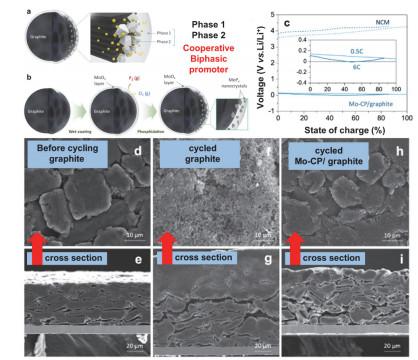
Fig 2
(a) Structural diagram of MoOx-MoPx@graphite composite; (b) construction strategy of MoOx-MoPx composite coating; (c) discharge electrochemical behavior of MoOx-MoPx@graphite composites in three electrode full cell system. (d) and (e) the initial morphology of the uncoated graphite electrode; (f) and (g) the morphology of uncoated graphite electrode after cycle; (h) and (I) the morphology of MoOx-MoPx@graphite after cycle.
Adapted with permission from Ref. 45, Copyright 2021, Nature publisher.
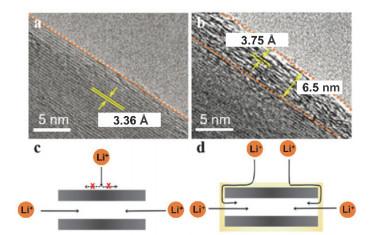
Fig 3
(a) HR-TEM result of original graphite; (b) HR-TEM result of turbine carbon@graphite composite; (c) schematic diagram of lithium ion migration in original graphite; (d) schematic diagram of lithium ion migration in turbine carbon@graphite composites.
Adapted with permission from Ref. 16, Copyright 2020, Wiley.
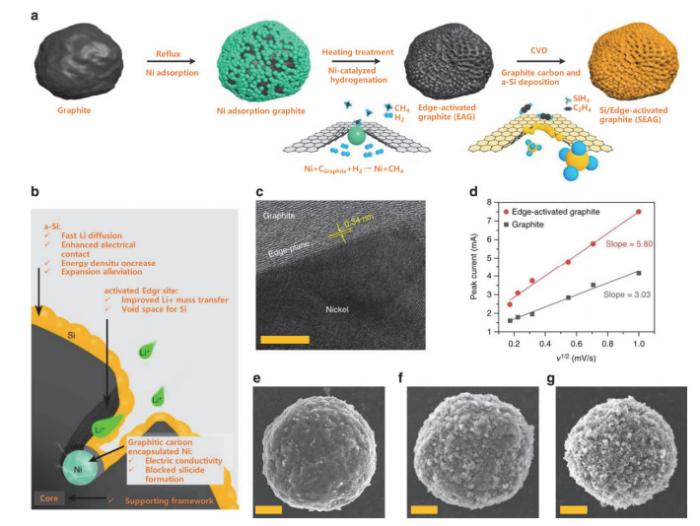
Fig 4
(a) Synthetic strategy of amorphous silicon coated edge activated graphite; (b) the mechanism of improving the electrochemical properties of graphite by edge activation and amorphous silicon coating. (c) HR-TEM of composite material; (d) comparison of electrochemically active surface areas of the two materials. SEM image of (e) original graphite, (f) nickel adsorbed graphite, (g) amorphous silicon coated graphite.
Adapted with permission from Ref. 21, Copyright 2017, Nature publisher.
Fig 5
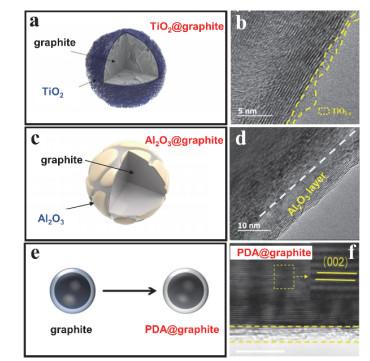
(a) Structural diagram of TiO2−x@graphite, (b) HR-TEM result of TiO2−x@graphite 47; (c) structural diagram of amorphous Al2O3@graphite, (d) HR-TEM result of amorphous Al2O3@graphite 48; (e) synthesis strategy of PDA@graphite, (f) HR-TEM result of PDA@graphite 49.
(a, b) Adapted with permission from Ref. 47, Copyright 2017, Elsevier. (c, d) Adapted with permission from Ref. 48, Copyright 2019, Elsevier. (e, f) Adapted with permission from Ref. 49, Copyright 2022, Wiley.
Fig 6
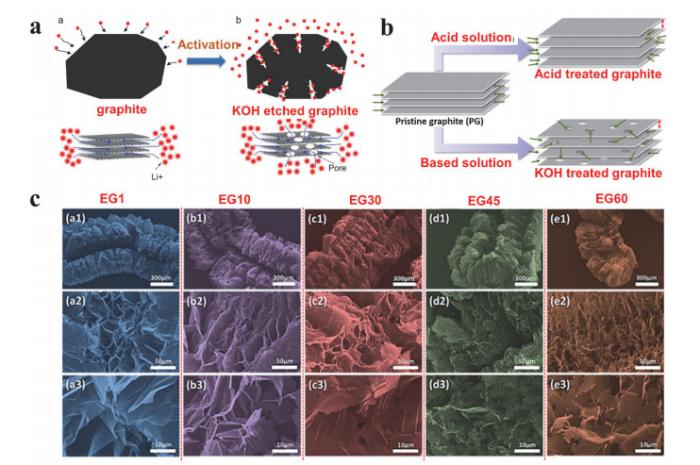
(a) Mechanism of KOH activated graphite 55; (b) mechanism of acid-base activated graphite 56; (c) SEM images of worm like expanded graphite prepared under different conditions 57.
(a) Adapted with permission from Ref. 55, Copyright 2015, Elsevier. (b) Adapted with permission from Ref. 56, Copyright 2020, Elsevier. (c) Adapted with permission from Ref. 57, Copyright 2021, Elsevier.
Fig 7
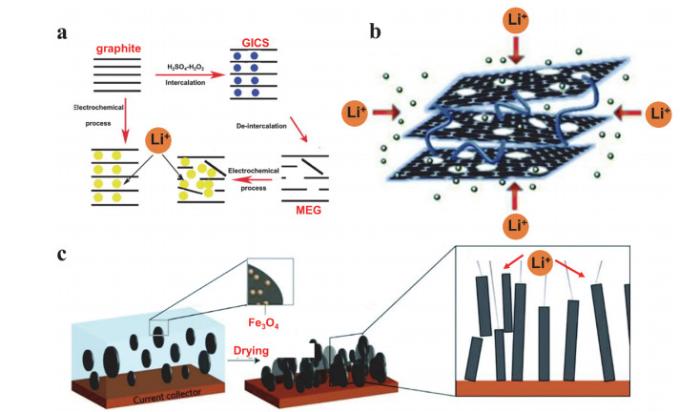
(a) Schematic of the preparation of MEG and its mechanism in improving the capacity 61; (b) schematic illustration of Li+ insertion in CNT separated porous graphite nano sheets 62; (c) schematic showing magnetically aligned graphite particles to shorten the Li+ diffusion path 33.
(a) Adapted with permission from Ref. 61, Copyright 2019, Elsevier. (b) Adapted with permission from Ref. 62, Copyright 2019, Elsevier. (c) Adapted with permission from Ref. 33, Copyright 2016, Nature publisher.
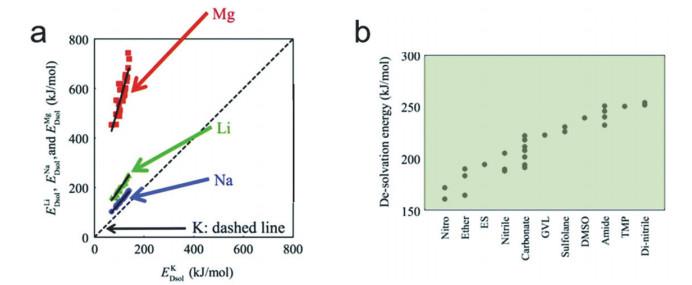
(a) Desolvation energies of Li, Na, and Mg ions compared to those of K ions 75. (b) The dependence of desolvation energy between solvents and Li ion on solvent type 37. (a) Adapted with permission from Ref. 75, Copyright 2017, The Electrochemical Society. (b) Adapted with permission from Ref. 37, Copyright 2013, The Electrochemical Society.
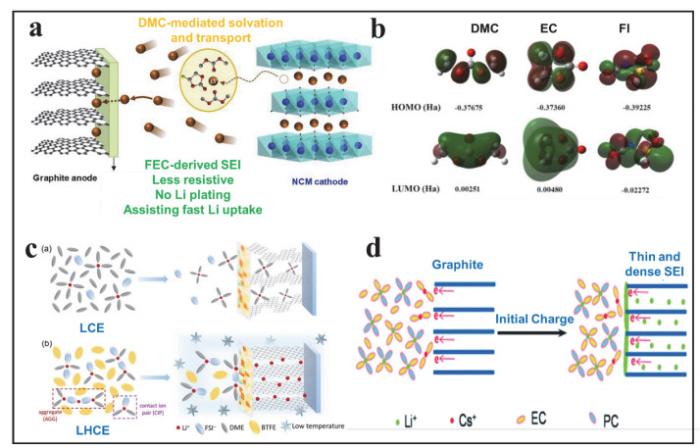
Fig 9
(a) improvement mechanism of FEC additive on the performance of NCM/graphite full cell; (b) homo and LUMO orbitals of DMC, EC and FI molecules; (c) illustration of solution structure and Li+ embedding process in graphite layer a) LCE and b) in DME without/using BTFE 71; (d) schematic diagram of adding metal cation additives to adjust the solvation structure to inhibit the cointercalation of solvent molecules 85.
(a) Adapted with permission from Ref. 81, Copyright 2018, Elsevier. (b) Adapted with permission from Ref. 82, Copyright 2019, Elsevier.) (c) Adapted with permission from Ref. 71, Copyright 2021, Wiley. (d) Adapted with permission from Ref. 85, Copyright 2016, American Chemical Society.
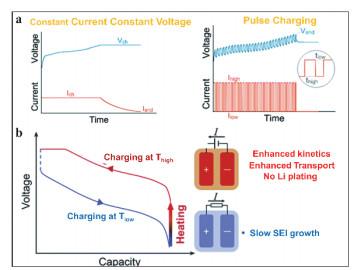
(a) Voltage and current profiles of CC-CV and pulse charging 93. (b) A LIB cell under an asymmetric temperature modulation method is rapidly pre-heated to and charged at 60 ℃ 94. (a) Adapted with permission from Ref. 93, Copyright 2001, Elsevier. (b) Adapted with permission from Ref. 94, Copyright 2019, Cell Press.
... 16(a) HR-TEM result of original graphite; (b) HR-TEM result of turbine carbon@graphite composite; (c) schematic diagram of lithium ion migration in original graphite; (d) schematic diagram of lithium ion migration in turbine carbon@graphite composites.
Adapted with permission from Ref. 16, Copyright 2020, Wiley. ...
... Adapted with permission from Ref. 16, Copyright 2020, Wiley. ...
... 21(a) Synthetic strategy of amorphous silicon coated edge activated graphite; (b) the mechanism of improving the electrochemical properties of graphite by edge activation and amorphous silicon coating. (c) HR-TEM of composite material; (d) comparison of electrochemically active surface areas of the two materials. SEM image of (e) original graphite, (f) nickel adsorbed graphite, (g) amorphous silicon coated graphite.
Adapted with permission from Ref. 21, Copyright 2017, Nature publisher. ...
... Adapted with permission from Ref. 21, Copyright 2017, Nature publisher. ...
(a) Schematic of the preparation of MEG and its mechanism in improving the capacity <sup><xref ref-type="bibr" rid="b61">61</xref></sup>; (b) schematic illustration of Li<sup>+</sup> insertion in CNT separated porous graphite nano sheets <sup><xref ref-type="bibr" rid="b62">62</xref></sup>; (c) schematic showing magnetically aligned graphite particles to shorten the Li<sup>+</sup> diffusion path <sup><xref ref-type="bibr" rid="b33">33</xref></sup>.
(a) Adapted with permission from Ref. 61, Copyright 2019, Elsevier. (b) Adapted with permission from Ref. 62, Copyright 2019, Elsevier. (c) Adapted with permission from Ref. 33, Copyright 2016, Nature publisher. ...
... 33.
(a) Adapted with permission from Ref. 61, Copyright 2019, Elsevier. (b) Adapted with permission from Ref. 62, Copyright 2019, Elsevier. (c) Adapted with permission from Ref. 33, Copyright 2016, Nature publisher. ...
... (a) Adapted with permission from Ref. 61, Copyright 2019, Elsevier. (b) Adapted with permission from Ref. 62, Copyright 2019, Elsevier. (c) Adapted with permission from Ref. 33, Copyright 2016, Nature publisher. ...
... (a) Desolvation energies of Li, Na, and Mg ions compared to those of K ions 75. (b) The dependence of desolvation energy between solvents and Li ion on solvent type 37. (a) Adapted with permission from Ref. 75, Copyright 2017, The Electrochemical Society. (b) Adapted with permission from Ref. 37, Copyright 2013, The Electrochemical Society. ...
... , Copyright 2017, The Electrochemical Society. (b) Adapted with permission from Ref. 37, Copyright 2013, The Electrochemical Society. ...
1
2015
... modification strategies and electrochemical properties of graphite in other reports.Table 1
Modification strategy
Electrochemical performance (capacity/corresponding current density)
Reference
Edge-plane activated graphite coated by an amorphous Si nanolayer
100 mAh∙g−1/1 A∙g−1 200 mAh∙g−1/0.67 A∙g−1
21
The electrolyte consists of 1.0 M lithium trifluoromethanesulfonate (LiTF) in DEGDME
~100 mAh∙g−1/1 A∙g−1
30
The electrolyte consists of a superconcentrated 4.5 M LiFSA/AN solution
~278 mAh∙g−1/1.86 A∙g−1
31
LTO coated graphite
~143 mAh∙g−1/2.14 A∙g−1
32
PEGPE coated natural graphite
298 mAh∙g−1/0.186 A∙g−1
26
Graphite particles oriented perpendicularly to the current collector
... 45(a) Structural diagram of MoO<sub><i>x</i></sub>-MoP<sub><i>x</i></sub>@graphite composite; (b) construction strategy of MoO<sub><i>x</i></sub>-MoP<sub><i>x</i></sub> composite coating; (c) discharge electrochemical behavior of MoO<sub><i>x</i></sub>-MoP<sub><i>x</i></sub>@graphite composites in three electrode full cell system. (d) and (e) the initial morphology of the uncoated graphite electrode; (f) and (g) the morphology of uncoated graphite electrode after cycle; (h) and (I) the morphology of MoO<sub><i>x</i></sub>-MoP<sub><i>x</i></sub>@graphite after cycle.
Adapted with permission from Ref. 45, Copyright 2021, Nature publisher. ...
... Adapted with permission from Ref. 45, Copyright 2021, Nature publisher. ...
... 47;(c)无定形Al2O3/石墨的结构示意图,(d)无定形Al2O3/石墨的HR-TEM图48;(e) PDA/石墨的合成策略,(f) PDA/石墨的HR-TEM图49(a) Structural diagram of TiO<sub>2−<i>x</i></sub>@graphite, (b) HR-TEM result of TiO<sub>2−<i>x</i></sub>@graphite <sup><xref ref-type="bibr" rid="b47">47</xref></sup>; (c) structural diagram of amorphous Al<sub>2</sub>O<sub>3</sub>@graphite, (d) HR-TEM result of amorphous Al<sub>2</sub>O<sub>3</sub>@graphite <sup><xref ref-type="bibr" rid="b48">48</xref></sup>; (e) synthesis strategy of PDA@graphite, (f) HR-TEM result of PDA@graphite <sup><xref ref-type="bibr" rid="b49">49</xref></sup>.
(a, b) Adapted with permission from Ref. 47, Copyright 2017, Elsevier. (c, d) Adapted with permission from Ref. 48, Copyright 2019, Elsevier. (e, f) Adapted with permission from Ref. 49, Copyright 2022, Wiley. ...
... 47; (c) structural diagram of amorphous Al2O3@graphite, (d) HR-TEM result of amorphous Al2O3@graphite 48; (e) synthesis strategy of PDA@graphite, (f) HR-TEM result of PDA@graphite 49.
(a, b) Adapted with permission from Ref. 47, Copyright 2017, Elsevier. (c, d) Adapted with permission from Ref. 48, Copyright 2019, Elsevier. (e, f) Adapted with permission from Ref. 49, Copyright 2022, Wiley. ...
... (a, b) Adapted with permission from Ref. 47, Copyright 2017, Elsevier. (c, d) Adapted with permission from Ref. 48, Copyright 2019, Elsevier. (e, f) Adapted with permission from Ref. 49, Copyright 2022, Wiley. ...
... 48;(e) PDA/石墨的合成策略,(f) PDA/石墨的HR-TEM图49(a) Structural diagram of TiO<sub>2−<i>x</i></sub>@graphite, (b) HR-TEM result of TiO<sub>2−<i>x</i></sub>@graphite <sup><xref ref-type="bibr" rid="b47">47</xref></sup>; (c) structural diagram of amorphous Al<sub>2</sub>O<sub>3</sub>@graphite, (d) HR-TEM result of amorphous Al<sub>2</sub>O<sub>3</sub>@graphite <sup><xref ref-type="bibr" rid="b48">48</xref></sup>; (e) synthesis strategy of PDA@graphite, (f) HR-TEM result of PDA@graphite <sup><xref ref-type="bibr" rid="b49">49</xref></sup>.
(a, b) Adapted with permission from Ref. 47, Copyright 2017, Elsevier. (c, d) Adapted with permission from Ref. 48, Copyright 2019, Elsevier. (e, f) Adapted with permission from Ref. 49, Copyright 2022, Wiley. ...
... 48; (e) synthesis strategy of PDA@graphite, (f) HR-TEM result of PDA@graphite 49.
(a, b) Adapted with permission from Ref. 47, Copyright 2017, Elsevier. (c, d) Adapted with permission from Ref. 48, Copyright 2019, Elsevier. (e, f) Adapted with permission from Ref. 49, Copyright 2022, Wiley. ...
... (a, b) Adapted with permission from Ref. 47, Copyright 2017, Elsevier. (c, d) Adapted with permission from Ref. 48, Copyright 2019, Elsevier. (e, f) Adapted with permission from Ref. 49, Copyright 2022, Wiley. ...
... 49(a) Structural diagram of TiO<sub>2−<i>x</i></sub>@graphite, (b) HR-TEM result of TiO<sub>2−<i>x</i></sub>@graphite <sup><xref ref-type="bibr" rid="b47">47</xref></sup>; (c) structural diagram of amorphous Al<sub>2</sub>O<sub>3</sub>@graphite, (d) HR-TEM result of amorphous Al<sub>2</sub>O<sub>3</sub>@graphite <sup><xref ref-type="bibr" rid="b48">48</xref></sup>; (e) synthesis strategy of PDA@graphite, (f) HR-TEM result of PDA@graphite <sup><xref ref-type="bibr" rid="b49">49</xref></sup>.
(a, b) Adapted with permission from Ref. 47, Copyright 2017, Elsevier. (c, d) Adapted with permission from Ref. 48, Copyright 2019, Elsevier. (e, f) Adapted with permission from Ref. 49, Copyright 2022, Wiley. ...
... 49.
(a, b) Adapted with permission from Ref. 47, Copyright 2017, Elsevier. (c, d) Adapted with permission from Ref. 48, Copyright 2019, Elsevier. (e, f) Adapted with permission from Ref. 49, Copyright 2022, Wiley. ...
... (a, b) Adapted with permission from Ref. 47, Copyright 2017, Elsevier. (c, d) Adapted with permission from Ref. 48, Copyright 2019, Elsevier. (e, f) Adapted with permission from Ref. 49, Copyright 2022, Wiley. ...
... 55;(b)酸碱活化石墨的机理示意图56;(c)不同条件下制备的虫状膨胀石墨的SEM图57(a) Mechanism of KOH activated graphite <sup><xref ref-type="bibr" rid="b55">55</xref></sup>; (b) mechanism of acid-base activated graphite <sup><xref ref-type="bibr" rid="b56">56</xref></sup>; (c) SEM images of worm like expanded graphite prepared under different conditions <sup><xref ref-type="bibr" rid="b57">57</xref></sup>.
(a) Adapted with permission from Ref. 55, Copyright 2015, Elsevier. (b) Adapted with permission from Ref. 56, Copyright 2020, Elsevier. (c) Adapted with permission from Ref. 57, Copyright 2021, Elsevier. ...
... 55; (b) mechanism of acid-base activated graphite 56; (c) SEM images of worm like expanded graphite prepared under different conditions 57.
(a) Adapted with permission from Ref. 55, Copyright 2015, Elsevier. (b) Adapted with permission from Ref. 56, Copyright 2020, Elsevier. (c) Adapted with permission from Ref. 57, Copyright 2021, Elsevier. ...
... (a) Adapted with permission from Ref. 55, Copyright 2015, Elsevier. (b) Adapted with permission from Ref. 56, Copyright 2020, Elsevier. (c) Adapted with permission from Ref. 57, Copyright 2021, Elsevier. ...
... 56;(c)不同条件下制备的虫状膨胀石墨的SEM图57(a) Mechanism of KOH activated graphite <sup><xref ref-type="bibr" rid="b55">55</xref></sup>; (b) mechanism of acid-base activated graphite <sup><xref ref-type="bibr" rid="b56">56</xref></sup>; (c) SEM images of worm like expanded graphite prepared under different conditions <sup><xref ref-type="bibr" rid="b57">57</xref></sup>.
(a) Adapted with permission from Ref. 55, Copyright 2015, Elsevier. (b) Adapted with permission from Ref. 56, Copyright 2020, Elsevier. (c) Adapted with permission from Ref. 57, Copyright 2021, Elsevier. ...
... 56; (c) SEM images of worm like expanded graphite prepared under different conditions 57.
(a) Adapted with permission from Ref. 55, Copyright 2015, Elsevier. (b) Adapted with permission from Ref. 56, Copyright 2020, Elsevier. (c) Adapted with permission from Ref. 57, Copyright 2021, Elsevier. ...
... (a) Adapted with permission from Ref. 55, Copyright 2015, Elsevier. (b) Adapted with permission from Ref. 56, Copyright 2020, Elsevier. (c) Adapted with permission from Ref. 57, Copyright 2021, Elsevier. ...
... 57(a) Mechanism of KOH activated graphite <sup><xref ref-type="bibr" rid="b55">55</xref></sup>; (b) mechanism of acid-base activated graphite <sup><xref ref-type="bibr" rid="b56">56</xref></sup>; (c) SEM images of worm like expanded graphite prepared under different conditions <sup><xref ref-type="bibr" rid="b57">57</xref></sup>.
(a) Adapted with permission from Ref. 55, Copyright 2015, Elsevier. (b) Adapted with permission from Ref. 56, Copyright 2020, Elsevier. (c) Adapted with permission from Ref. 57, Copyright 2021, Elsevier. ...
... 57.
(a) Adapted with permission from Ref. 55, Copyright 2015, Elsevier. (b) Adapted with permission from Ref. 56, Copyright 2020, Elsevier. (c) Adapted with permission from Ref. 57, Copyright 2021, Elsevier. ...
... (a) Adapted with permission from Ref. 55, Copyright 2015, Elsevier. (b) Adapted with permission from Ref. 56, Copyright 2020, Elsevier. (c) Adapted with permission from Ref. 57, Copyright 2021, Elsevier. ...
... 61;(b)碳纳米管分离多孔石墨纳米片中锂离子插入的示意图62;(c)磁对齐石墨颗粒缩短锂离子扩散路径的示意图33(a) Schematic of the preparation of MEG and its mechanism in improving the capacity <sup><xref ref-type="bibr" rid="b61">61</xref></sup>; (b) schematic illustration of Li<sup>+</sup> insertion in CNT separated porous graphite nano sheets <sup><xref ref-type="bibr" rid="b62">62</xref></sup>; (c) schematic showing magnetically aligned graphite particles to shorten the Li<sup>+</sup> diffusion path <sup><xref ref-type="bibr" rid="b33">33</xref></sup>.
(a) Adapted with permission from Ref. 61, Copyright 2019, Elsevier. (b) Adapted with permission from Ref. 62, Copyright 2019, Elsevier. (c) Adapted with permission from Ref. 33, Copyright 2016, Nature publisher. ...
... 61; (b) schematic illustration of Li+ insertion in CNT separated porous graphite nano sheets 62; (c) schematic showing magnetically aligned graphite particles to shorten the Li+ diffusion path 33.
(a) Adapted with permission from Ref. 61, Copyright 2019, Elsevier. (b) Adapted with permission from Ref. 62, Copyright 2019, Elsevier. (c) Adapted with permission from Ref. 33, Copyright 2016, Nature publisher. ...
... (a) Adapted with permission from Ref. 61, Copyright 2019, Elsevier. (b) Adapted with permission from Ref. 62, Copyright 2019, Elsevier. (c) Adapted with permission from Ref. 33, Copyright 2016, Nature publisher. ...
(a) Schematic of the preparation of MEG and its mechanism in improving the capacity <sup><xref ref-type="bibr" rid="b61">61</xref></sup>; (b) schematic illustration of Li<sup>+</sup> insertion in CNT separated porous graphite nano sheets <sup><xref ref-type="bibr" rid="b62">62</xref></sup>; (c) schematic showing magnetically aligned graphite particles to shorten the Li<sup>+</sup> diffusion path <sup><xref ref-type="bibr" rid="b33">33</xref></sup>.
(a) Adapted with permission from Ref. 61, Copyright 2019, Elsevier. (b) Adapted with permission from Ref. 62, Copyright 2019, Elsevier. (c) Adapted with permission from Ref. 33, Copyright 2016, Nature publisher. ...
... 62; (c) schematic showing magnetically aligned graphite particles to shorten the Li+ diffusion path 33.
(a) Adapted with permission from Ref. 61, Copyright 2019, Elsevier. (b) Adapted with permission from Ref. 62, Copyright 2019, Elsevier. (c) Adapted with permission from Ref. 33, Copyright 2016, Nature publisher. ...
... (a) Adapted with permission from Ref. 61, Copyright 2019, Elsevier. (b) Adapted with permission from Ref. 62, Copyright 2019, Elsevier. (c) Adapted with permission from Ref. 33, Copyright 2016, Nature publisher. ...
... 71;(d)添加金属阳离子添加剂以调节溶剂化结构以抑制溶剂分子共插层的示意图85(a) improvement mechanism of FEC additive on the performance of NCM/graphite full cell; (b) homo and LUMO orbitals of DMC, EC and FI molecules; (c) illustration of solution structure and Li<sup>+</sup> embedding process in graphite layer a) LCE and b) in DME without/using BTFE <sup><xref ref-type="bibr" rid="b71">71</xref></sup>; (d) schematic diagram of adding metal cation additives to adjust the solvation structure to inhibit the cointercalation of solvent molecules <sup><xref ref-type="bibr" rid="b85">85</xref></sup>.
(a) Adapted with permission from Ref. 81, Copyright 2018, Elsevier. (b) Adapted with permission from Ref. 82, Copyright 2019, Elsevier.) (c) Adapted with permission from Ref. 71, Copyright 2021, Wiley. (d) Adapted with permission from Ref. 85, Copyright 2016, American Chemical Society. ...
... 71; (d) schematic diagram of adding metal cation additives to adjust the solvation structure to inhibit the cointercalation of solvent molecules 85.
(a) Adapted with permission from Ref. 81, Copyright 2018, Elsevier. (b) Adapted with permission from Ref. 82, Copyright 2019, Elsevier.) (c) Adapted with permission from Ref. 71, Copyright 2021, Wiley. (d) Adapted with permission from Ref. 85, Copyright 2016, American Chemical Society. ...
... (a) Adapted with permission from Ref. 81, Copyright 2018, Elsevier. (b) Adapted with permission from Ref. 82, Copyright 2019, Elsevier.) (c) Adapted with permission from Ref. 71, Copyright 2021, Wiley. (d) Adapted with permission from Ref. 85, Copyright 2016, American Chemical Society. ...
... (a) Desolvation energies of Li, Na, and Mg ions compared to those of K ions 75. (b) The dependence of desolvation energy between solvents and Li ion on solvent type 37. (a) Adapted with permission from Ref. 75, Copyright 2017, The Electrochemical Society. (b) Adapted with permission from Ref. 37, Copyright 2013, The Electrochemical Society. ...
... . (a) Adapted with permission from Ref. 75, Copyright 2017, The Electrochemical Society. (b) Adapted with permission from Ref. 37, Copyright 2013, The Electrochemical Society. ...
... 81;(b) DMC、EC和FI分子的HOMO和LUMO轨道82;(c)溶液结构和Li+嵌入石墨层过程的图解a) LCE和b)在不使用/使用BTFE的DME中71;(d)添加金属阳离子添加剂以调节溶剂化结构以抑制溶剂分子共插层的示意图85(a) improvement mechanism of FEC additive on the performance of NCM/graphite full cell; (b) homo and LUMO orbitals of DMC, EC and FI molecules; (c) illustration of solution structure and Li<sup>+</sup> embedding process in graphite layer a) LCE and b) in DME without/using BTFE <sup><xref ref-type="bibr" rid="b71">71</xref></sup>; (d) schematic diagram of adding metal cation additives to adjust the solvation structure to inhibit the cointercalation of solvent molecules <sup><xref ref-type="bibr" rid="b85">85</xref></sup>.
(a) Adapted with permission from Ref. 81, Copyright 2018, Elsevier. (b) Adapted with permission from Ref. 82, Copyright 2019, Elsevier.) (c) Adapted with permission from Ref. 71, Copyright 2021, Wiley. (d) Adapted with permission from Ref. 85, Copyright 2016, American Chemical Society. ...
... (a) Adapted with permission from Ref. 81, Copyright 2018, Elsevier. (b) Adapted with permission from Ref. 82, Copyright 2019, Elsevier.) (c) Adapted with permission from Ref. 71, Copyright 2021, Wiley. (d) Adapted with permission from Ref. 85, Copyright 2016, American Chemical Society. ...
... 82;(c)溶液结构和Li+嵌入石墨层过程的图解a) LCE和b)在不使用/使用BTFE的DME中71;(d)添加金属阳离子添加剂以调节溶剂化结构以抑制溶剂分子共插层的示意图85(a) improvement mechanism of FEC additive on the performance of NCM/graphite full cell; (b) homo and LUMO orbitals of DMC, EC and FI molecules; (c) illustration of solution structure and Li<sup>+</sup> embedding process in graphite layer a) LCE and b) in DME without/using BTFE <sup><xref ref-type="bibr" rid="b71">71</xref></sup>; (d) schematic diagram of adding metal cation additives to adjust the solvation structure to inhibit the cointercalation of solvent molecules <sup><xref ref-type="bibr" rid="b85">85</xref></sup>.
(a) Adapted with permission from Ref. 81, Copyright 2018, Elsevier. (b) Adapted with permission from Ref. 82, Copyright 2019, Elsevier.) (c) Adapted with permission from Ref. 71, Copyright 2021, Wiley. (d) Adapted with permission from Ref. 85, Copyright 2016, American Chemical Society. ...
... (a) Adapted with permission from Ref. 81, Copyright 2018, Elsevier. (b) Adapted with permission from Ref. 82, Copyright 2019, Elsevier.) (c) Adapted with permission from Ref. 71, Copyright 2021, Wiley. (d) Adapted with permission from Ref. 85, Copyright 2016, American Chemical Society. ...
(a) improvement mechanism of FEC additive on the performance of NCM/graphite full cell; (b) homo and LUMO orbitals of DMC, EC and FI molecules; (c) illustration of solution structure and Li<sup>+</sup> embedding process in graphite layer a) LCE and b) in DME without/using BTFE <sup><xref ref-type="bibr" rid="b71">71</xref></sup>; (d) schematic diagram of adding metal cation additives to adjust the solvation structure to inhibit the cointercalation of solvent molecules <sup><xref ref-type="bibr" rid="b85">85</xref></sup>.
(a) Adapted with permission from Ref. 81, Copyright 2018, Elsevier. (b) Adapted with permission from Ref. 82, Copyright 2019, Elsevier.) (c) Adapted with permission from Ref. 71, Copyright 2021, Wiley. (d) Adapted with permission from Ref. 85, Copyright 2016, American Chemical Society. ...
... 85.
(a) Adapted with permission from Ref. 81, Copyright 2018, Elsevier. (b) Adapted with permission from Ref. 82, Copyright 2019, Elsevier.) (c) Adapted with permission from Ref. 71, Copyright 2021, Wiley. (d) Adapted with permission from Ref. 85, Copyright 2016, American Chemical Society. ...
... (a) Adapted with permission from Ref. 81, Copyright 2018, Elsevier. (b) Adapted with permission from Ref. 82, Copyright 2019, Elsevier.) (c) Adapted with permission from Ref. 71, Copyright 2021, Wiley. (d) Adapted with permission from Ref. 85, Copyright 2016, American Chemical Society. ...
... (a) Voltage and current profiles of CC-CV and pulse charging 93. (b) A LIB cell under an asymmetric temperature modulation method is rapidly pre-heated to and charged at 60 ℃ 94. (a) Adapted with permission from Ref. 93, Copyright 2001, Elsevier. (b) Adapted with permission from Ref. 94, Copyright 2019, Cell Press. ...
... (a) Adapted with permission from Ref. 93, Copyright 2001, Elsevier. (b) Adapted with permission from Ref. 94, Copyright 2019, Cell Press. ...
3
2019
... (a) Voltage and current profiles of CC-CV and pulse charging 93. (b) A LIB cell under an asymmetric temperature modulation method is rapidly pre-heated to and charged at 60 ℃ 94. (a) Adapted with permission from Ref. 93, Copyright 2001, Elsevier. (b) Adapted with permission from Ref. 94, Copyright 2019, Cell Press. ...
... , Copyright 2001, Elsevier. (b) Adapted with permission from Ref. 94, Copyright 2019, Cell Press. ...