

物理化学学报 >> 2024, Vol. 40 >> Issue (4): 2304037.doi: 10.3866/PKU.WHXB202304037
田晓靖1,2, 黄至纯3, 张青松1,4,*( ), 王旭5, 杨宁1,2, 邓南平3
收稿日期:2023-04-20
修回日期:2023-06-19
录用日期:2023-06-23
发布日期:2023-06-30
通讯作者:
Email: zqs8011@163.com; Tel.: +86-18622036882 (张青松)
基金资助:
Xiaojing Tian1,2, Zhichun Huang3, Qingsong Zhang1,4,*(), Xu Wang5, Ning Yang1,2, Nanping Deng3
Received:2023-04-20
Revised:2023-06-19
Accepted:2023-06-23
Published:2023-06-30
Contact:
Email: zqs8011@163.com; Tel.: +86-18622036882 (Qingsong Zhang)
Supported by:摘要:
聚N-异丙基丙烯酰胺(PNIPAm)交联温敏纳米纤维膜作为一种相变温度易于控制的新兴响应性材料,克服了传统PNIPAm块状水凝胶的生产成本高、响应速率慢和PNIPAm非交联温敏纳米纤维耐水性差的缺点,受到广泛研究并应用于智能开关、温度致动器、水油分离、药物、细胞控制释放和伤口敷料等领域。形貌稳定性和快速响应性是温敏纳米纤维膜在重复体积变化过程中最大的挑战,同时也作为评价PNIPAm温敏纳米纤维膜的实用性最重要指标引起了人们广泛的关注。本文全面综述了PNIPAm温敏纳米纤维膜近二十年来国内外的突破性进展和非交联作用下PNIPAm温敏纳米纤维膜的形貌变化和响应性,重点综合分析了物理和化学交联中交联反应类型、交联度、交联时间和交联分子量对PNIPAm温敏纳米纤维膜的形貌稳定性和响应行为的影响,为之后纤维膜的交联处理提供了理论支持,并对PNIPAm温敏纳米纤维膜的发展及应用前景进行了展望。
田晓靖, 黄至纯, 张青松, 王旭, 杨宁, 邓南平. PNIPAm温敏纳米纤维膜:交联作用下的形貌稳定性和响应行为[J]. 物理化学学报, 2024, 40(4), 2304037. doi: 10.3866/PKU.WHXB202304037
Xiaojing Tian, Zhichun Huang, Qingsong Zhang, Xu Wang, Ning Yang, Nanping Deng. PNIPAm Thermo-Responsive Nanofibers Mats: Morphological Stability and Response Behavior under Cross-Linking[J]. Acta Phys. -Chim. Sin. 2024, 40(4), 2304037. doi: 10.3866/PKU.WHXB202304037
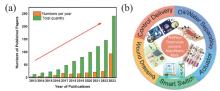
图1
(a) 2013–2023年Web of science核心期刊合集中发表的关于PNIPAm交联温敏纳米纤维膜的论文趋势,截止至2023年3月;(b) PNIPAm温敏纳米纤维膜应用"
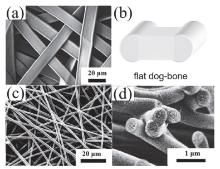
图2
纯PNIPAm纳米纤维的(a)平面SEM图,(b)截面示意图13;(c) ecovio®/PNIPAm纳米纤维的平面SEM图22;(d)纳米纤维截面SEM图23"
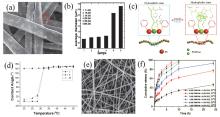
图3
(a) PNIPAm/35% ZnO纤维膜的SEM图,(b)不同氧化锌含量的纤维平均直径25;(c) PNIPAm/PS纳米纤维膜温度响应性的分子机理图,(d) PNIPAm/PS纳米纤维膜Ⅰ、Ⅱ和Ⅲ中PNIPAm与PS的比例分别为10%、60%和20%时,水接触角的温度依赖性12;(e) 16.0% (w/v) PNIPAm/1.0% (w/v) PEO纳米纤维膜的SEM图,(f) VB12从PNIPAm/PEO纳米纤维膜的体外释放谱26"
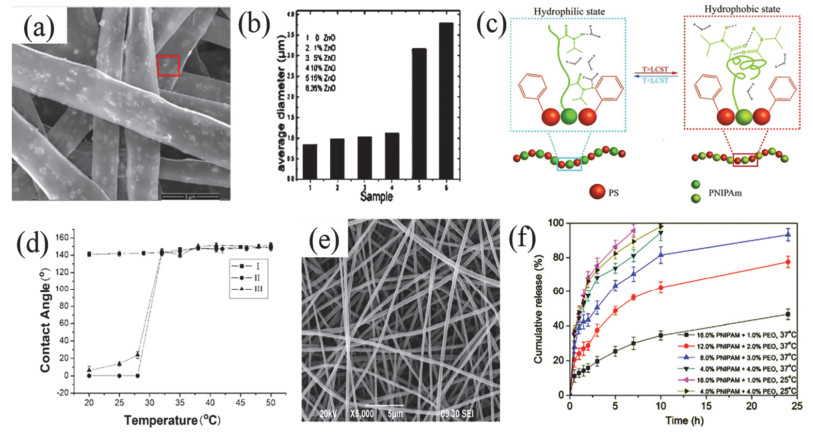
表1
聚N-异丙基丙烯酰胺非交联温敏纳米纤维膜的性能和应用场景"
| Composition of thermo-responsive nanofibers mats | Solvent | Mean diameter of nanofibers/nm | LCST/℃ | Water resistance | Application Scenarios | Ref. |
| PNIPAm/PS | THF | 100–500 | 32–33 | NO | – | |
| PNIPAm | Water | 750 | 32 | NO | – | |
| PNIPAm/ZnO | DMF | 1670 | – | NO | Thermo-responsive photocatalysis | |
| PNIPAm/PEO | Water | 250–380 | 32 | NO | Controlled release of drugs |
表2
聚N-异丙基丙烯酰胺温敏纳米纤维膜的交联方法、性能及应用场景"
| Composition of thermo-responsive nanofibers mats | Cross-linking methods | Crosslinkers | Solvent | Mean diameter of nanofibers/nm | LCST/℃ | Water resistance | Application Scenarios | Ref. |
| p(NIPAm-co-SA) | Physical cross-linking | – | – | 207 | 23 | YES | Actuators | |
| PNIPAm | – | OpePOSS | DMF : THF = 1 : 1 | 970 ± 120 | 31 | YES | – | |
| PNIPAm/Gelatin | In situ cross-linking | EDC-NHS | TFE : H2O = 1 : 1 | 600–800 | 32 | YES | Controlled release of drugs | |
| p(PFPA-co-NIPAm) | Esteramine reaction | – | THF : DMF = 3 : 1 | 620 ± 160 | 32 | YES | Cell culture | |
| PNIPAm/EA/PCL | Heating cross-linking | – | TFE | 614 | 26 | YES | Controlled release of drugs | |
| PCL/PNIPAm | UV cross-linking | BP、PETM | DMF/Trichloromethane | 600 | – | YES | Captures and Releases Cells | |
| p(NIPAm-ABP) | UV cross-linking | ABP | DMF | 150–250 | – | YES | Actuators | |
| p(NIPAm-co-MAA)/ β-CD | Esterification reaction | – | DMF | – | – | YES | Dye adsorption | |
| P(NIPAm-co-NMA)/ChNWs | In situ cross-linking | – | H2O : THF = 1 : 2 | 380 | – | YES | Water/oil separation | |
| PNIPAm/AuNRs | – | OpePOSS | DMF | – | – | YES | Smart Switch | |
| P(NIPAm-ABP)/TPU | UV cross-linking | ABP | DMF | 477 ± 69 | 29 | YES | Actuators | |
| p(NIPAm-co-NMA) | Self-condensation reactions | – | – | 600–700 | 38 | YES | Controlled release of drugs | |
| PNIPAm-NMA-Am | Esterification reaction | – | DMF : THF = 1 : 1 | 200 | 55 | YES | Controlled release of drugs |
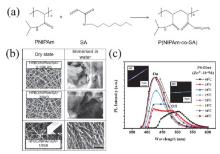
图4
(a) PNIPAm与SA聚合机理;(b)不同组成比HPBO/NIPAm/SA纤维膜的干态和水下SEM图,(c)使用10−4 mol∙L−1的Zn2+浓度,P4纳米纤维膜的PL光谱随温度的变化。两个插图显示了纳米纤维在40和10 ℃下的共焦图像35"
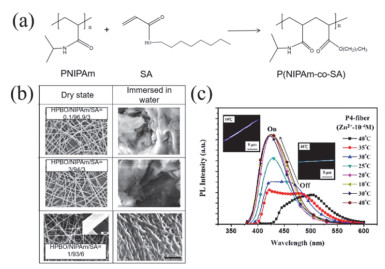
图5
PNIPAm基温敏纳米纤维膜化学交联机理:(a) OpePOSS作交联剂16;(b) NHS/EDC作交联剂;(c) ABP作交联剂;(d)酯化反应;(e)自缩合反应;(f)酯胺反应;(g)蛋蛋白加热交联;(h)原位交联"
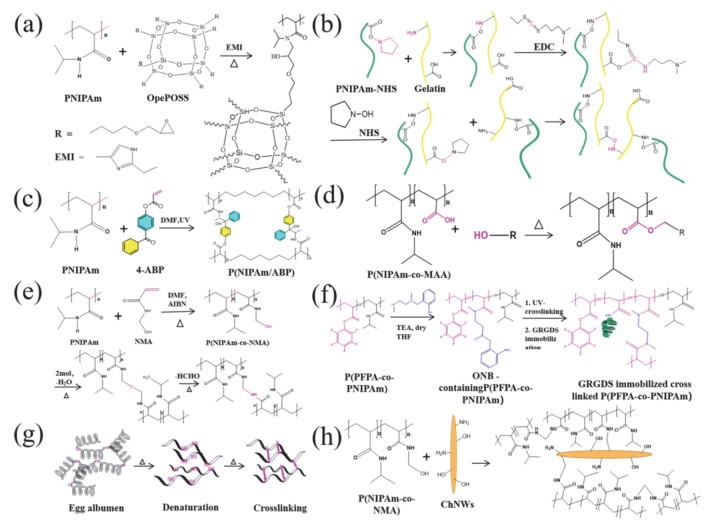
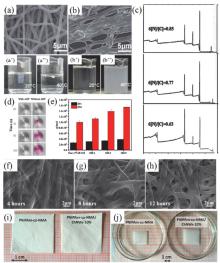
图6
(a,b) EMI的存在对PNIPAm/OpePOSS纳米纤维膜形貌的影响16;(c) PNIPAm/PCL交联纳米纤维膜在水中浸泡1,2,3 h后的XPS图谱63;(d)将p(NIPAm-ABP) (左)和纯PNIPAm(右)在20 ℃的水中浸泡一定时间后得到的纤维膜,(e) NIPAm和ABP之间不同摩尔比的p(NIPAm-ABP)的分子量64;经过(f) 4 h,(g) 8 h,(h) 12 h交联后的p(NIPAm-co-β-CD)/p(NIPAm-co-MAA)纤维膜SEM图68;(i)干态下,(j)水中的p(NIPAm-co-NMA)和p(NIPAm-co-NMA)/ChNWs纳米纤维膜图像69"
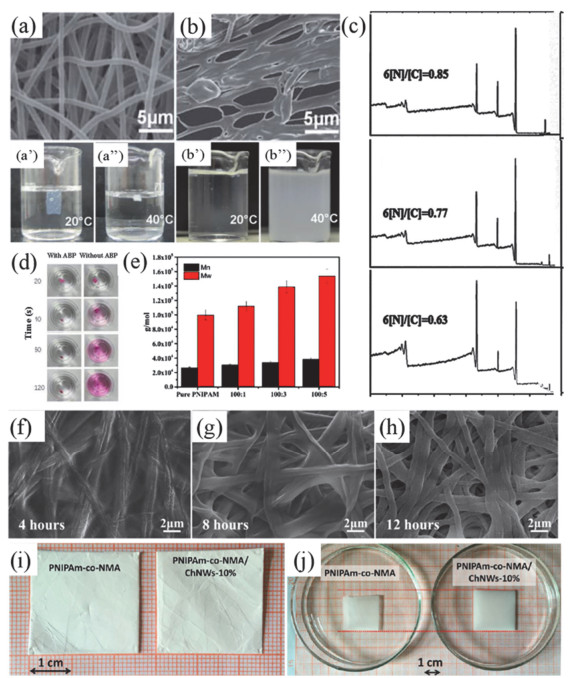
图7
AuNRs/PNIPAm/OpePOSS纳米纤维膜在光照(a) 0 s,(b) 2.5 s时的形貌,(c)热/光控开关打开关闭时“电流–时间”放大信号73;(d) p(NIPAm-ABP)/TPU双层纤维膜在不同状态下的形貌以及响应速率74;交联剂比例对p(NIPAm-ABP)纳米纤维膜的(e)溶胀率和(f)去溶胀率的影响64;(g)不同交联度纤维膜光学透射率的温度依赖性,(h)交联纳米纤维膜在10和45 ℃之间温度交替循环下的膨胀率变化76;(i) Am含量对PNIPAm-NMA-Am纳米纤维膜LCST的影响,(j) PNIPAm-NMA-Am10交联纳米纤维膜姜黄素的释放曲线77"
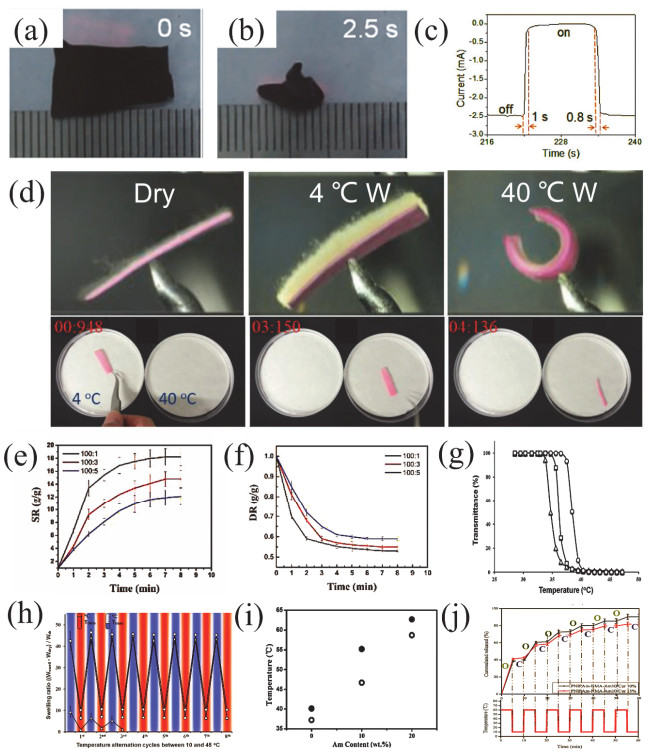
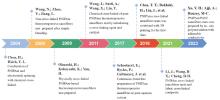
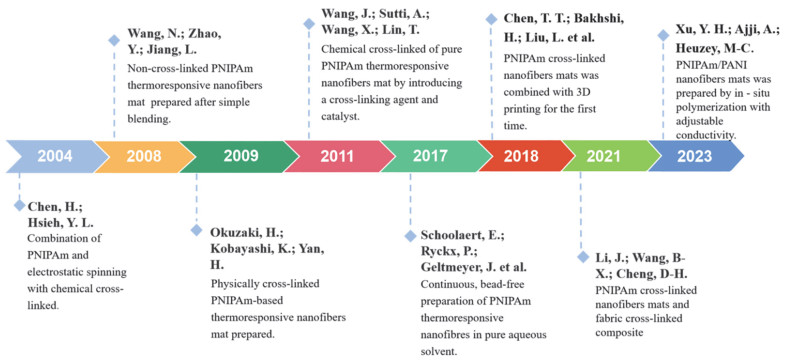
图8
PNIPAm交联温敏纳米纤维膜发展时间轴"
| 1 |
doi: 10.1002/adma.200306516 |
| 2 |
doi: 10.1016/s0142-9612(03)00340-5 |
| 3 |
doi: 10.1002/admt.202100410 |
| 4 |
doi: 10.1039/C8PY00378E |
| 5 |
doi: 10.1039/c2cs35083a |
| 6 |
doi: 10.1016/j.jconrel.2008.01.005 |
| 7 |
doi: 10.1016/j.ifset.2011.10.012 |
| 8 |
doi: 10.1002/marc.201100373 |
| 9 |
doi: 10.1007/s13233-016-4052-2 |
| 10 |
doi: 10.1039/c0nr00570c |
| 11 |
doi: 10.1002/pola.20461 |
| 12 |
doi: 10.1002/marc.200700785 |
| 13 |
doi: 10.1016/j.polymer.2008.06.018 |
| 14 |
doi: 10.1021/ma9014356 |
| 15 |
doi: 10.1016/j.synthmet.2009.07.046 |
| 16 |
doi: 10.1039/c1sm00010a |
| 17 |
doi: 10.1021/acsami.7b05074 |
| 18 |
doi: 10.1002/adfm.201800514 |
| 19 |
doi: 10.1371/journal.pone.0219254 |
| 20 |
doi: 10.1016/j.envres.2020.109494 |
| 21 |
doi: 10.3390/coatings11060632 |
| 22 |
doi: 10.1590/s1517-707620220002.1381 |
| 23 |
doi: 10.1021/acssuschemeng.9b05273 |
| 24 |
doi: 10.1016/j.sna.2022.114016 |
| 25 |
doi: 10.1016/j.colsurfa.2015.02.023 |
| 26 |
doi: 10.1016/j.colsurfb.2011.08.015 |
| 27 |
doi: 10.1039/C2JM33601D |
| 28 |
doi: 10.1088/0957-4484/18/45/455601 |
| 29 |
doi: 10.1073/pnas.1320298111 |
| 30 |
doi: 10.1002/mabi.201600123 |
| 31 |
doi: 10.1002/marc.200600653 |
| 32 |
doi: 10.1016/j.addr.2012.09.009 |
| 33 |
doi: 10.1007/s10973-019-08571-4 |
| 34 |
doi: 10.1038/376219a0 |
| 35 |
doi: 10.1039/C4RA07422J |
| 36 |
doi: 10.1039/C9RA08832F |
| 37 |
doi: 10.1002/marc.200500062 |
| 38 |
doi: 10.1002/mame.201500160 |
| 39 |
doi: 10.1016/j.xcrp.2021.100463 |
| 40 |
doi: 10.1039/C2PY20333B |
| 41 |
doi: 10.1163/156856200743670 |
| 42 |
doi: 10.1021/ma300784d |
| 43 |
doi: 10.1021/ma4007347 |
| 44 |
doi: 10.16790/j.cnki.1009-9239.im.2011.01.015 |
|
何伟; 唐安斌; 罗春明; 马庆柯; 李振中. 绝缘材料, 2011, 44, 67.
|
|
| 45 |
doi: 10.1002/anie.200801951 |
| 46 |
doi: 10.11777/j.issn1000-3304.2021.21047 |
|
鲍丙坤; 刘湍; 林秋宁; 朱麟勇. 高分子学报, 2021, 52, 646.
|
|
| 47 |
doi: 10.1016/j.polymer.2010.05.006 |
| 48 |
doi: 10.1021/acssuschemeng.5b00416 |
| 49 |
doi: 10.1021/cm00013a038 |
| 50 |
doi: 10.3866/PKU.WHXB202008047 |
|
王苹; 李海涛; 曹艳洁; 余火根. 物理化学学报, 2021, 37, 2008047.
|
|
| 51 |
doi: 10.1080/01932691.2018.1472012 |
| 52 |
doi: 10.1021/acs.biomac.7b00382 |
| 53 |
doi: 10.1081/PRE-120024419 |
| 54 |
doi: 10.1002/marc.200500390 |
| 55 |
doi: 10.1002/pola.22994 |
| 56 |
doi: 10.1016/j.msec.2014.11.037 |
| 57 |
doi: 10.1002/pi.1611 |
| 58 |
doi: 10.1002/adma.201102124 |
| 59 |
doi: 10.1016/j.memsci.2010.03.012 |
| 60 |
doi: 10.1016/S0266-3538(03)00178-7 |
| 61 |
doi: 10.1016/j.addr.2009.07.007 |
| 62 |
doi: 10.1016/j.actbio.2017.02.004 |
| 63 |
doi: 10.1002/admi.201500652 |
| 64 |
doi: 10.1016/j.polymer.2019.121880 |
| 65 |
Mu, Q. F. Thermo-responsive Gels Nanofibers Mats and Mechanism of Structural Evolution of Colloidal Electrospinning Fibers. Master Dissertation, TianGong University, Tianjin, 2018.
|
|
穆齐锋. 温敏凝胶纳米纤维膜及胶体静电纺纤维结构演变机理[硕士学位论文]. 天津: 天津工业大学, 2018.
|
|
| 66 |
doi: 10.1016/j.carbpol.2018.12.075 |
| 67 |
doi: 10.1021/ar500109h |
| 68 |
doi: 10.1016/j.cej.2020.124472 |
| 69 |
doi: 10.1021/acssuschemeng.7b03102 |
| 70 |
doi: 10.1002/adem.202100221 |
| 71 |
doi: 10.1016/j.desal.2023.116544 |
| 72 |
doi: 10.1002/adfm.201500420 |
| 73 |
doi: 10.1021/acsami.7b05223 |
| 74 |
doi: 10.1002/adma.201502133 |
| 75 |
doi: 10.1021/acsami.0c06164 |
| 76 |
doi: 10.1088/1468-6996/13/6/064203 |
| 77 |
doi: 10.1016/j.colsurfb.2019.110347 |
| 78 |
doi: 10.1016/j.actbio.2012.03.045 |
| 79 |
doi: 10.1039/D2TB02179J |
| [1] | 汪含笑, 徐俪菲, 刘鸣华. 基于两亲性喹喔啉的超分子凝胶:手性信号反转以及多重响应手性光学开关[J]. 物理化学学报, 2020, 36(10): 1910036 - . |
| [2] | 黄翔峰,刘婉琪,熊永娇,彭开铭,刘佳,陆丽君. 功能化磁性纳米粒子在乳状液制备及破乳中的应用及作用机制[J]. 物理化学学报, 2018, 34(1): 49 -64 . |
| [3] | 梁梅清,殷鸿尧,冯玉军. 智能水基泡沫研究进展[J]. 物理化学学报, 2016, 32(11): 2652 -2662 . |
| [4] | 陈韩婷, 樊晔, 方云. 全亲水无规共聚物P(NIPAM-co-AA)的pH和温度双重刺激响应性水相自组装[J]. 物理化学学报, 2014, 30(7): 1290 -1296 . |
| [5] | 赵雪婷, 董永春, 程博闻, 康卫民. 不同直径改性PAN纳米纤维膜与Fe3+的配位反应及其配合物对有机染料降解的催化性能[J]. 物理化学学报, 2013, 29(12): 2513 -2522 . |
| [6] | 申迎华, 刘慧敏, 李国卿, 翟志国, 树学峰, 台秀梅. pH响应型P(HEMA/MAA)纳米微凝胶分散液的凝胶化行为和流变性能[J]. 物理化学学报, 2011, 27(08): 1919 -1925 . |
| [7] | 王海燕;刘新厚;吴大勇. 静电纺丝及纳米纤维薄膜[J]. 物理化学学报, 2007, 23(Supp): 67 -74 . |
| [8] | 李富友, 郑杰, 柳汀汀, 金林培, 赵新生, 郭建权. “推拉”型希夫碱染料的光化学和光电化学性质[J]. 物理化学学报, 2000, 16(09): 787 -791 . |
|
||
